
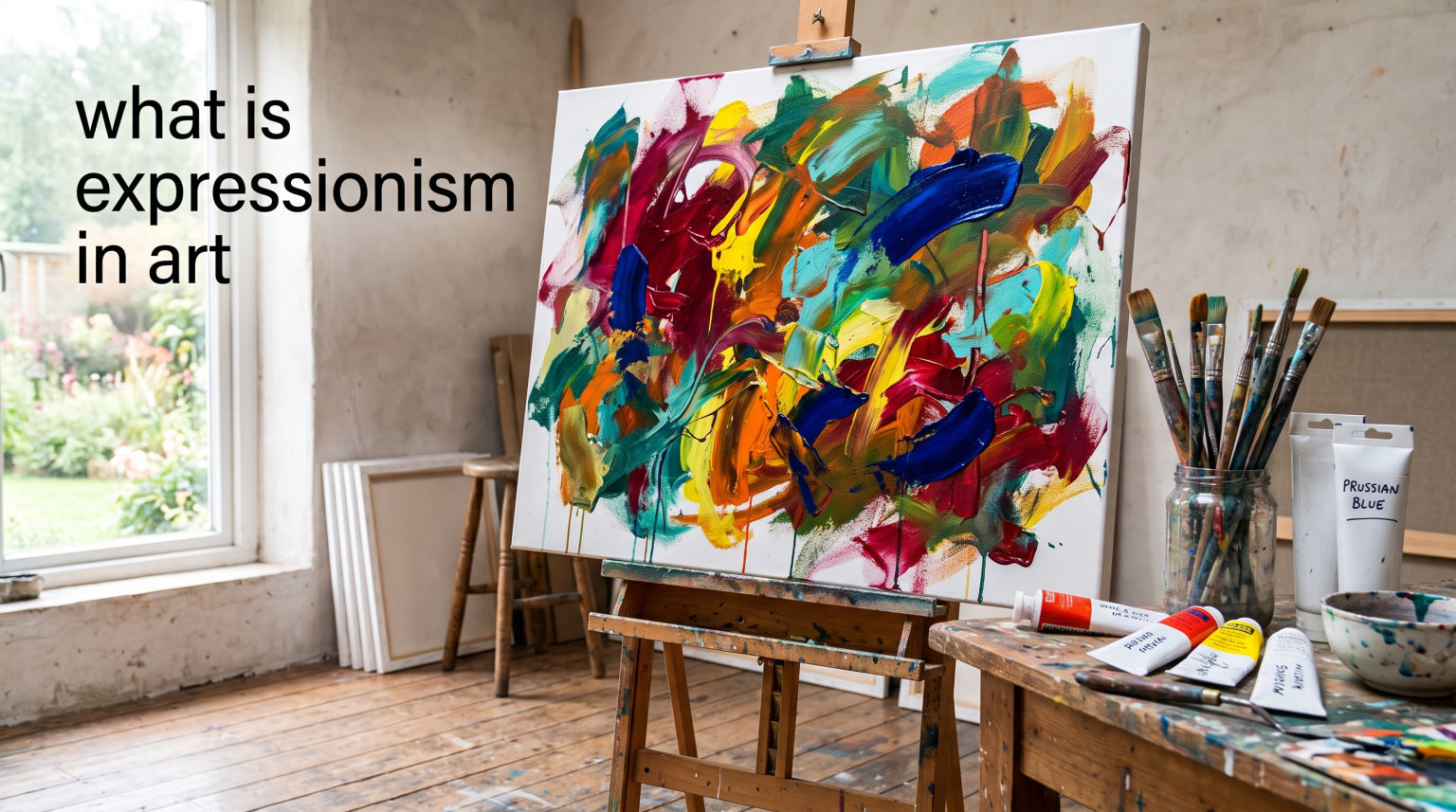
Expressionism is an artistic style in which the artist seeks to depict not objective reality but rather the subjective emotions and inner experiences that objects and events arouse within a person. I have studied this movement extensively, and I can tell you that understanding Expressionism opens up entirely new ways of experiencing art.
In this guide, you will learn what Expressionism in art really means, why it emerged in early 20th-century Germany, and how it changed the course of modern art forever. You will discover the key characteristics that define this movement, meet the artists who shaped it, and understand why Expressionism remains relevant in 2026.
I wrote this article after researching dozens of sources and studying the works of major modern art movements. Whether you are an art student, a curious enthusiast, or simply someone who wants to understand what makes Expressionist paintings so emotionally powerful, this guide has you covered.
Table of Contents
What Is Expressionism in Art?
Expressionism in art refers to the expression of subjective emotions, inner experiences, and spiritual themes, as opposed to realistic depictions of people or nature. The movement prioritizes the artist’s internal emotional response over accurate representation of the external world.
When I first encountered Expressionist works, I was struck by how different they felt from traditional realistic paintings. Instead of showing me exactly what a scene looked like, Expressionist artists showed me how that scene made them feel. This is the essence of what Expressionism in art represents.
The Core Philosophy
At its heart, Expressionism believes that art should serve as a vehicle for expressing the artist’s inner world. The German Expressionists in particular were influenced by philosopher Friedrich Nietzsche and the idea that modern society had become spiritually impoverished. They sought to restore meaning and emotional depth to art.
The movement embraced the concept of “inner necessity” – the idea that artists must paint what they feel compelled to express from within, not what they observe externally. This philosophy set Expressionism apart from nearly every art movement that came before it.
Expressionism as a Modern Art Movement
Expressionism emerged as part of the broader modernist movement that swept through Europe in the early 1900s. Like other art movements like Expressionism that followed, it represented a fundamental break from academic traditions and realistic representation.
The movement was not confined to painting alone. Expressionist ideas spread to literature, music, theater, architecture, and particularly film. German Expressionist cinema of the 1920s, with films like “The Cabinet of Dr. Caligari,” used distorted sets and dramatic lighting to create psychological tension that paralleled the visual strategies of Expressionist painting.
Key Characteristics of Expressionism
When you look at an Expressionist painting, you will immediately notice several distinctive visual characteristics. These are not random stylistic choices but deliberate techniques used to convey emotional intensity.
Visual Distortion and Exaggeration
Expressionist artists deliberately distort reality to match their emotional experience of it. Figures might be elongated, buildings might tilt at impossible angles, and faces might be twisted into masks of anguish or ecstasy. This distortion of reality serves a clear purpose: it externalizes internal psychological states.
I find this approach fascinating because it acknowledges something important. Our emotional experience of the world is rarely neat, proportional, or objectively accurate. When we are anxious, the world feels threatening. When we are joyful, colors seem brighter. Expressionism captures this subjective truth.
Non-Naturalistic Colors
Perhaps the most immediately recognizable characteristic of Expressionism is its use of jarring, non-naturalistic colors. Expressionist painters did not paint trees green and skies blue because those are the “correct” colors. Instead, they chose colors based on emotional impact.
A face might be rendered in sickly greens to suggest illness or corruption. A landscape might explode in violent reds and oranges to convey passion or danger. These jarring colors force viewers to respond emotionally rather than simply recognizing what they see.
Jagged Lines and Rough Brushwork
Expressionist paintings often feature visible, rough brushwork that emphasizes the artist’s hand and emotional intensity. Jagged, angular lines create tension and anxiety, while more fluid lines might suggest emotional release or spiritual transcendence.
The textured paint application creates a physical surface that seems almost to vibrate with energy. When I stand before an Expressionist canvas, I can sense the physical effort that went into its creation. Every brushstroke carries emotional weight.
Dramatic Compositions
Expressionist compositions often feel unstable, crowded, or dynamically charged. Figures might be pushed to the edges of the canvas or arranged in ways that create visual conflict. This compositional drama mirrors the emotional content of the work.
The anxiety of modern life that many Expressionists felt is often reflected in these unsettling arrangements. Urban scenes in particular capture the overwhelming, disorienting experience of city life in the early 20th century.
Expressionism vs Impressionism: Understanding the Difference
One question I encounter frequently is how Expressionism differs from Impressionism. The two movements are often confused because both emerged as reactions against academic art and both involve distinctive uses of color. However, they pursue fundamentally different goals.
Inner Experience vs Outer Appearance
Impressionism seeks to capture the fleeting effects of light and atmosphere on the external world. An Impressionist painter asks: “How does this scene look at this particular moment?” Expressionism, by contrast, asks: “How does this scene make me feel?”
While Impressionism focuses on optical experience, Expressionism focuses on emotional experience. This distinction is crucial for understanding what is Expressionism in art and how it differs from its predecessor.
Color Usage
Both movements use color expressively, but in different ways. Impressionist colors attempt to capture the subtle variations of natural light. Expressionist colors serve emotional expression regardless of natural appearance. Where Impressionism might use broken color to capture shimmering light, Expressionism uses bold, unmodulated areas of color to create emotional impact.
Brushwork Differences
Impressionist brushwork is typically small and rapid, capturing momentary visual impressions. Expressionist brushwork is often larger, more aggressive, and more heavily textured. The paint itself becomes a vehicle for expressing emotional intensity.
Origins and Historical Context of Expressionism
Understanding the historical context in which Expressionism emerged helps explain why this movement developed when and where it did. The early 20th century was a period of tremendous social, technological, and psychological upheaval.
Early 20th Century Germany
Expressionism originated in Germany and Austria around 1905, reaching its peak in the years leading up to World War I. The movement was particularly strong in Dresden, Munich, and Vienna – cities experiencing rapid industrialization and urbanization.
I find it significant that Expressionism emerged in Germany specifically. German culture had a strong tradition of valuing inner experience, spirituality, and emotional depth. The German Romantics of the 19th century had already explored similar themes, creating fertile ground for the Expressionist movement.
Reaction to Industrialization
Expressionism was partly a reaction against the dehumanizing effects of industrialization and urbanization. As cities grew and machines transformed daily life, many artists felt that traditional realistic art could no longer capture the experience of modern existence.
The anxiety of modern life became a central theme. Expressionist works often depict crowded urban streets, alienated individuals, and the overwhelming scale of modern cities. These are not neutral observations but emotionally charged responses to a changing world.
Pre-World War I Tensions
The years before World War I were filled with social and political tension. Revolutionary movements challenged established orders. Technology promised progress but also brought new forms of destruction. Psychology was revealing the hidden depths of the human mind.
Expressionism absorbed all these influences. The movement’s focus on subjective experience aligned with new psychological understandings. Its dramatic imagery reflected the tension of the pre-war period. Its spiritual themes offered an alternative to materialist modernity.
Influences and Precursors
Expressionism did not emerge in isolation. It built upon earlier artistic developments and was influenced by several key figures who anticipated its concerns.
Vincent van Gogh is perhaps the most important precursor. His emotionally charged brushwork, intense colors, and personal vision pointed toward Expressionist concerns. Edvard Munch’s “The Scream” became an iconic image of modern anxiety that directly influenced Expressionist artists. James Ensor’s mask paintings and explorations of death also provided important precedents.
German Expressionist Groups: Die Brücke and Der Blaue Reiter
The German Expressionist movement was organized around two major groups that developed somewhat different approaches to Expressionist art. Understanding these groups helps clarify the variety within Expressionism.
Die Brücke (The Bridge)
Die Brücke was founded in Dresden in 1905 by Ernst Ludwig Kirchner, Fritz Bleyl, Erich Heckel, and Karl Schmidt-Rottluff. The name “The Bridge” suggested their role as a bridge to a new artistic future. The group later moved to Berlin, where they were joined by Emil Nolde and Max Pechstein.
Die Brücke artists were influenced by primitivism and admired art from Africa and Oceania. They believed this “primitive” art was more emotionally direct and authentic than academic European traditions. Their work often features raw, aggressive brushwork and intense colors.
Subject matter included urban scenes, portraits, and nudes. Kirchner’s street scenes of Berlin capture the tense energy of the modern city. The group’s woodcuts are particularly notable for their bold, simplified forms and emotional intensity.
Der Blaue Reiter (The Blue Rider)
Der Blaue Reiter emerged in Munich in 1911, founded by Wassily Kandinsky and Franz Marc. The name came from a painting by Kandinsky and symbolized spiritual concerns – the blue rider representing a spiritual messenger.
Where Die Brücke focused on emotional intensity and urban experience, Der Blaue Reiter was more concerned with spiritual themes and the expressive potential of color itself. Kandinsky increasingly moved toward abstraction, believing that representational forms limited art’s spiritual power.
Franz Marc’s paintings of animals in vivid, non-naturalistic colors express his belief that animals were more pure and spiritual than humans. August Macke, another member, brought a lighter, more lyrical quality to Expressionism. The almanac published by the group in 1912 included essays on music, theater, and art theory, revealing their broad cultural ambitions.
Philosophical Differences
While both groups are considered Expressionist, they differed in important ways. Die Brücke was more focused on direct emotional expression and urban subjects. Der Blaue Reiter pursued spiritual transcendence through art and moved toward abstraction.
These differences show that Expressionism was never a single unified style but rather a shared commitment to expressing inner experience over external appearance. Both groups rejected academic conventions and sought to create art that conveyed genuine feeling.
Major Expressionist Artists You Should Know
Several artists stand out as particularly important to understanding Expressionism. Their work exemplifies the movement’s concerns and demonstrates its range.
Vincent van Gogh: The Precursor
Vincent van Gogh died in 1890, before Expressionism formally emerged, but his work was enormously influential on the movement. The question of whether Van Gogh was an Impressionist or Expressionist is common, and the answer is that he anticipated Expressionism while working in the late 19th century.
Van Gogh’s thick, visible brushstrokes, intense colors, and emotionally charged subjects directly inspired Expressionist artists. His letters reveal an artist deeply concerned with conveying inner experience. Works like “Starry Night” and his self-portraits show the emotional intensity that Expressionists would develop further.
Edvard Munch: The Iconic Image
Norwegian artist Edvard Munch created what may be the single most famous Expressionist image: “The Scream.” This painting of a figure clutching its face while the sky seems to scream around it has become a universal symbol of modern anxiety.
Munch’s series of works exploring themes of love, anxiety, and death influenced German Expressionists significantly. His use of simplified forms, bold colors, and symbolic content provided a model for Expressionist art.
Ernst Ludwig Kirchner: Die Brücke Leader
Kirchner was the leading figure of Die Brücke and created some of the most powerful Expressionist works. His Berlin street scenes capture the tense energy of urban modernity. His portraits feature harsh colors and angular forms that convey psychological intensity.
Kirchner’s work was particularly affected by his experiences during World War I. After serving in the army, he suffered a breakdown and his art became even more emotionally raw. His woodcuts demonstrate the movement’s interest in bold, simplified forms.
Wassily Kandinsky: The Spiritual Pioneer
Russian-born artist Wassily Kandinsky was a co-founder of Der Blaue Reiter and one of the first painters to move toward pure abstraction. He believed that art should serve spiritual needs and that color and form could convey meaning without representing objects.
Kandinsky’s theoretical writings, particularly “Concerning the Spiritual in Art,” provided intellectual foundations for Expressionism. His paintings became increasingly abstract, focusing on the emotional and spiritual effects of color and form.
Other Important Figures
Emil Nolde brought intense religious feeling to Expressionism. His paintings of biblical scenes and flowers use thick impasto and vivid colors. Franz Marc’s animal paintings express spiritual themes through non-naturalistic color. Karl Schmidt-Rottluff created powerful woodcuts and paintings with bold, simplified forms.
The Spread and Decline of Expressionism
Expressionism did not remain confined to Germany. It spread across Europe and influenced artists worldwide before facing suppression under the Nazi regime.
Spread Across Europe
Expressionist ideas spread to France, Austria, Russia, and beyond. In Vienna, artists like Oskar Kokoschka and Egon Schiele developed distinctive approaches to Expressionist portraiture. Their work featured distorted figures that conveyed psychological intensity.
In Russia, Expressionism influenced the development of avant-garde movements. Russian artists combined Expressionist emotional intensity with Constructivist geometric forms. The movement’s influence can be traced in various national schools of modern art.
The Nazi Persecution
When the Nazis came to power in Germany in 1933, they targeted modern art as “degenerate.” Expressionism was particularly attacked because of its association with left-wing politics, Jewish artists, and modernist experimentation.
In 1937, the Nazis organized the infamous “Degenerate Art” exhibition in Munich. Works by Kirchner, Kandinsky, Marc, and other Expressionists were displayed alongside racist commentary mocking modern art. Many works were seized from museums. Some were sold abroad to raise foreign currency, while others were destroyed.
Many Expressionist artists were forced into exile. Those who remained faced professional bans and persecution. Kirchner, already in poor health, was deeply affected and committed suicide in 1938. The Nazi campaign effectively suppressed Expressionism in Germany.
Post-War Revival
After World War II, Expressionist works gradually returned to museums. The movement’s influence continued in various forms, particularly through Abstract Expressionism in America.
Legacy and Lasting Impact of Expressionism
Despite its suppression, Expressionism had a profound and lasting impact on art history. Its influence can be traced through multiple later movements and continues to be felt in contemporary art.
Abstract Expressionism
American Abstract Expressionism of the 1940s and 1950s was directly influenced by German Expressionism. Artists like Willem de Kooning, Franz Kline, and Jackson Pollock took Expressionism’s emphasis on emotional intensity and subjective experience and pushed it toward abstraction.
Like the German Expressionists, abstract expressionism emphasized the physical act of painting and the direct expression of inner states. The connection between these movements demonstrates Expressionism’s continuing relevance.
Neo-Expressionism Revival
In the 1980s, there was a significant revival of Expressionist approaches in what became known as Neo-Expressionism. Artists like Anselm Kiefer, Georg Baselitz, and Jean-Michel Basquiat returned to figurative painting with raw, emotionally charged imagery.
This revival demonstrated that Expressionism’s concerns remained relevant. The emotional directness and subjective intensity of Expressionism offered an alternative to the cool conceptualism that had dominated the 1970s art world.
Expressionism in Film and Other Media
German Expressionist cinema of the 1920s created a distinctive visual style that influenced film history. The distorted sets, dramatic lighting, and psychological themes of films like “The Cabinet of Dr. Caligari” and “Nosferatu” established conventions for horror and fantasy cinema.
Expressionist ideas have also influenced theater, dance, and music. The movement’s emphasis on conveying inner experience through distortion has become a fundamental strategy across the arts.
Continued Relevance
Today, Expressionism remains an important reference point for artists and art historians. The movement’s insistence on art as a vehicle for genuine emotional and spiritual expression continues to resonate. In an age of digital media and virtual reality, the physical intensity of Expressionist painting offers something irreplaceably human.
I believe Expressionism matters because it reminds us that art is not just about accurate representation. It is about conveying what it feels like to be alive. That message remains as important now as it was in 1905.
Frequently Asked Questions
What is Expressionism in art definition?
Expressionism is an artistic style in which artists seek to depict subjective emotions, inner experiences, and spiritual themes rather than objective reality. The movement uses visual distortion, non-naturalistic colors, jagged lines, and rough brushwork to convey emotional intensity and inner necessity.
What are three characteristics of Expressionism?
Three key characteristics of Expressionism are: 1) Visual distortion and exaggeration of forms to match emotional experience, 2) Non-naturalistic colors chosen for emotional impact rather than accuracy, and 3) Jagged lines and rough brushwork that emphasize the artist’s hand and emotional intensity.
What best describes Expressionism?
Expressionism is best described as an art movement that prioritizes the artist’s inner emotional experience over objective depiction of external reality. It emerged in early 20th-century Germany as a reaction against industrialization and academic traditions, using dramatic distortion, bold colors, and expressive brushwork to convey subjective states.
Is Van Gogh an Impressionist or Expressionist?
Vincent van Gogh is often considered a Post-Impressionist who anticipated Expressionism. While he worked before the formal Expressionist movement began, his emotionally charged brushwork, intense non-naturalistic colors, and focus on conveying inner experience directly influenced the German Expressionists. Many art historians view him as a precursor to Expressionism.
Conclusion
Expressionism in art represents one of the most significant shifts in how artists understand their role. By prioritizing subjective emotions and inner experiences over objective reality, Expressionist artists opened new possibilities for art that continue to resonate in 2026.
From Van Gogh’s visionary brushwork to Kirchner’s anxious cityscapes to Kandinsky’s spiritual abstractions, Expressionism gave artists permission to paint what they feel rather than what they see. The movement’s emphasis on emotional honesty, spiritual depth, and authentic personal expression remains relevant for anyone seeking to understand modern art.
If you take one thing from this guide, let it be this: Expressionism teaches us that art is not just about showing the world accurately. It is about showing how the world affects us. That insight transformed art in the 20th century and continues to inspire artists today.