
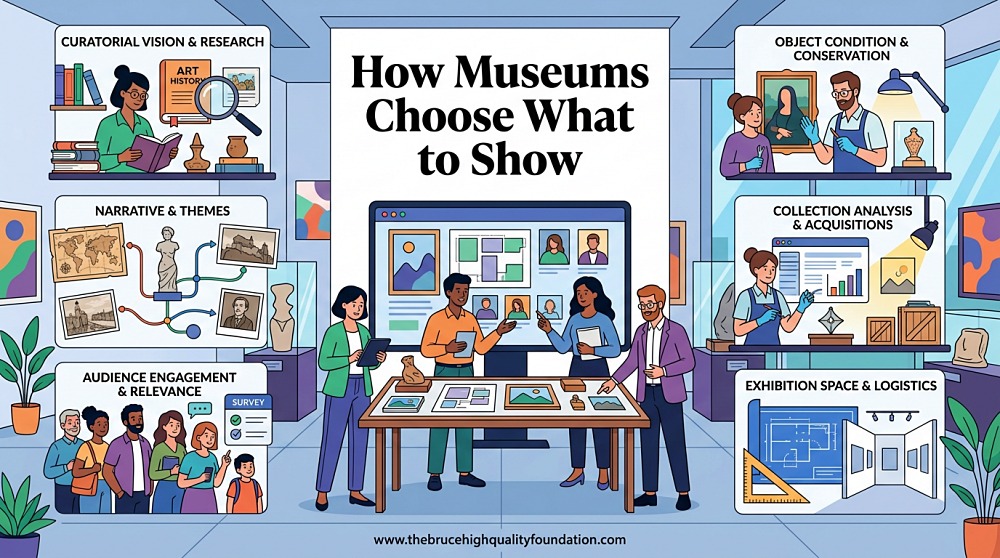
Have you ever walked through a museum and wondered why certain artworks hang on the walls while thousands of others remain hidden in storage? The Metropolitan Museum of Art houses over 1.5 million objects, yet only a tiny fraction ever greet visitors’ eyes. This reveals one of the most consequential yet invisible forms of cultural power in our world.
Understanding how museums choose what to show transforms how we view these institutions. The process involves complex negotiations between curators, directors, donors, and historical forces that determine whose stories get preserved and celebrated. In this guide, I will walk you through the complete curatorial power structure, from the initial spark of an exhibition idea to the final placement of artwork on gallery walls.
Our team spent months researching this topic, interviewing museum professionals, and analyzing institutional policies to give you an insider’s view of museum decision-making. Whether you are an artist seeking representation, a student studying art history, or simply a curious visitor, this article will forever change how you walk through museum doors.
Table of Contents
What Is Curation? The Art of Selection
The word “curation” derives from the Latin curare, meaning “to care for.” Originally, curators were simply caretakers who preserved and maintained collections. Today, curation encompasses a far more complex role that combines scholarship, storytelling, and cultural gatekeeping.
Modern curation involves selecting, organizing, and presenting artworks to create meaningful narratives that connect with audiences. A curator acts as both historian and interpreter, translating visual language into stories that resonate with contemporary viewers. The practice requires deep knowledge of art history, acute sensitivity to cultural contexts, and vision for how objects communicate across time.
The scope of curatorial work extends far beyond choosing what hangs on walls. Curators conduct original research, write exhibition catalogues, negotiate loans from other institutions, design educational programming, and shape the future direction of museum collections. Their decisions ripple outward, influencing which artists gain recognition, how art history gets written, and what cultural values receive institutional endorsement.
Who Decides: The Curatorial Power Structure
Museum exhibition decisions flow through a complex hierarchy where multiple stakeholders wield different forms of influence. Understanding this power structure reveals why certain exhibitions happen while others never materialize, and whose voices dominate these spaces.
Curators: The Primary Decision-Makers
Curators serve as the frontline arbiters of taste and scholarship within museums. These specialists research, propose, and develop exhibitions based on their expertise in specific periods, regions, or media. A contemporary art curator might spend years tracking emerging artists through studio visits, art fairs, and social media before selecting work for display.
The level of curatorial autonomy varies dramatically between institutions. Large encyclopedic museums like the Louvre or Met often have dozens of curators specializing in narrow fields, each with significant independence to shape their domains. Smaller institutions may have only one or two curators who handle everything from ancient ceramics to contemporary video installations.
Forum discussions with museum professionals reveal that curators increasingly use Instagram and other platforms to discover emerging artists. This digital shift has democratized discovery somewhat, allowing artists outside traditional networks to gain visibility. However, it has also created new pressures for artists to maintain social media presence alongside studio practice.
Museum Directors: Strategic Vision and Final Approval
While curators propose exhibitions, museum directors hold ultimate approval authority. Directors balance curatorial vision against institutional resources, public interest, and long-term strategic goals. They ensure that exhibition programs align with the museum’s mission while maintaining financial sustainability.
Directors also navigate external pressures from donors, board members, and community stakeholders. When a proposed exhibition might generate controversy or attract criticism, directors make the final call about whether the potential impact justifies the risk. This gatekeeping function can either expand or constrain the boundaries of what museums present to the public.
Boards of Trustees: Governance and Financial Oversight
Boards of trustees provide the highest level of governance for nonprofit museums, setting policies and ensuring institutional integrity. These volunteer leaders typically include wealthy donors, community figures, and art world professionals who contribute both financially and strategically. Board members rarely micromanage specific exhibition decisions, but they establish the ethical frameworks within which curators operate.
When museums face major acquisitions or controversial exhibitions requiring significant resources, boards often review and approve these initiatives. Their influence operates primarily through budget allocation and policy setting rather than direct curatorial intervention. However, the composition of museum boards has historically skewed toward wealthy white donors, raising questions about whose perspectives shape institutional priorities.
Donors and Sponsors: The Financial Influence
Private funding plays an outsized role in museum operations, creating complex dynamics around donor influence. Major gifts often come with naming rights, sway over acquisitions, or expectations about programming. While museums maintain that curatorial independence remains intact, the reality proves more nuanced.
When a donor contributes millions toward a new wing, their aesthetic preferences may subtly influence what gets displayed there. Corporate sponsors underwriting major exhibitions sometimes expect their brands associated with crowd-pleasing content. Museum professionals acknowledge these tensions while emphasizing that artistic merit ultimately drives their decisions. Transparency about funding sources has become increasingly important for maintaining public trust.
The Selection Process: From Storage to Spotlight
Museum exhibition development follows a rigorous multi-stage process that can span years from initial concept to public opening. Understanding these stages illuminates why certain artworks emerge while others remain in storage despite their quality.
Research and Conceptualization
Exhibitions typically begin with curatorial research, often sparked by gaps in the museum’s collection, anniversaries of significant artists, or emerging scholarly trends. Curators spend months or years researching themes, identifying potential artworks, and developing compelling narratives that justify public attention.
During this phase, curators assess what their institution already owns versus what must be borrowed. They consider which artists deserve greater recognition and how exhibition themes connect to contemporary concerns. The research process involves studio visits, archival work, conservation assessments, and extensive reading to build authoritative narratives.
Collection Assessment and Availability
Once a curator identifies desired artworks, they must determine availability. Pieces already in the museum’s permanent collection offer the easiest access, though even these require careful scheduling since many works cannot remain on view indefinitely due to conservation needs.
External loans involve complex negotiations with other institutions, private collectors, and artists. Loan agreements specify display duration, security requirements, climate conditions, insurance coverage, and shipping arrangements. These logistical constraints often eliminate otherwise desirable artworks from consideration.
Exhibition Theme and Narrative Development
Successful exhibitions tell compelling stories that connect artworks to broader human experiences. Curators develop themes that provide intellectual frameworks for viewers while allowing individual artworks to shine. The narrative structure might be chronological, thematic, comparative, or conceptual depending on the subject matter.
Wall text, catalog essays, and audio guides translate curatorial vision into accessible language. This interpretive work requires balancing scholarly rigor with public engagement, ensuring that visitors from diverse backgrounds find entry points into the material. Forum insights suggest that artists often feel excluded from this interpretive process, with their intentions sometimes overridden by institutional narratives.
Final Selection Criteria
The ultimate selection of artworks depends on multiple intersecting factors. Artistic merit remains paramount, though defined through institutional frameworks that reflect established art historical values. Historical significance, condition and conservation needs, availability for loan, relevance to the exhibition theme, and potential public appeal all influence final decisions.
Artists rejected from museum exhibitions should understand that rejection rarely reflects solely on their work’s quality. Logistical constraints, thematic fit, scheduling conflicts, and institutional priorities all play roles. As one curator noted in forum discussions, “selection is about alignment with our mission and practical constraints, not ranking artistic merit from best to worst.”
Conservation and Preservation Constraints
Behind every exhibition decision lurks the invisible hand of conservation science. Preservation requirements eliminate countless artworks from display possibilities and dictate how long remaining pieces can stay on view. These constraints represent non-negotiable limits that even the most ambitious curators must respect.
Light Sensitivity and Display Duration
Light damages artworks through photochemical reactions that fade pigments and degrade materials. Museums measure light exposure in lux hours, calculating cumulative damage that determines how long works can remain displayed. Highly sensitive materials like watercolors, textiles, and photographs might face display limits of just three to six months per decade.
This creates constant tension between public access and preservation. Museums want visitors to see masterpieces, but showing them too frequently accelerates deterioration. Rotation schedules ensure that popular works remain available while managing long-term preservation. Some fragile works remain in storage for years between brief display periods.
Climate Control and Environmental Requirements
Artworks require stable environmental conditions that prevent expansion, contraction, mold growth, and chemical degradation. Temperature, humidity, air quality, and pollution levels must remain within narrow parameters. Traveling exhibitions face particular challenges since different venues maintain varying climate standards.
Some artworks cannot travel at all due to extreme sensitivity. Murals permanently attached to architecture, fragile archaeological finds, and certain contemporary installations using perishable materials remain rooted to specific locations. These limitations constrain curators planning traveling exhibitions or loans between institutions.
Security and Insurance Considerations
High-value artworks require expensive insurance coverage and elaborate security protocols that influence exhibition feasibility. Museums assess security capabilities at potential venues before approving loans. Works with extreme value or political sensitivity might never travel due to uninsurable risks.
These practical constraints shape the art world in profound ways. Insurance costs add thousands of dollars to exhibition budgets. Security requirements limit where works can appear. The cumulative effect means that certain important artworks remain perpetually behind the scenes, visible only to researchers who request special access.
The Politics of Display: Whose Stories Get Told
Museum walls do not merely display art; they construct and reinforce cultural hierarchies. The history of museum curation reflects systemic biases that have elevated certain voices while marginalizing others. Understanding these politics helps visitors engage more critically with institutional narratives.
Historical Western Bias and the Canon
Major Western museums built their collections during colonial periods when European and American institutions dominated global art markets. The resulting canon privileged white male artists from Western traditions while relegating women, minorities, and non-Western cultures to peripheral status. Visitors walking through chronological galleries of Western art receive implicit messages about whose creativity matters most.
This bias persists despite decades of scholarship challenging the canon. Museum architecture, collection strengths, and donor interests all perpetuate traditional hierarchies. Changing these patterns requires more than adding diverse artists; it demands fundamental restructuring of how museums organize and present art history.
Underrepresentation and Recent Corrections
Studies consistently show that major museums underrepresent women artists and artists of color. A 2019 survey of 18 major American museums found that 87% of their collections came from white artists, while 85% came from men. These disparities reflect both historical acquisition patterns and ongoing institutional priorities.
Recent years have seen accelerated efforts toward representation. Major retrospectives for overlooked women artists, expanded acquisitions of African American art, and dedicated exhibitions of Indigenous artists signal shifting priorities. However, critics argue that these initiatives remain tokenistic without deeper structural changes to museum governance and curatorial staffing.
Repatriation and Colonial Collections
Museums worldwide hold millions of objects acquired through colonial violence, looting, and unethical collecting practices. Benin Bronzes taken during the 1897 British invasion, Native American sacred objects removed without consent, and archaeological treasures extracted from colonized nations all raise profound ethical questions about rightful ownership.
The repatriation movement demands return of these objects to their communities of origin. Some institutions have begun returning significant works, acknowledging that possession acquired through violence cannot create legitimate title. Others resist, citing legal restrictions, preservation concerns, or arguments that museums serve universal human heritage. This debate challenges fundamental assumptions about museum purpose and authority.
Digital Transformation in Modern Curation
Technology has fundamentally altered how curators discover artists, develop exhibitions, and engage audiences. This digital transformation represents one of the most significant shifts in museum practice since the rise of the modern public museum in the nineteenth century.
Social media platforms have democratized artist discovery, allowing curators to find talent outside traditional gallery networks. Instagram serves as a global portfolio platform where emerging artists can attract institutional attention without gallery representation. Our research found multiple curators who regularly browse hashtags and artist accounts to identify potential exhibition candidates.
Virtual exhibitions and digital collections have expanded access beyond physical walls. Online viewing rooms, 3D gallery tours, and searchable databases allow global audiences to explore collections previously available only to those who could travel to specific locations. The pandemic accelerated these trends, forcing museums to develop digital infrastructure that now complements physical programming.
Digital archives and cataloguing systems have transformed collection management. Museums can now track provenance, conservation history, and exhibition records with unprecedented precision. This data informs curatorial decisions, helping identify gaps in collections and connections between works that might otherwise remain hidden. The digital turn has made curation more data-informed while raising new questions about surveillance and data ownership.
Small Museums vs Large Institutions
The curatorial power structure operates differently across institutional scales. Small regional museums and major metropolitan institutions face vastly different constraints and opportunities, leading to distinct exhibition practices that serve different community needs.
Small museums often operate with minimal staff, sometimes employing just one curator who handles everything from ancient artifacts to contemporary acquisitions. These institutions typically focus on local history, regional artists, or specific collecting niches rather than encyclopedic coverage. Their exhibitions reflect deep community connections and respond quickly to local interests.
Large institutions maintain extensive curatorial departments with specialists in narrow fields. The Metropolitan Museum of Art employs over 150 curators across departments spanning ancient Egypt to contemporary photography. This specialization enables scholarly depth but can create silos where cross-cultural connections get overlooked. Bureaucratic layers mean that exhibition development takes longer but benefits from greater resources.
Community input mechanisms vary significantly between institutional sizes. Small museums often operate with direct community advisory boards that shape programming decisions. Large institutions may hold public forums but maintain more distance between curatorial decision-making and community input. Both approaches have merits: small museums offer responsiveness while large institutions provide resources for ambitious scholarly projects.
FAQ: Common Questions About Museum Curation
How do museums decide what to exhibit?
Museums decide what to exhibit through a multi-stage process involving curatorial research, collection assessment, and stakeholder approval. Curators propose exhibitions based on scholarly merit, collection strengths, and public interest. Museum directors and boards provide final approval, considering resources, strategic alignment, and potential impact. Practical constraints like conservation needs, loan availability, and exhibition space also heavily influence final decisions.
Who sets up museum exhibits?
Multiple professionals collaborate to set up museum exhibits. Curators develop the conceptual framework and select artworks. Exhibition designers handle spatial layout, lighting, and display aesthetics. Art handlers and preparators physically install artworks with curatorial oversight. Conservation staff ensure proper climate conditions and handling procedures. Education teams develop wall text and interpretive materials. This collaborative process typically spans months before an exhibition opens to the public.
What personality traits suit a curator?
Successful curators combine scholarly rigor with creative vision and strong communication skills. Essential traits include deep curiosity about art and culture, meticulous attention to detail, patience for long-term research projects, and ability to translate complex ideas for general audiences. Curators need diplomatic skills to negotiate loans, collaborate with artists, and navigate institutional politics. Adaptability matters since the role increasingly requires digital literacy and engagement with diverse communities.
How do viewing context and curator decisions shape the experience?
Curator decisions fundamentally shape how viewers experience art through spatial arrangement, lighting, wall colors, and interpretive text. Placing two works side by side creates implicit comparison that changes how each piece reads. Dramatic lighting elevates certain works while subdued presentation diminishes others. Wall labels provide context that colors interpretation. Even gallery flow determines viewing sequence and emotional pacing. Understanding these choices helps visitors recognize that museum presentation represents curatorial interpretation rather than neutral display.
Why do some artists get shown repeatedly while others are ignored?
Repeated exhibition of certain artists results from multiple factors including established reputation, institutional investment, market dynamics, and curatorial bias. Museums owning extensive collections of canonical artists naturally display those works frequently. Commercial galleries promote certain artists aggressively, influencing museum attention. Historical narratives emphasizing particular figures create self-perpetuating cycles where famous artists become more famous. Recent efforts to diversify exhibitions challenge these patterns, but systemic change requires sustained commitment beyond single inclusive shows.
Conclusion: Viewing Museums with New Eyes
Understanding how museums choose what to show empowers us to engage more critically with these powerful cultural institutions. Every exhibition represents thousands of decisions made by curators, shaped by conservation science, constrained by resources, and influenced by historical patterns of inclusion and exclusion. The walls do not neutrally display art; they actively construct meaning and cultural value.
As visitors, we can honor the knowledge museums provide while remaining attentive to whose voices dominate and whose remain marginalized. We can appreciate the scholarly work of curation while questioning the hierarchies it sometimes reinforces. We can enjoy beautiful objects while recognizing the colonial violence that brought many of them into these spaces.
The next time you visit a museum in 2026, look beyond the artworks themselves. Notice the lighting, the spacing, the wall text, the flow between galleries. Consider what is not shown as much as what is displayed. Ask yourself whose stories matter in this space and whose remain untold. This critical engagement transforms passive viewing into active participation in the ongoing conversation about what our culture values and preserves.