
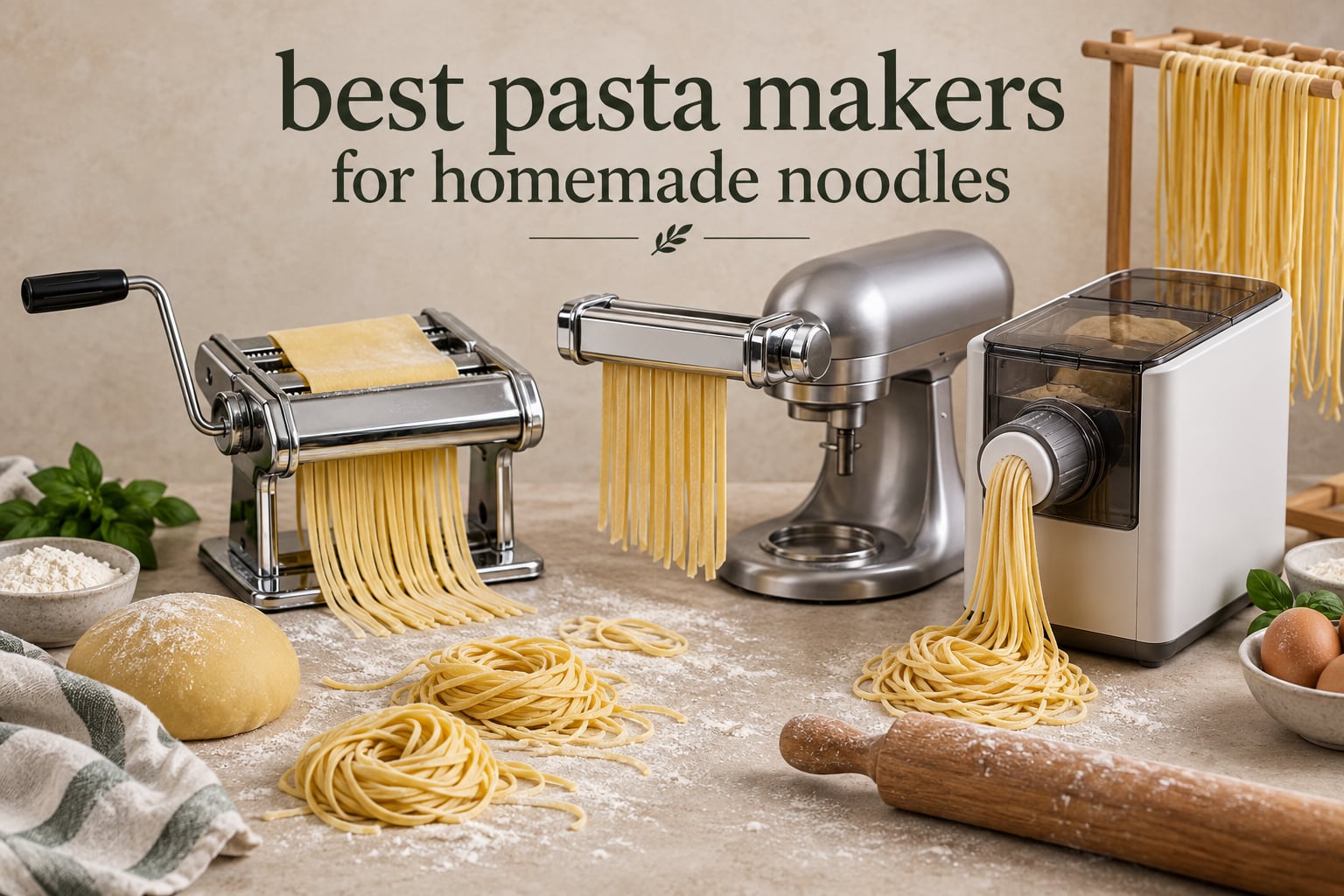
There are only three kinds of pasta maker on the market, and almost every confused buyer is comparing the wrong two. A manual hand-crank roller flattens and cuts dough into sheets and long noodles. A stand mixer attachment does the same job but takes its power from a mixer you already own. An automatic extruder mixes, kneads and forces dough through a die to make penne and spaghetti without a rolling stage at all.
That single distinction decides almost everything: how much arm work a batch takes, how much counter space you give up, which pasta shapes come out, and what the running cost looks like once you add extra cutting discs. Our team compared all ten machines in this guide across those three families, weighted heavily on the specifications owners actually cite after months of use rather than first impressions.
Our overall winner is the Marcato Atlas 150 Classic. It is not the flashiest machine here, but it carries the highest rating in the set alongside its wider sibling, and by far the largest review base of any of them. If you want the short version of the whole category, the Imperia iPasta is the better-made manual option, the Philips Viva Collection is the compact automatic, the GVODE attachment is the value play for stand mixer owners, and the YASHE is the lowest-cost credible way to start. We also looked at the broader home pasta machine roundup if you want more context on the format.
Table of Contents
Our Top 3 Pasta Maker Picks for 2026

Marcato Atlas 150 Classic
- Made in Italy
- 10 thickness settings
- 0.8mm to 4.8mm range
- 3 cutting shapes
Imperia iPasta Classic Line
- Made in Italy
- 6 thickness settings
- 0.5mm to 5mm range
- motor compatible

Nuvantee 3-in-1 Pasta Maker
- 7 thickness settings
- 2mm and 6mm cutting widths
- stainless steel body
- beginner friendly
Those three cover the widest useful spread without you needing a stand mixer. The Marcato is the one to buy if you will make pasta more than a few times a year. The Imperia costs less, ships with more in the box, and takes a wider range of thicknesses. The Nuvantee is the pick if the only thing standing between you and a batch of fettuccine is the cost of starting.
How We Evaluated These Machines?
We ranked these on four criteria, in this order.
1. The specification people defend later. Long-term owners in the r/pasta threads consistently talk about build quality, roller material and how many thickness settings the machine actually has, not about first-batch impressions. We read the rating and review volume together, because a 4.4 from 900 reviews tells you something different from a 4.6 from 27,000.
2. Shape range against effort. A machine that makes three shapes badly is less useful than one that makes two shapes well. We checked what each unit cuts out of the box and what needs a separately sold disc.
3. Fit on a real counter. Dimensions, weight and how the machine anchors matter more than most listings suggest. Several owners report clamp frustration, and a machine that slides during a long roll ruins the batch.
4. Clean-up reality. Manual rollers scrape dry. Electric extruders have a mixing chamber that needs washing. The difference is real and it should factor into your choice before you buy, not after the first batch.
We have not run laboratory measurements on these machines. Everything below comes from the manufacturer specifications, the aggregate customer review data and the behaviour owners describe in the forum threads, and we say so plainly wherever a claim is owner-reported rather than measured. The related bread maker roundup on the site follows the same approach.
Best Pasta Makers for Homemade Noodles in 2026: Quick Overview
All ten machines in this guide, with the specification that matters most for each. Ratings and review counts are copied exactly as shown on the product listing.
| Product | Specifications | Action |
|---|---|---|
| Marcato Atlas 150 Classic |
|
Check Latest Price |
| Imperia iPasta Classic Line |
|
Check Latest Price |
| Nuvantee 3-in-1 |
|
Check Latest Price |
 Sailnovo 3-in-1 Sailnovo 3-in-1 |
|
Check Latest Price |
 GVODE Stand Mixer Attachment GVODE Stand Mixer Attachment |
|
Check Latest Price |
 Philips Viva Collection HR2370/05 Philips Viva Collection HR2370/05 |
|
Check Latest Price |
 YASHE 3-in-1 YASHE 3-in-1 |
|
Check Latest Price |
 VeoHome Stainless Steel Kit VeoHome Stainless Steel Kit |
|
Check Latest Price |
 Marcato Ampia 150 Classic Marcato Ampia 150 Classic |
|
Check Latest Price |
 Shule Stainless Steel Roller Shule Stainless Steel Roller |
|
Check Latest Price |
Two patterns jump out immediately. First, the Italian-made machines hold the highest ratings in the set, which lines up with how the community talks about durability. Second, the mid-tier rollers cluster tightly on specification: seven to nine thickness settings and two cutting widths, which is enough for tagliolini and fettuccine but not much more.
1. Marcato Atlas 150 Classic Review
- Made in Italy with chrome steel construction
- 10 thickness settings for fine control
- Resin scrapers clean the rollers as you roll
- Works with the Pastadrive motor later
- Hand cranking tires you on large batches
- Only three cutting shapes without accessories
- Costs more than the mid-tier rollers
I keep coming back to this machine because of the review volume. A 4.6 across 27,000 ratings is not a spec sheet achievement, it is a decade of people telling us the thing still works. In the r/pasta threads, owners describe the Atlas 150 as the manual machine that outlasts everything else they have owned, and one long-term user puts it plainly: it is the gold standard of manual machines and will outlive your bloodline if you take care of it. That is unverified-purchase sentiment rather than a lab result, but sentiment repeated at that volume is still meaningful.
The build is a chrome-plated steel body on a nickel-plated steel frame, measuring 8 by 8 by 7 inches and weighing 2.6 kg. That weight is not a spec curiosity. It is what keeps the machine planted on the counter while you crank, and a machine that walks across the worktop halfway through a sheet is a machine you will stop using.
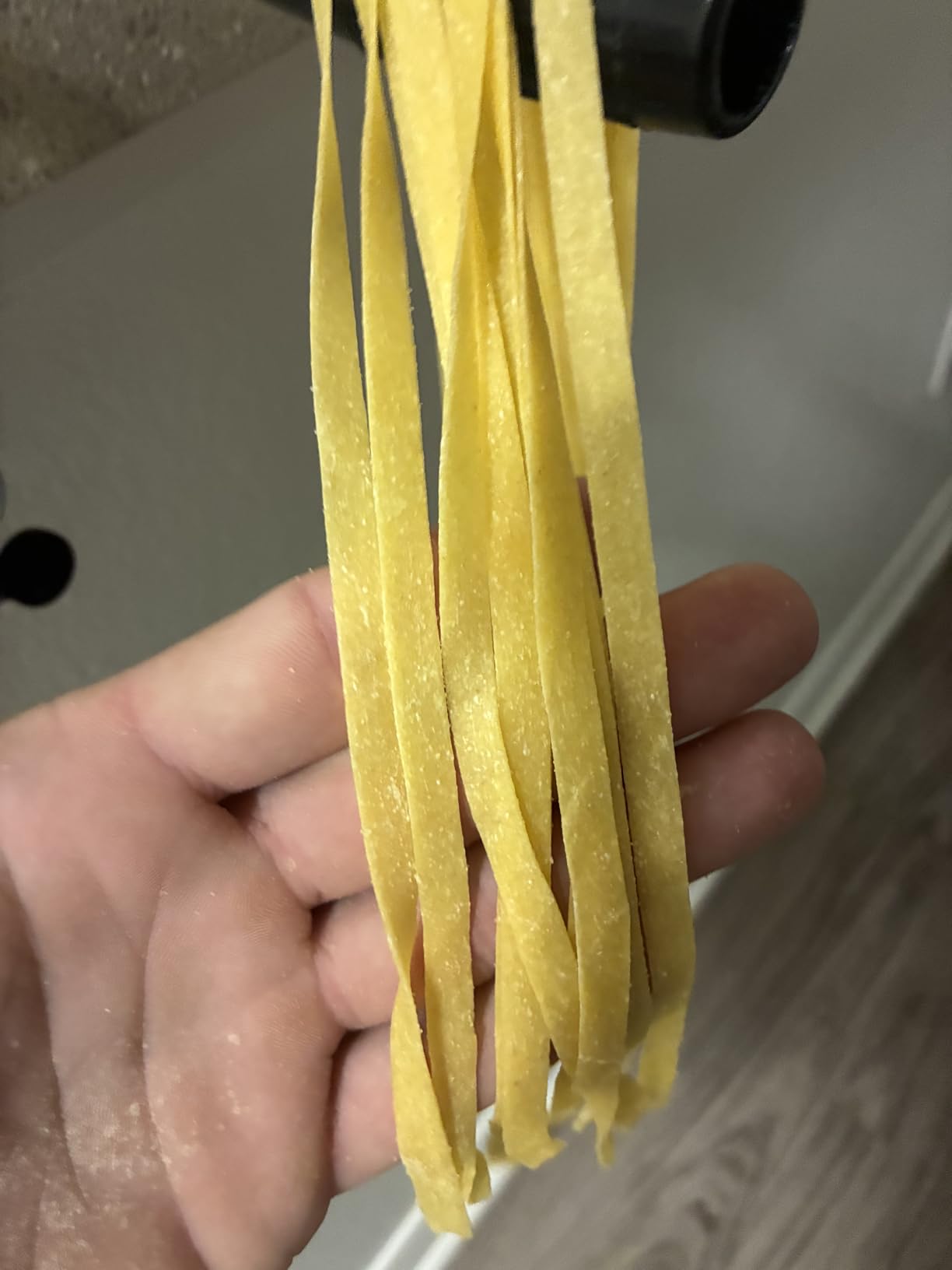
The ten thickness settings run from 0.8mm to 4.8mm, and that lower number is the one to care about. Restaurant-grade tagliolini and cappellini live below 1mm, and only a machine that gets genuinely thin will let you make them. Out of the box you get three cutting shapes: lasagna, fettuccine and tagliolini. Anything wider or finer needs a separate disc.
Roller material is the quiet differentiator here, and it is worth understanding why. Anodized aluminum leaves a slightly porous, matte surface on the dough sheet rather than a glassy polished one. Those micro-textures give sauce something to grip, which is why editors who know the category keep citing this machine for sauce adhesion rather than for its price. The resin scrapers mounted above the rollers also sweep flour and dough debris off the cylinders as you roll, which cuts clean-up time noticeably.
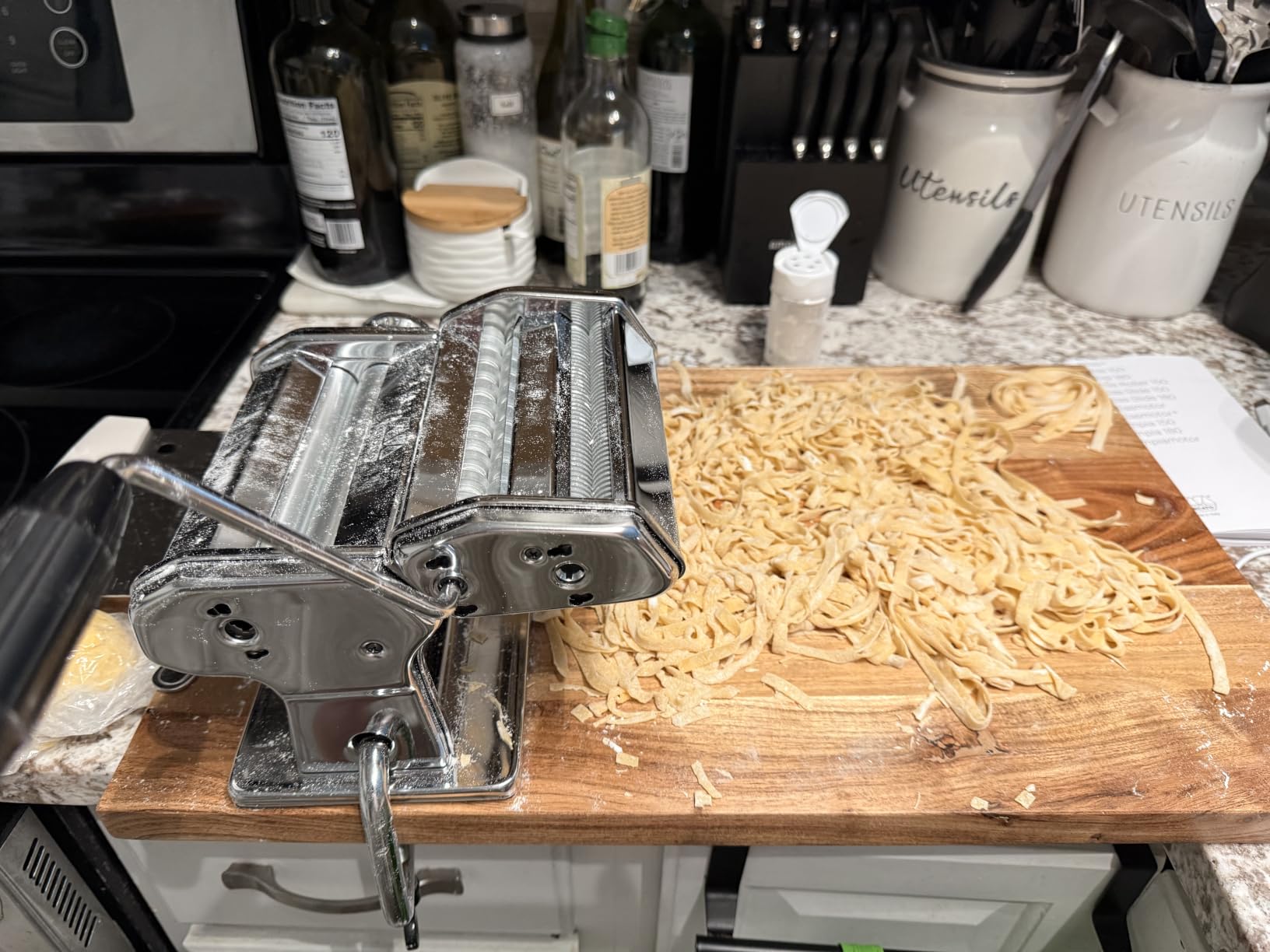
What the Atlas 150 is genuinely good at?
Even sheet thickness on long rolls. Ten settings with a positive detent at each number means you can return to the same setting all evening, which is what makes a lasagna sheet or a batch of taglioline consistent rather than a series of near misses.
Marcato makes a Pastadrive motor that clamps to its own bodies, and the Imperia takes a Pasta Facile unit, so on the Italian machines the purchase is a first step rather than a dead end. That upgrade path is the reason forum buyers who hesitated eventually bought the manual version first.
Where the Atlas 150 disappoints?
The crank. A single batch of 00 flour dough at a proper hydration takes real arm strength, and on a third pass at thin settings the resistance is noticeably higher. If you are feeding six people two nights a week, a motor or an extruder will change your life far more than another thickness setting will.
It also has a smaller sheet than some machines here. The 150 model is the standard width, which handles lasagna strips and a standard pot of pasta fine, but it is not the wide-body option. Only three shapes ship with it, so plan on buying at least one extra disc set if you want pappardelle or angel hair.
2. Imperia iPasta Classic Line Review
- Manufactured in Italy since 1932
- Reaches 0.5mm on its thinnest setting
- Comes with a cotton storage pouch and cleaning brush
- Expands with Duplex and motor accessories
- Only six thickness settings
- Fewer shapes than the Marcato
- Listed as end of line so finishes are limited
The Imperia is the machine to buy if the Atlas 150 feels like overkill for the number of times a year you will actually cook. It is manufactured in Italy by the same heritage that the community treats as a durability proxy, and its 4.5 rating across more than 6,700 reviews is a comfortable second place in this set.
What it does better than the Marcato is the box contents. You get a natural cotton storage pouch, a synthetic bristle roller brush, a non-slip base and a table support, all included. For a machine that lives in a cupboard between uses, the pouch is not a small thing.
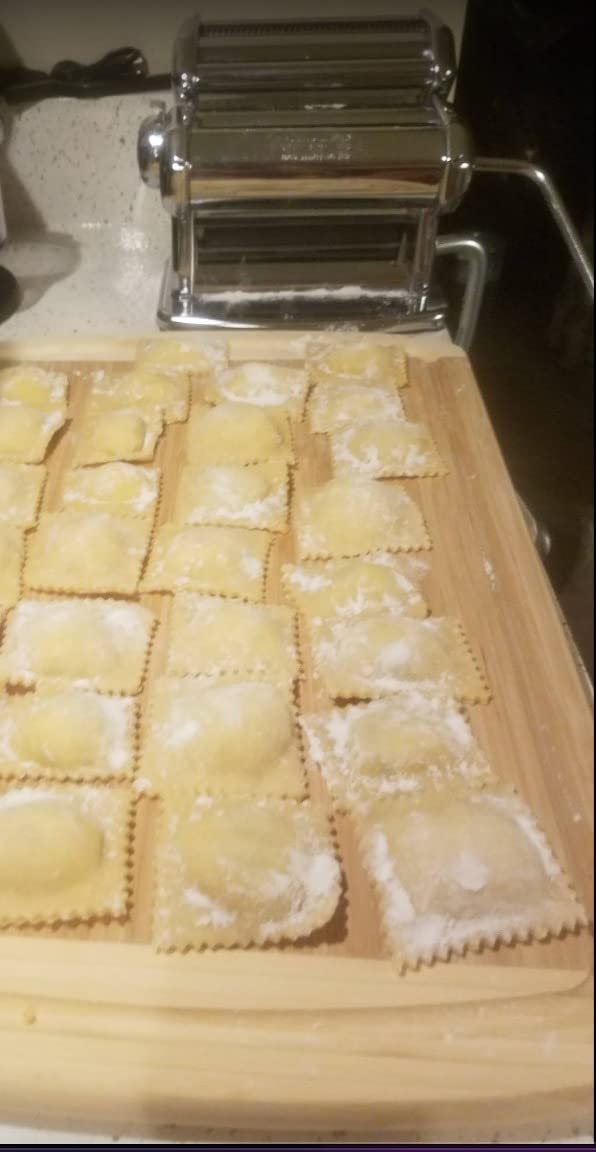
The sheet range runs from 0.5mm to 5mm, and it is that low end that makes the Imperia interesting. At 0.5mm it gets closer to dried-pasta consistency than most rollers here, and it makes fine tagliolini and angel hair well. Only the YASHE, at 0.3mm, goes thinner, and reaching that on a budget machine takes a technique the Imperia does not demand. Six settings is fewer than the Marcato’s ten, though, so the increments are coarser and you will feel more of the difference between passes.
It is also unusually expandable for a machine at this level. Owners confirm compatibility with the Pasta Facile 4600 motor, with Duplex and Simplex accessories for sheet-and-fillet combination work, and with a Raviolamp wheel for filled pasta. That accessory ecosystem is a genuine advantage if you plan to make ravioli, since the roller and the cutter then run in a single pass instead of two.
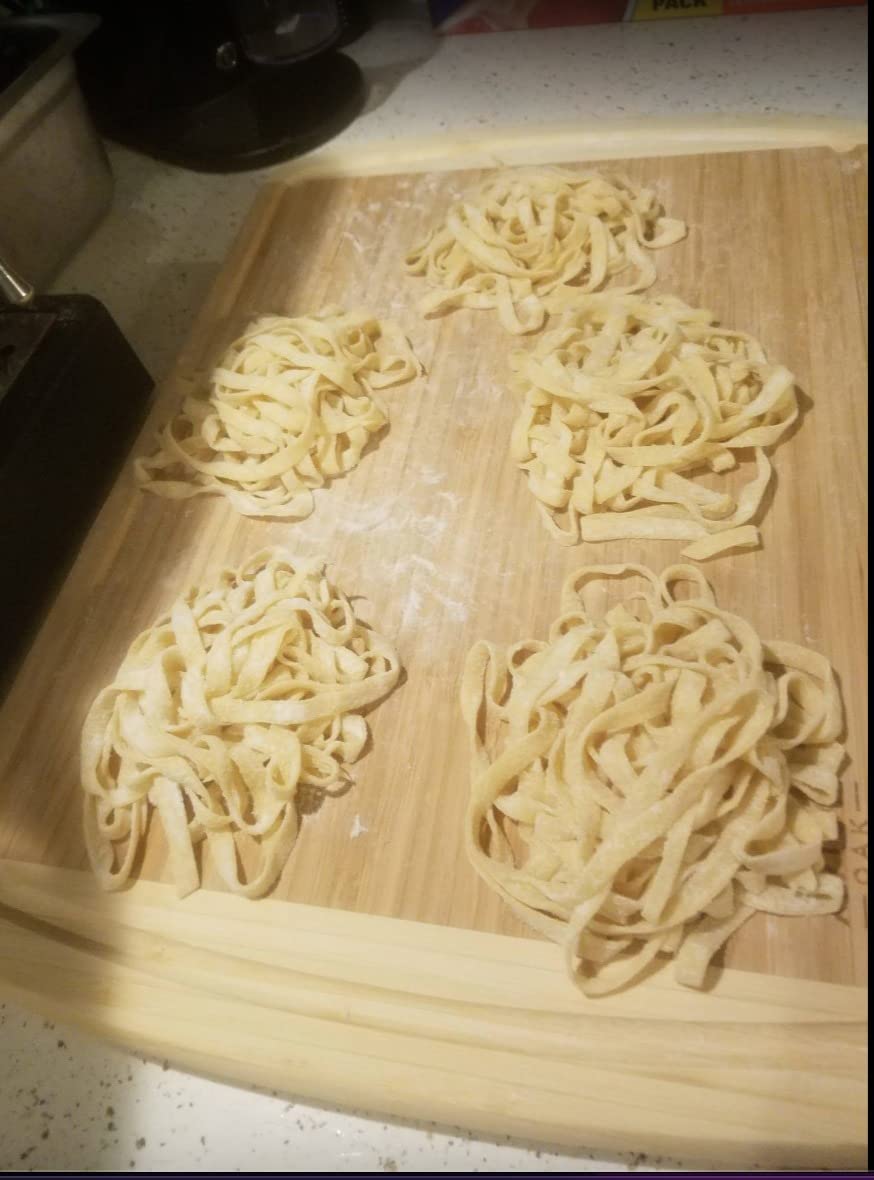
Who benefits from the Imperia?
Anyone who wants a genuinely thin sheet from an Italian machine. At a 0.5mm minimum the Imperia is the finest of the two Italian rollers here, and it makes angel hair and fine tagliolini better than the machines that stop at 0.8mm.
It is also the smarter buy if you are tight on storage. The included pouch and the non-slip base are small quality-of-life details that bigger machines often charge extra for or omit entirely.
Who should skip the Imperia?
Buyers who want the maximum number of shape options from one body. The accessory route is real but it costs extra pieces, and a six-position thickness dial gives you less fine control between settings than the Marcato’s ten.
Be aware it is listed as an end-of-line colourway, which means finishes are limited and you may not get the one you pictured. More practically, clamp slippage during long rolls is the most common owner complaint in this category for this machine, so check your counter edge before you commit.
3. Nuvantee 3-in-1 Pasta Maker Review
- Least expensive credible roller in this guide
- Seven thickness settings across 0.5mm to 6mm
- Two cutting widths cover fettuccine and thin spaghetti
- Light and compact for small kitchens
- Aluminum rollers wear sooner than steel bodies
- Clamp can be finicky to secure
- Hand cleaning only
- Light weight lets it shift during a long roll
I recommend the Nuvantee without much hesitation to anyone who has never rolled pasta and is not sure they will be rolling it next month. At 4.3 stars across more than 6,000 reviews, it has enough owner history to trust, and at the second-lowest cost in this guide it is still a machine that will produce a genuinely thin sheet rather than a thick demonstration piece.
The specification is closer to the mid-tier rollers than the listing suggests. Seven thickness settings running from 0.5mm up to 0.24 inches is a wide usable range, and the two included cutters at 2mm and 6mm give you spaghetti-width and fettuccine-width noodles without any extra purchase. That covers the two shapes most home cooks actually want.
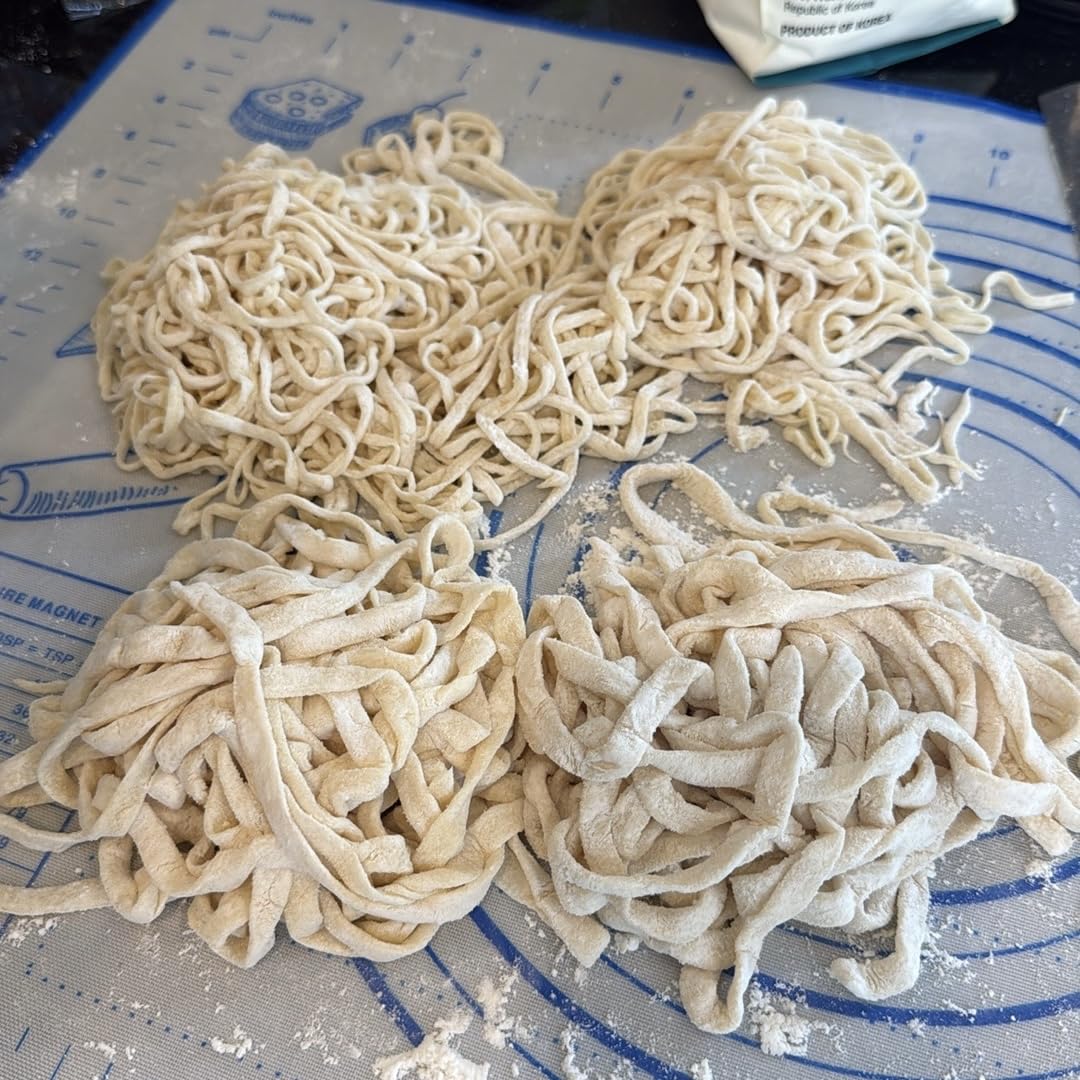
The frame is aluminum and stainless steel in a 5.4 by 6.9 by 8.5 inch body weighing about 2.7 kg. It comes in red or silver, which sounds trivial until you are trying to match a small kitchen. The rollers are aluminum rather than chromed steel, and that is the specification you should think about if you plan to keep this machine for years rather than seasons.
Owners report the clamp is the fiddliest part, and that the machine can move if the clamp is not seated fully on the counter lip. This is a normal issue with lightweight manual rollers rather than a fault specific to this model, and it is manageable once you learn where the machine wants to sit.
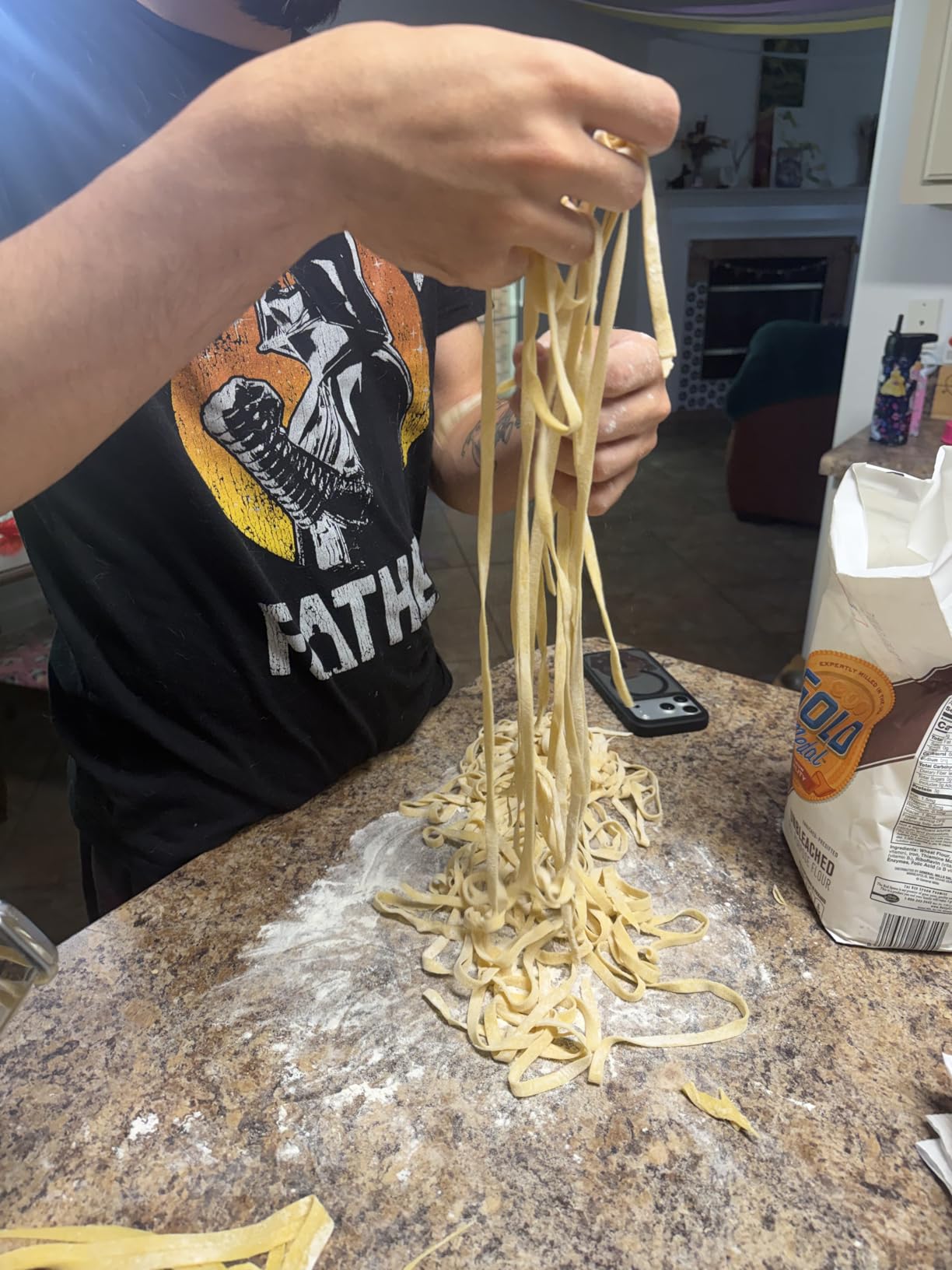
Why the Nuvantee earns its spot?
It removes the most common reason people never start. The first batch of fresh pasta is a learning batch, and a machine that is cheap enough that a clumsy first attempt does not feel expensive is the right way to learn. Seven settings and two cutters means you can produce something worth eating within a few attempts.
Its footprint suits a studio apartment kitchen, which is one of the questions that comes up repeatedly in the beginner threads.
Where it falls short?
Aluminum rollers are the honest weakness. They develop wear faster than the chromed rollers on the Italian machines, and the blade is aluminum too, so cutting performance softens over time. If you were expecting a twenty-year machine, this is not it.
Cleaning is entirely manual and the rollers should not be rinsed. Budget for a dry brush and a small wooden stick to lift dough from the roller grooves, and keep the machine somewhere dry between uses.
4. Sailnovo 3-in-1 Pasta Maker Review
Sailnovo 3-in-1 Pasta Maker with 9-Setting Pasta Roller & Cutters, Silver
- Number one best seller in manual pasta makers
- Nine adjustable thickness settings
- Food grade rust resistant materials
- Clamp and manual included in the box
- Cutting blades should never be washed in water
- Aluminum rollers wear over time
- Larger footprint than most competitors
- Deep cleaning needs a brush or toothpick
Volume tells a story here. The Sailnovo sits at the top of the manual pasta maker category by sales, with 3,242 ratings holding it at 4.4. That combination means a lot of first-time buyers landed on it, which also means a lot of first-time buyers learning their dough habits on the same machine.
On settings, it competes well for its tier. Nine adjustable thickness settings and two cutting widths at 2.0mm and 4.5mm give you a narrower pair of noodle widths than the Nuvantee, but a finer dial. The sheet range is 0.5mm to 3mm, which tops out thinner than the Atlas and the Imperia, and that ceiling is worth noting if you make thick dried-style sheets.
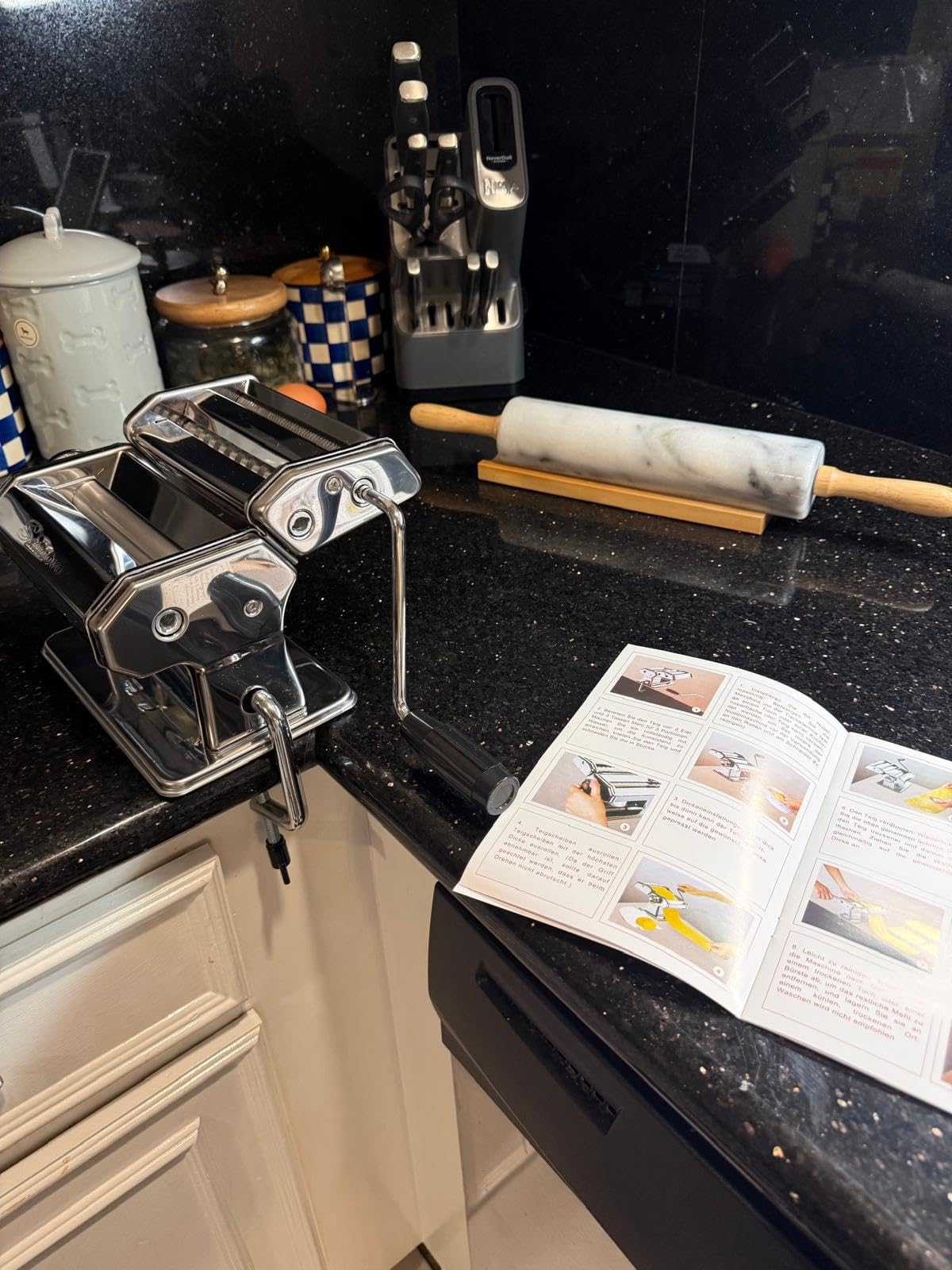
It measures 11.8 by 7.1 by 9.5 inches, which makes it the largest footprint of any manual roller here. If your counter space is tight, check that measurement before ordering, because the clamp needs solid surface right up to the edge.
The body is aluminum and stainless steel with food grade, rust resistant finishes, and a clamp and English manual in the box. The one maintenance rule that owners repeat is firm: the blades should not be washed in water at all. Wipe them, dry them, and store them in a fixed order on the machine.
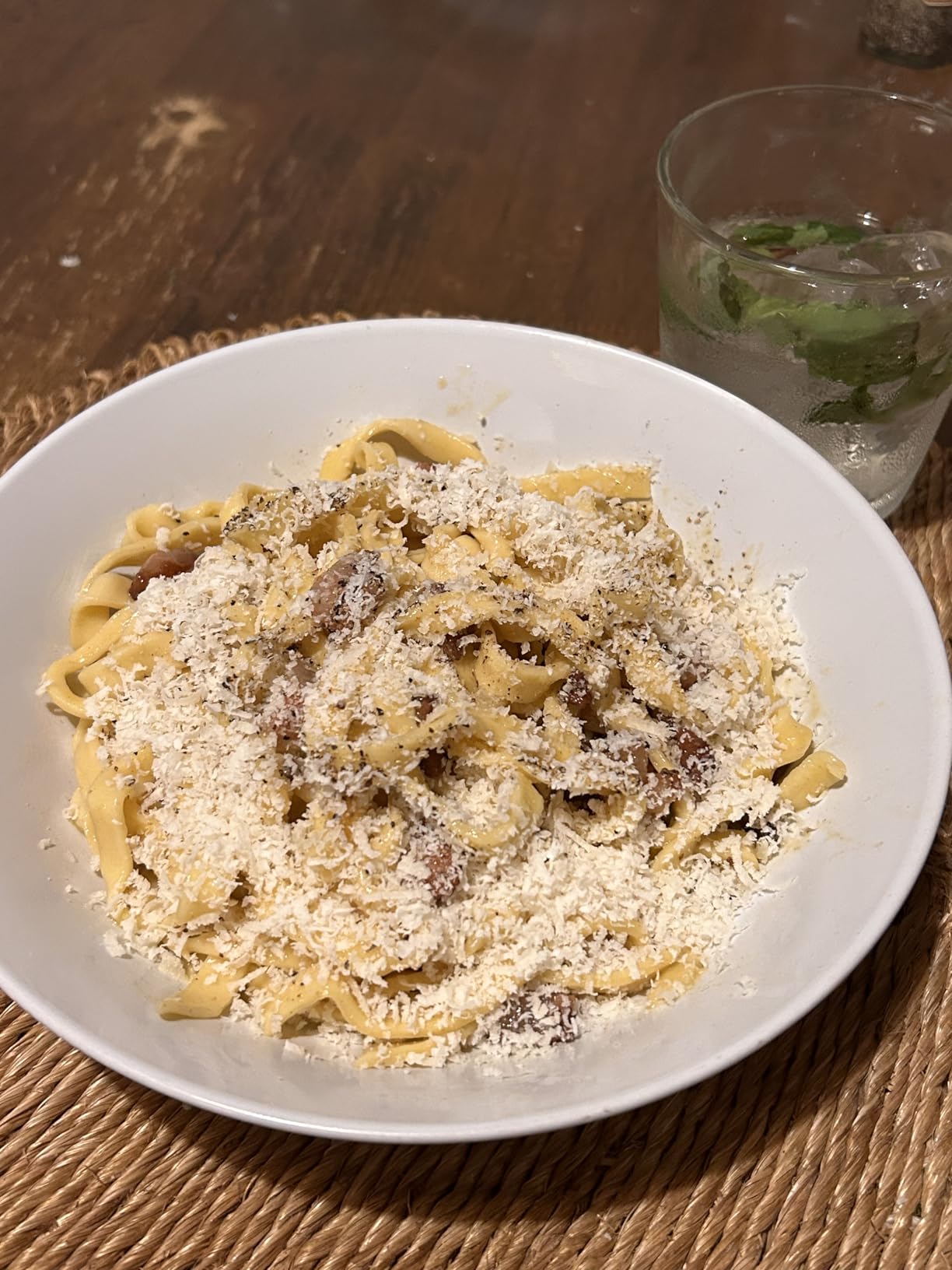
What the Sailnovo does better than the budget tier?
Its nine-setting dial gives finer control than the six or seven-setting machines, which matters on the second and third batch when you are chasing an even sheet rather than simply getting one. It is also rust resistant throughout, so it is a better fit for a humid kitchen than a bare aluminum frame.
The two cutting widths are enough for tagliolini and fettuccine, which covers most weeknight pasta without buying discs.
Who should pass on it?
Small kitchens. The footprint is the largest of any manual roller here, and the clamp needs to grip a counter edge with room behind it for the crank handle to swing in full circles.
Anyone who will wash a machine. The blades are not water safe and the rollers need dry cleaning, so if you plan to rinse a pasta maker under a tap, look at an electric machine with dishwasher safe parts instead.
5. GVODE 3-in-1 Pasta Maker Attachment Review
GVODE 3-in-1 Pasta Maker Attachment for KitchenAid Stand Mixers
- Uses the motor you already own
- All metal with no plastic body parts
- Metal baffle contains flour and dough splatter
- Polished stainless surface resists sticking
- Useless without a compatible stand mixer
- Thickness selector can slip under load
- Cutter may not sever thicker sheets
- Deep cleaning needs pliers to turn the shaft
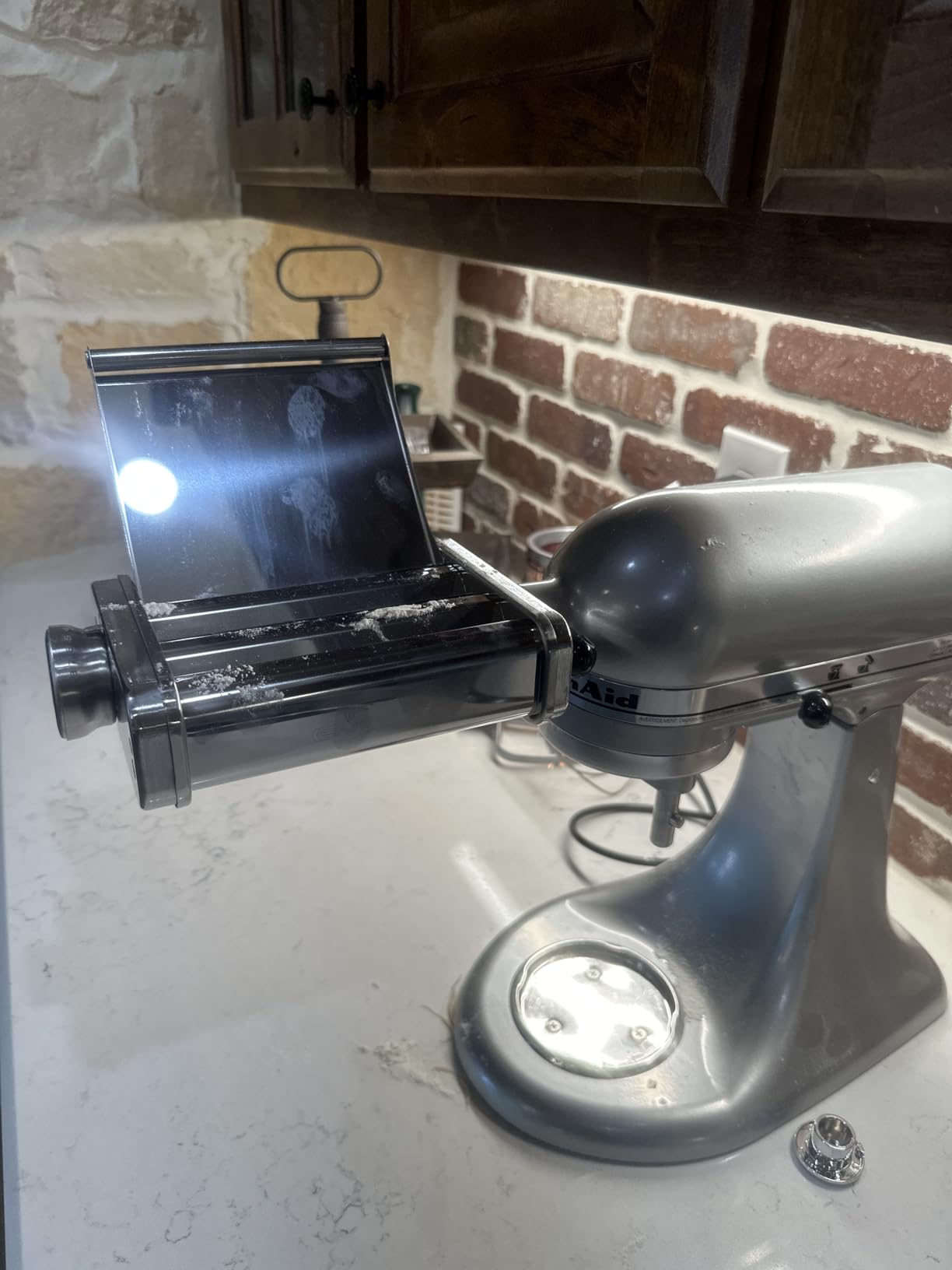
This is the only stand mixer attachment in the guide, and it changes the effort math completely. Instead of a hand crank, the mixer’s motor drives the rollers, which means a double batch takes minutes rather than a quarter of an hour of arm work. If you already own a compatible mixer, this is the strongest reason in the article to skip manual cranking entirely.
It is also a 3-in-1 unit: a sheet roller, a fettuccine cutter and a linguine cutter, with eight thickness levels across the dial. The build is all metal, stainless steel throughout, at 6 by 4 by 10 inches and 2.5 pounds. That weight is meaningful for an attachment because it resists the torque of the mixer better than a plastic-bodied unit.
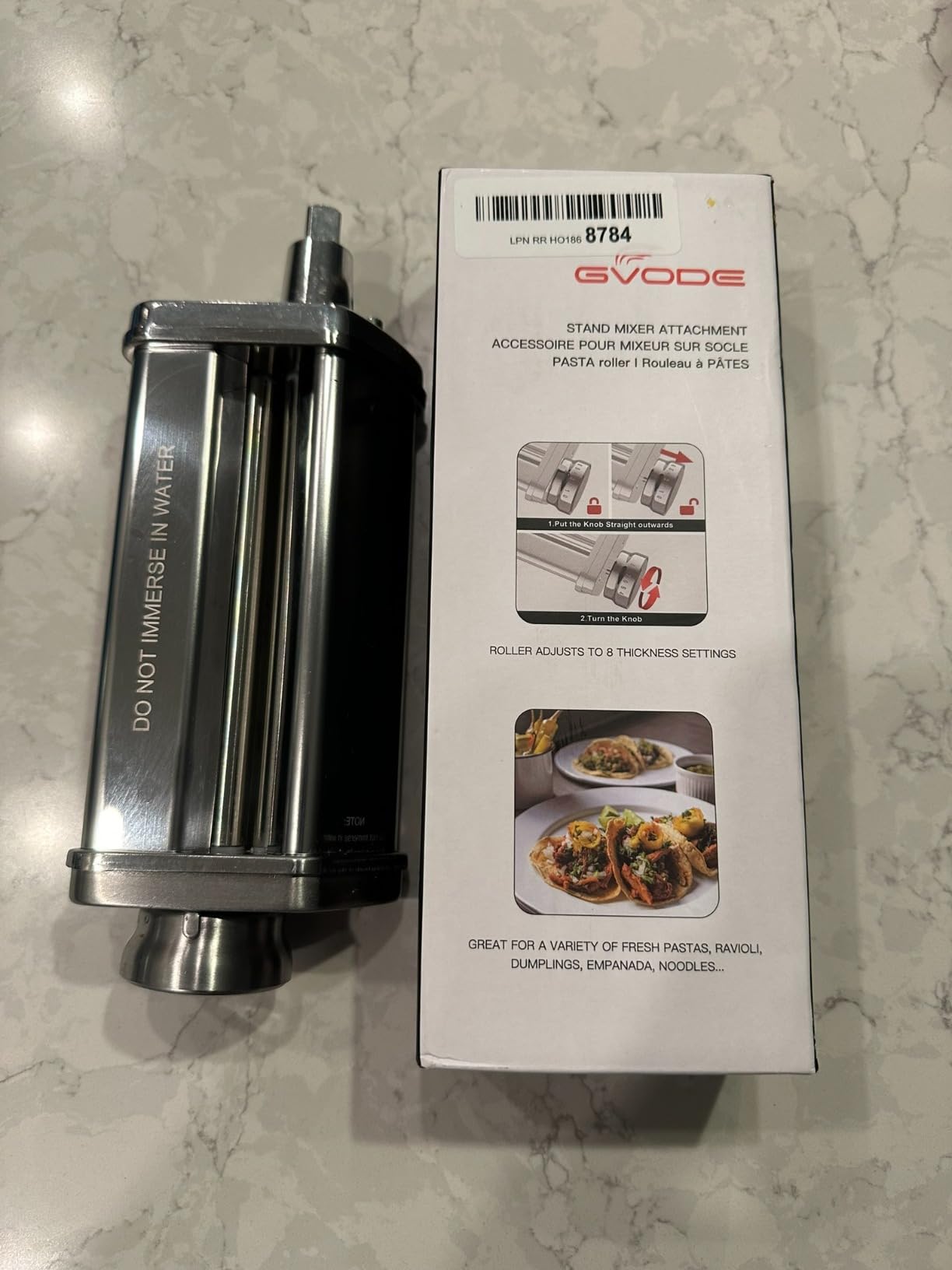
Two design details are worth calling out. First, the metal baffle sits between the rollers to contain flour and dough splatter, which matters when the mixer is running and you cannot stop it the instant dough tears. Second, the polished stainless surface is described by owners as noticeably less sticky than matte finishes, which means you need less flour on the sheet and there is less loose starch in the finished bowl.
The obvious drawback is dependency. If you do not already own a compatible stand mixer, this attachment does nothing for you, and it is useless to anyone who might move houses and leave the mixer behind. That dependency risk is exactly why one owner in the r/pasta recommendations thread abandoned the KitchenAid route, since the mixer belonged to their mother and was not moving with them.
Why mixer owners should look here first?
It converts a machine you already own into a pasta roller. There is no separate motor to buy, no second appliance on the counter, and no hand cranking, which removes the single biggest objection that owners have to manual rollers.
At 4.3 stars from 2,134 reviews it is well established, and the all-metal construction is the reason it holds up where cheaper plastic-bodied attachments crack at the roller mount.
Where it falls short?
Reports of the thickness selector slipping under load are the most common complaint. It is a small part, but it means you should re-check the setting after the first pass on a thick dough rather than trusting it blindly.
The cutters are the weaker point. Owners note the fettuccine cutter can struggle to sever a sheet at the top end of the thickness range, and a deep clean requires pliers to turn the shaft by hand, which is fussy. Buy this for sheet rolling and linguine, and treat fine fettuccine as a test batch.
6. Philips Viva Collection HR2370/05 Review
- Kneads and extrudes with no hand cranking
- Spaghetti penne and fettuccine discs included
- Discs store inside the machine
- Parts are dishwasher safe apart from the motor
- Only three shapes without buying extra discs
- Batches are limited to a few servings
- Cleanup involves washing a mixing chamber
- Motor failures reported by some owners
The Philips Viva is the machine to consider if hand rolling is the thing you dislike rather than the thing you want to master. It measures, mixes, kneads and extrudes, and a batch comes out in roughly 18 minutes with nobody touching a crank. It is the only automatic extruder in this guide, and it answers a different need from the other nine.
It measures 15.5 by 13 by 11.9 inches and weighs 4.7 kg, so it needs a stable counter even though the body itself is compact. Three shaping discs are included for spaghetti, penne and fettuccine, and they store inside the machine body rather than in a separate box, which is the sort of detail that matters in a small kitchen.
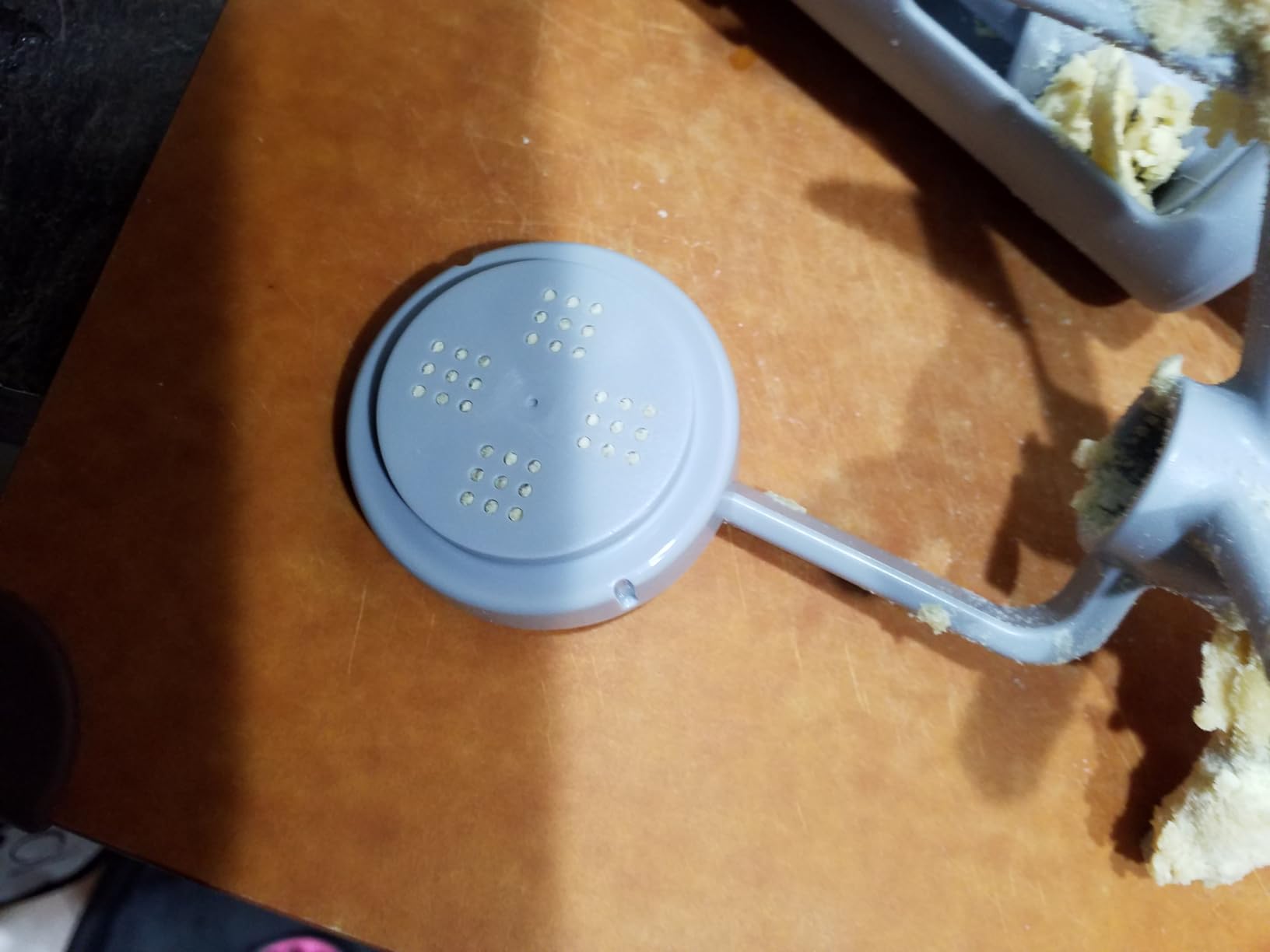
The recipe book and measuring cups that come with it are not filler. This machine works to ratios, and owners consistently report that the first batch or two come out wrong until you stop estimating and start weighing. Once you hit the ratio, the machine is repeatable, which is genuinely its advantage over a hand roller for coloured and flavoured dough.
It is also the option here for gluten-free pasta. Reviewers specifically rate how well it handles gluten-free dough, and a fixed mixing chamber with consistent pressure is the reason. A manual roller handles gluten-free dough fine as long as you rest it properly, but the extruder is more forgiving of inconsistent dough texture.
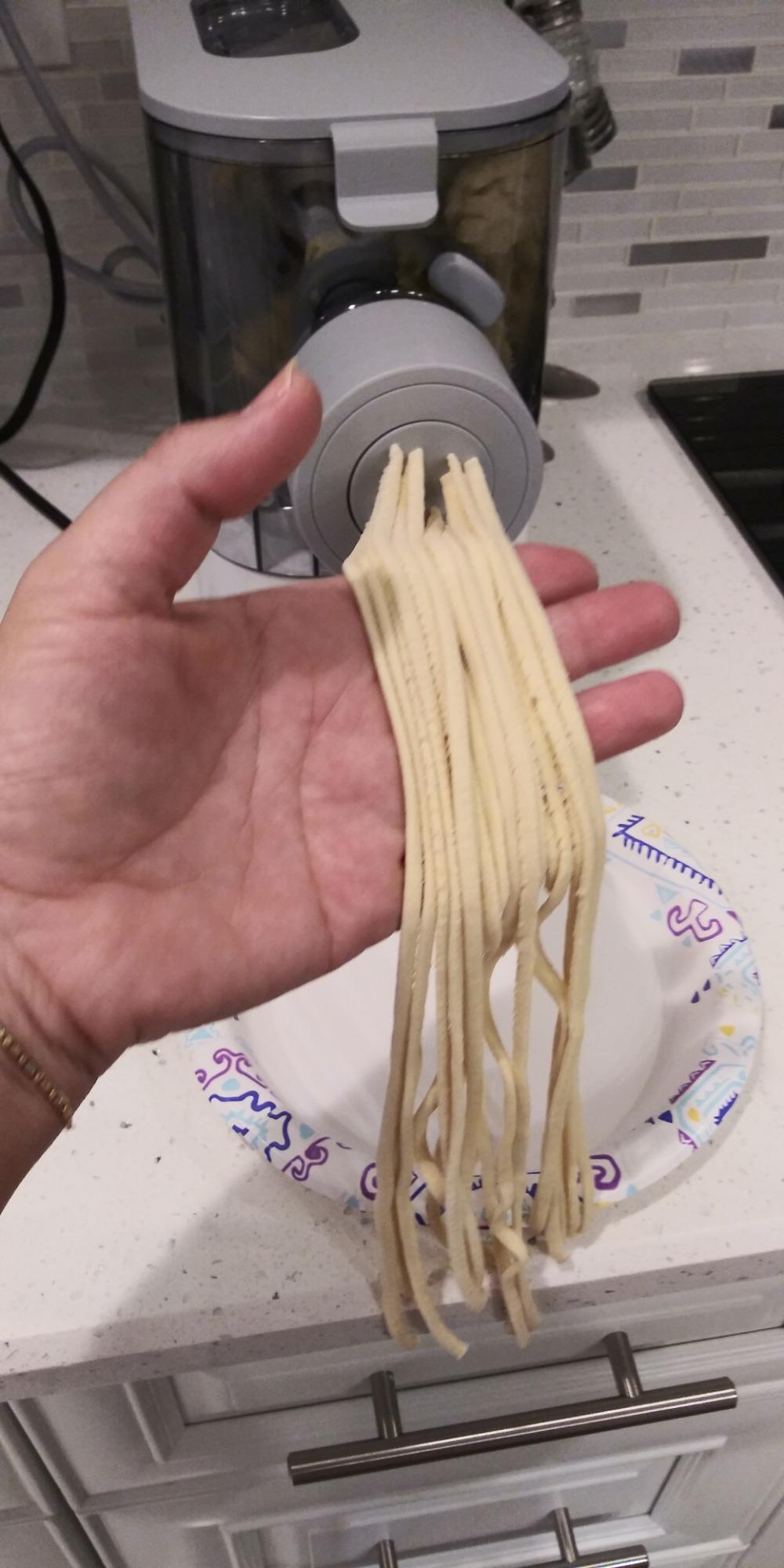
What the Philips does that no roller here can?
It makes extruded shapes. Spaghetti and penne coming out of a die is a different result from a sheet being sliced, and if your household eats penne constantly this is the only machine in the guide that produces it without special discs.
It also gives the same result every time once you have dialled in the ratio. For coloured and flavoured dough, or for a gluten-free household, that consistency is the argument rather than effort.
Where it will frustrate you?
Batch size is the limit. A batch is a few servings, so feeding a group means running it twice, and a second run means a second clean. Plan dinner around what one cycle produces rather than around how hungry everyone is.
Cleanup is more involved than any roller here because you are washing a mixing chamber rather than brushing a roller. Some owners also report motor failures over time, and additional shaping discs are sold separately, so treat the running cost as a factor before you commit. The machine is single voltage, which is worth checking if you travel with it.
7. YASHE 3-in-1 Pasta Maker Review
YASHE 3-in-1 Pasta Maker Machine with Adjustable Thickness
- Lowest cost of any machine in the guide
- Nine thickness settings at this price
- Thinnest minimum of any manual roller here
- Includes a cleaning brush and cloth
- Lightweight body can shift while rolling
- Aluminum components wear faster than premium machines
- Operating smoothness is below the Italian machines
- Instructions are thin
The YASHE is the specification winner in the budget tier. Nine thickness settings from 0.3mm to 3mm, two cutting widths at 2mm and 6.5mm, and stainless steel with aluminum alloy construction, in a 9.8 by 9 by 6.7 inch body weighing 2.9 kg. At 4.4 stars from 2,030 reviews, it also holds the highest rating of any machine in this guide below the Italian-made models.
A 0.3mm minimum is worth pausing on. That is thinner than the Atlas 150 manages and thinner than the Imperia’s 0.5mm, so on paper this is the machine here capable of the finest sheet. In practice, reaching 0.3mm needs a well rested dough and a very steady hand on the crank, which is a technique rather than a specification.
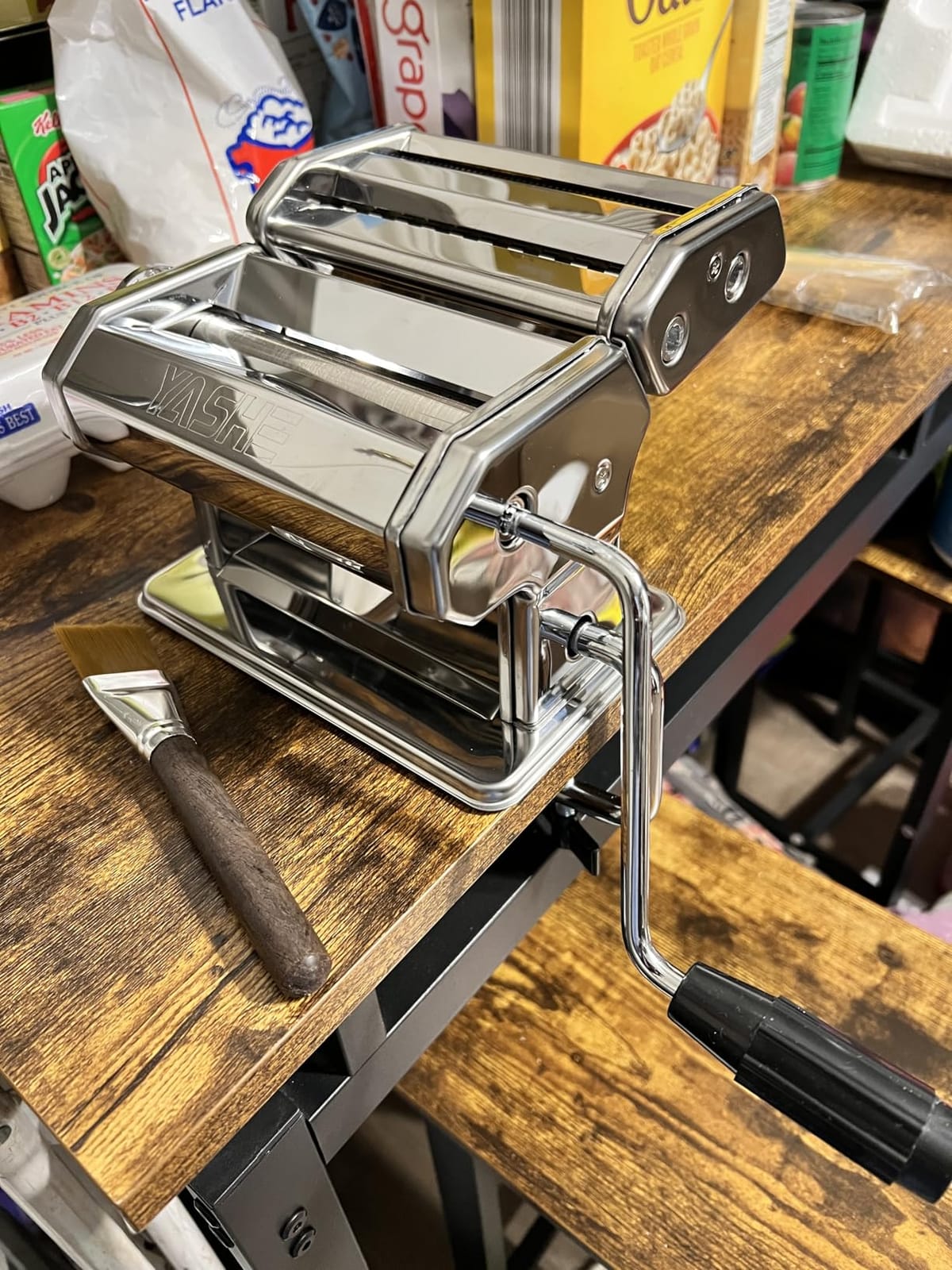
The box includes a noodle roller, a detachable noodle cutter, a hand crank, a fixing clamp, a cleaning brush and a cloth. That is a more complete kit than most machines at this level ship with, and the detachable cutter is a nice touch for storage, since it slides away when you are making flat sheets.
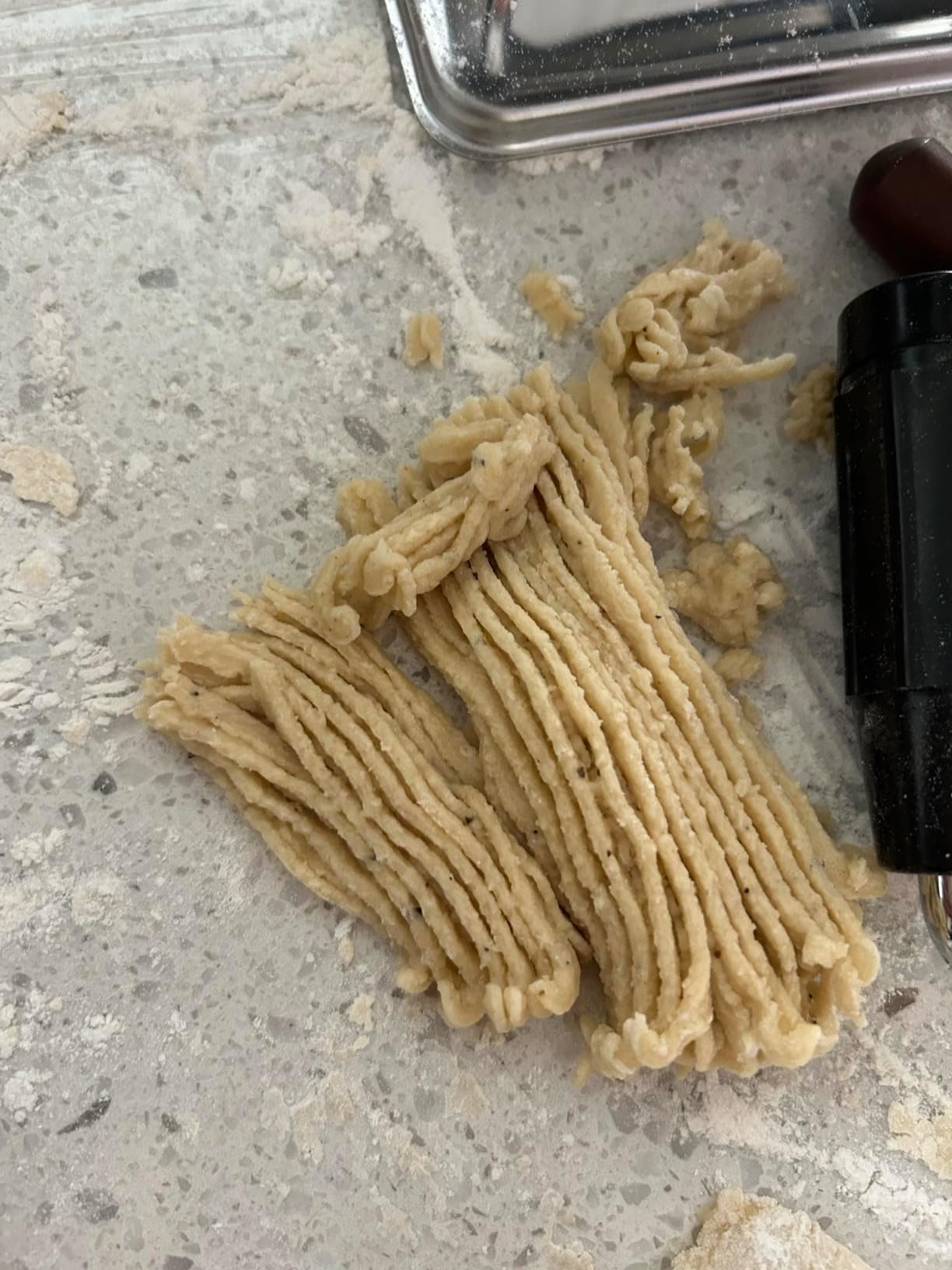
Owners consistently describe the clamp as sturdy compared with machines of similar weight, and the crank as smooth at the top settings. Where it loses ground is at the low end, where owners report the sheet catching rather than passing through cleanly. That is a dough handling issue more than a machine issue, and it resolves with a longer rest.
Why beginners should start here?
The risk calculus is the whole argument. It is the least expensive machine here, and it carries nine thickness settings rather than the six you would get elsewhere at this tier, so you are not trading capability for cost. The included brush and cloth mean you have a cleaning path from day one.
It is also a reasonable stepping stone. If you get good at this and want a wider sheet or a different material, you will know what you actually use the machine for, which is a better basis for the next purchase than a spec sheet.
Where it will not suit?
Anyone planning to keep it for a decade. The aluminum components wear faster than the chromed steel on the Italian machines, and the operating smoothness is measurably below it. For most people that is an acceptable trade, but it is a trade.
Check the instructions before your first session. Owners rate them as the weak point in the box, and knowing how long to rest the dough and how much flour to dust the rollers matters more with this machine than with the smoother Italian builds.
8. VeoHome Stainless Steel Pasta Maker Kit Review
- Drying rack and ravioli mould included
- Entirely stainless steel construction
- Two cutting widths at 2mm and 6.6mm
- Useful 0.6mm minimum sheet thickness
- Clamp can be hard to secure
- Machine may wobble in use
- Needs assembly before first use
- Occasional reports of ragged cuts
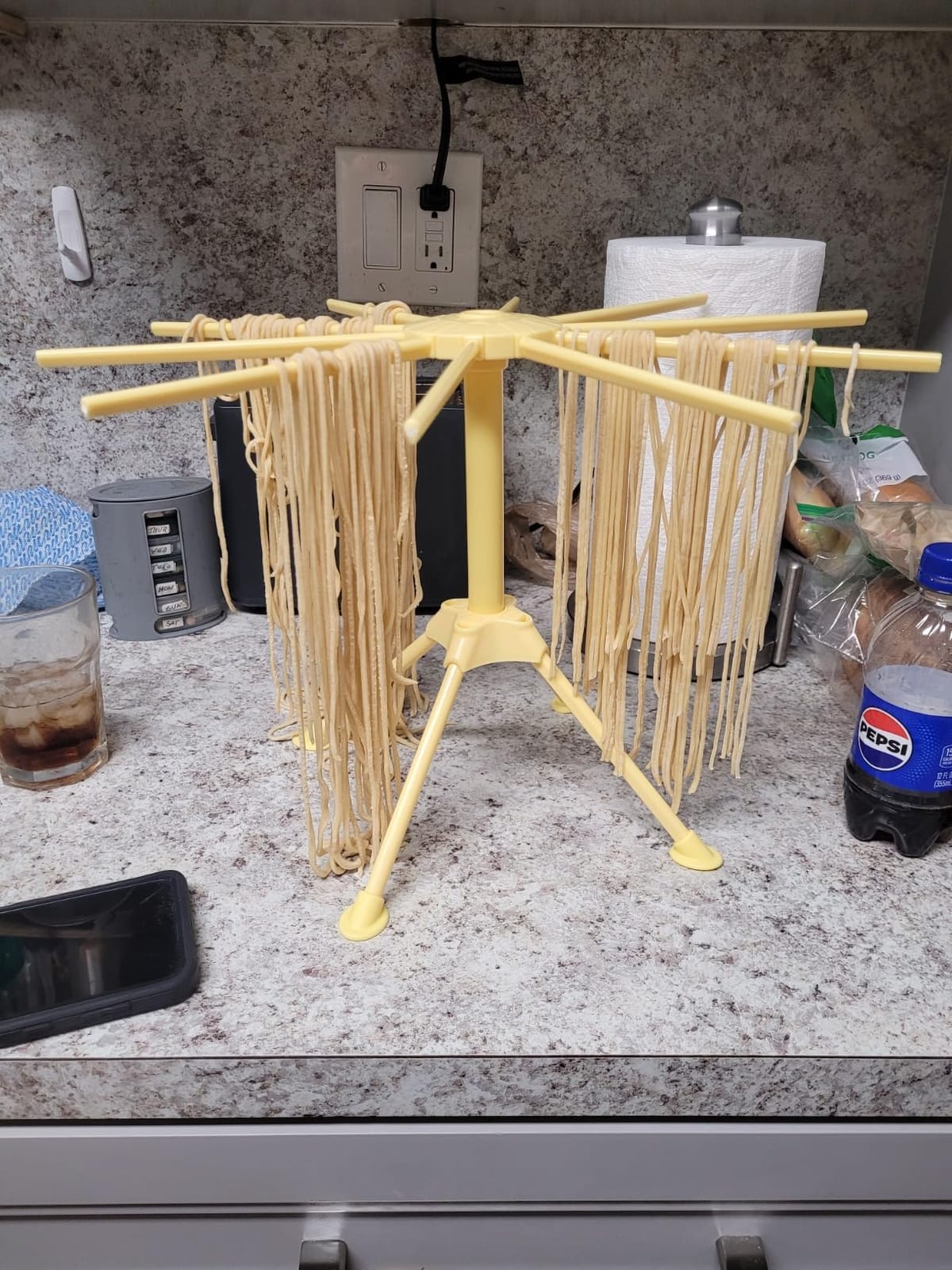
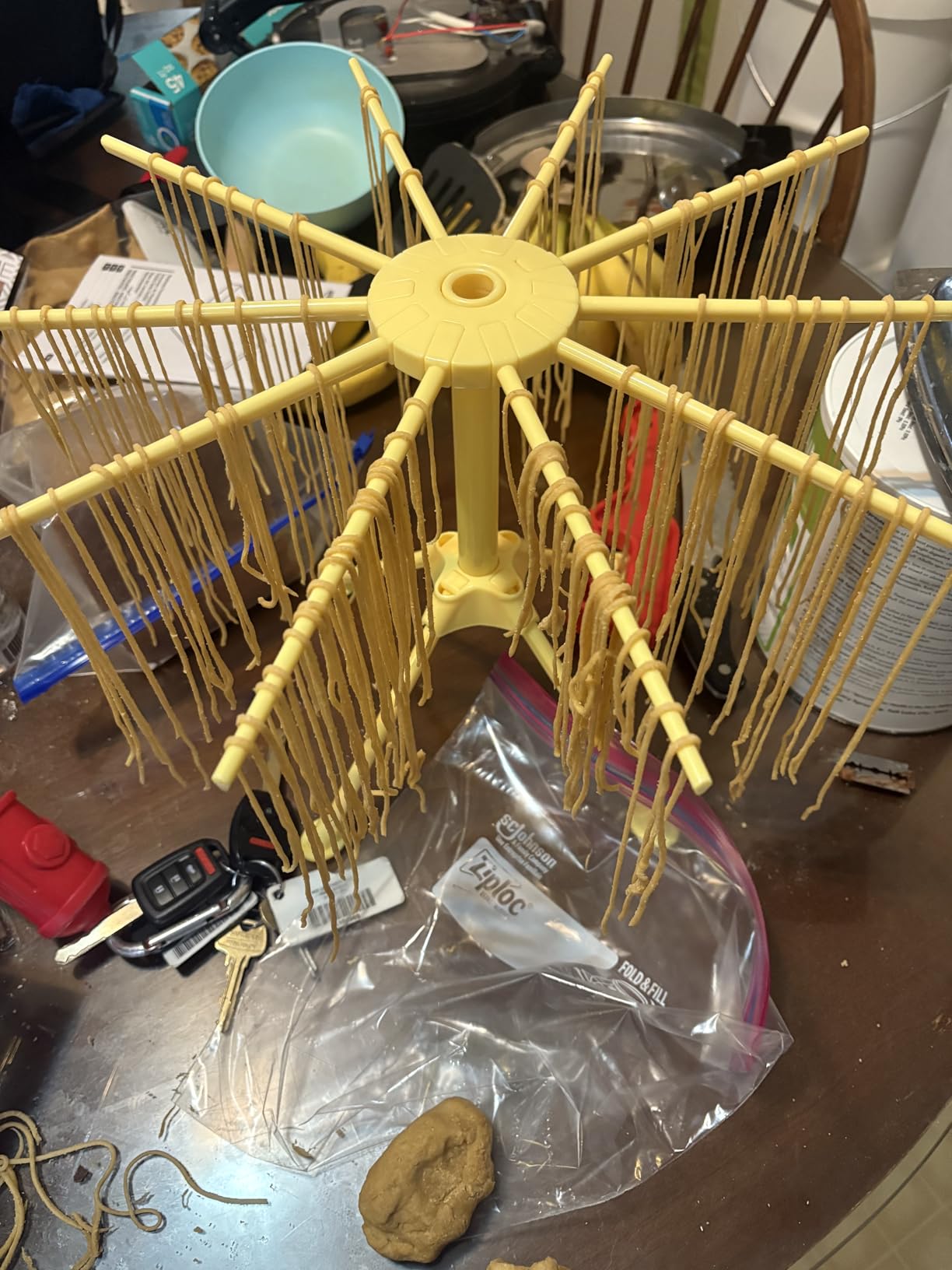
The VeoHome is the only machine here that solves the two things a first pasta night actually needs solved. It comes with a pasta drying rack, so freshly cut noodles have somewhere to hang instead of piling into a bowl and sticking, and a ravioli mould, so filled pasta is a same-day project rather than a later one.
The core machine is all stainless steel, 4.96 by 4.53 by 5.71 inches and 2.9 kg, with seven thickness settings across a 0.6mm to 7mm range and two cutting widths at 2mm and 6.6mm. The 7mm maximum is a thick sheet setting, which is useful if you roll a heavy dough for filled pasta rather than aiming at fine noodles.
What you should know before ordering is that this machine needs assembly. Owners note that the clamp and rollers take a few minutes to set up on the first pass, and that the clamp in particular can be difficult to secure properly. Once it is seated, the weight keeps it stable, and the included brush makes clean-up straightforward.
At 4.3 stars from 2,009 reviews it holds a solid middle position in the category. The lower category ranking it carries compared with the Italian machines is a sales signal rather than a quality one, but it does reflect that this is a newer presence in the manual roller category than the Atlas or the Imperia.
What makes the kit different?
The drying rack is the reason most people would keep this machine. Fresh noodles need to be laid out rather than coiled, and a kitchen counter does that job badly. Having a purpose-built rack in the box removes the most common post-cook problem of clumped pasta.
The ravioli mould covers the gap that every roller in this guide has. You can make ravioli on any of them by hand, but the mould makes the shape consistent and the speed tolerable.
Where it falls short?
The clamp and the wobble are the two reported issues, and they are related. If the clamp is not fully seated, the body moves under cranking pressure and cuts come out ragged. Work out the right position before your first batch rather than during it.
There is also no motor path here. If you later decide cranking is not for you, unlike the Marcato and Imperia there is no optional motor to bolt on, so the upgrade route is closed.
9. Marcato Ampia 150 Classic Review
MARCATO Made in Italy Ampia 150 Classic Manual Pasta Machine, Chrome Steel. Makes Lasagne, Fettuccine & Tagliolini
- Wider sheet than the standard Atlas model
- Same Italian build and ten setting dial
- Resin scrapers clean the rollers while rolling
- Pastadrive motor compatible
- Fewer reviews than the Atlas 150
- Costs more than the standard model
- Only three shapes without accessories
- Only available in one width
The Ampia 150 shares the Atlas 150’s rating at 4.6 stars, and it is the same machine thinking about sheet width. The name refers to the 150mm, or six-inch, sheet it produces, which is the size that decides whether you can roll a lasagna sheet in one clean pass or in two overlapping strips.
Everything else matches the Atlas we named as our overall winner: Italian manufacture, chrome steel body, the same ten thickness settings running 0.5mm to 4.8mm, three cutting shapes, and the same self-cleaning resin scrapers above the rollers. Body size is 7 by 8 by 5 inches at 2.58 kg, which sits lower than the Atlas 150 rather than towering over it.

The 4.6 rating here is backed by 1,562 reviews rather than the Atlas’s 27,000, so the evidence base is thinner even though the score is identical. That distinction matters if you are choosing between the two: identical specification and rating, different depth of long-term ownership evidence and a different price.
It is also Pastadrive compatible, so the same motor upgrade path is open to you as with the Atlas. That is the argument for buying Marcato over an otherwise similar machine at any point, and it is why owners in the forums treat the brand as a default recommendation when a thread asks for a mid-tier machine.
Why the Ampia earns its place?
Sheet width is a real quality decision, not a marketing one. A 150mm sheet covers a standard lasagna tray width in a single pass, which means no seam down the middle and no double-thickness join where the sauce penetrates more than the rest.
It is also the better choice for ravioli wrappers for the same reason, since a wider sheet yields more uniform rounds per pass.
Who should buy the Atlas instead?
If you make more noodles than filled pasta, width buys you little. The extra cost over the Atlas 150 is better spent on extra cutting discs if your plan is tagliolini, fettuccine and angel hair rather than lasagna and ravioli.
The lower review count is a fair reason to hesitate. Both machines rate 4.6, but two decades of ownership data behind one of them is a stronger durability signal, and the fear that buyers actually have is a machine that fails in year two.
10. Shule Stainless Steel Pasta Maker Review
Shule Pasta Maker Machine Stainless Steel Adjustable Pasta Roller and Cutter for Tagliattelle Linguine Lasagna Noodles, Classic Red
- Removable crank handle for compact storage
- Multi position clamp installation
- Stainless body with anodized aluminum rollers
- Tagliatelle and linguine cutters included
- Smallest review base in this guide
- Aluminum rollers rather than steel
- Only two cutting attachments included
- Limited colour options
The Shule is the machine here where the design details beat the specification, and that is worth saying out loud because most buyers never look at either. The crank handle unscrews for storage, so the machine goes back in a drawer or a cupboard as a compact block instead of standing permanently with a handle sticking out. The clamp also installs in multiple positions, which is the practical answer to thick, bevelled or awkward counter edges.
On paper it is a normal budget machine: 7 thickness settings from 0.5mm to 3mm, two cutting attachments for tagliatelle and linguine, a stainless steel body with anodized aluminum rollers, 8.3 by 8 by 6.2 inches and 4.7 pounds.
It rates 4.4, but on 935 reviews that is the smallest evidence base in this guide by some distance, and it is the number I would look at hardest before buying. The rating is good, but a smaller pool means each individual experience carries more weight, and the anodized aluminum rollers are the specification owners single out as the future weak point.
Tagliatelle and linguine as the two included cutters is a sensible pairing, since they are the two widths most people reach for. The red finish is genuinely attractive for something that lives on the counter, and both red and silver are offered.
What makes it worth considering?
Storage is the deciding factor in a small kitchen. A removable crank and a multi position clamp solve two problems at once, and neither the Imperia nor the Sailnovo offers the same combination.
If you are buying your first machine and you care about how it looks on the counter as much as how it performs, that is a legitimate tiebreaker between two similar budget options.
Where it falls short?
Review volume. 935 ratings is a real sample, but it is a fraction of the Nuvantee or the YASHE, and the fear the community actually has is durability failure early in ownership.
Two cutters and a 3mm maximum sheet limit it too. It is a solid weeknight tagliolini and linguine machine, but it is not the one to buy if lasagna sheets or filled pasta are the goal.
Pasta Maker Buying Guide: Manual vs Electric vs Attachment
Manual rollers: the most versatile and the most effort
A manual roller is a machine you control directly. You choose the thickness, you choose the shape, and you can stop mid-sheet and change direction. That control is why the Marcato Ampia, the Imperia and the YASHE can all reach 0.5mm or thinner, while the automatic extruder in this guide is producing extruded shapes at a fixed consistency rather than a sheet you judge by eye.
The cost is arm work, and the running cost is separate discs. If your plan includes pappardelle, angel hair or a shape that does not ship in the box, budget for an additional disc set, which is the cost-of-ownership item most roundups skip. On a manual roller the blade is the part that dulls with use, so a spare disc set is the running cost to plan for rather than the machine body.
Automatic extruders: hands off, limited output
An electric pasta maker like the Philips Viva does the kneading and the extrusion. You measure ingredients, press a button, and collect shaped pasta in about 18 minutes. For a household that wants penne or spaghetti several times a week without the physical part, the trade is simple and usually worth making.
What you give up is batch size, shape range and clean-up simplicity. A batch is a few servings, extra shaping discs cost more, and there is a mixing chamber to wash afterwards instead of rollers to brush. Extruders also shine on coloured, flavoured and gluten-free dough because they apply consistent pressure to whatever you feed them.
Stand mixer attachments: the effort shortcut
If you own a compatible stand mixer, the GVODE attachment removes the crank and the counter space of a standalone roller. The mixer is the motor, so a double batch is a matter of minutes. The cost is dependency: without the mixer the attachment is inert, which is a real risk if you move home or share the appliance.
The upgrade path most people miss
The three Italian machines here can each take an optional motor. Buy the manual roller now, learn on it, and add the motor in a year if the cranking is what stops you. Forum buyers treat this as a decisive advantage because it means the first purchase is not a dead end. Machines with no motor path, including most of the budget rollers, are a one-way decision.
Which Pasta Maker Matches Which Shape?
Start from the pasta you want, not from the machine. The most common mistake we see is buying a roller for its settings when the deciding question is which shapes the cutting discs actually produce.
Spaghetti and long noodles come from every machine in this guide. The Nuvantee, Sailnovo, YASHE and VeoHome cut thin spaghetti with their included 2mm cutters. The Philips Viva extrudes spaghetti without a rolling stage at all.
Fettuccine and tagliolini need a wide cutter, and this is where the machines separate. The Nuvantee, YASHE and VeoHome each ship a dedicated 6mm or wider cutter. The Marcato, Imperia and Shule rely on a combination cutter that handles two widths in one piece, and the Philips produces fettuccine through its extruder disc instead of a cutting blade.
Lasagna sheets and pappardelle need sheet width more than they need a cutter. The Marcato Ampia 150 at 150mm rolls a standard tray in one pass, which is the reason it is our lasagna pick. The other rollers need two overlapping strips, and pappardelle on any of them needs a separately sold disc.
Ravioli wrappers and filled pasta are mostly a sheet question too. Any roller works if the sheet is wide and even, and the VeoHome is the only machine in the guide with a mould in the box. The Imperia can take a Raviolamp wheel for single-pass rolling and cutting.
Angel hair and cappellini need a machine that gets genuinely thin. The YASHE at 0.3mm and the Imperia and Ampia at 0.5mm are the ones here with the lowest minimum, while the Atlas 150 stops at 0.8mm. The Philips produces extruded shapes rather than fine sheets, so it is not the machine for angel hair.
Penne and other extruded shapes come only from an automatic extruder. The Philips Viva is the only machine in this guide with a penne disc, and that alone can decide the purchase if your household eats penne constantly.
Counter Space, Clamps and the First-Use Clean
Measure your counter edge before you order
The countertop clamp is the most common source of post-purchase frustration, and an entire Facebook thread in this category exists for people trying to avoid it. A pasta machine clamps onto a counter lip, and it needs a straight edge with enough depth to take the jaw. A rounded, bevelled, tiled or thick butcher-block edge will not hold a clamp properly, and the machine will walk across the surface during a long roll.
Measure the edge thickness before you buy and check the machine’s maximum clamp opening. The rolling action also needs clearance behind the machine for the crank handle to swing through full circles, so leave more depth than the footprint suggests. The Shule’s multi position clamp and the Imperia’s included table support are the two answers in this guide to awkward counters. A steady hand against a wall is the free workaround owners use when a clamp will not seat.
Metal shavings on first use are normal
New rollers often shed fine metal particles on the first pass, and owners across multiple brands report finding bits in the rollers. This is manufacturing residue, not damage, and it disappears after a couple of cleaning batches. Run the machine with a plain flour dough two or three times before you make anything you plan to serve, and wipe the rollers dry with a cloth each time.
Then never rinse a manual roller. Dry brush the rollers while they are still warm, lift dried dough from the grooves with a small wooden stick, and leave the blades entirely dry. For the electric machine, the parts listed as dishwasher safe can be washed, but the motor unit cannot.
Rust prevention and storage
Dry everything immediately, including the cutter discs, and store the discs in a fixed order on the machine so you always reassemble the same way. In a humid kitchen, keep the machine in a cupboard between uses rather than leaving it on an open counter. The Imperia is the one machine here that includes a cotton storage pouch, and it makes a real difference in a small kitchen.
Two habits separate a machine that lasts from one that binds up. Rest the dough for at least 30 minutes before the first pass, because a rested dough rolls instead of tearing. And work from thick to thin, folding the sheet and passing it again rather than cranking straight down to a low setting, which is what causes the tearing and clicking that beginners report as a fault.
Frequently Asked Questions
What is the best pasta maker for home use?
The Marcato Atlas 150 Classic is the best pasta maker for most home kitchens. It is made in Italy, holds a 4.6 rating across more than 27,000 reviews, and its 10 thickness settings run from 0.8mm to 4.8mm with three cutting shapes included. If you want no cranking, the Philips Viva Collection is the compact automatic option.
What is the best all-in-one pasta maker?
An all-in-one machine mixes, kneads and extrudes in a single appliance, and the Philips Viva Collection HR2370/05 is the best of that type here. It includes discs for spaghetti, penne and fettuccine, produces a batch in about 18 minutes, and stores its discs inside the body. Batches are limited to a few servings and extra shapes cost extra.
Are pasta making machines worth it?
Yes, a pasta maker is worth it if you make pasta more than once a month or you want lasagna sheets and long noodles. Even sheet thickness is what determines how well sauce clings and how evenly the pasta cooks, and a machine cuts fettuccine in a fraction of the time a knife takes. If you make pasta once or twice a year, a rolling pin is genuinely enough.
What pasta maker do Italians use?
Italian kitchens overwhelmingly use a hand-crank roller with anodized aluminum rollers and a chromed or stainless steel body, which is exactly the specification the Marcato Atlas 150, the Marcato Ampia 150 and the Imperia iPasta share. The anodized surface leaves a slightly porous sheet that gives sauce something to grip. Italian manufacture is the most consistent durability signal in this category.
Which brand of pasta maker is considered the best?
Marcato is the most defensible brand answer, and the Atlas 150 is its strongest model with a 4.6 rating across more than 27,000 reviews. Imperia is the alternative Italian name, also made in Italy and rated 4.5. Philips leads the automatic extruder category, and an attachment from GVODE is the value route for anyone who already owns a stand mixer.
What is the best pasta maker for beginners?
The YASHE 3-in-1 is the best starter machine, with 9 thickness settings, two cutting widths and a cleaning kit included at the lowest cost in this guide. The Nuvantee is the alternative, and it is easier to store. Either way, treat the first batch as practice: rest the dough 30 minutes, work from thick to thin, and crank slowly.
Is an electric pasta maker worth it?
Yes, if you dislike the physical part of hand rolling or you want extruded shapes like penne that no roller in this guide makes. An electric maker kneads and extrudes without effort and handles gluten-free and coloured dough consistently. You trade away batch size, shape range without extra discs, and a washing-up step. It is also single voltage, which matters if you travel with it.
How do you maintain a pasta machine?
Brush the rollers dry while they are still warm after every session, never submerge a manual machine, and dry every part immediately to prevent rust. Lift dried dough from the roller grooves with a small wooden stick rather than water. Store the cutting discs in a fixed order on the machine and keep the whole unit in a cupboard between uses if your kitchen is humid.
Final Verdict
The Marcato Atlas 150 Classic is the best pasta maker for homemade noodles in 2026, and the reason is durability rather than a single headline specification. Its 4.6 rating across more than 27,000 reviews, its Italian chrome steel build and its ten thickness settings make it the machine the community keeps returning to, and the optional motor means it can grow with you instead of becoming a cupboard ornament.
Per family, our picks are the Imperia iPasta for the best-made manual value, the Philips Viva Collection HR2370/05 for the best compact automatic, and the GVODE attachment for anyone who already owns a stand mixer. The Nuvantee is the best budget start, the YASHE is the best first machine for a true beginner, and the Marcato Ampia 150 is the answer when sheet width is the whole decision.
One last practical point before you order. Measure your counter edge, confirm the thickness range will get thin enough for the pasta you actually want, and remember that the first batch is a learning batch. If you enjoy the process, most of these machines have a decade of life left in them. For related kitchen machine guides, our sausage stuffer roundup covers the same hands-on approach for a different kind of homemade staple.