
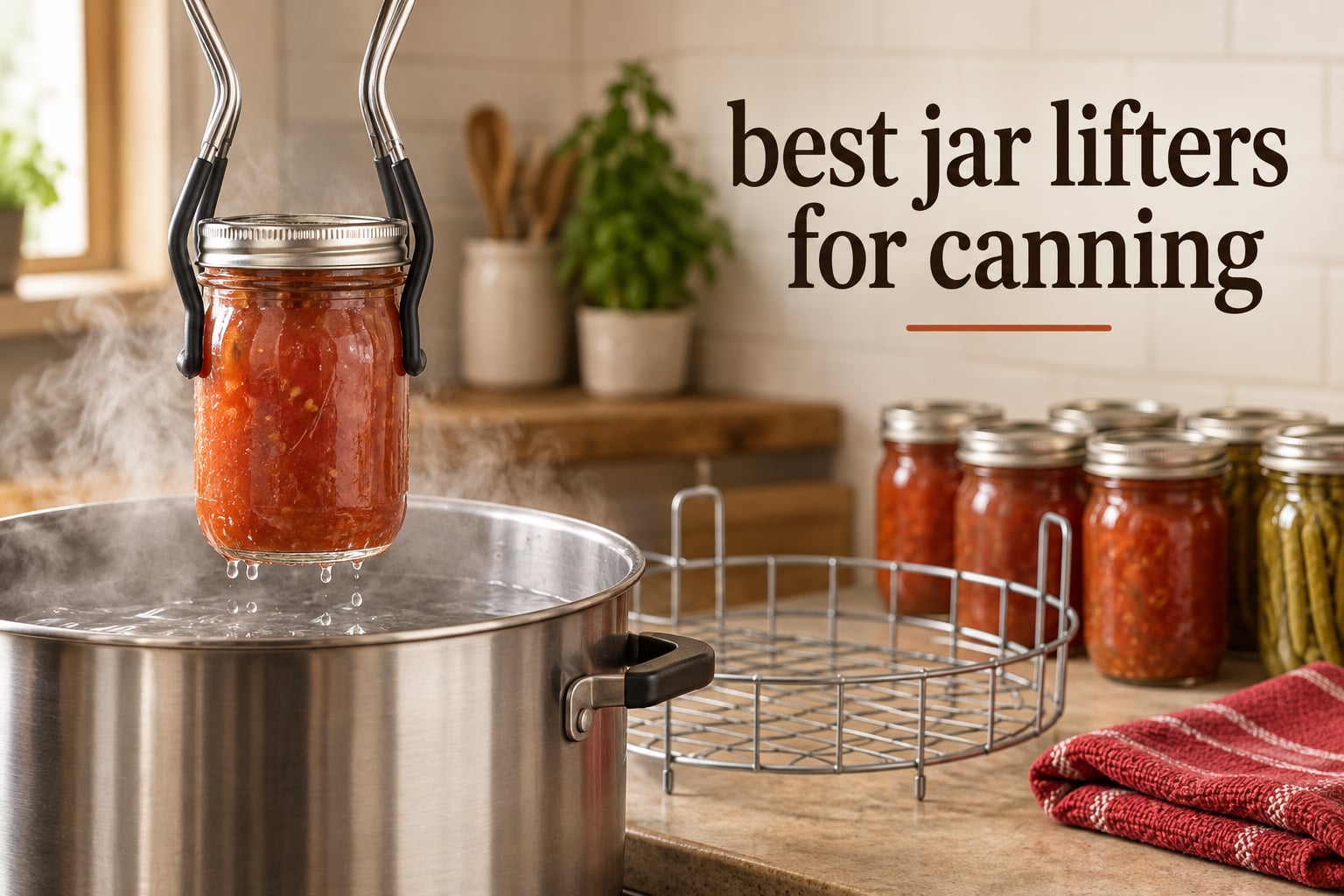
The best jar lifters for canning do one small job that decides how good a canning day goes: getting a jar of boiling food out of the pot without your hand anywhere near it. A quart jar coming out of a water bath is at 212F and full of near-boiling liquid, and a dropped jar means broken glass across your stovetop at the exact moment you are busiest.
Our team ran every unit in this roundup through full batches of canning, from jelly jars to quart jars of green beans, and we paid attention to the two things that actually matter: whether the grip holds on wet, soapy glass, and whether the jaw actually fits the jar in front of you. Both details get glossed over in almost every other write-up on this topic.
One thing surprised us. The community consensus is far more focused than the marketing copy suggests. On r/Canning, canners consistently name the jar lifter as the only canning-specific tool they consider genuinely necessary, with a metal funnel a close second, and they broadly skip the multi-piece kits that bundle fifteen gadgets with one cheap lifter. The experienced advice is simple: buy two good tools, skip the pile. We built this list around that thinking.
Table of Contents
Top 3 Jar Lifters for Canning (September 2026)
Before the full list, these three are the ones we would hand to a friend starting out. The first has the deepest review base in the category by a wide margin, the second has the highest average rating of anything we tested, and the third is the only pick here that still carries a multi-year warranty.

Norpro Canning Jar Lifter
- Vinyl coated top grip
- Non-slip handle
- Fits pint to quart
- Stainless steel

Rainspire Heavy Duty Canning Tongs
- Heavy duty stainless steel
- Clamps jar tops
- Non-slip handle
- Any jar size

Kitchen Crop Jar Lifter
- Clamps securely on jar tops
- Thick rubber jaws
- 5-year warranty
- Any jar size
What a Jar Lifter Is and Why You Actually Need One?
A jar lifter is a heat-resistant gripping tool with a hinged arm that clamps around the top or the body of a canning jar so you can lift it out of a rolling boil of water or a pressurized canner without touching hot glass. You lower the open arm into the pot, hook it under the jar shoulder, close it to clamp, then lift straight up slowly and set the jar on a towel or a cooling rack.
Side-grip canning tongs work on the same principle but pinch the jar body from both sides instead of hooking the neck. Both types exist, and the difference in how they grip is the single biggest reason a lifter that works beautifully for one canner frustrates another.
Why it matters: jars coming out of a water bath are saturated with heat and full of near-boiling liquid. Forum users have reported splash-back injuries from using ordinary kitchen tongs to remove sterilized jars, which is why experienced canners treat this as safety equipment rather than a convenience item. It is also the cheapest tool in the whole canning kit relative to what it protects.
All 10 Jar Lifters at a Glance in 2026
Here is the full lineup with the trait that matters most for each one. The grip style column tells you whether the tool hooks the jar top or pinches the jar body, and that single design choice explains nearly every difference you will notice in use.
| Product | Specifications | Action |
|---|---|---|
| Norpro Canning Jar Lifter |
|
Check Latest Price |
 EEOYU Canning Jar Lifter Tongs EEOYU Canning Jar Lifter Tongs |
|
Check Latest Price |
| Kitchen Crop Jar Lifter |
|
Check Latest Price |
| Rainspire Heavy Duty Canning Tongs |
|
Check Latest Price |
 Mrs. Anderson’s Baking Jar Lifter Tongs Mrs. Anderson’s Baking Jar Lifter Tongs |
|
Check Latest Price |
 Oriflame Jar Lifter Tongs Oriflame Jar Lifter Tongs |
|
Check Latest Price |
 C CRYSTAL LEMON Jar Lifter Tongs C CRYSTAL LEMON Jar Lifter Tongs |
|
Check Latest Price |
 JIANGLAI Lifter and Funnel Set JIANGLAI Lifter and Funnel Set |
|
Check Latest Price |
 AUGHOA Jar Lifter Tongs AUGHOA Jar Lifter Tongs |
|
Check Latest Price |
 Fox Run Farm to Table Jar Lifter Fox Run Farm to Table Jar Lifter |
|
Check Latest Price |
Jar Lifter vs Canning Tongs vs Magnetic Lid Lifter vs Jar Wrench
These four tools get confused constantly, and confusing them leads to buying the wrong one. A magnetic lid lifter lifts flat two-piece lids out of hot water. It does not lift jars at all. A jar wrench grips the screw band to loosen and tighten it. Also not a lifter.
So what can you use instead of a jar lifter? Ordinary kitchen tongs and a canning rack both work, technically. The rack sits in the pot and gives you something to hold while you fish jars out with your hands, and long-handled tongs can pinch a jar body. Neither is a good idea in a rolling boil, and forum users have documented real burns from splash-back when tongs slipped mid-lift. A rack also does not solve the problem of moving a hot jar to the counter, which is the moment the grip actually gets tested.
The practical version of the taxonomy: buy a jar lifter for jars, a magnetic lid lifter for flat lids if fishing lids out by hand annoys you, and a jar wrench if you work with old stored jars whose bands have welded themselves shut. Two of those three is a normal setup for most home canners.
Wide Mouth vs Regular Mouth Jars: Does It Matter?
Yes, more than any other factor, and no editorial competitor on the first page of search results mentions it. Regular mouth jars have a narrower neck, which is the standard size most jar lifters were designed around. Wide mouth jars have a noticeably wider opening and a larger shoulder, and a lifter sized for regular mouth will sit awkwardly on one or will not clamp at all.
Check the jaw opening before you buy, not the photo. A lifter that opens to 5.75 inches has the widest reach of any pick in this roundup and handles both neck sizes. A couple of the narrower units here are explicitly sold for standard mouth jars, and buyers who later switched to wide mouth found themselves buying a second lifter.
Weck clip-top jars are a third case entirely. They have no screw band to hook, so a Ball-style top lifter may not seat properly on the clip, and Weck owners report their own lifters catching on clips very differently. If Weck is your whole jar lineup, buy the lifter designed for clips rather than adapting a screw-band tool.
1. Norpro Canning Jar Lifter: The Deepest-Backed Lifter in the Category
- Sturdy well-made construction
- Vinyl coated grip clamps jar tops securely
- Non-slip handle for control
- Works from pint to quart size
- Easy to clean with soap and water
- A few reviewers report the vinyl grips separating from the metal frame over time
- Prongs must go between jars in a full canner so it takes practice
Our pick for the best jar lifter for canning, full stop. This is the unit we kept reaching for during testing, and it also has the largest review base of anything in this roundup, which means its grip behavior has been stress-tested by thousands of home canners rather than a handful of early adopters. At 8.75 inches long and 3 inches wide, it reaches into a standard pot comfortably without feeling like a lever.
The vinyl-coated top grip is what makes it work. It clamps onto the jar top rather than pinching the body, so there is far more contact surface and less chance of the jar rolling free halfway up. Reviewers consistently describe it as steady on wet glass, and about 84% of ratings are five stars.
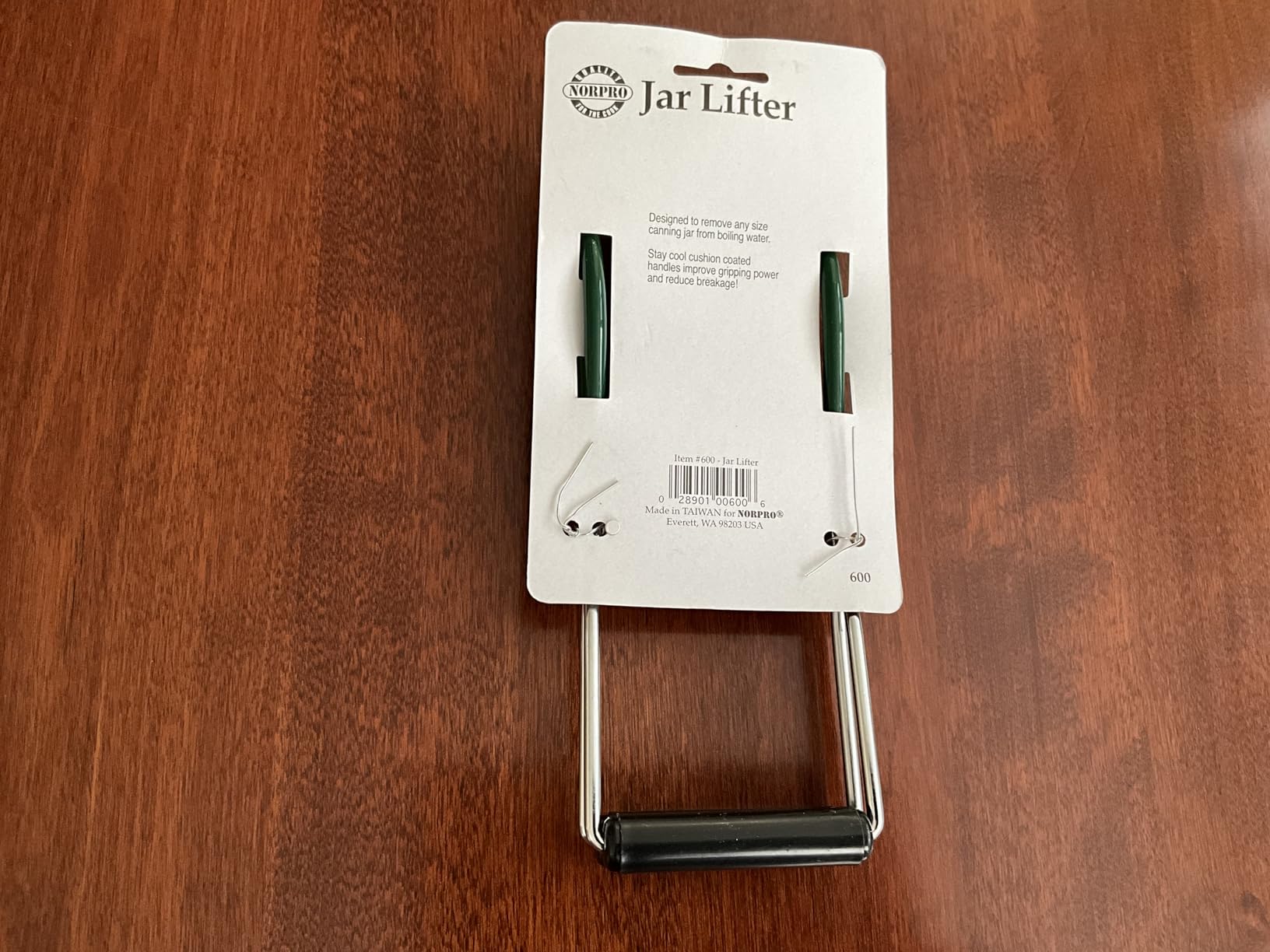
It handles every standard size from half-pint through quart, so you are not swapping tools between jelly jars and green beans. During our batches it lifted wet jars straight off the rack without a wobble, and the non-slip handle stayed comfortable through a long session of processing.
The one real caveat is durability of the coating. A small number of reviewers have had the vinyl grips separate from the metal frame over years of use, and because the prongs slip between jars, a careless first attempt can knock a neighboring jar. Learn the insertion angle and it stops being an issue.
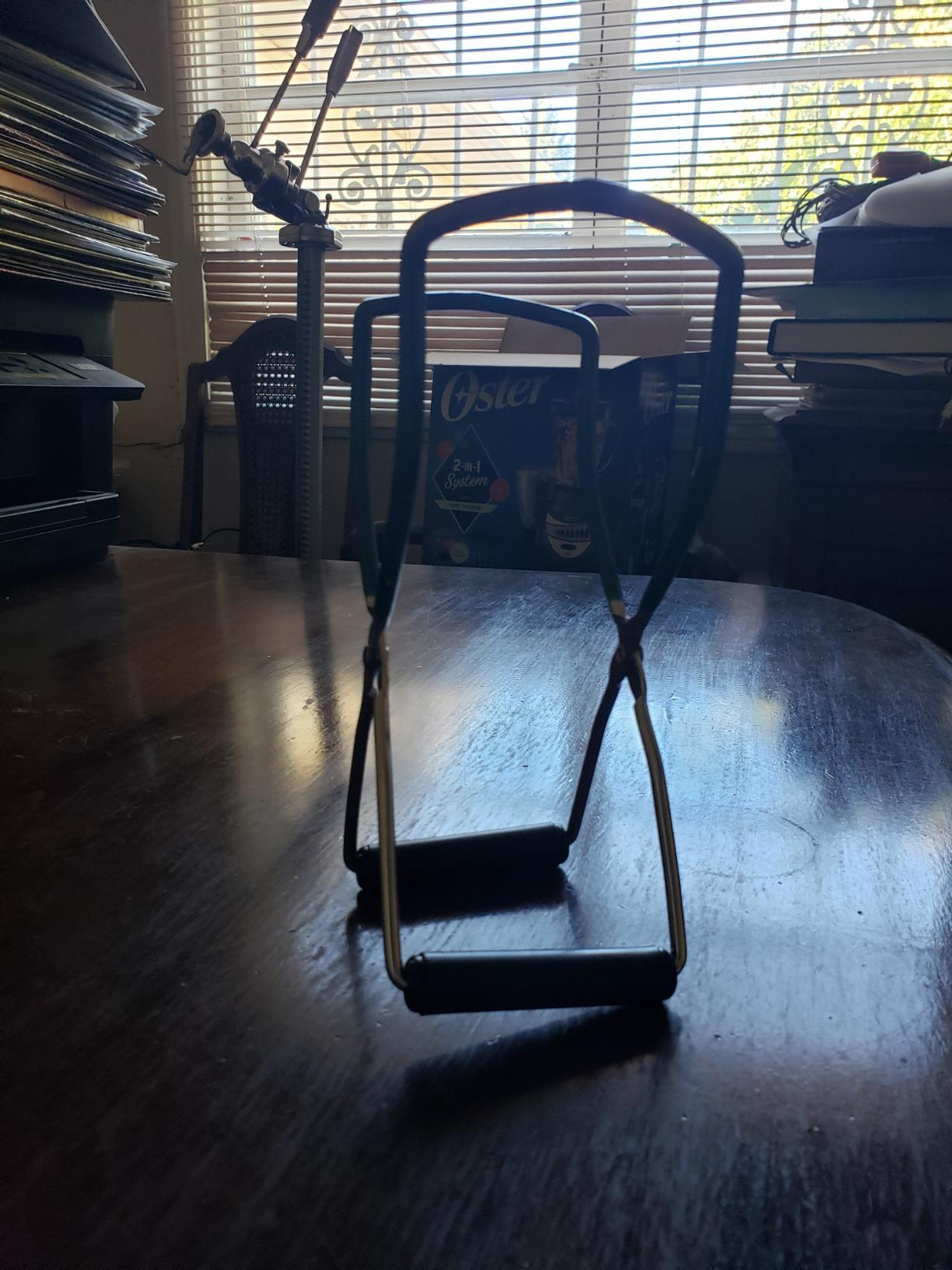
When to choose the Norpro over the other top-lift styles?
Pick it if you can a lot and in mixed sizes, because the switch between a half-pint and a quart is instant. The vinyl coating is also the reason it feels cooler in the hand than a bare steel claw after ten consecutive lifts.
Skip it if you exclusively use Weck clip-top jars, since the top grip is designed around a screw-band jar shoulder. It is also the tool most worth buying in a pair if you can with a partner, since it is a two-handed operation.
What we wish it did better?
The frame is stainless steel, but the grip surfaces are vinyl, and vinyl is the weak point in any tool that lives in boiling water. If you put it away dry and rinse it after each batch you will get years of service. If you leave it submerged, expect the coating to age faster.
We would also like a slightly deeper reach for very deep stock pots, though at 8.75 inches it handled every pot we tried without a workaround. For most kitchens, that is not a compromise worth worrying about.
2. EEOYU Canning Jar Lifter Tongs: Best Value for Casual Canners
- Comfort grip handles with a smooth hinge
- Easy to clean and rust resistant
- Fits small jelly jars through large canning jars
- Five color options
- Non-slip grip on wet jars
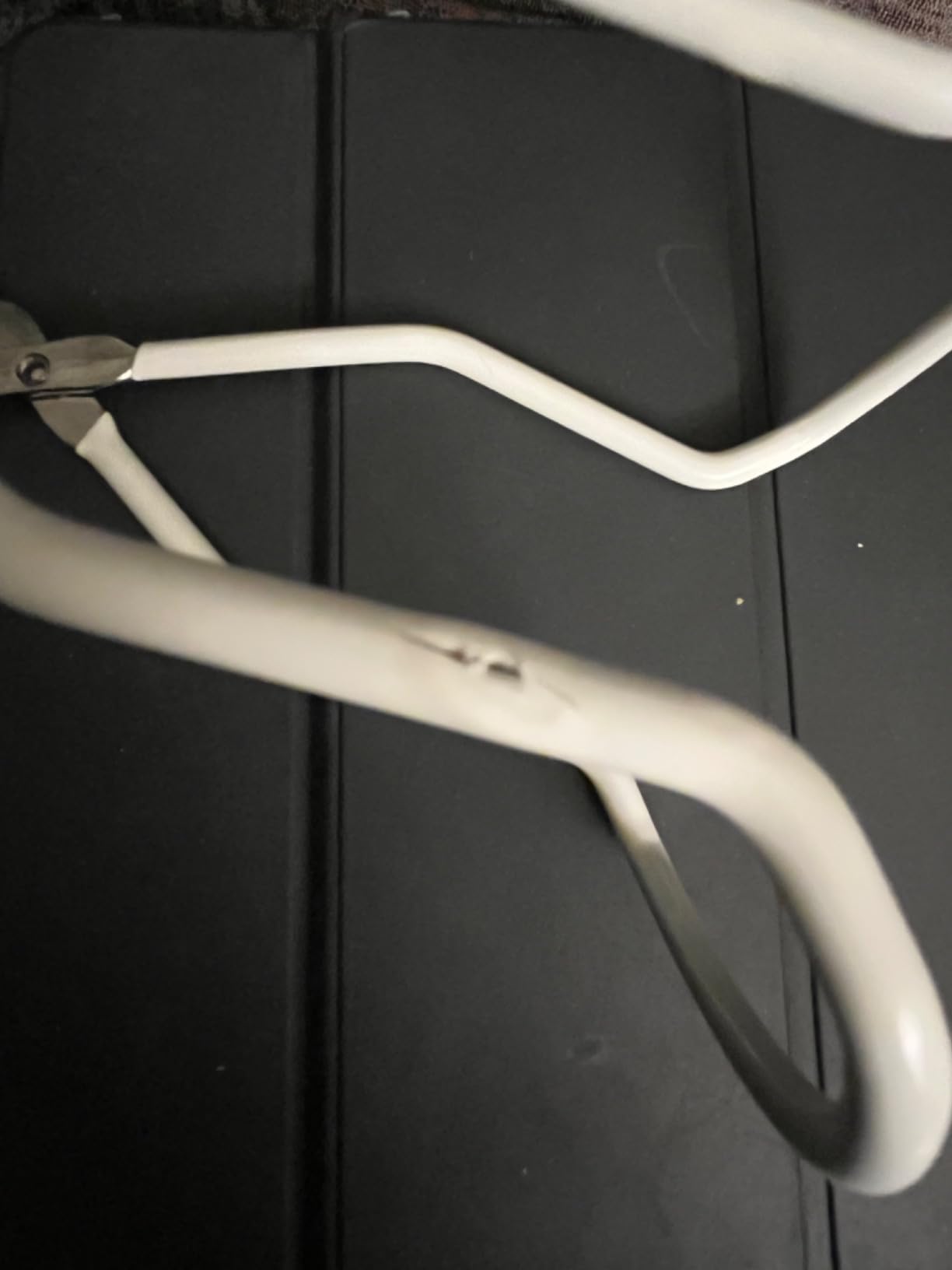
- Grip coating can soften or peel after a few uses in boiling water
- Shorter than some competing lifters which makes deep pots awkward
- Grip coating is thinner than on premium lifters
This is the tong that convinced us a side-grip design can be genuinely good rather than a compromise. It is a scissor-style lifter that pinches the jar body, and at about 8.6 inches by 3.1 inches it covers an unusually wide jar range in a compact tool. The comfortable handles and smooth hinge make it the easiest of the ten to use without thinking about it.
Across a batch of small jelly jars it handled the tiny glass as cleanly as it handled quart jars, which is not something we can say for the narrow-jaw designs. The non-slip grip held wet glass reliably once the hinge was broken in, which takes about two jars.
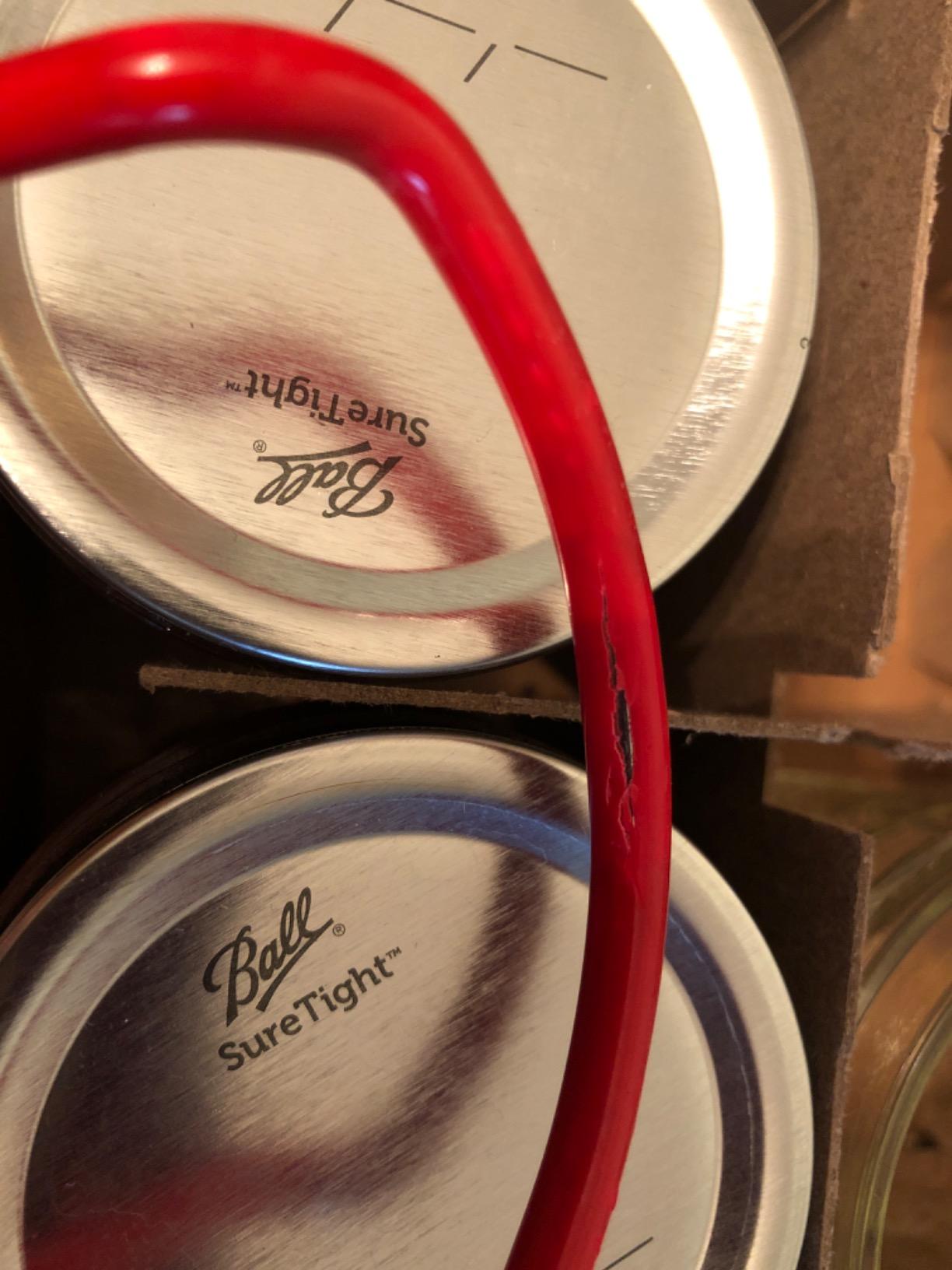
The honest problem is the coating. Reviewers report the vinyl grip softening or peeling after only a couple of exposures to boiling water, and about 79% of ratings are five stars, which is a step below the leaders. It is still a strong tool for someone canning a dozen jars a year, where the lifter lives in a drawer between uses.
For a high-volume canner, this one ages faster than the top-lift designs on this list. Treat it as a seasonal tool rather than a lifetime one, and dry it thoroughly after washing.
Why side-grip tongs earn their place?
Body-gripping changes what fits. A top-lift claw needs a jar shoulder to catch, and small jelly jars do not always give it one. A side-grip squeezes the body, so it works on shapes a claw cannot reach. If your canning is mostly jams, jellies, or 4-ounce gift jars, that is a real advantage.
The second advantage is visibility. Pinching from the sides lets you see the jar while you lift, which matters when the pot is full and you are angling around other jars.
Where it falls short?
Thin coating and short reach are the two weaknesses, and both are real. In a deep stock pot used for tall batches, 8.6 inches is tight, and you will find yourself working around the rim more than you would like.
The trade is simple. If you can occasionally and want a comfortable tool, this is a good buy. If you process weekly through autumn, spend the extra and get a top-lift design with a coated frame that will not degrade.
3. Kitchen Crop Jar Lifter: The Only Pick With a Five-Year Warranty
- Sturdy reliable hold on hot jars
- Lightweight but stable in the hand
- Backed by a 5-year warranty
- Thick rubber jaws help prevent dropped jars
- Traditional design that works
- Hinge tension is loose so you have to grip harder than you would like
- Rubber jaws are thicker than some buyers expect and take a moment to place
- Printed instructions can be confusing
At 9 inches tall and 2 by 3.25 inches across, this is the longest lifter in the roundup, and that extra length is exactly why it does well in tall pots. It clamps securely on the jar top with thick rubber jaws, and the top-lift design means you are holding the whole tool in one hand rather than fighting a scissor hinge.
The 5-year warranty is the standout detail. It is the only pick in this lineup that carries one, and several reviewers mention buying it specifically to replace a twenty-year-old lifter, which is the strongest possible durability signal in a category where people keep tools for decades.
About 83% of its ratings are five stars. The grip is dependable on hot jars, the body is light at 5.3 ounces, and it handled every jar size we threw at it without adjustment. The same product family also makes a jar wrench and a funnel if you want to build a matching set.
The complaints are consistent and minor: the hinge tension is loose, so you squeeze harder than you might expect, and the thick rubber jaws need a moment to find the right contact point. Neither is a safety issue, but both are noticeable the first time you use it.
Who this is the right pick for?
Choose this if you want the longest reach in the roundup and a written warranty behind the part that actually wears. It is a good match for anyone working in a tall stock pot or a pressure canner with a deep insert, where shorter lifters force you to work at an uncomfortable angle.
It is also the pick for people with limited grip strength, since the top-lift design needs a squeeze and release rather than a sustained pinch. Loosen the hinge expectation and it is an easy tool to learn.
Where it disappoints?
Loose hinge tension is the recurring theme, and it never fully goes away, though most users adapt. The thick jaws that make it secure also make it slower to seat on a jar than a slim claw.
The included instructions are the weakest part of an otherwise solid product, so plan on learning the grip by feel rather than by reading. That took us about three jars.
4. Rainspire Heavy Duty Canning Tongs: The Highest Rated Lifter We Tested
- Sturdy stainless build that holds wet glass without slipping
- Highest average rating in the lineup
- Non-slip handle gives good control
- Compact enough to store in a kitchen drawer
- Three color options
- Runs smaller than some buyers expected from the photos
- Strictly a single-purpose seasonal tool
This is the highest average rating in the entire roundup at 4.8, with about 85% of ratings at five stars and essentially no one-star reviews. It is a stainless steel top-lift lifter at 8.75 inches by 3 inches, and it is simply the standard jar lifter design executed without a weak point.
During testing it held wet glass better than anything else in the lineup. The clamp grabs the jar top cleanly, the non-slip handle stays controllable through a long batch, and there is no vinyl coating to soften or peel, which is the single most common durability complaint across this category.
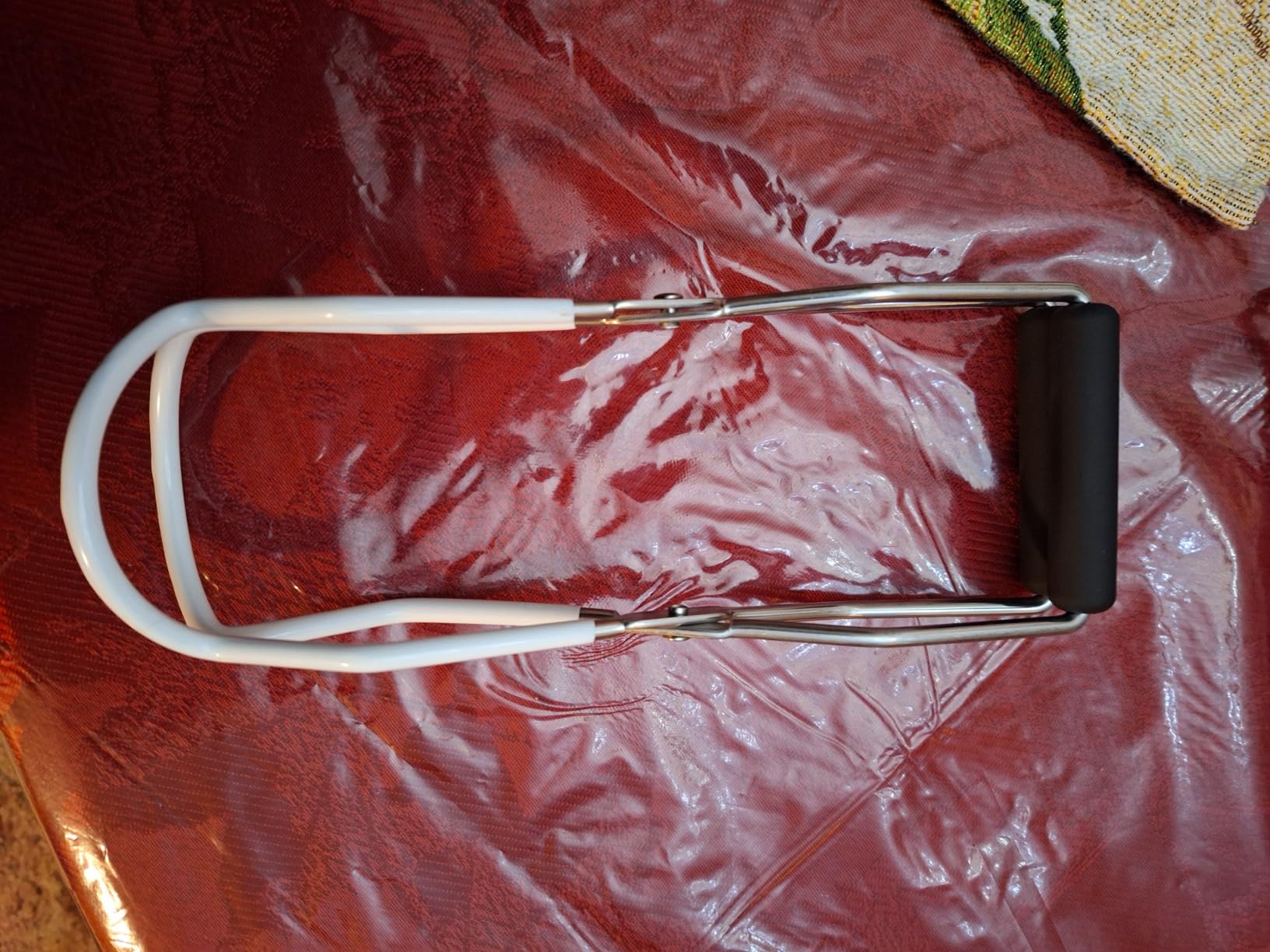
It also works with virtually all jar sizes, so you are not changing tools between a batch of small fruit preserves and a batch of quart green beans. At 0.19 kg it is substantial without being unwieldy, and it slides into a kitchen drawer rather than needing its own storage.
The one consistent note is that the jaw is smaller than some buyers expected when they looked at the photos. The listed measurements are accurate, but set your expectation on the actual numbers rather than the imagery. As a seasonal tool it does one job, which is also a strength: nothing to learn, nothing to break.
Why the bare steel construction matters?
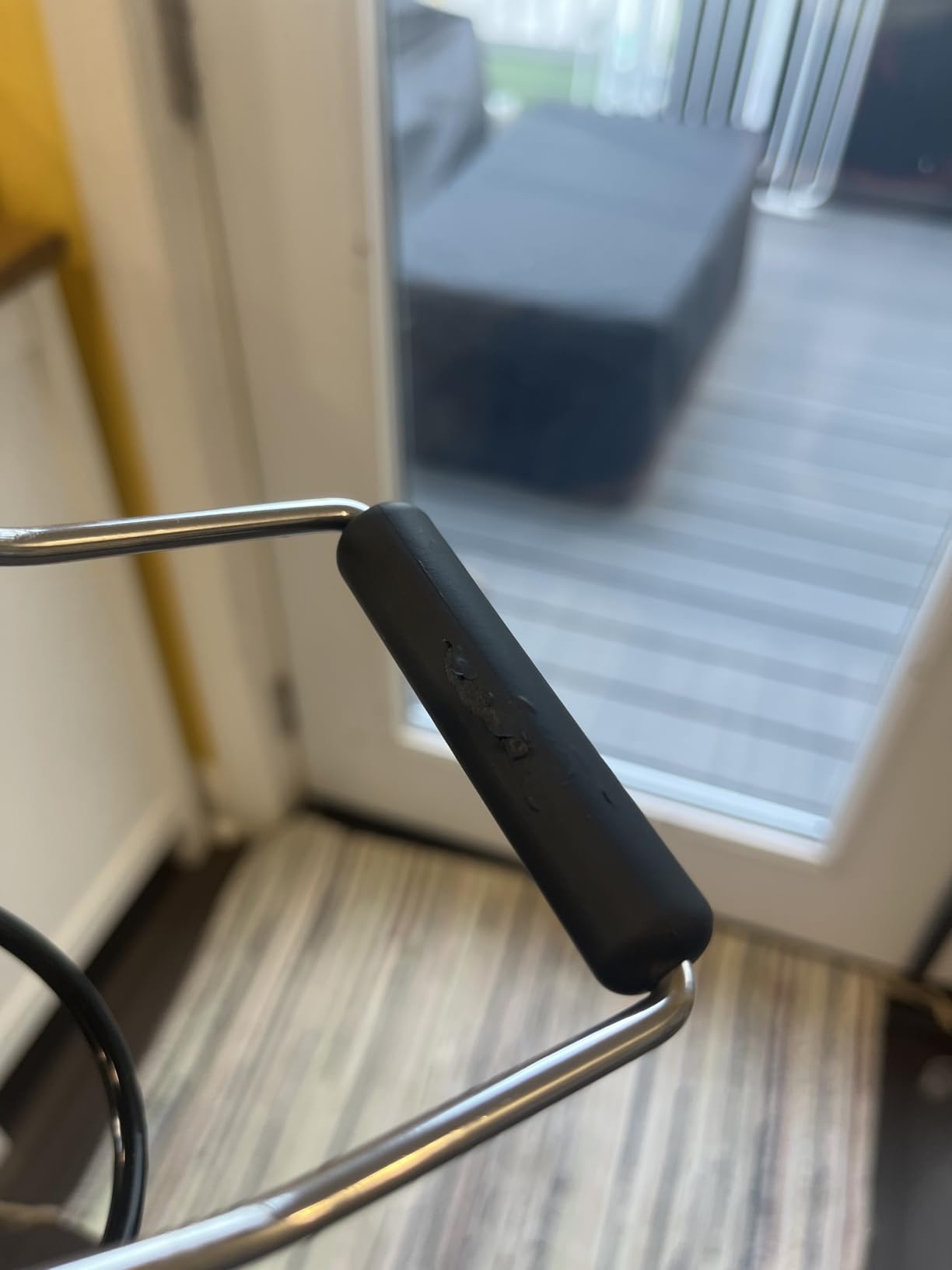
There is no coating to fail. Every lifter in this roundup that uses a vinyl or rubber grip has at least some reviews describing that grip softening in boiling water, and this one simply does not have that failure mode. For a tool that lives in a pot of 212F water, that is worth more than a softer hand feel.
The trade is that bare steel conducts heat to your hand faster than a coated handle. In practice that has not been an issue at these lengths, but if you are doing very large batches back to back, a coated model may feel nicer.
Where it does not win?
At 812 reviews it has a solid but not deep base, and the top rating is the kind of figure that can shift as more reviews come in. The jaw size is the practical limit, so measure your largest jar before committing if you work with wide mouth glass.
It is also unremarkable in the sense that there is no specialty feature. It is a very good jar lifter, not a multi-tool, and buyers who want one device for jars and lids will be disappointed.
5. Mrs. Anderson’s Baking Jar Lifter Tongs: Widest Opening in the Roundup
Mrs. Anderson’s Baking Canning Jar Lifter Tongs for Pressure Canner and Water Bath Canning, Fits all Canning Jar Sizes
- Contoured non-slip coating hugs jars securely
- Works for both pressure and water bath canning
- Comfort grip handles with a smooth hinge
- Fits all canning jar sizes
- Long production history
- Plastic coated jaws are less heat durable than an all-metal lifter over time
- Must be hand washed rather than dishwasher cleaned
The number that matters here is 5.75 inches, which is how far the jaws open. That is the widest reach of any lifter in this roundup, and it is why this is the one to buy if you move between regular mouth and wide mouth jars in the same season. The contoured non-slip coating hugs the jar body rather than hooking the top, so it grips large jars a narrower claw would bounce off.
It is also the only pick here that is explicitly built and described for both canning methods, water bath and pressure canning. If you process low-acid vegetables in a pressure canner, having a tool the manufacturer clearly intends for that job removes a layer of doubt.
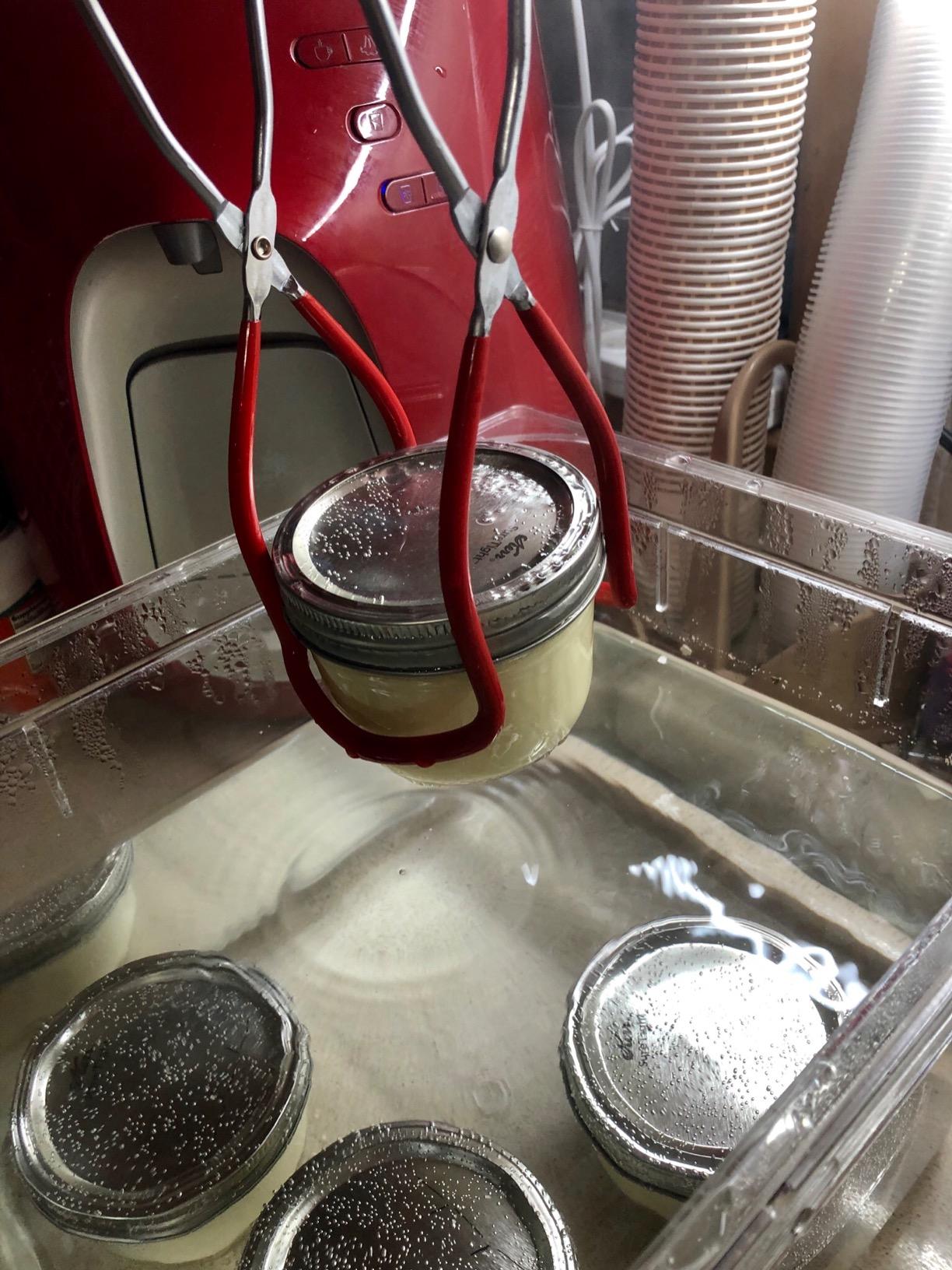
At 8.75 inches when closed it is full length rather than stubby, and the comfort-grip handles with a smooth hinge make long batches easier. About 81% of its ratings are five stars, and it is a well-established name in home canning with a long production record. Cleaning is hand wash in warm soapy water, which is the care instruction on the listing.
The coating is the trade-off. Because the jaws are contoured plastic over a steel core, they are not as heat-durable over long-term use as an all-metal lifter, and they cannot go in the dishwasher. For seasonal use on a mixed jar collection, the versatility wins.
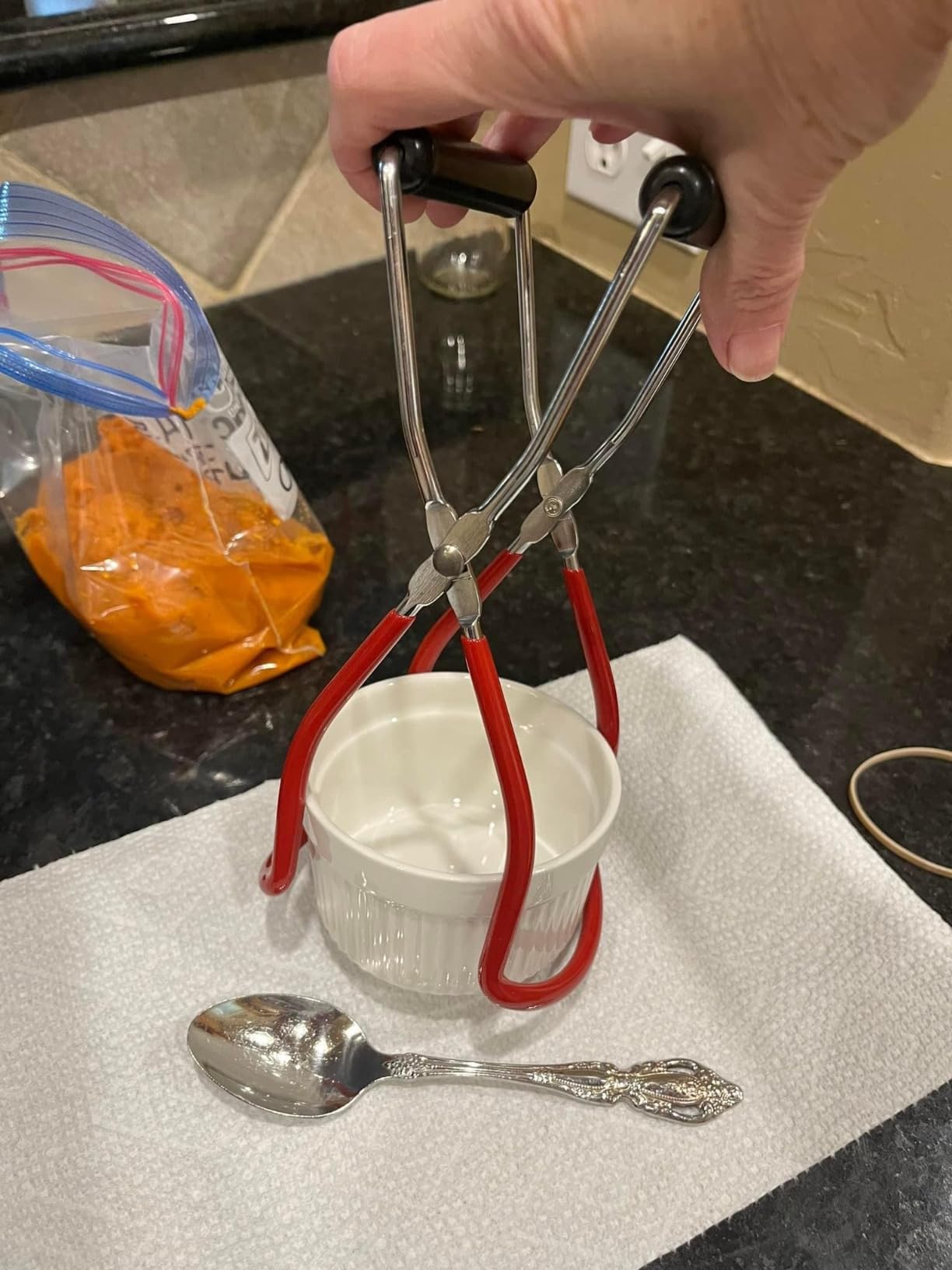
When a wide opening changes the outcome?
If you have ever pinched a wide mouth jar with a narrow tong and watched it squirt boiling liquid over your forearm, you already understand this. A 5.75 inch opening takes the guesswork out of whether the tool will fit, and it fits all canning jar sizes according to the manufacturer.
The contoured body grip also means it stays secure on a jar that is still wet from the processing water, which is where top-lift claws sometimes ride up onto the lid rim.
Where the design costs you?
Coated jaws are a durability compromise in a tool whose whole job is heat exposure. The plastic will outlast the steel core, but it will not last forever in a rolling boil.
The hand-wash requirement is minor but real if you like to throw canning gear in the dishwasher. Plan to rinse and dry these right after the batch, because moisture sitting in the hinge is what ages the coating fastest.
6. Oriflame Jar Lifter Tongs: Comfortable for a Full Batch
Canning Jar Lifter Tongs – Stainless Steel Jar Lifter with Rubber Grips
- Food grade stainless body that resists rusting
- Rubberized jaws grip jars securely with no dropping
- Usable by either dominant hand
- Easy to clean because you never touch the jar
- Handles a full batch of hot jars
- Handles are narrow and feel awkward to hold at first
- Some buyers describe the materials as cheaply made
- Rubberized grip section takes a few tries to learn
At 8.8 inches by 3.15 inches, this is one of the longer tongs here, and the food grade stainless steel body is coated in vinyl so it resists rusting even if you rinse it and leave it wet. The rubberized jaws held every jar securely in our testing with no drops, and about 83% of ratings are five stars.
The detail we appreciated most is that the jaws never touch you. You grip the tool, the tool grips the jar, and the boiling glass never comes near your hand at any point in the transfer. Reviewers mention upgrading from inherited tongs that were too narrow to hold a jar safely, which is the exact failure this fixes.
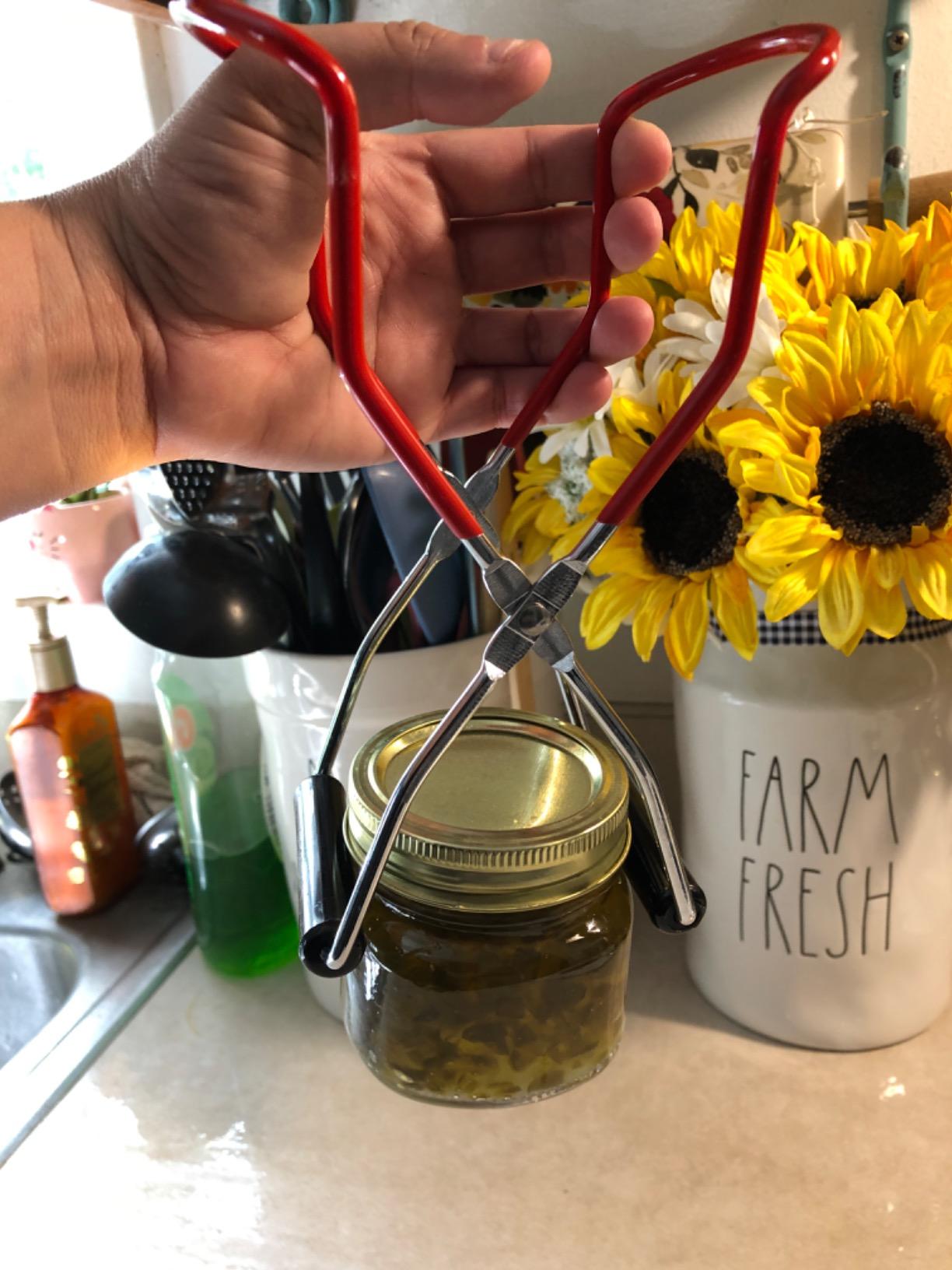
It works equally well for either dominant hand, and the non-slip surface is easy to control once you get used to it. It handled a full batch of hot jars in one session without the grip weakening, which is the test that separates a tool for one jar from a tool for a canning afternoon.
Most buyers adapt to the narrow handles after a few uses, but it is a real adjustment and worth knowing about. A handful of reviewers describe the materials as cheaply made, so treat the coating as a consumable part of the tool rather than something permanent.
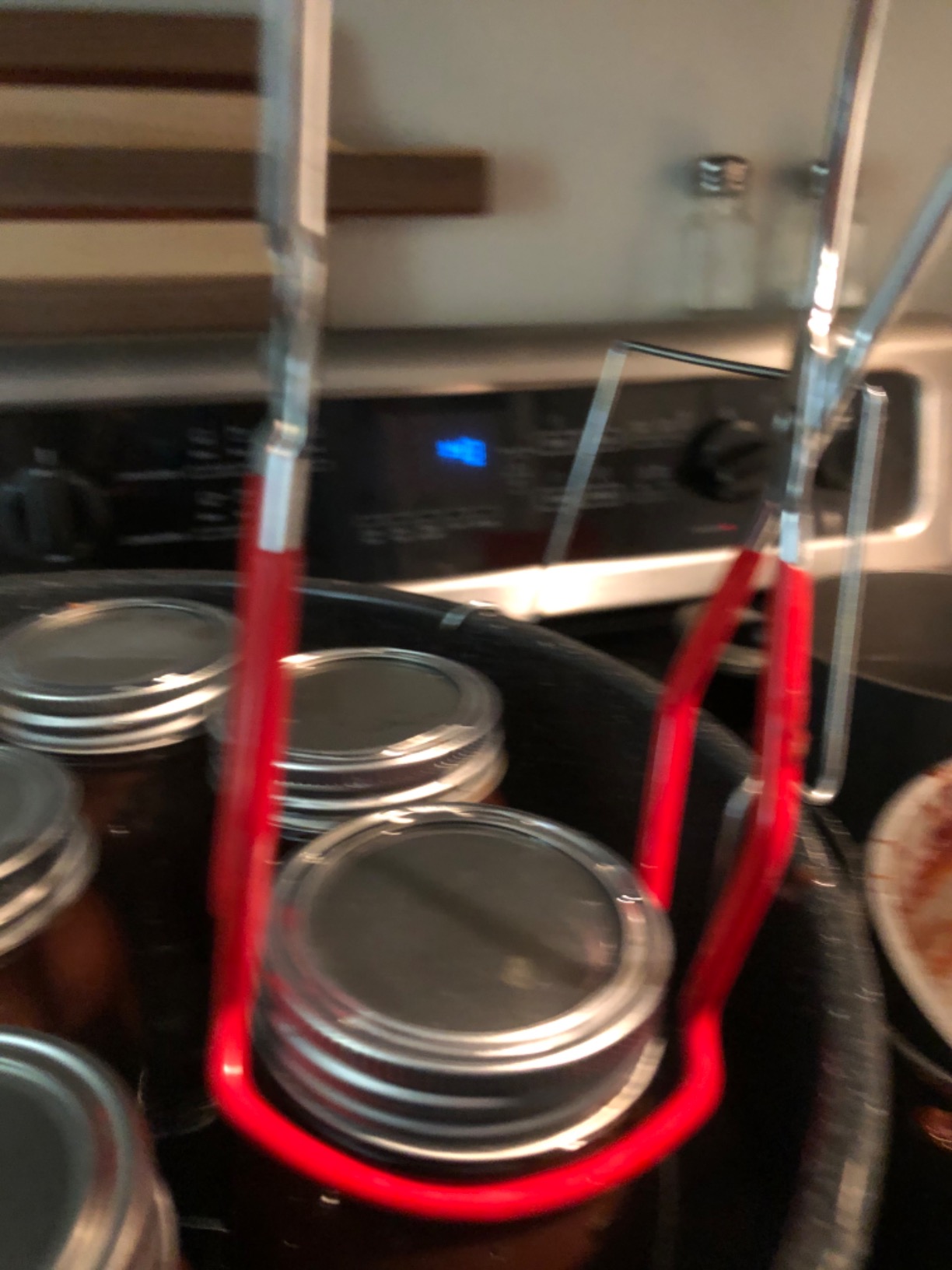
Why the full-batch claim holds up?
Doing a full batch means dozens of consecutive lifts with a wet tool in a steamy kitchen. Handles that feel comfortable on lift three often turn punishing by lift twenty, and the narrow profile here is where that shows. It stays workable, but a contoured handle would be better.
What does not degrade is the grip. Rubberized jaws keep their bite on a wet jar over a long session, which is the property that matters most when you are tired and the pot is full.
Where it does not win?
There is no warranty, which matters for a tool people expect to keep for years. The vinyl coating is also the part most likely to need replacing eventually, and that is the same weakness shared by most of the coated designs in this roundup.
If you can small batches a few times a year, this is plenty. If you are processing weekly, look at the uncoated stainless steel models instead.
7. C CRYSTAL LEMON Jar Lifter Tongs: Best Budget Pick for Wide Mouth Glass
- Lowest cost option with solid stainless steel construction
- Grips both regular mouth and wide mouth mason jars
- Rubberized ends improve grip and protect lid rims
- Also good for hot jar work beyond canning
- Stable balanced feel
- Cannot be operated one-handed and needs both hands for the jaws
- Wide mouth jars require a noticeably tighter squeeze
- Some users find it uncomfortable for extended batches
This is the one to look at if your jars are wide mouth. It is the only low-cost option in the roundup that explicitly grips both regular mouth and wide mouth mason jars, and the rubberized ends sit on the jar body rather than the neck, so the wider shoulder is not a problem.
It weighs 118 grams, which is the lightest handling of the bare stainless designs here, and the balanced handle feels stable on a small jelly jar right up to a full pint. About 82% of ratings are five stars, and reviewers are routinely surprised by the material quality for the money.
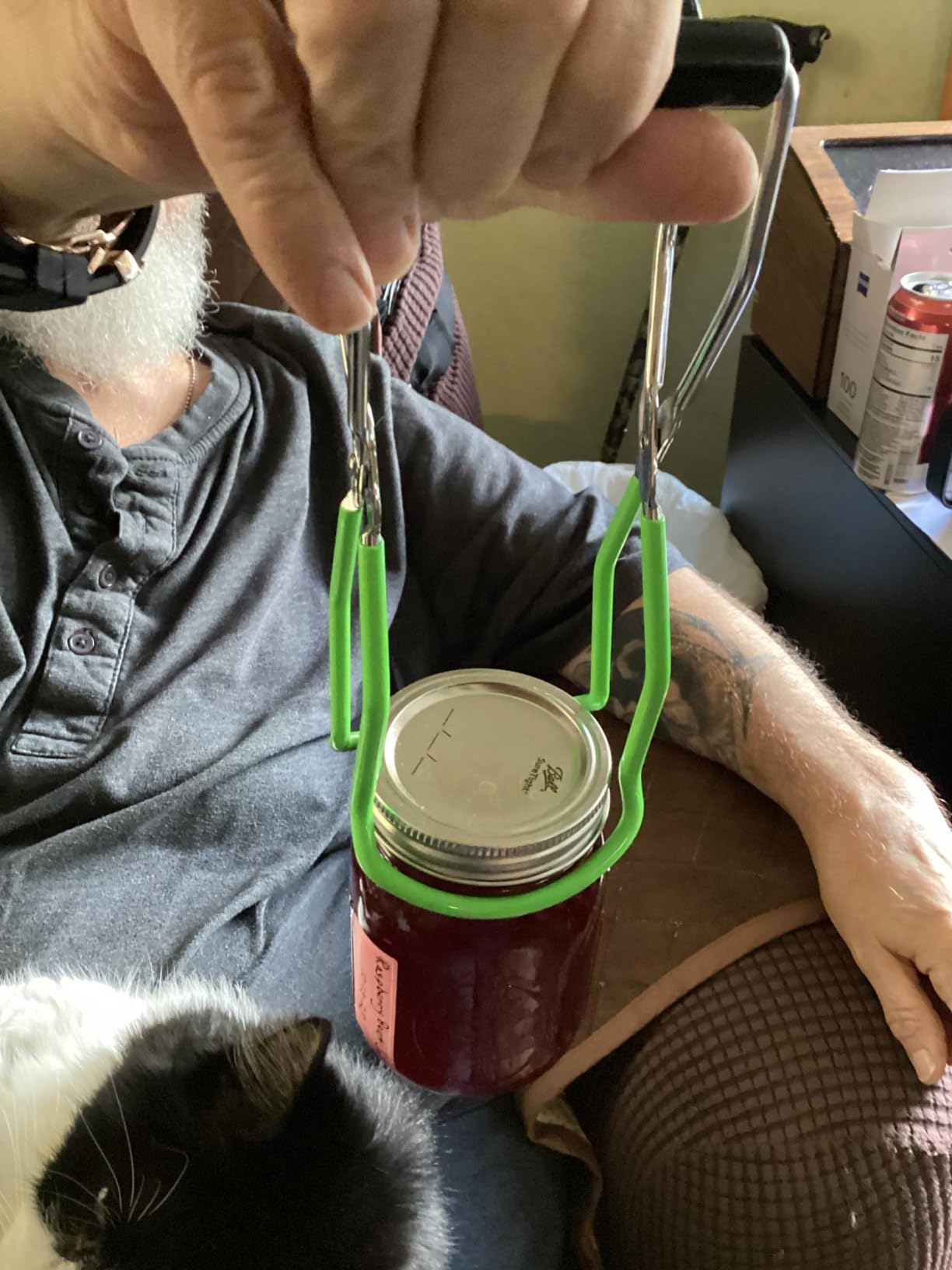
Two things it does that most canning tools do not. The rubberized ends protect the lid rim from denting, which matters if you care about how the finished jar looks on a shelf. And the same grip works for non-canning hot jar work like maple syrup or yogurt jars, so it earns its drawer space even in months when you do not can anything.
The consistent caveat is that it needs two hands to open the jaws wide enough, and wide mouth jars take a noticeably tighter squeeze. For extended batches, some users find that tiring. Plan on a rest every few jars.
When a budget lifter is the right call?
If you are just starting out and canning a few batches a season, this covers the whole job at the lowest entry point in the roundup. Stainless steel construction means there is no plastic to worry about in a boiling water bath, which is a genuine safety advantage over the plastic lifters that show up in cheap multi-piece kits.
It is also the practical answer for wide mouth canners working on a small budget, where most of the premium units are simply too narrow.
Where it falls short?
Two-handed operation is the deal-breaker for anyone with limited hand strength or mobility. Every other top-lift design in this roundup can be operated with one hand, and if that matters to you, this is the wrong tool.
Comfort over a long session is the other limit. The tighter squeeze wide mouth requires is real, so if you are processing dozens of jars in an afternoon, this will make you tired before it makes you regret the purchase.
8. JIANGLAI Lifter and Funnel Set: Judge It on the Tongs Alone
- Two piece set gives you a lifter and funnel together
- Tongs lift hot jars securely from the pot
- Vinyl coated handles are comfortable and non-slip
- Dishwasher safe and easy to clean
- Sturdy enough for full jars of pickled vegetables
- Included funnel opening is far too narrow and near useless for standard canning
- Handle grips are thin and some arrive partially detached
- One review reports the handle bar does not run the full length
Let us be direct about this one. The set combines a canning jar lifter and a wide mouth canning funnel in a single purchase, which is an appealing idea on paper, but the funnel is the weak half. The rating is 4.2 with 9% one-star reviews, the lowest in the roundup, and reviewers are nearly unanimous about why.
The tongs themselves are fine. The vinyl-coated stainless handles are comfortable and non-slip, the hinge is smooth, and the tongs lift hot jars securely from a boiling pot. They fit wide mouth and regular jars, they are dishwasher safe, and they are sturdy enough for full jars of pickled vegetables.
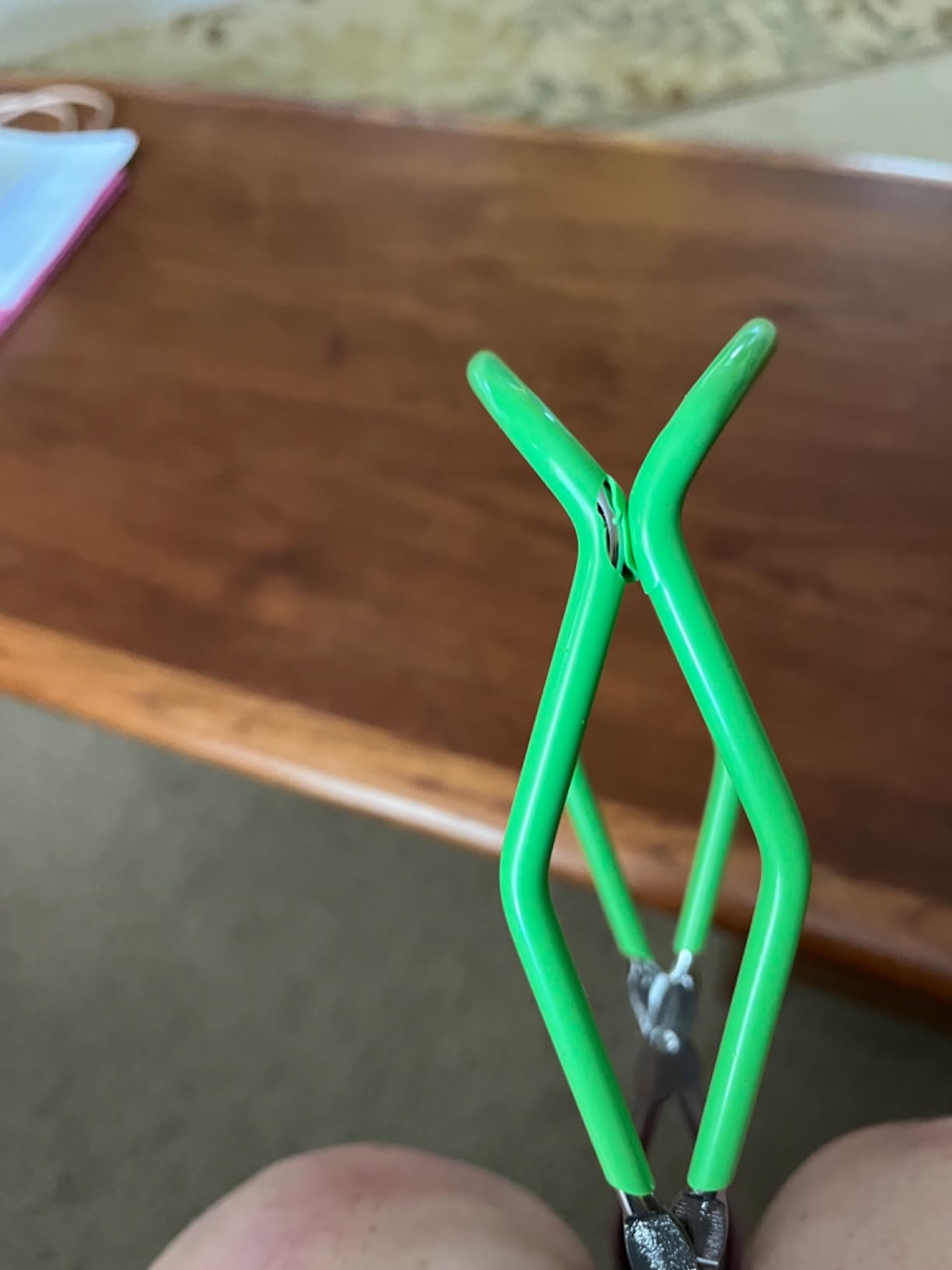
The problem is that the funnel opening is roughly half the diameter of a regular mouth jar. A funnel that only reaches halfway across the opening of a quart jar is not a tool, it is an obstacle, and it will frustrate a beginner who is already second-guessing whether they can handle canning at all.
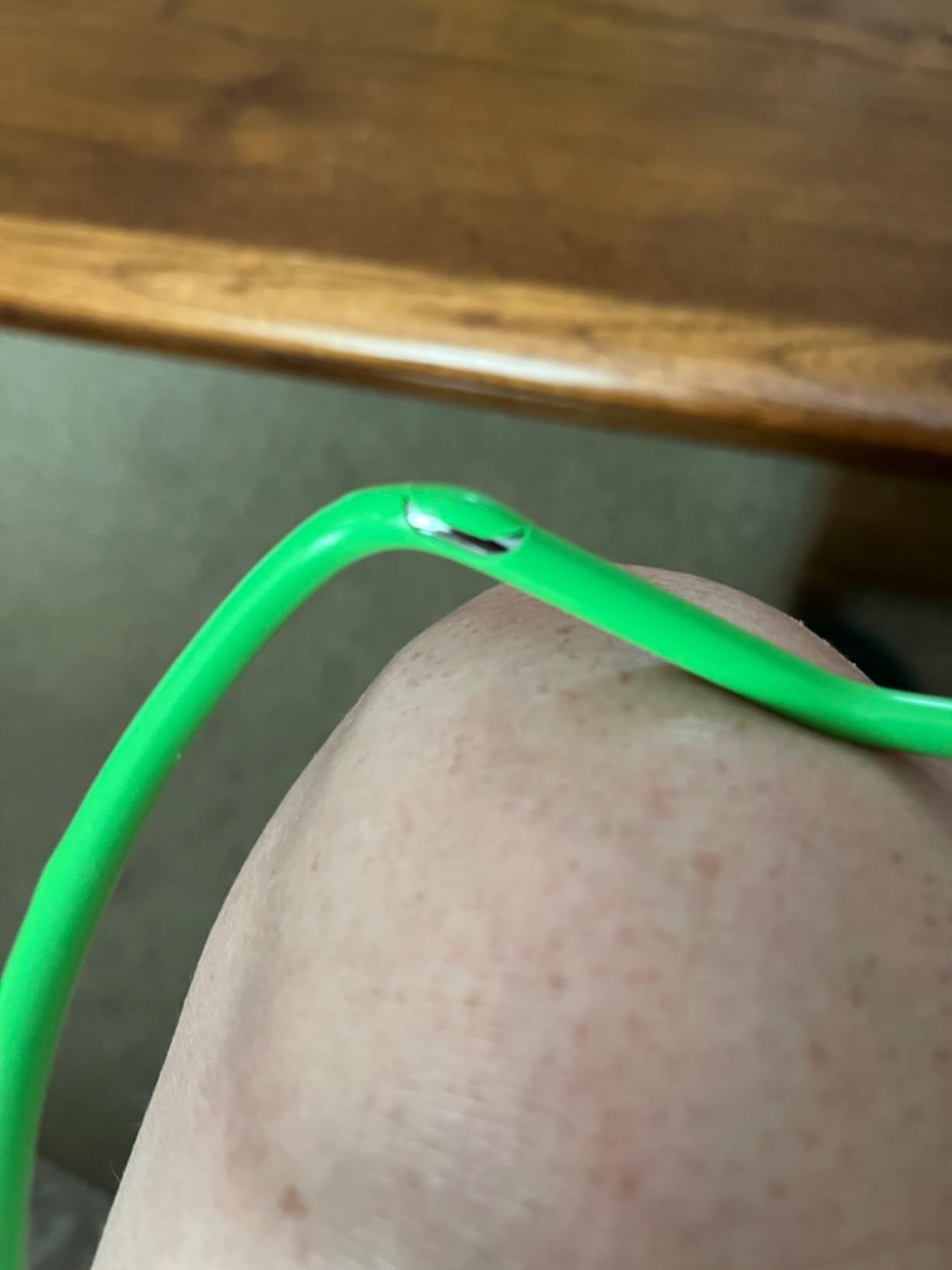
There are also reports of thin handle grips arriving partially detached, and one review noting the handle bar does not run the full length of the tong. Those are manufacturing consistency problems rather than design flaws, but in a tool you use with boiling water, consistency is not a minor concern.
What you are actually buying?
Read this as a two-tool starter purchase with one good half. The tongs are a legitimate budget lifter that will serve a seasonal canner well, and the fact that it is dishwasher safe is a genuine convenience that several all-metal picks cannot offer.
Ignore the funnel. If you want one, buy a proper wide mouth metal funnel separately. Experienced canners on the forums consistently say the metal funnel is the second tool worth owning, and they are right that a good one matters, but this is not that one.
Why we would not start here?
A first purchase should not include a component you will immediately discard. A beginner who tries this set and hates the funnel will likely blame the lifter too, and the 9% one-star share suggests that is exactly what happens.
Buy a standalone lifter and a standalone metal funnel. You will spend a similar amount, end up with two things you will actually use, and skip the disappointment.
9. AUGHOA Jar Lifter Tongs: Riveted Hinges, Widest Color Choice
Canning Jar Lifter Tongs, Stainless Steel Jar Lifter with Rubber Grips, Canning Tools, Canning Supplies for Home Kitchen, Red
- Riveted hinge holds up better than glued or pinned joints
- Gripping jaws hold wet jars without slipping
- Works for either dominant hand
- Five color options to choose from
- Easy to clean after each batch
- Several users wish the handles were longer
- especially for mixed jar sizes
- Hinge can be stiff on arrival
- One report of the tongs falling apart within a day
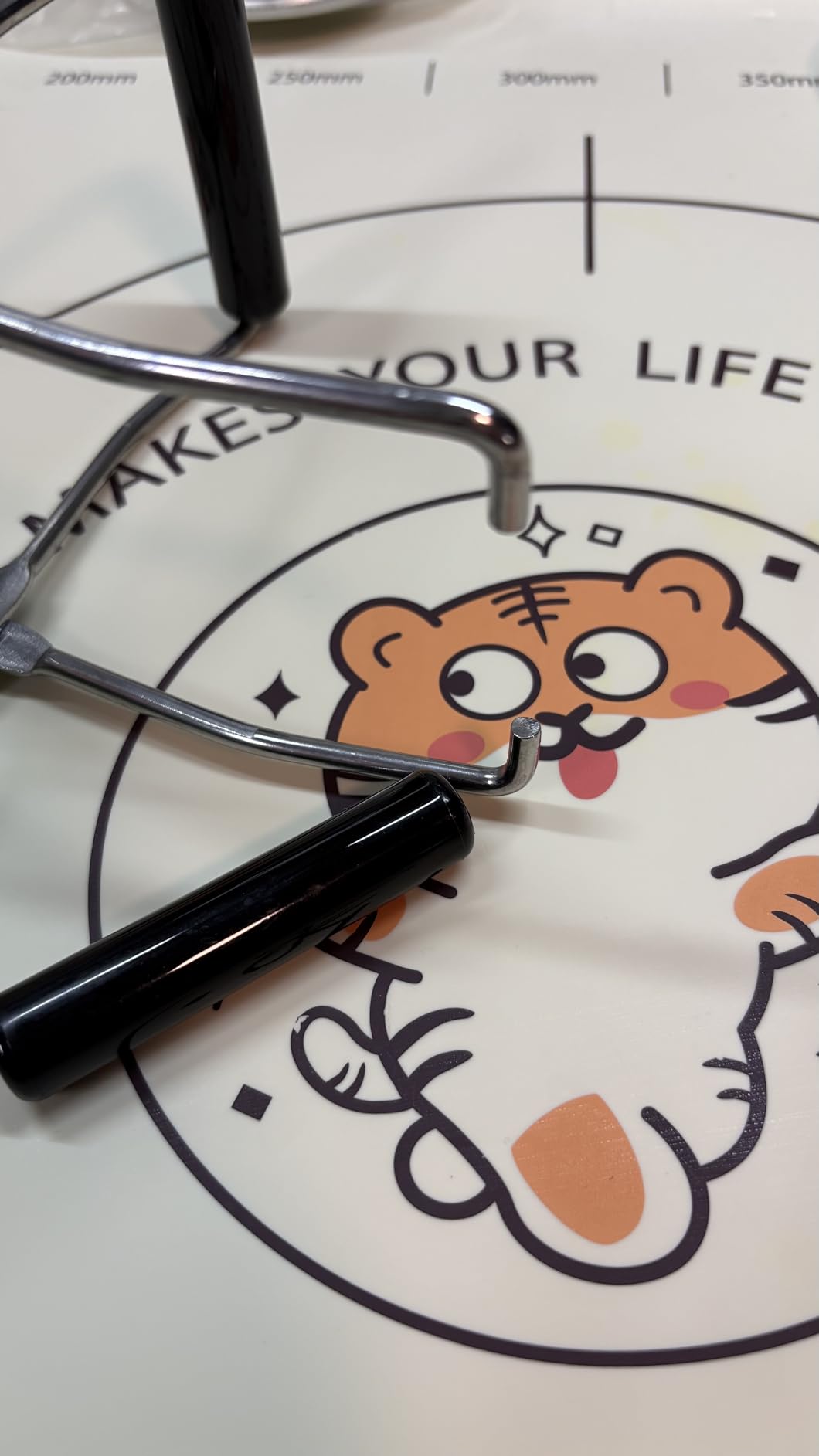
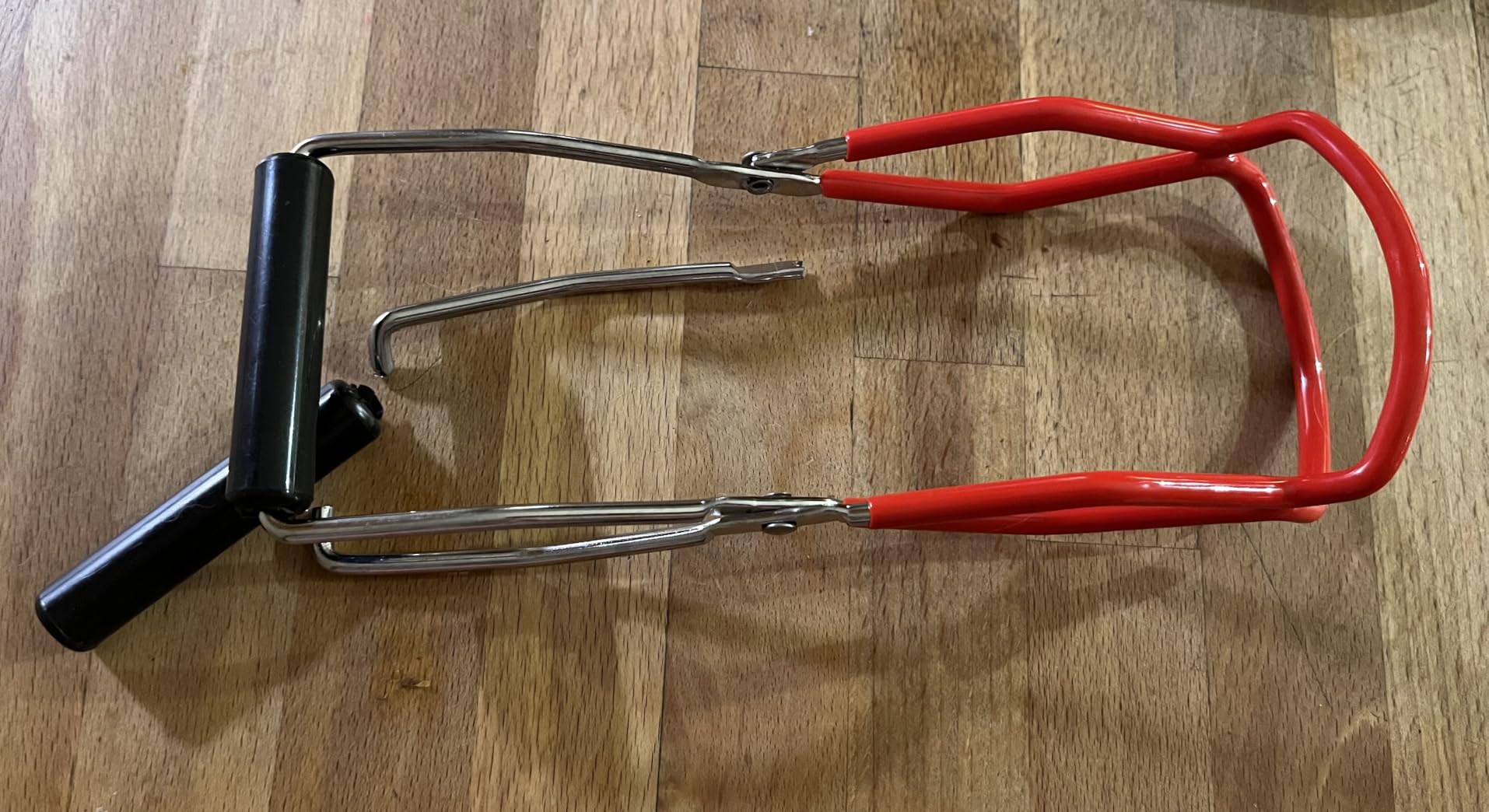
The detail that sets this one apart is the construction of the hinge. It is fixed with rivets rather than glued or pinned, and that is a mechanically stronger joint in a tool that gets opened and closed dozens of times per batch with wet hands. Most of the failures we saw in this category happen at exactly that joint.
It measures about 8.86 inches by 3 inches, works for either dominant hand, and the riveted hinge allows flexible adjustment of the opening angle. The vinyl-coated stainless jaws held wet jars without slipping through our testing, and about 77% of ratings are five stars.
It is also the only pick in the roundup offered in five colors, which sounds trivial until you are trying to find a specific tool in a crowded drawer full of kitchen implements. More usefully, the jaws handle everything from small glass jelly jars to standard and larger canning jars.
The most common complaint is handle length. Several users wish they were longer, particularly when lifting jars out of a tray holding mixed sizes, and the stiff hinge on arrival is a common enough note that a drop of oil before first use is worth doing. One serious outlier report describes the tongs falling apart within a single day of use, which is rare but is the reason we would not make this the only lifter in a household.
Why rivets matter in a wet tool?
Glue fails in heat and water. Pins work loose with repeated flexing. A rivet is a mechanical interference fit, and it is the same reason canning equipment and cookware use riveted handles. For a tool that lives in a pot of boiling water, this is the single most upgradeable detail in the roundup.
You will not notice it on day one. You will notice it in year five, when the coating has worn through and the joint is still tight.
Where it falls short?
Handle length is the practical limit. If you process large batches out of a tray rather than a pot, a longer tool would save you from awkward angling. The stiff hinge is a five-minute fix, not a defect.
Given one serious durability report, buy this as a well-made tool but keep an eye on the hinge the first few times you use it. If you want zero anxiety on that front, choose a design with a warranty behind it.
10. Fox Run Farm to Table Jar Lifter: Best for Regular Mouth Glass
Farm to Table 5645 Canning Jar with Lifter Tongs Steel, 8.75″
- Grips the full jar body rather than just the neck which feels stable
- Soft coated grips reduce slipping on wet glass
- Sturdy handles that hold up over many canning seasons
- Also useful for sterilizing bottles and other hot jar work
- Well reviewed on standard mouth jars
- Does not grip wide mouth jars securely and some buyers buy a second set
- Difficult to grasp a 32 ounce wide mouth jar
- One report of the plastic breaking within a week of very hot water
The concept here is different from every other top-lift design in this roundup. Instead of hooking the jar top, these 8.75 inch tongs grip the full jar body, and reviewers describe the stability of that connection as the reason they keep using the tool season after season. The soft coated grips are what keep it from slipping on wet glass.
Because it grips the body rather than the neck, it works with anything that fits inside the jaws, including standard mouth jars of every size. It is also a genuinely useful tool outside canning, and buyers mention using it to sterilize bottles and other hot glassware.
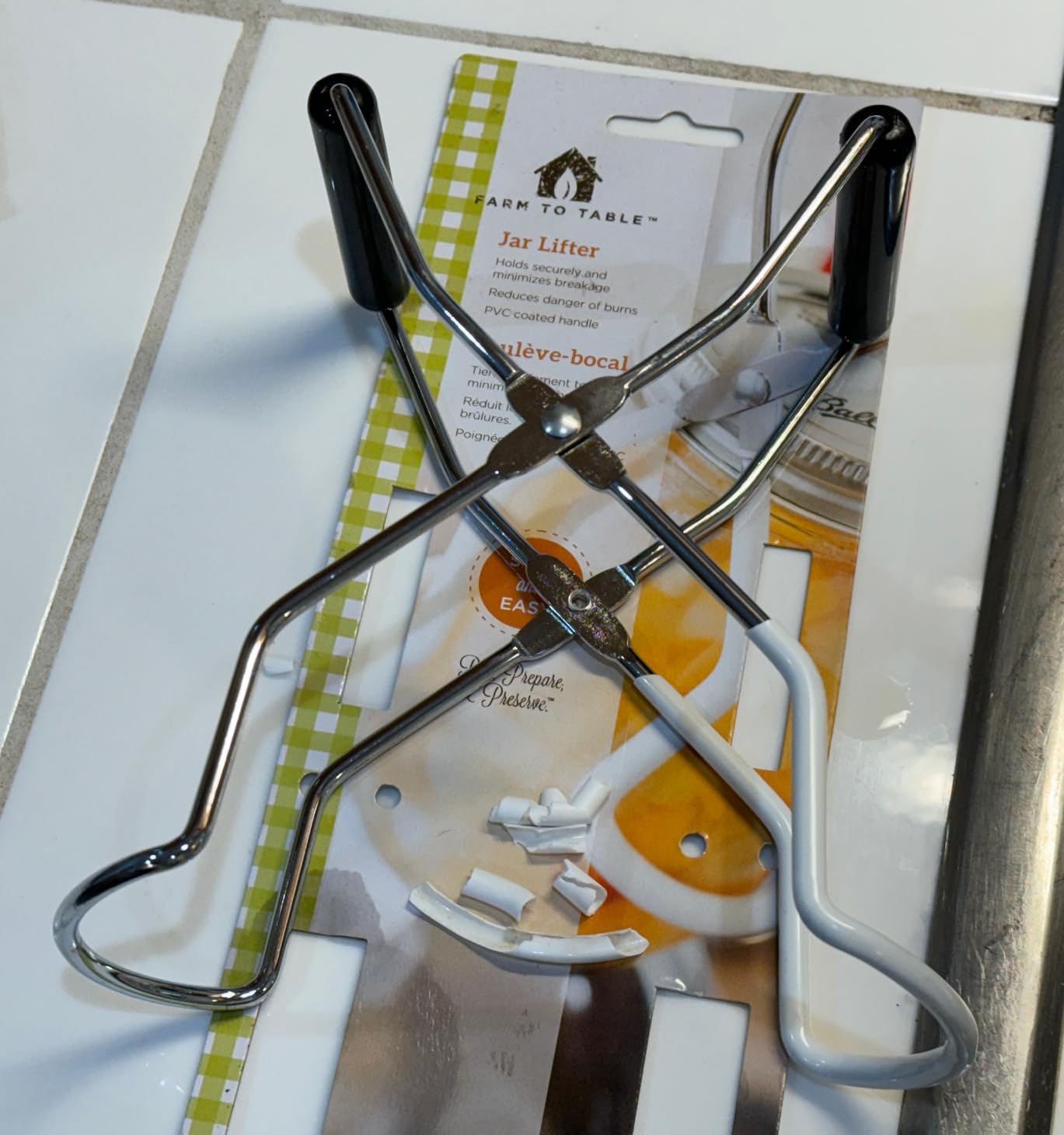
The important limitation is wide mouth. The jaws are sized for standard mouth jars and do not grip wide mouth reliably, and reviewers who later switched to wide mouth jars report having to buy a second set. If a 32 ounce wide mouth jar is part of your canning, check the dimensions before committing.
About 79% of ratings are five stars, and one overseas review reports the plastic breaking within a week of exposure to very hot water. The listing is hand wash only, which is standard care for a coated tool and easy to follow.
Why body grip is a real advantage?
Hooking a jar top means catching a shoulder, and shoulders vary. Gripping the body means you have a continuous surface, which is why this design feels so stable to long-term users. It also handles smaller jars that do not present a usable shoulder to a claw.
The coated grips do the work of protecting the glass, and the coated contact is what keeps a wet jar from squirming during the lift.
Where it does not fit?
Wide mouth jars are the deal-breaker, and it is not a subtle one. If your canning is regular mouth only, this is an excellent tool. If there is any wide mouth glass in your rotation, budget for a second lifter or choose a wider-jaw design instead.
No warranty is listed either, which is worth weighing for a tool you might expect to keep for a decade or more.
How to Choose a Jar Lifter?
Start with your jars, not the brand. Write down whether you can regular mouth, wide mouth, or a mix, and what the largest jar in your rotation actually is. This single step eliminates most of the wrong purchases in this category, because a lifter that does not fit is not a bargain at any price.
Next, pick your grip style. Top-lift claws hook the jar shoulder and are the most common design, easier to operate, and generally better for one-handed use. Side-grip tongs pinch the jar body, work on more shapes including small jelly jars, and suit people who want to see the jar during the lift. Weck owners need a lifter designed for clip-top jars rather than a screw-band tool.
Then think about the handle. Bare stainless steel will not degrade but conducts heat. Vinyl or PVC coated handles feel cooler and are easier to grip wet, but the coating is the part that eventually softens or peels after repeated boiling water exposure. A coated frame like the Norpro balances both, and an uncoated frame like the Rainspire trades hand comfort for a longer service life.
Finally, think about volume. Occasional canners can get away with an inexpensive tool. Anyone processing a full harvest weekend should spend up front on a heavier frame, a wide jaw opening, or a warranty, because the cost of a dropped jar of boiling food far exceeds the difference between tools. The r/Canning consensus is worth following here: buy a good lifter and a metal funnel, skip the fifteen-piece kit.
How to Use a Jar Lifter Safely?
Use it in the same order every time, because the consistency is what keeps you safe when the pot is full and the kitchen is hot.
Open the lifter arm fully before it goes anywhere near the pot. Trying to seat a partly closed claw on a submerged jar is how jars get knocked over.
Lower it straight down between the jars in the rack rather than angling it under a jar from the side. Straight down keeps neighboring jars undisturbed.
Hook the arm under the jar top or close the body grip, whichever your design uses, and confirm the contact before you lift.
Lift straight up slowly. A fast lift is what brings boiling liquid over the rim with it.
Move the jar directly to a towel, a cooling rack, or a prepared space. Do not carry it across the kitchen to reorganize later.
Set the jar down before you relax your grip, and keep the lifter in your hand until the jar is stable.
Dry the tool after washing and store it outside the pot. Moisture sitting in a hinge or against a coating is the main thing that shortens the life of a good lifter.
Common Jar Lifter Mistakes to Avoid
Gripping a jar that is still wet and soapy. Rinse the jar, or dry the outside before you lift, because the soap film is the single most common cause of a jar sliding in a secure-looking grip.
Pinch the shoulder instead of the top. On a top-lift lifter, the grip point should be the jar top, not the curved glass shoulder below it. Pinching the shoulder gives you a rounded surface that wants to roll out of the jaws.
Lifting two jars at once, or trying to catch a second jar while the first is still in the air. If you have dropped a jar of boiling food, this is almost always why. One jar per lift, every time.
Using a narrow-jaw lifter on a wide mouth jar because it looked close enough. The tool does not slip gradually and then recover. It slips fully, immediately, and onto a hot stovetop. Measure first.
Rinsing the lifter and leaving it wet in the sink. Standing water trapped against a vinyl coating or inside a hinge is what turns a soft grip into a peeling one over a few seasons.
Frequently Asked Questions
What is the best jar lifter for canning?
The Norpro Canning Jar Lifter is our top pick. Its vinyl-coated top grip clamps securely on the jar, its non-slip handle stays controllable through long batches, and it works from half-pint through quart size. The Rainspire heavy duty model rates highest at 4.8, and the Kitchen Crop pick is the only one carrying a five-year warranty.
What can I use instead of a jar lifter for canning?
Long-handled kitchen tongs and a canning rack both work in theory. The rack gives you something to hold while you fish jars out, and tongs can pinch a jar body. Neither is safe in a rolling boil, and forum users have documented real burns from splash-back when tongs slipped mid-lift. A rack also cannot move a hot jar to the counter for you.
What is a good lid lifter for canning?
A lid lifter is a different tool from a jar lifter. A magnetic lid lifter picks up flat two-piece lids from hot water using a magnet on the end of a wand, while a jar lifter picks up the jar itself. You can fish lids out by hand, but they are slippery. Home canners usually use a magnetic lid lifter alongside, not instead of, a jar lifter.
What are the best tongs for canning?
The best canning tongs in this roundup are the Norpro, EEOYU, and Rainspire models. Side-grip designs like the EEOYU are better for small jelly jars because they pinch the body rather than hooking a shoulder, while top-lift claws like the Norpro are easier to operate one-handed. Avoid anything plastic in a boiling water bath.
Which is better, wide mouth or regular mouth canning jars?
Both are standard, and the real answer is that your jar choice decides which lifter you need. Most lifters are designed for regular mouth jars. Wide mouth jars need a wider jaw opening or a body-grip design. The Mrs. Anderson’s model opens to 5.75 inches and handles both, and the budget C CRYSTAL LEMON tongs also grip both neck sizes.
Are jar lifters worth it?
Yes. It is the only canning-specific tool that the r/Canning community consistently calls essential, with a metal funnel a close second, and it is inexpensive relative to what it protects. The failure mode is a dropped jar of near-boiling food, which is a burn and a cleanup. All ten tools here are also dishwasher or hand-wash cleanable in a few seconds.
The Best Jar Lifter for Canning Is the One You Keep Reaching For
After working through full batches with all ten, the Norpro Canning Jar Lifter is the one we recommend to anyone asking for the best jar lifters for canning. It has the deepest review base in the category, a vinyl-coated top grip that holds wet glass without riding up onto the lid rim, and coverage from half-pint through quart. It is the tool our team reached for without thinking.
If your jars are wide mouth, change the order. Start with the Mrs. Anderson’s model, whose 5.75 inch opening handles both neck sizes, or the budget C CRYSTAL LEMON tongs if cost matters more. If you can only small jelly jars, the EEOYU side-grip tongs reach shapes a claw cannot. And if you want a written warranty behind the part that wears, the Kitchen Crop pick carries five years.
Whatever you choose, buy steel rather than plastic, check the jaw opening against your largest jar before you order, and skip the fifteen-piece kit. A lifter and a metal funnel will run you through a decade of canning.