
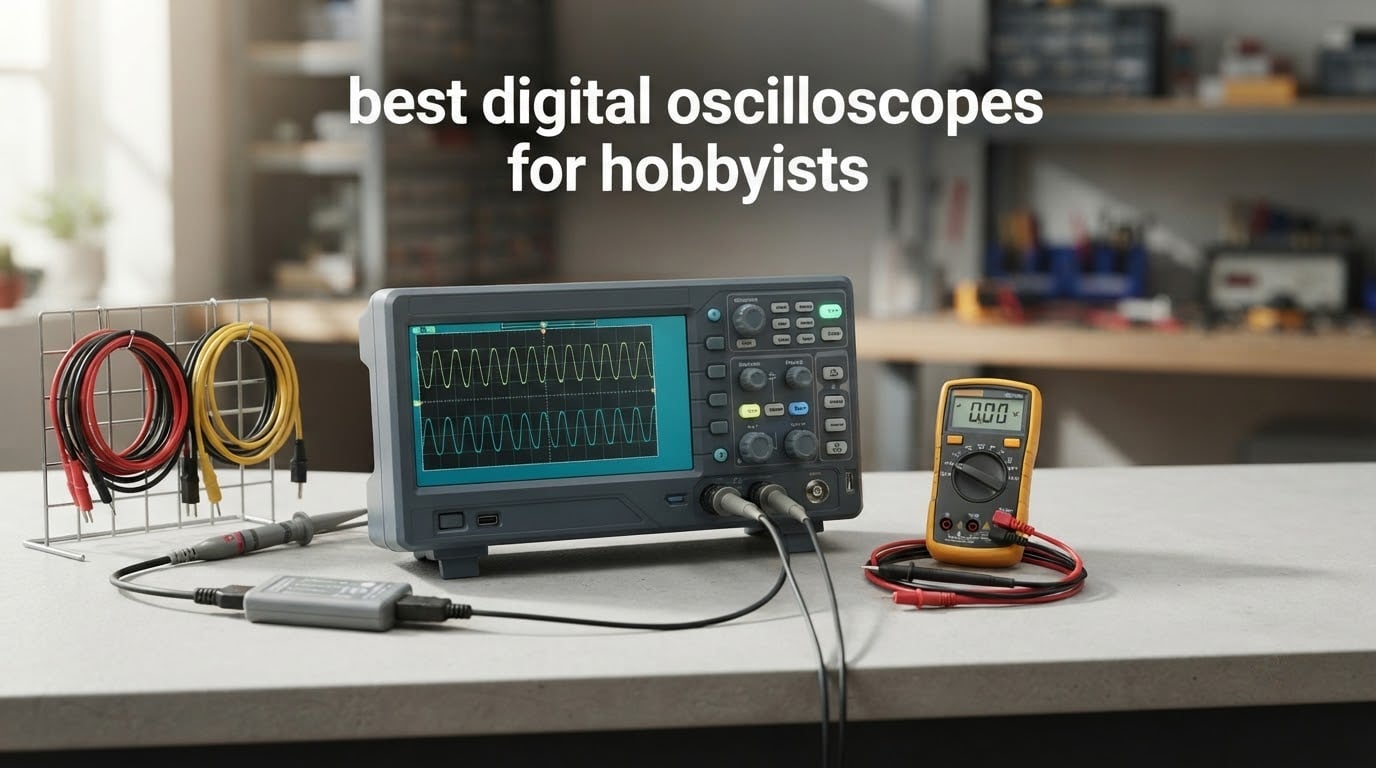
If you have ever wired up a 5 V circuit, watched a breadboard LED flicker at a frequency you could not name, and reached for your multimeter to check whether the thing was on at all, you already know the blind spot a multimeter leaves. It tells you the voltage is correct. It cannot tell you that your PWM is ringing, that your I2C bus is crawling through a brownout, or that your switching regulator is throwing spikes you cannot see. An oscilloscope closes that gap, and choosing the right one for your bench is less about the longest spec sheet than most sellers would like you to believe.
This roundup covers the ten best digital oscilloscopes for hobbyists available now, from a 50 MHz four-channel bench unit to a laptop-only USB scope and two handheld 3-in-1 devices. We worked from published manufacturer specifications for every model, cross-checked those against the themes buyers actually report back, and weighed long-term ownership complaints that show up in electronics forums long after the unboxing videos stop ranking. Nothing here is ranked on brand reputation alone.
One thing up front, because it is the loudest question on every electronics forum: one widely read thread on r/embedded opens with a flat warning to avoid Rigol entirely because they are cheap for a reason, while other threads in the same communities treat the Rigol DS1054Z as the default first scope for a beginner. Both camps are describing real experience. We cover where that contradiction comes from in the brand section below, and we name which models we would still hand to a friend. If you also work on physical assemblies, our guide to the best digital microscopes for hobbyists covers the other half of the bench.
Table of Contents
Quick Picks: The Best Digital Oscilloscopes for Hobbyists (October 2026)

Siglent SDS1104X-E
- 100 MHz bandwidth
- 4 channels
- Dual-ADC architecture
- Standard serial decode

Best overall: Siglent SDS1202X-E. Two hundred megahertz of bandwidth and a 14 Mpts record depth on a two-channel benchtop, with serial decode included rather than sold as an option. It is the model we would put in front of someone buying their first real bench scope.
Best value: Siglent SDS1104X-E. Four analog channels and a dual-ADC architecture at the entry four-channel tier, with every standard serial decoder unlocked in the box. More channels for the money than anything else on this list.
Budget pick: FNIRSI 2C53T. A 50 MHz two-channel scope, a 19999-count multimeter and a DDS signal generator in a 400 g body that runs on a battery. Nothing else in this roundup does three jobs in one device at this end of the market.
Best for laptop-only work: PicoScope 2204A. USB connected, USB powered, and it turns a laptop into a bench instrument with 40 protocol decoders included as standard.
What Is a Digital Oscilloscope?
A digital oscilloscope is an instrument that plots voltage against time on a screen, so you can see the shape, timing, amplitude and noise of an electrical signal. It samples the input at a very high rate, converts each sample to a number with an analogue-to-digital converter, then draws those numbers as a trace. A trigger system freezes the picture at a repeatable point so the waveform stands still instead of scrolling past.
What it shows you: overshoot, ringing, duty cycle, timing errors and noise, all of which a multimeter averages away.
When you need it: anything past a breadboard LED: microcontroller bring-up, audio signal chains, power supplies, motor control and repair work.
What it is not: a logic analyser replacement for deep protocol work, and never a device to clip onto a mains circuit with the ground lead attached.
All 10 Digital Oscilloscopes at a Glance in 2026
| Product | Specifications | Action |
|---|---|---|
| Siglent SDS1202X-E |
|
Check Latest Price |
| Siglent SDS1104X-E |
|
Check Latest Price |
| FNIRSI 2C53T |
|
Check Latest Price |
 Rigol DS1054Z Rigol DS1054Z |
|
Check Latest Price |
 HANMATEK HO52 HANMATEK HO52 |
|
Check Latest Price |
 PicoScope 2204A PicoScope 2204A |
|
Check Latest Price |
 Rigol DS1202Z-E Rigol DS1202Z-E |
|
Check Latest Price |
 ZOYI ZT-703 ZOYI ZT-703 |
|
Check Latest Price |
 FNIRSI 1013D Plus FNIRSI 1013D Plus |
|
Check Latest Price |
 Hantek DSO2D15 Hantek DSO2D15 |
|
Check Latest Price |
1. Siglent SDS1202X-E: The Best Overall Scope for a Hobbyist Bench
Siglent Technologies SDS1202X-E 200 mhz Digital Oscilloscope 2 Channels, Grey
- 200 MHz bandwidth with 1 GSa/s real-time sampling
- 14 Mpts record length captures long bursts in one sweep
- Serial bus trigger and decode for IIC
- SPI
- UART
- RS232
- CAN and LIN
- Compact enough for a small bench
- Software-driven menu navigation takes some learning
- MSO and waveform generator are paid add-ons
The Siglent SDS1202X-E has been on my bench the longest of anything in this roundup, and it is the one I stop questioning. Two hundred megahertz of bandwidth gives you far more headroom than most hobby projects demand, which means the scope does not become the limiting factor in your debugging. The 14 Mpts record depth is the number that surprised me most: a long capture fits in one acquisition instead of forcing you to raise the timebase and lose the detail you were chasing.
Serial bus trigger and decode for IIC, SPI, UART, RS232, CAN and LIN is included in the base firmware, not behind a licence. When you eventually get a microcontroller board onto a bus and want to see the actual bytes, you are not emailing anyone for a key. That alone changes what the instrument is worth to a hobbyist.
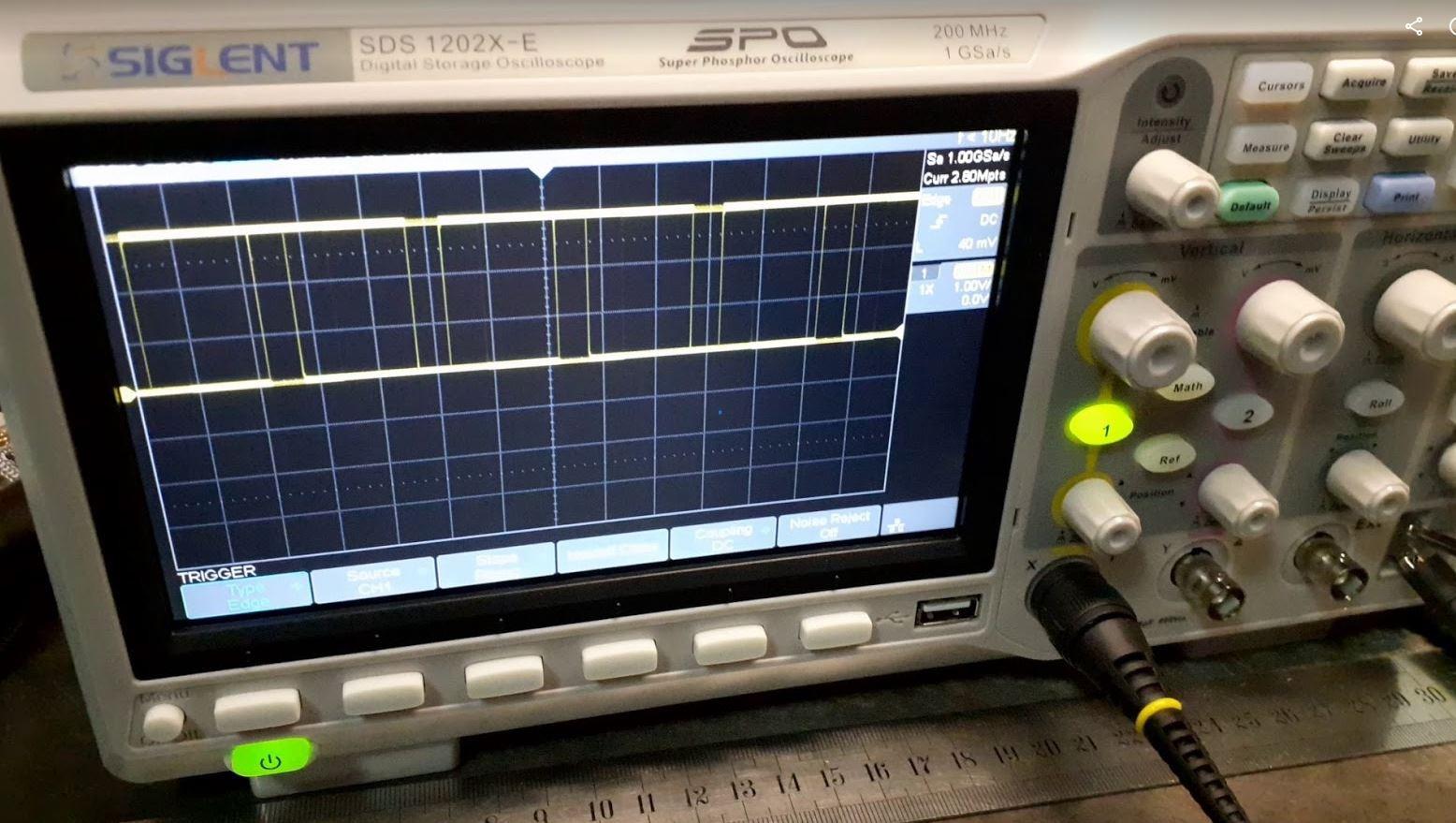
Two things to know before you commit. The menu system is driven through an on-screen interface rather than a bank of dedicated knobs, and it takes an evening to stop reaching for controls that are not physical. And the mixed-signal and waveform generator options are separate purchases, so treat those as future add-ons rather than features you have today. The probes in the box are usable, but a decent 10x probe is an upgrade worth making early.
At 5.5 pounds and roughly 10 by 15 by 17 inches, it is a genuinely portable bench unit. The bright display holds up in a room with the lights on, and the intensity graded trace makes it easy to see how often a waveform repeats rather than just where it sits.
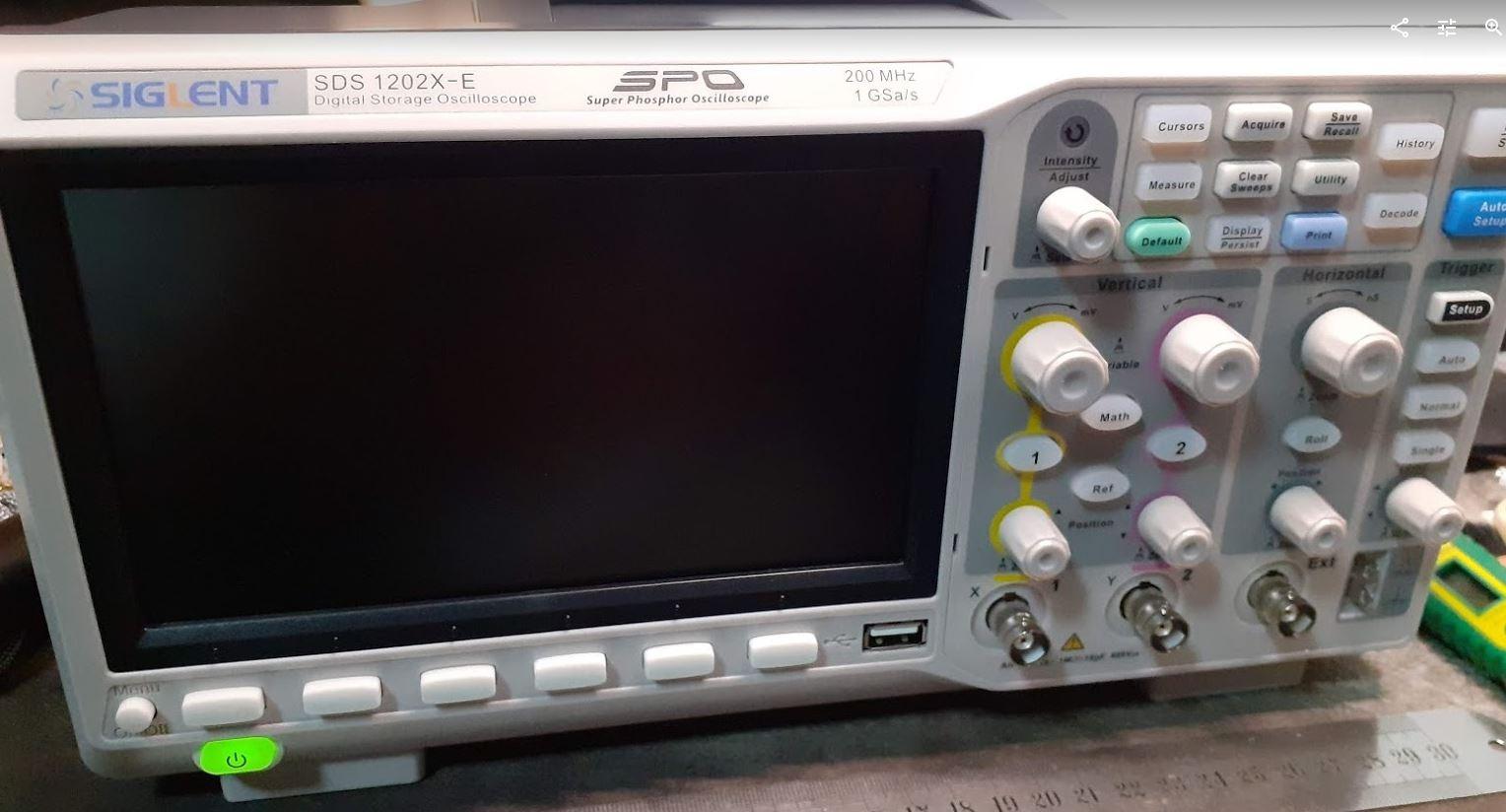
Who the Siglent SDS1202X-E suits?
This is the scope for someone whose hobby has outgrown a pocket device. Power electronics, audio work, motor control and any project where a switching edge is faster than 20 MHz will exercise the front end properly, and the bandwidth headroom means the display stays readable when harmonics appear.
Embedded developers get the most out of it. UART and I2C decode on a 200 MHz two-channel unit is a combination that is hard to find at this tier, and the record length is long enough to catch a boot sequence without fragmenting the capture.
Where the Siglent SDS1202X-E falls short?
Two channels is the real constraint. Once you are looking at a switching converter with input, switch node and output, you will be running math functions instead of probing all three at once. Models with four analog channels exist at a similar tier, and the difference becomes obvious the first time you need a third trace.
It is also a mains-unsafe instrument in the ordinary bench sense: the channels share an earth-referenced ground, so the ground clip must never be attached to a live or floating circuit. If your hobby involves household AC, you need a genuinely isolated and differentially capable scope, which is a different category and a different budget.
2. Siglent SDS1104X-E: Best Value Four-Channel Scope
Siglent Technologies SDS1104X-E 100Mhz Digital Oscilloscope 4 Channels Standard Decoder, Grey
- Dual-ADC architecture holds high sample rates with channels active
- All standard serial decodes unlocked out of the box
- Ethernet with a built-in web server for remote viewing
- 14 vertical divisions give a large usable waveform area
- Adjust knob is twitchy and can bounce to the next item
- Decoded serial refresh is slow at low message rates
- Optional MSO and AWG modules cost a lot
The SDS1104X-E is the model I recommend to anyone who keeps coming back to the question of how many channels they actually need. Four analog channels changes the way you work, because you stop choosing which two nodes to sacrifice. On a 100 MHz four-channel scope, power sequencing, UART traffic alongside a clock, and three-phase signals all become a single capture instead of three separate ones.
The dual-ADC architecture is the quiet advantage here. Rather than sharing a single converter across channels, it holds higher sample rates when multiple channels are active, which is precisely the situation where single-ADC rivals roll their effective rate off sharply. Reviewers regularly compare this unit to the Rigol DS1054Z, and the Siglent generally wins on channel count at a similar spend.
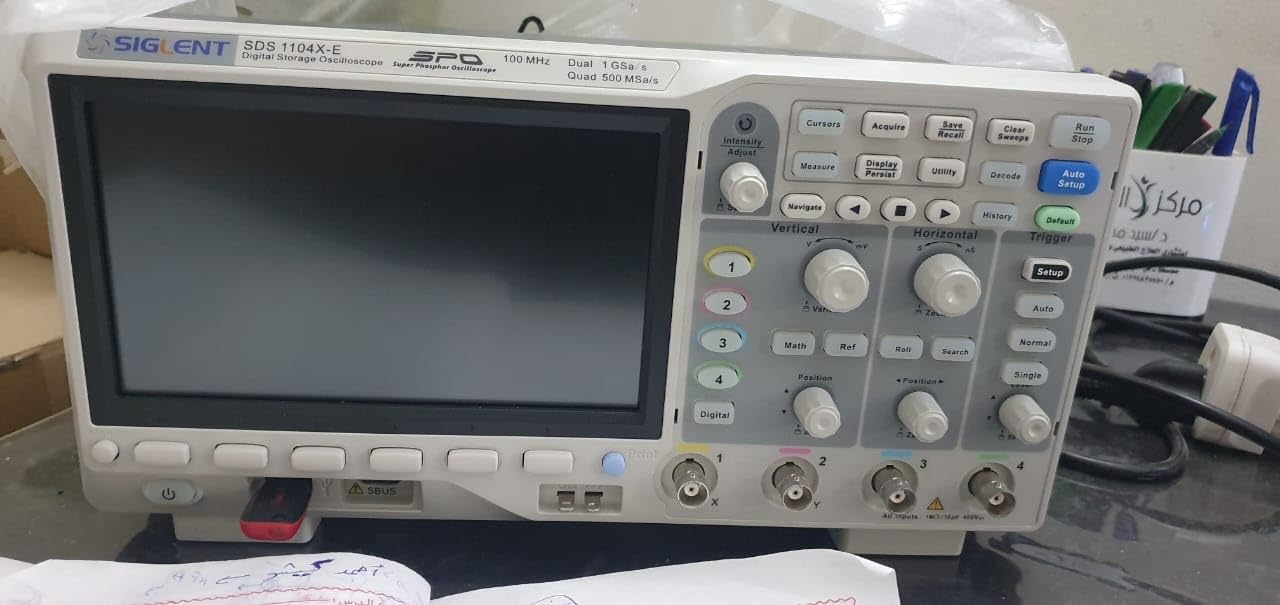
Serial decode for I2C, SPI, UART/RS232, CAN and LIN is standard, with no unlock step. The Ethernet port runs a built-in web server, so you can open a long acquisition on your laptop while the scope stays on the bench, share the screen with someone debugging remotely, or pull captures over the network without fighting a USB driver.
The package arrives with a quick start guide, a calibration certificate, four passive probes and a USB cable, which is a generous box for a unit at this level. Sixteen digital mixed-signal channels and a USB arbitrary waveform generator are options, and the waveform generator module is priced close to the scope itself, so budget for the extra only if you genuinely need it.
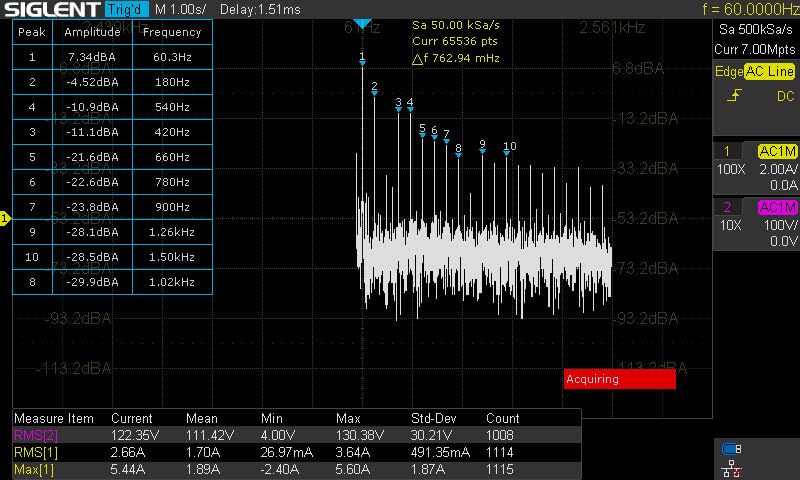
Who the Siglent SDS1104X-E suits?
It suits anyone working with more than one signal at a time, which in practice is most people past their first year. A 100 MHz bandwidth comfortably covers 5 V microcontroller rails, audio, automotive sensor buses and the slow half of switching supply work.
For students and lab work, 14 vertical divisions give a waveform area that is noticeably easier to read than a 8-division screen, and the calibration certificate in the box is a genuinely useful document if you ever need to prove the instrument was checked.
Where the Siglent SDS1104X-E falls short?
The push-to-select adjust knob is the most common complaint. It is over-sensitive, and a firm press can bounce the selection to the next item, which is annoying when you are trying to nudge a timebase by one division. Some settings, including the NTP clock and the screensaver timeout, do not persist between sessions.
Decoded serial output refreshes slowly at low message rates, so a sparse UART burst can take a moment to redraw. And the tilt feet are not sprung, meaning a bench with any vibration can creep forward under a heavy probe load.
3. FNIRSI 2C53T: The Best Budget Three-in-One
FNIRSI 2C53T 3-in-1 50MHz 2CH Oscilloscope Multimeter DDS Signal Generator
- Scope
- 19999-count multimeter and DDS signal generator in one 400 g body
- Battery powered with up to 6 h standby
- Reference waveform comparison and Type-C data transfer
- Auto measurement
- cursor and persistence modes
- 1 Kpts record depth is shallow for capturing bursts
- 2.8-inch LCD limits multi-channel viewing
- Entry-level accuracy above a few MHz
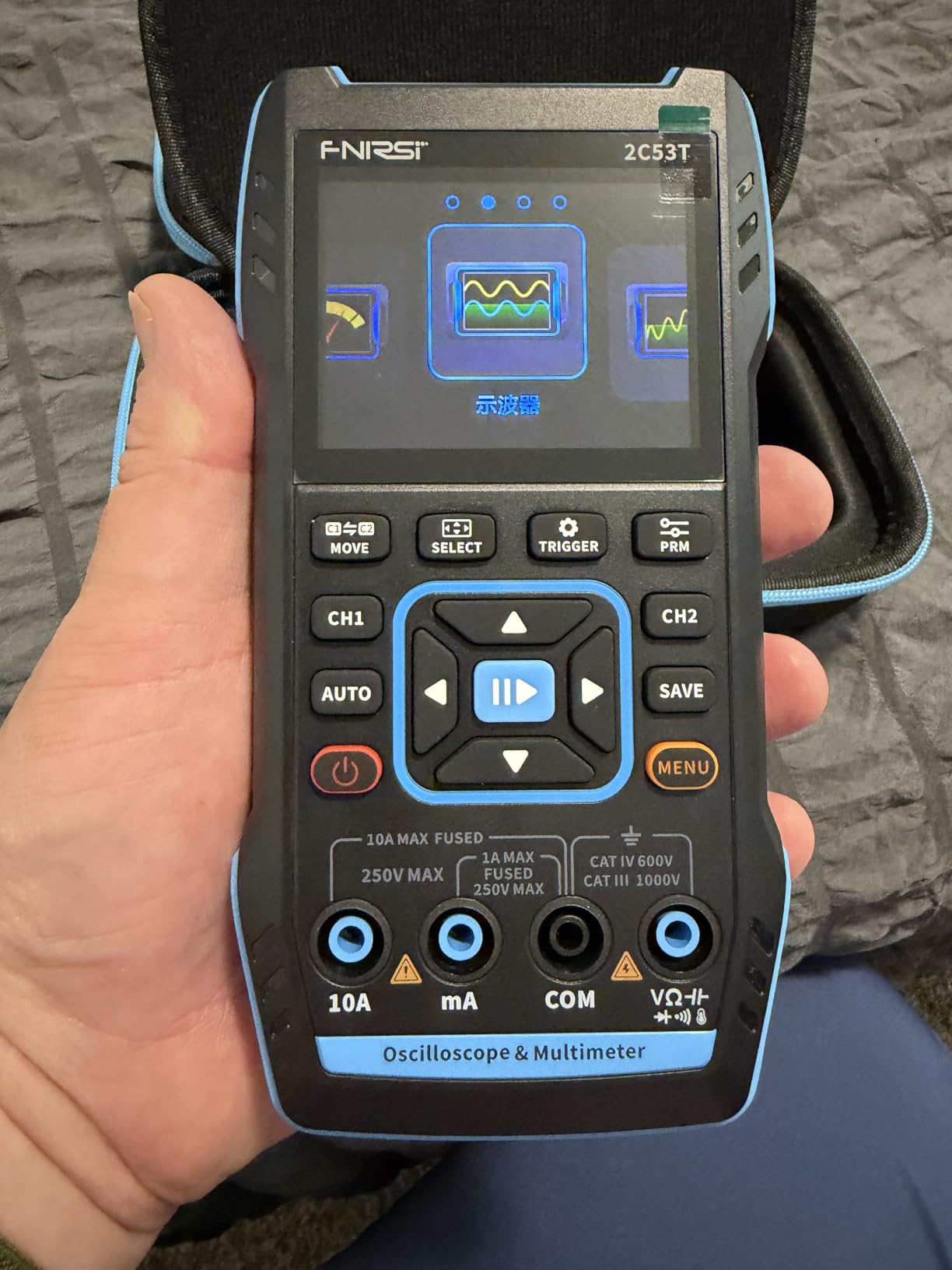
The FNIRSI 2C53T answers a question most roundups ignore: what should you actually buy if you are starting out and money is genuinely tight. It is a 2-channel 50 MHz scope, a 19999-count multimeter and a DDS signal generator in a 400 g body that runs from a 3000 mAh battery. The box includes a 10x probe, a crocodile clip probe, a multimeter probe, a Type-C cable and a storage case.
Having a working generator and a working multimeter alongside the scope changes your learning curve more than any spec does. You can produce a known waveform and check the instrument against a known reference, which is how you build intuition instead of guessing. This model is the upgraded version of the earlier 2C23T, adding math operations, cursor measurement, persistence mode and XY mode.
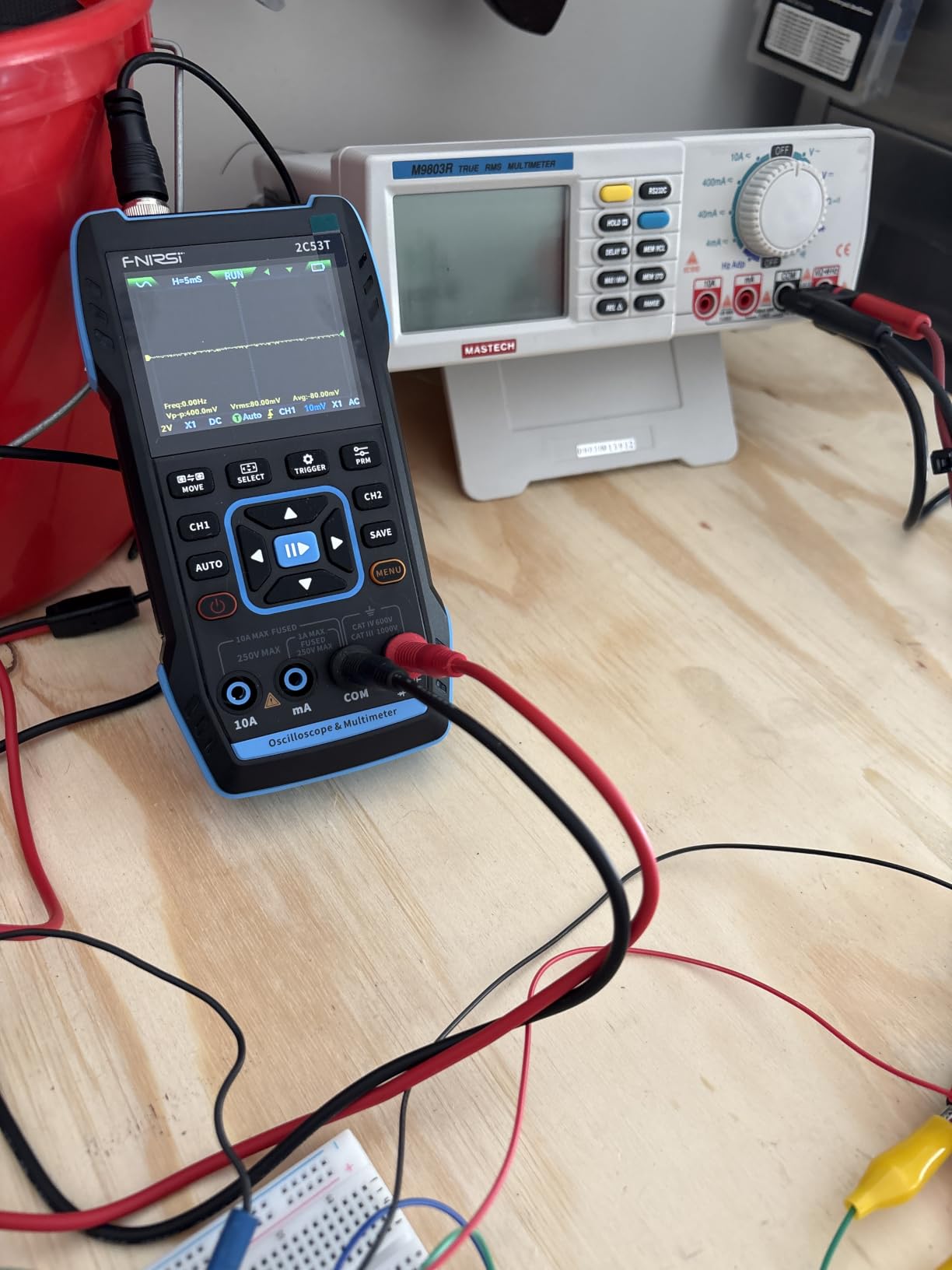
The generator outputs up to 50 kHz in 13 waveforms with a 1 Hz step, and vertical sensitivity runs from 10 mV per division to 10 V per division with a 400 V maximum input. The FPGA, MCU and ADC architecture includes high-voltage protection, which matters more than it sounds when you are probing around a live board with a cheap tool.
Reference waveform comparison lets you overlay a known-good capture against a new one and see the difference immediately. Screenshots and waveform data upload to a computer over Type-C, and language switching plus adjustable grid clarity are small touches that tell you the firmware was built for more than one market.
Who the FNIRSI 2C53T suits?
Students, people on a strict first budget, and anyone who wants a scope they can take to a car, a boiler or a field box without a mains socket nearby. Six hours of standby runtime makes it a realistic field instrument, not a bench unit with a token battery.
It also suits anyone who needs a serious multimeter as much as an oscilloscope. A 4.5-digit 19999-count meter covering AC and DC voltage, DC and AC current, resistance to 19.99 megohm, capacitance to 99.99 mF and continuity is a genuinely capable meter, and for many hobbyists it earns the purchase on its own.
Where the FNIRSI 2C53T falls short?
A 1 Kpts record depth is shallow. A burst signal will fit, but long captures and any real analysis of a repeating waveform will not, and this is the single biggest limitation separating it from a bench scope. Accuracy above a few MHz is entry level, so it is not a tool for looking at switch node ringing.
The 2.8-inch LCD is the second limit. Two traces on a screen that size are readable, but four plus a measurement panel is cramped, and you will be leaning in. Ratings cluster lower than the bench scopes here for exactly that reason. Treat it as a first instrument and a learning tool, then move up when you outgrow the record depth.
4. Rigol DS1054Z: The Best Four-Channel Value Bench Scope
Rigol DS1054Z Digital Oscilloscope, 50MHz, 4 Channel, 1GSa/s, Best Value
- 24 Mpts memory and 30000 wfms/s capture at this tier
- I2C
- SPI and RS232/UART decoders in the base firmware
- USB Host/Device
- LAN and AUX trigger output
- Bright matte screen with intensity graded display
- Onboard help function
- Cooling fan is noticeably noisy
- Rotary encoder can skip a step when pressed
- Channel 2 and 4 trace colours are hard to distinguish
The Rigol DS1054Z is the scope most electronics hobbyists meet first, and the one long-term owners on EEVblog most often describe as the natural entry point to a low-end digital storage oscilloscope. The reason is simple: it has been sold for years, it is heavily supported, and the combination of 24 Mpts of memory and a 30,000 waveforms per second capture rate is unusual at this tier.
That capture rate matters more than it sounds. A slow acquisition rate can skip intermittent glitches entirely, showing you a clean trace while the fault passes by unrecorded. With intensity grading on the display, repeated hits show up brighter, which is how you find a problem that only happens once every few thousand cycles.
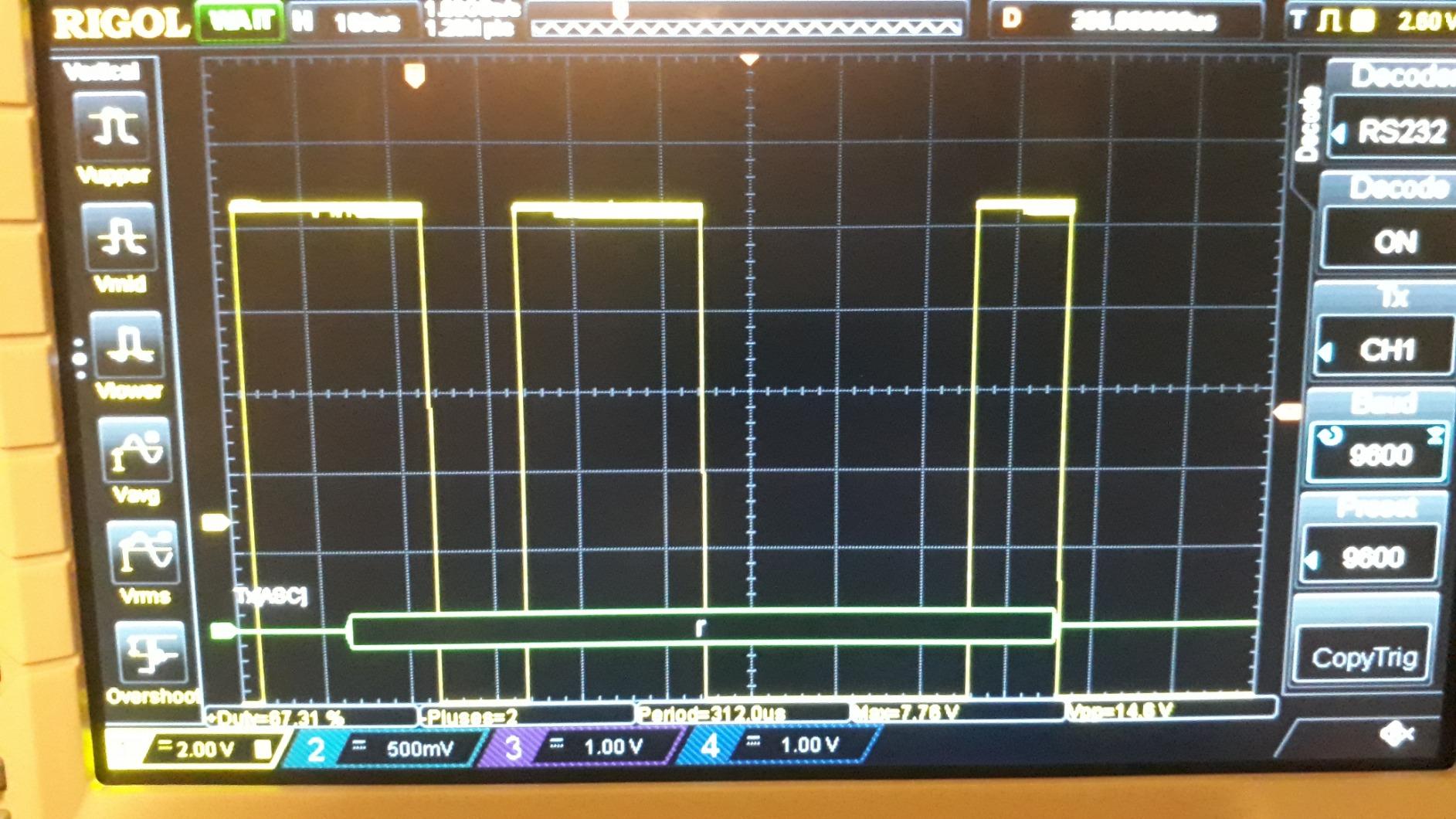
Serial bus trigger and decoding for RS232/UART, I2C and SPI is included in the base firmware, along with FFT and filters. Connectivity is unusually good for an entry instrument: USB Host, USB Device, LAN with LXI, and an AUX output carrying trigger and pass/fail status, so it integrates into a bench setup without adapters.
Waveform recording and playback goes up to 60,000 frames, meaning you can capture a fault, walk away, and review it later at the bench rather than watching the screen. The bright matte screen with colour-coded channels and the intensity graded display make it pleasant to use, and the onboard help function is a genuine assist for a beginner.
Who the Rigol DS1054Z suits?
It suits embedded and microcontroller work under 50 MHz signal content, which covers the overwhelming majority of hobby projects. Four channels means you can watch a clock, data and a power rail at the same time, and the deep memory captures a long enough window to see an entire packet exchange.
It also suits anyone who plans to keep the same scope for years. Because the model has been available since 2014, there is an enormous body of forum knowledge, firmware discussion and accessory knowledge around it, and a large pool of used units if you decide to go that route instead.
Where the Rigol DS1054Z falls short?
The cooling fan is noticeably noisy in a quiet room, and that is the complaint that appears most often. The rotary encoder can skip a step when pressed, which makes entering activation codes and selecting probes error prone, and the channel 2 and channel 4 trace colours are hard to tell apart on the default palette. The supplied probe colour rings may not match channel 4.
Some owners also report occasional hangs, whether on USB memory access or the unit as a whole. None of this touches measurement accuracy, and the ratings sit solidly in the same band as the Siglent models here, but if you are noise sensitive or work in a shared office, ask yourself whether the fan is a deal breaker.
5. HANMATEK HO52: Best Lightweight Field Scope
- Genuinely portable at 16 ounces with 2-channel 50 MHz capability
- One-key auto set and XY mode speed up first-time debugging
- Saves reference waveforms and CSV data to a computer
- Works as both scope and multimeter
- Small 3.5-inch TFT limits multi-channel readability
- 8k-dot record depth is shallow for burst analysis
- Basic on-screen controls versus a bench unit with knobs
The HANMATEK HO52 weighs 16 ounces. That is the headline, because it is the difference between a scope that lives on a shelf and one that ends up in the toolbox. Two channels, 50 MHz of bandwidth and 250 MSa/s real-time sampling, with a 3.5-inch backlit TFT, and it runs off USB-C charging so a power bank is a valid power source in the field.
The one-key auto set is more useful than it sounds for a first scope. Point it at an unfamiliar signal, get a readable trace immediately, then start adjusting from a working baseline rather than from a blank screen. XY mode is included, which makes phase comparison on stereo and speaker work straightforward.
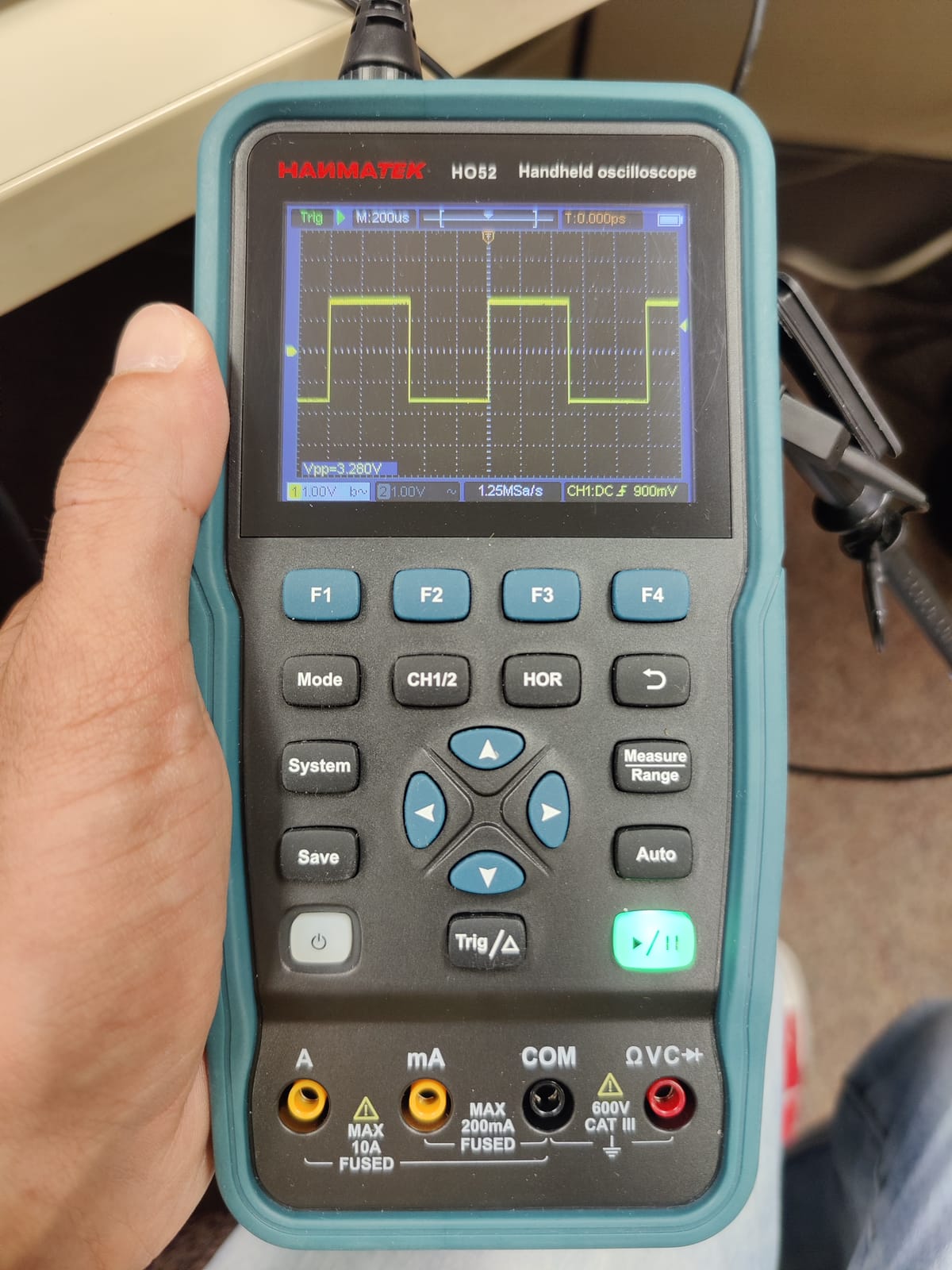
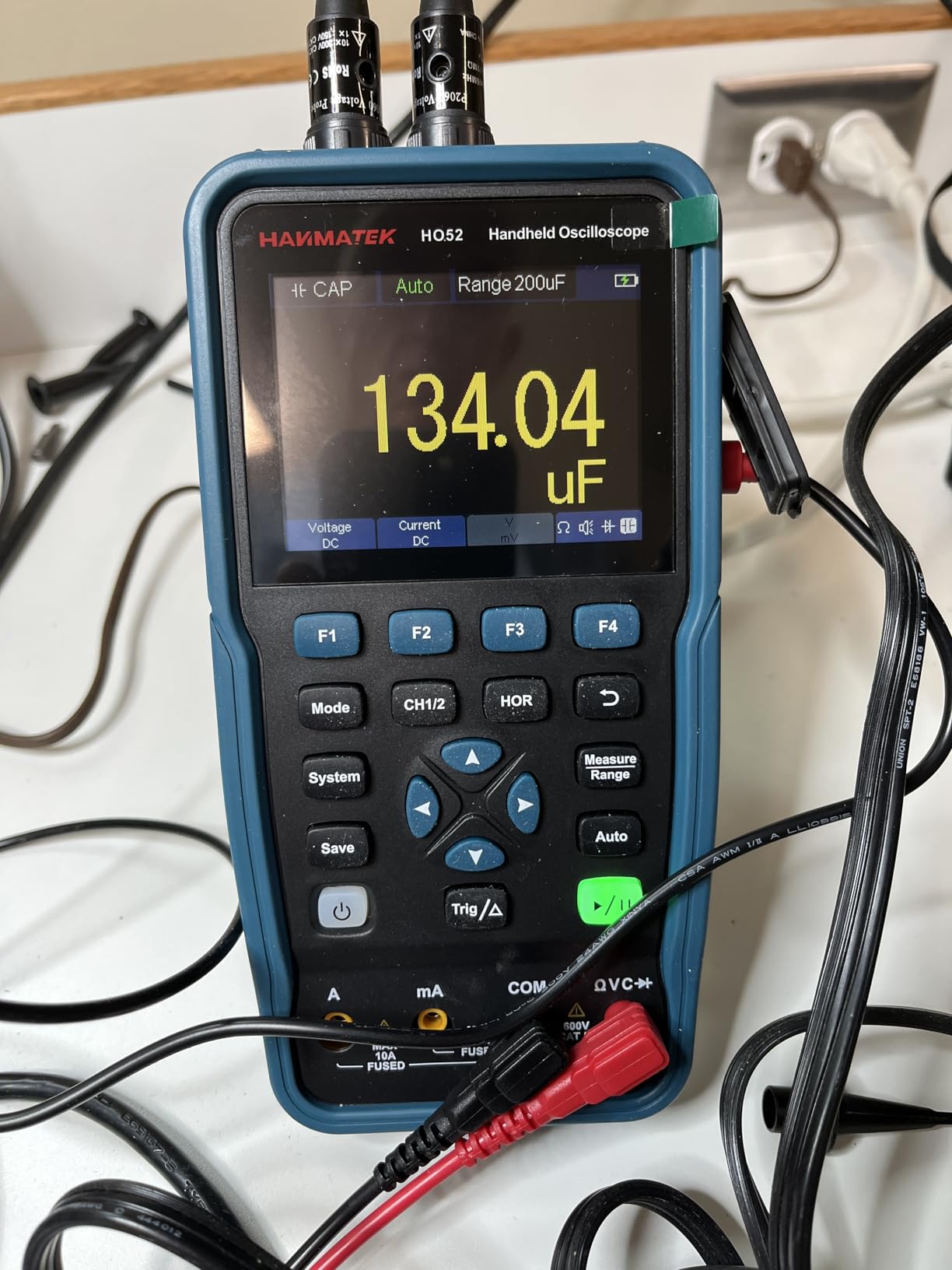
The meter mode is a 4.5-digit true-RMS instrument covering voltage, current, resistance, diode, continuity and capacitance with auto ranging, up to 750 V AC and 1000 V DC. The scope and multimeter use independent inputs, so you are not swapping leads back and forth to change jobs. Seven automatic measurement functions and cursor measurement cover most of what a beginner needs.
It stores four setup groups, four reference waveforms, four images and four CSV waveform groups, and self-calibration helps keep the two channels matched. Type-C handles charging and PC connection, so captures can go to a laptop for later analysis.
Who the HANMATEK HO52 suits?
It suits automotive and field troubleshooting, where the measurement happens somewhere that does not have a bench. Speaker phase checks, sensor signals and continuity around a vehicle are all realistic with this unit, and reviewers consistently rate it well for exactly that kind of work.
It also suits students and anyone learning away from a desk. Being able to carry the instrument to the thing under test removes a real psychological barrier, and a scope you will actually use beats a better one you never take out of a cupboard.
Where the HANMATEK HO52 falls short?
Three and a half inches is the ceiling. Two traces are workable; two traces plus a measurement panel plus a menu is crowded, and there is no rotary control to fall back on, only touch and buttons. The 8k-dot record depth is fine for a single burst but not for analysing a repeating waveform across many cycles.
Waveform refresh is quoted at up to 10,000 frames per second, which is low against the 30,000 frames per second the Rigol bench scopes manage, and a slow acquisition rate is exactly the condition under which intermittent glitches hide. This is a companion instrument, not a replacement for a bench scope.
6. PicoScope 2204A: Best USB Scope for a Laptop-Only Setup
Pico Technology PicoScope 2204A Oscilloscope 2 Channel 10 MHz Bandwidth USB
- USB connected and powered
- needs only a laptop
- Free lifetime software updates and 40 serial decoders included
- Cross-platform PicoScope 7 for Windows
- Linux and Mac
- Up to 12-bit enhanced vertical resolution
- 10 MHz bandwidth and 8 kS memory limit it to slow signals
- Software-driven operation adds latency
- No built-in display
- so it depends on a host machine
The PicoScope 2204A is the argument for not buying a benchtop at all. It weighs five ounces, draws power and data over USB, and connects to a laptop or a small-form-factor machine permanently on your desk. If your work is mostly digital: logic levels, serial buses, embedded firmware bring-up and slow analog signals, the combination of hardware and software is more capable than it has any right to be.
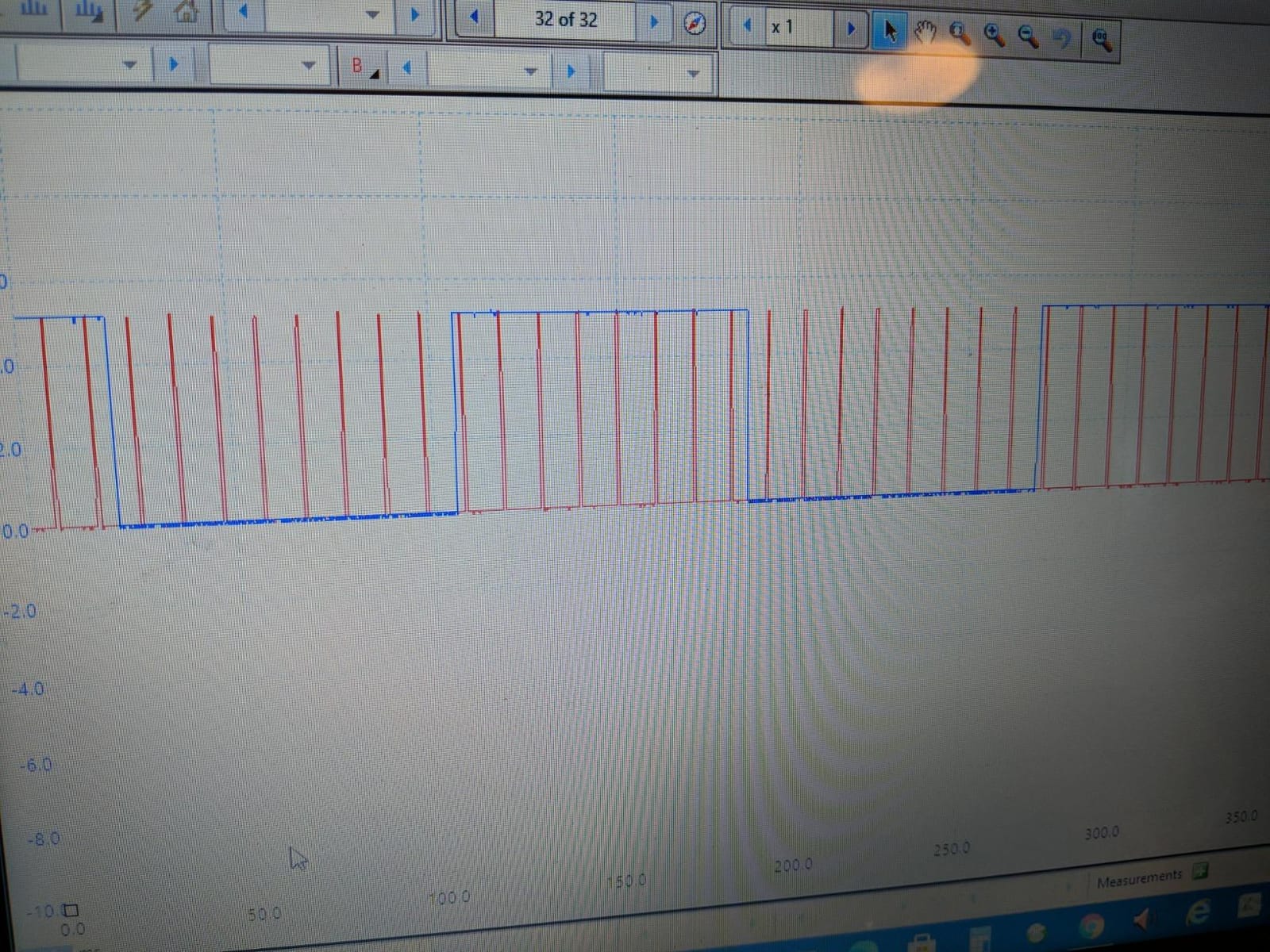
Forty serial protocol decoders are included as standard, with no licence and no key. The software also turns the same box into a spectrum analyzer, a function generator and an arbitrary waveform generator, so one purchase covers a surprising amount of a hobbyist bench. Vertical resolution reaches an enhanced 12-bit, which helps when you are trying to see a small signal riding on a large one.
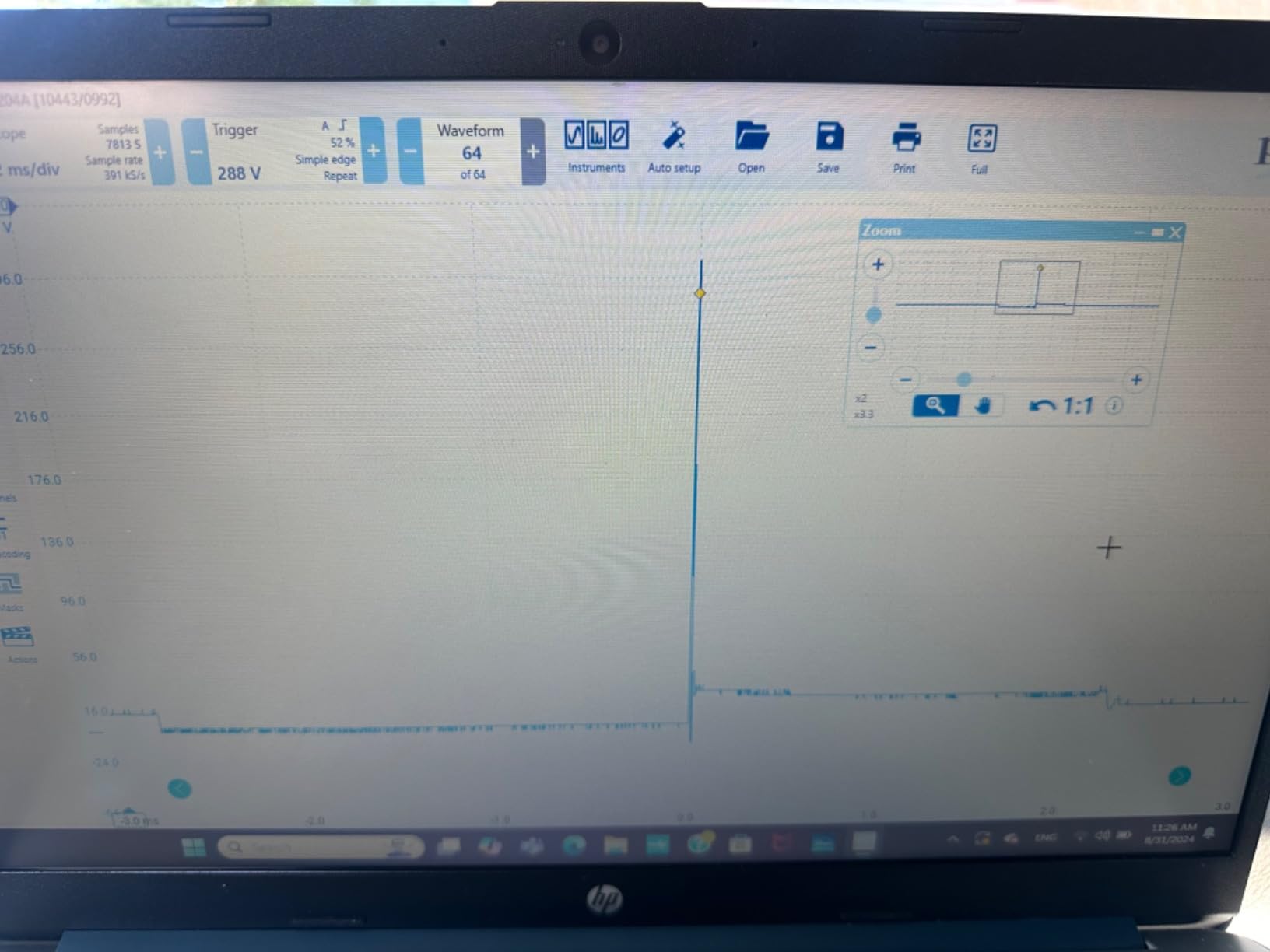
The software story is the real differentiator. PicoScope 7 runs on Windows, Linux and Mac with free lifetime updates, so the unit is not tied to one platform or one vendor’s support window. It is not compatible with PicoScope 7 Automotive, which matters if you plan to work on vehicle buses.
Capture memory is 8 kS, with a 10,000 waveform circular buffer, up to 2,000 waveforms per second update rate, mask limit testing, advanced math and filtering, statistics on measurements and advanced digital triggering. The kit includes a USB cable, two x1/x10 passive probes and a quick start guide.
Who the PicoScope 2204A suits?
It suits anyone who works at a laptop rather than a bench, particularly students, firmware developers and people sharing a small workspace. Having scope, generator and analyser on the same machine as your toolchain simplifies automated testing, where a script can drive measurements and log results without anyone watching the screen.
It also suits people who travel. Five ounces and a USB cable is a complete measurement setup, and unlike a handheld 3-in-1 the laptop screen is a large, high-resolution display you already own.
Where the PicoScope 2204A falls short?
Ten MHz of bandwidth is the hard ceiling, and it rules out anything fast: switch nodes, ringing on edges above a few MHz, most of what you would look for in a switching power supply. The 8 kS memory depth is similarly modest. If your hobby is analog or power, this is the wrong instrument.
Software-driven operation adds latency compared with a dedicated front panel, and having no display means a dead laptop ends your measurement session entirely. Open-source alternatives such as OpenHantek and H-Scope exist for other USB scopes and are worth knowing about if a vendor driver ever stops being maintained.
7. Rigol DS1202Z-E: Best for Deep Captures and Long Records
RIGOL DS1202Z-E Digital Oscilloscope, 200MHz, 2 Channel, 1GSa/s Sampling
- 200 MHz bandwidth and 1 GSa/s sampling in a hobbyist-tier body
- 7-inch bright display with a large usable waveform area
- 30000 wfms/s capture and 60000-frame record and playback
- RS232/UART
- I2C and SPI trigger and decode
- Three-year warranty on the main unit
- Multifunction knob is over-sensitive and overshoots
- Only USB 2.0 for external storage
- Ultrascope cannot pull full-resolution data from 24 Mpts
- Deep menu nesting hides some functions
The Rigol DS1202Z-E is the version of the DS1054Z idea for someone who wants more bandwidth and a much bigger screen. Two hundred megahertz, two analog channels plus an external trigger input, 1 GSa/s real-time sampling, and 24 Mpts of standard memory. When you are hunting an intermittent fault that appears once in ten thousand cycles, that memory depth is the feature that finds it.
The 7-inch WVGA TFT with intensity graded colour display is the other headline. It is a far better surface for reading a fast edge or a long record than the smaller panels on entry scopes, and for anyone who spends real time squinting at ringing, that is not a cosmetic upgrade.
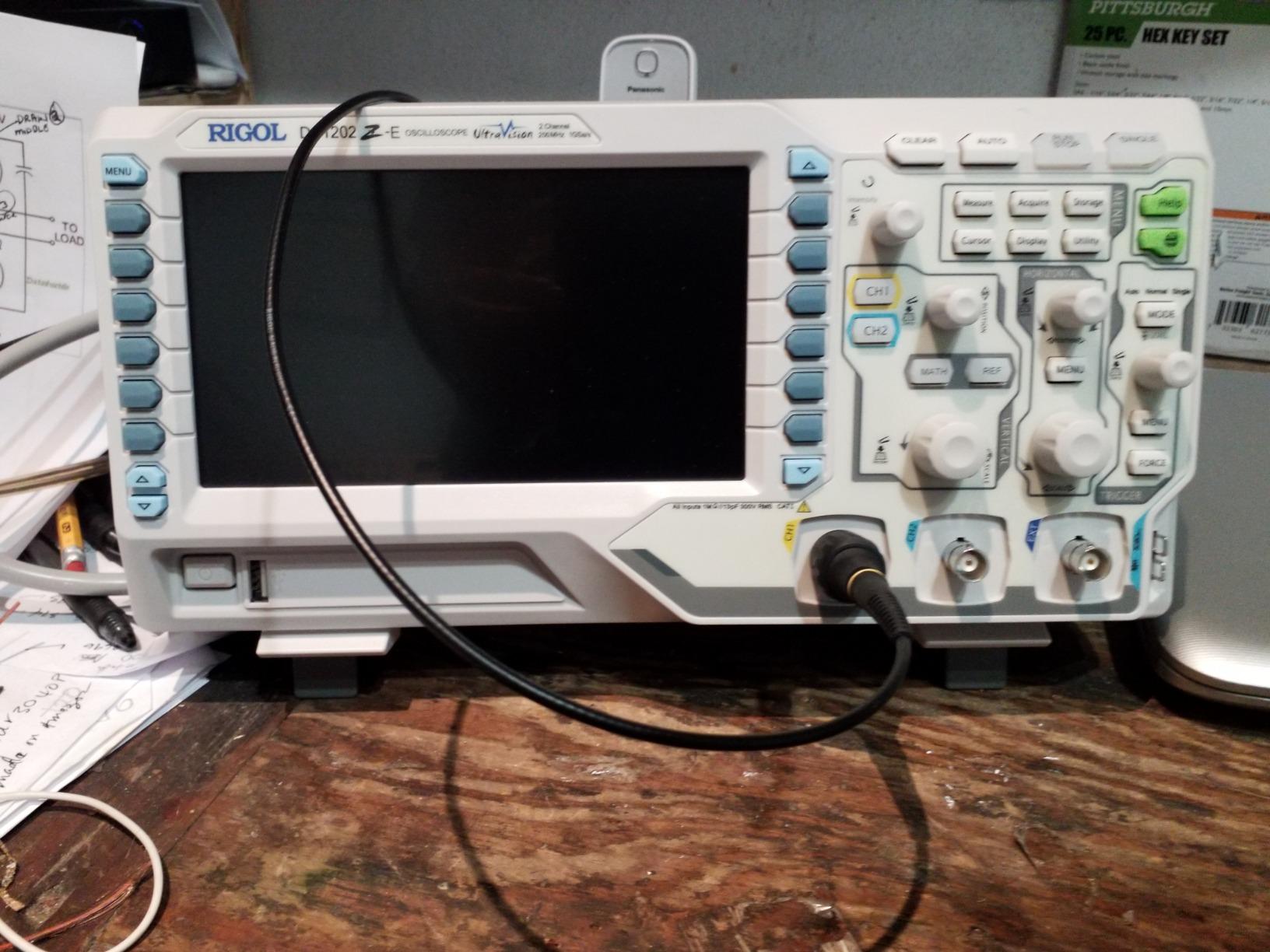
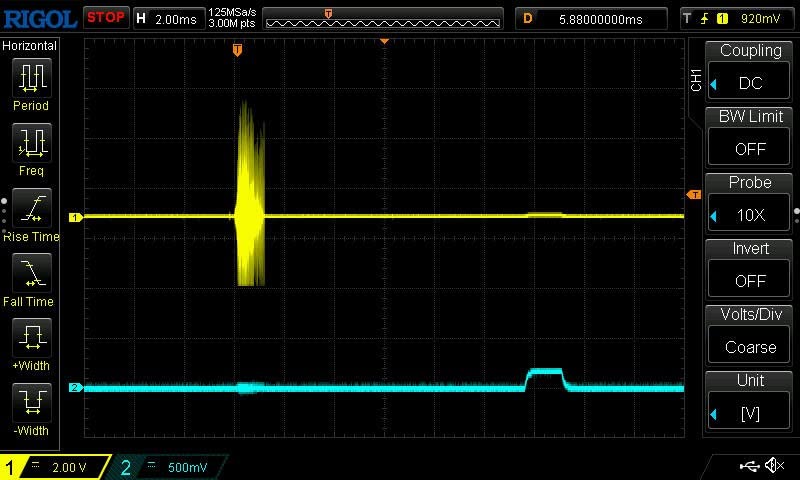
Capture runs at up to 30,000 waveforms per second, and hardware real-time recording and playback stores up to 60,000 frames. Serial bus trigger and decoding for RS232/UART, I2C and SPI is included. Connectivity covers USB Host, USB Device, LAN with LXI, and an AUX output for trigger and pass/fail, matching the wider Rigol bench range.
The box includes the main unit, a probe, a power cable and a USB cable, and the main unit carries a three-year warranty with one year on parts. That warranty length is longer than most rivals offer at this tier and is worth weighing against cheaper bodies with shorter cover.
Who the Rigol DS1202Z-E suits?
It suits embedded and power developers who have outgrown 50 MHz and want long records rather than raw bandwidth. Audio work, motor control, inverter and converter debugging all sit comfortably inside 200 MHz, and the large display keeps a multi-second capture readable at a glance.
It also suits education labs, where a big screen means a group can see the trace from the back of a bench and the deep memory supports capturing a full boot sequence or a switching cycle.
Where the Rigol DS1202Z-E falls short?
The multifunction knob is over-sensitive and frequently overshoots the intended selection, which is the most repeated complaint. External storage access is USB 2.0 only, so large captures transfer slowly, and the Ultrascope software cannot pull full-resolution data out of the 24 Mpts memory, which limits offline analysis.
Deep menu nesting hides some functions unless you already know where they are. Two channels is still the ceiling, so simultaneous multi-rail work remains constrained, and this is the same fan-noise and encoder trade-off family the DS1054Z carries.
8. ZOYI ZT-703: Best Field Scope for Automotive and Speaker Work
3 in 1 Handheld Oscilloscope Automotive Dual Channel 50MHz with Digital Multimeter and Signal Generator
- Strong 25000-count multimeter with clear auto-ranging display
- Solid construction and a replaceable rechargeable battery
- Useful for speaker phase checks and CAN bus hunting
- Covers resistance
- capacitance
- continuity
- diode and current
- Includes carrying bag
- probes and USB-C cable
- Small crowded screen with no rotary dials
- Usable sine-wave bandwidth is well below the 50 MHz headline
- Onboard signal generator is only good for probe compensation
The ZOYI ZT-703 is best understood as an excellent 25000-count multimeter with a scope attached, and that framing is how reviewers describe it. In practice the meter is what you will use most, and the two-channel scope at up to 280 MSa/s with 128K of storage depth is the reason to carry one device instead of two.
It runs two bandwidth modes. Normal mode gives 200 MSa/s with 30 MHz maximum bandwidth; high-speed mode gives 280 MSa/s with 50 MHz maximum bandwidth. That distinction is worth understanding before you rely on the headline figure, and it applies to the way you read the specification generally across this whole category.
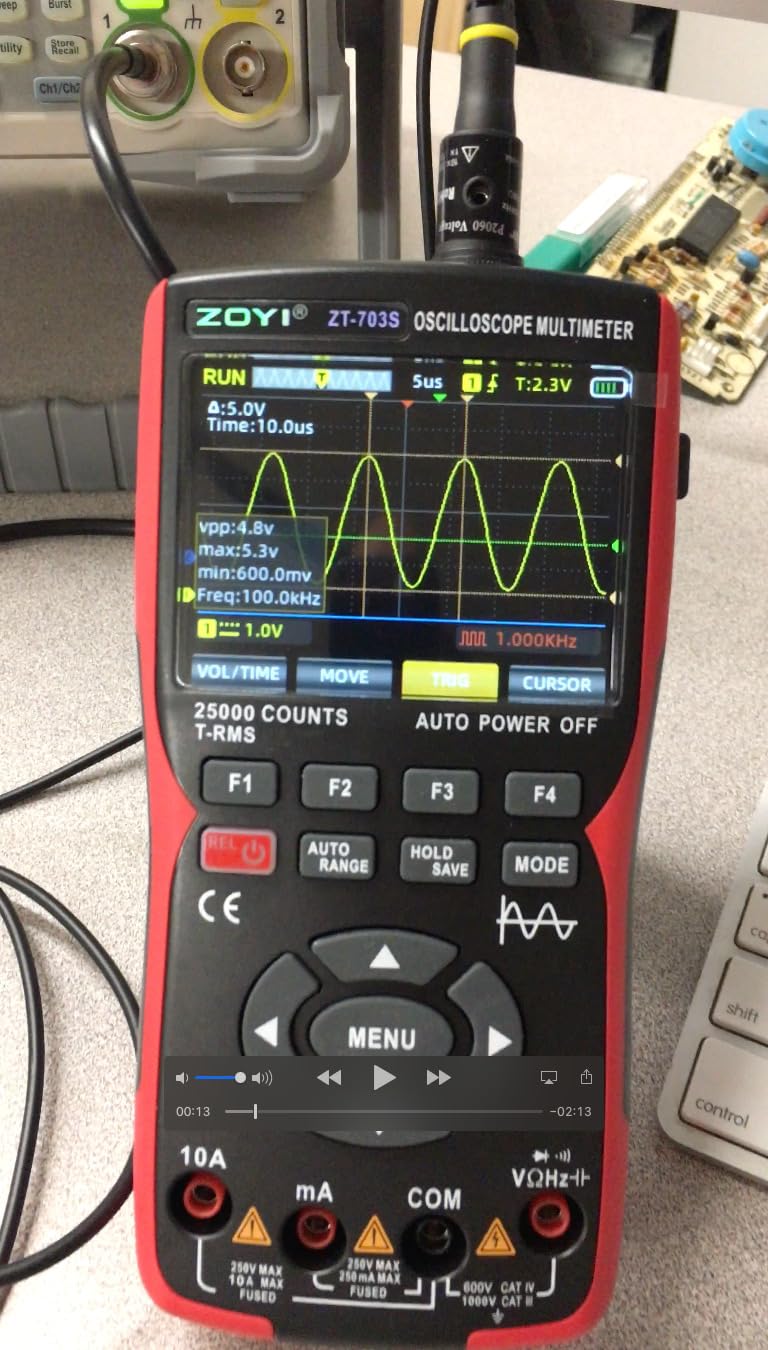
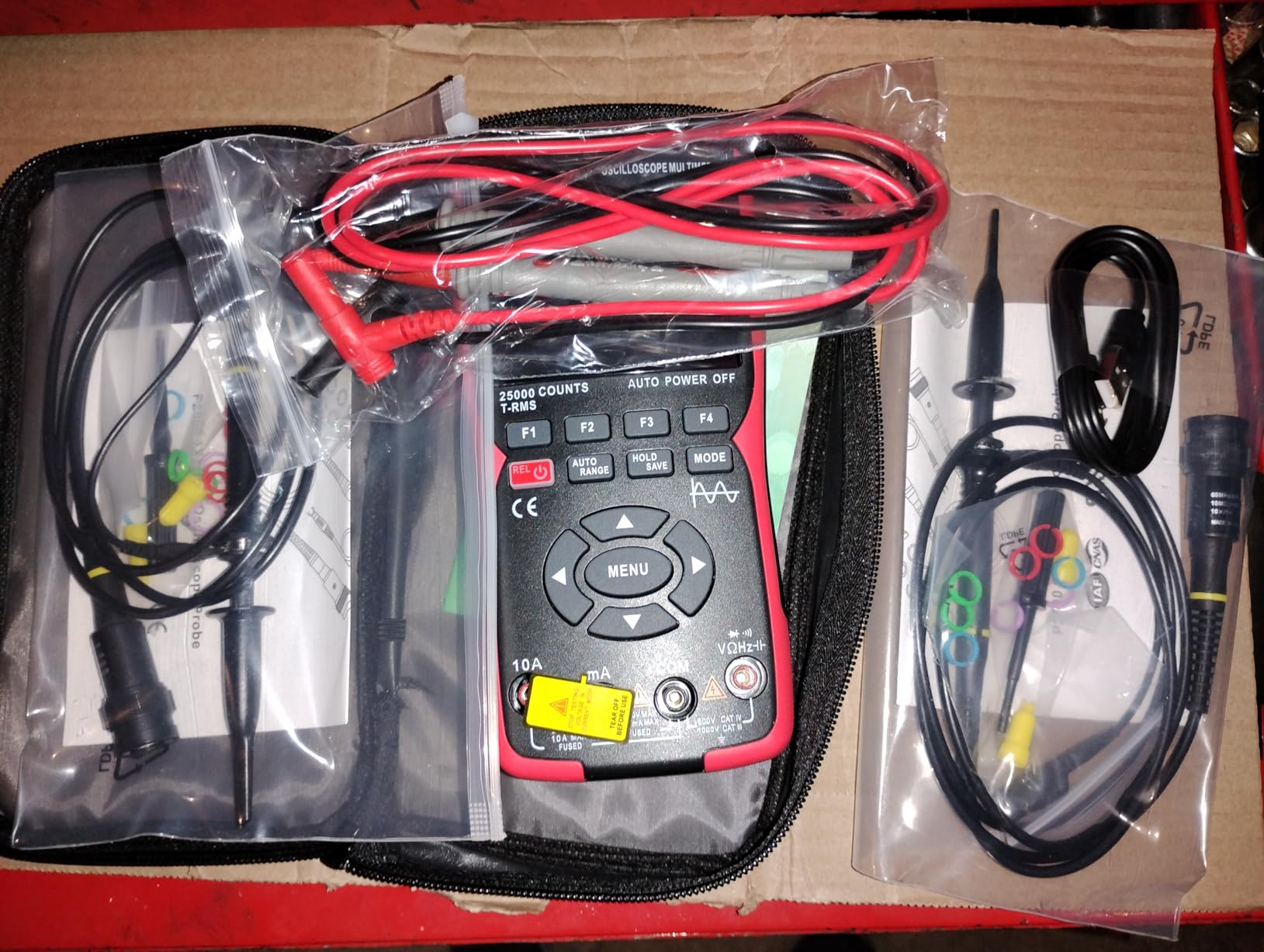
The signal generator outputs sine, square, triangle and more with a synchronous display in the demo window, which makes it useful for probe compensation and basic calibration. A Type-C port handles charging and data transfer, the battery is replaceable, and the box includes an oscilloscope probe, test leads, a charging cable and a cloth bag.
Automotive use is the common thread in owner feedback: speaker phase checks, hunting for activity on a CAN bus and general electrical diagnosis where there is no bench. The bright screen and solid construction survive that environment better than a plastic pocket device would.
Who the ZOYI ZT-703 suits?
It suits car electrics and field service, where one device has to cover a multimeter job and a signal-shape job in the same afternoon. A 25000-count meter is a meaningful step up from a 1999-count pocket meter for resistance and diode work, and auto-ranging means you are not selecting ranges by hand.
It also suits a beginner who wants to see waveforms without buying a bench unit yet, since the storage depth of 128K is far deeper than the 1 Kpts and 8k-dot record depths on the cheapest pocket units here.
Where the ZOYI ZT-703 falls short?
The screen is small and crowded, and there are no rotary dials, so every setting goes through menu buttons. More importantly, real usable sine-wave bandwidth lands closer to 10 to 20 MHz than the 50 MHz headline suggests, so it is not an instrument for looking at fast edges. The onboard generator is adequate for probe compensation rather than for driving real test circuits.
The display sleep timeout is short and only a full-shutdown time is configurable, which is an irritating behaviour on a bench. For anything above a few MHz, treat this as a diagnostic companion and buy a bench scope alongside it.
9. FNIRSI 1013D Plus: Best Large-Screen Portable Scope
FNIRSI 1013D Plus 100MHz Oscilloscope, 2 Channel Oscilloscope 7″ TFT Touch
- Large 7-inch bright touchscreen is unusually readable for a portable unit
- 1 GSa/s sampling paired with 100 MHz per channel is strong for the class
- Built-in waveform image manager with thumbnails
- zoom and pan
- 400 V input protection and a 6000 mAh battery
- Lissajous mode and FFT harmonic estimation
- Touch-only navigation is less precise than knobs
- 1-star reviews point at firmware stability
- Not as rugged as a benchtop under repeated hard use
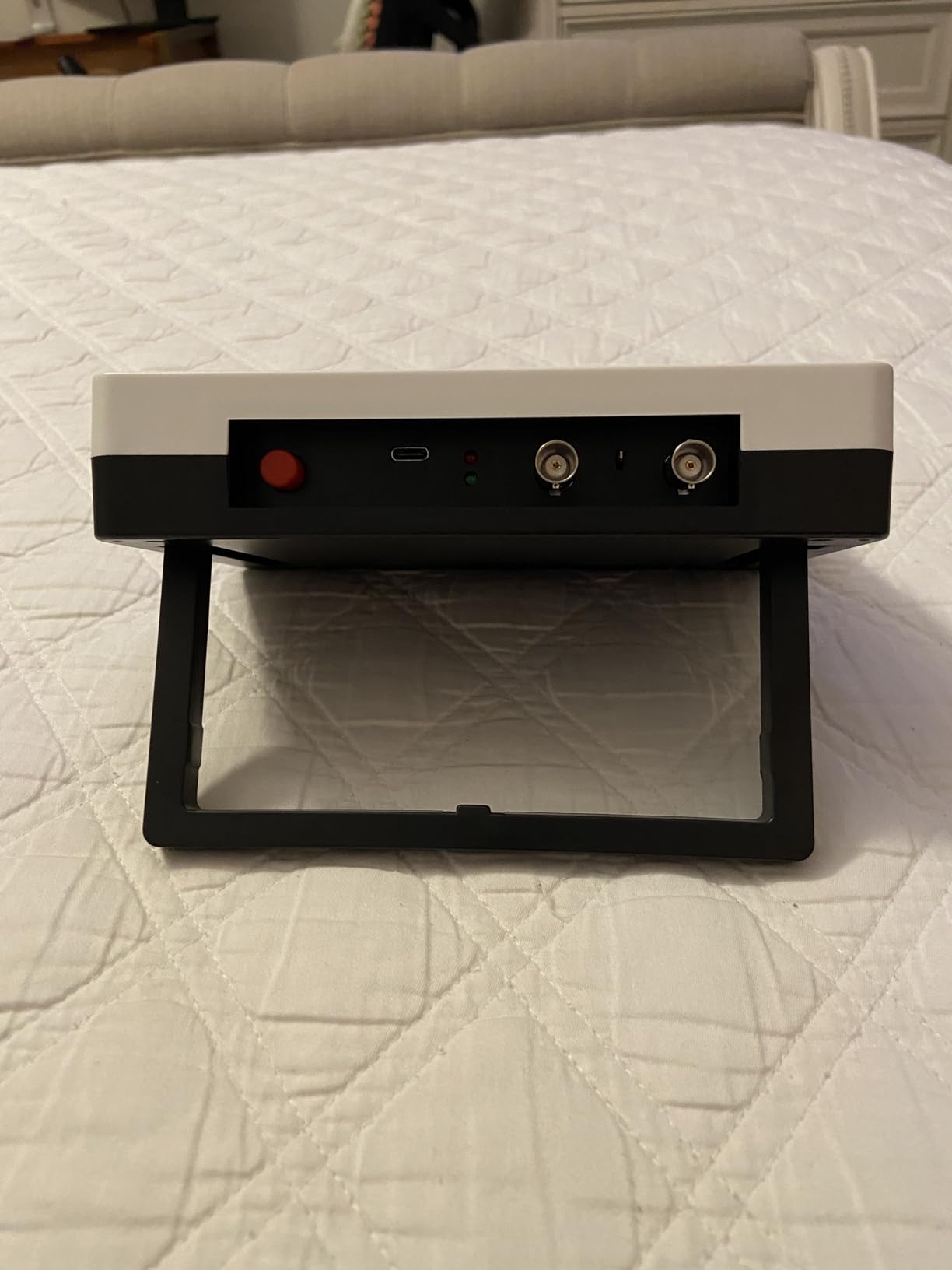
The FNIRSI 1013D Plus solves the problem that stops most people buying a portable scope: you cannot read a waveform on a two-inch panel. This unit has a 7-inch 800 by 480 high-contrast capacitive touchscreen in a thin body, and it still manages two channels at 100 MHz each with 1 GSa/s sampling. On paper that is a very strong combination for the category.
Triggering covers single, normal and automatic modes for both periodic analog and aperiodic digital signals. Single-shot matters more than it sounds: an aperiodic event such as a power-on transient or a switching glitch only appears once, and without single-shot you will never hold it on screen long enough to measure.
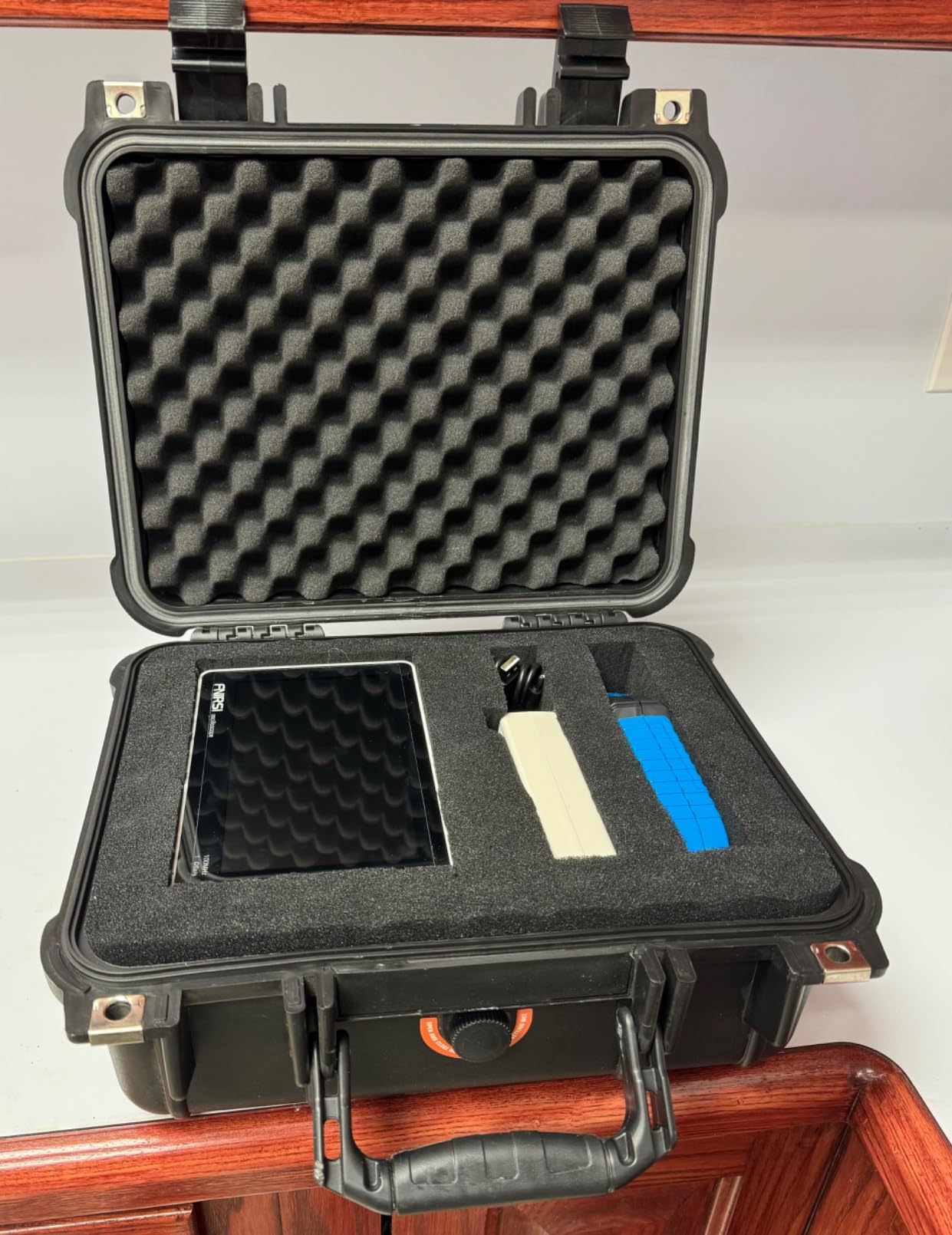
Onboard storage is 1 GB, holding up to 1,000 screenshots and 1,000 waveform sets with thumbnail browsing plus zoom and pan. That makes it a genuinely useful documentation tool: capture the fault, review it later, and send the screenshot to whoever is helping you debug. Cursor measurement, a Lissajous graphic display and FFT harmonic estimation round out the analysis features.
Power comes from a 6000 mAh lithium battery giving roughly four hours of use, and a built-in high-voltage protection module tolerates continuous input up to 400 V. At 2.31 pounds it is portable in a bag without being pocket-sized.
Who the FNIRSI 1013D Plus suits?
It suits anyone who wants a real screen but no permanent bench, including students and field engineers. The 100 MHz bandwidth covers 5 V microcontroller work, audio, and much of the slower switching electronics territory, while the battery makes it usable where mains power is not.
It also suits touch-first users. Capacitive touch and gesture operation make cursor work and FFT inspection quick, and the waveform image manager is a feature you will use more often than you expect once you start documenting your projects.
Where the FNIRSI 1013D Plus falls short?
Around nine percent of reviews are one-star, and the pattern points at firmware stability and touch responsiveness rather than hardware capability. Budget for the possibility that the software needs updating, and check that firmware support continues before you build a workflow around it.
Touch-only navigation is less precise than physical knobs for fine adjustment, which is exactly the adjustment you make most often when aligning a trigger level. And it is not as rugged as a benchtop under repeated hard use, so it is a portable instrument rather than a workshop one.
10. Hantek DSO2D15: Best Budget Scope With Waveform Output
Hantek DSO2D15 Digital Storage Lab Oscilloscopes150MHz Bandwidth 2CH
- 150 MHz bandwidth at an economy price point
- 14 trigger modes plus 5 serial protocol triggers and decoders
- Built-in arbitrary waveform output for calibration and component testing
- Default Setup button and colour-coded channel controls
- Colour-coded buttons
- zero-reset knobs
- Slower CPU makes the display refresh lag
- Can lock up and need a power cycle
- Front and rear USB share one port
- Accuracy degrades above roughly 5 MHz
The Hantek DSO2D15 is the one to consider if your hobby involves amplifiers, filters and oscillators, because the arbitrary waveform output is built in rather than being an extra module. That generator is useful far beyond a probe compensation square wave: it lets you sweep a circuit across frequencies and watch the response, and it can drive a passive component test setup on its own.
The 150 MHz bandwidth across two channels at 1 GSa/s puts it in a band where bench-level measurement is genuinely possible without crossing into professional pricing. Triggering covers 14 modes, with five serial protocol triggers and decoders included, and owner reports note that the UART decode works properly after a firmware update.
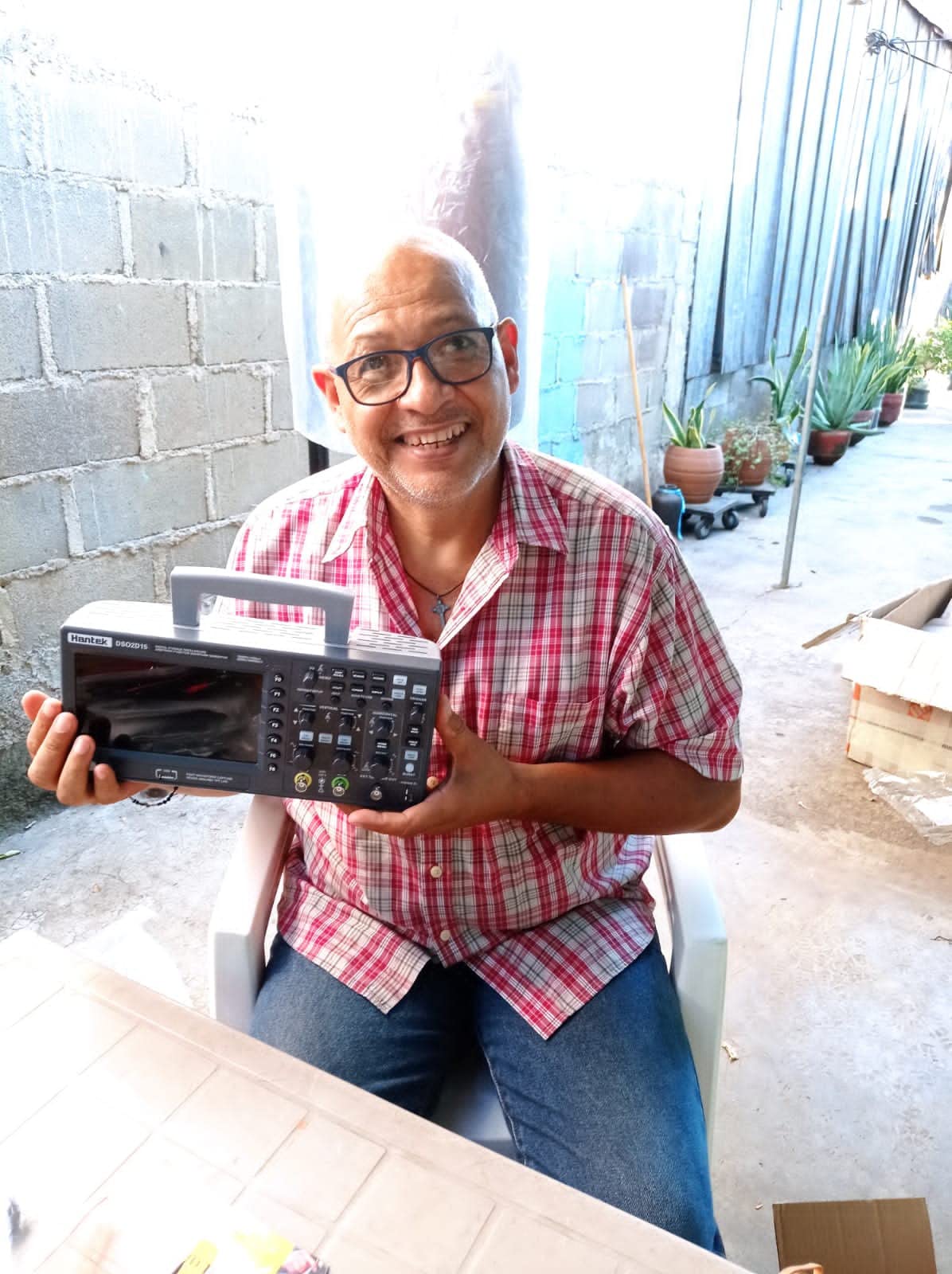
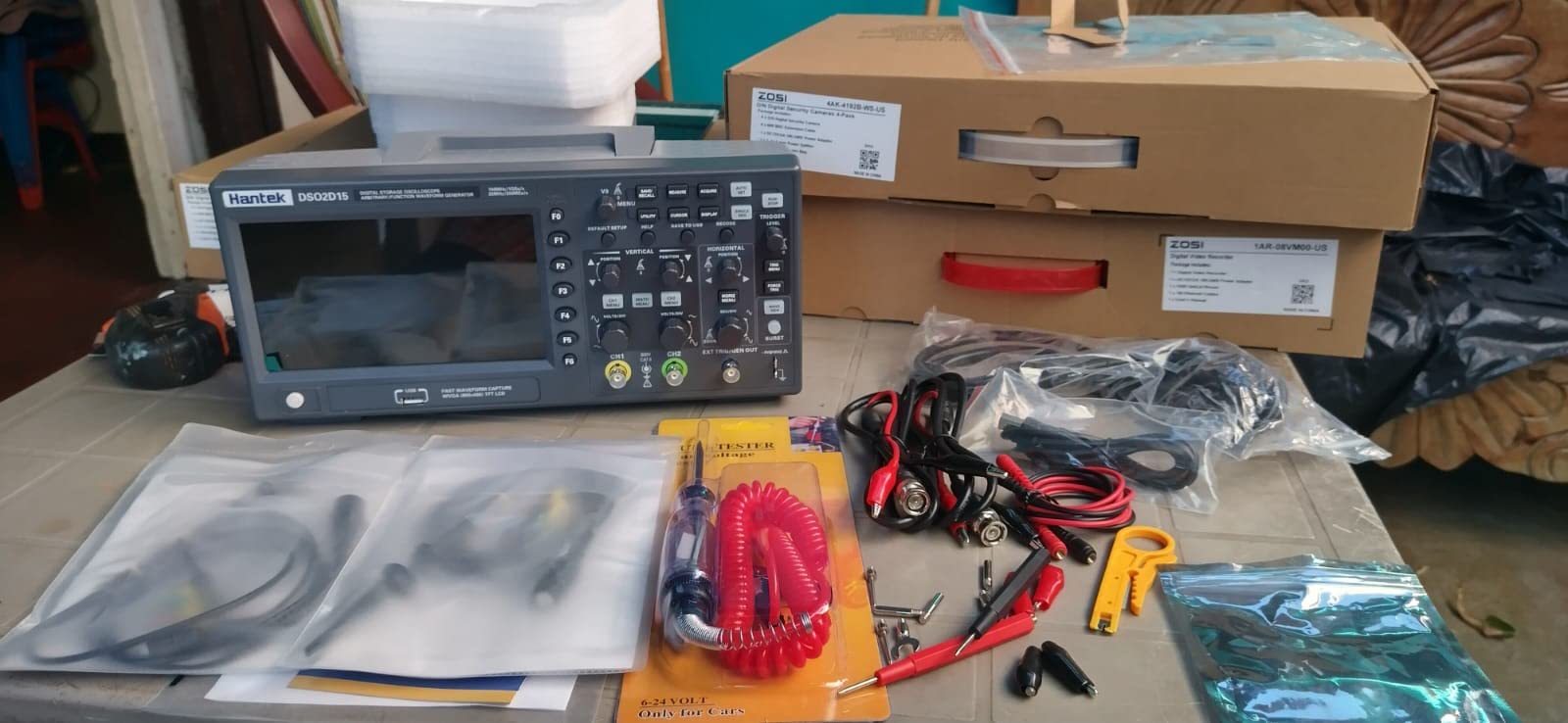
Front panel usability is better than the price suggests. Colour-coded channel buttons, knobs that zero-reset, and a dedicated Default Setup button mean a beginner can recover from a confusing screen state without a manual, which matters more than an extra spec when you are learning.
The listing describes it as a commissioning instrument for communication, aerospace, defence, embedded systems, computers, research and education, and the package includes a square-wave output for probe compensation. Firmware updates and a 68-page manual are downloadable from Hantek, and owners rate it higher once the firmware is current.
Who the Hantek DSO2D15 suits?
It suits audio builders, amplifier designers and anyone learning filter theory, because the built-in arbitrary waveform output means you can feed a circuit a controlled sweep instead of hunting for a function generator. Four and a half pounds and a 12.44 by 4.33 by 5.91 inch footprint also make it a small bench resident.
It suits students who need serial protocol decoding and a broad trigger set without a large budget, and the Default Setup button keeps the learning curve gentle for a first bench scope.
Where the Hantek DSO2D15 falls short?
The processor is slower than the competition, and the display refresh lags behind the acquisition. On a fast edge you will feel that lag. Accuracy also degrades above roughly 5 MHz, and Auto Set does not handle every signal, so you will be adjusting by hand more than you would like.
It can lock up when settings are misconfigured, and recovery means a power cycle. Front and rear USB share a single port, so only one connection is possible at a time, and the firmware update utility is Windows-only. Several owners treat it as a stepping stone toward a Rigol or Siglent if they move to intensive use.
How to Choose an Oscilloscope: 8 Specs That Actually Matter?
Bandwidth is the first filter, because a scope cannot show you a frequency it was not built to pass. The second is sample rate, then channel count, and after that the things that decide whether you enjoy using the thing. Here is the order we would actually work through, with the thresholds that matter for hobby work rather than professional work.
Bandwidth. Pick a bandwidth of at least five times the highest frequency you expect to measure, and remember the 5x rule is about the highest harmonic you care about, not the fundamental. A 3.3 V digital bus has edges far faster than its clock, which is why 50 MHz is a sensible floor for microcontroller work rather than a luxury.
Sample rate. Aim for at least twice the bandwidth, so a 100 MHz scope should sample at 1 GSa/s or better. The real limit is the effective rate with all channels active, which is where the Siglent SDS1104X-E dual-ADC architecture earns its place.
Channels. Two is enough for most beginners, four is enough for almost everything else. Every extra channel is a probe, a ground clip and a place for the ground clip to cause a problem, so count the signals you genuinely need to see at once.
Record length. Deeper memory finds intermittent faults. Somewhere around 10 Mpts or more is where catching a glitch that occurs once in a thousand cycles stops being luck.
Vertical resolution. Eight-bit is the entry standard; twelve-bit makes a small signal riding on a large one visible instead of lost in the quantisation steps.
Triggering. Look for edge, pulse width and timeout triggers at minimum, plus holdoff. Single-shot capture matters if you work with transients, because a repeating trigger will never hold a one-off event still.
Built-in function generator or waveform output. A generator on the scope saves a desk, a budget and a USB dependency, and it gives you a known source to check the instrument against.
Software and serial decoding. Check whether protocol decoders are included and whether the software still receives updates. Open-source tools such as OpenScope, OpenHantek and H-Scope exist for several USB scopes, which is a useful safety net if a vendor driver ages badly.
Two further questions answer themselves once the above is settled. Do you need isolation? If your work touches mains or battery-powered circuits in a floating state, an earth-referenced bench scope can destroy the circuit or the instrument, and a genuinely isolated scope is a different purchase. And do you want a multimeter too? A scope does not replace one, so a lot of hobbyists buy both; our guide to the best multimeters for electronics hobbyists covers what to pair it with.
Is 100 MHz Enough? Bandwidth and Sample Rate Rules?
Yes for most hobby work. A 100 MHz scope handles 5 V microcontroller logic, audio signal chains, sensor interfaces, CAN bus diagnostics and the slower half of switching power work. Move to 200 MHz for switch nodes, motor control and inverter work, and only look higher when you are chasing RF or fast edge phenomena.
The rules behind that answer are simple. The 5x bandwidth rule means choose five times the highest frequency of interest. The 2x sample rate rule means the sampling rate should be at least double the bandwidth, so a 100 MHz scope wants 1 GSa/s or more, and a 200 MHz scope wants 2 GSa/s or more.
Arduino, ESP32 and 5 V microcontroller logic: 20 to 50 MHz. The clock is slow; the edges are not.
Audio electronics: 20 to 50 MHz. In-band audio needs far less, but harmonics and switching supplies in the same box need more.
Switching power supplies and DC converters: 100 MHz as a minimum, 200 MHz for real comfort.
Automotive and CAN bus diagnostics: 50 to 100 MHz.
Motor control and inverters: 200 MHz.
RF and SDR work: 200 MHz and above, and often a dedicated software-defined radio instead.
USB Scope vs Benchtop Scope: An Honest Take
A USB scope is genuinely good enough for a large share of hobby projects, and the honest answer depends on the signals you measure rather than the label. A 10 MHz unit like the PicoScope 2204A is excellent for logic levels, buses and slow analog, and useless for switch nodes. A bench scope with knobs, a big screen and deep memory is what you want the moment you work on anything analog or fast.
Laptop only, digital work, tight budget: a USB scope. You gain 40 protocol decoders, a built-in generator and a spectrum analyser on a screen you already own. You give up raw bandwidth, memory depth and any ability to work when the laptop is shut.
Mixed work, a small desk, occasional bench sessions: a compact bench scope such as the Siglent SDS1202X-E or the Rigol DS1202Z-E. Physical controls and a real display beat a software interface every time you are adjusting a trigger.
Serious projects, analog or power electronics, long sessions: a bench scope with four channels and deep memory. Deep record length is what finds the fault that only appears once every few thousand cycles, and no amount of screen quality compensates for missing it.
Handheld 3-in-1 devices sit between the two. They are the right answer for automotive, field and speaker work where a bench is not an option, and the wrong answer for anything you intend to spend a whole weekend on.
Brand by Brand: Siglent, Rigol, FNIRSI, HANMATEK, Pico, ZOYI and Hantek
On the question of the best brand for oscilloscopes, the forum consensus on this topic is consistent enough to state plainly: for a hobbyist, Siglent and Rigol are the two names that come up. A long-running thread on the Arduino forum describes them as the market leaders in low-cost, decent instruments. Everything else on this list occupies a more specific niche, and the differences between them are real.
Siglent is the strongest all-round choice in this roundup. Both the SDS1202X-E and SDS1104X-E hold high ratings with large review counts, both include standard serial decoding with no unlock step, and the four-channel model’s dual-ADC architecture and Ethernet web server are genuine engineering advantages. On the Arduino forum, Siglent is perceived as the better-looking, better-screen option. The recurring gripes are the over-sensitive select knob and slow decoded serial refresh at low message rates.
Rigol is the value-and-memory champion, and the source of the biggest brand controversy in this category. One widely read thread on r/embedded opens by warning people to avoid Rigol because they are cheap for a reason, and contrasts them favourably with Keysight scopes on user friendliness. Other threads treat the DS1054Z as the default entry point. Both are describing real experience: the DS1054Z delivers 24 Mpts, a 30,000 wfms/s capture rate and standard decoders, while the fan noise, the encoder that skips a step, and occasional USB or unit hangs are exactly the reliability friction that warning refers to. For what we would call light and intermittent bench use, we would still recommend it. For a scope you will leave running for days capturing a rare fault, the Siglent is the calmer choice.
FNIRSI occupies the value and portable tier with two very different bodies here. The 2C53T is the cheapest genuine three-in-one available and doubles as a capable multimeter. The 1013D Plus is a portable scope with a genuinely large 7-inch touchscreen and 100 MHz of bandwidth. Both attract a higher share of one-star reviews than the bench scopes, and in the 1013D Plus the pattern points at firmware and touch responsiveness rather than hardware.
Pico Technology is the software-first brand. Free lifetime updates, cross-platform PicoScope software and 40 included decoders mean the hardware is rarely the limiting factor. The 10 MHz ceiling on the 2204A is the trade-off, and it is a deliberate one: you are buying a software ecosystem that keeps working.
HANMATEK, ZOYI and Hantek fill the field and economy gaps. HANMATEK builds genuinely light, capable handhelds. ZOYI leads with the multimeter and adds a scope that reviewers treat as a bonus. Hantek covers the economy bench tier with more trigger modes and a waveform output than the price suggests, at the cost of a slower processor. All three ask you to accept a slower refresh rate or narrower bandwidth in exchange for cost or portability.
Mistakes Every Beginner Makes
Clipping the ground clip to a live or mains circuit. This is the one that can destroy equipment or start a fire. Bench scope channels share an earth-referenced ground, so attaching the clip to a hot conductor shorts that node to earth through the scope. If your project involves mains or a floating battery, you need a genuinely isolated and differentially capable instrument, or a differential probe.
Using a 1x probe on a signal you expect to be fast. A 1x probe gives more detail on small signals but far less bandwidth, and it loads the circuit hard. Start on 10x, which is the default reason most probes ship labelled that way.
Skipping probe compensation. Every scope ships a calibration square wave output. Hook the probe tip and ground to it, attach a 1 MΩ reference to the probe tip, and adjust the compensation screw until the square wave is flat on top with no overshoot or droop. A badly compensated probe flatters you into thinking the circuit is wrong.
Believing the headline bandwidth. Several scopes on this list quote a maximum mode that the spec sheet qualifies elsewhere, and the ZOYI ZT-703 is the clearest example, with 30 MHz normal and 50 MHz high-speed modes. Read the full specification rather than the marketing number.
Ignoring the sample rate with channels active. The headline rate is often single-channel. Check the effective rate when all channels are on, which is where the dual-ADC design in the SDS1104X-E pulls ahead.
Aliasing and slow acquisition. A waveform that is not steady can be an artefact of insufficient sampling, and a low waveforms-per-second capture rate can skip glitches entirely. Increase record length, use single-shot for transients, and check persistence before concluding the circuit is faulty.
Buying on bandwidth alone. Screen readability, trigger controls and probe quality determine whether you can actually find a fault. A bigger bright display and physical knobs are worth more to most hobbyists than a doubled bandwidth figure they will never use.
Frequently Asked Questions
What is a good oscilloscope for a hobbyist?
A good oscilloscope for a hobbyist needs at least 50 MHz of bandwidth, two analog channels, 1 GSa/s sampling or better, and protocol decoders for the buses you use. Our overall pick is the Siglent SDS1202X-E at 200 MHz with a 14 Mpts record length. For 5 V microcontroller and audio work, a 50 MHz four-channel unit is genuinely enough.
What is a good, cheap oscilloscope for hobbyists?
The FNIRSI 2C53T is the lowest-cost option here with a genuine three-in-one design, pairing a 50 MHz two-channel scope, a 19999-count multimeter and a DDS signal generator in one 400 g battery-powered body. The Rigol DS1054Z is the route to a real bench scope instead, offering 50 MHz, four channels and 24 Mpts of memory. Below that tier, accuracy above a few MHz becomes the limiting factor.
What is the best brand for oscilloscopes?
For a hobbyist, Siglent and Rigol are the two strongest brands. Siglent generally wins on channel count, dual-ADC sampling and screen quality, and includes all standard serial decoding. Rigol wins on memory depth, capture rate and value. Pico leads on software, with free lifetime updates and 40 included protocol decoders.
Is a 100 MHz oscilloscope enough?
Yes, for most hobby work. A 100 MHz scope covers 5 V microcontroller logic, audio, sensor interfaces, CAN bus and much of the slower switching power territory. Move to 200 MHz for switch nodes, motor control and inverters. Use the 5x rule: choose five times the highest frequency of interest, and at least twice the bandwidth in sample rate.
What is the best oscilloscope for a beginner?
The Siglent SDS1202X-E is our beginner and overall pick because 200 MHz of bandwidth, a 14 Mpts record length and standard serial decode mean it will not be the limiting factor in your learning. The FNIRSI 2C53T is the better first purchase if you also need a multimeter and a signal generator on a tight budget.
How do I know what oscilloscope to buy?
Work through eight criteria in order: bandwidth, sample rate, channel count, record length, vertical resolution, trigger modes, whether you want a built-in generator, and whether the software and protocol decoders are still supported. Apply the 5x bandwidth rule and the 2x sample rate rule, and count the signals you genuinely need to see at the same time.
Is a USB oscilloscope good enough for hobbyists?
For logic levels, serial buses and slow analog signals, yes. A USB scope such as the PicoScope 2204A includes 40 protocol decoders, a spectrum analyser and a function generator in a five-ounce body. Its 10 MHz bandwidth and 8 kS memory rule it out for switch nodes, ringing above a few MHz and power electronics work, where a bench scope is the better purchase.
Conclusion: Your First Scope Should Grow With You
If you want one recommendation from this roundup of the best digital oscilloscopes for hobbyists, take the Siglent SDS1202X-E. Two hundred megahertz, a 14 Mpts record length and standard serial decoding give you room to grow well past the point where a 50 MHz unit starts to hide things.
Add the Siglent SDS1104X-E instead if your work involves more than two simultaneous signals, and the Rigol DS1054Z if deep memory at a lower bandwidth matters most to you. If money is the real constraint, the FNIRSI 2C53T is a complete first bench in a single body, and the PicoScope 2204A turns a laptop into a credible measurement setup for digital work. Whatever you choose, check the probe compensation output on day one and never attach that ground clip to a live circuit.