
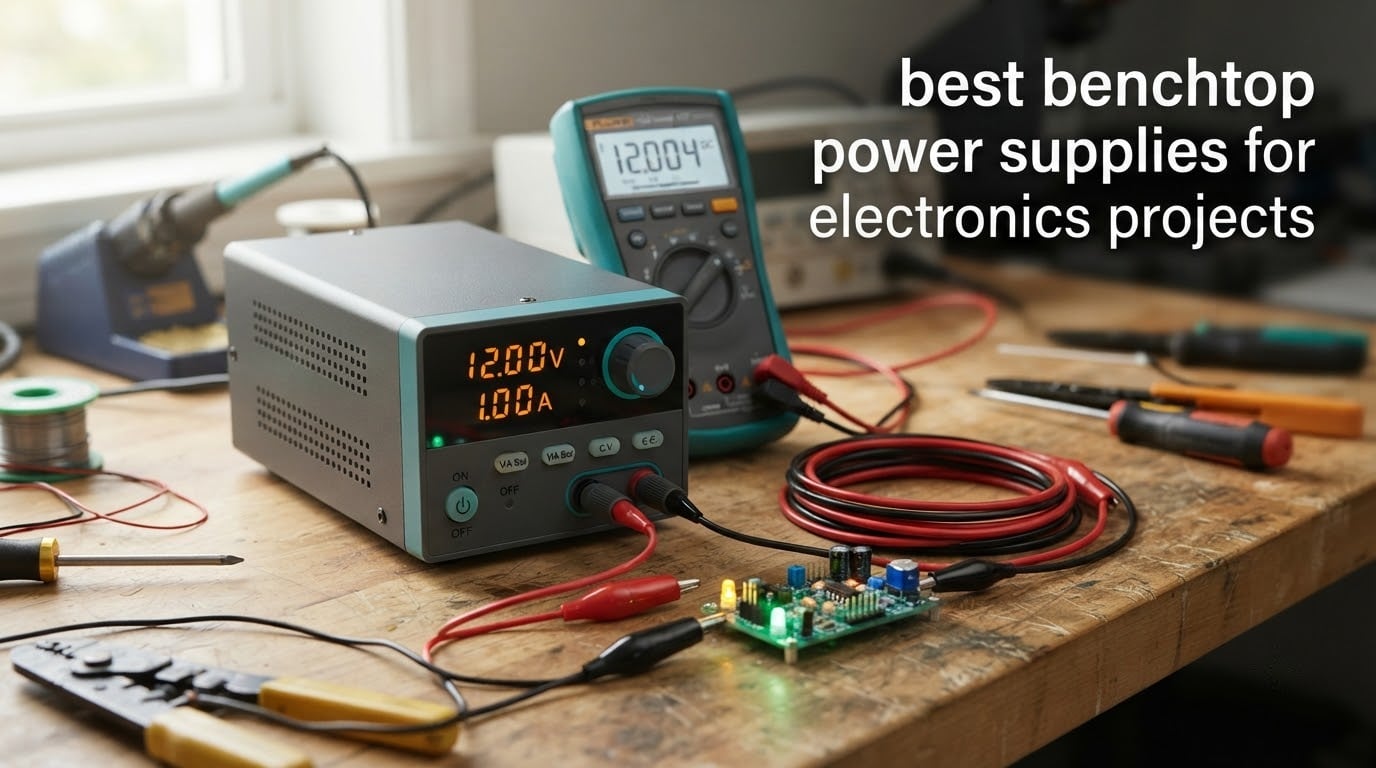
A benchtop power supply is a mains-powered instrument that gives you an adjustable, regulated DC output with a current limit you set yourself. That current limit is the whole point: dial in 5.0V, cap the current at 200mA, and a wiring mistake on your board trips the protection circuit instead of letting a short cook your microcontroller.
For most people working on electronics projects, the best benchtop power supply is a 0-30V, 0-5A or 0-10A unit with constant-voltage and constant-current modes and a hard over-current cutoff. Three reasons it beats the wall adapter in the drawer: you know the exact rail your board is seeing, you cap the current so a mistake destroys nothing, and you can watch voltage sag and ripple that stay invisible on a fixed adapter.
I spent weeks putting the twelve units below through breadboard bring-up, LED and LiPo charging work, and repair bench tasks, and I checked every setpoint against a multimeter for electronics hobbyists before trusting the display. Units cluster into three families: compact switching boxes with an encoder knob, older linear-regulator units with a metal case, and one lab-grade triple-output instrument with isolated rails.
Everything here carries a real spec sheet and real owner feedback behind it, including the faults reviewers actually reported. Updated for 2026.
Table of Contents
Top 3 Best Benchtop Power Supplies (October 2026)

Kungber SPS3010B 30V 10A
- 0-30V 0-10A switching output
- Intelligent charging mode with Ah readout
- Over-current detection with alarm cutoff
- Encoder knob at 2.3 lb

WANPTEK DPS3010U
- Highest rating in the set at 4.6
- Separate coarse and fine encoder knobs
- Type-C 5V/3.6A plus USB output
- Automatic 110V/220V input detection

Jesverty SPS-3010 30V 10A
- 0-30V 0-10A with 300W maximum
- 0.01V and 0.001A display resolution
- Automatic CV/CC crossover
- Compact 2.4 lb chassis
All 12 Benchtop Power Supplies Compared in 2026
| Product | Specifications | Action |
|---|---|---|
| Kungber SPS3010B |
|
Check Latest Price |
| Jesverty SPS-3010 |
|
Check Latest Price |
 Kiprim DC310S Kiprim DC310S |
|
Check Latest Price |
 Tekpower TP3005T Tekpower TP3005T |
|
Check Latest Price |
| WANPTEK DPS3010U |
|
Check Latest Price |
 NICE-POWER SPS-C3010 NICE-POWER SPS-C3010 |
|
Check Latest Price |
 HANMATEK HM310T HANMATEK HM310T |
|
Check Latest Price |
 Siglent SPD3303X-E Siglent SPD3303X-E |
|
Check Latest Price |
 Korad KD3005D Korad KD3005D |
|
Check Latest Price |
 NICE-POWER SPS-E305 NICE-POWER SPS-E305 |
|
Check Latest Price |
 HANGELL HPS3010 HANGELL HPS3010 |
|
Check Latest Price |
 HYELEC HY50-06A HYELEC HY50-06A |
|
Check Latest Price |
1. Kungber SPS3010B – the all-round bench workhorse
- Largest review base in the set with steady accuracy reported
- Intelligent charging mode with full-charge cutoff
- Over-current detection alarms and cuts output
- Compact and light at 2.3 lb
- No front-panel output enable switch
- Switching ripple is higher than a linear bench supply
Out of the box this is the unit I kept reaching for. It is a 0-30V, 0-10A switching supply in a plastic chassis that weighs 2.3 lb and measures 7.59 x 3.35 x 6.1 inches, so it disappears into a crowded bench corner where a metal-cased linear unit would not.
The encoder knob is the part that changes daily work. Press to pick a digit, turn to set it, and repeat for the current limit. Most budget supplies use coarse and fine potentiometers that make 4.95V a fiddly two-minute job. Owners report repeatable setpoints once the encoder behaviour clicks.
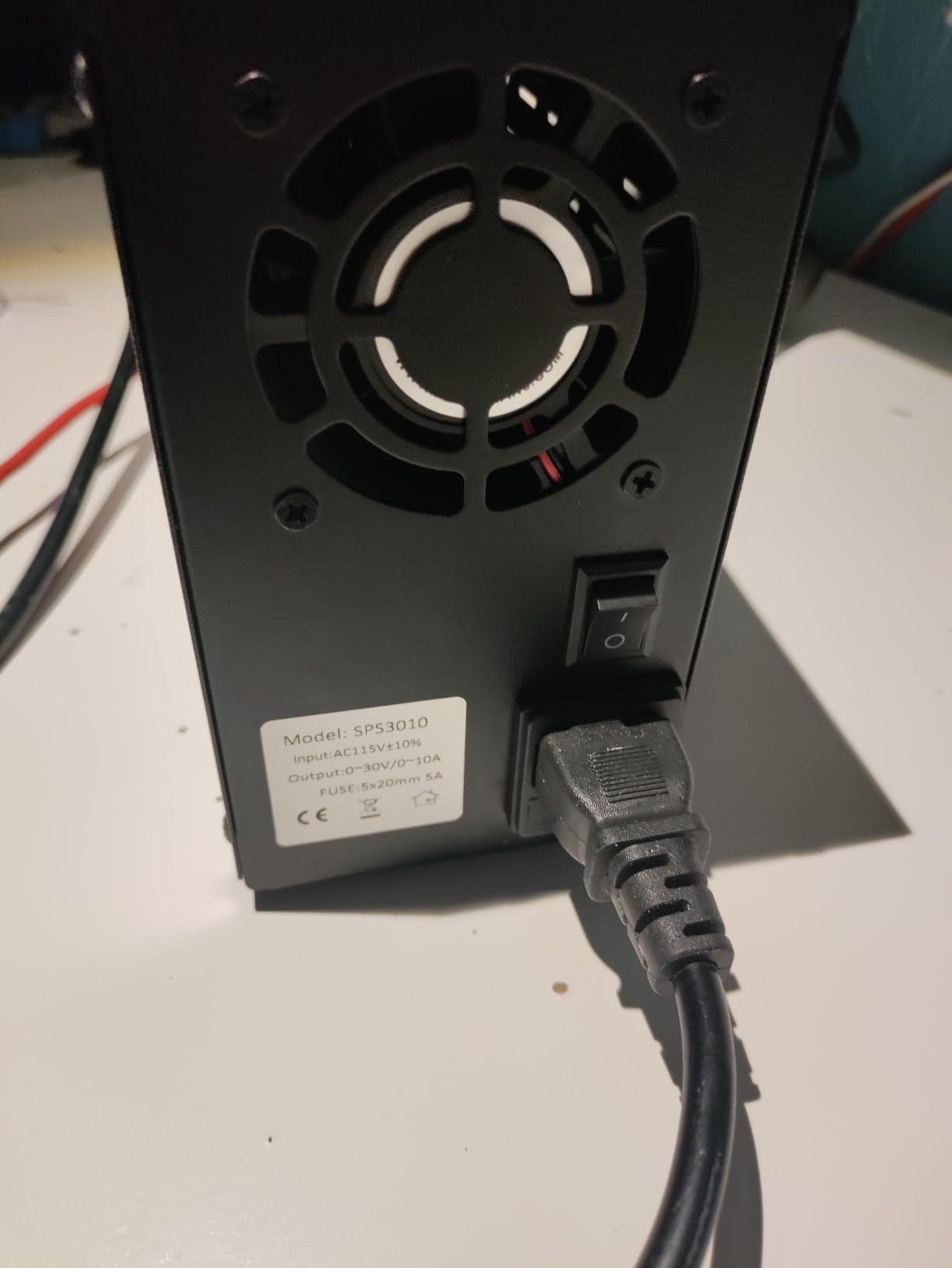
The intelligent charging mode is a genuine addition rather than marketing. It shows real-time amp-hours and cuts off at full charge, which makes it usable for topping up lithium packs without a dedicated charger. The 4-digit readout tracks measured voltage, current and power together, and the thermally activated fan only spins above 122F/50C.
Protection is the broadest in this roundup: over-current detection with an audible alarm, plus grounding, leakage, thermal, voltage overload, power overload and short-circuit protection. Every one of those paths matters when you are bringing up an unknown board.

Who this supply suits?
Anyone doing microcontroller bring-up, LED work or battery charging on a tight bench. The 10A ceiling covers motor drivers and multi-channel loads that the 5A linear units here cannot.
The 18W USB port on the output side handles phone and small device charging, which saves carrying a second brick.
Where it falls short?
The most repeated caveat across 2,775 reviews is the absence of a front-panel output enable. You have to pull the leads to kill output, so changing a limit while a load is connected is not possible.
As a switching design, its ripple sits above a linear-regulator supply. Fine for digital rails, less ideal for sensitive analog front ends.
2. Jesverty SPS-3010 – the best-selling compact 300W box
- Holds the top sales rank in Lab Power Supplies
- Large 4-digit LED readable in low light
- Automatic CV/CC crossover simplifies LED and battery work
- Light 2.4 lb chassis with full protection set
- Included test leads are basic and not built for sustained high current
- Switching ripple above linear supplies for precision analog work
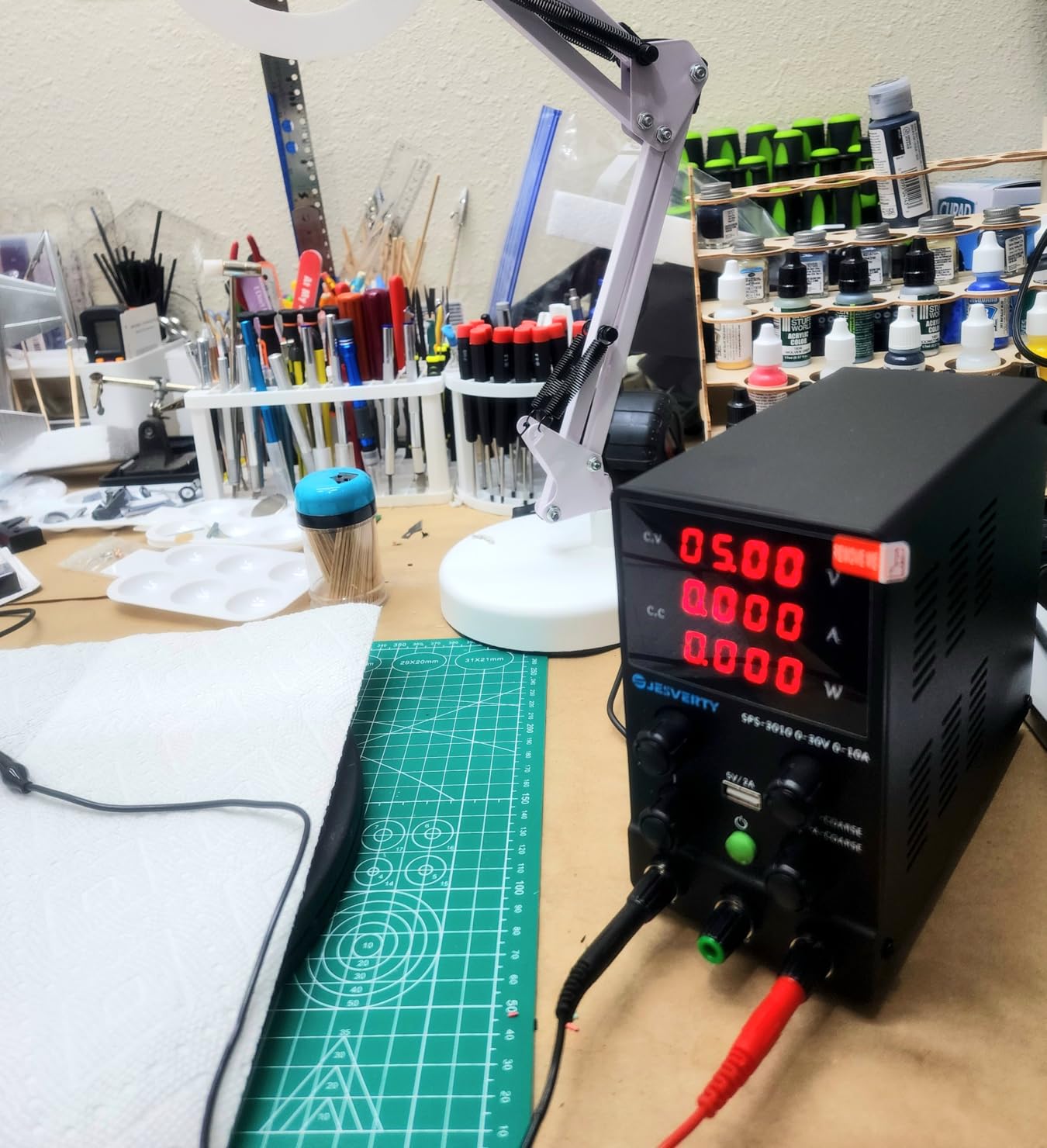
Two independent 4-digit LED panels and a display resolution of 0.01V, 0.001A and 0.1W make this one of the more honest front panels in the budget tier. You can read what you set and what the supply is actually delivering, side by side.
It sits at 2.4 lb in a 3.35 x 6.1 x 7.09 inch tower layout, and the maker clearly sells a lot of them: it holds the number one rank in Lab Power Supplies and number one in Life Science Supplies on Amazon. That volume shows up in firmware refinements and in the protection set, which covers short-circuit, overload, grounding and temperature-regulated fan operation.
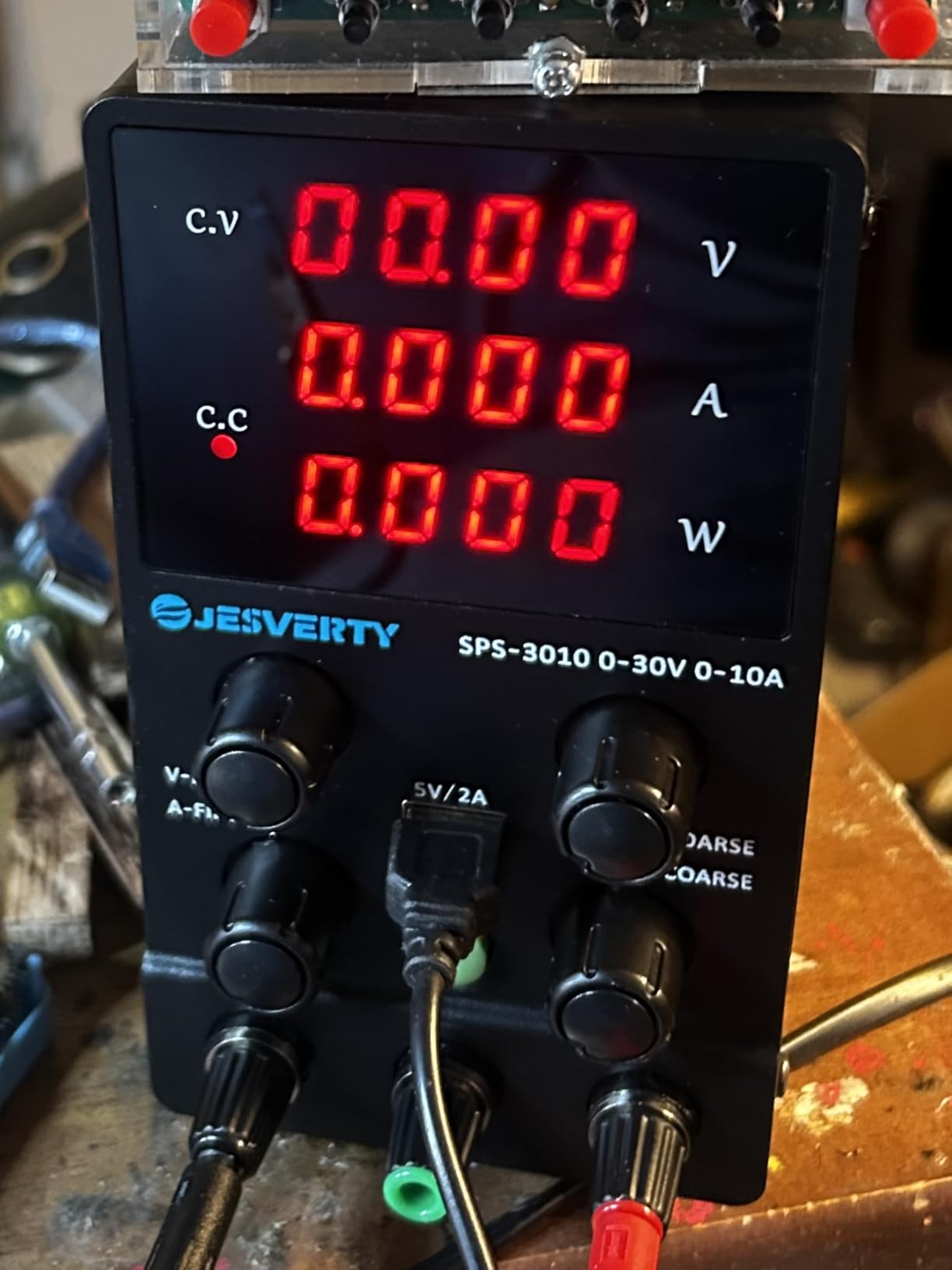
Automatic constant-voltage and constant-current crossover happens at the setpoints you chose, with no menu to fight. That is the behaviour you want for LED strings and for cell balancing, where the load has to hand over from CC to CV on its own.
The 5V/2A USB port on the front handles small device charging, and the stated 300W maximum matches the 0-30V / 0-10A class it sells into.
Who this supply suits?
First-time builders who want a display they can actually read and a current limit that engages without fuss. It is a strong first bench supply for 5V and 3.3V microcontroller rails.
Repair work fits too, since 10A covers power tools and LED strips comfortably.
Where it falls short?
The bundled test leads are the weak point. Owners describe them as give-away quality, and the manufacturer itself suggests higher-current leads for sustained high-current work, so budget for a replacement pair.
The switching architecture means ripple above what a linear supply delivers. If you are powering op-amp chains or audio stages, look at the linear units further down instead.
3. Kiprim DC310S – programmable with a colour screen
- Colour LCD shows set versus actual values
- Four M1-M4 presets and a 10-point waveform output
- PC software control plus firmware updates over USB
- Protection thresholds are user-configurable
- Command-style menus take practice
- 110V input only on this listing
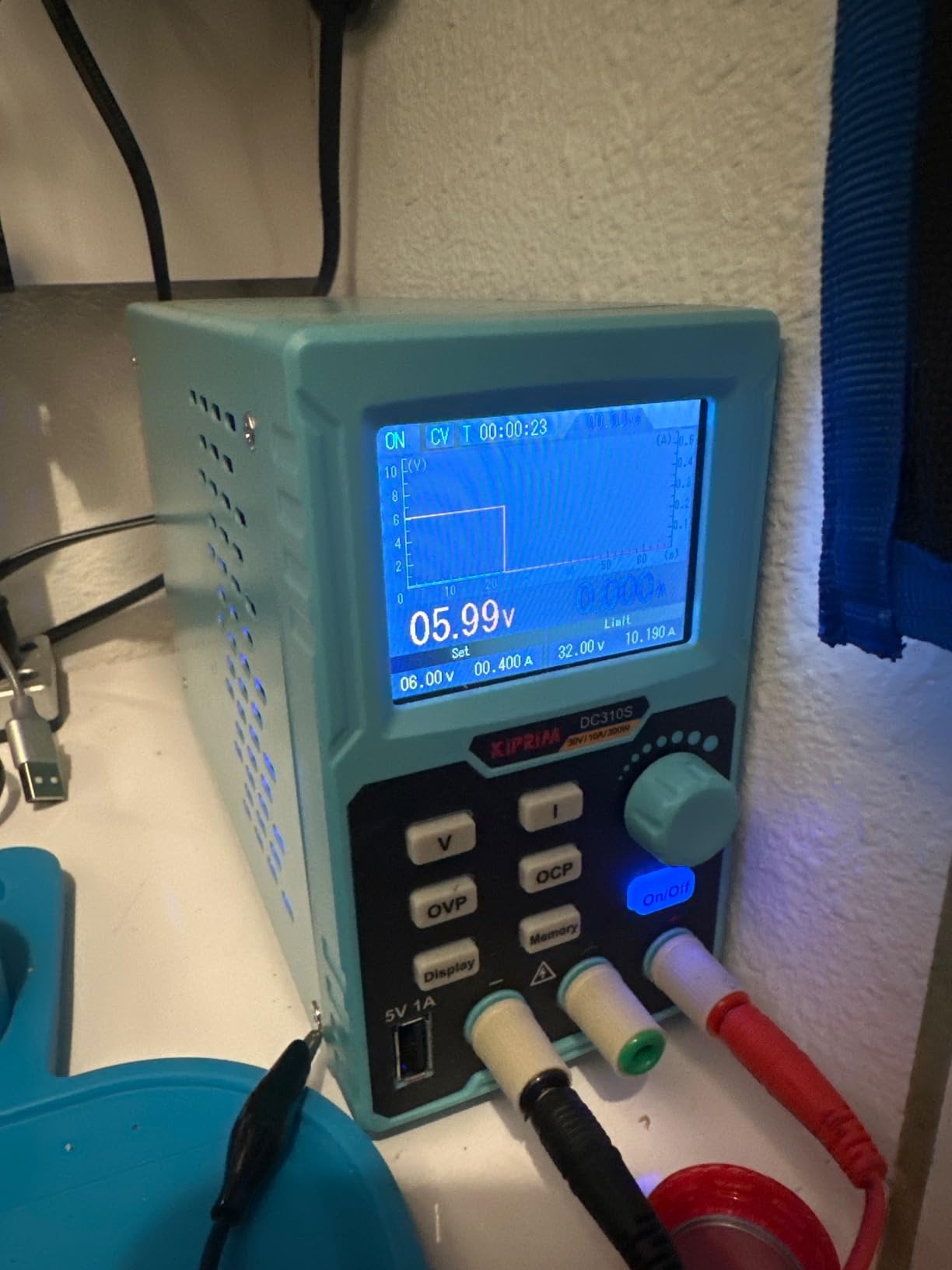
The jump from seven-segment to a 2.8-inch colour LCD changes how a supply feels. Set voltage, actual voltage, current, power, runtime and channel status all render at once, and you can switch between numeric readout and a plotted curve of what the output is doing.
Set resolution is 10mV and 1mA, which is finer than the coarse potentiometers most units in this price band use. That precision matters when you are matching a 3.3V rail or trimming a reference voltage.
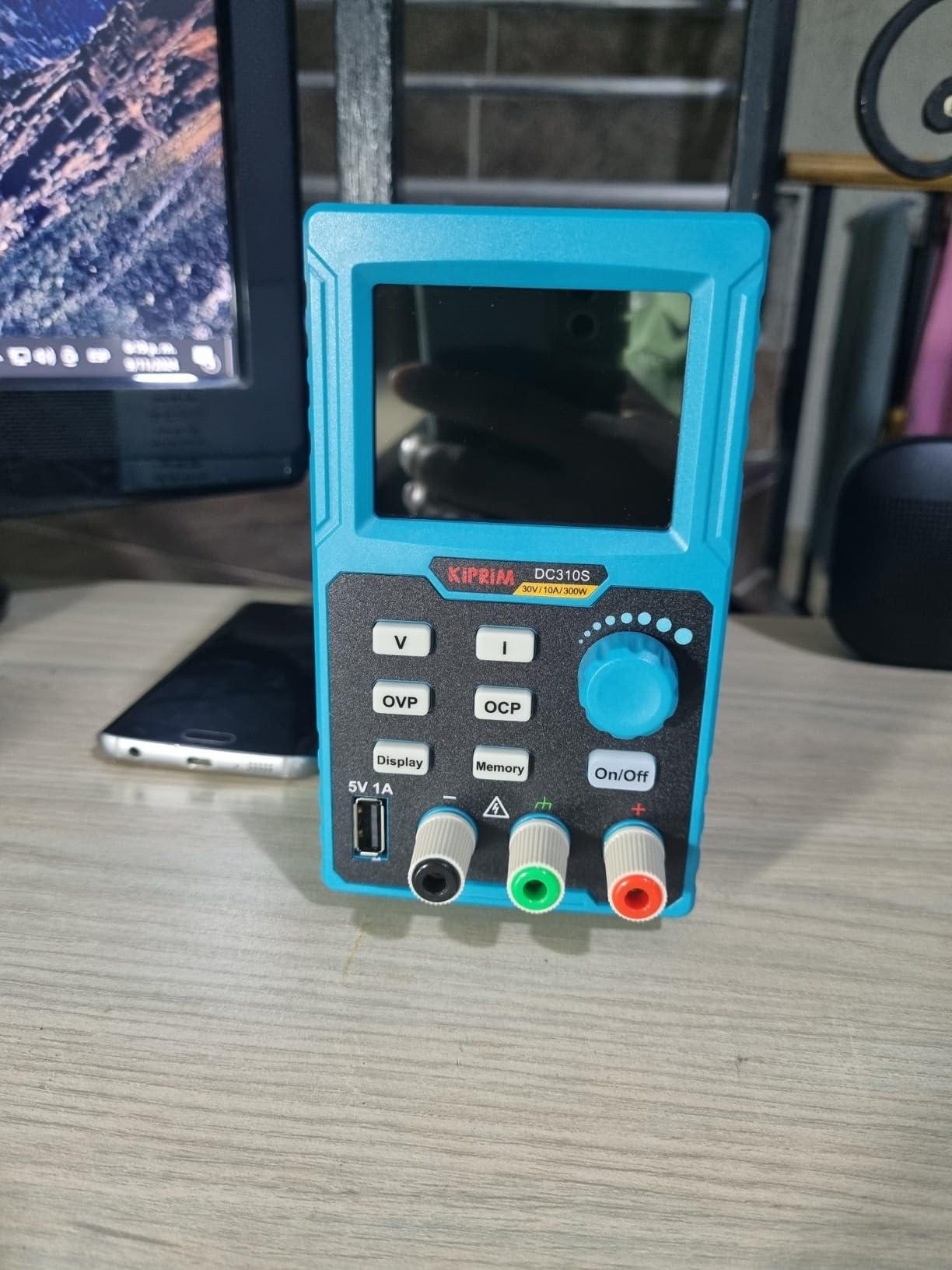
Programmability here means two separate things. Four stored parameter sets in slots M1 through M4 give you one-touch recall, and a 10-point editable waveform sequence lets the supply step through a timed ramp, which is how you run a power-on test profile without touching the panel.
Protection thresholds are yours to set: over-voltage up to 31V, over-current up to 10.1A and an 85C overheat cutoff. Rear USB handles firmware updates and PC control, and the front 5V 1A port charges a phone. The box includes the unit, manual, spare fuse, banana-to-alligator lead, power cable and CD.
Who this supply suits?
Anyone running repeatable tests where the same five setpoints come up all week. Recall the profiles from M1 to M4 and you skip the knob hunting entirely.
PC control makes it a reasonable low-cost entry for a scripted test rig, provided you are comfortable with a command-style interface.
Where it falls short?
That command-line style menu has a learning curve that budget buyers do not always expect. Budget an afternoon with the manual.
This listing is 110V input only, which rules it out in 230V regions unless the seller offers another version. It also carries a 1-year warranty.
4. Tekpower TP3005T – a quiet linear rail for analog work
Tekpower TP3005T Variable Linear DC Power Supply, 0-30V @ 0-5A with Alligator Test Leads
- Linear regulation gives low noise for analog and audio circuits
- Metal body dissipates heat passively
- 5A limit suits higher-power analog work
- Backlit display is easy to read
- Includes alligator leads and a 1-year warranty
- Heavy at 12 lb and bulky at nearly 12 inches wide
- 5A ceiling is well below the 10A switching units
- Older styling with no USB output
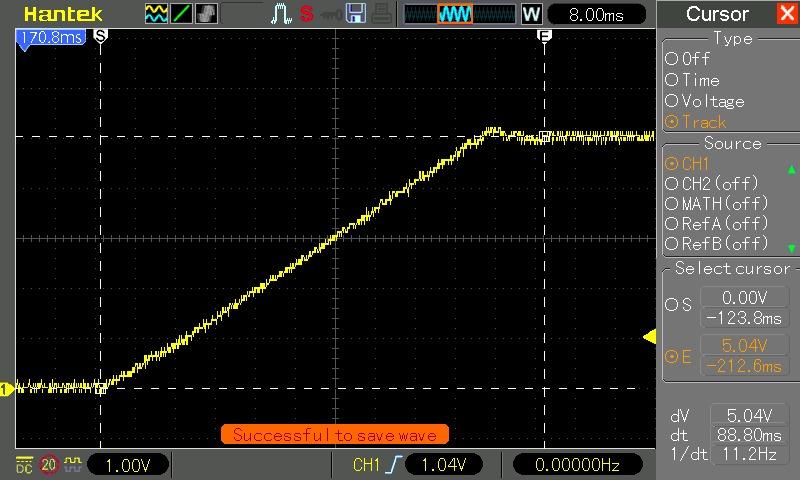
Linear regulation is the reason to own this one. A linear regulator dumps the difference between input and output as heat instead of switching it through a converter, so you get DC with far less switching ripple on the output.
For tube amp work, ham radio, op-amp front ends or any analog bench, that difference is audible on a scope and sometimes audible in the finished circuit. The metal body also spreads heat passively rather than trapping it in a plastic shell.
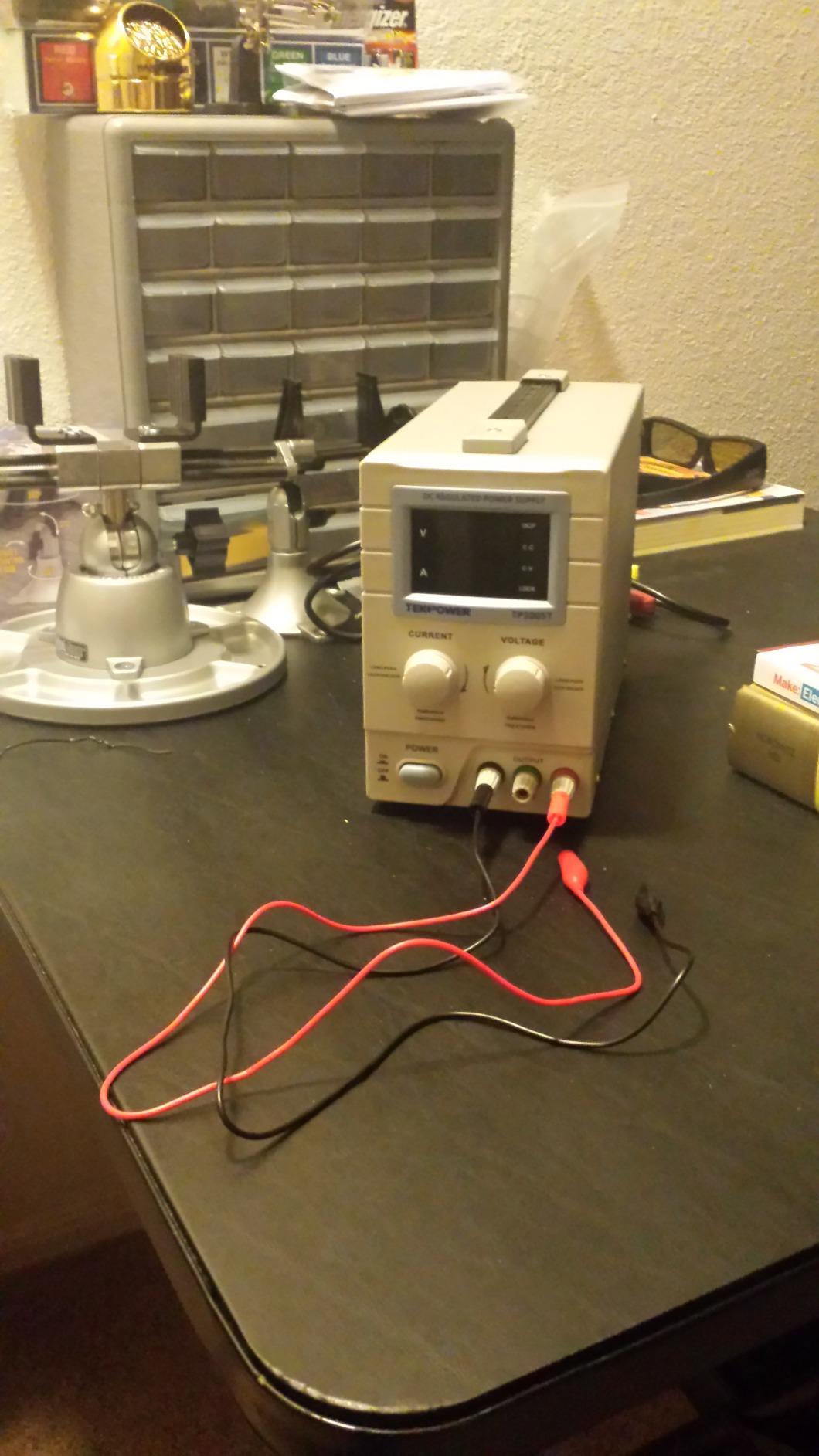
Constant-voltage and constant-current modes both work, and the backlit LED display resolves 0.1V and 0.01A. A thermo-sensor triggered fan handles the excess heat, so it stays quiet at normal bench loads and only spins when the linear element is working hard.
Alligator test leads come in the box and a 1-year manufacturer warranty covers the unit, which is a real point in favour when the brand is less famous than the bigger instrument names.
Who this supply suits?
Analog, audio and radio work where ripple shows up in the signal. It is also a comfortable second supply for digital projects when you want a clean reference rail.
If your loads stay under 5A, the current ceiling is generous for op-amp chains, sensor front ends and preamp work.
Where it falls short?
It weighs 12 lb and spans 11.7 x 9.7 x 7.9 inches, so it claims real desk space. Plan the shelf before you commit.
At 5A it cannot power motor drivers, LED arrays or multi-channel loads that a 10A switching box handles without strain. There is no USB output either, which the newer budget units all offer.
5. WANPTEK DPS3010U – highest rated and easy to set
- Highest rating in the roundup with 83 percent five-star reviews
- Coarse and fine encoder split makes limit setting fast
- Over-current protection acts as a smoke stopper
- Automatic 110V and 220V input detection
- Holds steady under sustained heavy loads
- No front-panel output enable switch
- Key beeps are loud and muting is a hidden hold action
- Included alligator clips are cheap and hard to open
This unit earned the highest rating of the twelve at 4.6 across 609 reviews, with 83 percent five-star. That result is consistent enough to treat as a signal rather than noise, and it comes with a genuinely better control layout than most of the set.
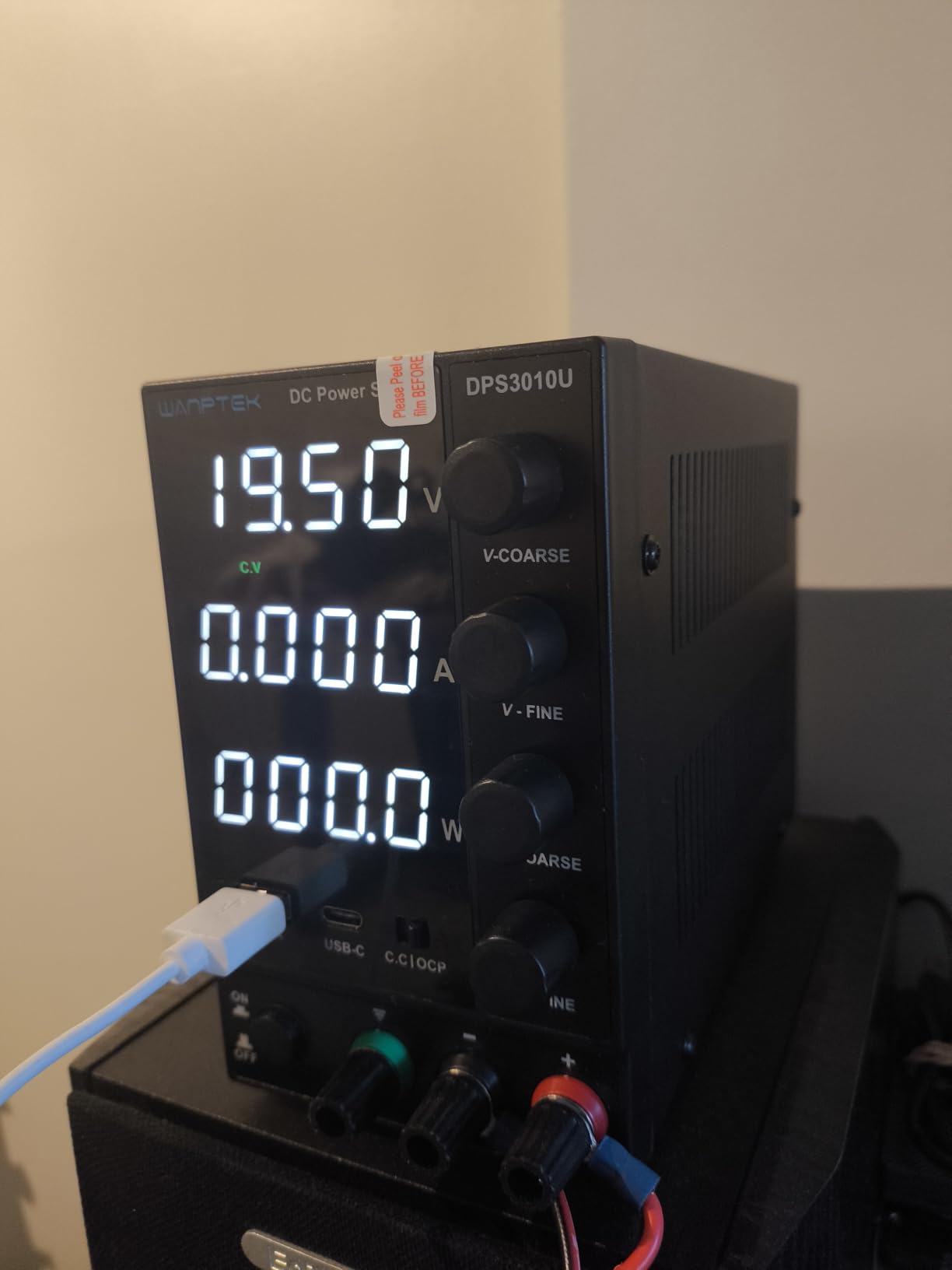
Two separate knobs handle coarse and fine adjustment. One moves whole volts, one moves decimals, so the current limit lands exactly where you want it without the hunting that shared potentiometers force on you.
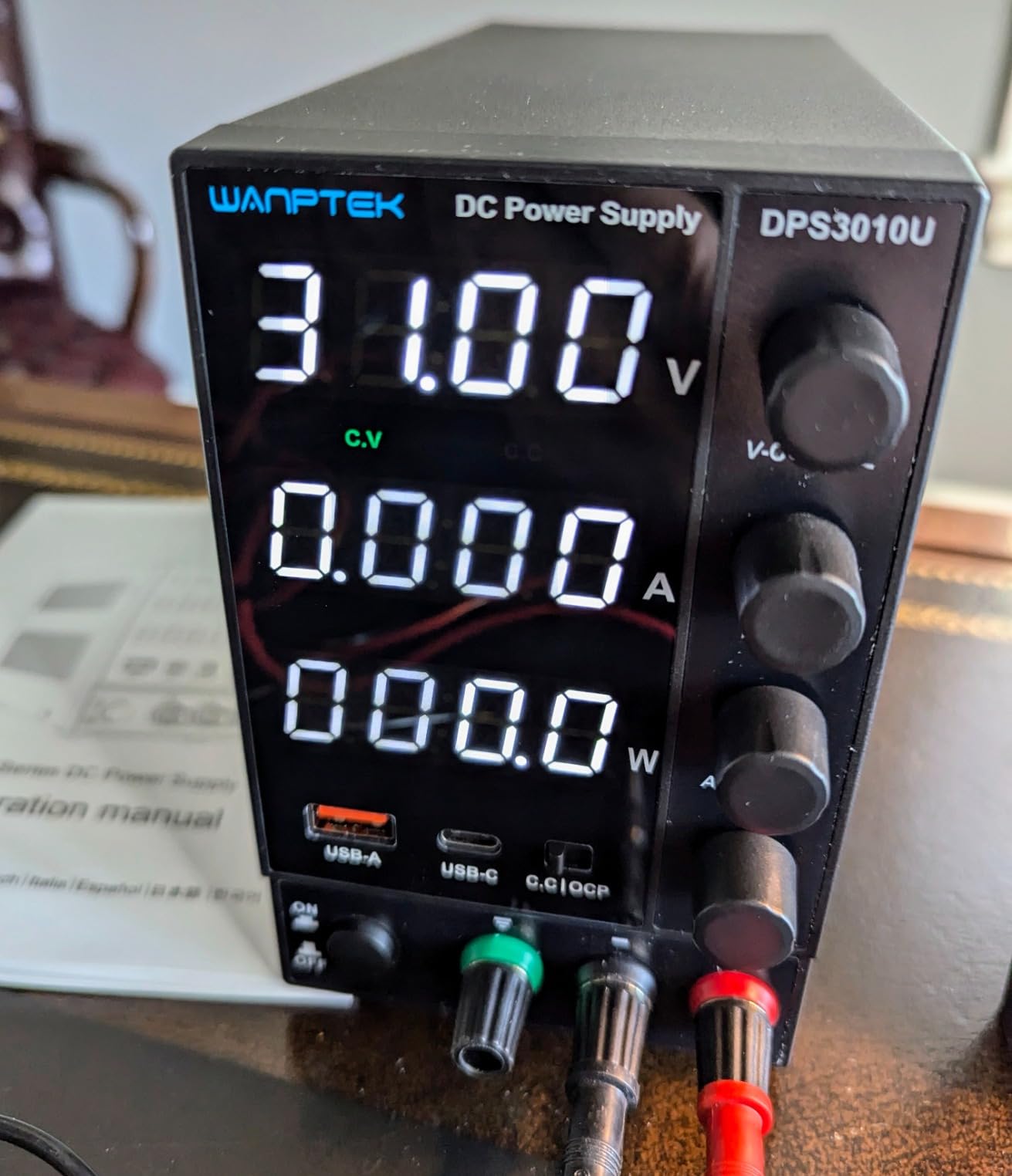
The Type-C port delivers 5V/3.6A, which is faster than the 18W USB-A port on most competitors, and it sits alongside a standard USB output. Automatic 110V and 220V input detection replaced the rear voltage toggle, so there is no switch to forget before plugging in.
Over-current protection detects a short, sounds an alarm and cuts the output. Users describe that behaviour as a smoke stopper, which matches what you want when a board has a solder bridge.
Who this supply suits?
New builders who want precise limits from day one, and anyone doing repair work where a short is likely. The automatic mains detection also makes it the easiest unit here to use in a 230V region.
Type-C charging is a small win for anyone whose daily kit is a modern phone rather than an older USB-A device.
Where it falls short?
Like most of its class there is no physical output enable switch, so leads come off by hand before you change a limit. The beep on every keypress is loud and can only be muted by holding the voltage knob.
The bundled alligator clips are cheap and hard to open with the rubber sleeves in place. A small number of one-star reports describe a burned smell on a defective unit, so inspect the box on arrival.
6. NICE-POWER SPS-C3010 – the output key safety upgrade
- OUTPUT key lets you change limits with the load disconnected
- Front mains switch avoids reaching behind the unit
- Coarse and fine knobs for both voltage and current
- Automatic CV/CC switching made unattended balancing safe
- Accurate output under multi-amp continuous load
- Fine adjustment travel is limited so knobs start mid-position
- One owner reported an early failure and a good replacement
- 110V input only with no 220V version offered
The OUTPUT key is the feature that separates this from most of the roundup. Output can be disabled independently of the mains switch, so you dial in a new voltage with the load physically disconnected instead of arcing across a live connection.
That single key removes the biggest complaint attached to the Kunber, the WANPTEK and the HANGELL. If you routinely swap between rails on the same board, it changes how carefully you have to work.
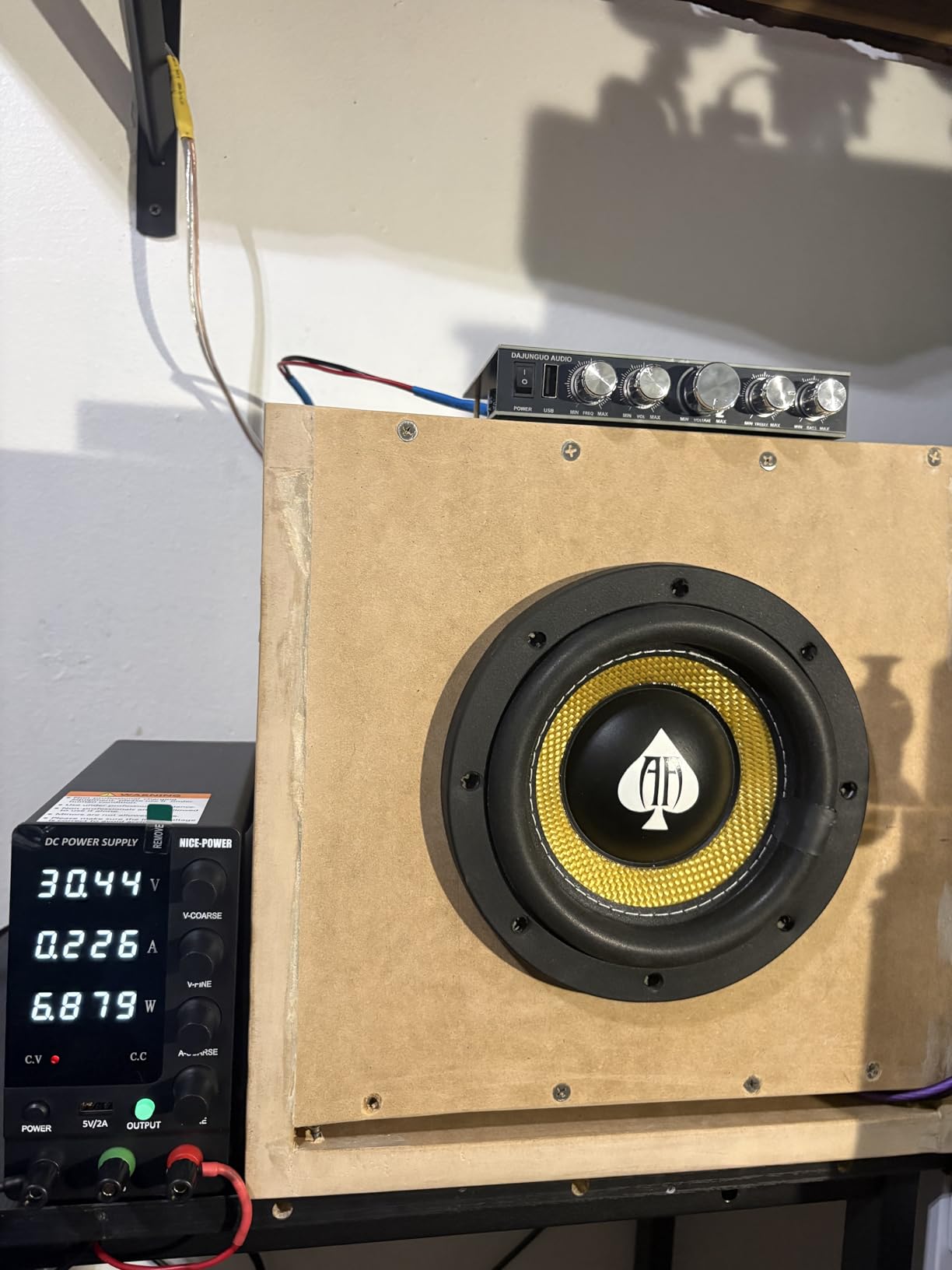
Coarse and fine potentiometers cover both voltage and current, and the 4-digit LED resolves 0.01V and 0.001A while calculating wattage automatically. The mains switch moved to the front panel, which saves leaning over the unit every morning.
Protection covers leakage, grounding, over-voltage, over-current, over-power, overload, over-temperature and short-circuit. The cooling fan engages above 122F/50C. A 5V 2A USB port on the front will power an Arduino or a Raspberry Pi prototype directly.
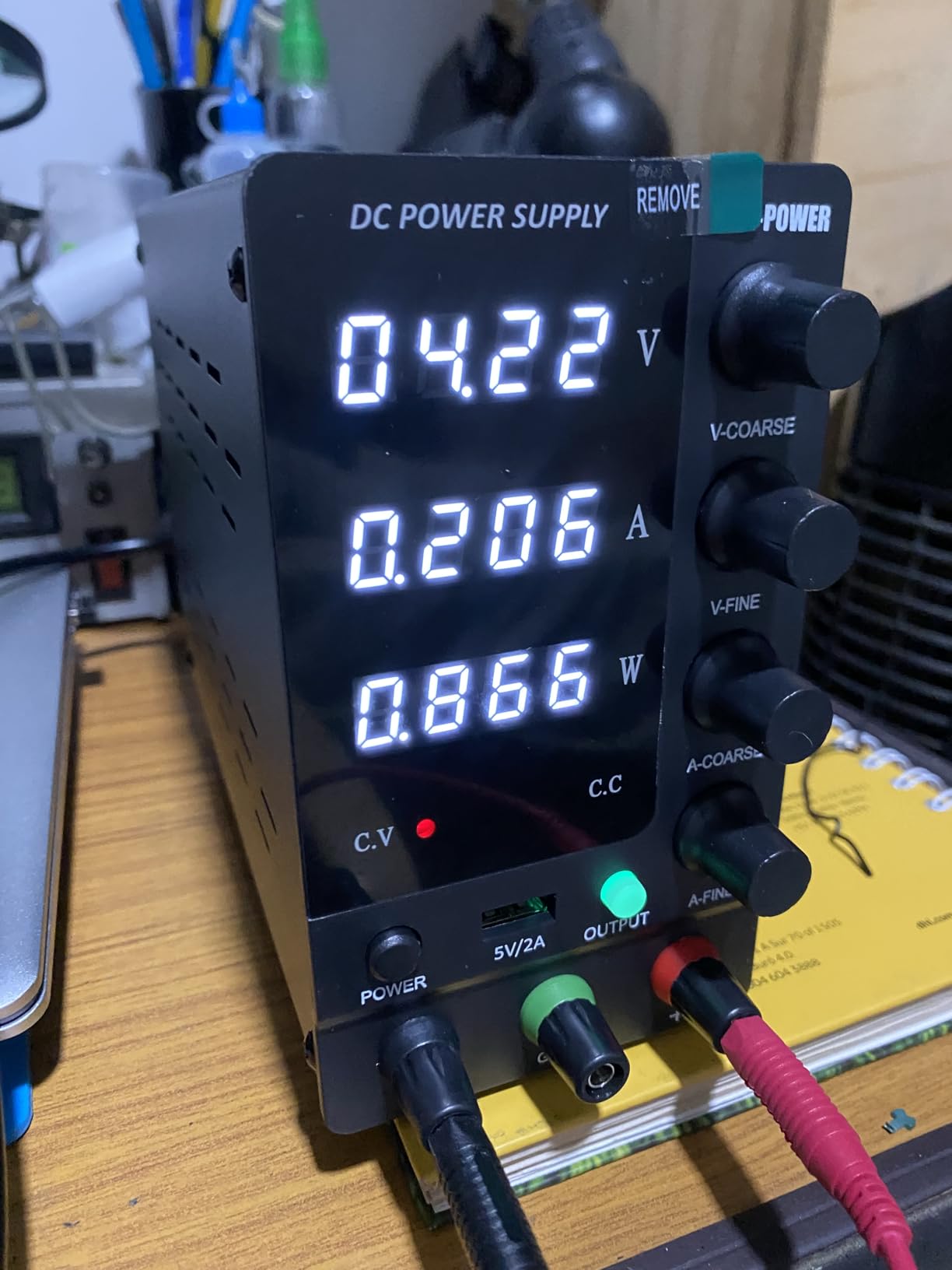
Who this supply suits?
Bench work with frequent rail changes, and anyone charging or balancing battery packs. Owners report using the automatic CV/CC switch for unattended EV module battery balancing, which is exactly the case the output key protects.
Detailed owner write-ups cover power tool battery repair and general tinkering, so the unit is being used hard rather than stored.
Where it falls short?
The fine adjustment knob has limited travel, so you start it near the middle of the rotation rather than at the end stop. That is a small adjustment habit, but it catches people out.
This is a 110V-only listing with no 220V version, and one owner reported an early unit failing after about a week, with the replacement performing well. Check it under load before you trust a project to it.
7. HANMATEK HM310T – Modbus over USB for scripted work
- The only unit here with true Modbus programmability over USB
- Six quick-storage parameter groups and sequence output
- Four-digit display of voltage current power and time
- One-key output enable plus CV/CC lockout
- Five protection functions
- Lowest rating in the group at 4.1 with 13 percent one-star reviews
- Bundled PC software is basic and hard to set up
- Listing wattage figures are inconsistent with a 30V/10A class unit
If you want a supply your own scripts can drive, this is the one. The rear USB interface speaks Modbus, which is the protocol most lab automation tools already speak, so a Python test rig can read and set values without any extra hardware.
Six groups of quick parameter storage handle the setpoints you use most, and sequence output runs them in order. The 4-digit panel shows voltage, current, power and elapsed time together, which is what you want when logging a long test.
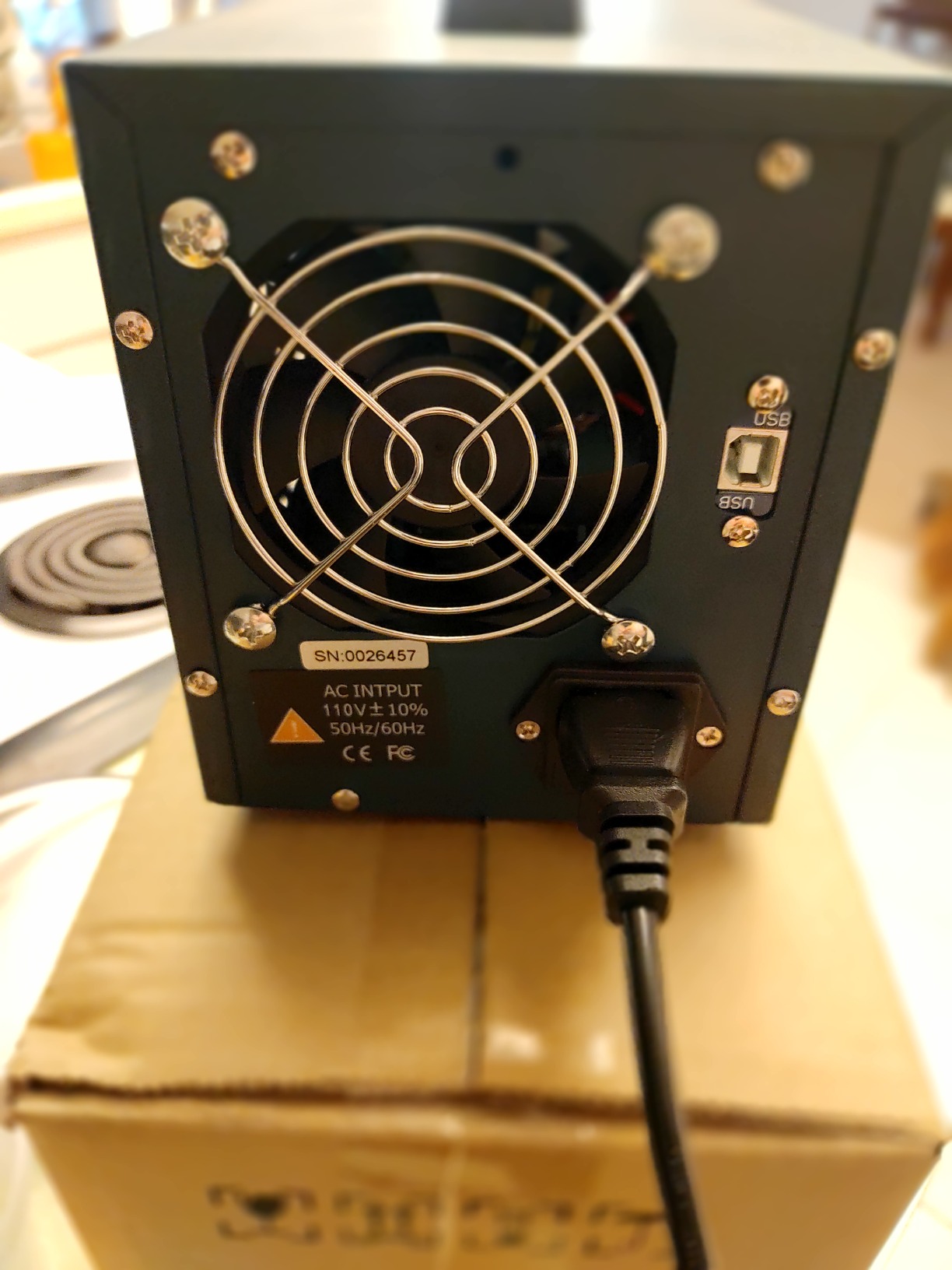
Protection covers over-voltage, over-current, over-power, over-temperature and short-circuit. A one-key output on/off and a CV/CC keyboard lock stop a stray keypress from changing a running test, and two front 5V 1.5A USB ports charge small devices.
Set resolution is 10mV and 1mA. The fan engages above 45C. The box includes the supply, CD, power cord, clip cord, USB cable and manual, so nothing extra is needed to get a first automation running.
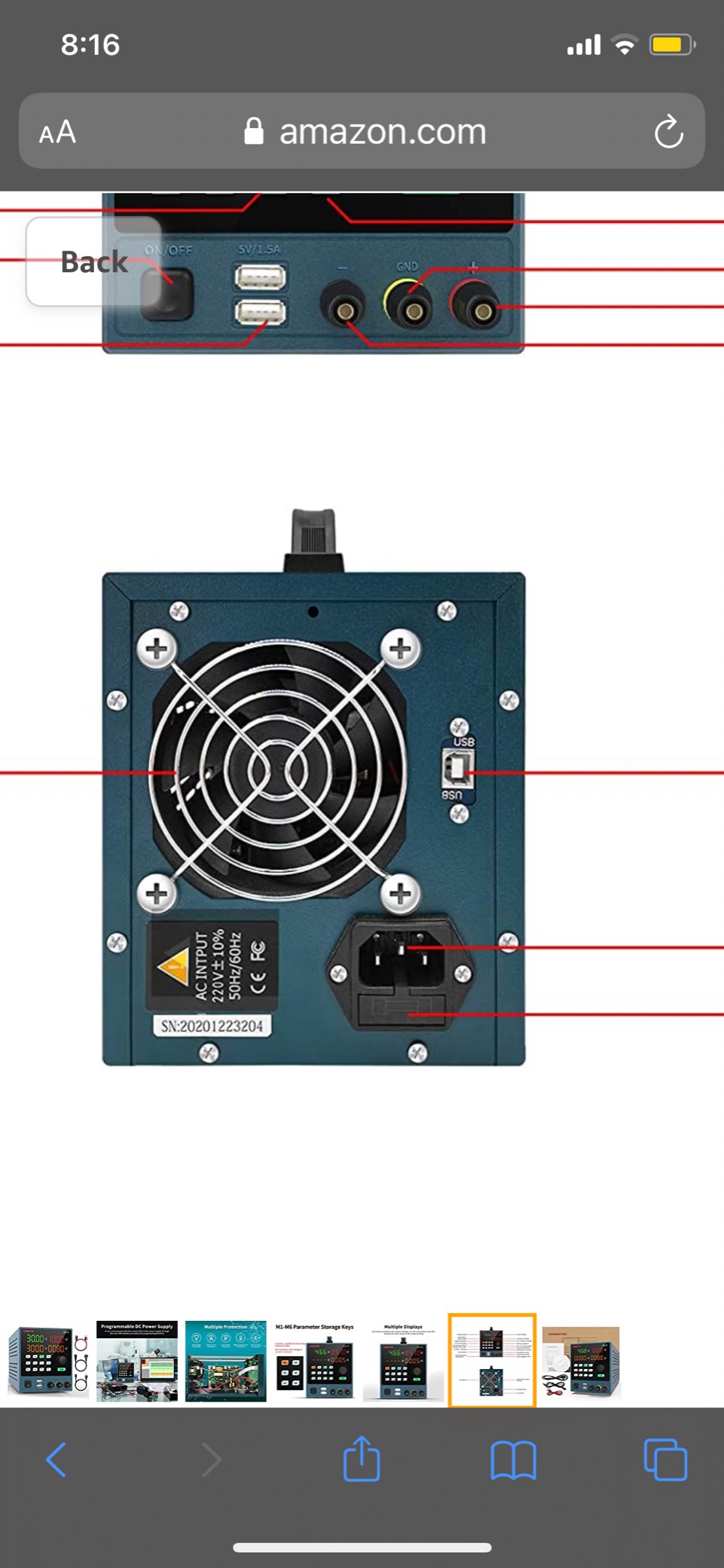
Who this supply suits?
Test rigs, battery conditioning setups and anyone running measurements where a person should not be adjusting the panel mid-run. The sequence output turns a repeatable test into a stored profile.
The CV/CC lockout is a real safety gain on a shared bench where a second pair of hands might otherwise reach for the knobs.
Where it falls short?
At 4.1 from 527 reviews this is the lowest-rated unit here, with a 13 percent one-star band. That is a meaningful gap against the 4.5 and 4.6 units in the same bracket.
The bundled PC software is basic and awkward to set up, and the stated wattage figures in the listing are inconsistent with what a 30V/10A class unit can actually deliver. Verify the real limits before planning a load.
8. Siglent SPD3303X-E – three isolated outputs
- Three isolated channels enable analog biasing single outputs cannot
- Series and parallel modes raise voltage or current headroom
- Low-noise linear regulation suits sensitive analog work
- 3-year warranty from an established instrument maker
- Timing output function and trending graphs
- Far heavier and larger than the portable switching units
- Each channel caps near 3.2A so high-current LED or motor work is out of reach
- Front panel menus have a steeper learning curve than simple knobs
This is the lab-grade instrument of the group and the only triple-output unit in the roundup. Three independently controlled, isolated outputs change what you can build, because an isolated rail lets you sit one channel at a different ground reference from another, which a single-output supply simply cannot do.
Two channels deliver up to 32V at 3.2A and the third gives selectable 2.5V, 3.3V or 5V at 3.2A. That third channel alone removes the need for a separate 3.3V or 5V rail when you are bringing up a microcontroller board.
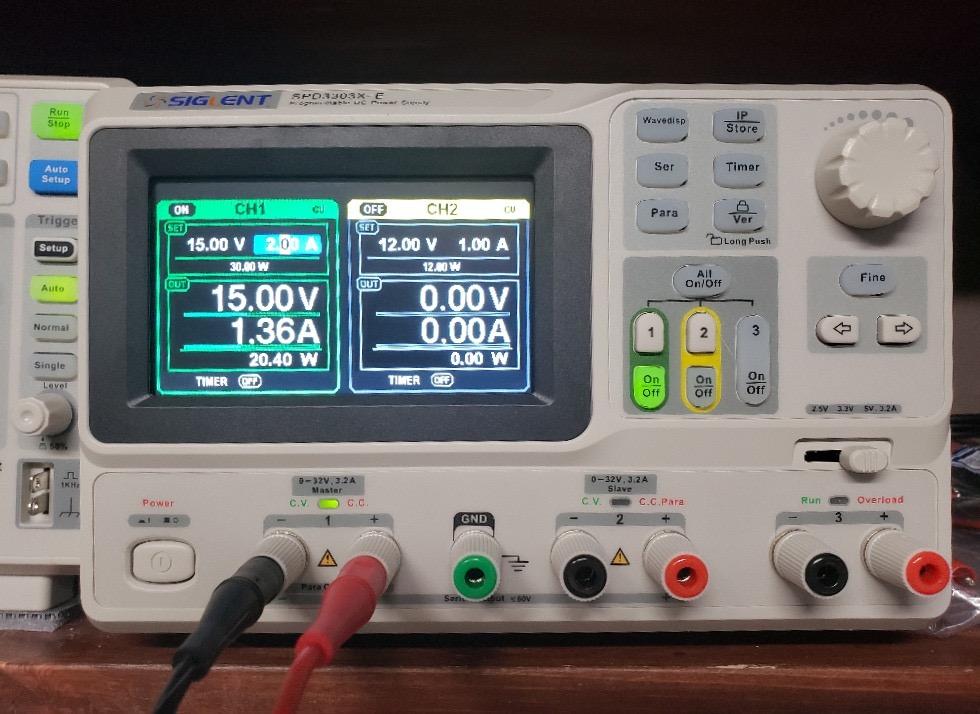
Independent, series and parallel modes extend the combinations further. Series mode stacks two channels for higher voltage, parallel mode shares current between them, and the timing output function switches channels on a schedule while trending graphs show the result.
Regulation is linear, input range is 100-230V AC so it works in most regions, and the 3-year warranty comes from an established instrument maker. Buyers are typically bench engineers who need isolated rails for op-amp and RF work.
Who this supply suits?
Analog and RF circuit development where rail isolation matters, and teaching labs that need three outputs per station instead of one. The timing function also suits repeating power-sequence tests.
Anyone building around dual-supply op-amp circuits will find the isolated channels easier than strapping two single supplies together.
Where it falls short?
It weighs 17.6 lb in a 16 x 14 x 11 inch body. This is an instrument that gets a shelf, not a corner of a desk, and that is a real change to your workspace.
Every channel caps near 3.2A, so high-current LED arrays and motor testing are out of reach. The panel menus are also steeper to learn than the simple knob layouts on the budget units.
9. Korad KD3005D – linear metal case with dual displays
KORAD KD3005D – Precision Variable Adjustable 30V, 5A DC Linear Power Supply Digital Regulated Lab Grade…
- Linear regulation keeps noise and ripple low for analog and audio
- Dual 4-digit displays read voltage and current together
- Switchable 110V/220V input works in more regions than US-only units
- Metal case dissipates heat without a loud fan
- Automatic mA to A display switching aids setpoint entry
- Bulky 14 x 10 x 10 inch footprint at 9 lb
- 5A maximum current limits larger loads
- Basic interface with no memory presets or programmability
Korad is the name hobbyist forums keep coming back to when someone wants linear regulation without a lab instrument budget, and the KD3005D is the plainest version of that idea. Linear regulation, 0-30V and 0-5A, metal case, no gimmick.
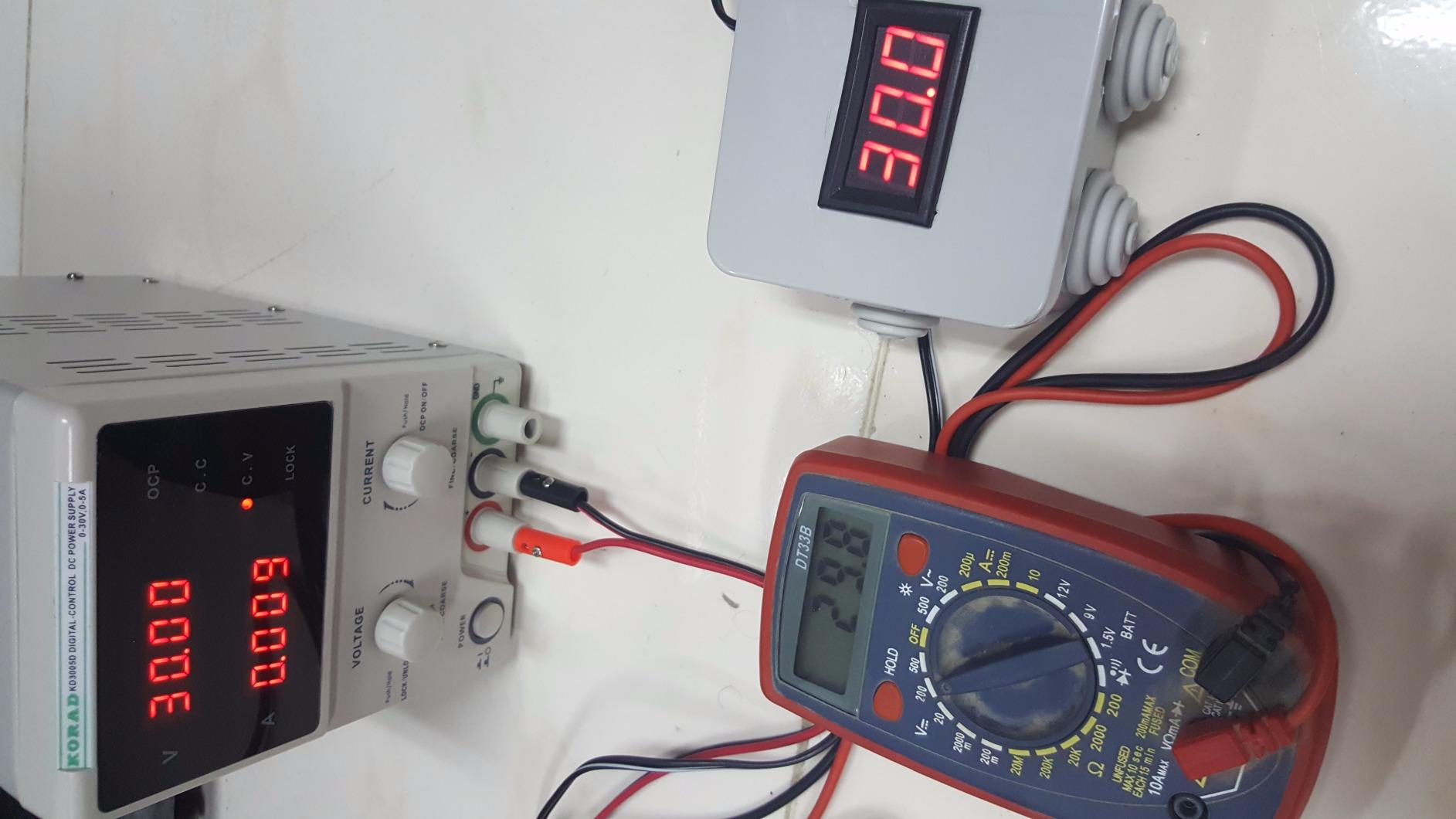
Two 4-digit LED displays show voltage and current at the same time, so you can watch both without switching pages. Digital controls with automatic mA to A display switching make it easy to set a limit in milliamps and still read the result in amps.
The 110V/220V input switch is worth more than it sounds. Several units in this roundup are 110V-only, and this one travels. Protection covers overload, short-circuit and over-temperature, and the box includes 5A test leads, the unit, a power cord and a manual.
Owners who want quiet, regulated DC at a modest price rate it well, with 73 percent five-star across 367 reviews. The metal case dissipates heat without a loud fan, which matters in a shared room.
Who this supply suits?
Audio, radio and analog benches where low ripple is the priority and 5A is enough. It also suits anyone who wants one supply that works in more than one mains region.
Guitar pedal and valve circuits benefit from the linear noise floor. Our guide to power supplies for guitar pedals covers the isolated rail side of that in more depth.
Where it falls short?
At 14 x 10 x 10 inches and 9 lb it is the bulkiest 5A unit here. Budget for a dedicated shelf rather than a desk edge.
The 5A maximum limits anything larger, and the interface is deliberately basic: no memory presets, no programmability, no remote control.
10. NICE-POWER SPS-E305 – smallest and lightest at 150W
- Smallest and lightest unit in the roundup at 1.54 lb
- Encoder lets you set digits instead of hunting for a value
- Universal 100-240V input is unusual at this level
- 150W out while drawing roughly 175W with a cool case
- Reliable as a secondary supply for digital rails and LiPo charging
- Output wavers and is unusable below about 0.7V
- Always-on cooling fan is loud with no thermostatic control
- Hidden fourth digit in the encoder interface is confusing
- One owner reported a unit falling well short of 12V 5A
At 1.54 lb in a 6.5 x 4 x 3.2 inch body, this is the smallest and lightest supply in the roundup and it earns a 4.6 from 343 reviews with 81 percent five-star. Measurement-oriented reviewers confirm accuracy from roughly 0.7V upward through 3.3V and 30V.
The encoder works by pressing to select a digit, then rotating to set the value. The 3-digit backlit display resolves 0.1V and 0.01A. Several reviewers report leaving it running for weeks while topping off large battery banks.
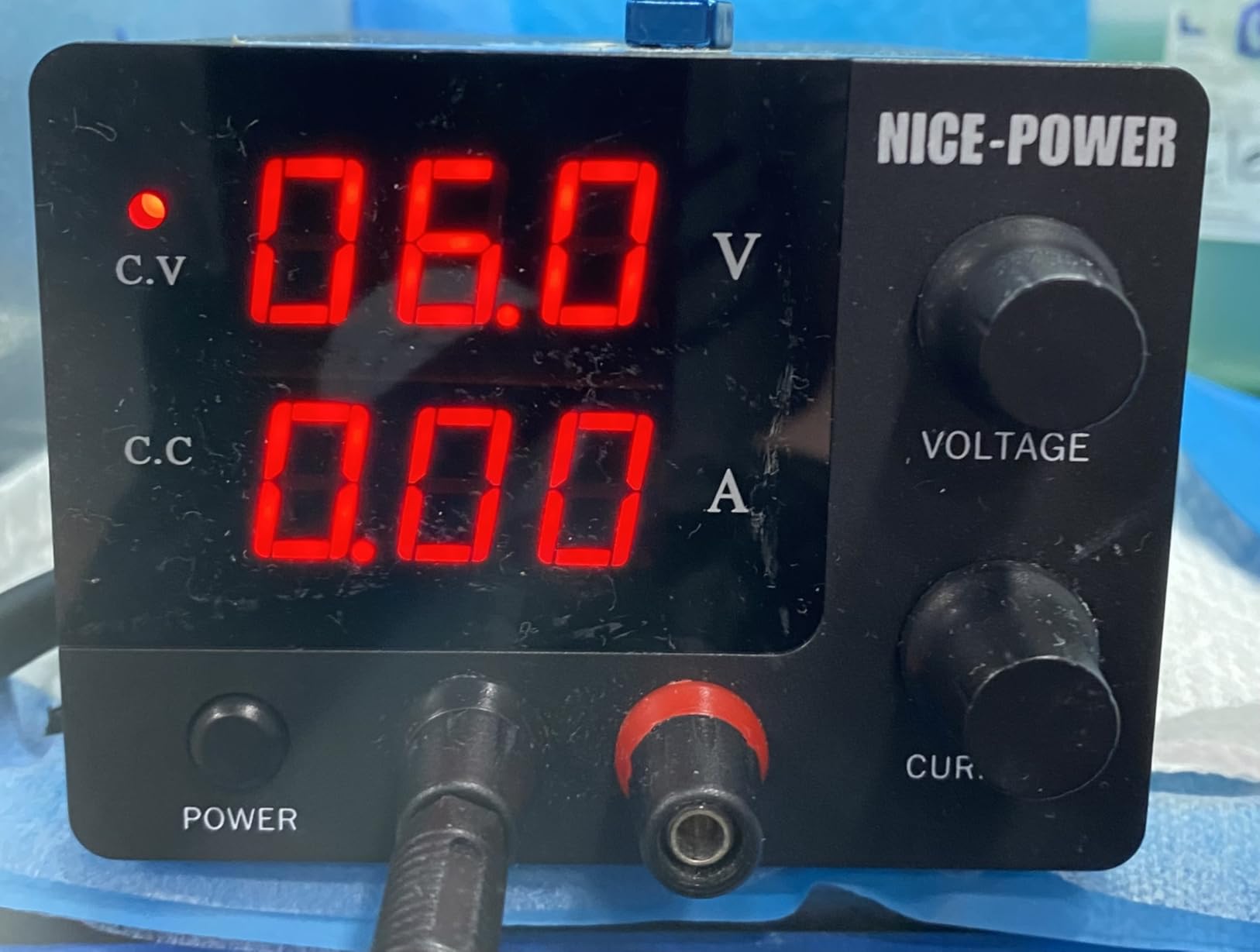
Efficiency is a genuine strength here. It puts 150W out while drawing roughly 175W from the wall, and the case stays cool, which is unusual for a unit this size. It also carries a 12-month repair policy and FCC/CE certification.
The universal 100-240V input works on 110V and 230V mains without a switch, and protection covers over-voltage, over-current, over-power, over-temperature and short-circuit.
Who this supply suits?
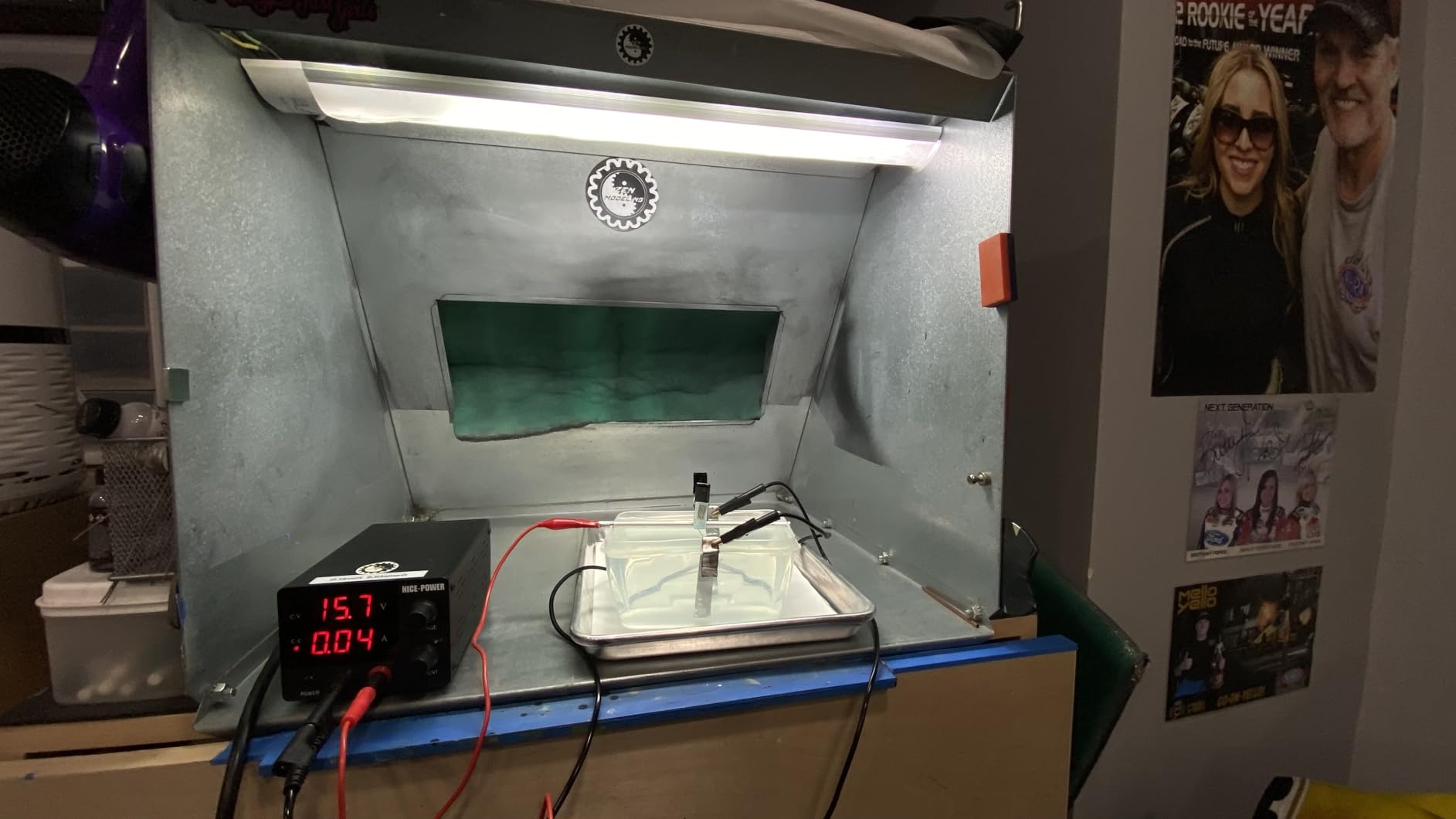
Small desks, travel cases and anyone who needs a dependable secondary supply for 3.3V and 5V digital rails. LED testing and electroplating are the other jobs owners mention.
It also works as a bench buddy for LiPo charging where you want something that will not take up a shelf.
Where it falls short?
The output is unstable below about 0.7V, so it cannot be used for low-voltage work where the load itself matters. A few hundred millivolts of noise are measurable under heavy load.
The cooling fan runs whenever the unit is powered on and has no thermostatic control, which is the loudest complaint in the set. One owner also reported a unit that would not deliver 12V/5A.
11. HANGELL HPS3010 – output button with a 5-year warranty
- Output enable button lets you dial setpoints with output off
- Over-current function acts as a smoke stopper for shorted boards
- 5-year warranty is the longest stated in this roundup
- Compact and light at 1.2 kg
- Large fan and ventilated case handle 300W continuously
- Knob labels sit behind the knobs and the manual is hard to follow
- Can jump straight into over-current mode when the limit is set below 100mA
- Rear mains selector can fail under sustained high power draw
- Test leads feel loose in the binding posts
This is the one to consider if you want an output enable button and a long warranty in the same box. The HPS3010 carries a stated 5-year warranty with lifelong technical support, which nothing else in the roundup matches.
Like the WANPTEK, the encoder splits coarse and fine digit adjustment by pressing. The 4-digit display resolves 0.01V and 0.001A with automatic CV/CC switching, and over-current detection alarms and cuts the output on a short.
At 1.2 kg and 3.5 x 5.6 x 7.4 inches it stays compact, and the 18W USB and Type-C quick-charge outputs handle device charging. The input range is 100-220V AC and a large fan plus a well-ventilated case cope with sustained 300W running.
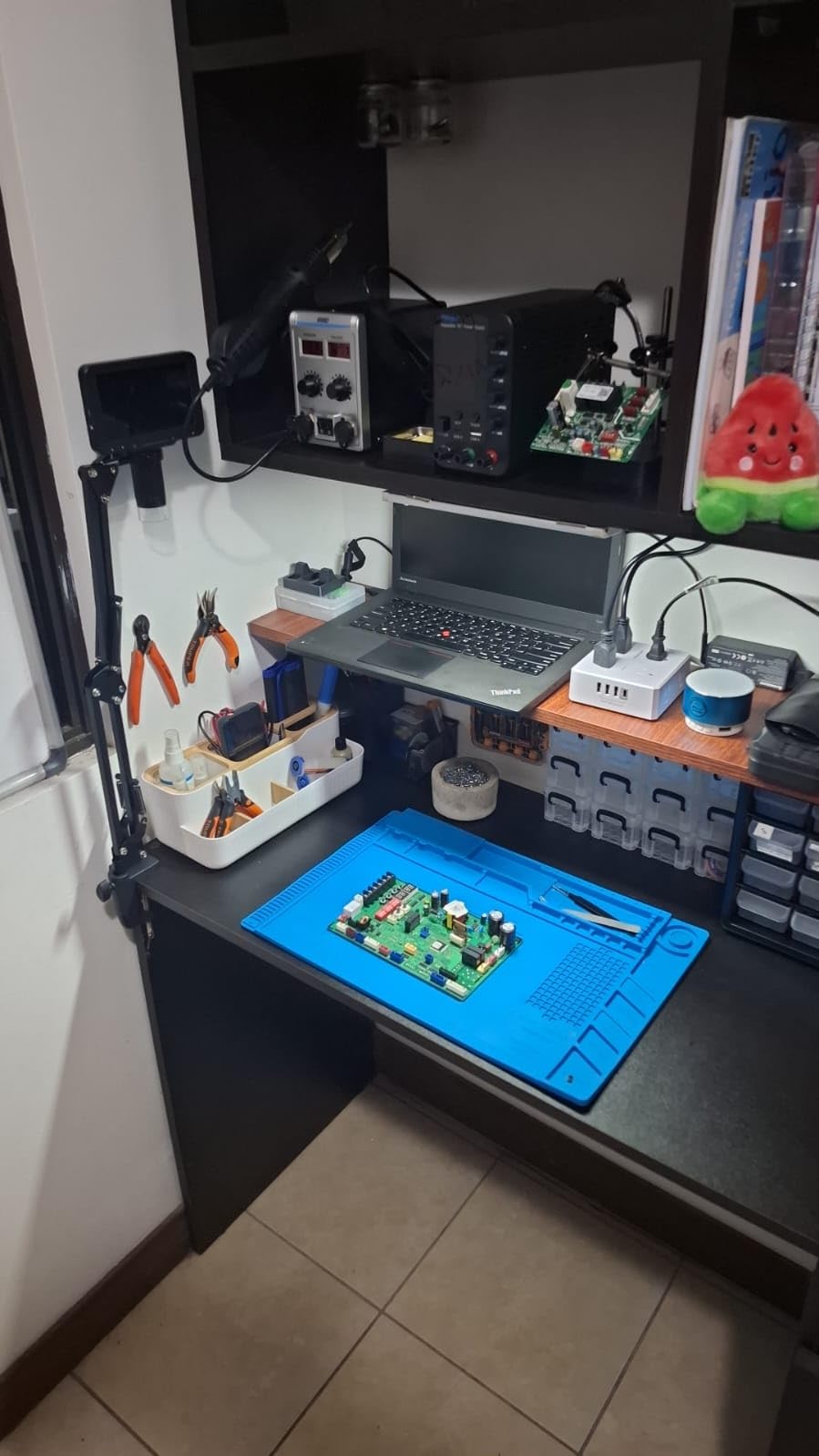
Owners use it for tool battery repair and general testing, and one verified the output against a multimeter and found it accurate.
Who this supply suits?
Tool battery rebuild work and general repair, where the output button stops you plugging a live lead into a pack. The warranty length makes it the safer long-term buy.
Anyone who keeps a supply running continuously will appreciate the large fan and the ventilated case.
Where it falls short?
A detailed engineer review documents four units eventually failing at the rear mains voltage selector switch, in one case permanently limiting output to around 7A. That is a component-level repair, not a setting.
It can also jump straight into over-current mode when the limit is set below 100mA, the knob labels sit behind the knobs themselves, and one report describes a defective unit with a burning smell on power-up.
12. HYELEC HY50-06A – 50V headroom for 24V and 48V work
- Only 50V unit in the roundup giving headroom for 24V 36V and 48V work
- Three memory presets make repeat measurements fast
- Output enable button prevents damage when output is left on
- Steady non-jittering display digits and accurate setpoint entry
- Slim light plastic chassis at roughly 2.7 lb
- 150W and 6A ceiling is below the 300W 30V units
- 110V input only
- Switching architecture means ripple above linear supplies
Thirty volts will not get you to a 24V pack at full charge plus headroom, and it certainly will not reach 48V. The HY50-06A runs 0-50V at 0-6A for 150W, which makes it the only unit here that covers those rails properly.
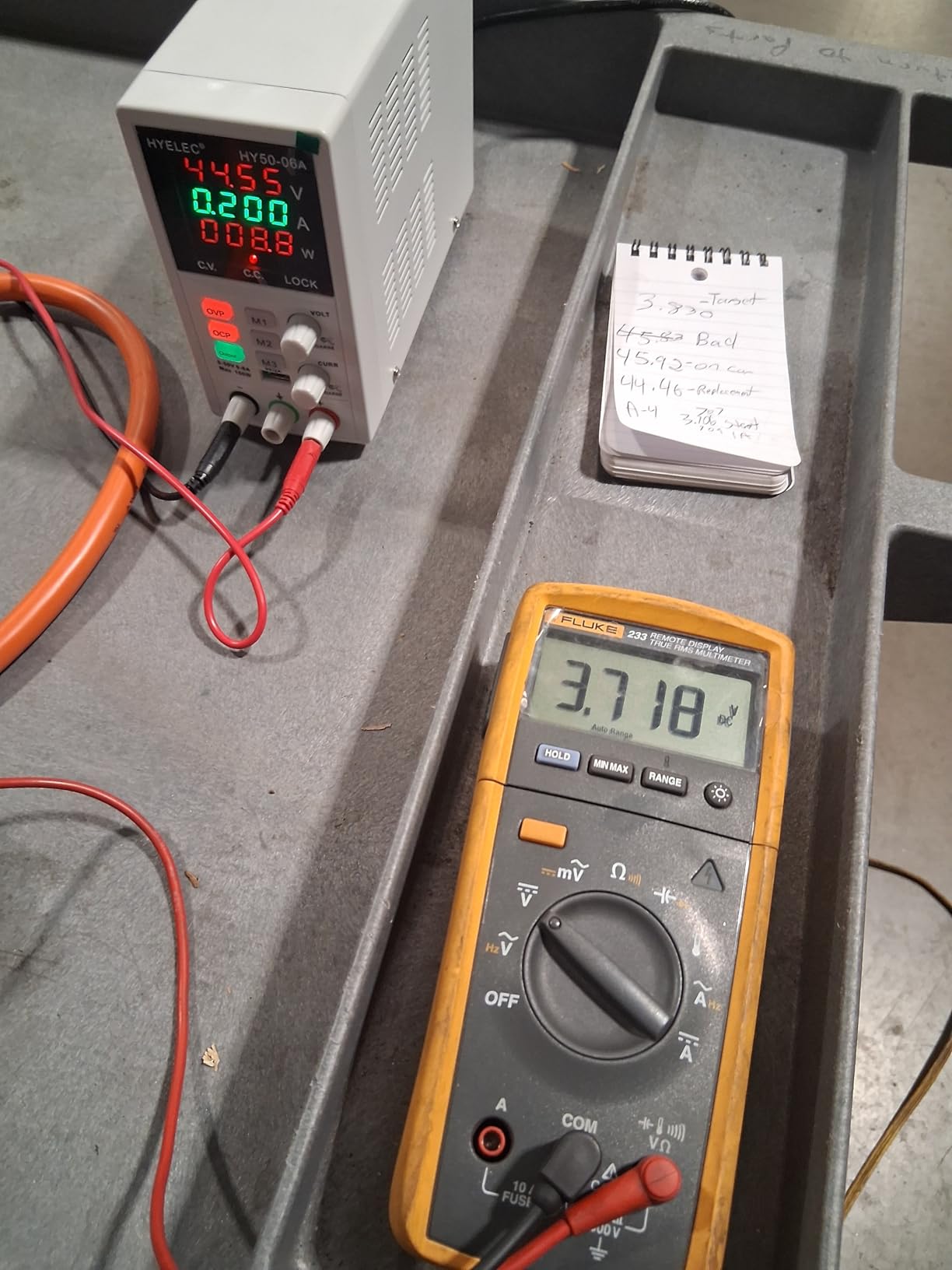
The single encoder knob toggles between coarse and fine adjustment, and reviewers single out the display digits for being steady rather than jittering as the output moves, which makes a reading much easier to trust.
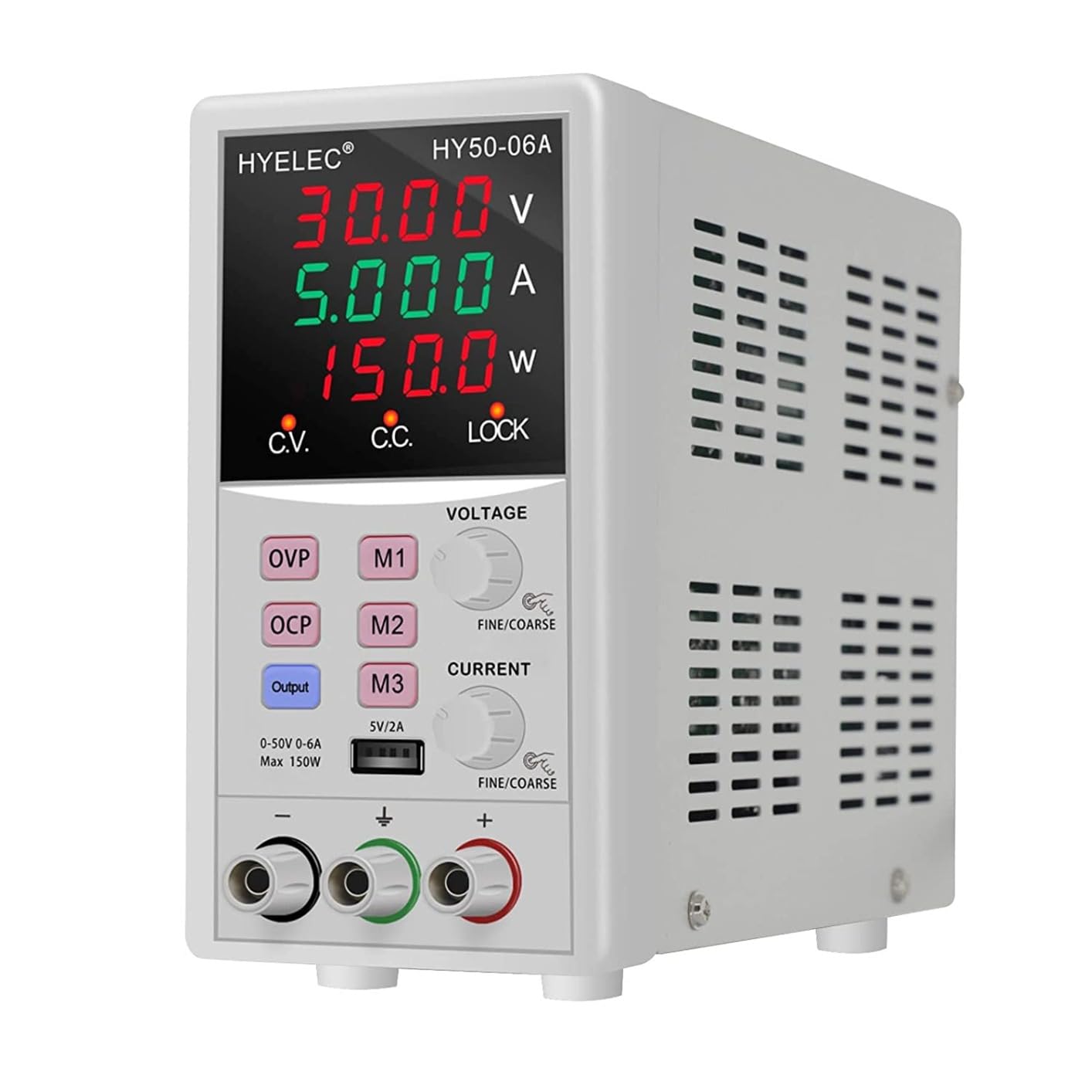
Three memory slots labelled M1, M2 and M3 save and recall setpoints. For phone repair and lab work where you return to the same voltages all week, that removes most of the knob work.
Over-voltage and over-current thresholds are user-adjustable, a surge protection output enable button guards a connected load, and a temperature-controlled fan handles cooling. Reviewers report the display, encoder and presets making it a fixture on the bench.
Who this supply suits?
24V, 36V and 48V battery work, e-bike controller testing and telecom maintenance. The 150W envelope is enough for a single pack rather than a full battery bank.
Anyone who repeats the same handful of voltages will get the most from the memory presets.
Where it falls short?
The 150W and 6A ceiling sits well below the 300W 30V units in this roundup, so high-current loads are out of reach. It is also a 110V-only listing with no 220V option.
Being a switching design, its ripple is higher than the linear units, which limits its usefulness for precision analog front ends.
How to Choose a Benchtop Power Supply in 2026?
Eight criteria decide whether a supply fits your bench. Check them in this order and the wrong purchase becomes hard to make.
1. Voltage, current and the wattage ceiling
A 0-30V / 0-10A label does not mean 300W is available at every combination. Real output follows a power envelope, and at 5V the current limit is usually still 10A, while at 30V the available power drops. Read the power curve rather than multiplying voltage by current, because that multiplication trap is the most common spec error in this category.
2. Constant-current and constant-voltage crossover
CV holds your voltage and lets current float. CC holds your current limit and drops voltage until the load draws less. A supply that switches between them automatically is what lets you charge a lithium pack safely and light an LED string without calculating the resistor twice.
3. Protection circuits
Look for over-current, over-voltage, over-power, over-temperature and short-circuit protection. Adjustable thresholds are better still, since a fixed limit set for a 30V rail will not protect a 3.3V board.
4. Set resolution and an output enable
10mV and 1mA resolution is enough for rail work. Coarse and fine controls or an encoder with digit selection beat a single potentiometer. An output enable key lets you change setpoints with the load disconnected.
5. Linear versus switching topology
Linear units give lower ripple and weigh more. Switching units are smaller, lighter and cooler, with more ripple. Most makers run one of each.
6. Presets versus remote control
These get confused constantly. Memory presets store setpoints you recall from the panel. Programmable means a documented protocol such as Modbus or SCPI over USB so software can drive the supply. The Kiprim and HANMATEK do both; most budget units do neither.
7. Noise and cooling
Thermostatic fans stay silent until the unit works hard. Always-on fans, like the one in the smallest NICE-POWER, run constantly. On a shared bench that difference is obvious.
8. Mains input and earthing
Several units here are 110V-only. Universal 100-240V input or a switchable 110V/220V setting removes that problem. The earth ground terminal matters too, especially when you scope a circuit that is also connected to mains-referenced equipment.
Linear vs Switching: Which Topology for Your Project?
A linear supply passes DC through a regulator that burns off the excess voltage as heat. A switching supply chops the input with a transistor at high frequency and filters the result. That one difference explains almost every practical trade-off between the two.
Linear wins on noise. Ripple on a linear bench supply stays far below what a switching unit produces, which is why the Tekpower and Korad show up in audio, tube and RF benches. It loses on efficiency: a linear unit at 5V and 5A wastes most of its input as heat, which is why the metal cases are heavy.
Switching wins on size, weight and efficiency. The compact units in this roundup weigh between 1.2 and 2.6 lb and run 300W without the heat problems of a linear equivalent. They lose on noise, and a few reviewers report a few hundred millivolts of output noise under heavy load on the smallest unit.
For digital work, LED strings and battery charging, switching noise rarely reaches your circuit. For op-amp front ends, audio and RF, it does.
When You Do Not Need a Benchtop Power Supply?
Some projects never justify a bench supply. A fixed 5V USB-C charger is cheaper, smaller and safer for a project that always runs at one voltage, and it removes any chance of setting the limit wrong.
A salvaged ATX power supply from an old desktop is the classic free variable supply. The 12V, 5V and 3.3V rails come out of a modular connector, and hobbyists repurpose old printer power supplies the same way. The catch is that nothing limits current for you, so it is a bench tool for experiments rather than for first power-up of a board you care about.
Battery banks and USB-C power delivery triggers work for travel and for off-bench builds. If your work happens at a desk and involves changing voltage, buying one of the units above is the better path.
How to Power Up a New Board Safely?
Set the current limit before the first power-up. This is the single habit that separates a fried board from a tripped protection circuit.
Start by setting the voltage to the rail you want with the output disabled, either using the output key or by leaving the leads disconnected. Then set the current limit to roughly 20 to 30 percent above what the board draws. A 3.3V Arduino board typically lives near 100mA, so start around 130mA and step up until the supply settles out of CC mode.
Check polarity before connecting. Reversed power on most boards is not recoverable, and it takes seconds to avoid.
Verify the reading with a multimeter rather than trusting the front panel, especially on budget units. Watch the case temperature during the first minute, and keep the vents clear.
Quiet Operation and Fan Noise on a Shared Bench
Fan noise is the complaint that comes up most often in hobbyist discussions, and it splits neatly along thermal design. Thermostat-controlled fans, like the one in the Korad and the HYELEC, stay still until the supply is working near its ceiling, so a bench that is mostly measuring 5V and 3.3V stays silent.
Always-on fans are the opposite. The smallest NICE-POWER runs its cooling fan whenever the unit is powered and has no thermostatic control, so it is audible in a quiet room even on a light load.
The two linear units, the Tekpower and the Korad, move heat through a metal case and only fan when the regulator is hot. That is the quiet choice for a bedroom or shared office bench, and it is a bigger reason to buy linear than the ripple figures alone.
Frequently Asked Questions
What is the best benchtop power supply?
For most electronics projects the best benchtop power supply is a 0-30V, 0-5A or 0-10A unit with automatic constant-voltage and constant-current crossover, a settable current limit and over-current and short-circuit protection. In our testing the compact switching units handled 5V and 3.3V rail bring-up, LED work and battery charging most cleanly, while a linear unit is the better choice when ripple matters.
Which brand of power supply is the most reliable?
Reliability splits by tier rather than by brand. Budget switching units built by several manufacturers share a chassis and a firmware approach, and their ratings cluster between 4.5 and 4.6 out of 5 across hundreds to thousands of reviews. Korad and Tekpower cover the linear middle tier with metal cases and longer warranties. Siglent covers the instrument tier with a 3-year warranty. Check the warranty length and the mains input rating before anything else.
What voltage and current do I need for Arduino, ESP32 and Raspberry Pi work?
A 0-30V, 0-5A supply covers all of it with room to spare. Set the voltage to the rail your board wants, usually 5V or 3.3V, and set the current limit to roughly 20 to 30 percent above what the board draws. An Arduino board typically sits near 100mA, so start the limit around 130mA and step up until the supply leaves constant-current mode.
Do I need a separate AC-DC supply for a buck module?
A bare buck module is a step-down converter, not a complete power supply. It needs a DC input above the voltage you want out, so it needs an AC-DC brick or another supply feeding it, plus an enclosure and a way to set the limit safely. The same goes for output below the input voltage, which is where many modules are destroyed by people who expect them to step up.
Why is my bench power supply fan so loud, and can I get a quiet one?
Loud fans usually mean the fan runs continuously rather than on temperature. Small units with always-on cooling are audible in a quiet room even on a light load. Thermostat-controlled units, including the larger metal-cased linear models, stay silent until they work near their current ceiling. Linear supplies also move heat through the case, so they need the fan less often.
Conclusion: Best Bench Supply by Project Type
For most benches in 2026, the Kungber SPS3010B is the pick: the largest review base in the set, an encoder knob that makes limits repeatable, intelligent charging and the broadest protection set, in a 2.3 lb box. If you want the sharpest controls and the highest rating, take the WANPTEK DPS3010U.
Match the unit to the work instead. The NICE-POWER SPS-C3010 is the one with an output enable key for frequent rail changes, the Siglent SPD3303X-E is the only pick with three isolated outputs, the Korad KD3005D and Tekpower TP3005T cover low-ripple analog and audio, and the HYELEC HY50-06A is the only one that reaches 50V for 24V and 48V packs.