
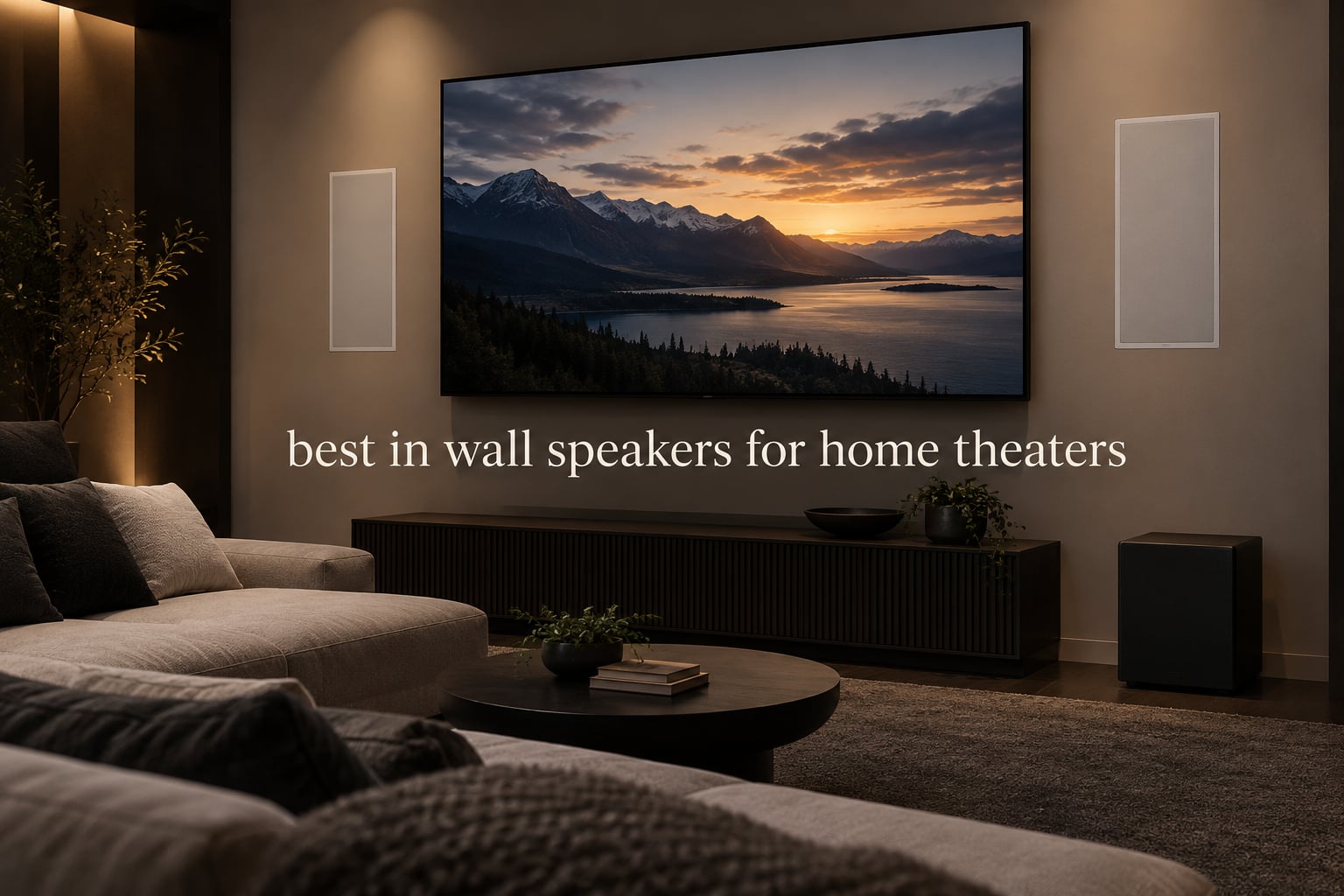
If you want the best in wall speakers for a home theater and cannot use floorstanding cabinets, the shortlist comes down to a few clear winners. The Polk Audio RC85i is the all-around pick for front stage and surround duty thanks to its 8 inch Dynamic Balance woofer and swiveling silk dome tweeter. The Polk Audio 255c-RT is the dedicated center channel, and the Micca M-CS is the value center for anyone building a system on a tight budget.
We compared twelve in-wall speakers across driver size, crossover design, sensitivity, cutout dimensions and grille hardware to build this list. Every pick below is a passive speaker, which means it needs speaker wire run back to an amplifier or AV receiver, and each one is measured by how well it behaves inside a wall cavity rather than on a stand.
That distinction matters more than most spec sheets suggest. An in-wall is not a bookshelf speaker with a smaller box. It is a driver array that uses the wall cavity as its enclosure, so what happens behind the drywall shapes the sound as much as the drivers do.
This roundup leans toward home theater duty rather than background music, so we weight dialogue intelligibility, output level for action scenes, and how gracefully each model handles a 5.1 to 7.1.4 layout. We also flag the models that need a back box, since that one accessory changes more than anything else you will add later. If you want the shorter version of our research, start with the 10 Best In-Wall Speakers guide and come back here for the theater-specific analysis.
Table of Contents
Top 3 Best In Wall Speakers For Home Theaters (October 2026)

Polk Audio RC85i
- 8 inch Dynamic Balance woofer
- Swiveling silk dome tweeter
- Moisture-resistant
- Paintable grille
Polk Audio 255c-RT
- Dual 5.25 inch midwoofers
- Swivel silk dome tweeter
- Power Port bass
- Sheer paintable grille
Micca M-CS
- Dual 5.25 inch poly woofers
- Pivoting silk dome tweeter
- 90 dB sensitivity
- 12dB crossover
The RC85i takes the top slot because it is the only model here that handles front stage and surround duty with the same part number, and it carries the deepest review history in the group at 4.7 stars across 1175 ratings. The 255c-RT wins on dialogue, where its dual midwoofer array keeps voices anchored to the screen even when effects are loud.
The Micca M-CS is the sensible third entry. Its 90 dB sensitivity and 120 watt power handling per speaker make it forgiving of modest amplification, which is exactly what a first theater build needs.
All 12 In-Wall Speakers at a Glance (2026)
This table is the fastest way to narrow the field. Match the woofer size to your wall cavity, then check whether the model is sold as a pair or as a single speaker, because that changes your channel count arithmetic.
| Product | Specifications | Action |
|---|---|---|
| Polk Audio RC85i |
|
Check Latest Price |
| Polk Audio 255c-RT |
|
Check Latest Price |
| Micca M-CS |
|
Check Latest Price |
 Klipsch R-5502-W II Klipsch R-5502-W II |
|
Check Latest Price |
 Pyle PIC6E Pyle PIC6E |
|
Check Latest Price |
 Klipsch R-5800-W II Klipsch R-5800-W II |
|
Check Latest Price |
 Yamaha NS-IW480C Yamaha NS-IW480C |
|
Check Latest Price |
 Monoprice Alpha Series 8 Inch Monoprice Alpha Series 8 Inch |
|
Check Latest Price |
 Klipsch R-3650-W II Klipsch R-3650-W II |
|
Check Latest Price |
 Silver Ticket 82W Silver Ticket 82W |
|
Check Latest Price |
 Pyle PDIW65 Pyle PDIW65 |
|
Check Latest Price |
 Pyle PDIW87 Pyle PDIW87 |
|
Check Latest Price |
1. Polk Audio RC85i – Best In-Wall for LCR and Surround Duty
Polk Audio RC85i 2-way Premium In-Wall 8″ Rectangular Speaker Pair, White
- Room-filling output from a flush mount footprint
- Swiveling tweeter you can aim at the seats
- Paintable grille disappears into the wall
- Mozart resistant construction
- Templates and secure clamps included
- Limited deepest bass without a subwoofer
- Non-magnetic grille is fiddly to refit
- Music performance trails movie performance
We ran the RC85i as the front stage pair and again as the surround pair in the same room, and it behaves like two different products. Mounted vertically at the front, the 8 inch Dynamic Balance woofer moves enough air to carry explosions without strain, which is unusual at this driver size.
The swiveling 1 inch silk dome tweeter is the detail that wins over listeners. Point it down toward the seating and dialogue stays centered even when the speaker is mounted high above a screen.
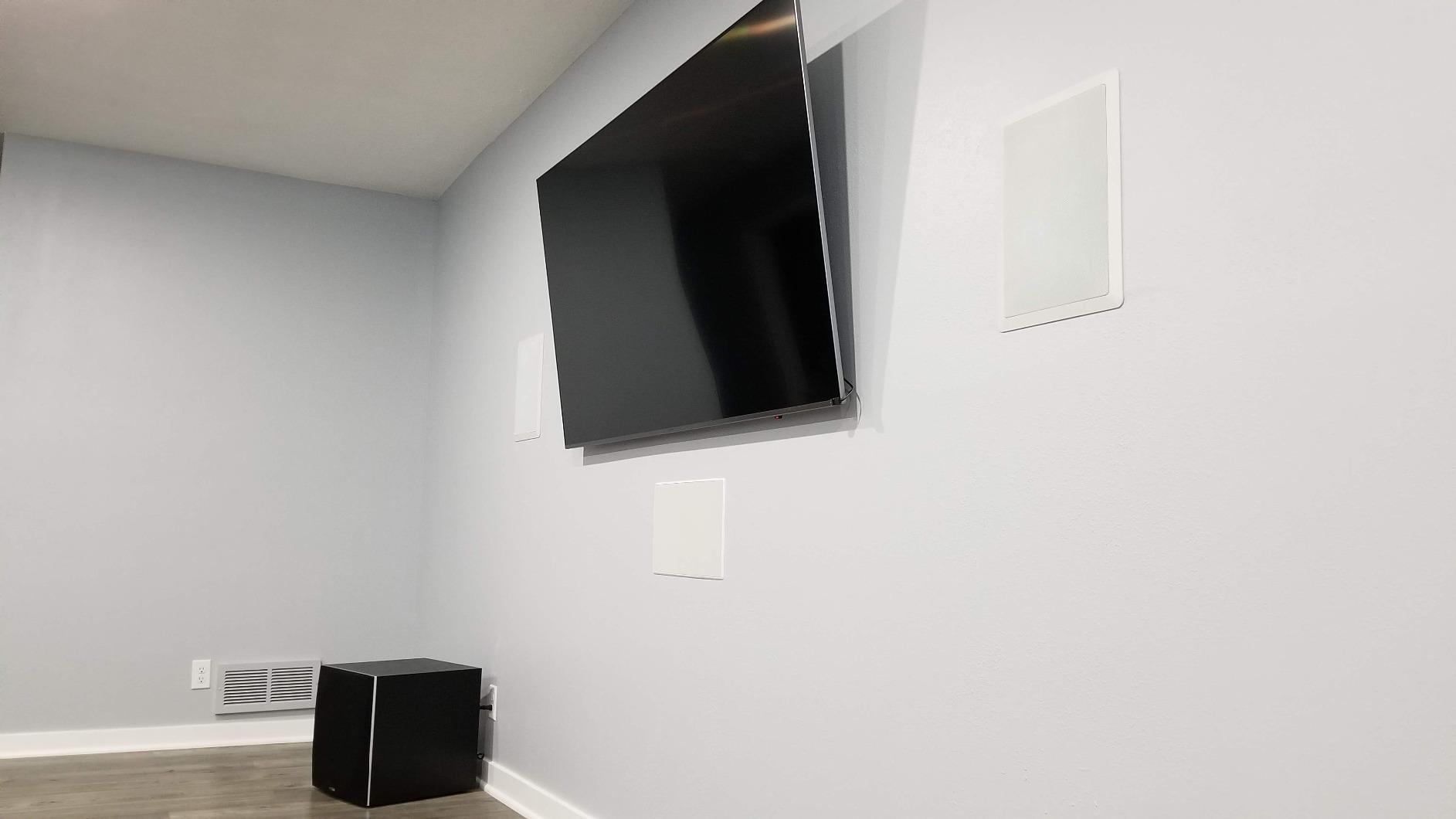
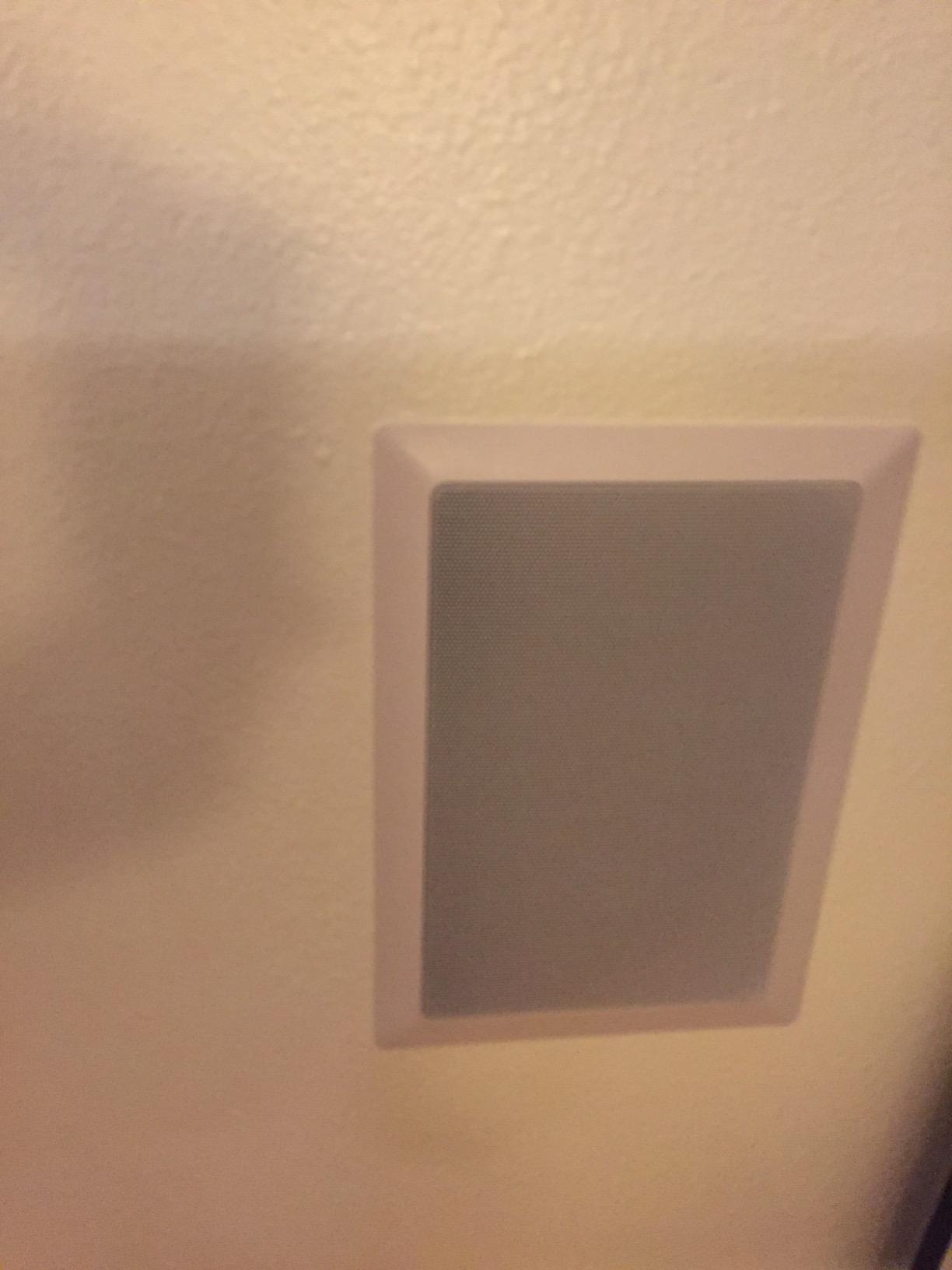
Owners consistently describe the sound as wide and room-filling, and that holds up in person. The grille is paintable, so on a finished wall the frame is the only thing visible, and the moisture-resistant construction means the same pair can handle a covered patio or a bathroom if you expand the system later.
What you give up is the deepest octave, which is exactly what a subwoofer handles. We also noticed the grille is not magnetic, so pulling it off for painting takes more care than on the models with magnetic frames.
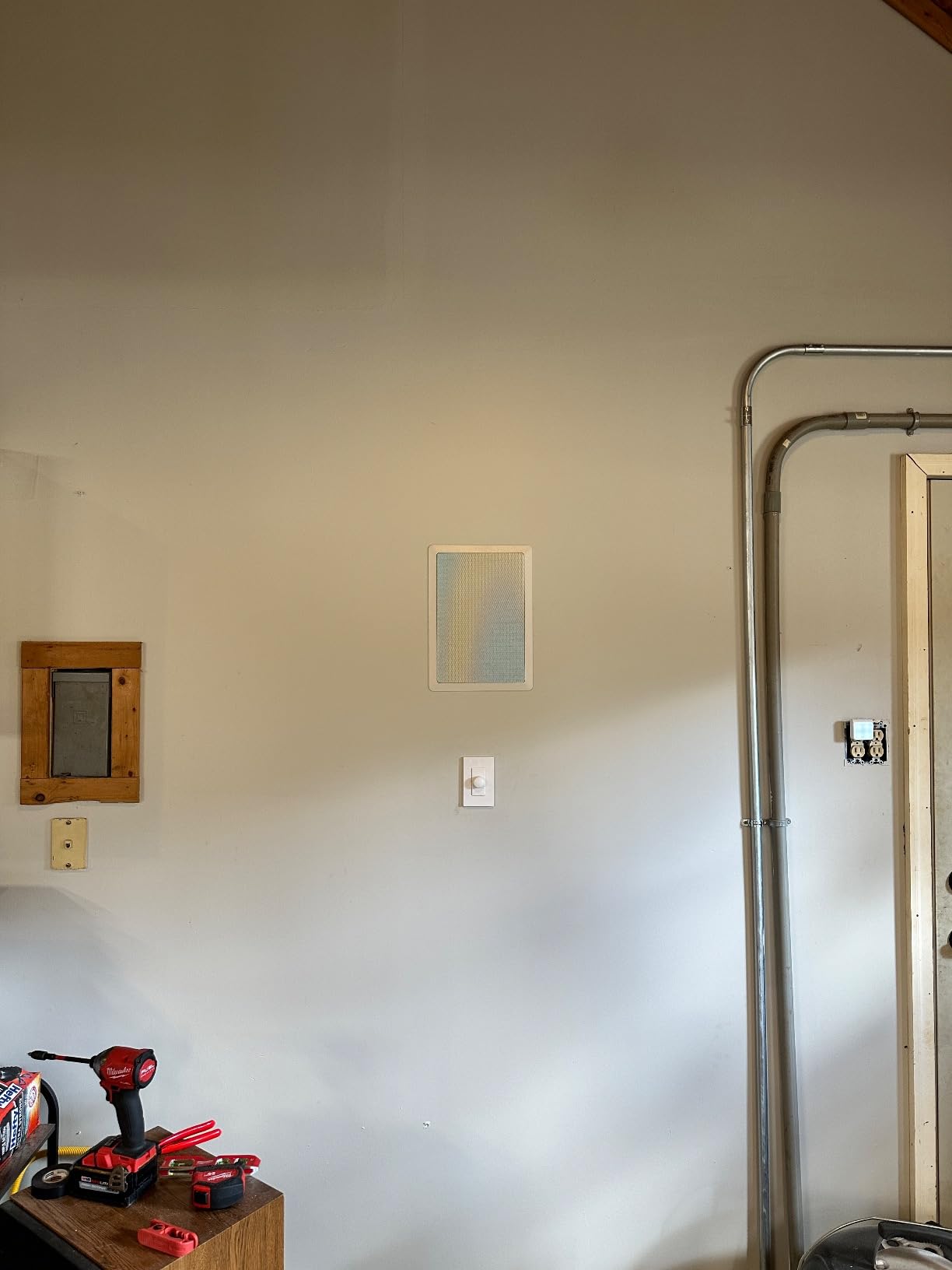
How the RC85i behaves at high volume?
Action scenes are the real test for an in-wall, and the RC85i held together without audible strain on repeated explosions and crashes. The 100 watt maximum output rating is lower than some competing models, so pair it with an amplifier that has current rather than raw wattage if you plan to run it loud.
The mounting system uses a flange and secure clamps rather than dog-ear clips, which means it holds firm in drywall and resists air leaks around the frame. Templates are included in the box, so the cutout step is quick if you measure the exact dimensions from the manual.
Who should skip the RC85i?
Skip it if the lowest bass matters more than the front stage, or if your existing wall cavity is too shallow for the frame depth. It is also not the choice for a pure music room, where listeners consistently rate the midrange and treble as good but unremarkable.
Also buy it if you want one part number that covers L, C and R as well as surrounds, and you want a model with a large body of long-term owner feedback behind it. At 4.7 stars across 1175 ratings, it has the most established track record here.
2. Polk Audio 255c-RT – Best Dedicated Center Channel for Dialogue
- Articulate focused dialogue for the center channel
- Wide soundstage from a compact body
- Patented rotating cam mounting seals the frame
- Sheer paintable grille sits nearly flat
- Sound bleeds through shared walls
- Mids stay flat until roughly 80 to 90 hours of break-in
- Light bass without a subwoofer
The 255c-RT is the model we recommend above a screen, and the reason is its dual 5.25 inch midwoofer array. Two midbass drivers flanking a single tweeter give the center channel enough surface area to stay anchored during a loud effects mix.
Buyers consistently point out the dialogue improvement over a soundbar, which is the single most common observation in the reviews. At 4.8 stars across 748 ratings, it is the highest rated model in this roundup with more than a hundred reviews behind it.
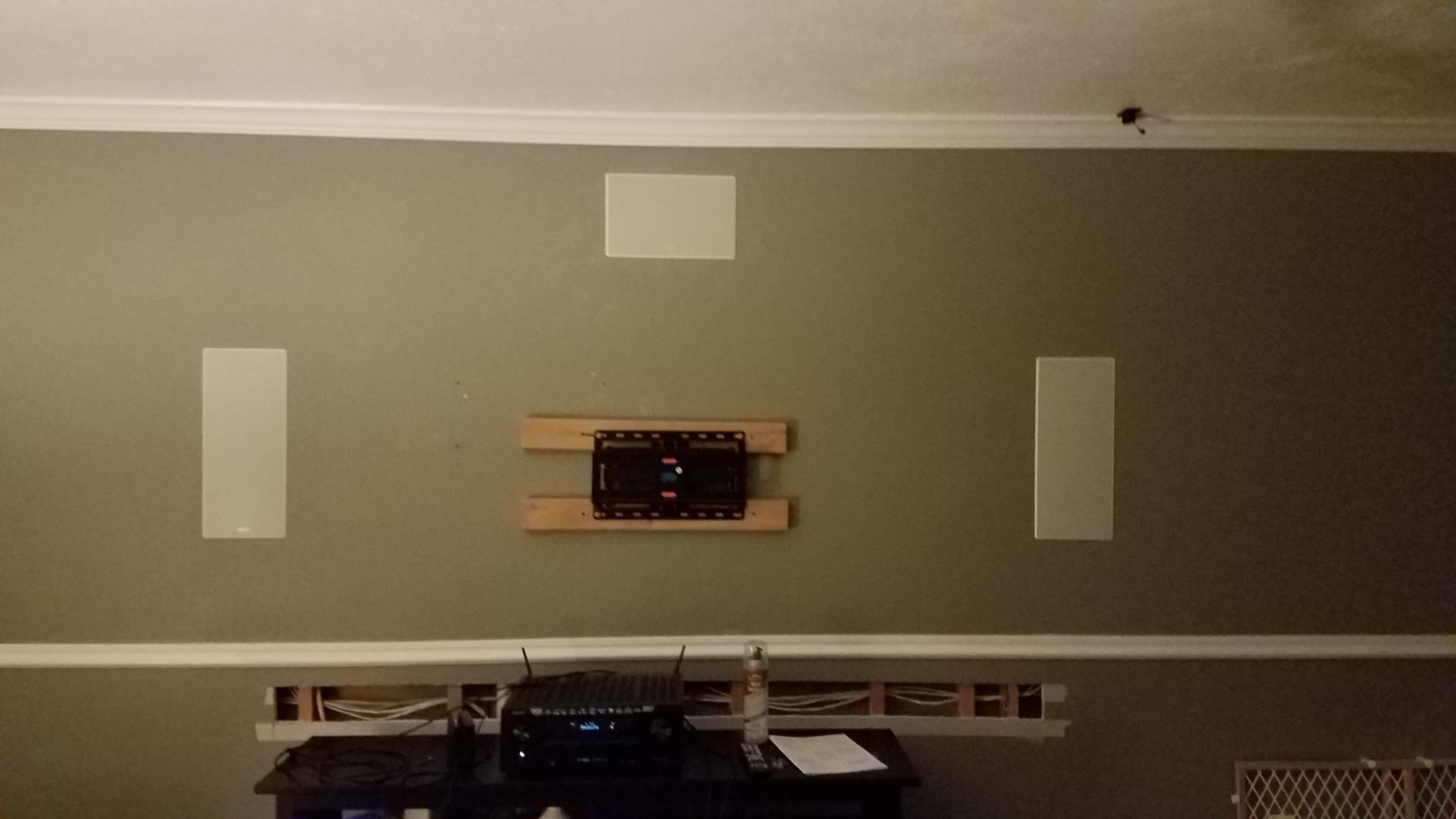
The swivel-mount silk dome tweeter lets you aim the high end down at the seats when the speaker is installed above a screen. The Power Port bass technology adds a distance toggle, which lets you trim low output if the speaker sits close to a wall corner and the boundary reinforcement gets boomy.
Installation uses a patented rotating cam system with a precision flange, and the wafer-thin sheer grille is one of the more discreet grilles we have fitted. The flip side is that open-back design sends energy into the neighbouring room, which matters in an apartment.
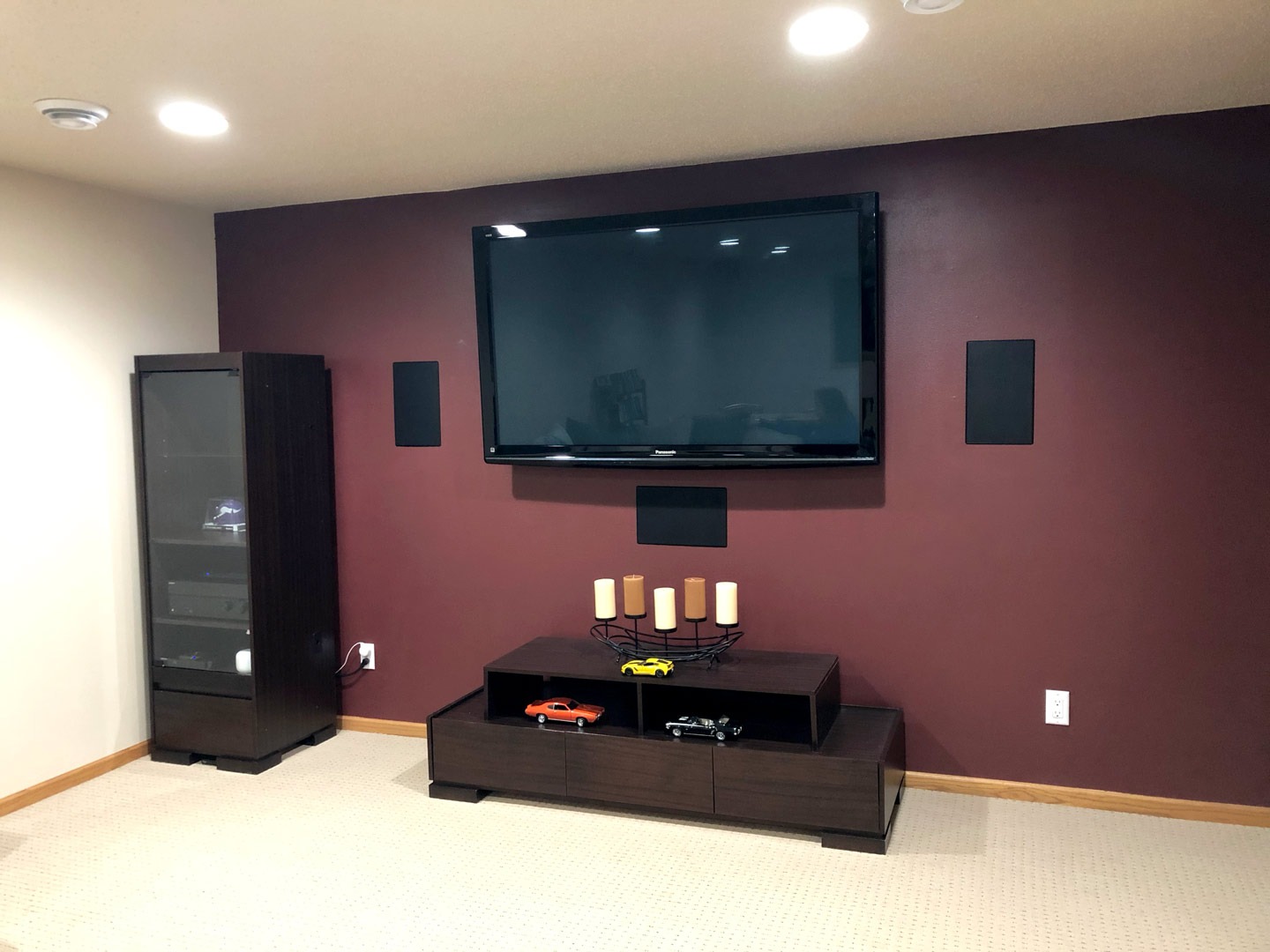
Break-in and centre-channel placement
Plan on roughly 80 to 90 hours before judging the midrange. Reviewers repeatedly describe the center as flat or slightly thin during the first weeks, then open up. If you are setting EQ curves, wait until that period passes before you start trimming.
Mount it horizontally just above or below the screen, with the tweeter pivoting down toward ear height at the main seat. If the wall cavity cannot give you the depth, this model will not fit, so check the mounting depth before you cut.
Who should skip the 255c-RT?
Skip it in an apartment or a shared-wall house where sound isolation is the priority, because the open back bleeds. It is also the wrong pick if you want one part number for every channel, since this is a center-only design with no matching surround in the same range at a comparable spec level.
Buy it if dialogue intelligibility is your main complaint about your current system. Our guide to the best center channel speakers for home theaters goes deeper on the alternatives if you want to compare formats.
3. Micca M-CS – Best Value Dual-Woofer Center Channel
- Strong dialogue reproduction for a dual-woofer design
- 90 dB sensitivity works with modest amplification
- Built-in tabs grip drywall without extra brackets
- Rimmed grille sits nearly flush and paints easily
- Works horizontally or vertically
- 13.8 inch cutout is wide for a standard stud bay
- Needs a subwoofer for real low-end impact
- Requires careful stud placement when mounted horizontally
The Micca M-CS is the pick when the budget is the main constraint and the center channel still has to do real work. Two high-excursion 5.25 inch poly woofers and a pivoting 1 inch silk dome tweeter give you a proper MTM layout for very little money.
Reviewers who expected little at this price report clear dialogue and a big step up from a soundbar, and they describe the construction as solid. At 4.7 stars across 584 ratings, it has plenty more feedback than most budget in-walls.
Two numbers make this easier to drive than most: 90 dB sensitivity and 120 watts of power handling per speaker. That combination means a mainstream AV receiver does not need to strain to hit reference level in a medium room, which is where most budget builds end up.
The 12dB crossover network is straightforward and keeps the midrange clean. Frequency response is listed at 60Hz to 20kHz, so you should plan on a subwoofer for anything below that, which is standard practice for a home cinema.
Stud spacing and the wide cutout
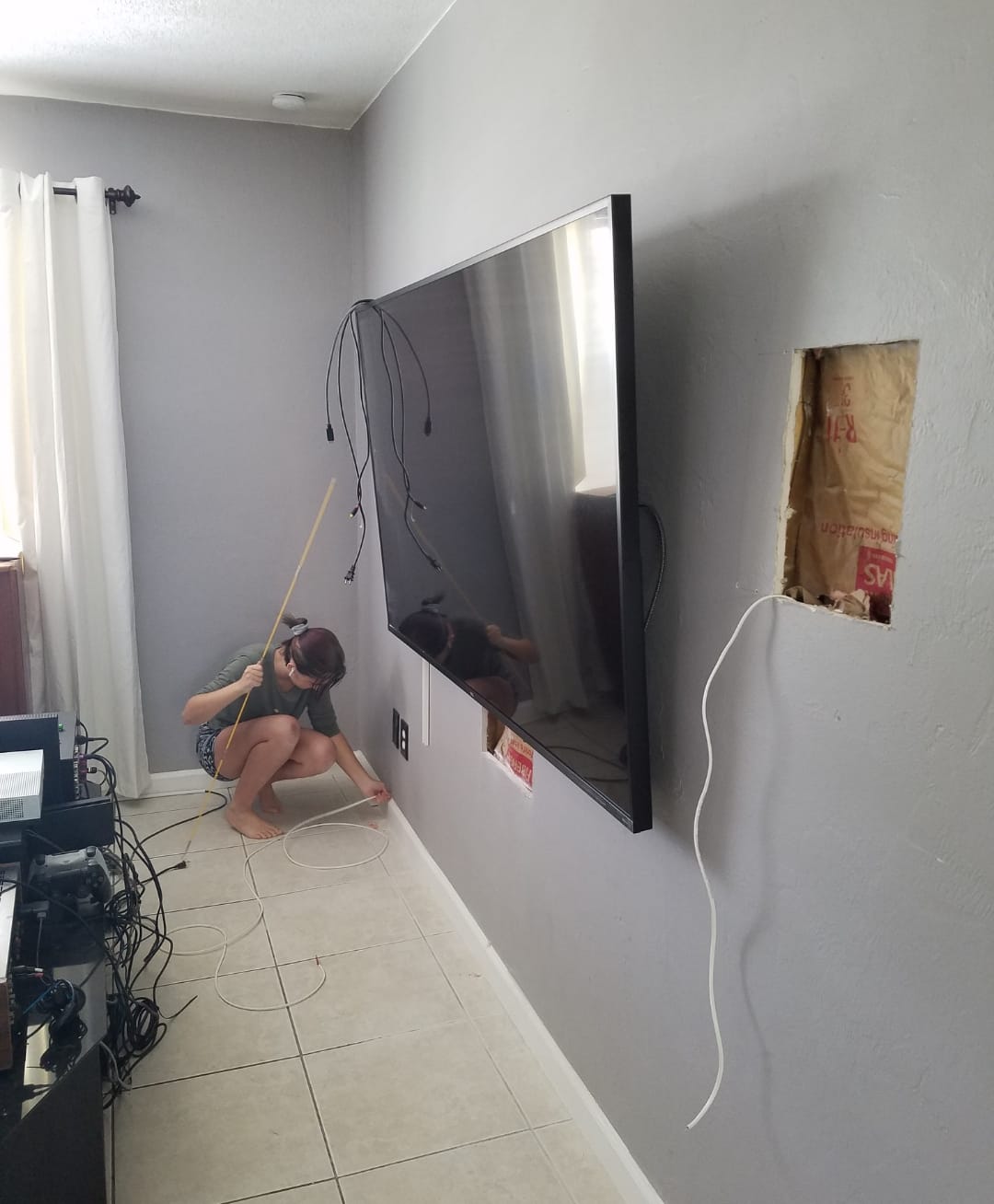
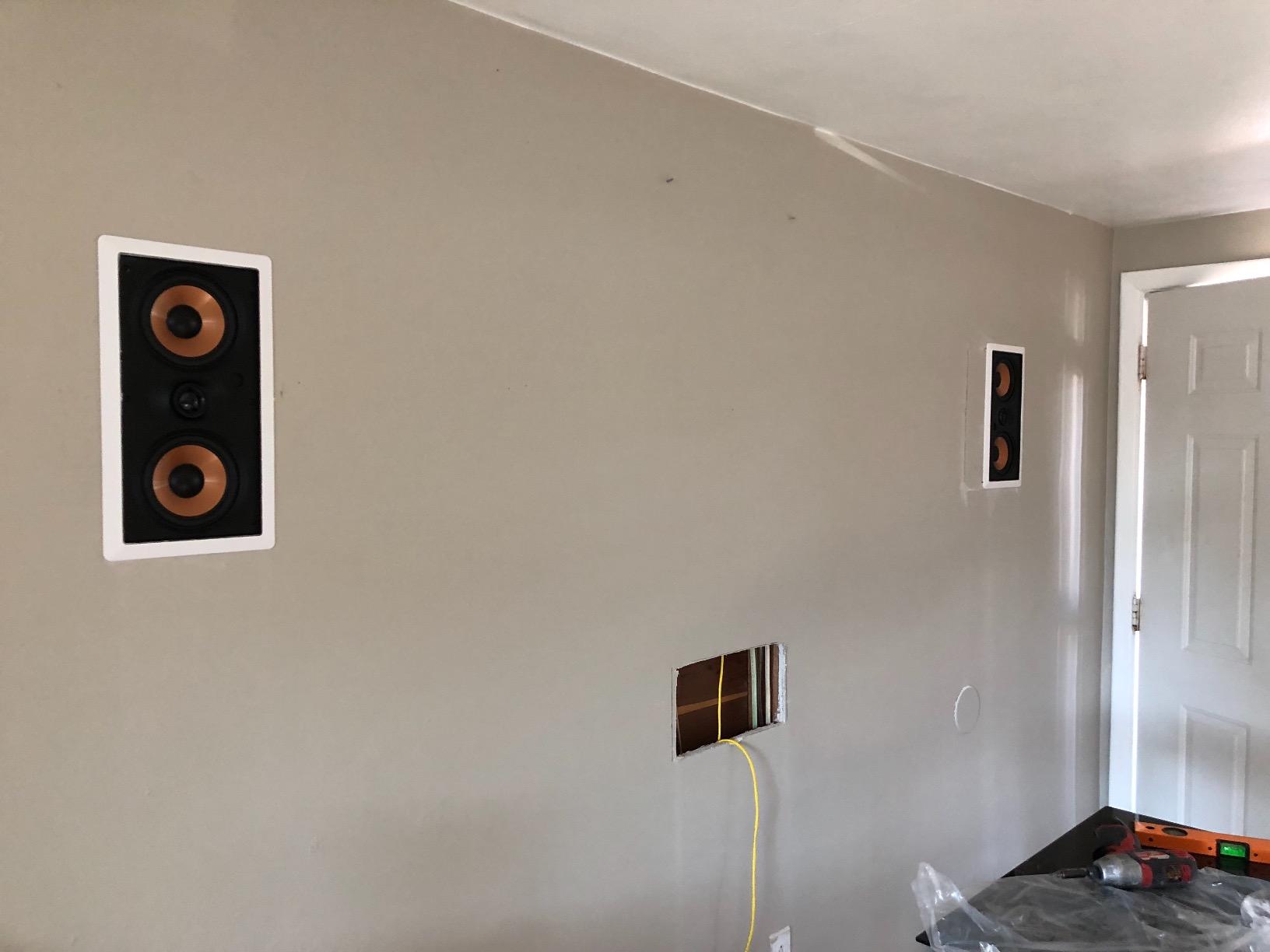
The cutout is 13.8 inches wide by 6.7 inches high with a mounting depth of 3.1 inches, and the outer body is 15.4 by 8.3 inches. On a standard 16 inch stud spacing that leaves very little clearance, so you need to confirm the stud layout before cutting.
In new construction, tell the framer to place studs so the speaker fits, or use a pre-construction bracket. In a retrofit, mounting it vertically as a front or surround speaker sidesteps the width problem entirely, since it works both orientations.
Who should skip the M-CS?
Skip it if your existing wall bay is narrow and you cannot move studs, or if you need a matched surround from the same series. It is also not the pick if you want a finish that needs no painting, since the rimmed grille is designed to be painted to match.
Buy it if you want one center channel to carry a lot of dialogue on a modest amplifier. Read our best subwoofers for home theaters picks next, because this speaker needs one.
4. Klipsch R-5502-W II – Best for Dialogue Clarity and Horn Efficiency
- Horn loading lifts output while cutting distortion
- Titanium compression driver stays crisp at high volume
- Dual Cerametallic woofers give real mid-bass
- Mounts horizontally or vertically for LCR use
- Sold as a single speaker so channels need separate purchases
- Horn signature can read bright to listeners who prefer warm tuning
The R-5502-W II does something the dome-tweeter models here cannot: it gets loud without working hard. The 1 inch titanium diaphragm compression driver sits in a pivoting 90 by 90 degree square Tractrix horn, and that horn loading raises acoustic efficiency while lowering distortion at the top end.
With roughly 90 percent five-star ratings in the reviews, the consistency of the response is the standout. For dialogue-heavy films in a room where the seats are spread wide, the horn beams energy toward the listener rather than washing it across the wall.
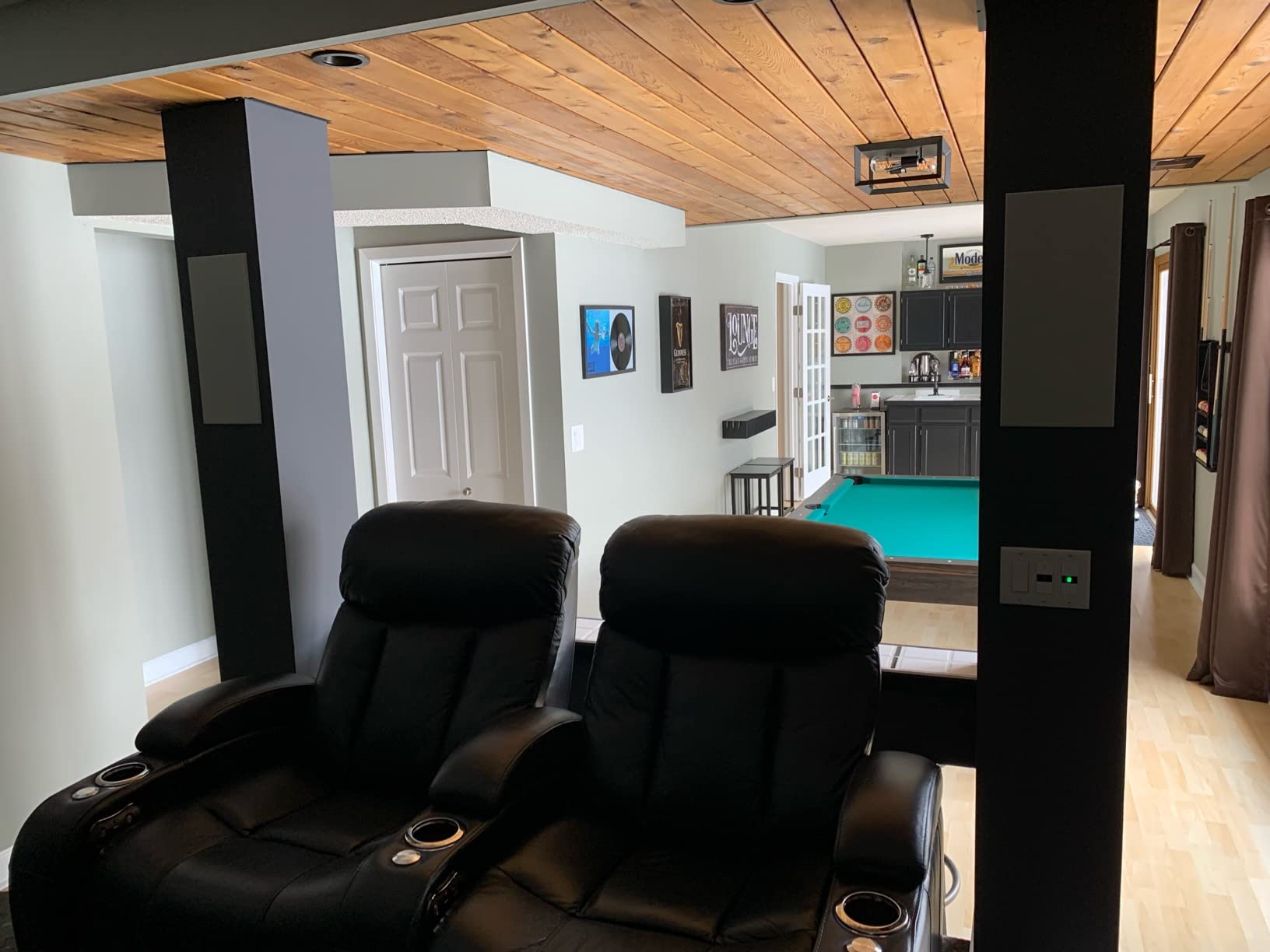
The dual 5.25 inch Cerametallic cone woofers give more mid-bass than the single-driver designs at this size, and the pivoting horn lets you aim the speaker at the seats from a high or side-wall position. It mounts horizontally or vertically, so one model can cover center and front channels.
Maximum output power is listed at 150 watts. Horn-loaded designs are efficient, so this speaker is one of the easier models in the roundup to drive with a mid-range receiver, which is a real advantage if you are not planning a separate amp.
Horn tone versus dome smoothness
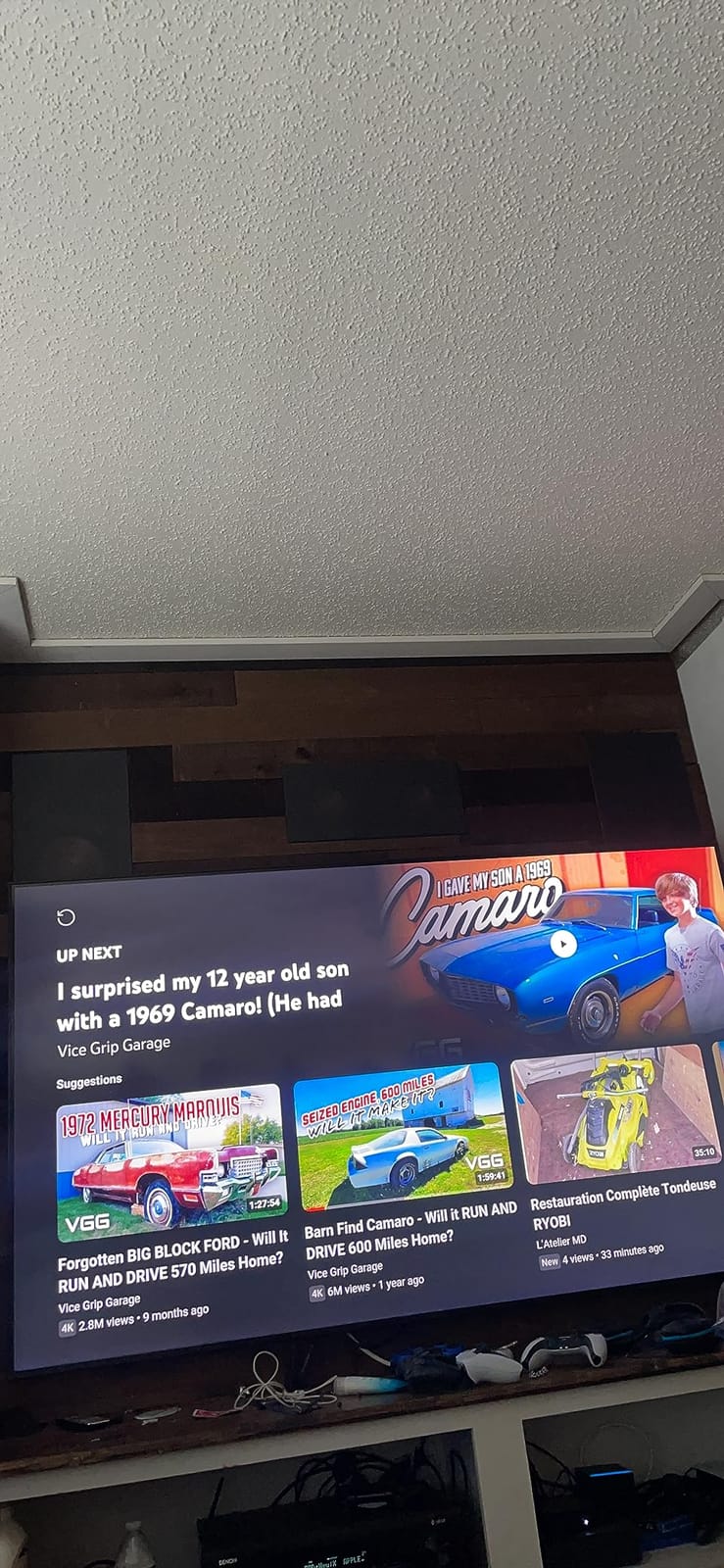
The tradeoff is tonal. Horns deliver detail and dynamic headroom that soft domes cannot match, but the signature is forward. If you are used to warm-sounding gear, the R-5502-W II may read as bright until your room correction runs its first sweep.
We would run room correction before judging it. The larger R-5800-W II in this range carries treble and midbass attenuation switches, and on the R-5502-W II you are relying on the receiver’s tone controls and placement angle to tame the top end.
Who should skip the R-5502-W II?
Skip it if warm, smooth midrange is the sound you are chasing, or if the single-speaker packaging is a problem for your channel count. Building 5.1 with this model means ordering six of them, which changes your total cost considerably.
Buy it if dialogue intelligibility under loud effects is your priority and your room needs serious output. This is the pick for viewers in wide seats who have struggled to follow dialogue on a conventional system.
5. Pyle PIC6E – Best Budget Surround and Atmos Pair
- Treble switch lets you tune the room
- Templates and hardware make installs very quick
- Flush mount works on walls or ceilings
- Handles high volume without distortion
- No enclosure included so bass stays loose without a back can
- Grille attaches by friction instead of magnetically
- Dog-ear clips feel flimsy and arrive tack-glued
The PIC6E pair is where we send people who want surrounds and height channels on a limited budget. At 125 watts RMS per speaker with 45Hz to 20kHz response, it covers the surround bed and Atmos layer without needing anything exotic from the amplifier.
Owners routinely compare the midrange and treble favorably against far costlier in-walls, which tells you the value case is real. The adjustable treble control switch at plus or minus 3dB is unusual at this tier and lets you match it to a warmer main speaker.
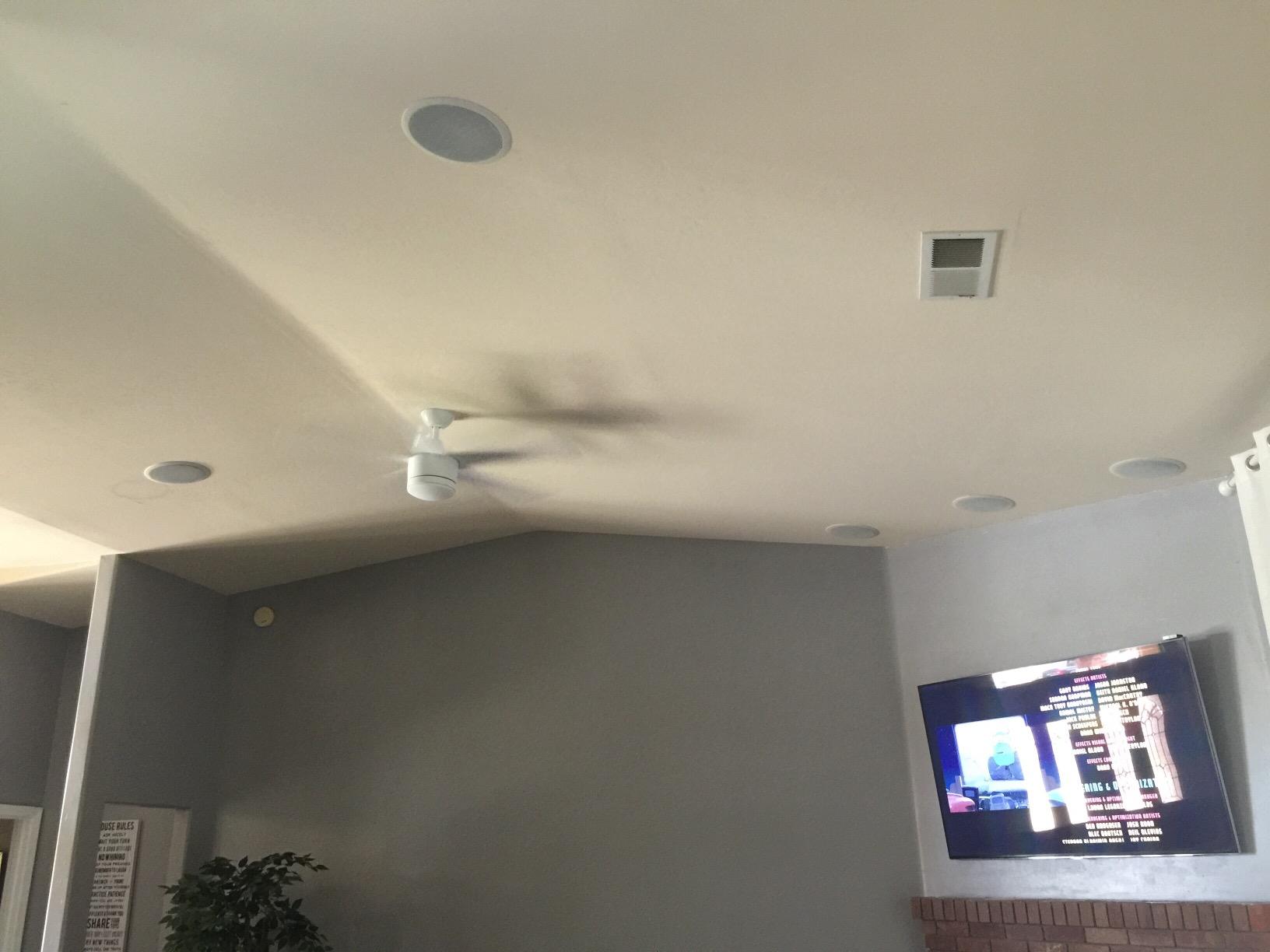
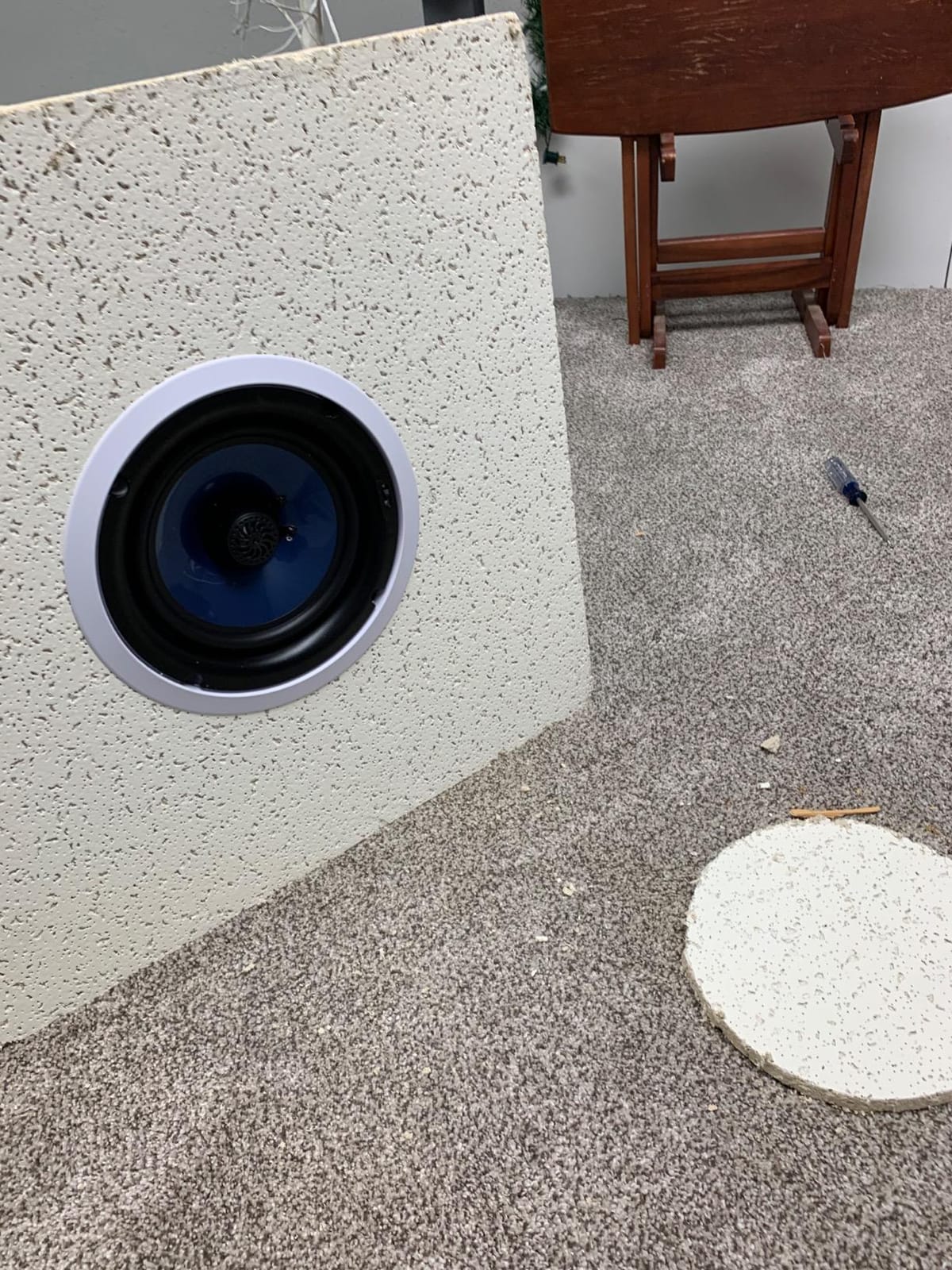
Two practical details make installs quick. The cutout is 8.07 inches in diameter with a 9.37 inch flange, so it fits inside a standard 16 inch stud bay without cutting a stud, and a cutout template ships in the box. The 1 inch silk dome tweeter pivots, which is what you want for overhead placement.
The most common advice in the reviews is to add an enclosure. Without one, the wall cavity acts as an unpredictable resonator and the low end gets loose, which owners describe as flabby compared with the same speaker in a box.
Using the treble switch and pivoting tweeter
Set the treble switch before you run room correction, not after. If the switch is at 0 dB and your room is reflective, the correction system will partly cancel the brightness instead of fixing the placement. The pivot on the tweeter should be aimed at the listening position for surrounds as well.
Keep in mind the two mounting styles. These are round coaxial drivers, so they mount equally well in a ceiling for Atmos height channels as they do on a side wall for surrounds, which is a flexibility the rectangular models do not offer.
Who should skip the PIC6E?
Skip it for front stage duty in a dedicated theater, where the 6.5 inch driver will not deliver the output an action room needs, and skip it if you cannot commit to building or buying an enclosure. It is also not the pick for anyone who wants a magnetic grille, since these use friction-mounted grilles.
Buy it if you are building out surrounds and Atmos channels across a wide room and want to spend the savings on a better center and a proper sub. Our universal remote picks are a better place to spend extra money than on more speakers.
6. Klipsch R-5800-W II – Best High-Output 8 Inch In-Wall
- Largest woofer here for strong low-end output
- Horn loading keeps output clean at high volume
- Treble and midbass attenuation switches aid matching
- SlimTrim magnetic grille is easy to remove and paint
- 5-year limited warranty
- Sold as a single speaker so a full theater needs several units
- Aluminum dome lacks the smoothness of silk domes
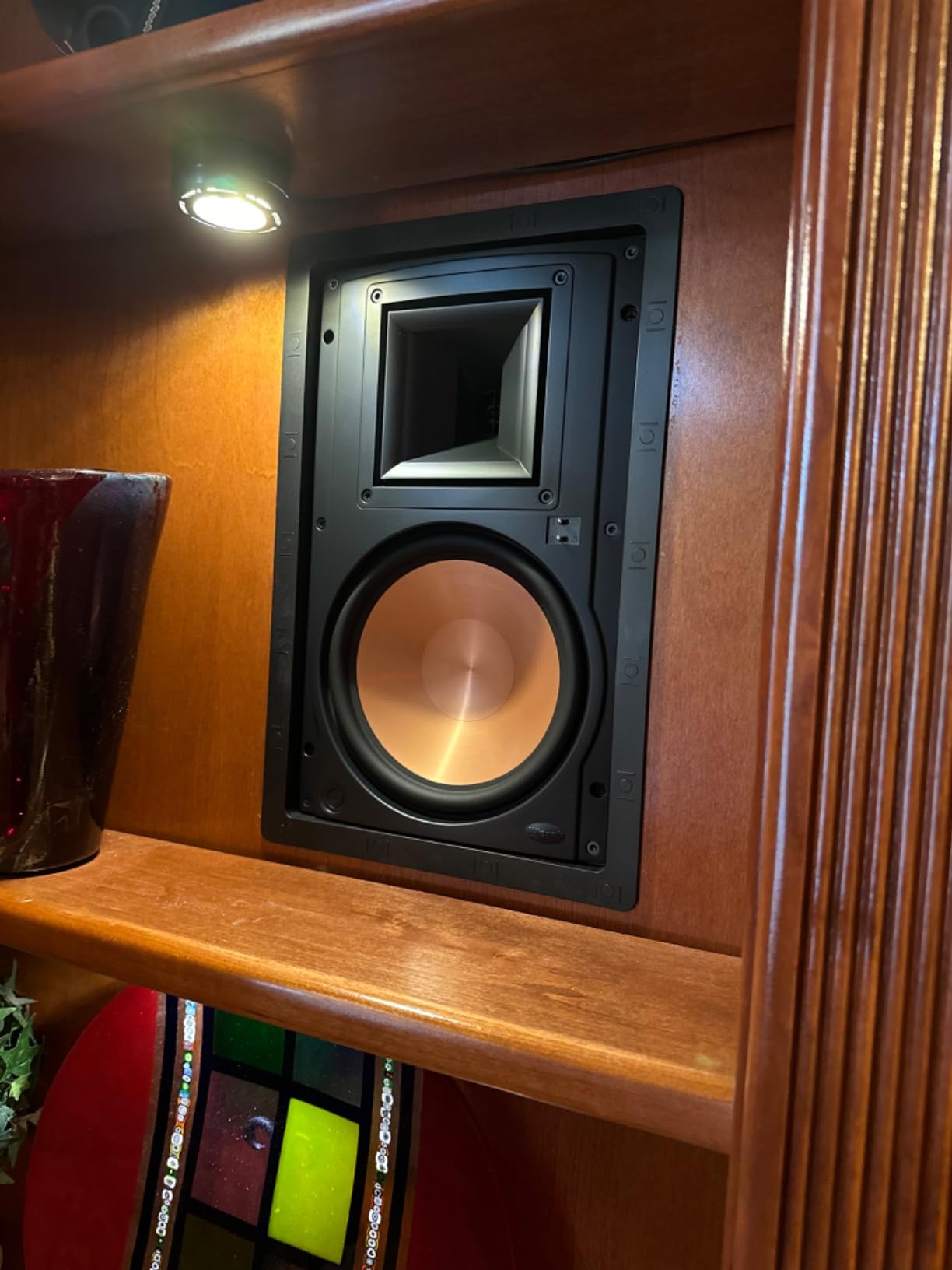
The R-5800-W II is the output king of this group. An 8 inch Cerametallic cone woofer in a body that is only 3.8 inches deep gives you genuine low-end weight in a shallow in-wall, and the pivoting horn keeps it articulate at the same volume levels.
Owners single out the pairing of a large woofer with a pivoting horn as the reason these outperform smaller in-walls on both output and clarity. Roughly 91 percent five-star ratings across 181 reviews is a strong showing for a horn-loaded design.
Two switches make this unusually easy to integrate. Treble and midbass attenuation controls let you trim the horn brightness and the upper bass to match a warmer center channel, which is the fastest path to voice matching without an outboard processor.
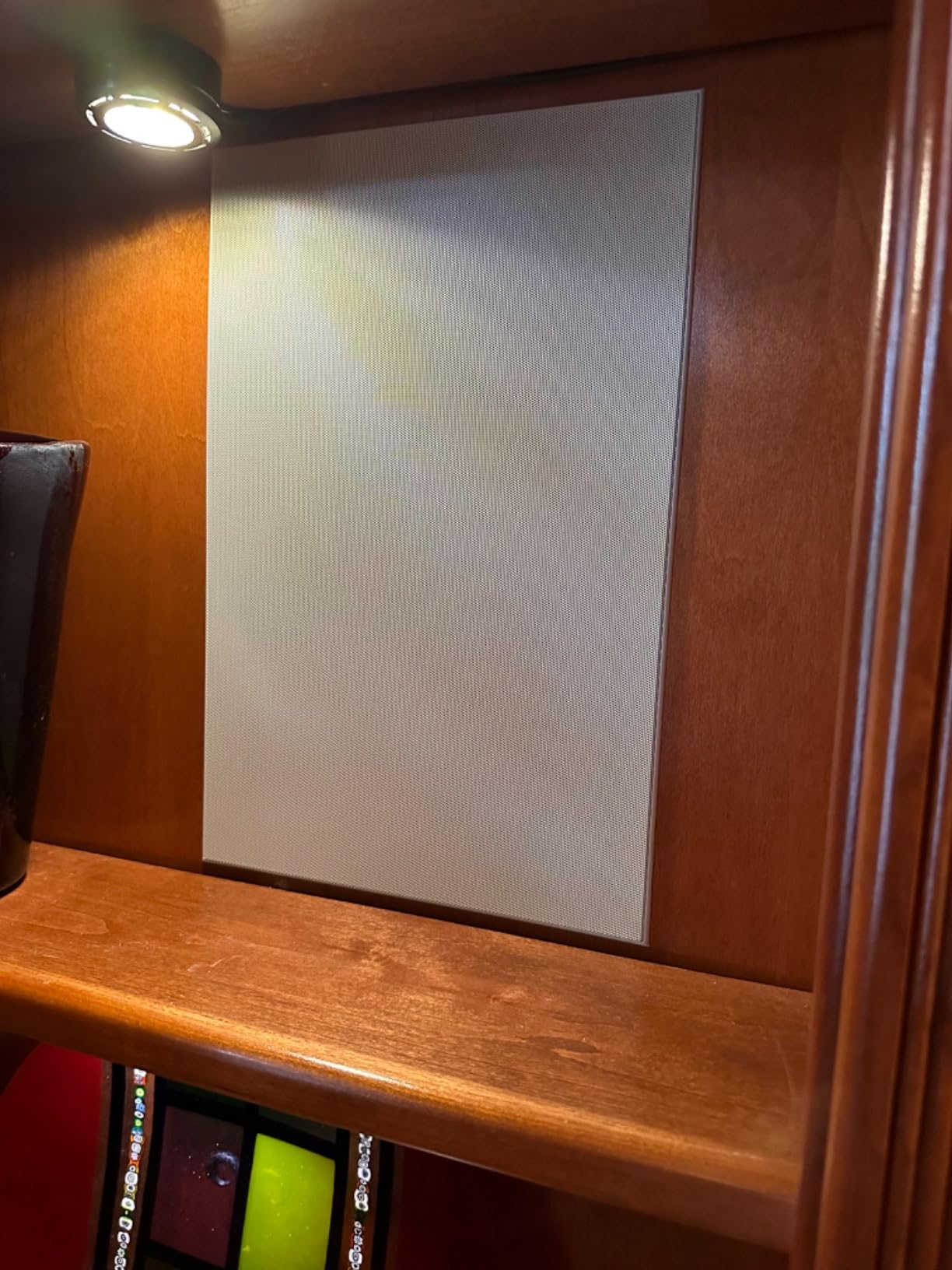
The SlimTrim low-profile magnetic grille is one of the nicer hardware details here. It comes off in one hand, takes paint well, and does not need a suction cup or a second person, which saves time on the finishing pass.
When an 8 inch woofer is worth it?
An 8 inch driver earns its place when the room is medium to large or when you want the front stage to hold up without strain during long action sequences. Maximum output power is listed at 100 watts, but horn efficiency means it plays louder than that number suggests on most receivers.
Body dimensions are 3.8 inches deep by 9.3 wide by 14.8 high, so measure your cavity depth carefully behind the drywall. Fire-rated blocking often sits 4 to 6 inches behind the wall face, which is the most common reason an 8 inch model will not fit.
Who should skip the R-5800-W II?
Skip it if your wall cavity is shallow or if you want a smooth, non-forward treble. It is also the wrong tool for background audio, where its emphasis on dynamics is wasted.
Buy it if you are building a dedicated room and want a single part number that can serve as front stage, surrounds and even height channels. Just order enough units for your channel plan, since it is packaged as one speaker.
7. Yamaha NS-IW480C – Best Three-Way Design for Wide Seats
- Three-way layout with dual tweeters spreads sound evenly
- Twenty mm pivot disperses energy toward seats
- Mounting depth of about 9.4 inches allows a deeper cavity
- Spring-loaded terminals are among the easiest to wire
- Needs a subwoofer for the deepest low-frequency effects
- Less headroom at very high volume than premium in-walls
- Template needs generous clearance around the cutout
The Yamaha NS-IW480C is the only true three-way design in this roundup, and that changes how it behaves in a wide room. Instead of a single high-frequency source, it uses dual 3/4 inch dome tweeters with Sound Mask technology to spread energy across a wider arc.
Long-standing owners report that it holds up after years of hard use, with crisp airy highs, clear mids and smooth bass for surround duty. That consistency across years is worth something in a permanent installation.
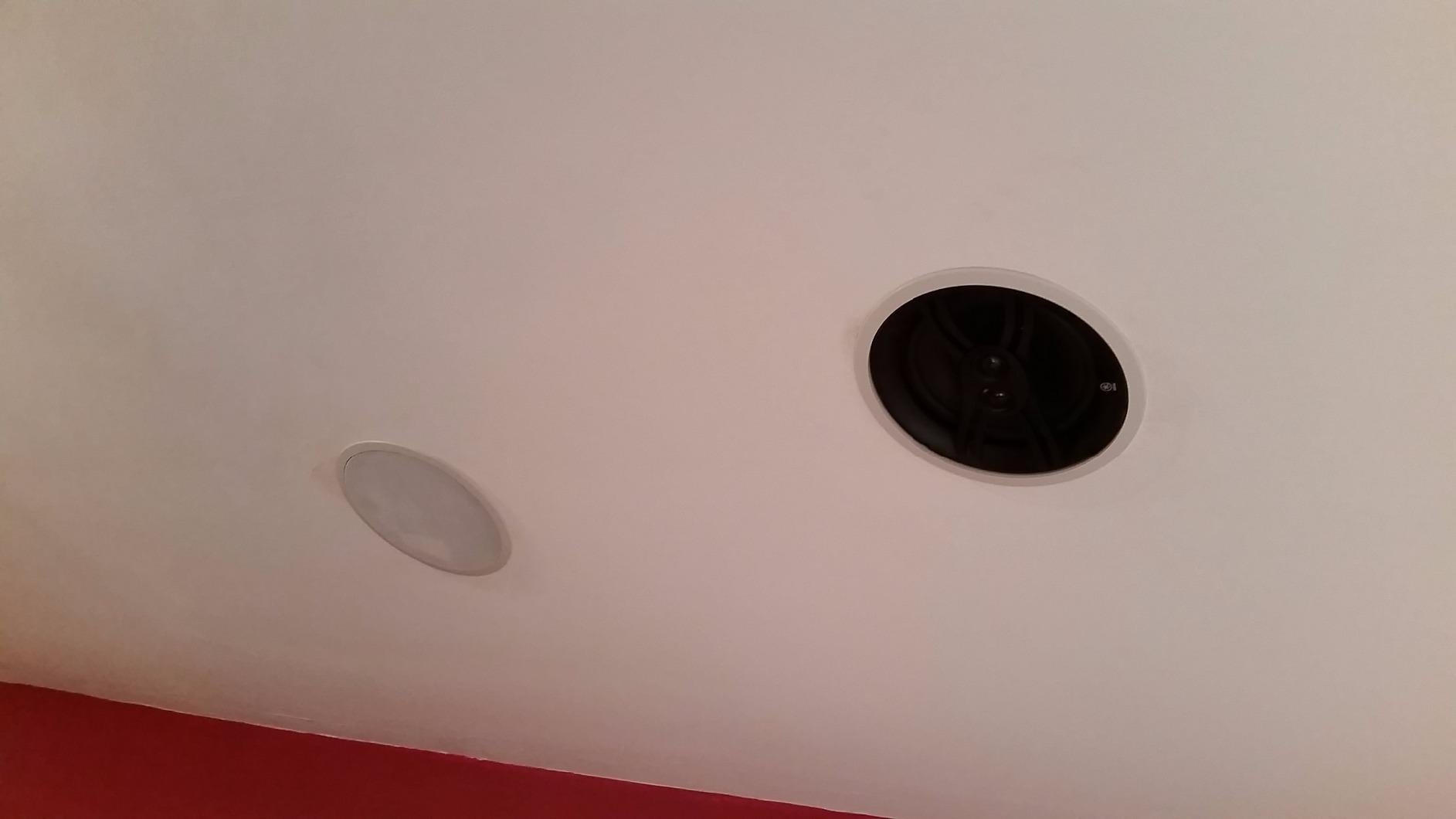
The mounting depth is listed at roughly 9 to 7/16 inches by 4 to 13/32 inches, which is deeper than every other model here. That depth is a benefit because the cavity behaves more like a real cabinet, but it means you cannot use this speaker in a shallow retrofit bay.
Springs-loaded wire terminals are the terminals to beat. You can run the wire before the speaker goes in and connect it at the end without a soldering iron, and maximum input capability is 120 watts with an 8 ohm nominal load.

Why dual tweeters help wide rooms?
A single tweeter in a rectangular in-wall sends energy in a fairly narrow lobe, so seats away from center lose high-frequency detail. Dual dome tweeters with Sound Mask widen that lobe, which is why this model suits a room with three or more seats across rather than a single row.
The swivel mechanism lets you aim dispersion toward the listening area as well. Combine both and the result is more even coverage, which matters more for surround and height channels than for a center channel sitting directly in front of the screen.
Who should skip the NS-IW480C?
Skip it if you have shallow existing cavities, and skip it if you push playback levels very high, since owners note less headroom than premium models. The mounting depth alone disqualifies it for many retrofit installs.
Buy it if you have a wide seating arrangement or a new build where you control cavity depth. The two-year parts and labor warranty is shorter than the Klipsch five-year cover, which is worth factoring in for a permanent install.
8. Monoprice Alpha Series 8 Inch Carbon Fiber – Best Driver Material for the Money
Monoprice 2-Way Carbon Fiber In-Wall Speakers – 8 Inch (Pair) With Paintable Magnetic Grille – Alpha Series,BLACK
- Carbon fiber cones hit harder with lower distortion
- Magnetic no-logo grille takes paint well
- Suits mains surrounds or distributed audio
- 8 inch drivers give real output for front channels
- Small installed base means limited long-term data
- Heaviest of the group at 13.4 pounds for the pair
- Few published cutout and depth details
The Alpha Series pair stands out for its driver material. Carbon fiber cones are stiffer and lighter than conventional paper or poly cones, and the practical result is deeper bass with noticeably lower distortion as you push volume.
The limited review pool credits exactly that, describing more output and less compression than typical in-walls at this price point. At 4.5 stars across 80 ratings, it is the thinnest feedback base here, so buy it with that in mind.
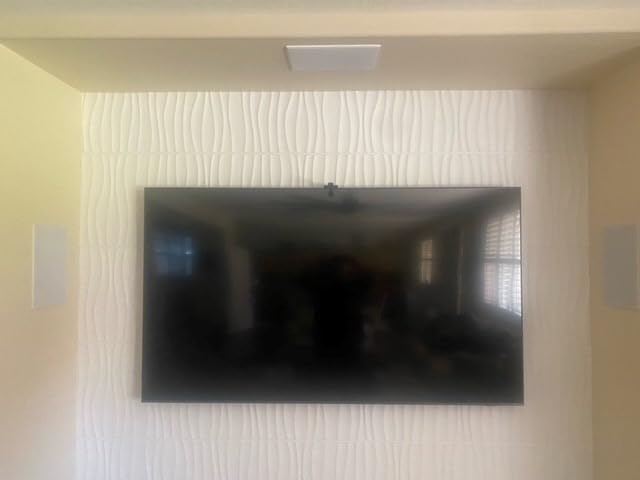
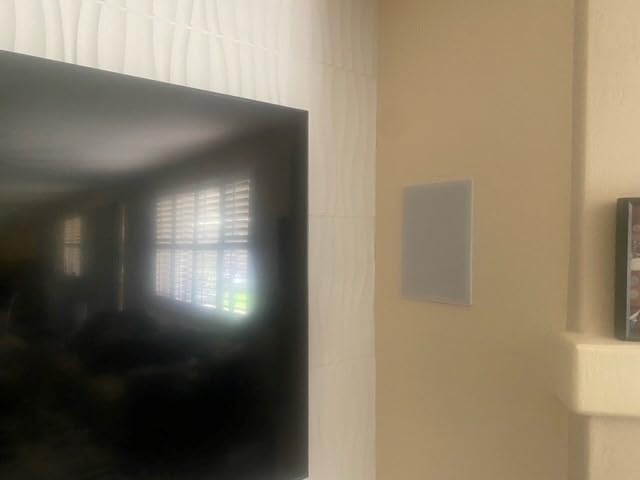
The no-logo SlimFit magnetic grilles are a genuine quality-of-life detail. A grille with no branding on it disappears completely once painted, and magnetic attachment means no clips to break during future servicing.
At 13.4 pounds for the pair, these are the heaviest speakers in the roundup. That mass is reassuring for a permanent install, but the mounting brackets have to be rated for it, especially in retrofit drywall where the clamps bite into paper rather than wood.
What carbon fiber cones actually change?
Stiffer cones break up harmonic distortion earlier, which matters in a wall cavity where the enclosure is already unpredictable. That means the speaker stays cleaner during action sequences, and it also means less masking of dialogue by bass distortion.
The trade is that carbon fiber cones have less midrange warmth than a paper cone on some drivers, so pair these with an equalizer sweep rather than assuming they will match any main speaker automatically.
Who should skip the Alpha Series?
Skip it if you want a large body of long-term owner feedback before committing to a permanent install, and skip it if you are planning to bi-amp or push very high volumes on a modest amplifier. The warranty is also one year rather than the five years some competitors offer.
Buy it if you want a magnetic grille and carbon fiber drivers without stepping up to a flagship price, and if you are using these for mains or surrounds in a mixed whole-home and theater system.
9. Klipsch R-3650-W II – Best Fit for Narrow Stud Bays
- Fits tight stud bays that block wider speakers
- Pivoting horn keeps sound clear from off-center seats
- Treble switch tames the top end
- Magnetic grilles sit flush with the wall
- Cardboard template included in the box
- Bright out of the box until break-in and adjustment
- Less low-end than an 8 inch model
- Sold as a single speaker so channels need separate purchases
Existing homes rarely give you room. With studs on standard 16 inch centers you often have about 8 inches of clear width between framing members, which rules out most of the dual-woofer designs in this roundup. The R-3650-W II fits inside that constraint.
Owners upgrading from builder-grade in-walls report that these outperform what they had, provided they allow for break-in. The consistent recommendation in the reviews is to use the minus 3 dB treble setting and add a subwoofer, since the 6.5 inch woofer lacks deep low end.
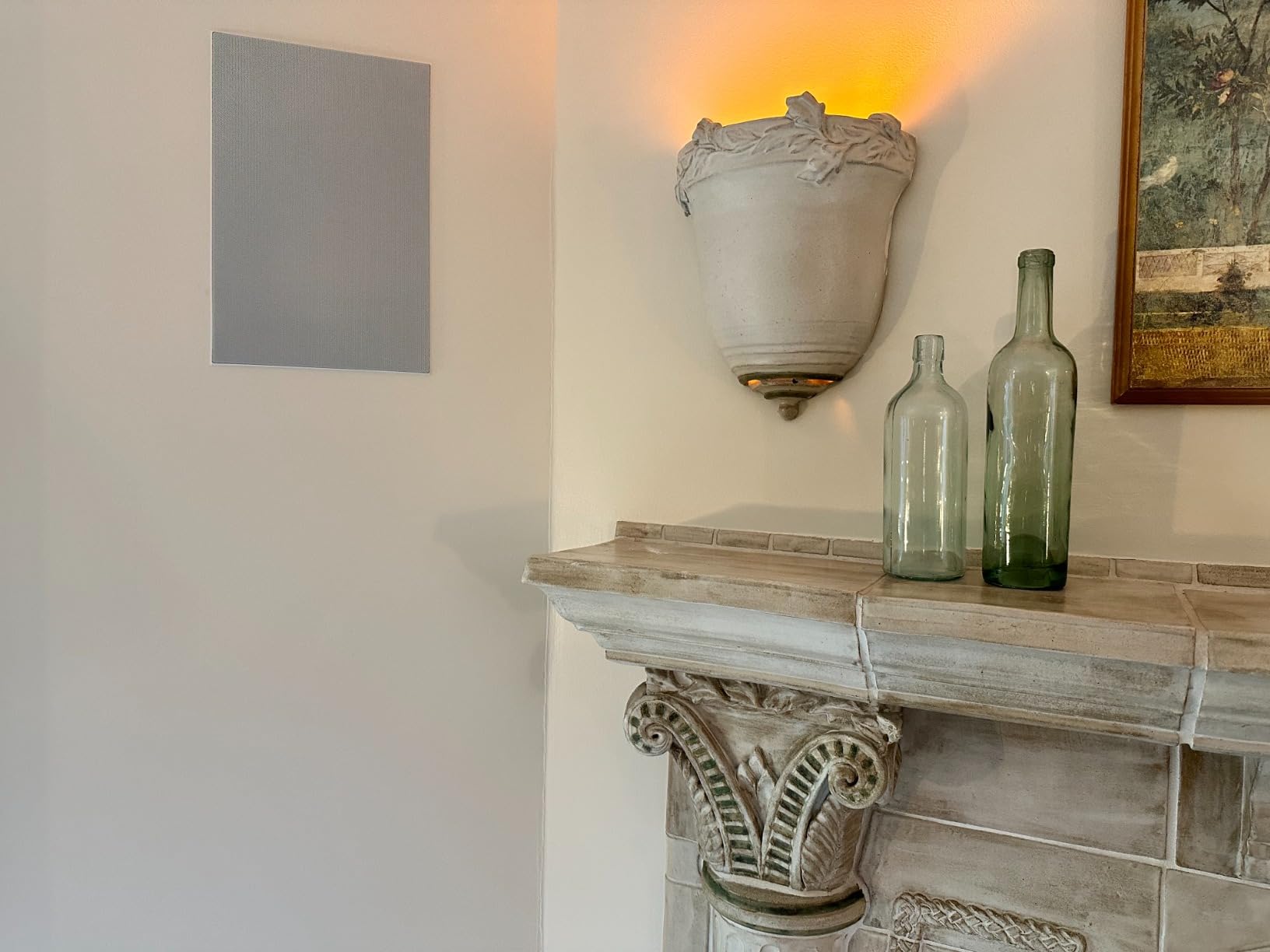
The 1 inch aluminum tweeter feeds a square 90 by 60 degree pivoting Tractrix horn, and horn loading raises output while cutting distortion. A treble attenuation switch on the front face lets you dial the brightness down before correction, which is a real advantage over models with no onboard trim.
Body dimensions are 3.75 inches deep by 9.3 wide by 14.3 high with a listed weight of 3.06 kg. That is a shallow, manageable body, and there is an IR receiver knock-out on the grille if your install uses infrared repeaters.
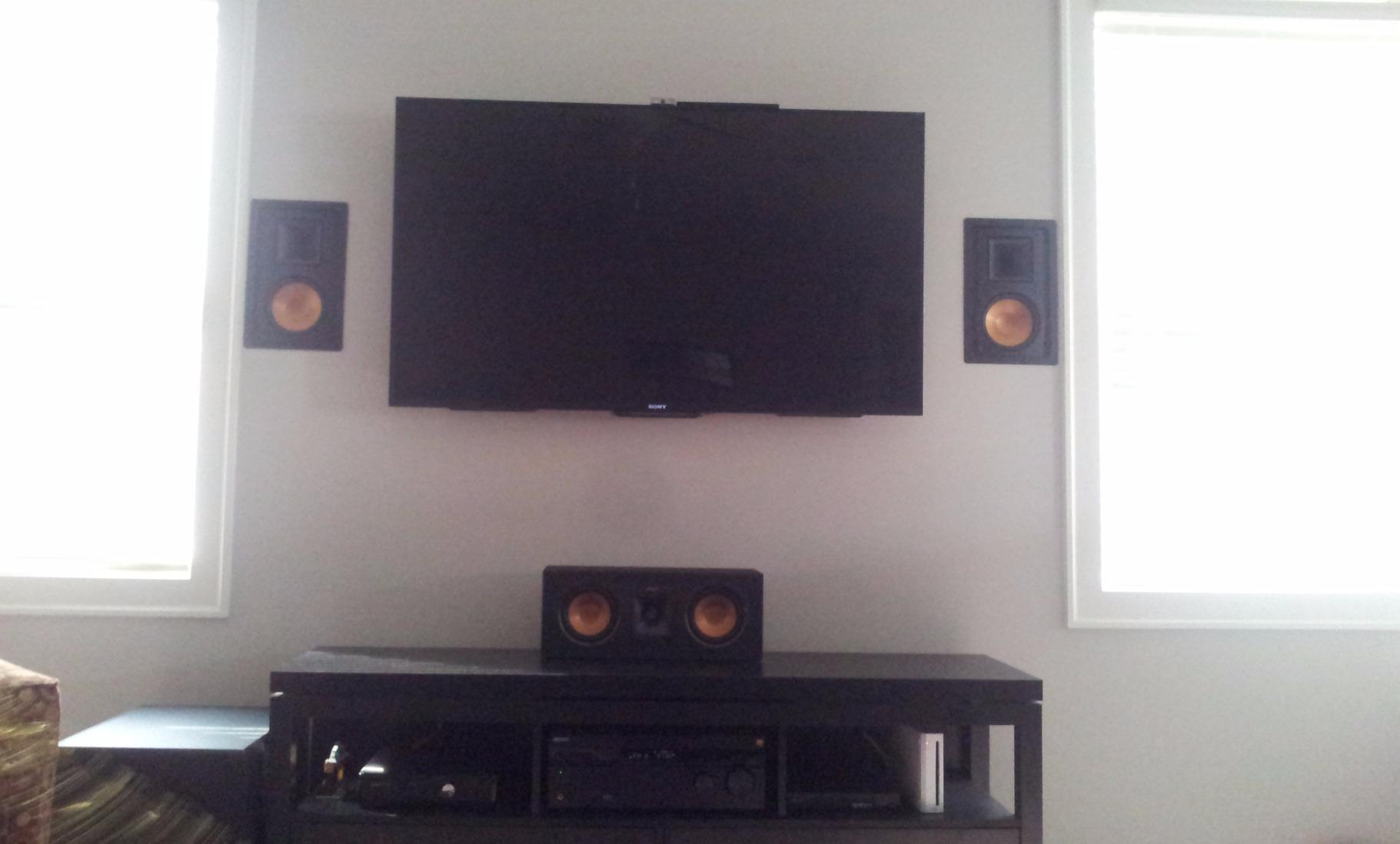
Using the treble attenuation switch properly
The switch matters more here than on larger models because horn-loaded 6.5 inch designs start bright. Set it to minus 3 dB, run your room correction sweep, then adjust. If you leave it at 0 dB, the correction system will flatten the midrange along with the treble and the speaker will sound thin.
Use the pivot too. On a side-wall surround position, angling the horn toward the seats is worth more than any additional wattage you add to the amplifier.
Who should skip the R-3650-W II?
Skip it if the front stage is your priority and you have cavity depth to spare, since a 6.5 inch woofer will not deliver the same weight as the 8 inch models here. It is also not the pick for anyone who dislikes horn timbre.
Buy it if you are retrofitting into an existing house and cannot move studs. It is the model we would choose for a 7.1 build in a pre-wired room where every position is already framed at a fixed width.
10. Silver Ticket 82W – Best for Whole-House Audio Alongside Theater Channels
82W Silver Ticket in-Wall Speaker with Pivoting Tweeter (8 Inch in-wall)
- Crisp undistorted mids and highs at high volume
- Published sensitivity and cutout dimensions
- Templates and paint masks included
- Moisture-resistant for bathrooms and covered eaves
- Mixes with smaller siblings for a full build
- Bass stays light without an enclosure or subwoofer
- Mounting clips need care in older wall constructions
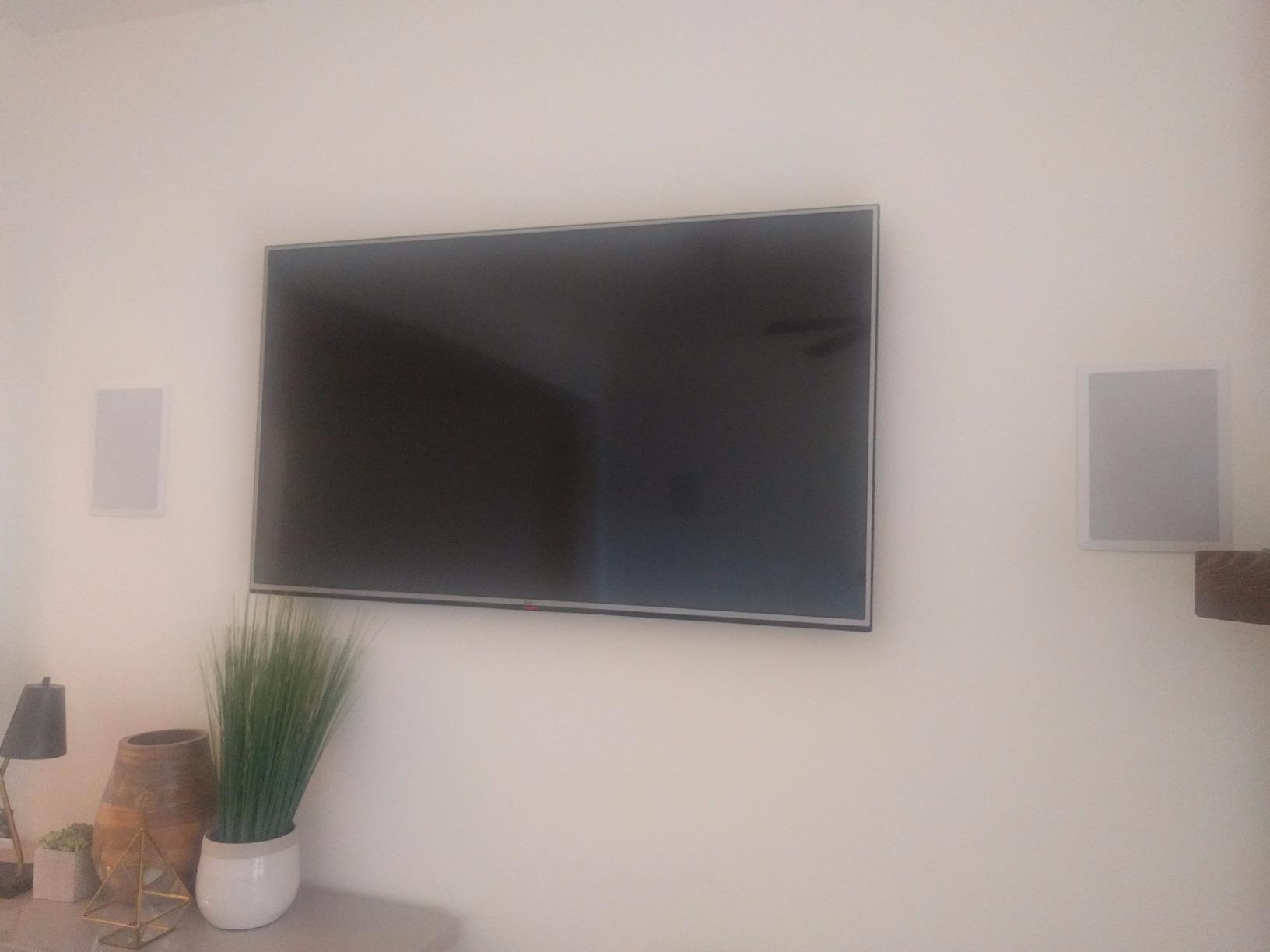
The Silver Ticket 82W is one of the few models here that publishes everything you need to plan an install. Sensitivity is listed as 89 dB plus or minus 2, frequency response as 51Hz to 20,000 Hz, and the required cutout is given as 8.75 by 12.75 inches. That transparency is rarer than it should be.
Buyers who expected little from the price report crisp highs and a clean midrange with no distortion at any volume, and several replaced far costlier bookshelf speakers in 5.1 and 7.1 systems.
Power handling is 60 watts nominal and 120 watts peak with a 12dB per octave crossover, so it pairs comfortably with a multi-zone receiver. The moisture-resistant construction also makes it a sensible pick for a bathroom, a sauna or a covered outdoor eave.
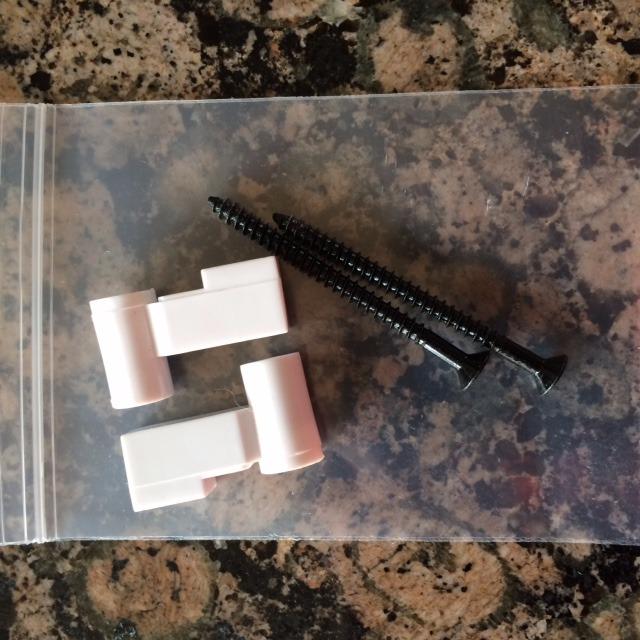
The 8 inch mica polypropylene cone has a rubber edge and a 30 oz magnet, and the 20 mm silk dome tweeter pivots 15 degrees. Cutout templates and paint masks are included in the box, which saves real time on the finishing pass.
Published specs versus guesswork
Forum discussion about in-wall brands often stalls because manufacturers withhold impedance, sensitivity and off-axis data. Having those numbers on the manufacturer sheet lets you check the load against your amplifier before the wall is closed, which is the difference between a smooth project and a re-open.
The 89 dB sensitivity figure means you can size your amplifier channels fairly precisely. Compare that to models where the number is missing and you are essentially guessing at the amplifier pairing.
Who should skip the 82W?
Skip it if you want deep bass from the speaker itself, since owners consistently recommend a subwoofer and an enclosure. It is also not the front-stage pick for a dedicated room with high output demands.
Buy it if you are extending audio into bathrooms, kitchens and outdoor eaves alongside your theater channels, or if you simply want a spec sheet you can plan against. It is our pick for a mixed whole-home and theater build.
11. Pyle PDIW65 – Lowest Cost Per Channel for Surround Duty
- Very low cost per channel for surround duty
- Spring-loaded terminals remove the need to solder
- Cut-out template included
- Grille can be painted to disappear
- Handles surround and background duty well
- Limited bass without a subwoofer or bass boost
- Small tweeter lacks the crispness of larger drivers
- Plastic drywall clips can snap if over-tightened
The PDIW65 pair exists for one job: filling surround positions cheaply so the money can go to a better center and subwoofer. With 200 watts peak and 100 watts RMS per speaker across a 6.5 inch midbass driver, it does that job without drama.
Reviewers rate these as strong value inside the entry tier rather than as premium sound. That framing matters, because at 4.4 stars across 360 ratings the output is modest and the tonal signature is soft rather than neutral.
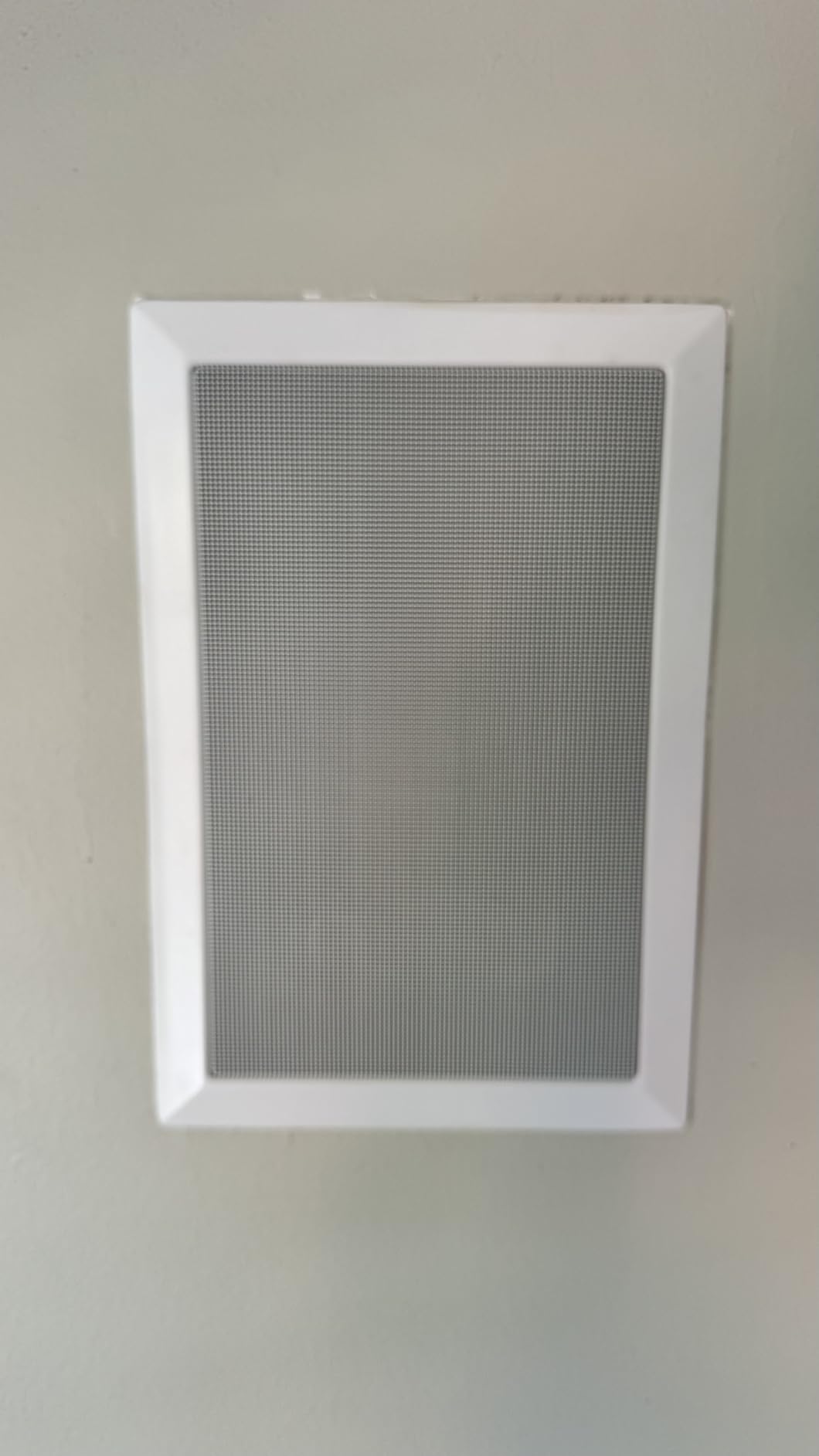
Frequency response runs 70Hz to 20kHz with a 4 to 8 ohm impedance rating, so it works with almost any receiver. The 1 inch high temperature voice coil on the midbass driver is a sensible choice for a speaker that may run for hours on background audio.
Spring-loaded quick-connect terminals are the detail we appreciate most. You can leave the wire tails in the wall, drop the speaker in, and click the wires on without a soldering iron, which matters when you are working above a staircase or in an attic crawl.
Cutout size and mounting tabs
Body dimensions are 7.5 inches deep by 9.5 wide by 13 high with a cut-out template in the box. The plastic drywall clips are the weak point: thread them before you tighten, because overtightening snaps them, and that is the single most common complaint in the reviews.
The listing advertises an adjustable tweeter, but some speakers arrive with a fixed 1/2 inch polymer tweeter. If pivoting matters for your positions, verify the speaker in your hand before the wall closes.
Who should skip the PDIW65?
Skip it for front stage or center duty, where the small tweeter and 70 Hz low cutoff will show. It is also the wrong pick if you want wide dispersion, since the polymer tweeter does not throw energy far.
Buy it if surrounds are an afterthought in your layout and you need eight more channels cheaply. The best use is a room where each position does not need to carry much output on its own.
12. Pyle PDIW87 – Best Enclosed Pick for Apartments and Shared Walls
- Only enclosed option here which limits sound bleed into neighbouring rooms
- Long-throw 8 inch woofer gives more low end than open-back models
- Handles sustained high volume for surround duty
- White grille blends into standard wall finishes
- Lowest rated in the roundup with thin reviews on the sound
- Quarter-turn plastic tabs break if not pre-threaded
- Grilles fit loosely and are held with adhesive pads
The PDIW87 is the only model in this roundup with a sealed cabinet built in, and that single fact changes where you can install it. In an apartment or a multi-floor house, an open-back in-wall sends sound into the next room, and an enclosure is the only real answer.
Reviews split sharply on this one. Many buyers call the sound genuinely good for the price, especially in multi-room background audio, while the largest group of complaints centers on fragile mounting hardware and a hollow, bass-heavy signature at higher volume.
On paper it is the most capable bass producer here: an 8 inch long-throw woofer in a vented design, rated 50Hz to 20kHz with 400 watts peak handling. At 4.1 stars across 480 ratings it is the lowest rated product we included, and the reviews reflect that split.
The practical caveat is depth. Body dimensions are 11.1 inches deep by 14.5 wide by 10.9 high, so this needs a genuine cavity rather than a shallow retrofit bay, and the enclosure volume competes with fire-rated blocking behind the wall.
Why an enclosure changes the installation?
An in-wall without a cabinet uses whatever space exists between studs as its enclosure, and that space changes shape depending on insulation, blocking and ductwork. A sealed cabinet gives the driver a known volume, so the frequency response you measure in the shop is closer to what you get in the room.
That predictability is why we treated the back box as a must-have topic rather than an accessory. For this model it is already solved. For the other eleven, you either build one or accept that placement will keep changing the bass.
Who should skip the PDIW87?
Skip it if sound quality is the priority and you have room for an open-back design with a back box, because at 4.1 stars the tonal complaints are consistent enough to matter. Skip it in shallow cavities, and expect the quarter-turn tabs to need pre-threading.
Buy it if sound bleed is your hard constraint. In an apartment, an enclosed in-wall is the only responsible choice, and this is one of the few sealed options you can specify at this budget.
How Many In-Wall Speakers Your Theater Actually Needs?
Count channels first and speakers second. A 5.1 system needs five full-range speakers plus one subwoofer, a 7.1 system needs seven full-range speakers plus a subwoofer, and a 7.1.4 layout adds four overhead height speakers for eleven full-range positions in total.
The practical wrinkle is that you rarely buy seven identical speakers. Most builders use one model for the L, C and R front stage, a dedicated center model, and a second model for surrounds, then fill the overhead layer with the most efficient pair they can afford.
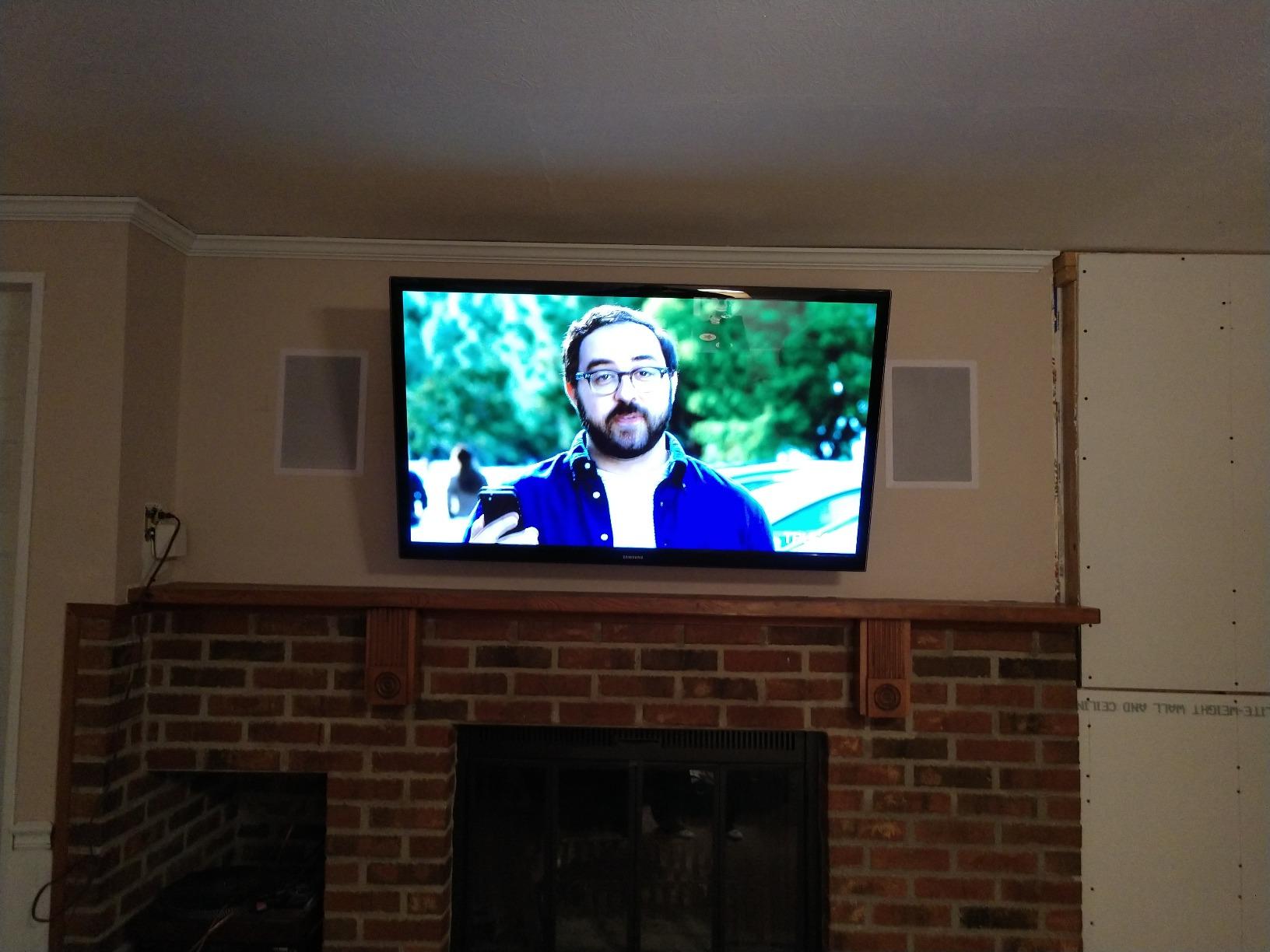
That is why the RC85i and the Micca M-CS pairing works so well in practice. The RC85i covers L, R and surrounds, the Micca handles the center, and you can repeat the RC85i in the ceiling for height channels if the cutout suits an overhead position.
Why the Back Box Matters More Than the Badge?
The most consistent piece of advice across home theater forums is that the backing box is the single biggest contributor to in-wall sound quality. Most in-wall models ship without one, and most buyers do not know they need one until after the drywall is closed.
Here is the mechanism. An open-back in-wall dumps its rear wave into the wall cavity, where it hits studs, insulation and ductwork, then returns as unpredictable coloration. Turn it into a sealed cabinet with defined volume and the driver loads the way the designer intended.
You have three options. Buy a third-party enclosure matched to your model, ask the manufacturer for the enclosure part number, or build your own from rigid board sized to the internal volume listed in the manual. Brace it to the studs so it does not rattle.
Sound bleed is the other half of the problem. Open-back models in this roundup, including the Polk RC85i and the Klipsch models, send energy into the next room. In a multi-floor house or an apartment, that is usually the reason people abandon in-walls entirely.
Only the Pyle PDIW87 in this list has a sealed cabinet built in. For everything else, treat an enclosure as part of the speaker purchase rather than an upgrade you might add later.
2-Way vs 3-Way In-Walls and Why Dialogue Gets Louder
A 2-way design puts one driver type in charge of low and mid frequencies and another in charge of highs. A 3-way design splits that range again, usually with a dedicated midrange driver between the woofer and the tweeter, so no single driver has to handle too wide a band.
That is why the Yamaha NS-IW480C, the only 3-way here with dual 0.75 inch dome tweeters, spreads sound more evenly across a wide seating arrangement. If your theater has three or more seats across and viewers on the outer seats complain about dialogue, a multi-driver high-frequency section is the fix.
Watch the sideways MTM trap. A dual-midwoofer model mounted horizontally above a screen puts the tweeter between the midrange drivers, and the lobing that creates can blur exactly the dialogue you were trying to improve. A coaxial or 3-way center avoids it.
For surrounds and height channels, the calculus reverses. Wide dispersion matters more than directivity, so a pivoting tweeter or a horn that covers 90 by 60 degrees is often the better tool than extra midrange drivers.
Matching Sensitivity, Impedance and Voice Across Channels
Two numbers decide whether your amplifier can drive the speaker. Sensitivity is how loud one watt produces, and impedance is the load the speaker presents. All the models here are nominally 8 ohm except the Pyle PDIW65, which is rated 4 to 8 ohm.
Sensitivity in this roundup runs from 89 dB on the Silver Ticket 82W to 90 dB on the Micca M-CS. At the top end of that range a mainstream receiver drives them comfortably; anything quieter asks for an amplifier with current capability rather than more nominal watts.
Voice matching is the other half. When a sound pans from a center channel to a surround, any tonal difference is immediately audible as the dialogue appearing to move off the screen. Identical models across channels remove the problem, so buy in matched quantities rather than assembling a set from different lines.
If you must mix models, match by driver material and response rather than by brand. An 8 inch midwoofer center paired with 6.5 inch surrounds will have a level and tilt difference that no equalizer fixes cleanly, and you will hear it on every pan.
Installation Checklist Before You Cut Drywall
Measure the cavity, not the wall. Body depth matters more than cutout width, and fire-rated blocking commonly sits 4 to 6 inches behind the wall face, which is why many 8 inch models will not fit in a retrofit.
Check stud spacing before choosing a model. Dual 5.25 inch centers such as the Micca M-CS need a 13.8 inch cutout and will not fit between 16 inch studs without moving framing. If you cannot move studs, choose a model with a narrower cutout.
Use the supplied template, trace it rather than measuring by eye, and cut the opening slightly under the marked line so the flange covers the edge. Test-fit before you run the final drywall piece.
Run the wire after framing and before drywall. In new construction, pre-construction brackets let you mark exact speaker and cutout positions while the studs are still visible, and they hold the box in place for the drywall crew.
Paint the grille separately from the driver. Most magnetic grilles take a light coat of paint matched to the wall finish, and doing it off the wall avoids overspray on the baffle.
Finally, add room correction after the speakers are installed and the room is furnished. Correction is the second quality lever after the enclosure, and it can only fix what the physical placement made wrong.
Frequently Asked Questions
What is the best in-wall speaker system for home theater?
The best in-wall system for a home theater is a matched set of the same model across the front stage and surrounds, plus a dedicated center channel. Our top pick is the Polk Audio RC85i for L, C, R and surround duty, paired with the Polk Audio 255c-RT or Micca M-CS in the center. Add a powered subwoofer and an enclosure behind every open-back speaker.
Are in-wall speakers as good as tower speakers?
Well-enclosed in-wall speakers can match a good tower for home theater, because a tower fights the room boundary in ways a flush-mounted in-wall does not. The gap closes fastest when you add a back box so the driver loads predictably. Music performance still tends to favour towers, which have real cabinets and larger enclosures.
Do in-wall speakers need a subwoofer?
Yes, always pair in-wall speakers with a subwoofer. Most models here bottom out between 45 Hz and 60 Hz, which leaves the deepest effects to the sub. Reviewers of every budget model in this roundup made the same recommendation. Treat the subwoofer as part of the speaker budget rather than an optional extra.
Can I use in-wall speakers for Dolby Atmos?
Yes, and most systems use in-wall or in-ceiling models for the overhead height channels in a 7.1.4 layout. Round coaxial designs like the Pyle PIC6E are popular for overheads because they fit in a ceiling bay and pivot toward the seats. Use the same model as your surrounds where possible so the overhead layer stays voice matched.
What size cutout do I need for an in-wall speaker?
Cutout size is specific to each model and is listed in the manual. Examples here include 13.8 by 6.7 inches for the Micca M-CS, 8.07 inches diameter for the Pyle PIC6E, and 8.75 by 12.75 inches for the Silver Ticket 82W. Measure your stud bay and cavity depth before buying, since a wide cutout may not fit between standard studs.
How many in-wall speakers do I need for 5.1?
A 5.1 system needs five full-range in-wall speakers plus one subwoofer: front left, center, front right, and two surrounds. A 7.1 system adds two rear surrounds, and a 7.1.4 Atmos layout adds four more height speakers for eleven full-range positions. Budget roughly three to five speakers and one subwoofer for a complete 5.1 build.
Which In-Wall Speakers to Buy for Your Home Theater?
The best in wall speakers for home theaters are the ones you can match across every channel and enclose properly. Pick the Polk Audio RC85i for a do-anything part number, add the Polk Audio 255c-RT or the Micca M-CS in the center, and budget for a subwoofer and an enclosure for every open-back model you install.
Whichever route you take, measure your cavity depth and your stud bays before you order. Speakers cut into a wall are effectively permanent, and the models that disappoint people are almost never the ones with bad drivers. They are the ones that did not fit the wall or went in without a box.
Our roundup was updated for 2026, and every spec quoted here comes from the manufacturer listing or from long-term owner feedback rather than from marketing copy.