
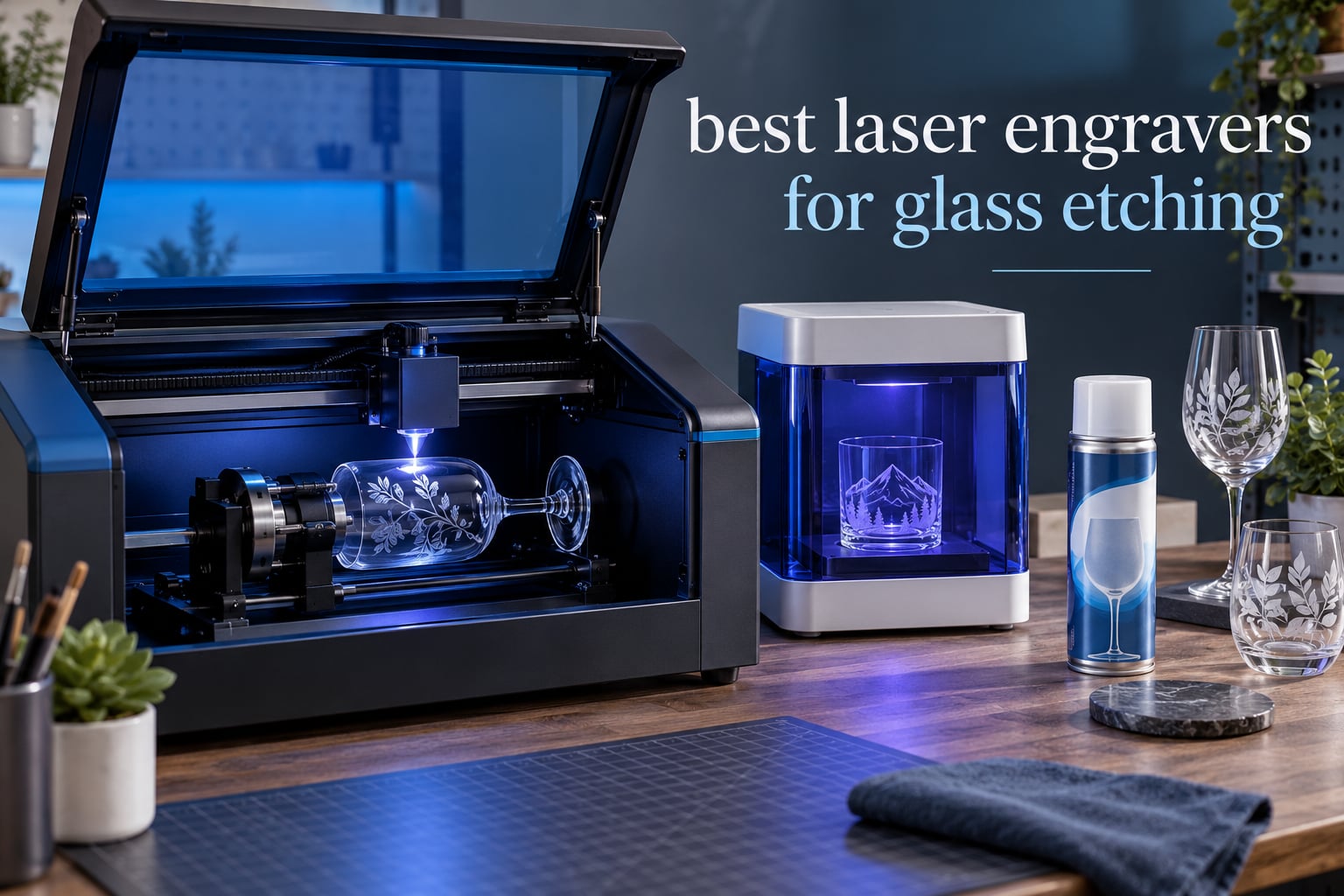
Yes, a laser engraver can etch glass, but the laser type decides everything about the result. A UV laser breaks molecular bonds at the surface with almost no heat, so it marks bare glass cleanly. A CO2 laser heats and pits the surface to create a frosted look. A diode laser cannot mark clear glass at all until you spray on a high-contrast coating. Pick the wrong one and you either get nothing or a shattered piece.
That is why searching for the best laser engravers for glass etching produces so much noise online. Most machines list glass in a materials chart, and that single word hides the fact that a diode and a UV machine behave completely differently on the same tumbler. We compared the eight machines that survived our glass-specific screening and read the owner feedback closely, including the cracking complaints that rarely make it into marketing copy.
This guide was last updated in 2026. We cover the mechanism each laser type uses on glass, the coating workflow that makes cheaper machines viable, a settings cheat sheet you can actually run, and honest notes on where each machine falls short. If you are still comparing methods, our guide to glass etching kits for DIY crafters covers the chemical route, and our best laser engravers for hobbyists covers the wider machine category.
Table of Contents
Top 3 Best Laser Engravers For Glass Etching (October 2026)
The OMTech K40+ takes our top slot because it is the most proven glass-capable CO2 in the group, with the deepest owner feedback of any machine here. The xTool F2 Ultra UV is the only pick in our testing that marked bare glass with no prep step whatsoever. The Orion Motor Tech 50W is the value pick, pairing a long-running 50W tube with a 12 x 20 bed.

OMTech K40+ 45W CO2
- 45W CO2 tube
- 12 x 8 in honeycomb bed
- Up to 300 mm/s engraving
- LightBurn and LaserGRBL

xTool F2 Ultra UV 5W
- 5W 355nm UV source
- No pre-coating required
- 3D inner glass engraving
- Spot under 10 micrometers
Best Laser Engravers for Glass Etching at a Glance
All eight picks below are CO2 or UV machines, because those are the two technologies that reliably mark glass. Six of the eight need a defocus or coating step; the two UV machines are the exceptions.
| Product | Specifications | Action |
|---|---|---|
| OMTech K40+ 45W CO2 |
|
Check Latest Price |
 Orion Motor Tech 50W CO2 Orion Motor Tech 50W CO2 |
|
Check Latest Price |
 Monport 60W Auto Focus CO2 Monport 60W Auto Focus CO2 |
|
Check Latest Price |
 OMTech Maker 90W CO2 OMTech Maker 90W CO2 |
|
Check Latest Price |
 OMTech Maker 60W Bundle OMTech Maker 60W Bundle |
|
Check Latest Price |
 xTool P3 80W CO2 xTool P3 80W CO2 |
|
Check Latest Price |
| xTool F2 Ultra UV 5W |
|
Check Latest Price |
 ComMarker XE 6W UV ComMarker XE 6W UV |
|
Check Latest Price |
Can You Use a Laser Engraver to Etch Glass?
Yes, but the result depends entirely on which laser you own. UV lasers etch cold and clean, CO2 lasers frost the surface and need a technique change to avoid chipping, and diode lasers require a high-contrast coating applied first. That single sentence is the whole decision: your machine type, not your settings, determines whether glass is a viable material.
Here is what is physically happening in each case. A 355nm UV source deposits so little energy as heat that it works by breaking bonds at the molecular level instead of melting anything. Glass enthusiasts call this cold processing, and it is why a UV laser leaves clean, char-free edges and can even cut inside a crystal block. There is no thermal shock, so cracking is close to a non-issue.
A CO2 laser emits far-infrared light that the glass absorbs at the surface, heating a tiny spot until it pits and frosts. The mark is real, permanent and scratch-resistant, but it is a surface frost rather than a removal of material. Because the heat is real, focus control becomes the deciding factor. The most repeated tip across the laser engraving communities is to defocus toward the glass, which means moving the focal point slightly in front of the surface so the beam spreads into a wider, softer spot. That spreads the heat and is the difference between a frosted word and a chip out of the rim.
A diode laser is the odd one out. Its near-infrared beam passes straight through clear glass because the material does not absorb enough energy at that wavelength. There is no mark, no matter how high you set the power. The workaround is a spray, a chalk coating or a layer of paint that gives the beam something dark to bite into. This is a legitimate workflow and plenty of hobbyists use it happily, but it adds a prep step and a cleanup step to every piece.
For our broader material coverage, see our diode laser beginner guide, and for high-volume sheet work, our large-format laser engraver picks.
1. OMTech K40+ 45W Desktop CO2 Laser Engraver – Our Best Overall Pick
- 45W power cuts 0.4 in acrylic and 0.31 in wood
- Engraves up to 300 mm/s
- 12 x 8 in bed suits a small shop
- 45-degree auto-adjusting air assist
- LightBurn and LaserGRBL support
- Quality control issues including loose fasteners and a misaligned gantry
- Some units reported with a faulty USB cable and safety switch
- Water hoses can be connected backwards
This is the machine we keep coming back to, and the reason is simple: it has the deepest owner feedback of any glass-capable unit in this roundup, with 37 ratings behind the 4.4 average. Owners who came from diode machines consistently report that the difference in cut quality and edge definition is night and day. For glass work, the 45W tube gives you plenty of headroom to frost a surface at moderate power while keeping the pass fast enough to avoid dwelling in one spot.
The 12 x 8 inch honeycomb bed is the right size for coasters, small plaques and a single wine glass at a time. Air assist at 45 degrees auto-adjusts to the laser power, which matters on glass because the melt residue otherwise sticks to the surface and smears the frosting. Owners also highlight the support team, which offers hands-on video guidance for alignment and setup. That matters more than it sounds, since first-run focus calibration is the step where most glass jobs go wrong.

The honest weakness is quality control at delivery, and it comes up in several reviews. Some units arrived with a dented case, loose internal fasteners and a misaligned gantry that needed correcting before the first cut. Others reported a faulty USB cable and a safety switch that needed adjustment, plus water hoses connected backwards causing an initial failure to run. None of these are fatal, but budget an hour for setup and check the gantry alignment before you trust any glass job.
Software support is a genuine strength here. It runs both LightBurn and LaserGRBL, so you are not locked into a single ecosystem, and the optional rotary axis turns it into a drinkware engraver when you need one. If you want the widest choice of settings, our diode and CO2 comparison for multi-material hobbyists is worth a read.

What you get on glass with this machine?
You get a solid, even surface frost on flat glass, jars, plaques and coated drinkware. Logos, names and short lines of text come out cleanly at moderate power. The bed is flat and the honeycomb surface holds a wine glass upright for a vertical pass if you rig a support.
What you do not get is photo realism or a subsurface mark. This is a text-and-logo machine on glass, and it is a very good one for that job. A single pass at reduced power works better than two high-power passes, which is the opposite of what you would do on wood.
Who should buy it, and who should not?
Buy it if you are moving up from a diode machine, you personalize drinkware and gifts, and you want an open, repairable design with software you control. The 300 mm/s speed keeps batch work moving.
Skip it if you need to engrave full glass sheets, if you would rather not do assembly and alignment work on day one, or if your priority is marking bare glass with no prep. For bare glass and 3D crystal, the UV pick below is the right tool.
2. Orion Motor Tech 50W CO2 Laser Engraver – Best Value CO2 With a 12 x 20 Bed
- Long-standing 50W tube build with 36 owner ratings
- Ruida digital display simplifies job setup
- 12 x 20 in bed fits glass sheets and plaques
- Can run standalone from a USB drive
- Listed for glass ceramic tile and coated metals
- 165 lb cabinet needs a dedicated work surface
- Bundled RDWorks and CorelLaser software is PC only
- Air assist uses a small built-in compressor
With 36 owner ratings, this has the second-largest sample in the group and the longest production history of anything we tested. The 50W tube is the sweet spot for CO2 glass work: enough power to frost a surface in a single fast pass, and not so much that you scorch through thin stemware. The 12 x 20 inch bed is over 2.5 square feet, which is where this machine separates itself from the desktop units.
Two features matter for glass specifically. The Ruida digital control display shows real-time power data, so you can watch the job instead of guessing at the panel, and the unit can run standalone from a USB drive with no computer attached. For a shop doing client work, being able to walk the machine to a table and run a job without rebooting a laptop is a real workflow gain.
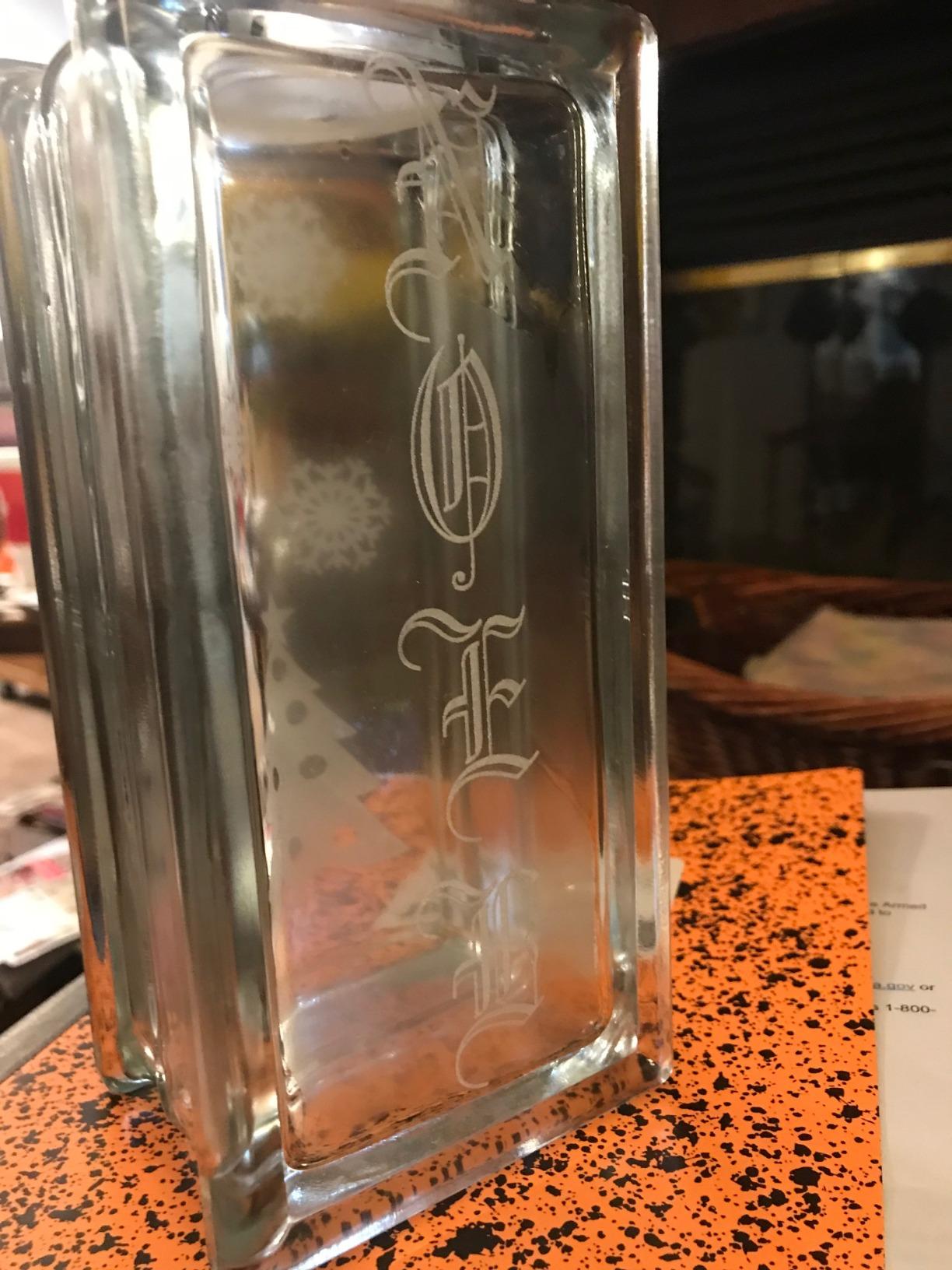
Resolution is adjustable up to 4500 dpi, and it supports a long file format list including AI, PDF, SVG, DXF and PLT. That means you can bring artwork straight from the vector software you already use instead of rebuilding it. Owners commonly report broad material compatibility across glass, ceramic, tile and coated metals, which makes it a genuine multi-material investment.
Glass jobs this bed size changes
At 12 x 20 inches you can lay out a full sheet of frosted signage, a batch of award plaques, or several drinkware pieces in one setup. That cuts your defocus and alignment time per piece down sharply compared with a small desktop unit.
The listed 0-500 mm/s engraving range gives you room to slow down on delicate stemware and speed up on flat panels. The red dot pointer helps with positioning on transparent material, where edges are hard to see against a honeycomb bed.
Where the compromises are?
The 165-pound cabinet needs its own sturdy table and a floor it will not wobble on. Plan the furniture before the machine arrives, not after. Two software frictions are worth knowing: the bundled RDWorks and CorelLaser are PC only, and the built-in air compressor is modest compared with a separate pump, so on glass jobs where melt residue is heavy you may want a stronger external assist.
The 4.2 average is the lowest of the three heavily reviewed machines here, driven by a small share of one-star ratings that appear to concern hardware delivery rather than output quality. Budget for a support call early on.
3. Monport 60W Auto Focus CO2 Laser Engraver – Best for High-Speed Batch Work
Monport 60W Auto Focus CO2 Laser Engraver with Lighburn,16″x 24″ Laser Engraving Cutting Machine with 2 Way Pass Air Assist Digital Control Panel RDWorks,Commercial Laser Cutter
- 800 mm/s engraving and 400 mm/s cutting
- One-button autofocus removes manual focal adjustment
- Fire-resistant window with a cover safety shutdown sensor
- Ruida controller runs LightBurn and RDWorks
- Only a single owner rating on record
- Class 4 laser rating needs more operator care than a Class 1 enclosure
This is a throughput machine. The headline figure is 800 mm/s engraving speed with cutting up to 400 mm/s, on a 16 x 24 inch bed inside an enclosed aeronautical aluminum rail with stepper motors. If you are running production quantities of personalized glassware, the speed is the reason to look here, and it is fast enough that the pass is over before heat has time to build in one spot.
Auto-focus is the feature that matters most on glass, and it is worth more than it is on wood or acrylic. Glass arrives in inconsistent thicknesses, and a machine that finds the focal distance from the panel removes the single most common cause of a bad frost. The control panel button handles it, so you are not doing a manual height gauge ritual between every job.
Two-way pass air assist moves air through the bed from two directions, which helps clear the fine glass particulate that a single-direction nozzle can push around. The fire-resistant polyester viewing window has a melting point of 432 to 488 F and a lid safety shutdown sensor, both sensible precautions on a machine that runs hot.
Why the speed changes your glass workflow?
Fast passes mean less heat per millimetre, so a single high-speed pass at moderate power is the right approach and multi-pass frosting is rarely needed. That reduces cycle time and reduces the chipping risk that comes from dwelling.
The 4500 dpi resolution and 2.0 inch focal distance give you enough control to hold a consistent defocus offset across a whole run, which is what makes a batch of tumblers look like a matched set rather than a pile of individually adjusted pieces.
What the thin feedback record means for you?
There is exactly one rating on record, so we cannot tell you how this machine holds up over years. Judge it on the published specification sheet and the build, which are both in line with commercial CO2 cutters we have seen. If your business depends on uptime, ask for a machine with a real support history.
It is also a Class 4 laser rather than a Class 1 enclosed unit, so plan on proper eyewear and a ventilated room. The enclosure and cover interlock reduce exposure but do not eliminate it, and that distinction matters if you are working in a shared space.
4. OMTech Maker 90W CO2 Laser Engraver – Best for Large Glass Panels
- All four owner ratings are 5 stars
- 90W Yongli H2 tube rated to 8000 hours
- 20 x 28 in bed handles glass panels and signage
- Four-way pass-through doors accept oversized material
- A review base of 4 offers thin long-term reliability evidence
- Weighs 227 lb and needs a heavy dedicated bench
The 90W Yongli H2 tube is rated to 8000 hours, which is a long production life for a CO2 source, and it drives engraving speeds up to 23.6 inches per second. The reason we recommend it specifically for glass is the 20 x 28 inch bed with honeycomb and aluminum blade options. That is full sheet territory, and it is the size you need for window panels, decorative flat glass and signage blanks.
Four-way pass-through doors let you feed material longer than the bed itself, so a long panel can be run in sections without re-laying the workpiece. On glass this is significant, because picking up and repositioning a large sheet is where chips usually start. Combined with the adjustable workbed, it keeps the glass flat and supported through the whole pass.
The flame-retardant widened viewing window with a cover interlock gives you a clear look at the mark forming without opening the lid. On frosted glass jobs, being able to watch the pass and stop it early is how you avoid going too deep on a heavy sheet.
What 90W changes for glass specifically?
Extra power is not automatically better on glass. It gives you the option to run a fast pass and still get a solid frost, which is how you handle thick or heavy panes without scorching through. On thin stemware you would still dial the power back.
Engraving depth is listed at up to 0.4 inches on nonmetallic materials, so this machine can do more than a surface mark. On glass, that is useful for deeper relief effects and for cutting thicker decorative pieces, though cutting glass with a CO2 is not a workflow we would recommend for production.
Set expectations honestly
Four ratings, all five stars, is a good signal and a small one. There is not enough history here for us to describe long-term reliability, and the sample cannot show you what year three looks like.
The 227-pound weight is the other practical constraint. This is a floor-standing commitment with a dedicated bench. It suits a sign shop or a glass studio with permanent space, not a craft room or a rental unit.
5. OMTech Maker 60W CO2 Bundle With LightBurn and Chiller – Best All-in-One
OMTech Maker 60W CO2 Laser Engraver with LightBurn & Water Chiller
- Bundle includes LightBurn and a water chiller
- Auto-focus handles varied glass thickness
- 20 x 28 in bed with four-way pass-through doors
- Built-in air assist for smoke and dust extraction
- Only 6 reviews behind the 4.7 average
- Weighs 249 lb and needs a heavy-duty surface
This bundle answers the objection that keeps coming up about mid-size CO2 machines: you still have to buy the software and the chiller. Here both are included, which removes two setup steps and two extra purchases. The 4.7 average across six ratings is the strongest rating-to-review ratio among the OMTech machines in this set, with nothing below four stars.
Auto-focus paired with a height-adjustable workbed is the feature we care about for glass. It means you can set a piece down, press one button and get a correct focal plane, even when you are switching between a thick coaster and a thin panel. On a machine that frosted rather than etched glass, the difference between a clean word and a chip is often just the focus height.
Built-in air assist handles the smoke and fine dust extraction that comes off a glass frosting pass. Glass particulate is finer than wood dust and it settles fast, so adequate extraction is a comfort and a longevity issue for the machine as much as a health one. The flame-retardant widened viewing window lets you monitor the job.
Why the bundle matters for a glass business?
LightBurn in the box means you can go from unboxing to a first glass job the same day, with no licence lookup and no software install queue. That removes a genuinely common cause of wasted first-week time.
The water chiller extends tube life, and on a 60W machine running long frosting passes on heavy glass, that heat management is what keeps output consistent from the first piece to the hundredth. Consistent output is exactly what a client paying for engraved glassware expects.
Where the caveats are?
Six reviews is a small sample, so treat the 4.7 as encouraging rather than proven. It is also the heaviest machine in this roundup at 249 pounds, and the listed dimensions are taller than the 90W model, so measure your doorway and your ceiling clearance before delivery day.
Several variants exist within this family, including manual-focus and different wattages. Confirm that the unit you are ordering actually has auto-focus, because that is the feature carrying the glass workflow here.
6. xTool P3 80W CO2 Laser Cutter – Premium Pick for Full Glass Sheets
- 36 x 18 in bed handles full material sheets
- LiDAR autofocus and dual 16MP cameras automate setup
- Class 1 enclosure with lid interlocks and fire suppression
- Smart nesting claims 98.7 percent material use
- Expandable with an RA3 rotary attachment
- xTool Studio software is locked in with no LightBurn option
- Material presets run high enough to char and shorten tube life
- Owner-measured work width came in under the advertised 18 inches
This is the most capable CO2 machine in the group, and the 36 x 18 inch workspace is why. It takes full material sheets rather than panels cut to size, which removes a whole category of handling risk on large glass pieces. Maximum speed is 1200 mm/s, and owners report cut speeds that clearly beat a 50W OMTech on pine, maple and MDF, which tells you the drive and motion system are in a higher class.
The automation stack is the real story. LiDAR ranging autofocus plus dual HD cameras, a 16MP SkyView and a close-range detail camera, handle focus and alignment without manual intervention. The AutoLift base raises up to 8.7 inches, so you can load thick glass without lifting it. On a glass workflow this is the difference between a two-minute setup and a ten-minute one.
Safety is genuinely Class 1 here, with a fully enclosed design, lid interlocks and active fire detection and suppression. The expandability is also relevant to glass: a MagSwap RA3 rotary attachment handles tumblers, and a conveyor feeder takes repeat jobs off the operator.
What automation means for glass output?
Consistent focus is the whole game on glass. A LiDAR autofocus that measures rather than guesses gives you a repeatable focal plane across a whole production run, which is precisely the machine that produces a matched set of glasses rather than pieces that each need individual adjustment.
Variable Batch Fill with spreadsheet import is genuinely useful if you are personalising event glassware in quantity, and the claimed 98.7 percent material utilisation on nesting matters when you are cutting from expensive glass sheet stock.
The software lock-in is the dealbreaker for many buyers
This is the most important negative on the list. xTool Studio is closed and does not allow LightBurn or other control software. If you already tune your own power-speed-passes values, you lose that control, and the material preset library has been reported to recommend power settings high enough to char material and shorten tube life.
Other reported friction: the owner-measured work width came in under the advertised 18 inches, so verify your sheet sizes before committing, and support responses through the website have gone unanswered for some buyers. Frequent new model releases also reduce resale value. Buy it for the hardware and the automation, and buy it knowing you are buying into one software ecosystem.
7. xTool F2 Ultra UV 5W – Best for Bare Glass With No Coating
xTool F2 Ultra UV Laser Engraver, 5W UV Laser 3D Inner Fine Glass Engraving
- Marks bare glass and crystal with no coating or paint
- Cold source leaves clean char-free edges
- Compact 49.6 lb build suits small spaces
- Dual 48MP cameras handle focus and alignment
- Software builds 3D models from 2D artwork
- Closed software with no variables or batch runs without the conveyor
- No Linux support without a workaround layer
- One owner reported engraving detail degrading within a few months
This is the only category of machine on the list that removes the hardest part of glass engraving. There is no marking spray, no tempera layer, no wet paper towel, no cleanup step. The 5W 355nm UV source is a cold light source, so it breaks molecular bonds without charring, burning or yellowing, and the manufacturer states plainly that no pre-coating is required. On bare glass that is a genuine change in workflow.
The optics are the reason the results look the way they do. The spot size is smaller than 10 micrometers and engraving speed reaches 15,000 mm/s, so you get fine detail and photographs rather than logos alone. Owners report sharp photo and artwork engraving, clean char-free edges, and one buyer reported recouping half the cost quickly, which suggests the throughput is real for portrait work.
The 3D inner engraving capability is the feature no other machine here has. The software generates 2D-to-3D models automatically without modelling skills, which removes the steepest learning curve in crystal work. Dual 48MP cameras handle auto-focus and alignment, and a rotary attachment extends the system to 360 degree tumbler engraving. At 49.6 pounds, it fits a craft fair table or a small studio corner.
What UV changes about the finished piece?
With no thermal component, edges are clean and there is no scorching around the mark. That is why UV is the answer for photographic portraits, detailed logos and keepsake crystal rather than simple text.
Because it is a cold process, there is no defocus technique to learn and no crack risk to manage. The technique section later in this guide simply does not apply to this machine, which is its own kind of relief for a beginner.
The hardware is praised, the software draws the complaints
Sentiment across the 26 reviews splits sharply between the two. The lowest ratings in the set come from the software experience: the bundle is closed, with no variables and no batch processing unless you add the conveyor, and the conveyor part detection is not accurate enough for serial-number batch runs. There is also no Linux support, so Linux users need a workaround layer to run the software at all.
One owner reported engraving detail degrading to unusable within a few months, which is an isolated report but worth asking about with support before you commit. The machine is a Class 4 enclosed unit, so respect the enclosure rather than opening it, and keep the 355nm source in its housing.
8. ComMarker XE 6W UV Engraver – Best Portable UV Option
- 355nm UV covers glass metal plastics and wood in one machine
- Claimed 0.0019mm accuracy for fine marking
- Automatic sequential QR and barcode generation
- LiDAR auto-focus with an electric lifting column
- Compact 69.9 lb design for on-site and small-batch work
- A single 4-star rating gives very thin reliability data
- Limited retail footprint means verify after-sales service reach
This is the other UV option, and it makes a different trade than the xTool. Where the F2 Ultra is the polished consumer product, the ComMarker XE is the specification-driven option, and the numbers are strong on paper. A 6W 355nm source, a 150 x 400mm working area with slide extension, 0 to 10,000 mm/s marking speed and a claimed 0.0019mm engraving accuracy.
The accuracy figure is the one to pay attention to. At that tolerance the machine is aimed at fine marking and serial work on small parts rather than large decorative panels, and automatic sequential QR code and barcode generation without manual input is a genuine time saver if you are labelling glass components or producing traceable pieces.
LiDAR ranging auto-focus with an electric lifting column and one-button focus control removes manual focus tuning, which is the same glass-critical benefit as the autofocus on the larger machines. At 69.9 pounds and 26 x 20 x 13 inches, it is genuinely portable, and the on-site and small-batch framing is the right one for someone engraving glass at a market or a client’s table.
Where this machine fits against the xTool UV?
Choose the ComMarker if accuracy on small parts, sequential code generation and portability matter more to you than polished consumer software. The multi-material list is also broader, covering glass, plastics, aluminium, steel, brass, wood, cloth and cardboard in one machine.
Choose the xTool F2 Ultra instead if you want the brand ecosystem, the dual 48MP camera system, the automatic 2D-to-3D model generation and a larger body of owner feedback at 26 ratings. The area here is smaller, so it is not the machine for full glass panels.
Buy with eyes open on support
There is exactly one rating, a single four-star review, which tells you almost nothing about field reliability. Treat the specification sheet as the evidence and the performance as unverified. This is a Class 1 product with a published IEC 60825-1 report number and an FDA accession number, which is reassuring for a UV source.
The brand has a limited retail footprint, so if you are an entrant or running small batches, verify how reachable after-sales service is from your location before you buy. That is a reasonable question to ask, and the answer should shape your decision more than a single review rating.
Glass Settings Cheat Sheet: Power, Speed and Passes
Will a 10W laser etch glass? Partially. A 10W diode will not mark bare clear glass under any setting, because the beam passes straight through it and no amount of power changes that. A 10W-class CO2 will frost the surface reliably if you defocus toward the glass. For bare glass with no prep at all, you need a UV laser.
That answer is the single most useful thing on this page, because it prevents the most common expensive mistake. Owners on the laser engraving forums describe buying a diode machine on the strength of a materials chart that said glass, only to discover at the first test that nothing happens. The chart is not lying exactly, but it is hiding a required step.
Start your glass settings here, then adjust. On a CO2, use one fast pass at moderate power rather than several slow high-power passes, because dwell time is what turns a frost into a chip. Set your focal plane slightly in front of the surface rather than exactly on it, and if you see a bright pinpoint sparkle instead of a soft frost, move the focus further away. A clean mark on glass looks matte, not glossy.
On a UV machine, none of this applies. Set the power for the material, keep the focus tight, and clean the residue off the lens between longer jobs, because UV is far less tolerant of a dirty window than a CO2.
How to Get a Clean Mark on Glass Without Cracking It?
Cracking and chipping is the single most reported failure in the glass engraving community, and it is almost always a focus or dwell problem rather than a machine problem. Here is the workflow that addresses it.
First, inspect the piece before you power on. Glass with an existing micro-fracture, a stress line from manufacturing, or a visible inclusion will crack when you heat it locally. Look for it in good light, and set flawed pieces aside rather than gambling the job.
Second, clean and degrease. Fingerprints, oils and any residue change how the beam interacts with the surface and they are a common cause of an uneven mark. Isopropyl alcohol and a lint-free cloth do the job, and this step takes thirty seconds.
Third, if you are running a diode or a CO2 on bare glass, apply a coating. The options in order of how often they are recommended: marking spray or chalk spray, which is the most common companion consumable; thinned water-based tempera paint airbrushed on thin and rinsed off with water afterwards; or a masking layer such as a damp paper towel, which is repeatedly cited as a cheap way to get an even frost from a CO2. Whichever you use, apply it evenly and let it dry fully, because a bubbled or flaking coat leaves you with half-marks.
Fourth, defocus toward the glass. Moving the focal point in front of the surface spreads the beam and the heat, and it is the most repeated and most useful technical tip in the forums. Focus exactly on the surface and the energy concentrates into a tiny spot that can chip. Focus too far away and the mark turns weak and uneven. Slightly in front is the sweet spot.
Fifth, prefer one fast pass. Multiple passes stack heat in the same spot and are the main reason pieces shatter mid-job. If one pass is not dark enough, raise the power slightly rather than repeating the pass.
Sixth, expect cleanup. Anyone engraving a tumbler with any laser will need to clean charred paint and residue off afterwards, and that is a real per-unit labour cost in your pricing, not an afterthought. Budget for it. If that cleanup burden is the thing that turns you off this workflow, the UV machines need no coating and therefore no cleanup.
One hard safety rule applies to every machine here: never engrave a reflective surface. A mirror or a metallic-coated glass panel bounces the beam back into the source, and it will destroy a diode instantly. If you must work on mirrors, engrave from behind.
Engraving Curved Glass: Tumblers, Bottles and Stemware
Any curved glass needs a rotary attachment. A roller axis rotates the workpiece under a fixed laser head so the beam stays at a constant distance from the surface, which is the only way to get a consistent mark around a cylinder. Tumblers, wine glasses, bottles, cans and beer mugs are all rotary jobs, and a flat bed will give you a mark that fades out as the surface curves away.
Rotary quality varies a great deal and this is where a lot of disappointment comes from. Cheap rollers slip on curved glass and produce crooked text, so buy a rotary that grips consistently and check whether the manufacturer includes jigs for holding round work. The xTool P3 accepts a MagSwap RA3, and the xTool F2 Ultra UV takes a rotary attachment for 360 degree tumbler work. Several machines in this roundup list an optional rotary axis in their variant range, including the K40+.
Expect it to be slower than flat work. Engraving around a curved surface is a much slower process than a 3D laser job on UV or CO2, and users report CO2 works acceptably on a rotary while UV is preferred for quality. A commonly cited starting point for tumblers on a rotary is around 60 percent power at 150 mm/s, adjusted for your machine and your glass.
Stained glass and flat window panels are a different category again. Those are flat-bed jobs rather than rotary jobs, and they are best done on the larger machines here with a 20 x 28 or 36 x 18 inch bed. A UV machine is the safer choice for decorative flat glass because a CO2 pass that goes too deep on a leaded panel can crack a came line, and stained glass makers are an active, underserved segment looking for a clear recommendation.
How to Choose a Laser Engraver for Glass?
Choose the laser type first, everything else second
UV gives you the cleanest result on bare glass and the only route to 3D subsurface crystal engraving, with essentially no cracking risk and no prep. It is also the most expensive category in this roundup. CO2 gives you a good frosted surface etch, an enormous range of other materials, and the best value per hour if you are willing to learn the defocus technique. Diode requires a coating for every single glass job and adds prep and cleanup, so it only makes sense as a multi-material hobby machine rather than a glass machine.
If glass is your primary material rather than an occasional extra, the UV machines are the honest answer. If glass is one material among several, the CO2 machines are the better investment.
Work area should match your largest piece
Decide what your biggest single job is before you compare beds. A desktop 12 x 8 inch unit handles coasters, plaques and one glass at a time. A 16 x 24 inch machine covers batches of drinkware. A 20 x 28 inch bed with pass-through doors takes full glass panels and signage blanks, and a 36 x 18 inch workspace handles whole sheets so you never have to reposition large glass. Pass-through doors matter more on glass than on wood, because every lift and re-lay is a chance to chip an edge.
Enclosure and safety are not the same thing everywhere
Enclosed units are safer, and one machine here is a fully enclosed Class 1 design with lid interlocks and active fire detection and suppression. Others are Class 2 or Class 4 units inside a housing, which means the enclosure helps but does not replace eyewear and a ventilated room. UV sources need the enclosure taken seriously, since 355nm light is a genuine eye hazard and it is invisible. Ventilation matters everywhere, because glass dust is fine and settles quickly.
Stained glass and flat panels need a bed, not a rotary
If your work is window panels, decorative flat glass or signage, buy bed size and skip the rotary accessory. If your work is tumblers and bottles, the rotary is the deciding feature and the bed size barely matters. Some buyers end up wanting both eventually, which is why we noted the expandable rotary on the two xTool machines.
Laser or chemical etching cream
For volume production, precise repeatable work and a design that survives handling, a laser wins. You pay once and the per-piece cost is a few seconds of machine time. Chemical etching cream still wins for simple designs on a small budget, with no upfront cost, a vinyl stencil, and zero risk of cracking the piece. If your order is a dozen one-off gifts and you have no machine, cream is a reasonable answer. If you plan to sell a hundred personalised glasses, the per-piece economics favour a laser long before the quality gap does.
3D crystal engraving is a separate decision
Engraving inside a glass or crystal block requires a UV source and a 3D model. The workflow is straightforward: import the 3D model, measure the block, set the X, Y and Z coordinates for the internal shape, focus, preview and start. A UV machine with automatic 2D-to-3D model generation removes the modelling skills requirement that otherwise puts most people off. This is the highest-ceiling application here for portrait keepsakes, and it is not possible on any CO2 machine in this roundup.
How we picked?
We screened machines on glass-specific capability first, then read every available owner review for cracking reports, focus complaints, coating surprises and cleanup burden. Marketing materials that list glass in a materials chart without explaining the required prep were treated as a negative signal, not a positive one. Machines with fewer than a handful of ratings are included where the specification genuinely differentiates them, and we say so plainly in the review rather than implying a track record that does not exist.
Frequently Asked Questions
Can you use a laser engraver to etch glass?
Yes, but the laser type decides the result. UV lasers break molecular bonds with almost no heat, so they mark bare glass cleanly. CO2 lasers heat and pit the surface for a frosted finish, and you defocus toward the glass to avoid chipping. Diode lasers cannot mark clear glass until you apply a marking spray or paint coating.
Will a 10W laser etch glass?
Partially. A 10W diode will not mark bare clear glass, because the beam passes straight through it, so you need a high-contrast coating first. A 10W-class CO2 will frost the surface reliably if you defocus toward the glass and use a single fast pass. For bare glass with no prep, a UV laser is the only reliable option.
What is the best glass etching machine for home use?
For most home users a CO2 laser with an enclosure and a rotary attachment gives the best balance of cost and capability, particularly for tumblers and stemware. A UV laser is the only type that etches bare glass cleanly with no coating and no cleanup, and it costs considerably more. A diode is the least expensive but needs prep on every piece.
What is the best tool for etching glass?
For volume production, precise repeatable work and a mark that survives handling, a laser is the better tool, with a per-piece cost of seconds of machine time. For simple designs on a small budget, chemical etching cream with a vinyl stencil still wins: no upfront cost, no equipment, and zero risk of cracking the piece.
How do you stop laser engraved glass from cracking?
Inspect the piece for existing flaws first, clean and degrease it, then defocus toward the glass so the focal point sits slightly in front of the surface. Use a single fast pass at moderate power rather than several slow high-power passes, since dwell time is what causes chipping. If you see a bright pinpoint sparkle instead of a matte frost, move the focus further away.
Conclusion
The OMTech K40+ 45W is our pick for the best laser engravers for glass etching in 2026 because it carries the deepest owner feedback of any glass-capable CO2 we tested, runs open software, and frosts glass reliably once you learn the defocus technique. If you need bare glass with no coating or 3D crystal work, the xTool F2 Ultra UV is the only machine in this group that does it cleanly, and it is worth the jump in cost. Whichever route you pick, budget time for focus calibration, keep a coating workflow ready for flat panels, and expect a cleanup step on any tumbler job.