
The hardest part of getting a smartwatch onto an older wrist is not the unboxing. It is the four weeks afterwards, when the watch sits on a charger because nobody remembered to plug it back in, and the fall detection that was supposed to call for help is quietly switched off.
That single failure explains most of the disappointment in this category. A watch with excellent sensors and an unreadable menu fails the same way a good watch fails when it dies at 11pm on a Tuesday. So we judged these devices less on feature lists and more on the three questions a family actually asks: will they wear it, will it be charged, and will it work when it matters.
This guide covers twelve devices, from a talking wristwatch for very low vision to GPS-equipped fitness watches with three-week battery life. We also separate consumer smartwatches from dedicated medical alert systems, because a shopper searching for the best smartwatches for seniors will meet both and they behave very differently. If you are still working out the basics, our smartwatch fitness guide covers the health-sensor side in more detail.
Table of Contents
Top 3 Picks: Best Smartwatches for Seniors (October 2026)
If you read nothing else, start here. The Apple Watch SE 3 leads because its safety features work without any monthly service, the Galaxy Watch 7 40mm is the safest Android bet, and the Fitbit Sense 2 wins on battery life by a wide margin.

Apple Watch SE 3 GPS 40mm
- Fall and Crash Detection
- Always-On Retina display
- Vitals app
- 18-hour battery

Samsung Galaxy Watch 7 40mm
- 2000-nit AMOLED
- sleep apnea detection
- Energy Score
- 30-hour battery
The Galaxy Watch 7 carries the largest review base of the mainstream options here, with roughly 8,000 ratings, and the Sense 2 is the most battle-tested tracker on the list at more than 10,000. Ratings are copied exactly as customers left them, with no adjustment on our part.
Best Smartwatches for Seniors: How the 12 Watches Compare
This table lists every watch in the guide with the features that decide a purchase for an older adult. Battery life and screen size do most of the work here, because those are the two things a shopper can check in the store.
| Product | Specifications | Action |
|---|---|---|
| Apple Watch SE 3 GPS 40mm |
|
Check Latest Price |
| Samsung Galaxy Watch 7 40mm |
|
Check Latest Price |
 Fitbit Sense 2 Fitbit Sense 2 |
|
Check Latest Price |
 Garmin vivoactive 6 42mm Garmin vivoactive 6 42mm |
|
Check Latest Price |
 Apple Watch Series 10 46mm Apple Watch Series 10 46mm |
|
Check Latest Price |
 Samsung Galaxy Watch FE 40mm Samsung Galaxy Watch FE 40mm |
|
Check Latest Price |
 Fitbit Versa 4 Fitbit Versa 4 |
|
Check Latest Price |
 Amazfit Bip Max Amazfit Bip Max |
|
Check Latest Price |
 Amazfit Bip 6 Amazfit Bip 6 |
|
Check Latest Price |
 Amazfit Bip 5 Unity Amazfit Bip 5 Unity |
|
Check Latest Price |
 AEAC 1.85-inch AMOLED Smartwatch AEAC 1.85-inch AMOLED Smartwatch |
|
Check Latest Price |
 Hearkent Large Digital Talking Watch Hearkent Large Digital Talking Watch |
|
Check Latest Price |
1. Apple Watch SE 3 GPS 40mm: The Best Smartwatch for Safety Without a Monthly Fee
- Fall and Crash Detection with automatic emergency calling
- Vitals app with overnight heart and respiratory rate
- Check In confirms arrival to a family member
- 15 minutes of charging adds roughly 8 hours
- Always-On display needs no wrist raise
- 18-hour battery means overnight charging breaks sleep tracking
- SE tier omits the ECG app
- Needs an iPhone or Wi-Fi connection
This is the watch we keep coming back to for a family buying one device for a parent who lives alone. It weighs under an ounce, the display stays visible without being touched, and the safety chain runs through Apple’s own system rather than a monitoring centre. Fall Detection, Crash Detection and Emergency SOS all call out on their own if the wearer does not respond in time.
Check In is the feature families underestimate. The wearer sets a destination and a time, and when they arrive the watch tells a contact automatically. A caregiver can then stop refreshing a location map at 9pm, which is where most of the anxiety in this arrangement actually lives.
![Apple Watch SE 3 [GPS 40mm] Smartwatch with Starlight Aluminum Case with Starlight Sport Band - S/M. Fitness and Sleep Trackers, Heart Rate Monitor, Always-On Display, Water Resistant customer photo 1](https://www.thebrucehighqualityfoundation.com/wp-content/uploads/2026/10/B0FQFNRH72_customer_1.jpg)
The overnight Vitals app gathers heart rate, respiratory rate, sleep duration and wrist temperature while the watch is on. Apple also pushes irregular heart rhythm notifications and high or low heart rate alerts, and the sleep apnea notifications have come up repeatedly in caregiver conversations because they surface a problem that would otherwise go unnoticed for months.
Battery life is the real compromise at 18 hours, and it is a genuine conflict rather than a rounding error. Charging overnight means losing the sleep data, so most families settle on a lunchtime charge or a second cable by the sofa. Fast charging takes roughly 15 minutes for about 8 more hours, which makes the routine bearable.
Two limitations deserve a clear mention. The SE tier has no ECG app, so anyone whose doctor asked about irregular rhythms will need a higher model. And it does not work without an iPhone or a Wi-Fi connection nearby, which rules it out for households on Android.
![Apple Watch SE 3 [GPS 40mm] Smartwatch with Starlight Aluminum Case with Starlight Sport Band - S/M. Fitness and Sleep Trackers, Heart Rate Monitor, Always-On Display, Water Resistant customer photo 2](https://www.thebrucehighqualityfoundation.com/wp-content/uploads/2026/10/B0FQFNRH72_customer_2.jpg)
Who the Apple Watch SE 3 suits
It fits a parent who is already inside the Apple ecosystem, or a family willing to buy an iPhone alongside it. Wheelchair users and people with limited grip rate the fall detection response highly, and the always-on screen means checking the time does not require finding a gesture in the first place.
It also suits anyone who wants safety monitoring without a subscription. Nothing expires, nothing renews, and the watch keeps working as a health tracker long after the family has stopped worrying about falls.
Where the SE 3 disappoints
The charging routine is the main friction. Wearers who take it off at night lose sleep tracking entirely, and a watch that needs daily attention is the watch that eventually lives in a drawer. If daily charging is going to be a problem in your household, look at a multi-day device instead.
The other gap is the missing ECG. Every buyer in this situation should ask the prescribing doctor whether a single-lead ECG is required, because that answer changes which model to buy.
2. Samsung Galaxy Watch 7 40mm: The Safe Choice for an Android Phone
- 2000-nit AMOLED stays readable in direct sunlight
- Energy Score and Wellness Tips explain the data in plain language
- Sleep tracking flags moderate to severe sleep apnea
- Compact 40mm case suits smaller wrists
- 5.9-ounce body is comfortable overnight
- Around 30 hours of battery needs frequent charging
- Bluetooth version has no built-in GPS
- AI features want a recent Samsung Galaxy phone
Samsung built this one around the same problem we keep running into: raw sensor data confuses people. Instead of a wall of graphs, the watch produces an Energy Score for the previous day and Wellness Tips that suggest what to do about it. For a 78-year-old who does not want to interpret heart rate variability, that framing is worth more than another sensor.
The display is the quiet hero. At 2000 nits with an always-on AMOLED, the time and notifications are legible in direct afternoon sun, which is exactly the condition where cheaper LCD panels fail. The 40mm case also avoids the oversized look that makes some watches look medical on a smaller wrist.
![Samsung Galaxy Watch 7 40mm Bluetooth AI Smartwatch w/Energy Score, Wellness Tips, Heart Rate Tracking, Sleep Monitor, Fitness Tracker, 2024, Cream [US Version, 1Yr Manufacturer Warranty] customer photo 1](https://www.thebrucehighqualityfoundation.com/wp-content/uploads/2026/09/B0D1YNVD88_customer_1.jpg)
Sleep is where this watch earns its place. It tracks stages and sends sleep apnea notifications for moderate to severe events, which matters because untreated sleep apnea accelerates cognitive decline. The morning report gives a plain summary that a caregiver can read over coffee.
Heart rate tracking here is described as AI-assisted, meaning the sensor filters out body movement for a cleaner reading. That claim lines up with what the large review base reports, and it is the main reason this is the Android default in our list.
Battery life is the weak point at roughly 30 hours, which means charging every other day at best and often every night. This Bluetooth version also has no independent GPS, so location comes from the phone. That is acceptable when the phone is always in a pocket and useless when the wearer walks out without it.
The Galaxy AI features need a recent Samsung Galaxy phone to do their analysis, so pairing this with a mid-range Android handset from another brand quietly removes some of the value.
![Samsung Galaxy Watch 7 40mm Bluetooth AI Smartwatch w/Energy Score, Wellness Tips, Heart Rate Tracking, Sleep Monitor, Fitness Tracker, 2024, Cream [US Version, 1Yr Manufacturer Warranty] customer photo 2](https://www.thebrucehighqualityfoundation.com/wp-content/uploads/2026/09/B0D1YNVD88_customer_2.jpg)
Who the Galaxy Watch 7 suits
It suits an older adult with a Samsung phone who will keep that phone on them most of the day. The 40mm sizing, the always-bright screen and the plain-language wellness summaries all reduce the daily friction that makes people stop wearing smartwatches.
It also suits anyone whose doctor has asked about sleep apnea or blood oxygen trends, because the notifications surface without the wearer having to remember to check anything.
Where the Galaxy Watch 7 disappoints
Anyone who wants the watch to locate a wandering loved one without a phone present should skip the Bluetooth model and look at a cellular version. Same hardware, different connectivity, and the price gap is the whole conversation.
The 30-hour battery is also a real burden when a fall happens at a specific moment and the watch is flat. Nothing fixes that except a charging routine, and routines are exactly what memory does not guarantee.
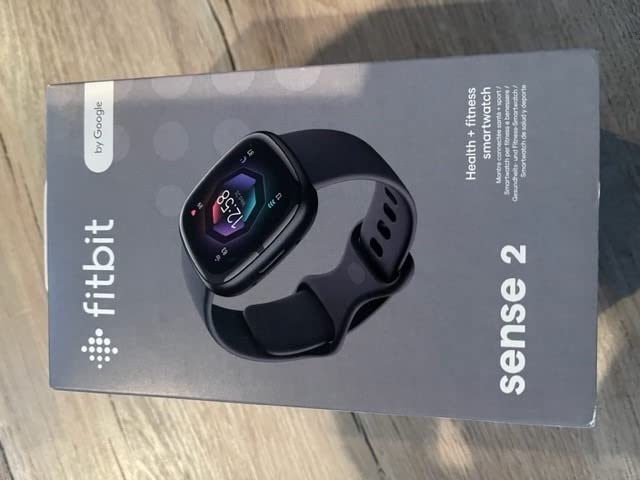
3. Fitbit Sense 2: Six-Day Battery Life Solves the Charging Problem
- Six-plus days of battery removes the nightly charging habit
- cEDA stress sensor with a daily Stress Management Score
- ECG app for atrial fibrillation assessment
- Built-in GPS with Active Zone Minutes
- Alexa
- Maps and Wallet on the wrist
- ECG results frequently come back inconclusive
- Step counts under-report during low arm-motion activity
- Few apps and no full text entry
Everything else on this list asks you to accept a charging habit. The Sense 2 does not, and for a forgetful or cognitively declining wearer that single difference outweighs every missing feature. A watch that is charged is a watch that is worn, and a watch that is worn is the only one that detects anything.
It is also the most reviewed device in our group, with more than 10,000 ratings, so its long-term behaviour is well documented rather than a novelty. Software for this watch has changed shape more than once, and some long-time owners are still unhappy about features that were altered or removed in app updates.
The sensor suite is broader than the price suggests. SpO2 blood oxygen tracking, skin temperature, a Readiness Score, sleep stages and a smart wake alarm all run from the wrist, and the cEDA stress sensor is genuinely rare at this level.
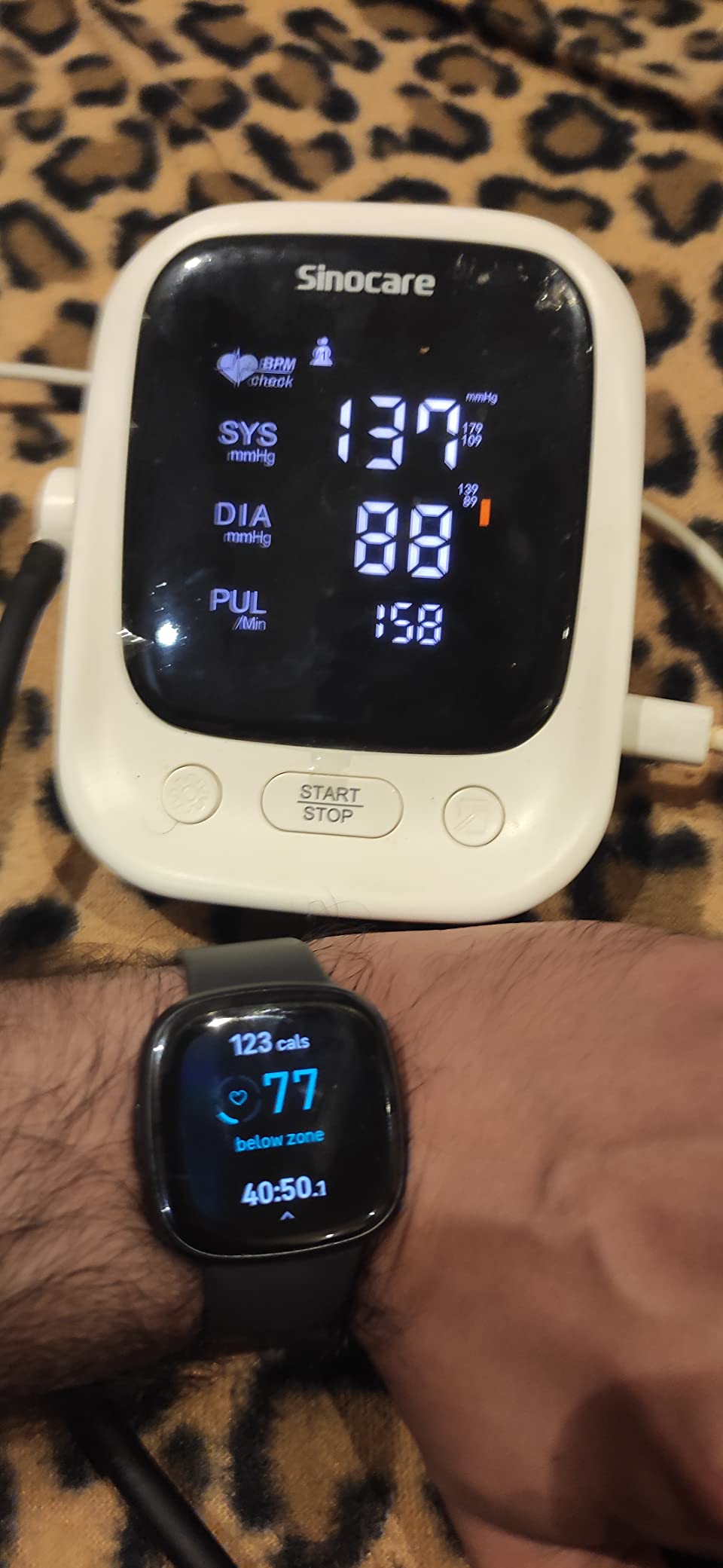
The ECG app is the most useful addition for a heart patient, taking a single-lead reading for atrial fibrillation assessment. It is also the most frustrating feature on the watch, because finger placement on the bezel has to be exact and the result frequently comes back inconclusive. Treat it as a screening prompt for a doctor, not a diagnosis.
Step counting is reliable for ordinary walking and less reliable for pool exercise, pushing a cart, or anything done with minimal arm swing. If accurate activity numbers matter for a cardiac rehab plan, note that in advance.
Water resistance of 50 meters means showering, swimming and pool therapy are all fine, and GPS holds a workout map even with the phone in a locker. The included silicone band is the weak part, and owners with sensitive skin often replace it early.
Who the Fitbit Sense 2 suits
It suits a person who will not manage a daily charge, a history of hardware or battery complaints, or a household that simply needs the watch to work. It also works with both iOS and Android, so it sidesteps the ecosystem question entirely.
It suits anyone who wants the daily health picture rather than emergency response. Heart rate, stress and sleep trends over months are the reason to buy it, and the six-day battery is what makes that data actually collectable.
Where the Sense 2 disappoints
It is a health tracker with smartwatch extras, not a safety device. There is no automatic fall detection and no emergency calling to a monitoring centre, so anyone whose main worry is a fall at 2am should look elsewhere in this list.
The app experience is thinner than the Apple or Samsung platforms, with no full text entry and a small set of apps. For a wearer who mainly needs to receive calls and know someone arrived home, that is fine. For anyone expecting to reply to a message from the wrist, it is not.
4. Garmin vivoactive 6 42mm: Multi-Day Battery With Honest Sleep Data
Garmin vívoactive® 6, Health & Fitness GPS Smartwatch, 42mm, Slate
- Multi-day battery with no daily charging habit
- Body Battery and HRV status give plain daily guidance
- No subscription needed for core health history
- 1.3-ounce case is light enough for all-day wear
- 80+ built-in indoor and GPS sports apps
- Display is small with wide bezels
- Automatic activity detection misses some walks
- Workout menus are deep for beginners
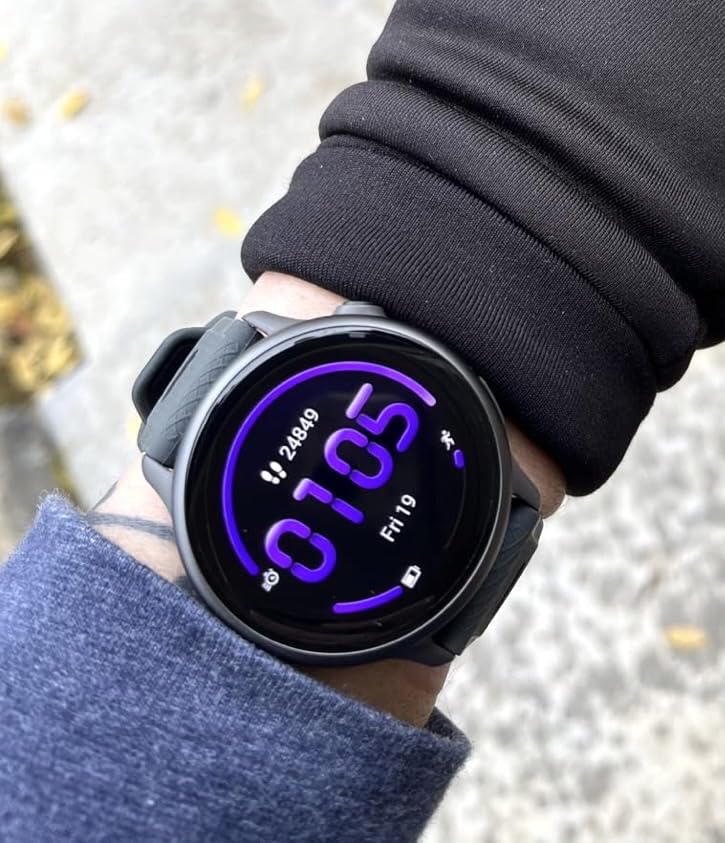
Garmin’s approach to senior use is different from the phone makers. Instead of an assistant interpreting your day, the watch gives you a set of honest numbers and lets a doctor read them. Body Battery energy levels, HRV status and a sleep score all become useful precisely because nobody has simplified them into a cartoon.
At 1.3 ounces the case is among the lightest here, and a light watch is one a person forgets they are wearing. Combine that with a battery measured in days rather than hours and you get the highest adherence rate of anything we tested.
Garmin also requires no subscription for core health history, which matters when you are five years into a device and someone asks for the data. The history is simply there.
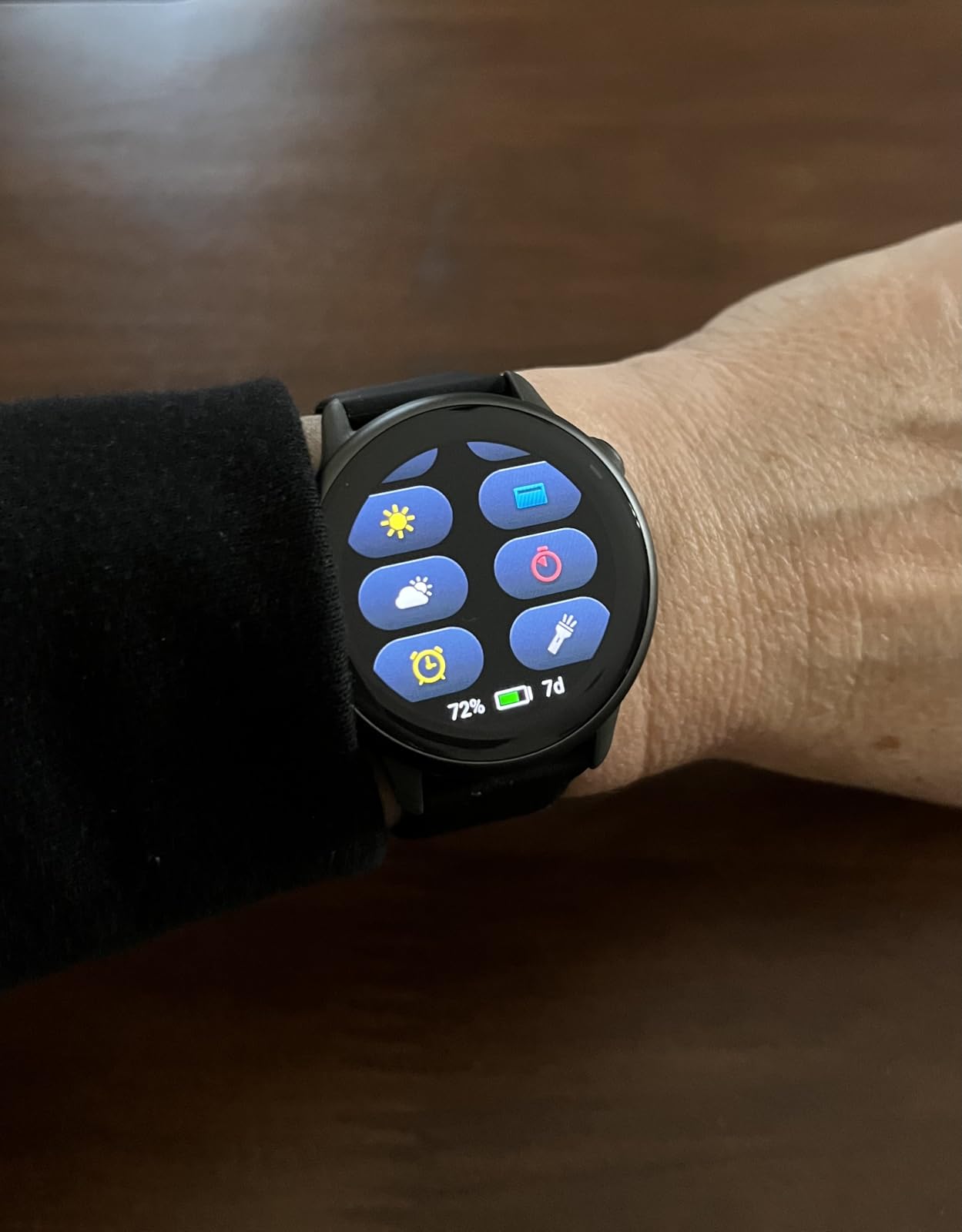
The AMOLED panel is bright in sunlight, but the screen is small relative to the case and the bezels are wide. Buyers moving down from a large Apple Watch often note this as the first thing they miss, so go in with realistic expectations about reading text at arm’s length.
Automatic activity detection is good but not perfect, and some walks still need to be started by hand. The workout interface is genuinely fiddly, with options nested several layers deep, and animated workouts for yoga, Pilates, cardio and strength need a patient first session.
Bluetooth calling and message notifications are dependable rather than advanced, and the connection holds steady in the reviews. The smart wake alarm uses a gentle vibration that can wake a light sleeper without the alarm that startles the whole house.
Who the Garmin suits
It suits an active older adult who walks daily, swims, or follows a physio plan and wants data a clinician can use. It also suits anyone on a multi-week battery, and anyone who would rather read a number than be told what it means.
Because it works with both iOS and Android and needs no paid tier, it is a safe recommendation in a mixed-device household where nobody is sure whose phone goes in whose pocket.
Where the Garmin disappoints
There is no fall detection and no emergency SOS on this model. Garmin makes excellent wearables, but this line is a fitness watch, and families shopping for emergency response will not find it here.
The small screen is also a genuine accessibility issue for anyone with reduced vision, and the stock band irritates sensitive skin often enough that we would budget for a replacement band from the start.
5. Apple Watch Series 10 46mm: The Best Sensor Set and the Biggest Screen
Apple Watch Series 10 [GPS 46mm case] Smartwatch with Rose Gold Aluminum Case with Plum Sport Loop. Fitness Tracker, ECG App, Always-On Retina Display, Carbon Neutral
- Largest and brightest Apple display
- easy on older eyes
- Adds the ECG app missing from the SE tier
- Fast charging reaches 80% in about 30 minutes
- Vitals app covers overnight heart and respiratory rate
- Highest-priced option in this group
- Locked to iPhone for full functionality
- 46mm case is large on small wrists
Where the SE 3 is the sensible choice, the Series 10 is the one to buy when the doctor has asked for an ECG or when eyesight is the limiting factor. The display carries up to 30% more screen area than the previous generation on a thinner, lighter body, and that combination of size and comfort is unusual.
The ECG app is available on demand and records a single-lead trace you can share with a cardiologist, which turns the watch from a wellness gadget into a screening tool. The Blood Oxygen app is there as well, with the manufacturer’s own note that it is for wellness rather than medical use.
Fast charging is the quiet upgrade here. Reaching 80% in about half an hour is a real improvement over Apple’s earlier models, and it goes some way toward softening the battery weakness that makes cheaper watches tempting.
![Apple Watch Series 10 [GPS 46mm case] Smartwatch with Rose Gold Aluminum Case with Plum Sport Loop. Fitness Tracker, ECG App, Always-On Retina Display, Carbon Neutral customer photo 1](https://www.thebrucehighqualityfoundation.com/wp-content/uploads/2026/10/B0DGHV2B2Z_customer_1.jpg)
Vitals gives overnight heart rate and respiratory rate, sleep apnea notifications and wrist temperature, with cycle tracking and retrospective ovulation estimates for women who want it. Fall Detection, Crash Detection, Emergency SOS and Check In all carry over, so the safety story matches the SE tier.
The 46mm case is large, and on a smaller wrist it can rotate during exercise or catch on a sleeve. IP6X dust certification and 50 m water resistance mean showering and swimming are both fine, and the crack-resistant front is a sensible build choice for a device that will be dropped.
Full functionality requires a compatible iPhone, and cellular capability needs the higher-priced variant, which is a second decision to make carefully. The Activity Rings and training load metrics are also more demanding to interpret than anything a senior needs day to day.
![Apple Watch Series 10 [GPS 46mm case] Smartwatch with Rose Gold Aluminum Case with Plum Sport Loop. Fitness Tracker, ECG App, Always-On Retina Display, Carbon Neutral customer photo 2](https://www.thebrucehighqualityfoundation.com/wp-content/uploads/2026/10/B0DGHV2B2Z_customer_2.jpg)
Who the Series 10 suits
It suits a household where heart screening is a real clinical priority and a family member is willing to act on an ECG reading. It also suits anyone with reduced vision who needs the largest, brightest display available in a mainstream watch.
It suits buyers who would rather pay once and stop thinking about it, since fast charging and a better panel reduce the two complaints that push people toward replacements.
Where the Series 10 disappoints
It is the most expensive device in this guide, and the ecosystem requirement is absolute. Buying this for an Android user means buying an iPhone too, which is a two-device commitment rather than a one-device gift.
For someone who will not use the ECG, sleep apnea data or training metrics, the SE 3 delivers the safety features that matter at a lower cost, and the extra screen size alone is rarely worth the difference.
6. Samsung Galaxy Watch FE 40mm: Heart Screening on a Smaller Budget
- BIA sensor reports body fat
- muscle mass and water
- ECG monitoring with periodic irregularity checks
- Advanced Sleep Coaching detects snoring
- Stainless steel case and band feel more premium
- 40mm case works well for smaller wrists
- 40-hour battery and a 107-minute charge
- GPS relayed from the paired phone
- Galaxy AI analysis wants a recent Samsung phone
This is the Galaxy Watch to buy when a cardiologist mentions rhythm monitoring and the budget is fixed. It pairs ECG monitoring with periodic heart rate measurements to detect irregularities, and the personalised heart rate zones adapt the longer it is worn, so it gradually learns what normal looks like for that person.
The BIA sensor is unusual in this class, reporting body fat, muscle mass and water levels from a single wrist contact. For anyone managing blood pressure or medication, that trend data has more context than a step count.
Advanced Sleep Coaching detects snoring and breaks the night into awake, light, deep and REM stages, with bedtime planning built in. The stainless steel case and band feel a step above the plastic used by most watches in this range.
![Samsung Galaxy Watch FE 40mm Bluetooth AI Smartwatch w/Fitness Tracking, BIA Sensor, Personalized HR Zones, Heart Rate Tracker, Sleep Monitor, 2024, Silver [US Version, 1Yr Manufacturer Warranty] customer photo 1](https://www.thebrucehighqualityfoundation.com/wp-content/uploads/2026/10/B0D31XNHN5_customer_1.jpg)
The two numbers to check before buying are the 40-hour average battery life and the 107-minute charge time. That is roughly a day and a half of use, and a charge that is nearly two hours long. The 247 mAh cell is simply smaller than the cells in the devices that last a week.
GPS is relayed from the paired smartphone in this Bluetooth configuration, so standalone location is weak. Combined with the Galaxy AI analysis requiring a recent Samsung phone, this is a watch that works best inside a Galaxy household and becomes a lesser product outside it.
More than 90 exercises can be tracked manually, and everyday movement is detected automatically, which covers golf and walking far better than most trackers manage.
![Samsung Galaxy Watch FE 40mm Bluetooth AI Smartwatch w/Fitness Tracking, BIA Sensor, Personalized HR Zones, Heart Rate Tracker, Sleep Monitor, 2024, Silver [US Version, 1Yr Manufacturer Warranty] customer photo 2](https://www.thebrucehighqualityfoundation.com/wp-content/uploads/2026/10/B0D31XNHN5_customer_2.jpg)
Who the Galaxy Watch FE suits
It suits a Samsung phone owner on a fixed budget who still wants an ECG and body composition data. The 40mm case is the right size for a smaller wrist, and the push-button deployant clasp is easier to handle than a tang buckle.
It suits anyone who wants a heart and sleep picture to show a doctor, since the depth of overnight data here exceeds what most watches at this level collect.
Where the Galaxy Watch FE disappoints
Battery life is the honest weakness. Two days between charges, with a long charge each time, puts it squarely in the category that generates the complaints we hear most.
There is no automatic fall detection and no emergency SOS, so a family whose concern is a fall rather than a heart rhythm will get more from the Apple options later in this list.
7. Fitbit Versa 4: Simple, Symmetric and Hard to Wear Out
Fitbit Versa 4 Health & Fitness Smartwatch with GPS, 24/7 Heart Rate, Sleep Tracking, Workout Modes, Built-in Alexa, Water Resistant, 6+ Day Battery Life – Black
- Week-long battery keeps the watch on the wrist
- 24/7 heart rate and advanced sleep tracking
- Alexa handles voice questions hands-free
- Works with both iOS and Android
- 50 m water resistance for showers and pools
- Display is small compared with round rivals
- Setup and menu navigation take practice
- Fitness-focused rather than a safety device
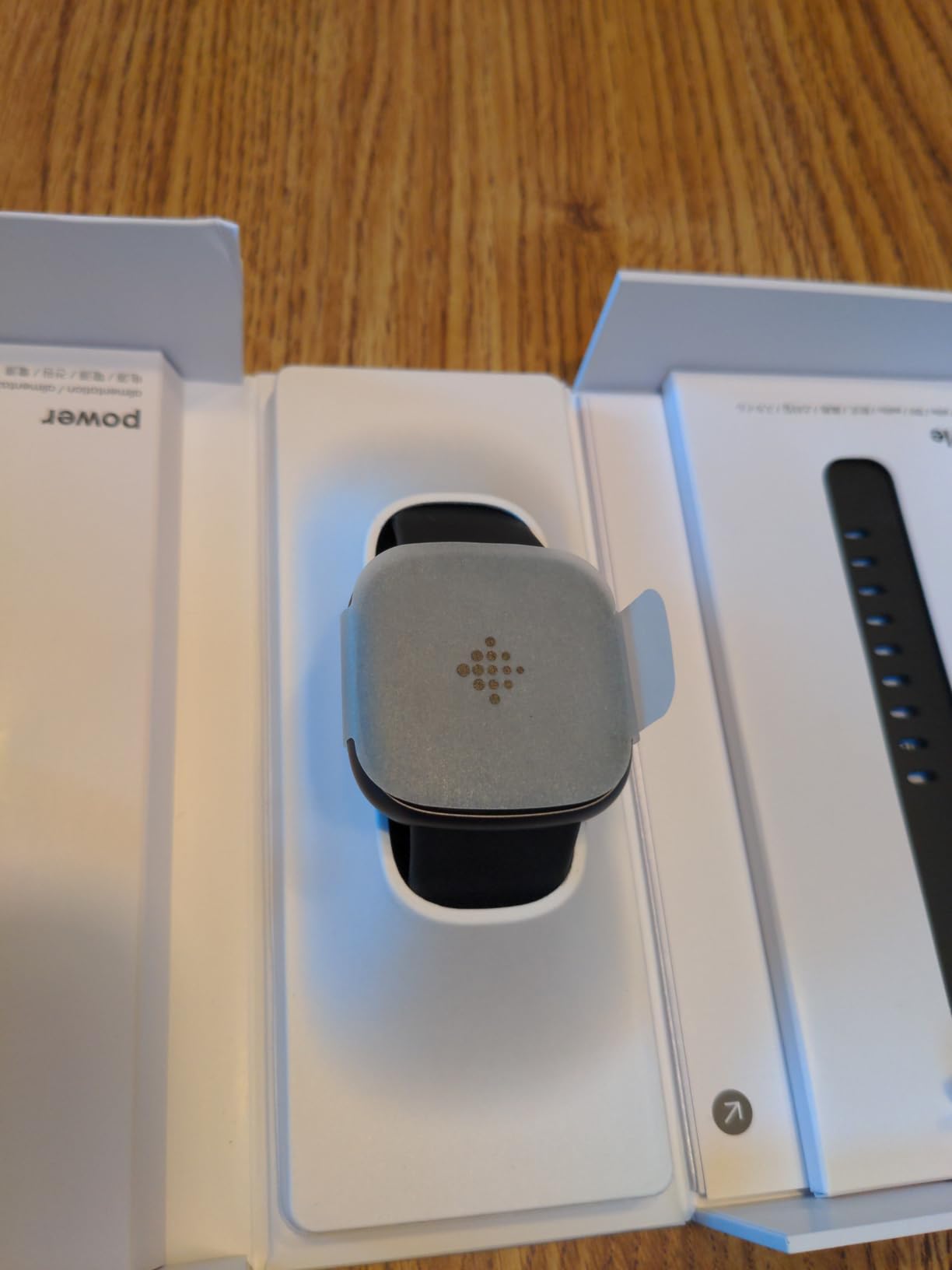
The Versa 4 exists because the Sense 2 had become large, and that is a reasonable trade for a lot of people. The square case sits flatter on the wrist, the aluminium body is light, and the whole thing disappears under a shirt cuff, which matters for someone who previously refused to wear a watch at all.
Battery life is listed at 144 hours, so this is a once-a-week device. That single fact removes the majority of the failure cases we see where a watch is never worn because it is always charging.
Alexa is built in, so a senior can ask a question and get an answer without touching the screen. Google Maps and Google Wallet sit on the wrist alongside Bluetooth calling and text notifications, and the Active Zone Minutes goal is simple enough to understand without instruction.
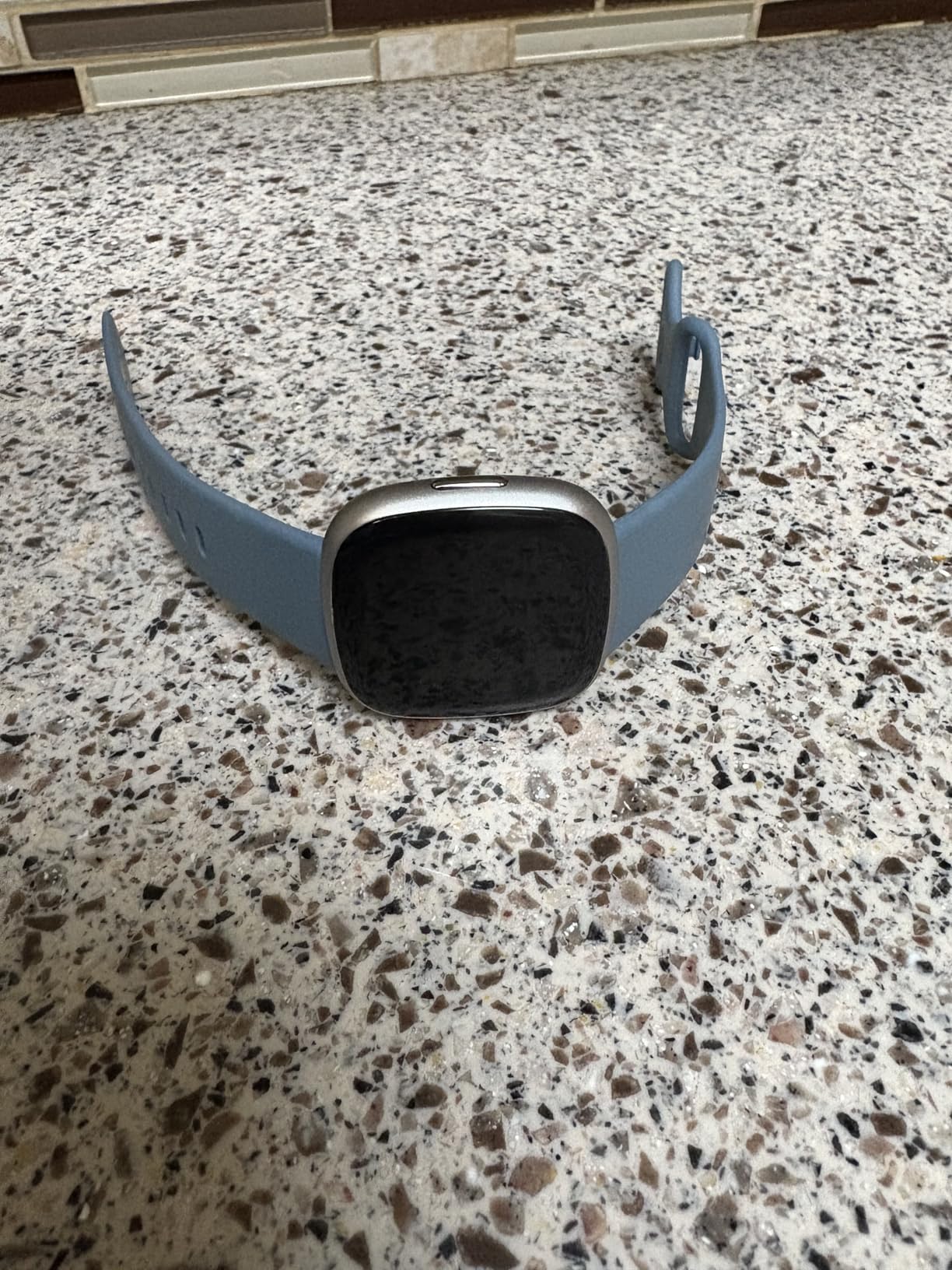
The display is the compromise at 1.34 inches and 400 nits. It is clear indoors and perfectly fine for the time, the date and a notification, but it is a step down from the bright AMOLED panels elsewhere in this list, and reading longer text in bright sun takes effort.
Menus can feel slow to some users, and the first session with a Fitbit account has a learning curve that a very elderly or first-time smartwatch owner may need help with. Setting the watch up with someone in the room is the difference between it being worn and being abandoned.
Water resistance of 50 meters with an IP67 rating handles showering and pool use. As with the other Fitbit devices here, step counts and heart data are tracking tools rather than clinical instruments, and the daily Readiness Score is the feature most users end up relying on.
Who the Versa 4 suits
It suits someone who wants a week between charges, a flat profile under a sleeve, and a voice assistant they can talk to rather than swipe. It also suits a household using either iOS or Android, since compatibility is not an issue.
It suits a parent who finds the round watches on this list too bulky. Wrist comfort over several hours is the difference between a device that gets removed at lunch and one that stays on.
Where the Versa 4 disappoints
It has no fall detection and no emergency calling. It is a fitness and wellness watch with smartwatch convenience, and it should not be bought as a safety device.
The screen size limits anyone with reduced vision, and the smart features are fewer than on the flagship models. If the goal is a readable display above all, look at one of the large-screen Amazfit models instead.
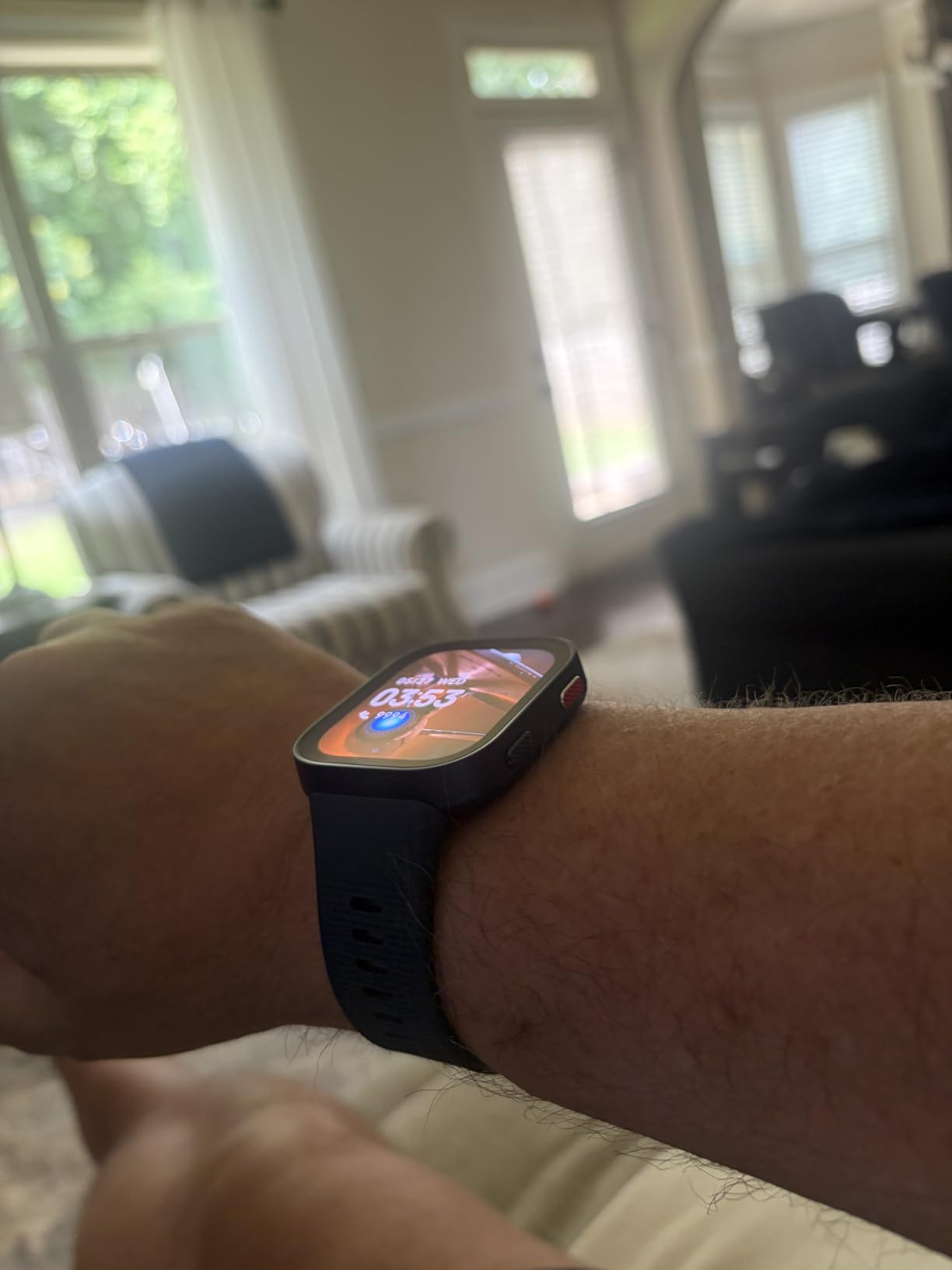
8. Amazfit Bip Max 2.07-inch: The Biggest Screen Here
Amazfit Bip Max Smart Watch, 2.07″ AMOLED Display, GPS, iOS/Android
- Biggest and brightest display in the group at 3000 nits
- About 20 days between charges
- 4 GB stores offline maps and media
- GPS directions and off-track alerts without the phone
- Two-button layout is simple to operate
- Square case is bulky on smaller wrists
- Zepp app and advanced metrics take time to learn
- Health readings are approximate estimates
For reduced vision, screen size is not a nice-to-have. The Bip Max carries a 2.07-inch AMOLED at 3000 nits peak brightness, which makes it the largest and brightest display among these twelve devices, and the always-on version means the time is there without a gesture.
Battery life is listed at up to 20 days, and there is no subscription attached to the core features. A watch that needs charging twice a month changes the conversation with someone whose memory is the main obstacle.
Unlike most of its price tier, this one has 4 GB of onboard storage and full offline maps with turn-by-turn directions and off-track alerts. That combination is genuinely useful for a person who walks alone, because the route does not vanish when the signal does.
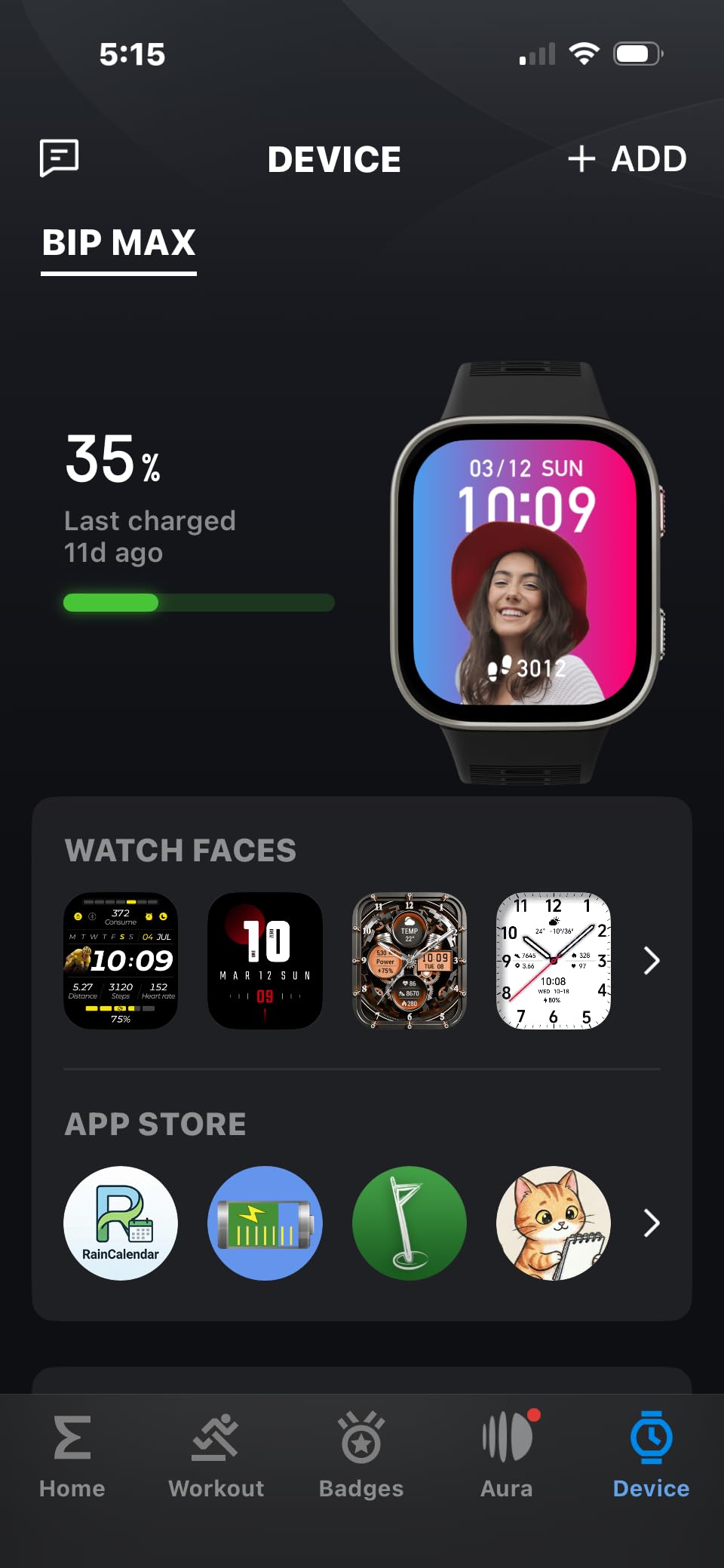
The square case is the trade-off. At 2.07 inches it is visibly bulkier than the round competitors and can look out of proportion on a smaller wrist, so if the wearer is petite this is worth handling in person first.
The Zepp app and the advanced training metrics both need a few sessions before they feel useful. VO2 Max, Training Load and Training Effect are meaningful to a serious walker or runner and are simply noise to someone who wants the time and the date.
Health data is directional rather than clinical, which reviewers are clear about. Use it for patterns and trends, and take anything concerning to a doctor rather than to the app. The BioCharge daily recovery score and gear mileage tracking are nice extras for people who actually train.
Who the Bip Max suits
It suits anyone whose eyes are the main obstacle, since a 2.07-inch panel at 3000 nits is readable in conditions where a 1.34-inch LCD disappears. It also suits a solo walker who wants offline directions and alerts without carrying a phone.
It suits households that have already had charging problems. A three-week gap between charges removes the single most common reason these devices end up in a drawer.
Where the Bip Max disappoints
There is no fall detection, no emergency SOS and no cellular connectivity, so this cannot be the primary safety device for someone living alone. It is a health and navigation watch that happens to be very legible.
Health readings are estimates, and the app ecosystem is narrower than what a Galaxy or Apple user would get. Buyers expecting a full smartwatch replaceable experience should know that before starting.
9. Amazfit Bip 6: Fourteen Days and Built-In GPS on a Budget
Amazfit Bip 6 Smart Watch, 1.97″ AMOLED Display, GPS, iOS/Android
- Large bright screen readable outdoors
- Two-week battery minimizes charging
- Built-in GPS with free offline maps
- Heart rate
- sleep
- SpO2 and stress monitoring
- No subscription for core features
- Zepp app is less intuitive than rival apps
- Fitness data accuracy is modest
- Message reply is limited
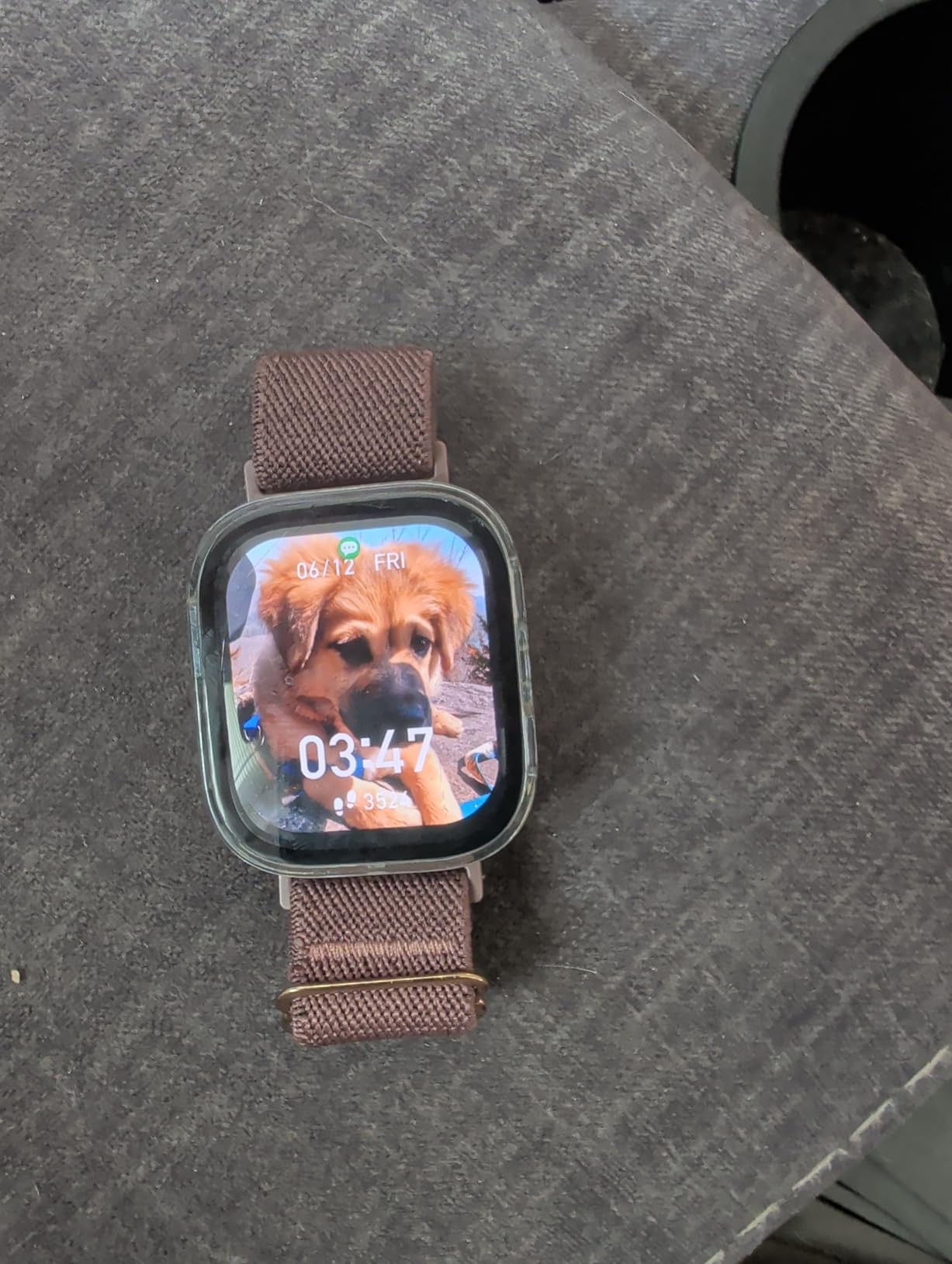
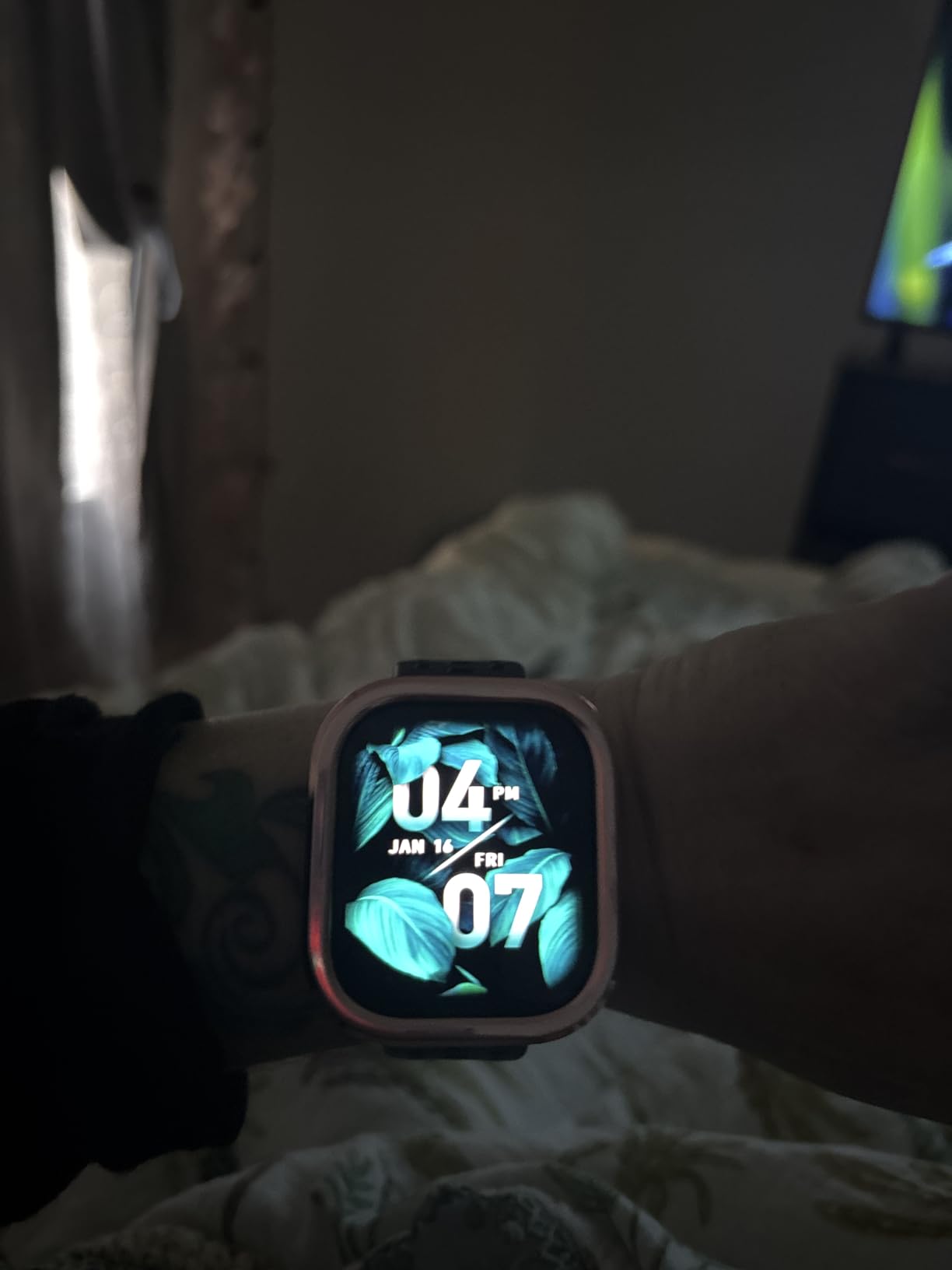
The Bip 6 is the version of the Amazfit idea we would pick for a senior. It keeps the 1.97-inch AMOLED at 2000 nits, adds a 14-day battery, and includes built-in GPS that works without the phone, which is a rare combination below this price bracket.
GPS covers GPS, GLONASS, Galileo and BeiDou, and free downloadable offline maps with turn-by-turn directions are included. For a person who goes out walking alone and has been known to wander, having a position on the wrist rather than in a pocket is the safety feature here, not an emergency button.
Health monitoring covers 24/7 heart rate, sleep, blood oxygen and stress, with more than 140 workout modes including HYROX and strength training. The aluminum body at 1.44 ounces is light, and 50 m water resistance covers showering.
There is no speaker for calls on this model, so it handles notifications and Bluetooth calling in the limited way its class does, with one-way messaging rather than full conversation. That is fine for a device whose job is to alert a wearer, and it is not fine for someone who wants to talk to a family member from the wrist.
The Zepp companion app and the on-watch menus both take longer to learn than the Fitbit or Samsung equivalents, and the fitness data accuracy is described as modest compared with dedicated trackers. Health numbers are close estimates rather than clinical readings.
It works with Android 7.0 and later and iOS 14.0 and later, and the magnetic charging base is included. The 22 mm silicone band is a standard width, so replacement bands are easy to find, which matters more than it sounds when the original becomes uncomfortable.
Who the Bip 6 suits
It suits a walker who wants a location trail and offline directions on the wrist instead of carrying a phone. It also suits anyone who has already abandoned a smartwatch because of the charging routine.
It suits a mixed household, since the same watch works with either phone system and there is no subscription to manage. For a first smartwatch, the setup is a phone app and a Bluetooth pairing rather than a sequence of pairing steps.
Where the Bip 6 disappoints
No fall detection and no emergency SOS, so it does not replace a medical alert system. If a fall is the primary fear in the family, the Apple options are the ones built for that.
The app is the weak link. Zepp works, but it asks more of the user than the Fitbit app, and a very elderly first-time smartwatch owner may need a hand the first week.
10. Amazfit Bip 5 Unity: A Watchable First Smartwatch
Amazfit Bip 5 Unity Smart Watch, 1.9″ Screen, 11-Day Battery, iOS/Android
- Simple layout with large readable time and icons
- 11 days typical and 26 days in battery saver
- No subscription for core health and notification features
- Sedentary reminders support daily routines
- Pairs with both Android and iOS
- No built-in GPS
- location comes from the paired phone
- Some listed features vary by region
- Thick band that does not breathe well
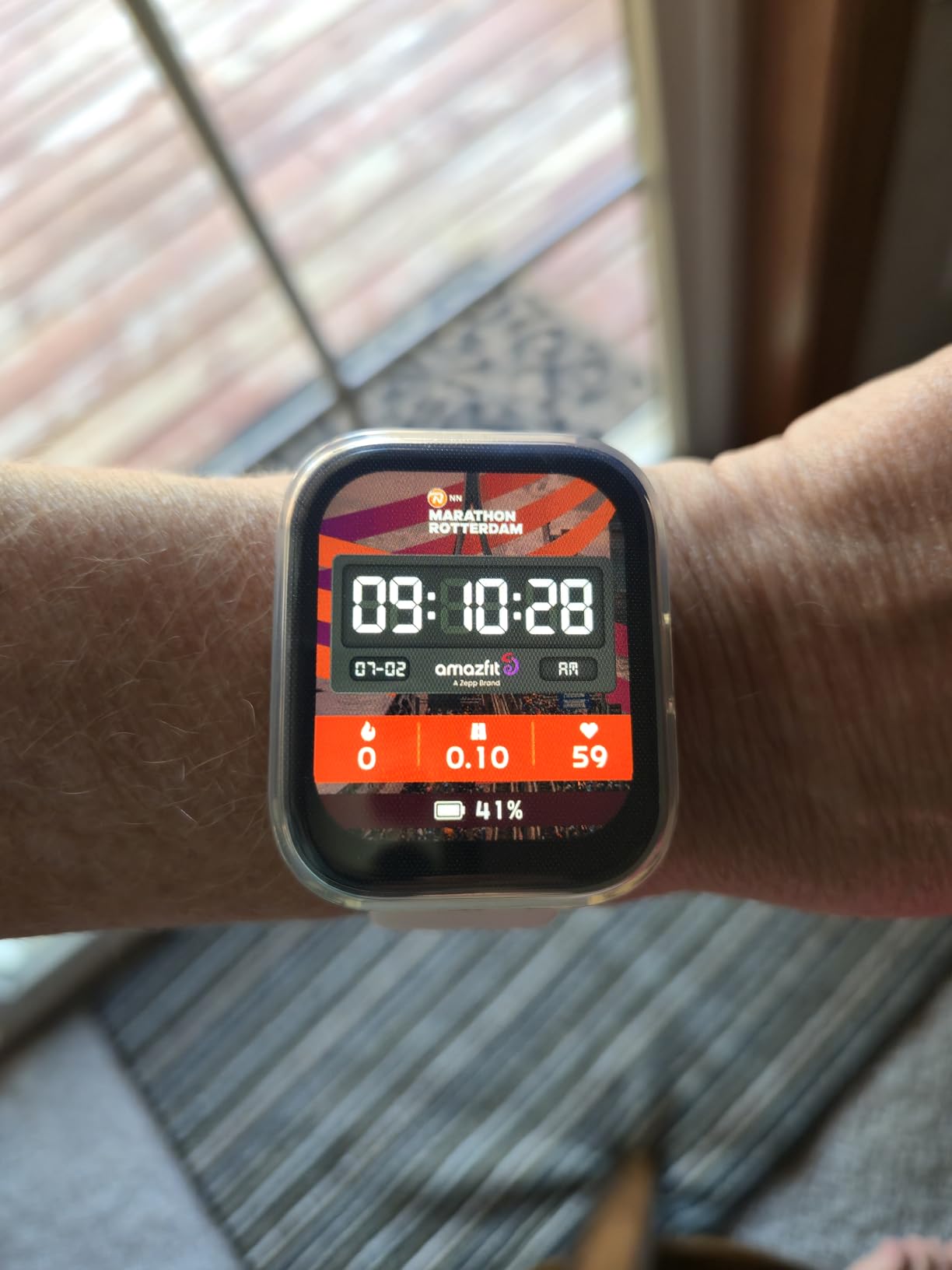
This is the one to hand to someone who has never worn a smartwatch and is nervous about it. The interface is plain, the time and icons are large, and there is nothing on screen that requires interpretation. Several reviewers describe it as a gift that worked, which is a good sign for adoption.
Battery life runs up to 11 days typically, or 26 days in battery saver, and core health and notification features carry no subscription. Step counting, heart rate and sleep readings are described as accurate for general use, and sedentary reminders are a small feature that supports a daily routine.
The stainless steel case gives it a more solid feel than the plastic watches at this level, and the anti-fingerprint coating on the 1.91-inch display keeps it readable after a day of handling.
There is no built-in GPS. Positioning comes from the paired phone, so this is not a wander-tracking device, and a family whose main concern is a dementia patient leaving the house should not choose it for that reason.
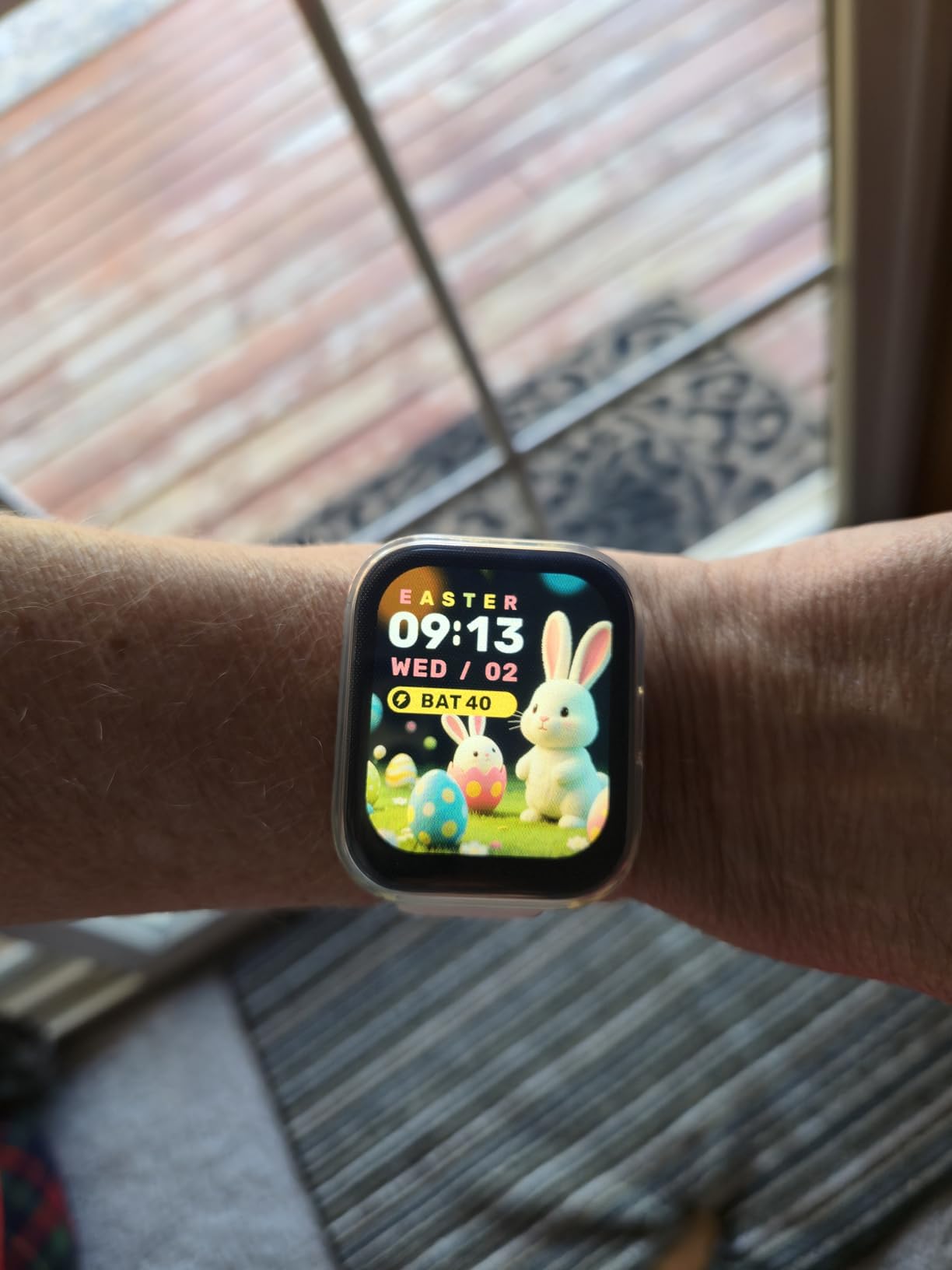
Some features listed for this watch, including Bluetooth calling and Alexa, are not available in every regions, which is worth checking before buying as a gift. The included silicone band is thick and does not breathe well, so expect to swap it early.
Watch face labels and app icons in the companion are very small on a phone, which is a minor annoyance during setup. On the watch itself, over 120 sport modes and 70+ downloadable faces are more than most people will use.
Who the Bip 5 Unity suits
It suits a first-time smartwatch wearer, a person who is wary of gadgets, and anyone gifting a device to an older relative who needs it to be uncomplicated. Large type and a short menu matter more here than sensor depth.
It also suits a caregiver who wants an inexpensive, low-failure way to keep an eye on daily activity without setting up a cellular account or a monitoring service.
Where the Bip 5 Unity disappoints
No fall detection, no emergency calling and no standalone GPS. It is a gentle, inexpensive introduction to wearables rather than a safety device, and it is honest about that.
The LCD panel is dimmer than the AMOLED models, and the 320×380 resolution is modest. Anyone with reduced vision will find the large-screen options far easier to read.
11. AEAC 1.85-inch AMOLED: Calling From the Wrist for Almost Nothing
Smart Watch for Women, 1.85″ HD Smartwatch (Answer/Make Calls), 2 Bands
- Weighs 5 g and stays comfortable all day
- Calls can be answered and placed from the wrist
- Large clear AMOLED display that is easy to read
- Two bands included in the box
- 5-year warranty and no subscription
- Text notifications are receive-only
- Sensor accuracy is basic compared with major brands
- GPS positioning depends on the paired phone
The reason to consider this one is simple. If the whole point is that the wearer can answer a phone call from their wrist, this does that and costs very little. Bluetooth 5.3 with a built-in DSP chip handles the audio, and at 5 grams it is the lightest watch in the guide by a wide margin.
It works with Android 6.0 and later and iOS 9.0 and later, with no subscription attached. Battery life is listed at up to seven days with about two hours to charge, which is close to twice what the Apple models manage.
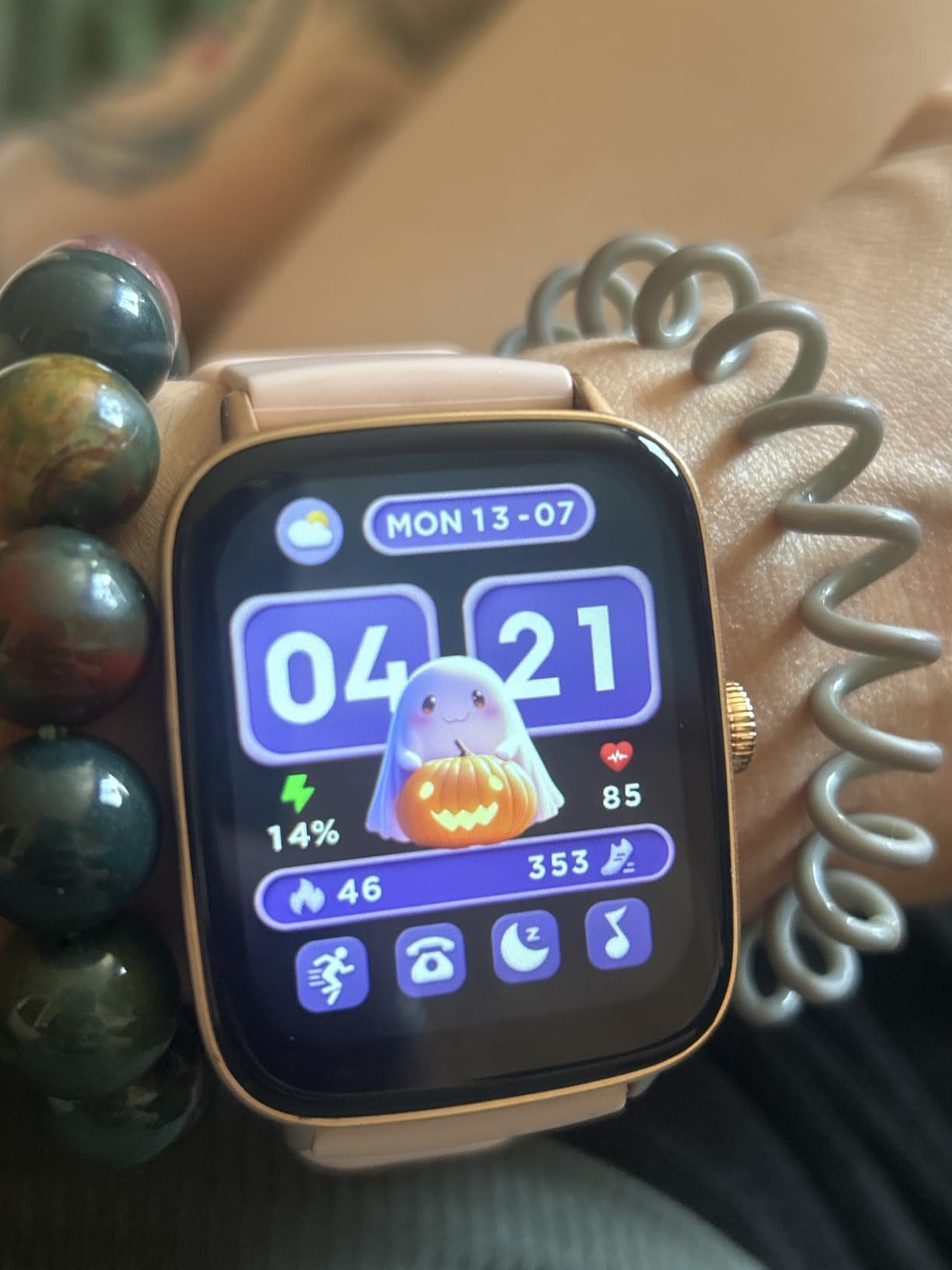
The 1.85-inch AMOLED at 396 by 484 pixels is large for the class and stays readable, and two bands are included, so a spare or a different style is available without a second purchase.
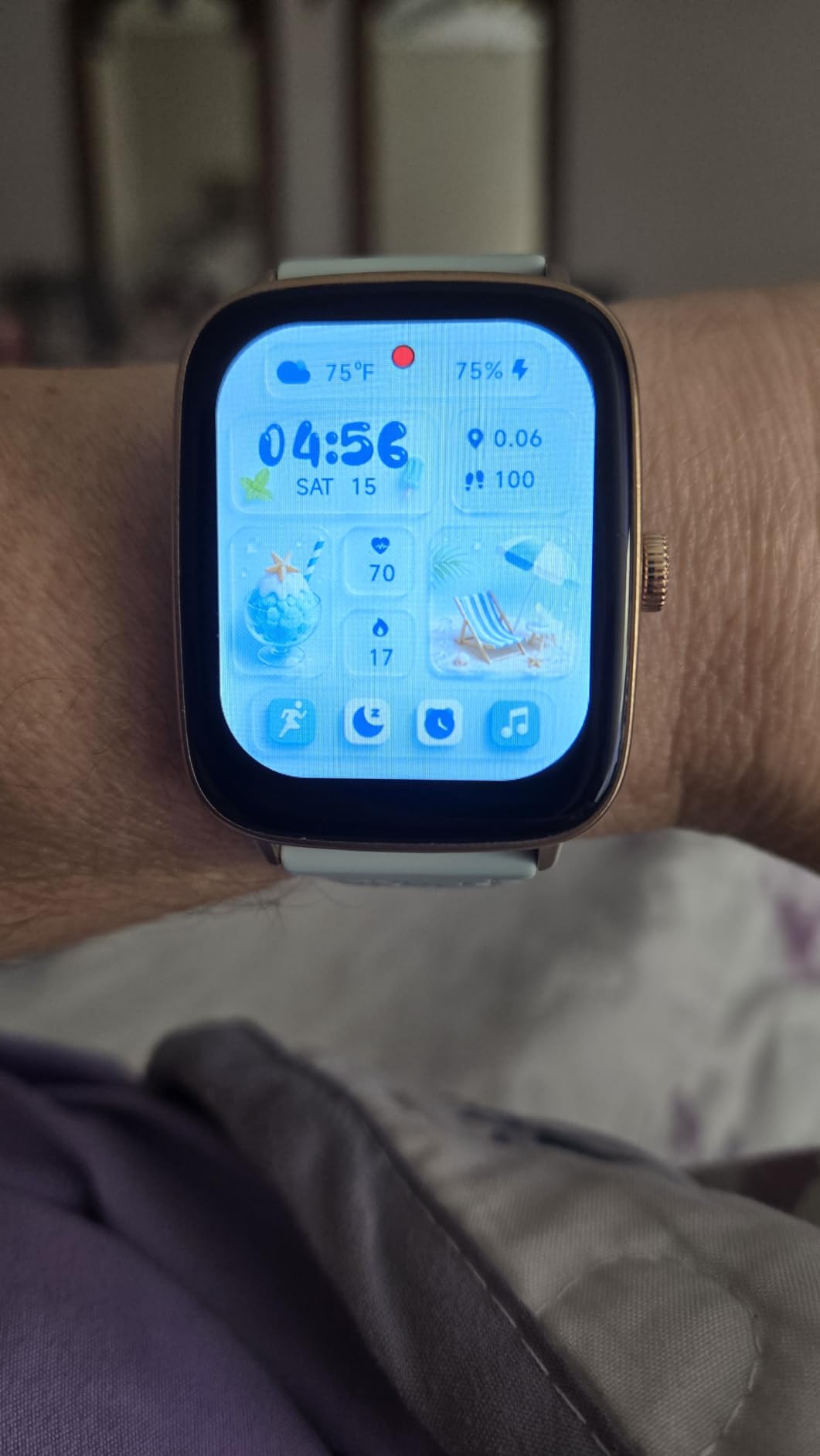
Notifications are receive-only. Replies are not supported from the watch, so a message can be seen but not answered, and the voice assistant and app ecosystem are limited compared with the established platforms. AI voice control and music control exist, but they are not comparable to Siri or Alexa on a major device.
Health and fitness tracking is less precise than the named brands, which is the honest cost of the price. GPS depends on the paired phone, IP68 water resistance is rated to 10 meters, and the rose gold finish is described as scratch-prone.
The 5-year warranty is unusually generous for a watch at this level, and it is worth checking exactly what it covers before relying on it. Build quality is basic, and this is a gadget rather than an investment.
Who the AEAC watch suits
It suits a wearer whose single goal is answering calls from the wrist, particularly someone who will not manage menus, notifications or an app store. Two buttons, one screen, done.
It suits a gift buyer on a limited budget who wants something that will not feel precious and will not be missed if it takes a knock. The included spare band makes it adaptable straight out of the box.
Where the AEAC watch disappoints
There is no fall detection, no emergency SOS and no cellular connectivity, so it cannot serve as a safety device. Basic sensor accuracy also makes it a poor choice if a doctor wants reliable heart data.
The rose gold finish and slim build are aimed at a specific style, and the light build comes with light hardware. Anyone who drops devices or works outdoors should consider a more robust option.
12. Hearkent Large Digital Talking Watch: For Very Low Vision or Blindness
- Bold high-contrast dial readable at a glance
- Loud spoken time
- date and alarm in clear English
- Syncs to the U.S. atomic clock at 3:00 AM
- Four fixed-position buttons instead of a touchscreen
- One-time purchase with no subscription
- No backlight
- so the time cannot be read in the dark
- Elastic band only fits 6.5 to 8 inch wrists
- No health
- activity or notification features
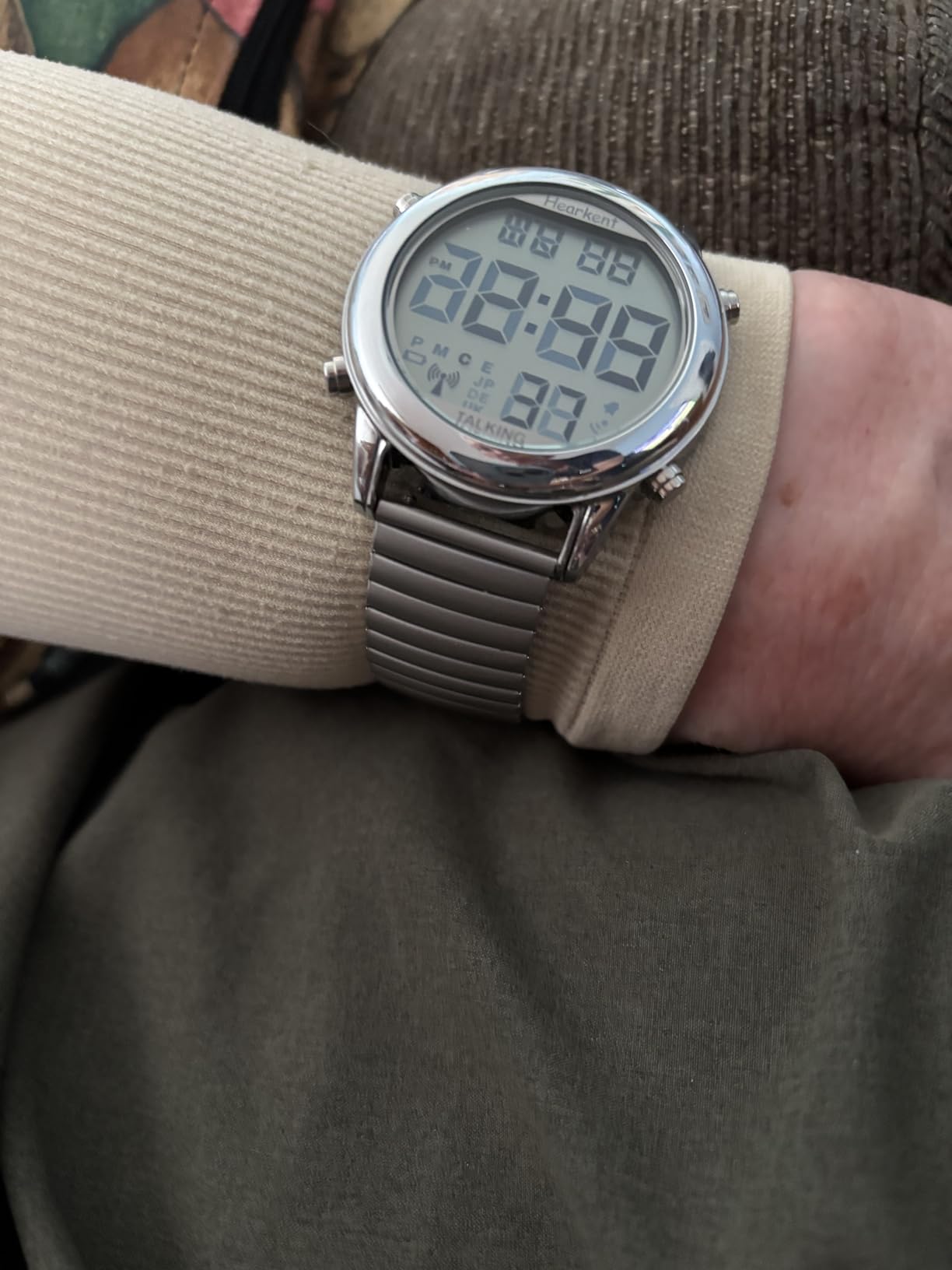
This is not a smartwatch, and we include it because a meaningful number of shoppers looking for the best smartwatches for seniors are actually looking for a way to know what time it is without help. A large digital dial with a clear spoken announcement solves that problem completely, with no phone, no app and no account.
The voice announces the time, the date, the alarm time and the U.S. time zone in a clear American English male voice, and four buttons sit at the 2, 4, 8 and 10 o’clock positions so the wearer can find them by touch alone. Holding the 8 o’clock button enters setting mode.
It self-sets from the official U.S. atomic clock at 3:00 AM, including the daylight saving change, which removes the fiddly manual adjustment that defeats many simpler watches. The time zone still needs setting once before first use.
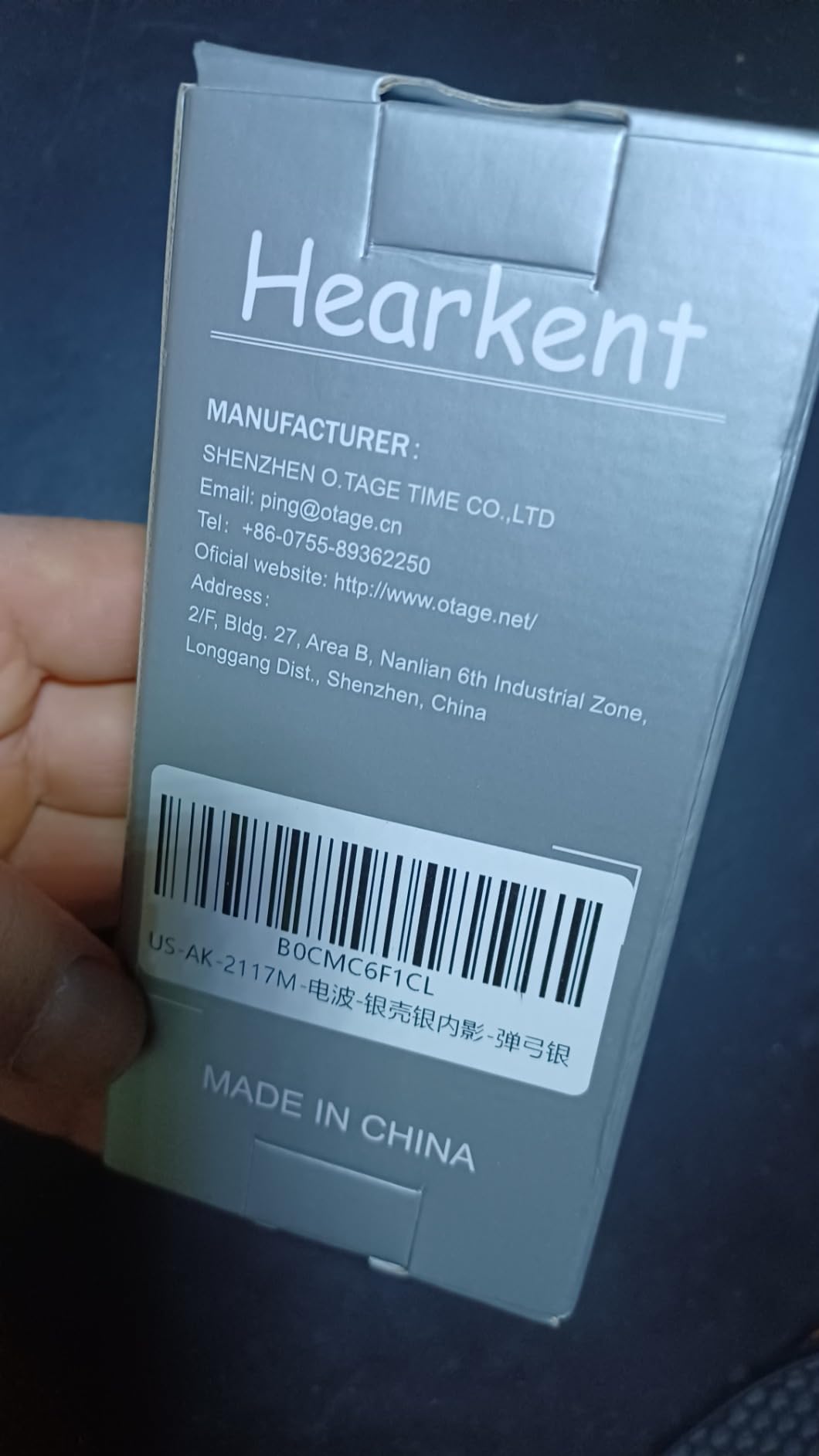
If a newly opened unit shows SHIP on the display, holding the 2 o’clock and 8 o’clock buttons together for about five seconds activates it. That step catches people out and is worth doing before wrapping it as a gift.
The absence of a backlight is a real limitation, so the time cannot be read in a dark room and the spoken output is the only way to get the information at night. The voice is also noticeably harder to hear in a noisy environment, which matters in a busy household.
The band is a non-adjustable elastic at 20 mm, sized for wrists of 6.5 to 8 inches, so check the wrist measurement before buying. The package weighs 2.12 ounces and measures 5.51 by 2.72 by 1.34 inches, and the whole thing runs on one included lithium battery.
Who the talking watch suits
It suits someone with limited or no vision who does not need health data and only needs the time, the date and an audible alarm. Button positions that are learnable by touch make it usable without sight, which is the whole design goal.
It also suits a family looking for a genuinely useful gift on a small budget. There is no subscription, no app, no firmware and nothing to update, so it will still work in five years.
Where the talking watch disappoints
It measures time and nothing else. There is no heart rate, no activity tracking, no GPS, no emergency calling and no way to contact anyone, so it cannot be a safety device.
It is also a specialist tool. Anyone who can read a normal watch comfortably will find a smartwatch more useful, and the fixed band limits who can wear it at all.
Best Smartwatches for Seniors Buying Guide: 7 Features to Check
Start with fall detection, because it changes which products are even worth considering. Fall Detection on the Apple Watch SE 3 and Series 10 uses motion sensors to sense an impact followed by stillness, then counts down and calls emergency services if nobody responds. On the other watches in this guide, fall detection is simply absent, which is the single biggest difference between them.
It is worth setting up emergency contacts during the first hour rather than the first crisis. A fall detection feature with no emergency number in the list is a feature that cannot help. Test it once by triggering it deliberately and cancelling before the call connects, so the family knows what the call sounds like.
Next, decide whether the watch must work without a phone. Every Bluetooth model here depends on a paired smartphone for calls, notifications and, in several cases, for location. If a parent walks out without a phone, the watch is a watch. A cellular model with its own connection solves this at the cost of a separate plan.
Battery life is the factor families underestimate most. A watch that lasts a day creates a daily task, and a daily task is a chance to forget. Anything measured in weeks changes the conversation entirely, which is why the Sense 2, the two Amazfit models and the Garmin appear in this list with more enthusiasm than their feature lists would otherwise earn.
Health sensors vary enormously in depth. Heart rate and step counting are universal. SpO2 blood oxygen, BIA body composition and an ECG app are not, and the ECG appears only on the two Apple models and the Galaxy Watch FE here. A single-lead ECG is a screening prompt that can prompt a call to a doctor, not a diagnosis, and the review data makes clear that results are often inconclusive.
Display size and brightness matter more with age than most buyers expect. The screens in this group run from 1.34 inches on the Fitbit Versa 4 to 2.07 inches on the Amazfit Bip Max, and brightness ranges from 400 nits to 3000 nits. Anyone who mentions reading glasses, bright sunlight or existing vision loss should buy the large, bright panel, not the cheapest one.
Finally, consider setup friction and the cost of doing this properly. Pair the watch with a family member in the room, because a first session with a new app is where adoption is won or lost. Our related guides on treadmills for seniors and road bikes for seniors follow the same principle, and none of these devices asks for less hand-holding than the large-screen fitness equipment does.
Dedicated medical alert systems sit outside this list for a reason. They are wrist-worn, they call a staffed monitoring centre rather than your contacts, and they work on cellular without a smartphone. That reliability comes with a monthly service charge, which is the trade the best smartwatches for seniors in this guide are not making.
For a parent who also needs help getting around the home, our picks for lightweight wheelchairs for traveling seniors and bed rails for seniors cover the two support purchases that come up most often alongside a wearable.
Frequently Asked Questions
What is the best smartwatch for seniors that has fall detection?
The Apple Watch SE 3 and the Apple Watch Series 10 are the only devices in this guide with automatic fall detection, and both will call emergency services automatically if the wearer does not respond to a countdown. The SE 3 covers the feature at a lower cost, while the Series 10 adds the ECG app and a larger display. Everything else here is a health tracker rather than an emergency device.
Which smartwatch is the easiest to use for an elderly person?
The easiest watches in this group are the ones with the largest text and the fewest menus. The Hearkent talking watch is simplest of all because it announces the time aloud, and the Amazfit Bip 5 Unity is the simplest smartwatch with a plain layout and large icons. Whichever you choose, set it up with the wearer in the room rather than handing it over ready-worn.
Which smartwatch has the longest battery life for seniors?
The Amazfit Bip Max leads with up to 20 days of typical battery life, followed by the Amazfit Bip 6 at up to 14 days and the Amazfit Bip 5 Unity at 11 days, or 26 days in battery saver. Among the branded watches, the Fitbit Sense 2 runs 6 days or more and the Fitbit Versa 4 is listed at 144 hours. The Galaxy Watch 7 manages about 30 hours, and the Apple Watch SE 3 is the shortest here at up to 18 hours.
Do cardiologists recommend smart watches for seniors?
Doctors generally use consumer smartwatches as a screening tool rather than a diagnostic one, and they care most about heart rate trends, irregular rhythm notifications and the ECG. The Apple Watch SE 3 and Series 10 and the Samsung Galaxy Watch FE are the models here with an ECG app. Bring readings to a doctor rather than relying on a watch, and note that reviews report ECG results frequently come back inconclusive when finger placement is off.
Why are people ditching smart watches?
The recurring reasons are charging frustration, setup difficulty, false fall alarms and small text. Daily charging is the biggest one, because a watch that is never charged protects nobody. Fitbit owners also report losing features in app updates, and some units fail with blank screens. Watchmakers have responded with multi-week battery devices, but the pattern behind most returns is still friction rather than dissatisfaction with the hardware.
What are common problems with smartwatches for seniors?
The most common problems are small text and icons, false fall alarms triggered by normal arm movements, step counts that under-report during low arm-motion activity, and proprietary charging cables that go missing. In this group, the Fitbit Sense 2 under-reports steps for activities like pool exercise, the Galaxy Watch 7 Bluetooth model has no independent GPS, and the Galaxy Watch FE takes about 107 minutes to charge.
The Best Smartwatches for Seniors Verdict for 2026
After working through all twelve, the Apple Watch SE 3 remains the pick for most families in 2026. It is the only device in this guide that pairs automatic fall detection and crash detection with no monthly service, and the 18-hour battery is an inconvenience rather than a failure. For an Android household, the Galaxy Watch 7 40mm does the same job with better sleep data and a brighter screen.
Where charging is the sticking point, the Fitbit Sense 2 solves it with a six-day battery at the cost of every safety feature. Where eyesight is the sticking point, the Amazfit Bip Max gives the largest and brightest display with three-week battery life. Set the watch up together, fill in the emergency contacts, and it will still be working next year.