
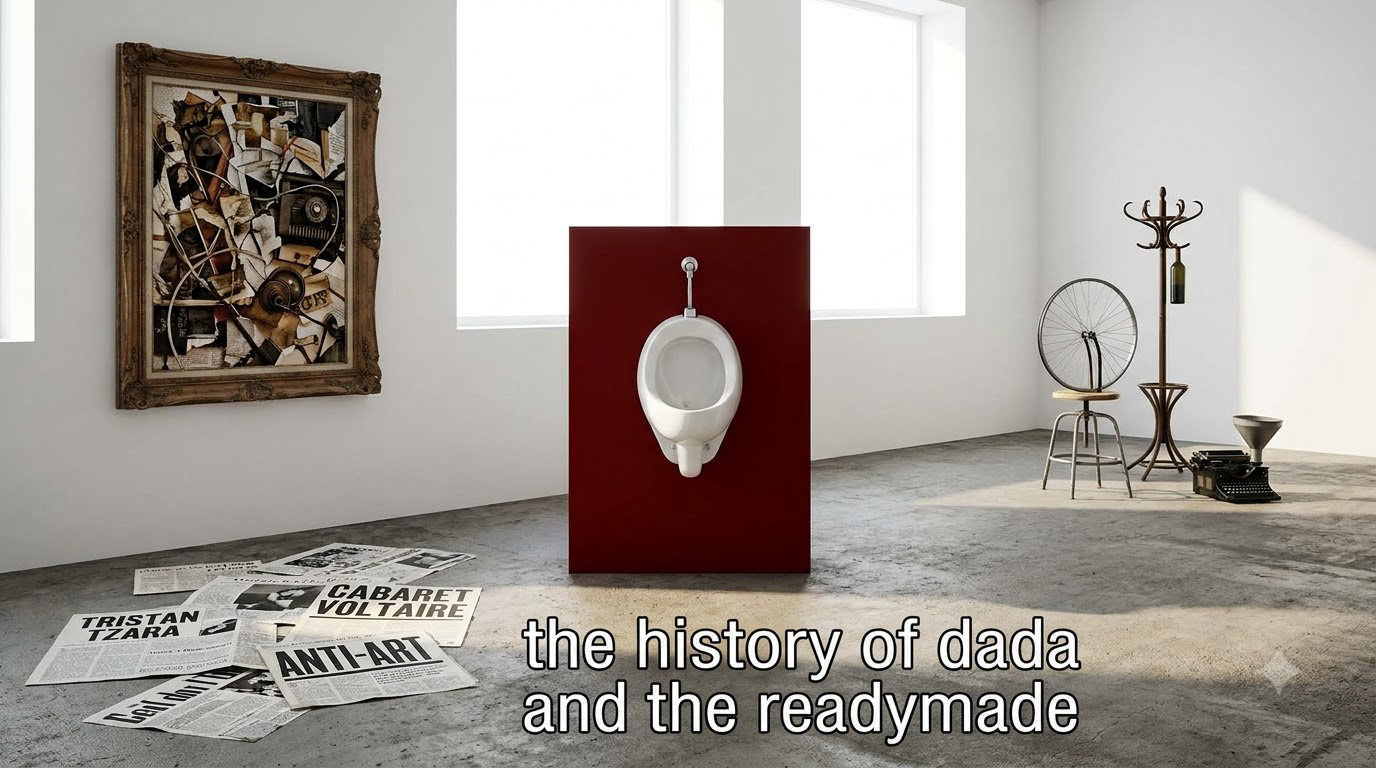
When most people think of art that challenges convention, they picture a urinal turned on its side and signed with a pseudonym. That single object, Marcel Duchamp’s Fountain, changed how we think about art forever. But this work did not emerge in a vacuum. It came from a chaotic, desperate moment in history when a group of artists in neutral Switzerland decided that rationality itself had failed. The movement they created called itself Dada, a word that meant nothing and everything at once. Understanding the history of Dada and the readymade means understanding how catastrophe breeds innovation, and how a deliberate rejection of meaning can become one of the most meaningful movements in modern art.
Table of Contents
Dada Origins: World War I and the Birth of a Movement
The year was 1916. Europe was engulfed in the bloodiest conflict the world had yet seen, a war driven by nationalism, industrial killing, and an arrogance that seemed to promise endless progress. In the midst of this horror, a small group of artists, writers, and intellectuals found refuge in Zurich, Switzerland, a neutral island surrounded by war.
On February 5, 1916, Hugo Ball and Emmy Hennings opened a small club on Spiegelgasse street. They called it Cabaret Voltaire. The space was tiny, seating perhaps 25 people, with a stage barely larger than a large table. But what happened inside those walls ignited one of the most radical artistic movements of the twentieth century.
Cabaret Voltaire became a gathering place for artists fleeing the war. Romanian poet Tristan Tzara arrived shortly after its opening. Alsatian artist Jean Arp joined. German poet Hugo Ball provided the philosophical framework. Together, they created performances that defied logic, sound poetry that screamed words without meaning, and manifestos that rejected everything the war represented.
The name “Dada” itself reflects the movement’s ethos. The origin remains disputed. Some say Tzara found the word in a children’s dictionary, randomly pointing to “dada,” the French word for a hobbyhorse. Others suggest it emerged from the Romanian word “da,” meaning “yes,” or that it was simply a nonsense syllable that captured the movement’s rejection of sense and meaning. Regardless of its origin, the name stuck and became synonymous with anti-art, irrationality, and deliberate provocation.
Key Figures of Dada
While Duchamp would later become the most famous figure associated with Dada and the readymade, the movement was collaborative and international from its beginning. Understanding the history of Dada requires knowing the artists who shaped it in those early, chaotic years.
Tristan Tzara, born Samuel Rosenstock in Romania, became Dada’s chief theorist and propagandist. His manifestos defined Dada as “the knife of the public,” a weapon against rational society. Tzara believed that art should wound, provoke, and ultimately destroy conventional notions of beauty and meaning.
Hugo Ball, a German poet, co-founded Cabaret Voltaire and developed the concept of sound poetry, reciting verses where the sounds mattered more than any meaning. His manifesto declared that “Dadaism wishes to introduce into literature all those forceful elements that are customarily suppressed.” He understood that the war had broken something fundamental in European civilization, and that art needed to reflect that breakage.
Jean Arp brought a sense of abstraction and chance to Dada. Alongside Tzara, he helped develop the technique of chance operations, where art was created through random selection rather than deliberate design. This approach reflected Dada’s distrust of rational authorship and intentional meaning.
Other figures joined the movement. Artist Sophie Taeuber-Arp, who would later become Arp’s wife, contributed geometric abstractions and architectural designs. German artist Raoul Hausmann developed photomontage as a weapon against militarism and nationalism. French artist Francis Picabia created absurdist drawings that mocked artistic pretension. These artists worked across multiple centers, including Zurich, Berlin, Paris, and later New York, spreading Dada’s influence across continents.
Marcel Duchamp and the Readymade Revolution
Marcel Duchamp arrived at Dada somewhat late and from a different direction. Trained as a painter in Paris, he had already created controversial works like Nude Descending a Staircase when he grew frustrated with what he called “retinal art,” art that appealed only to the eye without engaging the mind.
In 1913, Duchamp first used a found object as art. He took a bicycle wheel, mounted it upside down on a stool, and called it Bicycle Wheel. The object was not created by the artist but simply selected and presented as art. This moment marked the invention of what Duchamp would later call the “readymade.”
A readymade is an ordinary, manufactured object that an artist selects and presents as art, removing it from its functional context. The object itself carries no artistic intervention in the traditional sense. No painting, no sculpture, no craft. Just the decision to call something art.
Duchamp’s most famous readymade remains Fountain, created in 1917. He purchased a standard porcelain urinal from a plumbing supplier, signed it “R. Mutt,” and submitted it to an exhibition of the Society of Independent Artists in New York. The work was rejected, but its photograph, published in a small avant-garde magazine, became one of the most reproduced images in art history.
The Fountain asked a question that has never stopped being asked: What makes something art? Is it the object’s material form, or the context and intention behind it? By presenting an ordinary manufactured object as art, Duchamp claimed that the artist’s choice, not the object’s appearance or craftsmanship, determines its status.
Duchamp created several other readymades. A bottle rack became a sculpture. A snow shovel hung from the ceiling. A coat rack hung on a hook. Each work challenged viewers to reconsider what art could be and where it could exist. The readymade was not about aesthetic beauty. It was about conceptual intervention, about using ordinary objects to make viewers think differently about art itself.
The Philosophy of Anti-Art
Dada was fundamentally a philosophical movement as much as an artistic one. The artists who gathered at Cabaret Voltaire believed that rationality itself had led to the catastrophe of World War I. If logic and progress had produced industrialized slaughter, then perhaps logic and progress were illusions. Dada responded by embracing irrationality, absurdity, and deliberate contradiction.
The term “anti-art” describes this approach. Dada artists did not simply create new kinds of art. They attacked the very concept of art as a meaningful human activity. They created works designed to shock, confuse, and provoke. They used chance operations to remove intentionality from creation. They published manifestos full of contradictions and non-sequiturs.
This philosophy influenced conceptual art profoundly. If the idea behind a work matters more than its physical form, then traditional craftsmanship becomes less important than the conceptual framework the artist establishes. Duchamp argued that the viewer completes the artwork through their interpretation, meaning that art exists in the mind rather than in the object.
Dada also challenged authorship in ways that anticipated later developments. By using chance operations, by selecting readymades, by collaborating on works where no single artist could claim responsibility, Dada artists undermined the romantic notion of the genius creator. These strategies would later influence everything from collaborative performance art to digital appropriation.
Women in Dada: Overlooked Pioneers
History has not been kind to the women who participated in Dada. While names like Tzara, Ball, and Duchamp appear in every textbook, the contributions of female artists remain underappreciated. Addressing this gap helps us understand Dada more completely.
Hannah Hoch was a German artist who used photomontage to create politically charged works that anticipated Pop Art by decades. Her piece Cut with the Kitchen Knife Dada Through the Last Weimar Beer-Belly Cultural Epoch of Germany (1919) is a massive collage that commented on the post-war political situation with savage irony and visual ingenuity. Hoch was part of the Berlin Dada circle, where she was among the few women taken seriously as an artist, though her work was often dismissed as secondary to her male colleagues.
Sophie Taeuber-Arp embodied Dada’s interdisciplinary spirit. An architect, painter, sculptor, and dancer, she taught at the Zurich School of Applied Arts and created abstract geometric works that balanced order and chaos. Her vertical compositions and dynamic sculptures brought a formal rigor to Dada’s chaos. She married Jean Arp and continued working until her untimely death in 1943.
These women were not peripheral participants. They were central to Dada’s development, bringing perspectives and skills that shaped the movement’s direction. Recognizing their contributions corrects historical oversights and reveals Dada as a more diverse phenomenon than its standard narrative suggests.
Dada Techniques and Lasting Influence
Dada artists developed distinctive techniques that distinguished their work from traditional art forms. Collage and photomontage allowed them to critique modern media and militarism by cutting up and reassembling images from newspapers and magazines. The result was jarring, disorienting, and intentionally ugly in ways that challenged conventional aesthetic standards.
Chance operations removed intentionality from creation. Artists would randomly select words from newspapers to create poems, or let their hands determine where to place forms on a page. These techniques reflected Dada’s distrust of rational authorship and its embrace of absurdity as a valid artistic strategy.
The influence of these techniques on subsequent movements is immense. Surrealism emerged directly from Dada, adopting Dada’s embrace of the unconscious, chance, and irrational imagery. Andre Breton, who would become Surrealism’s chief theorist, had participated in Dada before breaking away to create his own movement. Surrealism took Dada’s rejection of rational control and systematized it into a comprehensive artistic philosophy.
Dada’s influence extends further into conceptual art. The readymade’s emphasis on ideas over craft directly prefigured Conceptual Art’s core argument that art is about proposing ideas rather than making objects. Artists like Sol LeWitt, Lawrence Weiner, and Yoko Ono drew explicitly on Duchamp’s strategies when they declared that the artist’s intention, not the physical work, constitutes art.
Neo-Dada: A New Generation
After World War II, a new generation of artists looked back to Dada for inspiration. Neo-Dada emerged in the 1950s and 1960s, particularly in the United States, where artists responded to Abstract Expressionism’s emphasis on spontaneous emotional expression by reintroducing objects, humor, and conceptual strategies.
Artists like Robert Rauschenberg, Jasper Johns, and Claes Oldenberg led this revival. Rauschenberg’s “Combines,” works that combined painting and sculpture with everyday objects, directly echoed Dada’s readymade approach. Johns famously painted American flags and targets, questions about representation and objecthood that paralleled Dada’s interrogation of meaning.
Neo-Dada was not simply a repetition of the original movement. It responded to different circumstances, particularly the dominance of Abstract Expressionism and the emerging consumer culture of postwar America. But it maintained Dada’s fundamental skepticism about what art could be and how it could function.
The movement also connected Dada to Pop Art and Minimalism. Andy Warhol’s Brillo boxes, which presented commercial packaging as sculpture, extended the readymade tradition into the heart of American consumer culture. Donald Judd’s geometric sculptures removed the handmade mark of the artist in ways that paralleled Duchamp’s original conceptual intervention.
Dada and Contemporary Art: Why It Still Matters
A century after its birth, Dada remains relevant in ways that its founders could never have anticipated. The movement’s core ideas about appropriation, irony, and the questioning of artistic authority have become fundamental to contemporary art practice.
The rise of internet culture has created new contexts for Dada’s ideas. Memes, which remix and recontextualize existing images, echo Dada’s collage strategies. Internet humor that subverts expected meaning reflects Dada’s embrace of absurdity and contradiction. When someone takes an image out of its original context and gives it a new meaning, they are performing the same conceptual operation that Duchamp did with his readymades.
Appropriation art, which directly borrows and recontextualizes existing works, has its roots in Dada. Artists like Sherrie Levine, who photographed other photographers’ images, or Richard Prince, who reprinted advertising images, continue the readymade tradition of questioning originality and authorship. These practices, which seem radical to traditional art audiences, are logical extensions of Dada’s original interventions.
Dada collectives also anticipated the collaborative practices that dominate contemporary art. The idea that art can be made by groups rather than individuals, that anonymity can replace individual authorship, that art can emerge from collaboration rather than genius, all derive from Dada’s early experiments.
Dada’s relevance today stems from its fundamental argument that art is not about objects or skills but about ideas and contexts. This argument, which seemed radical in 1916, has become so accepted that we rarely notice it. Every time an artist presents an ordinary object as art, every time a curator declares that something belongs in a museum, every time we accept that something counts as art simply because someone says it does, we are living in the world that Dada created.
FAQs
What is the historical context of Dada art?
Dada emerged during World War I (1914-1918) in neutral Switzerland, specifically in Zurich. Artists fleeing the war gathered at Cabaret Voltaire, creating an anti-war, anti-rational art movement that responded to the horrors and absurdity of modern warfare.
Who started the Dadaism movement?
Dada was founded by several artists including Romanian poet Tristan Tzara, German poet Hugo Ball, and Alsatian artist Jean Arp. They were soon joined by Marcel Duchamp, whose readymades would become among the most influential works in modern art.
How did the Dada art movement get its name?
The name ‘Dada’ has disputed origins. Some say it was found in a children’s dictionary, randomly selected. Others suggest it is simply a nonsense word that captured the movement’s rejection of meaning and rational thought.
What is the difference between Dada and Neo-Dada?
Neo-Dada emerged in the 1950s-1960s as artists revived Dada strategies. While Dada was a reaction to WWI, Neo-Dada responded to Abstract Expressionism and sought to reintroduce imagery, objects, and humor into American art.
Is Dada still relevant today?
Dada remains profoundly relevant. Its emphasis on appropriation, irony, and questioning what constitutes art directly influenced Conceptual Art, Pop Art, and contemporary practices. Modern internet meme culture and remix culture echo Dada’s core ideas.
Conclusion
The history of Dada and the readymade is ultimately a story about questioning. When the artists of Cabaret Voltaire looked at a world destroyed by rational thought, they asked what art could do in the face of such destruction. The answer they found was to reject the assumptions that made both war and traditional art possible.
Duchamp’s readymades took this questioning to its logical extreme. By presenting ordinary objects as art, he asked viewers to examine their own assumptions about what art is and where it can be found. The question has never been fully answered, and that uncertainty is precisely the point. Every urinal in a museum, every appropriation of an existing image, every work that challenges viewers to think about what they are looking at, carries within it the spirit of Dada’s original provocation.
A century later, the readymade’s question remains productive. Art institutions, critics, and viewers still struggle with what makes something art. The debate that Dada started has never ended, which is perhaps the greatest evidence of its lasting power. The history of Dada and the readymade is not simply historical. It is ongoing, shaping how we think about creativity, authorship, and meaning in a world saturated with images and objects competing for our attention.