
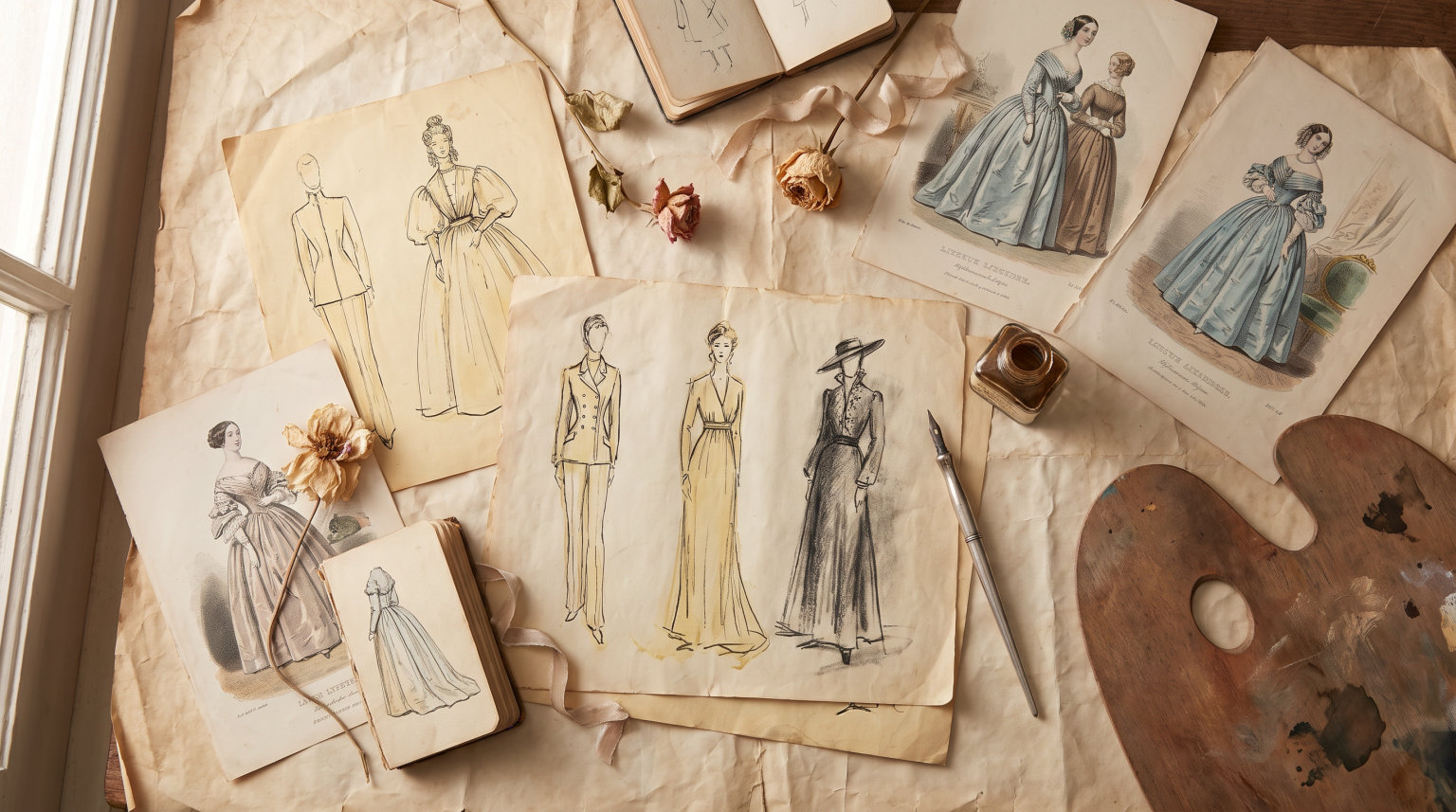
Fashion illustration is the practice of creating artistic drawings and depictions of clothing, accessories, and fashion designs. It serves as a visual representation of fashion trends and styles throughout history, documenting how societies have expressed identity, status, and creativity through dress. From hand-drawn fashion plates to modern digital artwork, this art form has evolved alongside technological advances and shifting aesthetic ideals.
The history of fashion illustration spans over 500 years, beginning in the sixteenth century when global exploration sparked widespread fascination with the dress and costume of different cultures. This art form has transformed dramatically from elaborate engraved fashion plates to the glamorous illustrations of the Golden Age, through a period of decline, and into today’s vibrant digital revival. Understanding this evolution reveals how fashion illustration has remained an essential creative force, even as photography came to dominate fashion media.
This guide explores the complete timeline of fashion illustration, examining the key periods, pioneering illustrators, and techniques that shaped this distinctive art form. Whether you are a fashion enthusiast, an aspiring illustrator, or simply curious about how visual fashion communication evolved, you will find a comprehensive overview here.
Table of Contents
What Is Fashion Illustration?
Fashion illustration is the art of depicting clothing and accessories through drawing, painting, or digital rendering. Unlike technical fashion sketches used in design processes, fashion illustration emphasizes artistic expression and visual storytelling. The goal is to capture the spirit, silhouette, and emotional quality of garments rather than their precise construction measurements.
Throughout its history, fashion illustration has served multiple purposes. It documents fashion trends for magazines and periodicals, communicates design concepts from couturiers to manufacturers, preserves cultural attitudes toward dress, and serves as a form of fine art. The best fashion illustrators manage to convey not just what a garment looks like, but how it moves, how it feels, and the lifestyle it represents.
Key characteristics distinguish fashion illustration from other drawing disciplines. These include exaggerated proportions that emphasize the garment, stylized rendering of the human form, attention to fabric drape and texture, and a signature aesthetic that reflects the era’s artistic movements. A fashion illustration from the Art Deco period looks distinctly different from one created during the minimalist 1990s, yet both serve the same fundamental purpose of visual fashion communication.
The Early Origins: 16th Century Beginnings
The history of fashion illustration began in earnest during the sixteenth century. Global exploration and discovery during this period led to widespread fascination with the dress and costume of people in many nations. European courts wanted to understand and display the exotic clothing of newly discovered lands, creating demand for visual documentation of diverse cultural attire.
The invention of the Gutenberg printing press around 1440 proved transformative for fashion illustration. Suddenly, images could be reproduced and distributed widely, enabling the spread of fashion ideas across Europe. Early fashion images often took the form of woodcut illustrations in travel journals and costume books, documenting the clothing of different nations and social classes.
One of the earliest significant works in this tradition was Cesare Vecellio’s “Habiti Antichi et Moderni,” published in Venice in 1590. This comprehensive costume book featured detailed woodcut illustrations depicting clothing from across Europe and beyond. These images served both as ethnographic documentation and as sources of fashion inspiration for European designers and aristocrats seeking new styles.
The earliest fashion illustrations focused on accuracy and detail rather than artistic stylization. They depicted silhouettes, fabric types, and decorative elements with near-documentary precision. This emphasis on faithful reproduction reflected the era’s understanding of illustration as a recording medium rather than an expressive art form. However, even these early works showed the beginning of fashion illustration’s enduring concern with presenting clothing as a form of cultural expression.
The Fashion Plate in the 19th Century
The nineteenth century witnessed the transformation of fashion illustration into a sophisticated art form. Fashion plates emerged as the dominant medium for communicating fashion trends to a growing middle-class audience. These hand-colored engravings depicted the latest styles from Paris and other fashion centers, serving as visual magazines for readers who could not afford direct access to couture houses.
Several technical innovations drove this expansion. Improved printing techniques, particularly lithography and etching, allowed for more detailed and nuanced images. The pochoir technique became especially significant—a method of applying color through hand-cut stencils that produced remarkably vibrant and precise results. Pochoir work could achieve a level of detail and color intensity that mechanical printing methods could not match, making it ideal for luxury fashion publications.
Fashion magazines proliferated during this period, creating sustained demand for fresh illustrations. Publications like “Le Moniteur de la Mode” in France and “The Lady’s Magazine” in England featured regular fashion plate columns. These illustrations followed strict conventions: they typically showed a full-length figure in a posed stance, often against a simple background, with particular attention to the silhouette and key garment details.
The relationship between fashion illustration and the emerging fashion industry strengthened throughout the 1800s. Designers and houses began working more closely with illustrators to communicate their seasonal visions. The fashion plate was no longer just a record of trends—it was becoming a tool for shaping and directing fashion choices. This period established many conventions that would define fashion illustration for decades to come.
The Golden Age of Fashion Illustration (1920s-1950s)
The Golden Age of fashion illustration spanned roughly three decades, from the 1920s through the 1950s. This period represented the pinnacle of fashion illustration’s influence and artistic achievement. The combination of Art Deco’s geometric elegance, Hollywood’s glamour, and the prosperity of luxury fashion publications created ideal conditions for illustrative artists to thrive.
Art Deco profoundly influenced fashion illustration during this era. The movement’s emphasis on bold lines, geometric forms, and luxurious materials translated perfectly into fashion imagery. Illustrators developed signature styles that combined elegant simplification with dramatic flair, creating images that captured the spirit of modernity while celebrating glamorous femininity.
Several legendary illustrators defined this period. Erté, born Romain de Tirtoff, created iconic covers for Harper’s Bazaar during the 1920s and 1930s. His elegant, elongated figures with intricate details became synonymous with Art Deco glamour. Georges Barbier’s elegant compositions and Gruau’s distinctive linear style influenced generations of subsequent illustrators. Other masters included Paul Iribe, whose crisp linework defined a generation, and Carl Erickson, whose work for Vogue defined American fashion illustration.
The relationship between fashion illustrators and major magazines reached its peak during these years. Vogue and Harper’s Bazaar competed fiercely for the most talented illustrators, recognizing that distinctive artwork could distinguish their publications in a crowded market. Fashion illustrators were treated as artistic celebrities, with their names prominently featured alongside their work. The covers and editorial spreads created by these artists were collected and cherished by readers.
Hollywood’s influence on fashion illustration grew during this period as well. Illustrators created promotional artwork for films and celebrities, bridging the worlds of cinema and fashion. This connection worked in both directions—movie stars wore designer gowns that were then interpreted through fashion illustration for publications worldwide. The glamorous, aspirational quality that characterized Golden Age illustration reflected this Hollywood connection.
Why Fashion Illustration Declined
The dominance of fashion illustration began to fade in the 1950s as photography rapidly advanced in both technical capability and artistic respectability. Camera technology improved dramatically, enabling photographers to capture fashion with unprecedented clarity and speed. Color photography became commercially viable, offering a realism that illustration could not match for showing actual fabric colors and textures.
Fashion magazines gradually shifted their visual emphasis from illustration to photography. The change was gradual at first—early photography lacked the ability to capture movement and fabric drape convincingly. However, as photographers developed techniques for working with moving fabric and complex lighting, the case for illustration weakened. By the 1960s, photography had become the primary medium for fashion journalism.
Several factors accelerated illustration’s decline beyond the rise of photography. The minimalist aesthetic that dominated fashion in the 1960s and 1970s suited photography’s straightforward approach better than illustration’s tendency toward stylization. Additionally, the economics of magazine publishing favored photography—images could be processed and printed faster than custom illustrations could be created and reproduced.
For a period in the 1970s and 1980s, fashion illustration seemed headed toward irrelevance. Major publications reduced or eliminated their illustration content. Many talented illustrators shifted to advertising or other commercial work. Those who continued working in fashion often found themselves in reduced circumstances, their skills no longer valued by the industry that had once celebrated them.
The Digital Revival of Fashion Illustration
Fashion illustration began its comeback in the 1980s, though the revival initially moved slowly. A new generation of designers and editors, weary of photography’s dominance, sought the distinctive character that illustration offered. The return of maximalism in fashion also created conditions more favorable to illustrative work.
Digital technology transformed the possibilities for fashion illustration during this revival. Computer graphics programs gave illustrators new tools for creating and manipulating images. Digital techniques allowed for experimentation with media, combining traditional drawing methods with computer processing. This technological flexibility helped illustrators develop distinctive styles that could not be replicated mechanically.
By the 1990s, fashion illustration was establishing a renewed presence in fashion media. Magazines began featuring illustrated editorial content alongside photography. Advertising campaigns started incorporating illustrative elements as brands sought differentiation in a visually crowded marketplace. Young illustrators emerged who had grown up with digital tools, approaching fashion illustration with fresh perspectives.
The emergence of social media accelerated fashion illustration’s contemporary revival dramatically. Platforms like Instagram created direct connections between illustrators and audiences, bypassing traditional editorial gatekeepers. Illustrators could build followings based on the distinctive quality of their work, demonstrating that hand-drawn imagery retained appeal in an age of photographic saturation.
Fashion Illustration Today
Contemporary fashion illustration represents a diverse and vibrant field. Today’s illustrators work across a spectrum from traditional hand-drawing to purely digital creation, often combining multiple techniques. This diversity reflects the broader fragmentation of media and the increasing specialization of audiences. Fashion illustration today serves not just magazines and advertisers but also branding, social media content, and fine art galleries.
Several factors distinguish contemporary fashion illustration from its Golden Age predecessor. The pace of production has increased dramatically—social media demands constant fresh content. The audience is more fragmented, requiring illustrators to develop clearly distinctive voices to stand out. Competition comes not just from other illustrators but from AI-generated imagery, raising questions about the future role of human artistic interpretation.
Questions about AI’s impact on fashion illustration have become increasingly urgent. Artificial intelligence tools can now generate images in various styles, including approaches that mimic fashion illustration. However, most experts believe AI will complement rather than replace human illustrators. The appeal of fashion illustration lies in its human qualities—the personal vision, emotional interpretation, and unique perspective that no algorithm can fully replicate.
Fashion illustration has also gained recognition as fine art in recent years. Major museums now collect and exhibit fashion illustration works. Auction houses report growing interest in historic fashion illustrations, with works by Golden Age masters commanding significant prices. This institutional recognition has elevated the status of the profession and attracted new talent to the field.
The Future of Fashion Illustration
The future of fashion illustration seems likely to involve continued evolution rather than decline. The fundamental value of human-created illustrative imagery—that it offers artistic interpretation rather than documentary record—remains relevant even as technology advances. In a world saturated with photographs, the distinctive perspective of a skilled illustrator becomes more valuable, not less.
Technology will undoubtedly continue shaping fashion illustration’s development. Digital tools are already becoming more sophisticated, and AI assistance may become a standard part of many illustrators’ workflows. However, the most successful illustrators will likely be those who use technology to enhance their personal vision rather than replace it. The human element—the emotional connection between illustrator, subject, and viewer—appears destined to remain central to the art form.
Emerging platforms and media create new opportunities for fashion illustration. Short-form video, immersive digital experiences, and interactive media all offer possibilities for illustrative work. Fashion illustration’s ability to convey atmosphere and emotion through stylized imagery suits it well for these emerging contexts. Illustrators who can adapt their skills to new media formats will find expanding opportunities.
The enduring appeal of fashion illustration reflects something deeper than nostalgia or aesthetic preference. At its core, fashion illustration represents human interpretation of fashion—someone’s artistic vision of what clothing means and how it transforms the wearer. This interpretive quality ensures that fashion illustration will continue serving as a vital form of visual fashion communication, even as the specific tools and techniques continue evolving
FAQs
How did fashion illustration begin?
Fashion illustration began in the sixteenth century when global exploration created widespread fascination with the dress and costume of different cultures. The invention of the Gutenberg printing press enabled images to be reproduced and distributed widely. Early works like Cesare Vecellio’s costume books documented clothing from across Europe and beyond, establishing fashion illustration as a tool for recording and communicating fashion trends.
What is the concept of fashion illustration?
Fashion illustration is the practice of creating artistic drawings and depictions of clothing, accessories, and fashion designs. It emphasizes artistic expression and visual storytelling rather than technical accuracy, capturing the spirit, silhouette, and emotional quality of garments. Key characteristics include exaggerated proportions that emphasize garments, stylized rendering of the human form, and attention to fabric drape and texture.
Will AI replace Fashion Illustrators?
Most experts believe AI will complement rather than replace human fashion illustrators. While AI can generate images in illustrative styles, the appeal of fashion illustration lies in its human qualities – the personal vision, emotional interpretation, and unique perspective that algorithms cannot fully replicate. In a world saturated with photographs, the distinctive perspective of a skilled illustrator becomes more valuable.
What is the brief history of fashion?
Fashion illustration evolved from 16th-century costume documentation through 19th-century fashion plates, reaching its Golden Age during 1920s-1950s when Art Deco influence and luxury magazines elevated the art form. Photography’s rise in the 1950s diminished illustration’s prominence, but digital tools and social media sparked a revival from the 1980s onward. Today fashion illustration thrives as both commercial art and recognized fine art form.