
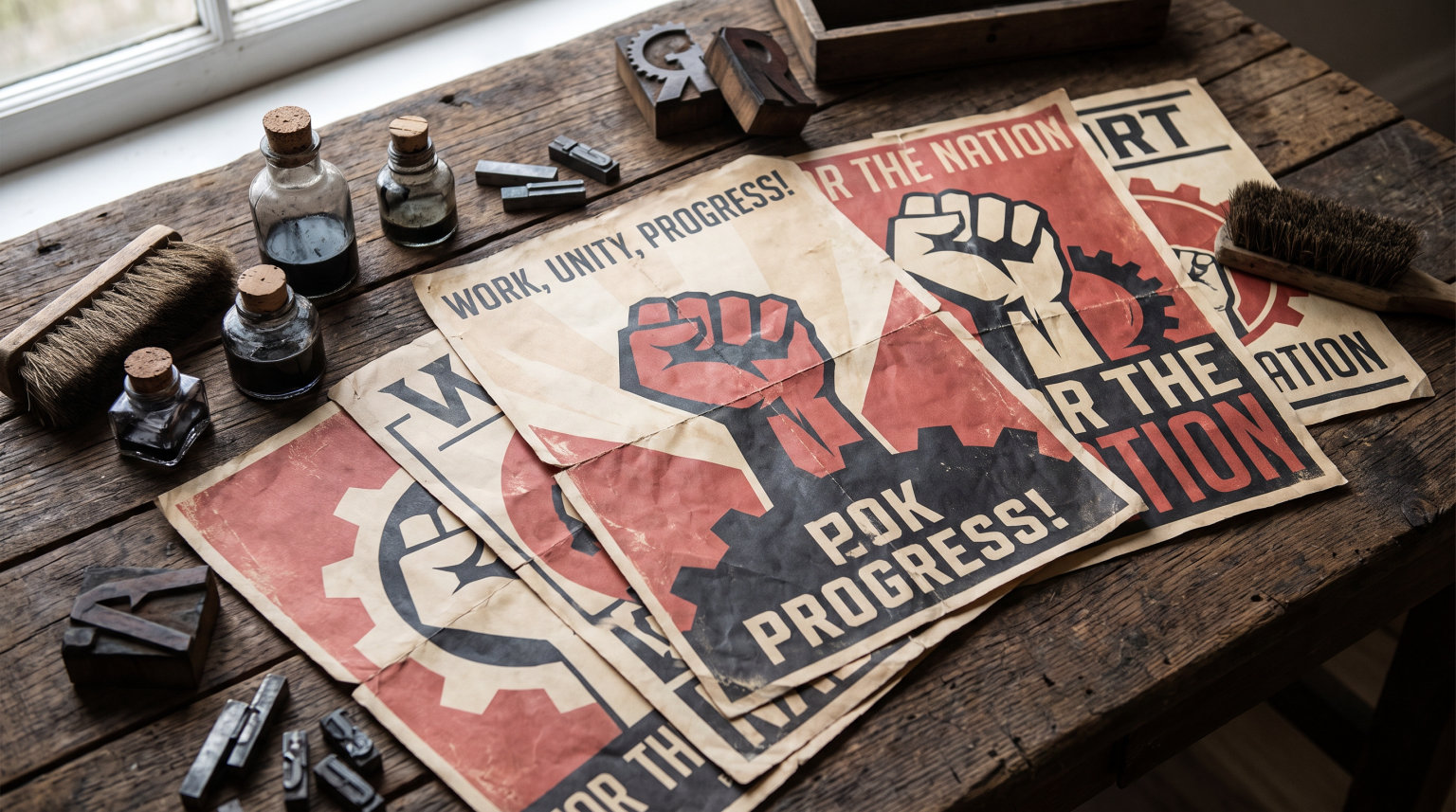
Poster art and propaganda represent one of the most powerful branches of visual communication in modern history. From hand-drawn notices in 15th-century London to digital memes shared across social media platforms, the evolution of poster art mirrors changes in printing technology, artistic movements, and shifts in how societies persuade their citizens. The history of poster art and propaganda spans over five centuries, weaving together commerce, conflict, and creative expression into a medium that continues to shape how we understand images as tools for influence.
This article traces that remarkable journey from the earliest printed notices to the sophisticated visual campaigns of the digital age. We will explore how technological breakthroughs like colour lithography transformed humble advertisements into celebrated works of art, how wartime governments harnessed bold graphics to mobilize millions, and how contemporary artists continue to use poster formats to challenge authority and amplify social movements. Whether you are a student, historian, or simply curious about how images communicate ideas, understanding this history illuminates much about the world we inhabit today.
Table of Contents
What Is Poster Art and Propaganda?
Poster art and propaganda refers to the use of printed visual materials to communicate messages, influence public opinion, or promote ideas. A poster typically combines bold imagery with text elements, designed to be displayed publicly and reach a wide audience. The format evolved from simple text-only notices into sophisticated compositions that blended artistic creativity with strategic messaging.
Propaganda, specifically, describes content intended to persuade viewers toward a particular viewpoint, often political or ideological in nature, sometimes without regard for objective truth. The distinction between propaganda and persuasion more broadly lies in intent and methodology. Propaganda typically emanates from centralized authority seeking to advance a particular agenda, while general persuasion might emerge from commercial or personal motivations.
The distinction between decorative poster art and propaganda is not always clear-cut. Many artistic posters promoted products or entertainment rather than political causes. However, the techniques used in propaganda posters drew heavily from commercial advertising methods, creating a visual vocabulary of emotional appeal, symbolic imagery, and bold typography that proved effective for both selling soap and selling war. This overlap between art, advertising, and persuasion is what makes studying poster history so fascinating and occasionally controversial.
Understanding propaganda in art history requires acknowledging that all visual communication carries some persuasive intent, whether obvious or subtle. Even purely decorative posters influence viewers through aesthetic choices, colour selections, and compositional decisions. The most effective propaganda, historically, disguised its persuasive purpose behind artistic merit, making viewers complicit in their own persuasion.
Origins: From Antiquity to the 19th Century
The oldest known posters date back well before the printing press. Archaeological discoveries suggest that ancient civilizations used painted signs and carved stone announcements to communicate with their communities. Egyptian hieroglyphic inscriptions functioned as proto-posters, publicizing royal decrees and religious teachings to populations that gathered at significant sites. Roman civilization employed wax tablets and painted notices to announce gladiatorial games, election results, and commercial offerings.
However, the true ancestor of modern poster art emerged with the advent of moveable type printing in Europe during the 15th century. This technological revolution made it possible to produce identical text quickly, establishing the foundation for mass visual communication. The printing press transformed posters from unique hand-crafted objects into reproducible commodities that could be distributed widely.
William Caxton, an English merchant who introduced the printing press to England in 1476, produced some of the earliest recognizable posters. These handbills advertised books and products, combining text with simple woodcut illustrations. Woodcut printing involved carving an image into a wooden block, inking the raised surfaces, and pressing paper onto the block to create an impression. While effective, this technique produced images with coarse lines and limited detail.
The printing press made it possible to reproduce identical notices quickly and distribute them across towns and cities, establishing the poster as a tool for mass communication that had never existed before. Guilds, merchants, and civic authorities embraced the new technology to announce everything from market prices to public executions. The visual language of these early posters remained primitive by later standards, but their function as mass communication tools was firmly established.
During the 17th and 18th centuries, printed posters became common for public notices, theatrical performances, and commercial advertising. These early posters were typically produced using woodblock printing or copper plate engraving techniques. Copper plate engraving offered finer detail than woodblock, allowing for more sophisticated imagery, but the process was slow and expensive. Engraved copper plates wore down quickly with use, making large print runs impractical.
While effective for text reproduction, these methods struggled with detailed imagery. The images that did appear were often crude approximations rather than the vibrant graphics that would later characterize the medium. Colour was almost nonexistent, and when it appeared, printers typically applied it by hand after the main printing was complete, a labour-intensive process that drove up costs dramatically.
The stage was set, however, for a revolutionary transformation that would arrive in 19th-century Paris. Advances in chemistry and engineering were about to combine in ways that would fundamentally alter the relationship between images and mass audiences, creating new possibilities for artistic expression and commercial persuasion that earlier generations could never have imagined.
The Lithography Revolution: Jules Cheret and Colour Printing
The breakthrough that elevated poster art from functional necessity to artistic medium arrived in 1866 when Jules Cheret, a French printer and designer, developed the three-stone process for colour lithography. This technique allowed artists to combine three separate stones, each printing a different colour, to produce vivid, multi-hued images with unprecedented clarity and range. The process took its name from the three limestone blocks used: one for the outline drawing, another for the background tones, and a third for additional colour accents.
Lithography worked on a simple but elegant chemical principle. Oil-based inks adhered to greasy surfaces while water repelled them, allowing artists to draw directly onto specially prepared limestone with greasy crayons or pens. The stone would then be treated with acid to fix the drawing, moistened with water (which the greasy lines repelled), and inked with a roller. The oil-based ink stuck only to the drawn areas, and pressing paper against the stone transferred the image perfectly.
Cheret himself became one of the first master poster designers, creating iconic images for Parisian cabarets, theaters, and product advertisements. His posters featured graceful female figures dancing through luminous colour palettes, capturing attention through movement and joy rather than aggression or fear. His figures seemed to float across the poster surface, drawn in dynamic poses that suggested music and movement even in static images.
His work demonstrated that posters could be beautiful as well as communicative, earning recognition from the French government, which eventually awarded him the Legion of Honour for his contributions to the graphic arts. This official recognition signified that poster art had achieved legitimacy as a cultural form, no longer dismissed as mere commercial trivia but recognized as a significant artistic achievement.
The impact of lithography extended far beyond artistic achievement. Lithographic printing did not require raised surfaces like traditional type, meaning artists could draw directly onto the printing stone with no intermediary. This directness preserved the expressive qualities of hand-drawn work while enabling mass production. Every nuance of pressure, every hatched shadow, every flowing line translated directly from the artist’s hand to the printed poster.
Suddenly, a single original artwork could reach thousands of viewers simultaneously. A poster that previously would have required months of carving now emerged from the presses in days. The cost per copy dropped dramatically, making posters accessible to advertisers with modest budgets. Advertising had found its ideal medium, and governments soon recognized the same potential for reaching and mobilizing public opinion on a scale previously unimaginable.
The democratization of poster production opened doors for artists who lacked the backing of wealthy patrons. Suddenly, a talented designer with access to a lithographic press could reach the public directly, without intermediary galleries or collectors. This direct relationship between artists and audiences foreshadowed modern creative industries and established principles of visual communication that remain relevant today.
Art Nouveau and the Golden Age of the Art Poster
Between 1890 and 1910, the poster achieved status as a respected art form in Europe and America. Collectors formed societies dedicated to acquiring historic and contemporary posters. Museums began including posters in their permanent collections. A thriving market emerged for limited edition prints that combined artistic merit with commercial accessibility. Two artists in particular defined this Golden Age: Alphonse Mucha and Henri de Toulouse-Lautrec.
Mucha, a Czech artist working primarily in Paris, created some of the most recognizable poster images in history. His signature style featured elegant women surrounded by floral borders, pastel colour palettes, and graceful, flowing lines that recalled both medieval illuminated manuscripts and contemporary Art Nouveau aesthetics. The organic curves and natural motifs that characterized his work epitomized the Art Nouveau movement that swept through European design during this period.
His posters for Sarah Bernhardt theatrical productions made him internationally famous. Bernhardt, the most celebrated actress of her era, demanded posters that matched her dramatic presence and theatrical flair. Mucha delivered images that seemed to capture moments of emotional intensity frozen on paper, surrounded by decorative frameworks that echoed the ornate environments of Parisian theaters. Each poster functioned as a complete artwork, with decorative elements framing the central figure in harmonious composition.
Mucha’s influence persists in design aesthetics even today, decades after his era ended. His flat colour areas, decorative borders, and idealized figures appear in contemporary graphic design, advertising aesthetics, and popular culture references. The term “Mucha style” remains recognizable to designers worldwide, testament to the enduring power of his visual vocabulary.
Toulouse-Lautrec took a different approach. Rather than idealized beauty, he depicted the gritty reality of Parisian nightlife with bold strokes and unconventional compositions. His figures emerged from shadows, their faces often obscured or shown in unflattering angles that challenged conventional ideas of beauty and dignity. Where Mucha offered fantasy, Toulouse-Lautrec delivered documentary observation filtered through an Expressionist sensibility.
His 1891 poster for the Moulin Rouge cabaret shattered conventions by placing the viewer at a low angle looking up at the performers, creating an immediate sense of spectacle and intimacy. The poster measured over six feet tall, dwarfing viewers and immersing them in the vibrant world of the can-can dance. The flattened perspective, bold outlines, and dynamic composition broke from academic painting traditions while demonstrating the unique possibilities of the poster format.
This poster, more than any other single work, demonstrated that poster art could achieve fine art status while serving commercial purposes. Collectors recognized the poster’s significance immediately, and its influence rippled through artistic and commercial circles alike. In 1891, Toulouse-Lautrec’s extraordinary first poster for Moulin Rouge elevated the status of the poster to fine art and touched off a poster craze across Europe and America.
Collectors began purchasing posters as artworks, museums started acquiring them for their collections, and a market emerged for limited edition prints. The poster had transcended its utilitarian origins to become a cultural phenomenon. Design schools began incorporating poster design into their curricula, recognizing that the medium demanded unique combinations of artistic skill and commercial awareness.
Art Deco, Modernism, and New Visual Languages
Following World War I, artistic styles shifted dramatically away from the organic curves of Art Nouveau toward the geometric precision of Art Deco and the minimalist approaches of modernist movements. The war had exposed the limitations of decorative aesthetics divorced from social reality, leading many artists to embrace movements that foregrounded function, clarity, and social purpose. Poster art reflected these changes, embracing streamlined forms, bold colours, and stylized typography that suggested speed, technology, and progress.
Art Deco posters celebrated modernity through geometric patterns, angular compositions, and luxurious colour contrasts. The style proved particularly effective for transportation posters, where sleek locomotives and ocean liners demanded representation that conveyed motion and power. Posters advertising airlines, shipping companies, and railway lines employed Deco aesthetics to suggest that their services represented the pinnacle of modern civilization.
The Bauhaus movement and International Typographic Style introduced systematic design approaches that emphasized clarity and functionality over ornamental decoration. Influential designers like Herbert Bayer and El Lissitzky developed grid-based layouts, sans-serif typefaces, and asymmetric compositions that prioritized communication efficiency. These approaches proved particularly valuable for political posters, where clear messaging was essential.
Russian Constructivism represented perhaps the most radical departure from artistic convention. Rejecting beauty as a bourgeois concern, Constructivist artists like El Lissitzky and Alexander Rodchenko created posters designed purely for revolutionary propaganda purposes. Their work featured bold diagonal compositions, stark geometric shapes, and limited colour palettes dominated by red and black. Text became an integral visual element rather than mere caption, with letters sometimes filling the entire poster surface.
These posters were meant to stir the masses, to educate workers and soldiers about revolutionary ideals while mobilizing them for collective action. The Constructivists believed that art must serve social purpose, abandoning individual expression for collective communication. Their experiments with typography, photomontage, and geometric form established techniques that would influence graphic design worldwide for decades.
Meanwhile, in America, artists like AM Cassandre created iconic Art Deco posters for transportation companies that remain influential today. His posters for the French railway system and ocean liners demonstrated how modernist principles could produce images of striking beauty while achieving commercial objectives. The balance between artistic innovation and communicative clarity that these designers achieved remains a benchmark for poster design.
World War Propaganda: How Posters Mobilized Nations
World War I marked the moment when government propaganda poster campaigns achieved unprecedented scale and sophistication. Both Allied and Central Powers recognized that controlling public opinion was essential for maintaining wartime morale, recruiting soldiers, and encouraging civilian participation in war efforts. Posters became one of the primary tools for achieving these goals, displayed on public buildings, transportation stations, factory walls, and anywhere else crowds gathered.
The scale of poster production during the war years was staggering. Britain alone produced millions of posters addressing recruitment, rationing, morale, and enemy portrayal. The United States War Department commissioned hundreds of poster designs once it entered the conflict in 1917. Germany, France, and other combatant nations developed similar programs. The poster had become an essential weapon of modern warfare, deployed alongside rifles and artillery on domestic fronts.
British posters during the war famously featured Lord Kitchener pointing his finger directly at viewers with the message “Your Country Needs You.” The direct address created an uncomfortably intimate connection between the viewer and the recruitment message. The poster assumed every viewer was a potential soldier, addressing them personally and demanding a response. The effectiveness of this approach lay in its simplicity and directness.
American posters employed similar techniques, with Uncle Sam pointing his finger and asking for men to enlist. The Uncle Sam figure drew from earlier American political symbolism, giving the recruitment message a patriotic framing that connected individual action to national destiny. These images worked because they addressed viewers as individuals rather than anonymous masses, creating a sense of personal responsibility that abstract political messaging could never achieve.
Propaganda became a common term around America during World War I when posters and films were leveraged against enemies to rally troop enlistment and encourage home front support. The government established dedicated propaganda agencies that coordinated messaging across all media. The Committee on Public Information, led by George Creel, produced thousands of posters, pamphlets, and films designed to maintain public enthusiasm for the war effort.
Posters demonized enemy nations through grotesque caricatures while simultaneously idealizing Allied soldiers as heroic defenders of civilization. German soldiers appeared as Huns, drawing on historical associations with Attila the Hun to suggest barbaric cruelty. The contrast proved effective at generating emotional responses that translated into action: buying war bonds, conserving food, or enlisting in military service.
World War II propaganda poster campaigns expanded even further in scope and technique. The Office of War Information in America coordinated messaging across multiple fronts, while British and Soviet authorities developed similarly extensive campaigns. Posters encouraged factory workers to increase production, reminded citizens that loose lips sink ships, and depicted the horrors awaiting axis powers.
The visual language of wartime propaganda established techniques of emotional manipulation that continue to influence political communication today. Techniques like demonization of opponents, idealization of friendly forces, appeals to fear and duty, and simplification of complex issues into memorable imagery all emerged from this period. Understanding these historical precedents helps us recognize similar techniques in contemporary political communication.
The Cold War, Vietnam, and Continued Political Poster Use
The decades following World War II saw poster propaganda continue to serve political purposes across the globe. The Cold War created a bifurcated media environment where American and Soviet powers each developed distinct visual propaganda traditions. In the West, commercial advertising techniques increasingly influenced political messaging, while Eastern Bloc countries maintained more direct propaganda approaches rooted in Constructivist traditions.
During the Vietnam War era, protest posters became central to anti-war movements in America and Europe. These posters drew from both commercial advertising aesthetics and historical propaganda techniques, creating visual arguments against military intervention. The protests generated thousands of distinct poster designs, each communicating opposition to the war through imagery ranging from realistic battlefield depictions to symbolic representations of military power.
Protest posters of this era demonstrated how the medium could serve countercultural movements as effectively as it served establishment causes. Anti-war posters appeared on university campuses, in urban neighbourhoods, and at protest marches, creating a visual environment that challenged official justifications for military action. The posters reflected and amplified growing public skepticism about government pronouncements regarding the war.
The Psychedelic Era and Political Activism
The 1960s brought dramatic changes to poster art as counterculture movements embraced the medium for political and social protest. Psychedelic poster art emerged from San Francisco concert venues, featuring swirling colour patterns, elaborate hand-lettered typography, and surreal imagery influenced by LSD experiences and Eastern spiritual traditions. Artists like Wes Wilson, who designed iconic posters for the Fillmore Auditorium, created images that challenged mainstream aesthetic conventions and celebrated alternative lifestyles.
These concert posters functioned as advertising for live music events while simultaneously expressing anti-establishment sentiments. The visual intensity and experimental approaches distinguished them from both commercial advertising and traditional political posters. They demonstrated that poster art could serve community-building functions beyond individual persuasion, fostering collective identities around shared cultural experiences.
The contrast between psychedelic poster aesthetics and earlier poster traditions was striking. Where Art Deco and modernist posters emphasized clarity and precision, psychedelic posters embraced visual complexity, dense imagery, and typography that often prioritized aesthetics over legibility. The posters themselves became collectible art objects, bought and sold at concerts and through underground publications.
The 1980s AIDS crisis brought new urgency to activist poster campaigns. Groups like Gran Fury, an artist collective formed in 1987, created posters designed to challenge government inaction and fight stigma surrounding the epidemic. Their work featured bold graphics with explicit information about safe sex practices and demands for accessible treatment. The posters confronted viewers with uncomfortable truths about a disease that government officials often refused to acknowledge publicly.
Keith Haring, whose iconic imagery emerged from New York street culture, used his distinctive visual language to address AIDS awareness before his death from the disease in 1990. His bold figures and simple shapes communicated effectively with general audiences, making abstract health concepts visually concrete. These posters proved that poster art remained relevant as a tool for public health communication and social justice advocacy.
The Digital Age: Memes, Social Media, and the Future of Visual Persuasion
The internet transformed poster art in ways that would have seemed impossible just decades earlier. Digital design tools eliminated the technical barriers that previously required specialized training and expensive equipment. Anyone with a computer could now create visually sophisticated graphics and distribute them globally within seconds. This democratization of production fundamentally altered the relationship between creators and audiences.
Graphic design software like Adobe Photoshop and Illustrator became standard tools for visual communication, enabling rapid iteration and experimentation that previous poster artists could never have imagined. The ability to manipulate photographs, combine disparate visual elements, and produce perfect reproductions instantly transformed how posters were created and distributed. Print-on-demand services further democratized production, allowing small batches of posters to be printed economically.
Internet memes represent perhaps the most direct descendant of historical poster art in the digital age. Like their predecessors, memes combine imagery with text to communicate ideas quickly, spread virally through networks, and adapt to commentary on current events. The formats established by early poster artists continue to influence meme creators, even when they never consciously study those historical precedents.
The “posterized” aesthetic, with bold outlines and flat colours, remains influential in digital design. Filters that replicate the look of historical printing techniques give contemporary images a sense of visual history that connects them to earlier poster traditions. The visual rhetoric of persuasion that early poster artists developed continues to operate in digital environments, even as the specific techniques adapt to new platforms.
Social media platforms became the primary distribution channels for contemporary visual communication, replacing the physical walls where posters traditionally appeared. Instagram, Twitter, and TikTok function as digital bulletin boards where images compete for attention across algorithmically curated feeds. The attention economy that governs these platforms rewards visual impact, creating incentives for designers to create images that stop scrolling thumbs.
Political movements worldwide now organize through social media graphics that serve functions identical to historical protest posters, even as the technology enabling their creation and distribution differs radically. The Women’s March, Black Lives Matter, and climate activism movements all developed visual identities that spread through social media in ways that would have been impossible in earlier eras.
Non-Western Poster Traditions: The Polish School and Beyond
While European and American poster traditions dominate most historical accounts, significant contributions emerged from other regions that deserve attention. The Polish poster school, developed primarily during the mid-20th century, established a distinctive national style that combined poetic symbolism with Surrealist imagery and sophisticated cultural references. Polish artists like Henryk Tomaszewski and Waldemar Siwek created posters that operated on multiple levels, functioning as promotional graphics while also serving as meditative artistic statements.
The Polish school emerged partly from the unique political circumstances of the country, where socialist realism was officially mandated but artists found ways to work around ideological constraints. Posters for state-sponsored cultural events became spaces where artistic expression could flourish within apparently compliant frameworks. The resulting works displayed visual intelligence and artistic sensitivity that transcended their immediate promotional purposes.
Chinese revolutionary posters represent another substantial tradition, particularly during the Cultural Revolution period when poster campaigns became central to political mobilization. These posters featured characteristic red colour palettes, heroic worker imagery, and revolutionary slogans that communicated Maoist ideology to populations with limited literacy rates. The aesthetic drew from both traditional Chinese painting conventions and Western propaganda traditions, creating a distinctive visual language.
Japanese visual culture developed poster traditions that blended Western modernist influences with distinctly Japanese aesthetic sensibilities. From wartime propaganda materials to contemporary commercial advertising, Japanese posters demonstrate how poster art adapts to local cultural contexts while participating in global design conversations. The influence of Japanese aesthetics on global graphic design has been substantial, particularly in the realm of minimalism and information design.
Indian poster traditions reflect the country’s complex colonial and postcolonial history, with independence movements producing distinctive political poster aesthetics that drew from both Western modernist influences and indigenous artistic traditions. The visual vocabulary of Indian political posters continues to influence contemporary design as India emerges as a major force in global creative industries.
Understanding these diverse traditions enriches our appreciation of poster art as a worldwide phenomenon rather than a purely Western development. The medium’s adaptability to local contexts demonstrates its fundamental flexibility as a communication tool. From Japanese minimalism to Polish poetic symbolism, poster art has expressed cultural uniqueness while serving universal functions of persuasion and communication.
Conclusion
The history of poster art and propaganda reveals how visual communication has shaped human societies across five centuries of technological and artistic transformation. From William Caxton’s early handbills to internet memes shared millions of times within hours, the poster format has consistently served as a powerful medium for expressing ideas, selling products, and mobilizing public opinion.
This history demonstrates that visual persuasion is neither new nor unprecedented. Each generation discovers or rediscovers the power of bold imagery combined with clear messaging to influence public perception. The techniques refined through poster art continue to influence contemporary visual communication. Whether you encounter political graphics on social media, advertising campaigns on websites, or activist posters wheat-pasted to urban walls, the design principles established by Jules Cheret, Alphonse Mucha, and generations of propaganda artists remain operative.
The question of how images influence our perceptions and decisions grows only more urgent as visual media multiplies across platforms and devices. Understanding the history of poster art and propaganda helps us become more critical consumers of visual communication, better equipped to recognize persuasive techniques when we encounter them. The study of poster history is ultimately a study of human persuasion itself, conducted through the concrete evidence of images that attempted to shape how people understood their world.
Poster art and propaganda are important because they represent a powerful medium of mass communication that has shaped public opinion during wars, social movements, and cultural shifts throughout modern history. By studying how images have persuaded past generations, we gain critical perspective on how images persuade us today, and perhaps develop greater awareness of our own susceptibility to visual manipulation in the contemporary world.
FAQ
When did propaganda posters start?
Propaganda posters emerged alongside the printing press itself, with early examples dating to 15th-century Europe. However, the systematic use of posters for political persuasion became prominent during the French Revolution and Napoleonic era, reaching mass audiences through advances in printing technology. The true proliferation of propaganda as a deliberate government tool occurred during World War I when modern propaganda poster campaigns first achieved unprecedented scale.
What is the history of poster art?
Poster art evolved from hand-drawn notices in 15th-century England to a respected art form by the late 19th century. Key developments include William Caxton’s early printed posters, Jules Cheret’s colour lithography breakthrough in 1866, the Art Nouveau era featuring Mucha and Toulouse-Lautrec, wartime propaganda poster campaigns, and the digital transformation of the modern era. Each technological and artistic movement shaped how posters communicated messages and achieved visual impact.
What is propaganda in art history?
Propaganda in art history refers to artwork created with the explicit purpose of persuading viewers toward particular beliefs, ideologies, or actions. In poster art, propaganda combines bold imagery with persuasive text to influence public opinion, often serving political or governmental interests. The term itself became particularly prominent during World War I when poster and film propaganda campaigns reached unprecedented scale and sophistication.
Why were propaganda posters effective?
Propaganda posters worked by combining bold imagery with persuasive text to reach mass audiences, using visual symbolism, emotional appeals, and repeated exposure to influence public perception and behavior. They addressed viewers as individuals rather than anonymous masses, creating personal responsibility. Additionally, limited media competition meant posters received focused attention in ways impossible in today’s fragmented media environment.