
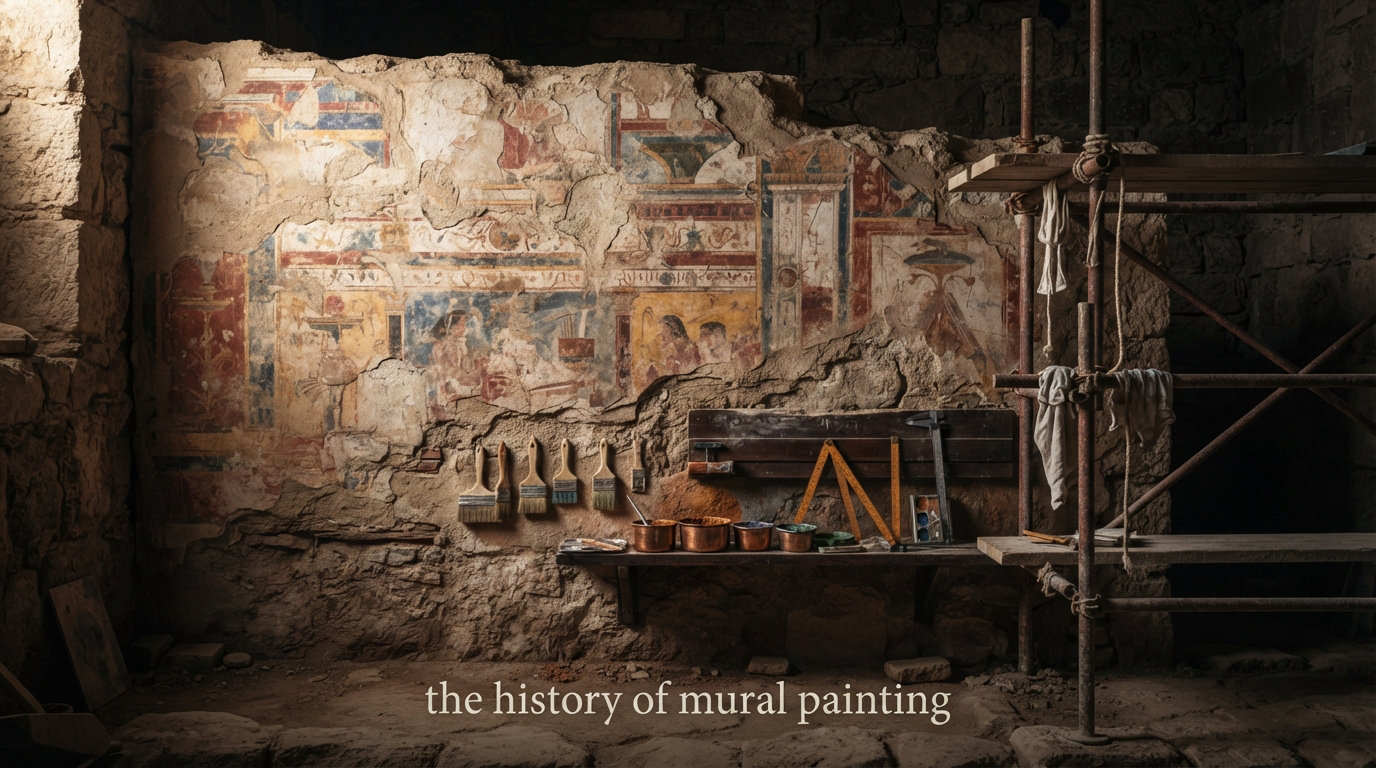
Mural painting stands as one of humanity’s oldest and most ambitious art forms. From prehistoric cave walls to modern city streets, murals have served as cultural documents, political statements, and expressions of community identity. This exploration of the history of mural painting reveals how this art form has evolved across civilizations while maintaining its power to transform public spaces into accessible galleries for all.
Table of Contents
Prehistoric Cave Paintings: Humanity’s First Murals
The history of mural painting begins approximately 30,000 to 40,000 years ago in the dark recesses of European caves. These ancient artists used natural pigments derived from ochre, charcoal, and clay to create images that still captivate viewers today.
Chauvet and Lascaux: Windows to 30,000 BC
The Chauvet Cave in France contains some of the earliest known figurative paintings, dating to around 30,000 BC. Our team has examined high-resolution images of these remarkable works, and the level of detail in depicting animals and movement suggests sophisticated artistic understanding even in these earliest examples. Lascaux, discovered in 1940, showcases similarly impressive murals featuring over 600 paintings of animals including horses, deer, and aurochs. The pigments used were applied directly to limestone walls using fingers, brushes, and possibly blown through bone tubes.
These prehistoric murals were not merely decorative. Evidence suggests they held spiritual significance, possibly related to hunting rituals or shamanic practices. The discovery of handprints and abstract symbols alongside figurative paintings indicates complex cultural meaning behind these ancient wall artworks.
Ancient Civilizations: Murals as Cultural Chronicles
As human civilizations developed, mural painting evolved into a sophisticated art form used to document daily life, religious beliefs, and royal power. These wall paintings moved from caves to palaces and tombs, becoming integral to architectural design.
Egyptian Tomb Paintings
Ancient Egyptian murals served as windows to the afterlife, depicting scenes of farming, fishing, hunting, and ceremonial events. The flat, frontal style with hieroglyphic labels created a visual language that combined art and writing. Pigments were derived from minerals and binding agents, applied to plaster-coated mud brick walls. The tomb of Nebamun, now at the British Museum, exemplifies this tradition with its vibrant depictions of life along the Nile. Egyptian muralists followed strict conventions regarding color and pose, with skin tones distinguished by gender and deities shown in idealized forms.
Mesopotamian and Minoan Murals
In Mesopotamia, the walls of palaces at Babylon and Nineveh featured glazed brick murals depicting lions, dragons, and mythological scenes. The Ishtar Gate’s lions represent some of the most recognizable examples of this tradition. Meanwhile, on the island of Crete, Minoan civilization produced vibrant murals around 2000 BC featuring dolphins, bull-leaping ceremonies, and graceful figures in naturalistic poses. The palace at Knossos showcases these colorful frescoes that reveal a sophisticated culture with strong connections to nature and ritual.
Greek and Roman Frescoes
Greek mural painting flourished during the Classical period, though few examples survive due to the fragility of the medium. Roman frescoes, however, remain abundant, particularly at Pompeii and Herculaneum. Roman wall painters mastered the fresco technique, creating illusionistic spaces that mimicked architectural features and landscape vistas. The Villa of the Mysteries near Pompeii features remarkable frescoes depicting what scholars believe to be Dionysian initiation rituals. Roman muralists developed quadrant painting, dividing large walls into sections for efficient large-scale work.
Medieval and Renaissance: The Golden Age of Fresco
The medieval period saw mural painting serve primarily religious functions, with churches and cathedrals decorated with biblical scenes and saints’ lives. Then, during the Renaissance, mural art reached new heights of technical mastery and artistic ambition.
Buon Fresco Technique
Buon fresco, meaning “true fresco,” represents the most durable and challenging mural technique ever developed. Artists apply pigments directly onto freshly laid wet lime plaster, allowing the paint to chemically bond with the wall as it dries. This process requires meticulous planning since the plaster must be applied in sections called giornate, matching the artist’s work pace for that day. The challenge lies in working quickly enough before the plaster dries, while maintaining precise brushwork. Mistakes cannot be corrected, making buon fresco a technique demanding exceptional skill and preparation.
Michelangelo and the Sistine Chapel
The Sistine Chapel ceiling, completed by Michelangelo between 1508 and 1512, stands as perhaps the most famous mural in Western art. Working from scaffolded platforms above, Michelangelo painted over 5,000 square feet of ceiling with scenes from Genesis. The physical toll of this work, painting above his head for four years, became legendary. His later Last Judgment fresco, covering the altar wall, took another four years to complete. The technique requires not only artistic vision but profound understanding of human anatomy, perspective, and color theory.
Mexican Muralism: Art as Revolutionary Weapon
In the early 20th century, Mexico produced one of the most significant mural movements in art history. Mexican muralism transformed public buildings into canvases for revolutionary messages about social justice, indigenous heritage, and national identity. The movement succeeded in making art accessible to the masses rather than reserving it for wealthy collectors and institutions. The three masters trained a generation of younger muralists, and their influence spread throughout guerrilla art artists throughout Latin America and beyond.
Diego Rivera, Siqueiros, and Orozco
Diego Rivera stands as the most internationally recognized figure of Mexican muralism. His massive frescoes at the National Palace in Mexico City depict pre-Columbian history alongside scenes of conquest and revolution. Rivera’s wife, Frida Kahlo, though primarily known for her easel paintings, also contributed to the mural tradition. David Alfaro Siqueiros brought experimental techniques to muralism, rejecting traditional fresco for materials like pyroxen and vinyl resins. His dynamic, politically charged compositions often used advanced projection methods. Jose Clemente Orozco created emotionally powerful murals characterized by their dramatic use of light and shadow, with his work at Dartmouth College’s Baker Library particularly notable for its unflinching depiction of human suffering.
Muralism’s Political Impact
Mexican muralism aligned with the post-revolutionary government’s agenda of promoting Mexican identity and socialist values. Buildings throughout Mexico City and beyond became covered with messages celebrating workers, peasants, and indigenous peoples. Today, Mexican muralism continues inspiring artists who see public art as a tool for social commentary and community empowerment. The movement demonstrated how walls could become platforms for voices often excluded from traditional artistic spaces.
20th Century to Present: From WPA to Street Art
The modern era has witnessed mural painting fragment into diverse movements, from government-sponsored public art programs to underground street art cultures that challenge authority and transform urban landscapes.
WPA Federal Art Project Murals
During the Great Depression in the United States, the Works Progress Administration’s Federal Art Project employed thousands of artists to create murals in public buildings. These works, often depicting American workers and scenes of daily life, brought art to post offices, libraries, and schools nationwide. Artists like Thomas Hart Benton, Jackson Pollock, and Arshile Gorky contributed to the program, creating a legacy of publicly accessible art during difficult economic times. The WPA murals, while sometimes controversial for their leftist leanings, demonstrated how government patronage could support artistic expression for common benefit.
Contemporary Street Art and Banksy
The late 20th century saw the emergence of street art as a distinct movement, blending graffiti culture with mural painting. Artists began creating large-scale works in urban environments, often without permission, transforming abandoned buildings and city walls into galleries. The anonymous British artist known as Banksy became perhaps the world’s most famous street artist, with works appearing overnight in cities worldwide. His satirical stencil art comments on war, politics, surveillance, and consumer culture. Street art has evolved to include wheat-pasted posters, projection mapping, and installation pieces that push the boundaries of what qualifies as mural art. The movement’s relationship with authorities remains complex, with some artists receiving commissions while others face prosecution for unauthorized work. Understanding the distinction between street art and gallery art reveals how contemporary muralists navigate questions of accessibility and authorization.
Asian Mural Traditions: Goryeo Tombs
While often overlooked in Western art history, Korean mural traditions deserve recognition for their sophistication and beauty. The Goryeo dynasty tombs from the 13th and 14th centuries feature elaborate wall paintings depicting celestial realms, religious scenes, and daily life. These murals, preserved in tombs near Gaegyeong, showcase technical mastery in depicting textile patterns, architectural details, and human figures. Chinese tomb murals from various dynasties similarly reveal rich artistic traditions spanning centuries, with the Mogao Caves in Gansu containing thousands of Buddhist paintings that represent one of the world’s most significant artistic legacies.
Conclusion
The history of mural painting spans over 30,000 years of human creativity, from flickering torchlight illuminating animal paintings in French caves to the vibrant political statements of Mexican muralists and the provocative stencil art of contemporary street artists. What remains constant is the impulse to transform walls into statements of identity, belief, and aspiration.
Murals democratized art by bringing it out of private collections and into public spaces where anyone could experience it. The techniques may have evolved from natural pigments on cave walls to digital projections and spray paint, but the fundamental purpose remains unchanged: to communicate, to commemorate, and to transform the spaces we inhabit. As cities worldwide continue commissioning murals and street artists gain recognition in galleries, this ancient art form proves it still has the power to surprise, challenge, and inspire.
When was the first mural painting created?
The first mural paintings date back approximately 30,000 to 40,000 years ago, with the earliest known examples found in Chauvet Cave in France. These prehistoric cave paintings represent humanity’s first attempts at large-scale artistic expression on wall surfaces.
What is the main purpose of mural painting?
Mural painting serves multiple purposes across cultures and time periods: religious documentation, political messaging, community beautification, historical preservation, and social commentary. Unlike gallery art, murals are accessible to the public and often become integral parts of the architecture they adorn.
What are the main techniques used in mural painting?
The primary mural techniques include buon fresco (painting on wet plaster while it is still damp, allowing pigments to bond permanently), fresco secco (painting on dry plaster), marouflage (applying pigments to canvas that is then adhered to walls), and modern spray paint and digital projection techniques for contemporary street art.