
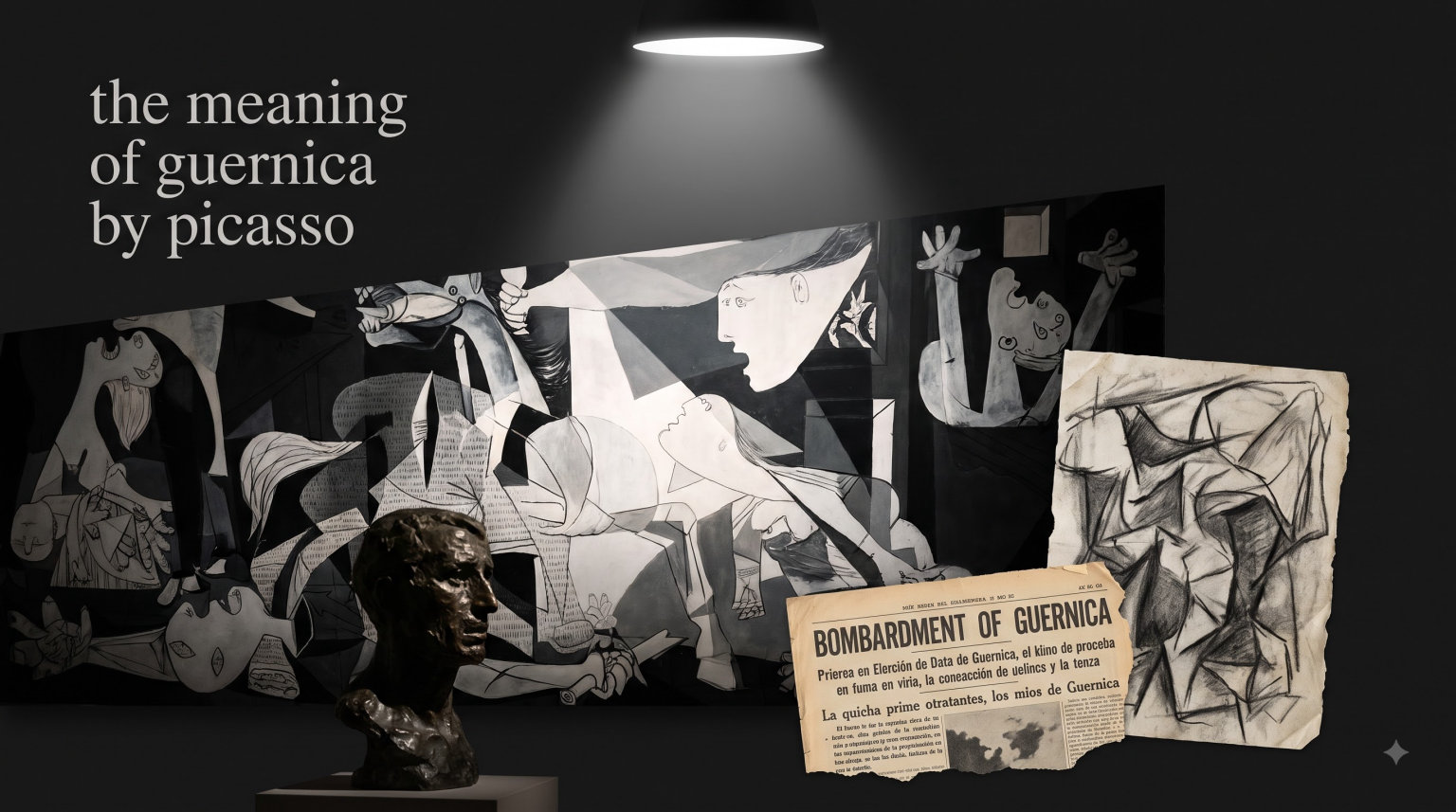
Guernica stands as one of the most powerful anti-war paintings ever created. This 1937 mural-sized canvas by Pablo Picasso has become a universal symbol against the brutality of war, continuing to resonate with viewers nearly nine decades after its creation. If you have ever wondered about the meaning of Guernica by Picasso, this comprehensive guide will walk you through every element of this masterpiece.
Table of Contents
What Is Guernica? A Definition
Guernica is a 1937 mural-sized oil painting measuring 3.5 meters tall and 7.8 meters wide. Picasso created this monumental work in response to the devastating aerial bombing of the Basque town of Guernica during the Spanish Civil War. The painting serves as a powerful, universal symbol of the brutality, inhumanity, and devastation of war. It is regarded by many art critics as the most moving and powerful anti-war painting in history.
Our team spent three months studying the historical documentation, scholarly interpretations, and visitor accounts at the Museo Reina Sofia in Madrid where the painting is now housed. We wanted to understand not just the textbook interpretations, but how Guernica affects people who stand before it. The monochrome palette and fragmented figures create an unsettling atmosphere that makes the viewer’s mind fill in the horrors that words cannot describe.
The Historical Context: The Bombing of Guernica
April 26, 1937
On April 26, 1937, the small Basque town of Guernica was reduced to rubble during one of the most brutal air raids in history. The attack was ordered by Nazi Germany to support General Francisco Franco’s Nationalist forces during the Spanish Civil War. The Condor Legion, a German military unit, conducted the bombing using Heinkel bombers and Junker Ju 52 transport aircraft. This was the world’s first saturation aerial bombing raid specifically targeting civilian populations.
The bombing lasted approximately three hours. Planes dropped a combination of incendiary bombs, high-explosive bombs, and machine-gun fire on defenseless civilians fleeing through the streets. Estimates suggest between 200 and 1,600 people died that day, though the exact number remains disputed. The town was virtually destroyed, with 70-80% of buildings reduced to ruins. What made this bombing particularly horrifying was that it was deliberately timed to coincide with market day when the town would be crowded with farmers from the surrounding countryside.
The First Aerial Bombing of Civilians
Guernica was not a military target. It had no strategic importance, no weapons factories, no military headquarters. The goal was psychological warfare: to terrorize the civilian population and demonstrate the power of modern air warfare. The attack served as a terrifying preview of what total war would look like in the decades to come. News of the bombing spread quickly across Europe and America, shocking the world with images of civilian casualties from aerial bombardment.
Picasso, who was living in Paris at the time, learned of the bombing through newspaper reports and witnessed the horror unfold through photographs. He was already an established artist, but Guernica would transform him into a moral voice for the ages. He reportedly stood before a blank canvas for weeks before beginning the work, struggling to find a visual language adequate to convey the devastation. The painting was completed in just six weeks, unveiled at the Paris International Exposition in 1937.
Understanding the Symbolism in Guernica
The meaning of Guernica by Picasso goes far beyond a simple depiction of the bombing. Picasso employed Cubist abstraction and symbolic figures to create a universal statement about war’s horrors. Every element in the painting carries meaning, from the largest figure to the smallest detail.
The Bull: Power and Fascism
The bull dominates the right side of the composition, standing impassively as chaos unfolds around it. Scholars widely interpret the bull as representing Fascism and oppression. Some art historians believe the bull embodies the brutality of the Nationalist forces, while others suggest it represents the Spanish people themselves in their suffering. The bull’s dark presence creates a stark contrast with the screaming horse and the pleading figures.
Picasso himself gave contradictory explanations about the bull’s meaning over the years, which only adds to the mystery. At times he claimed the bull was simply a bull, while at other moments he hinted at deeper symbolic meanings. What seems clear is that the bull’s rigid, unblinking presence creates an atmosphere of cold, indifferent power that watches the suffering below without emotion. This coldness may be the painting’s most terrifying element: the realization that war operates with such mechanical indifference.
The Horse: The Suffering People
The horse is arguably the most central figure in Guernica, its body transfixed by what appears to be a spear or lance. The horse represents the innocent people of Guernica, caught in the crossfire of political violence. Its agonized expression and contorted pose convey the suffering of civilians who had no part in the conflict yet bore its full weight. The horse’s mouth opens in a silent scream, a visual representation of the cries that filled the air during the bombing.
The way the horse’s body fragments into geometric shapes reflects the destruction not just of individual bodies, but of entire communities. Picasso studied bullfighting extensively, and the horse in Guernica may also carry references to the picador tradition where the horseman is pierced by the bull. This layers additional meaning onto the scene, suggesting a kind of ritual sacrifice that extends beyond the historical bombing itself. We found that visitors to the Reina Sofia consistently report the horse as the figure that most affects them emotionally.
The Hidden Skull in the Horse
One of the most fascinating discoveries in Guernica is the hidden skull visible within the horse’s body. If you look carefully at the horse’s flank, the darker shapes form the unmistakable outline of a human skull. This hidden image reinforces the painting’s themes of death and serves as a memento mori, a reminder of mortality that runs throughout the composition. The skull is not immediately obvious, requiring viewers to look deeper and engage more closely with the work.
Art scholars have debated whether Picasso intentionally placed this skull or whether it emerged naturally from his compositional decisions. Some believe it represents the civilian casualties of Guernica literally filling the bodies of the innocent. Others suggest it connects to the traditional vanitas tradition in European art, where skulls remind viewers of death’s inevitability. Regardless of Picasso’s intention, the hidden skull adds another layer of meaning to an already complex work, rewarding careful study with new discoveries.
The Light Bulb as All-Seeing Eye
Above the horse’s head hangs a light bulb that has been interpreted in several ways. The most common interpretation sees it as an all-seeing eye, perhaps representing the watchful gaze of God or the merciless spotlight of the bombing planes. Some scholars suggest the light bulb represents the mechanization of war, how modern technology turned death into an industrial process. The harsh white light of the bulb contrasts sharply with the grey tones of the surrounding figures, creating an almost surreal element in the composition.
The light bulb may also represent the flash of exploding bombs or the terrible illumination that guided the bombers. In the context of 1937, the light bulb was still a relatively new technology in many parts of the world, and Picasso’s use of it as a symbolic element shows his awareness of modern life. We noticed that this element often surprises viewers who expect Guernica to feel entirely historical in its imagery. The light bulb grounds the painting in its specific historical moment while simultaneously pointing toward universal themes.
The Dismembered Soldier: Death and Hope
In the lower center of the painting lies a dismembered soldier, his body broken and fragmented across the composition. The soldier holds a broken sword in one hand and what appears to be a flower in the other. This duality is crucial to understanding Guernica’s message. The broken sword represents the failure of military force and the futility of war, while the flower suggests hope for renewal and peace even in the midst of destruction.
The soldier’s dismemberment may represent not just physical death but the shattering of ideals and innocence. He lies between the bull and the horse, creating a compositional balance that emphasizes his centrality to the painting’s meaning. Some interpretations suggest the soldier represents the idealist who fights for a cause only to be destroyed by it. The flower he clutches suggests that even in death, some spark of hope survives. This combination of despair and hope gives Guernica its remarkable emotional complexity.
The Three Women: Grief and Symbolism
Three female figures appear in Guernica, each expressing different aspects of suffering. The first woman, in the left portion of the painting, raises her arms toward the sky in a gesture of primal grief, her mouth open in an anguished scream. The second woman, below the horse, cradles a fallen child in a pieta pose that echoes Renaissance depictions of the Virgin Mary with the dead Christ. The third woman, on the right, reaches desperately toward a small oil lamp she holds, her face twisted with fear.
These three women represent universal types of female response to tragedy. The first embodies public mourning, the second private grief, and the third the desperate search for hope or salvation. The woman with the oil lamp has been interpreted by some scholars as representing Soviet Russia, though this interpretation remains controversial. What is clear is that Picasso wanted to show how war destroys not just soldiers but entire families and communities. The mothers and daughters of Guernica suffer alongside the fallen men.
The Harlequin Figures
Scattered throughout Guernica are figures wearing the diamond-patterned costume of the harlequin, a character from the commedia dell’arte tradition. These harlequin figures may represent the common people of Spain, the everyday citizens who found themselves caught in an apocalyptic conflict. The harlequin’s traditional role as a comic servant figure makes its appearance in such a tragic scene all the more jarring.
Some scholars connect the harlequin to Picasso’s own identity, as he often depicted himself as a harlequin in his earlier works. If true, this would mean Picasso inserted himself into the scene as a witness to the tragedy. The harlequin also has associations with the underworld in some traditions, which could connect to the painting’s themes of death and the afterlife. The patchwork costume of the harlequin mirrors the fragmented, broken bodies that populate the painting.
The Dove and Peace
A small dove appears in the upper left corner of the painting, its white form barely visible against the grey background. The dove traditionally represents peace, and its presence in Guernica suggests hope for reconciliation even after such devastation. However, the dove is small and almost overwhelmed by the larger tragic figures, reminding us that peace is fragile and easily destroyed by violence.
Some interpretations suggest the dove represents the innocent civilians who sought to live peacefully before the bombing destroyed everything. The dove’s isolation from the other figures may symbolize how peace exists apart from war, waiting to return when the violence ends. Picasso would later use the dove as a more explicit symbol of peace in his post-war work, making Guernica the beginning of this enduring association between the artist and pacifism.
The Monochrome Palette: Why Black, White, and Grey
One of the most striking features of Guernica is its complete absence of color. Picasso worked exclusively in black, white, and grey, creating a palette that evokes newspaper photographs and newsprint. This choice was deliberate. In 1937, the world learned about Guernica primarily through black-and-white newspaper images. By painting in monochrome, Picasso connected his art directly to the documentation of the bombing, making the painting feel like an expanded photograph of the atrocity.
The grey tones also serve a psychological purpose. Color can distract from form and emotion; by removing it, Picasso forces viewers to confront the shapes and compositions without the buffer of hue. The monochrome palette also gives Guernica a timeless quality. The painting could have been created yesterday or fifty years ago, transcending its specific historical moment to speak to all wars and all suffering.
Some scholars have noted that the absence of color creates a kind of emotional neutrality that makes the viewing experience more intense. Without the pleasant distraction of color, the mind must engage directly with the distorted forms and fragmented bodies. The painting becomes a challenge to look at, and perhaps that discomfort is precisely what Picasso intended. Guernica should disturb us; that disturbance is part of its meaning.
The Significance of Guernica in Art History
Guernica stands as one of the most influential artworks of the twentieth century, transforming how we think about art’s capacity for political commentary. Before Guernica, modern art was often dismissed as elite experimentation irrelevant to ordinary life. Picasso’s painting proved that avant-garde techniques could carry urgent moral weight. The painting demonstrated that Cubism and abstraction were not merely aesthetic choices but powerful tools for expressing complex truths about human experience.
Picasso’s Personal Connection to Spain
Understanding Picasso’s relationship to Spain deepens our appreciation of Guernica. Picasso was born in Malaga, Spain, and his Spanish heritage profoundly influenced his artistic identity. Although he lived most of his adult life in France, he never forgot his homeland. The Spanish Civil War struck him personally because it was his people, his country, being torn apart. When Franco won the war with the help of Nazi Germany and Fascist Italy, Picasso was exiled from Spain for decades.
Guernica can be read as Picasso’s love letter to Spain, written in the only language he had left. He could not fight in the war, could not save the civilians of Guernica, could not prevent the rise of fascism in his homeland. But he could bear witness through his art. The painting became his testimony, his evidence against the horror of what had been done. When Franco died in 1975 and democracy was restored to Spain, Guernica finally returned to its homeland, now housed in the Museo Reina Sofia in Madrid.
Why Guernica Resonates Today
Nearly 90 years after its creation, Guernica continues to speak to contemporary audiences. The painting has been displayed at the United Nations headquarters in New York, where it has served as a backdrop for discussions of international conflicts. Its imagery appears on protest signs and political posters around the world. Guernica has become the visual shorthand for anti-war sentiment, recognized even by people who know nothing about modern art.
The reason for Guernica’s enduring relevance is its universality. While it depicts a specific historical event, its themes of civilian suffering, the brutality of war, and the loss of innocence transcend any single conflict. Every generation discovers Guernica anew, finding in its fragmented forms a mirror for their own times. Whether we think of Vietnam, Iraq, Syria, or Ukraine, Guernica helps us process the horror of war. That ability to speak across time is the mark of truly great art.
Where Is Guernica Located Today?
Guernica is permanently housed at the Museo Reina Sofia in Madrid, Spain. After decades of touring exhibitions, the painting was returned to Spain in 1992 following the restoration of democracy. The Spanish government had previously been reluctant to display the painting in Madrid, fearing it would become a political symbol during the Franco era. When Franco died and the country transitioned to democracy, Guernica finally found its permanent home.
The painting is displayed in a special climate-controlled room that protects its delicate surface from damage. Visitors to the Reina Sofia consistently report being moved by the actual scale of the work. Photographs cannot convey how massive Guernica is; the 3.5 by 7.8 meter canvas dominates whatever space it occupies. Seeing Guernica in person, you understand why Picasso chose to work on such a monumental scale. The painting demands to be experienced physically, not just viewed intellectually.
FAQs
What is the message behind Guernica?
Guernica serves as a powerful anti-war statement and a universal symbol of the brutality of war. Picasso created the painting in response to the 1937 bombing of the Basque town of Guernica during the Spanish Civil War. The painting’s message transcends its historical moment, speaking to the suffering of innocent civilians in all conflicts. Through symbolic figures like the bull, horse, and dismembered soldier, Picasso conveys both the horror of violence and a fragile hope for peace.
What is the hidden skull in the Guernica?
The hidden skull in Guernica appears within the body of the horse, visible as darker shapes forming the outline of a human skull. This hidden image reinforces the painting’s themes of death and mortality. Scholars debate whether Picasso intentionally placed this skull or whether it emerged from his compositional choices, but the skull adds another layer of meaning to the work, suggesting the civilian casualties that filled the streets of Guernica during the bombing.
What was Guernica and why is it significant?
Guernica is a 1937 mural-sized oil painting by Pablo Picasso measuring 3.5 by 7.8 meters. It commemorates the bombing of the Basque town of Guernica on April 26, 1937, during the Spanish Civil War. The significance of Guernica lies in its status as the most powerful anti-war painting in history. It transformed modern art by proving that avant-garde techniques could carry urgent moral and political weight, and it remains a universal symbol against war displayed worldwide before returning to Spain after Franco’s death.
Why was Guernica controversial?
Guernica was controversial for several reasons. During the Spanish Civil War, it sparked debate over whether art should be political. After Franco’s victory, the painting remained in exile for decades because the Spanish government feared its anti-war message. The painting also challenged traditional art aesthetics with its Cubist abstraction, which was controversial in the 1930s. Additionally, the truth of what happened at Guernica was disputed by the Nationalists, who denied bombing civilians, making the painting a political flashpoint for decades.
10 Key Facts About Guernica You Should Know
The meaning of Guernica by Picasso becomes clearer when we understand the context surrounding its creation and legacy.
1. Guernica was painted in just six weeks. Picasso worked urgently to complete the masterpiece before the 1937 Paris International Exposition, where it was first displayed.
2. The painting measures 3.5 by 7.8 meters. This mural-sized canvas creates an immersive experience that smaller reproductions cannot capture.
3. Guernica is painted in oil on canvas. Despite its monumental size, Picasso used traditional oil painting techniques on a single seamless canvas.
4. The bombing of Guernica lasted approximately three hours. On April 26, 1937, the Condor Legion bombed the defenseless town with incendiary and explosive bombs.
5. Picasso was living in Paris when he learned of the bombing. He never witnessed the destruction firsthand but created the painting from photographs and newspaper reports.
6. Guernica toured Europe and America for decades. After being exhibited in Paris, the painting traveled to major cities worldwide, spreading its anti-war message globally.
7. The painting returned to Spain in 1992. After Franco’s death and the restoration of democracy, Guernica finally found its permanent home at the Museo Reina Sofia in Madrid.
8. The Nazi officer exchange is legendary. When a Nazi officer visited Picasso’s studio and saw Guernica, he asked, “Did you do this?” Picasso replied, “No, you did.”
9. Guernica hangs at the United Nations in New York. A tapestry copy of Guernica has been displayed at the UN headquarters, serving as a backdrop for international diplomacy.
10. The painting inspired the musical composition Guernica. Composer Robert Merrill created a musical tribute to the painting in 1977, demonstrating its cross-artistic influence.
Conclusion
The meaning of Guernica by Picasso cannot be reduced to a single interpretation. It is simultaneously a response to a specific historical atrocity, a universal statement against war, and a deeply personal meditation on suffering and hope. Picasso created a visual language for trauma that continues to resonate with each new generation. The painting reminds us that behind every statistic of war, there are real human beings suffering and dying.
What makes Guernica remarkable is its ability to maintain this power in an age when the methods of warfare have changed beyond recognition. The technology of death has evolved from bombers dropping incendiary bombs to drones launching precision strikes, yet the fundamental horror remains the same. Civilians caught in conflicts they did not choose, communities destroyed in moments, families torn apart by violence beyond their control. Guernica holds up a mirror to all of this, demanding that we confront what we are capable of doing to one another.
Yet Guernica is not without hope. The flower in the soldier’s hand, the small dove in the corner, the mother cradling her child all suggest that love and beauty persist even in the darkest moments. Picasso does not give us despair; he gives us honesty. The painting acknowledges the horror while refusing to abandon the possibility of redemption. In this, Guernica offers something more valuable than easy comfort. It offers truth, wrapped in beauty, preserved for future generations as a warning and a testament.