
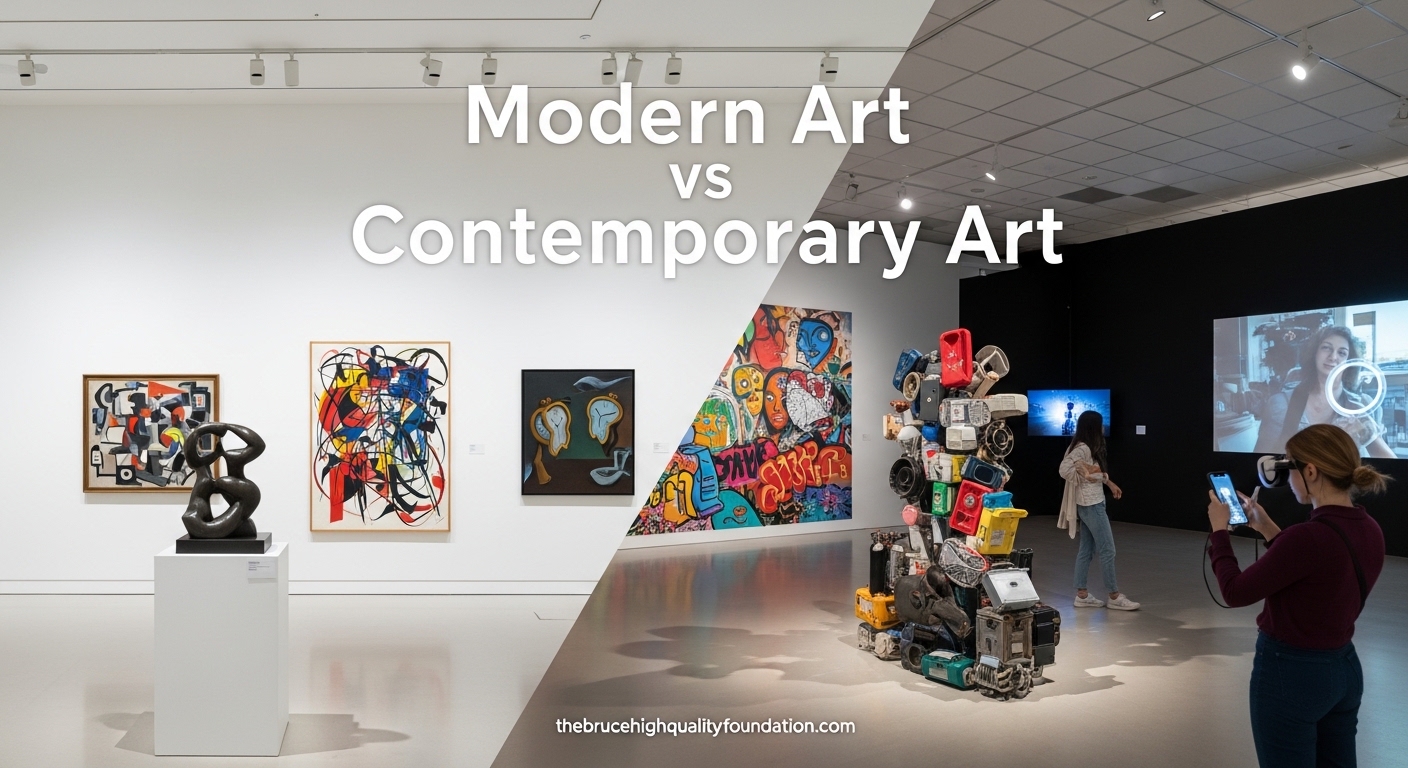
Modern art refers to the period from roughly the 1860s to the 1960s, while contemporary art encompasses art created from the 1960s and 1970s through the present day. These terms are often used interchangeably in casual conversation, but they represent distinct eras with different philosophies, materials, and approaches to artistic expression. Understanding the difference between modern and contemporary art is essential for anyone interested in art history, museum visits, or art collecting.
I have spent years visiting galleries and studying art movements, and I still hear people confuse these terms regularly. The distinction matters because it helps you understand what the artist was trying to communicate and the cultural context that shaped their work. Modern art broke from tradition and celebrated the individual artist’s vision. Contemporary art questions everything, including the definition of art itself.
In this guide, I will break down exactly what separates these two periods, explore the key movements and artists that define each era, and give you practical tips for identifying which category a piece of art belongs to. By the end, you will have a clear framework for understanding and appreciating art from both periods.
Table of Contents
What Is Modern Art?
Modern art is the creative output produced during the period from approximately the 1860s through the 1960s. This era represents a radical break from the traditional academic art that dominated Western culture for centuries. The modern period coincided with massive societal changes, including the Industrial Revolution, urbanization, and shifting political landscapes across Europe and America.
Art historians generally mark the beginning of modern art with the work of French painter Edouard Manet in the 1860s. His painting “Luncheon on the Grass” shocked the Paris Salon of 1863 with its unconventional composition and subject matter. Manet and the artists who followed him rejected the strict rules of the academies and began experimenting with new ways of seeing and representing the world.
Key Movements in Modern Art
Several major movements emerged during the modern art period, each pushing boundaries in different directions. Impressionism, led by Claude Monet and Pierre-Auguste Renoir, captured fleeting moments of light and everyday life with loose brushwork and bright colors. Post-Impressionists like Paul Cezanne and Vincent van Gogh moved further toward abstraction and personal expression.
The early 20th century brought explosive experimentation. Cubism, pioneered by Pablo Picasso and Georges Braque, shattered traditional perspective by showing multiple viewpoints simultaneously. Surrealism, led by Salvador Dali and Rene Magritte, explored the unconscious mind through dreamlike imagery. Abstract Expressionism, with Jackson Pollock’s energetic drip paintings and Mark Rothko’s meditative color fields, placed emotion and gesture at the center of the work.
The Philosophy of Modern Art
Modern art was driven by a belief in progress, utopian ideals, and the power of the individual artist. Art critic Clement Greenberg famously argued that modern art should pursue its own pure elements, stripping away everything that belonged to other art forms. This led to an emphasis on the flatness of the canvas, the qualities of paint, and the unique properties of each medium.
The modern artist saw themselves as a visionary breaking from tradition. Movements published manifestos declaring their principles. Artists pursued “art for art’s sake,” focusing on aesthetic beauty, formal innovation, and the expression of inner feelings. There was an earnestness to modern art, a sincere belief that art could change society and reveal deeper truths about the human condition.
What Is Contemporary Art?
Contemporary art refers to art made from the 1960s and 1970s through the present day. While modern art ended roughly with the rise of Pop Art and Conceptual art in the 1960s, there is some overlap in the transition period. The contemporary era is characterized by pluralism, meaning there is no single dominant style or movement. Instead, artists work in countless different approaches, often simultaneously.
The contemporary period emerged from the social and cultural upheavals of the 1960s and 1970s. Post-World War II uncertainty, the civil rights movement, feminism, and globalization all influenced how artists thought about their role in society. Where modern artists believed in universal truths and progress, contemporary artists embrace uncertainty, question authority, and acknowledge diverse perspectives.
Diversity of Medium and Approach
Contemporary art breaks free from traditional media in ways that would have shocked early modernists. While modern artists experimented with paint on canvas, contemporary artists use installation, performance, video, digital media, street art, and mixed media. The idea matters more than the materials. If an artist wants to communicate a concept, they choose whatever medium serves that purpose best.
Pop Art, led by Andy Warhol and Roy Lichtenstein in the 1960s, blurred the lines between high art and popular culture. Warhol’s silkscreened soup cans and celebrity portraits challenged the idea that art must be unique, hand-crafted, or serious. Minimalist artists like Donald Judd and Dan Flavin reduced art to simple geometric forms and industrial materials. Conceptual artists argued that the idea behind the work was more important than the finished object itself.
The Philosophy of Contemporary Art
Contemporary art shifts focus from aesthetic beauty to the underlying concept. Many contemporary works are not meant to be beautiful in the traditional sense. Instead, they are designed to make you think, question assumptions, or engage with social and political issues. The tone is often ironic, playful, or self-referential rather than earnest.
Where modern art emphasized the individual genius, contemporary art often addresses social impact and collective experience. Artists like Banksy use street art to comment on capitalism and political authority. Damien Hirst’s preserved animals in formaldehyde explore themes of death and consumerism. Cindy Sherman’s photographs examine identity and representation. Contemporary art is global, diverse, and concerned with issues ranging from climate change to gender identity to technology’s impact on human relationships.
Key Differences Between Modern and Contemporary Art
Understanding the distinction between modern and contemporary art comes down to several key factors. The most obvious difference is time period, but the philosophical and material differences are equally significant. Here is a clear breakdown of how these two eras diverge.
Time Periods
Modern art covers roughly 1860 to 1960, a century of explosive innovation that broke from academic tradition. Contemporary art begins in the 1960s and continues through today. The transition was gradual, with artists in the late 1960s and early 1970s creating works that could arguably fit in either category. Some historians use World War II as a dividing line, while others point to the rise of Pop Art and Conceptual art in the 1960s.
Philosophy and Focus
Modern art prioritized aesthetic beauty, formal innovation, and the artist’s individual expression. The goal was often to create something visually powerful that revealed truth or emotion. Contemporary art prioritizes the underlying concept and social impact. A contemporary work might be deliberately ugly if that serves its purpose of critiquing consumerism or exploring uncomfortable themes.
Modern artists pursued utopian ideals and believed in progress. Contemporary artists are more skeptical, often questioning grand narratives and embracing multiple viewpoints. Modern art was earnest and sincere. Contemporary art can be ironic, playful, or self-referential, often commenting on art itself and the systems that support it.
Materials and Medium
Modern artists primarily worked with traditional materials like oil paint, bronze, and marble, even as they pushed these media in new directions. Picasso and Braque might add newspaper clippings to their Cubist collages, but they were still fundamentally working within the painting tradition. Contemporary artists use anything and everything. Installations fill entire rooms. Performance art exists only in the moment of presentation. Digital art lives on screens. Street art appears on buildings and sidewalks.
| Aspect | Modern Art | Contemporary Art |
|---|---|---|
| Time Period | 1860s to 1960s | 1960s/1970s to present |
| Primary Focus | Aesthetic beauty, individual expression | Concept, social impact |
| Tone | Earnest, sincere, utopian | Ironic, playful, skeptical |
| Materials | Traditional (canvas, paint, bronze) | Diverse (installation, digital, performance) |
| Key Movements | Impressionism, Cubism, Surrealism, Abstract Expressionism | Pop Art, Minimalism, Conceptual art, Postmodern |
| Philosophy | Art for art’s sake, individual genius | Concept over technique, social engagement |
Notable Artists and Examples
Recognizing the artists associated with each period is one of the fastest ways to distinguish modern from contemporary art. Here are the key figures you should know from both eras.
Pioneers of Modern Art
Edouard Manet broke the rules of academic painting in the 1860s with works like “Olympia” and “A Bar at the Folies-Bergere.” His loose brushwork and modern subjects paved the way for everything that followed. Claude Monet and the Impressionists captured the changing effects of light on water lilies and haystacks.
Pablo Picasso revolutionized representation with Cubism, fragmenting forms in works like “Les Demoiselles d’Avignon.” Wassily Kandinsky painted the first purely abstract compositions. Marcel Duchamp’s “Fountain,” a signed urinal submitted to an art exhibition in 1917, challenged the very definition of art and foreshadowed conceptual approaches.
The Abstract Expressionists brought American art to international prominence. Jackson Pollock dripped and poured paint onto canvases laid on the floor. Mark Rothko created luminous rectangles of color that seem to float in space. These artists emphasized the act of painting itself and the expression of inner emotion.
Contemporary Art Icons
Andy Warhol became the face of Pop Art with his Campbell’s soup cans and Marilyn Monroe portraits, produced using silkscreen techniques that removed the artist’s hand. Roy Lichtenstein borrowed imagery from comic books, complete with Ben-Day dots. These artists embraced mass production and consumer culture rather than rejecting them.
Jeff Koons creates shiny sculptures of balloon animals and oversized reproductions of everyday objects that sell for millions. His work comments on kitsch, consumerism, and the art market itself. Damien Hirst gained notoriety with animals preserved in formaldehyde and spot paintings produced by his assistants, raising questions about authorship and the value of art.
Street artist Banksy keeps his identity secret while creating satirical works that appear overnight on walls around the world. His pieces critique capitalism, war, and surveillance with wit and visual punch. Cindy Sherman photographs herself in various costumes and personas, exploring how women are represented in media. These artists show the range of contemporary approaches, from spectacle to social critique to identity politics.
How to Identify Modern vs Contemporary Art
When you are standing in a museum or gallery trying to determine whether a piece is modern or contemporary, look for these clues.
Check the date first. If the work was created between 1860 and 1960, it is modern art. If it was made from the 1960s onward, it is contemporary. There is some gray area in the 1960s and early 1970s, but the date will give you a strong starting point.
Look at the materials. Traditional oil painting or bronze sculpture suggests modern art. Video screens, found objects, room-sized installations, or digital projections indicate contemporary art. Mixed media that combines unconventional materials is almost always contemporary.
Consider the philosophical approach. Does the work aim for aesthetic beauty and emotional expression? That points toward modern art. Does it seem designed to make you think about a concept, question an assumption, or engage with social issues? That suggests contemporary art.
Check the artist’s name against the lists above. If you see Picasso, Monet, or Pollock, you are looking at modern art. If you see Warhol, Koons, or Banksy, you are looking at contemporary art.
Frequently Asked Questions
Is contemporary art the same as modern art?
No, contemporary art and modern art are not the same. Modern art refers to art created from approximately the 1860s to the 1960s, while contemporary art encompasses art made from the 1960s/1970s through the present day. Modern art emphasizes aesthetic beauty and individual expression, while contemporary art prioritizes concept, social impact, and diverse media.
What comes first, modern or contemporary art?
Modern art comes first. The modern art period spans roughly from the 1860s to the 1960s, while contemporary art began in the 1960s and continues through the present. Modern art broke from academic traditions and established the foundation that contemporary artists would later question and expand upon.
Is Picasso modern art?
Yes, Pablo Picasso is considered a modern artist. He pioneered Cubism in the early 20th century and remained active through the 1960s. His work Les Demoiselles d’Avignon (1907) and Guernica (1937) are masterpieces of modern art. Picasso passed away in 1973, right at the transition between the modern and contemporary periods.
Is Damien Hirst postmodern?
Damien Hirst is generally classified as a contemporary artist working within postmodern traditions. His work from the 1990s onward, including preserved animals in formaldehyde and spot paintings, exemplifies contemporary art’s focus on concept, spectacle, and questioning traditional values. Postmodernism is an approach within contemporary art that rejects modernism’s grand narratives and embraces irony and appropriation.
When did modern art end and contemporary art begin?
There is no single agreed-upon date, but most art historians place the transition between the late 1960s and early 1970s. Some mark the shift with the rise of Pop Art in the 1960s, while others point to the emergence of Conceptual art or use the end of World War II as a cultural dividing line. The transition was gradual, with the 1960s and early 1970s representing a period of overlap.
Conclusion
Modern Art vs Contemporary Art comes down to time period, philosophy, and approach. Modern art (1860s-1960s) broke from academic tradition and celebrated individual expression through movements like Impressionism, Cubism, and Abstract Expressionism. Contemporary art (1960s-present) embraces diverse media and prioritizes concept and social impact over traditional aesthetic beauty.
As you explore museums and galleries in 2026, use the frameworks in this guide to deepen your appreciation of what you see. The best way to understand these distinctions is to experience the art itself, so visit your local museums, attend gallery openings, and trust your own responses to the work in front of you.