
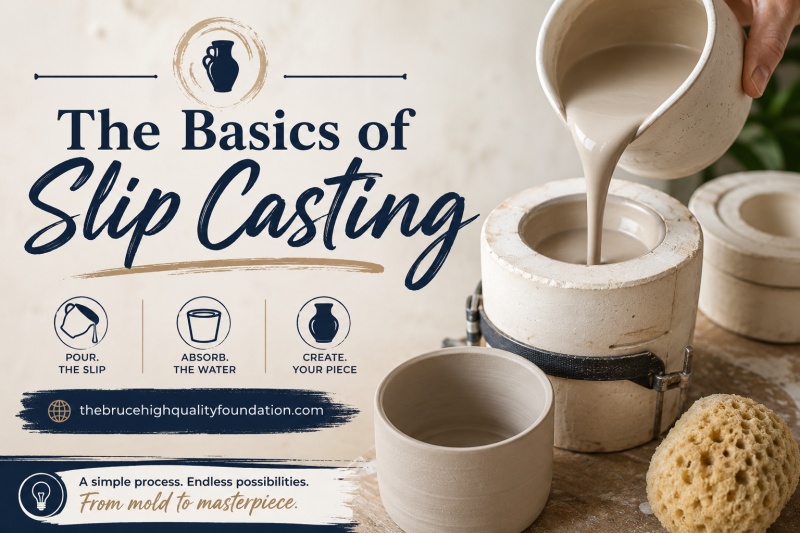
Slip casting is one of the most rewarding ceramic techniques for beginners because it opens doors to creating identical multiples and intricate shapes that would be nearly impossible to form by hand. Whether you are a pottery student exploring new methods or a hobbyist curious about production ceramics, understanding the basics of slip casting will expand your creative possibilities dramatically.
In this guide, I will walk you through everything you need to know to get started. We will cover what slip casting actually is, the materials you need, the step-by-step process, and how to troubleshoot common problems. By the end, you will have the confidence to pour your first mold and understand why this technique has been used by ceramicists for over a thousand years.
Table of Contents
What Is Slip Casting?
Slip casting is a ceramic forming technique where liquid clay (called slip) is poured into a porous plaster mold. The plaster draws water from the slip through capillary action, leaving a layer of clay particles deposited against the mold walls. After 15 to 25 minutes, this layer becomes thick enough to form a hollow vessel, and the excess slip is poured out.
The magic of this process lies in the science of capillary action. Plaster is naturally absorbent because of its porous gypsum structure. When wet slip contacts the dry plaster surface, the plaster literally pulls water molecules from the liquid clay. The clay particles, which are too large to pass through the plaster pores, accumulate on the mold interior, gradually building up a solid clay wall.
This technique dates back to at least the Tang dynasty in China, though it became widely adopted in European ceramic production by 1745. English potteries used slip casting to mass-produce everything from teacups to decorative figurines, revolutionizing the ceramic industry. Today, artists use it for everything from fine porcelain sculptures to everyday pottery, making it one of the most versatile techniques in ceramics.
Materials You Need for Slip Casting
Getting started with slip casting requires some specific materials, though many are tools you may already have in your studio.
Essential Materials
Plaster mold: You can purchase pre-made molds or learn to make your own from plaster of Paris. The mold must be completely dry before use.
Casting slip: This is not the same as regular clay slip. Casting slip contains deflocculants (chemicals like sodium silicate or sodium carbonate) that allow it to flow smoothly with less water. You can buy commercial casting slip or make your own from dry clay.
Pitcher or pouring container: Something with a spout makes pouring slip into molds much easier and less messy.
Fine mesh sieve or strainer: Removes lumps and ensures your slip flows properly.
Rubber bands or straps: Holds multi-piece molds together securely during casting.
Finishing Tools
Sponge: For smoothing surfaces and cleaning up seams.
Pin tool or needle tool: For cleaning up edges and removing excess clay (called fettling).
Dowel or grate: Helps when draining slip from the mold.
Soft brush: For dusting off greenware before firing.
Safety Equipment
Respirator or dust mask: Essential when mixing dry plaster or clay. Plaster dust and clay silica are harmful when inhaled.
Ventilation: Work in a well-ventilated area, especially when handling dry materials.
Protective gloves: Helpful for protecting your skin from drying effects of clay.
The Slip Casting Process: Step by Step
Here is the complete slip casting process broken down into manageable steps. Take your time with each stage, and remember that timing may vary slightly depending on your slip consistency and mold size.
Step 1: Prepare Your Mold and Slip
Start by ensuring your plaster mold is completely dry. A simple test: touch the surface. If it feels cool or damp, it needs more drying time. Dry molds absorb water efficiently, which is essential for proper casting.
If using a multi-piece mold, assemble it carefully and secure it with rubber bands. Check that the seams align properly to prevent leaks.
Prepare your casting slip by mixing it thoroughly and passing it through a fine sieve. The consistency should resemble heavy cream: thick enough to coat a spoon but fluid enough to pour smoothly.
Step 2: Fill Your Mold with Slip
Pour your prepared slip into the mold opening, filling it completely. Pour steadily but not too quickly to avoid creating air bubbles that could cause voids in your finished piece.
Agitate the mold gently by tapping or rocking it slightly. This helps release trapped air bubbles and ensures slip reaches all corners of the mold cavity.
Top up the slip as it settles. The plaster begins absorbing water immediately, so you may need to add more slip to keep the mold full.
Step 3: Wait for the Clay to Thicken
This is where patience becomes essential. Allow the slip to sit in the mold for 15 to 25 minutes. During this time, the plaster draws water from the slip, building up a clay wall against the mold interior.
The exact timing depends on several factors: your slip’s specific gravity, the plaster’s absorption rate, and the desired wall thickness. For a standard teacup or bowl, 15 to 20 minutes typically produces a wall thickness of about 1/8 inch (3 millimeters).
You can check progress by gently tilting the mold. If you see a distinct wall forming and the center slip moves separately, you are getting close to the right thickness.
Step 4: Drain the Excess Slip
Once your wall has reached the desired thickness, carefully pour out the excess slip. This is called the “drain” or “pour-out” stage.
Tilt the mold slowly over a container to catch the returning slip. You can reuse this slip for future casts, so do not discard it.
After the initial pour-out, let the mold sit upside down on a dowel or grate for 20 to 40 minutes. This allows the remaining slip to drain completely and the clay to reach the leather-hard stage, where it is firm enough to handle but still damp.
Step 5: Release Your Casting from the Mold
When your casting feels leather-hard (firm but cool and slightly damp), it is time to demold. Remove any rubber bands or straps first.
Gently separate the mold pieces. If the casting resists, do not force it. Instead, let it dry a bit longer in the mold. The casting should release easily when ready.
Handle the greenware carefully at this stage. It is fragile and can be easily deformed or cracked.
Step 6: Fettle and Finish Your Piece
Fettling is the process of cleaning up seams and edges where the mold pieces met. Use a pin tool or damp sponge to smooth parting lines and remove any rough areas.
Allow your piece to dry completely to the bone-dry stage before firing. This typically takes 24 to 48 hours depending on humidity and piece thickness.
Understanding Your Slip: Consistency and Chemistry
Successful slip casting depends heavily on using the right slip. Here is what you need to know about the science behind good casting slip.
The Difference Between Slip and Casting Slip
Regular slip is simply clay mixed with water to a liquid consistency. It is typically used for decoration (slip trailing) or joining pieces. Casting slip, however, is specially formulated for mold work.
Casting slip contains deflocculants, chemicals that allow clay particles to remain suspended while using less water. This creates a slip with high clay content that still flows like a liquid. The result is stronger cast pieces with less shrinkage and warping.
Specific Gravity: The Numbers That Matter
Experienced casters often measure specific gravity to ensure consistent results. This measures the density of your slip compared to water.
The ideal specific gravity for most casting slips falls between 1.75 and 1.80. Lower numbers mean too much water (thin walls, slow casting). Higher numbers mean too little water (thick walls, potential cracks).
You can measure specific gravity with a simple hydrometer or by weighing a known volume of slip. However, beginners can rely on the heavy cream consistency test for excellent results.
The Heavy Cream Test
Here is a simple at-home method for checking slip consistency. Dip a spoon into your slip and lift it out. The slip should coat the back of the spoon in a layer about 1/8 inch thick, similar to heavy cream or buttermilk.
If the coating is too thin, your slip is too watery. If it globs or does not flow smoothly, your slip is too thick. Adjust by adding small amounts of water (to thin) or letting some water evaporate (to thicken).
Working with Deflocculants
If you are making your own casting slip from dry clay, you will need to add deflocculant. Common options include sodium silicate (liquid glass) and sodium carbonate (soda ash).
Start with small amounts. For a 5-gallon bucket of slip, begin with about 1 tablespoon of sodium silicate. Mix thoroughly and test the consistency. Add more in small increments until you achieve that heavy cream flow.
Be careful not to over-deflocculate. Too much deflocculant can cause the slip to become thixotropic, meaning it behaves like a solid when still but flows when agitated. This makes controlled pouring nearly impossible.
Troubleshooting Common Slip Casting Problems
Even experienced ceramicists encounter problems when slip casting. Here are the most common issues and how to fix them.
Problem: Mold Leaks During Pour
Cause: Seams between mold pieces are not tight enough, or the mold has developed cracks.
Solution: Check that your rubber bands are tight and evenly positioned. For persistent leaks, try using clay coils pressed along the exterior seams to create a temporary seal. If the mold itself is cracked, it may need repair or replacement.
Problem: Slip Is Too Watery
Cause: Insufficient clay content or over-dilution.
Solution: Let the slip sit undisturbed so excess water can evaporate from the surface. Alternatively, add small amounts of dry clay and mix thoroughly. If using commercial slip, check that you have not accidentally purchased regular slip instead of casting slip.
Problem: Rough or Pitted Surface Texture
Cause: Air bubbles trapped against the mold surface, or plaster degradation.
Solution: Tap the mold gently after pouring to release bubbles. Pour slip slowly and steadily. If the problem persists, your mold surface may be deteriorating. Light sanding with fine sandpaper can refresh the surface, but heavily degraded molds need replacement.
Problem: Casting Cracks During Drying
Cause: Uneven drying, wall thickness variation, or slip that is too thick.
Solution: Ensure even air circulation around your piece during drying. Cover thinner sections with plastic to slow their drying and match the thicker sections. Check your slip consistency and casting time to avoid overly thick walls.
Problem: Mold Becomes Saturated
Cause: Using the mold too frequently without adequate drying time between casts.
Solution: Allow molds to dry completely between casts. You can speed drying by placing molds in a warm, dry area or using a fan. Once a mold becomes fully saturated, casting becomes impossible until it dries thoroughly, which may take days.
Problem: Casting Sticks in the Mold
Cause: Insufficient drying time before demolding, or mold degradation.
Solution: Wait longer before attempting to remove the casting. Leather-hard clay should release easily. If the problem persists, your mold may have absorbed oils or contaminants. Try dusting the mold interior lightly with cornstarch before pouring.
Problem: Uneven Wall Thickness
Cause: Slip pooling in certain areas, or mold design issues.
Solution: Rotate the mold gently during the casting time to encourage even slip distribution. Some complex molds naturally create thicker areas that require post-casting thinning with tools.
From Greenware to Finished Piece: Firing Your Cast Ceramics
Once you have successfully cast and dried your piece, it is time to think about firing. Here is what you need to know about finishing slip-cast ceramics.
Understanding the Drying Stages
After demolding, your piece is in the greenware stage: unfired and still containing some moisture. Allow it to dry completely to bone-dry before firing. Bone-dry clay is pale, feels room temperature (not cool), and makes a hollow sound when tapped.
Rushing to fire damp greenware is a recipe for disaster. Trapped moisture turns to steam during firing, causing cracks, explosions, or ruined kiln shelves.
Bisque Firing Basics
The first firing, called bisque firing, transforms clay into ceramic. For slip-cast earthenware, typical bisque temperatures range from cone 04 to cone 06 (approximately 1,900 to 1,950 degrees Fahrenheit). For porcelain or stoneware, higher temperatures are required.
Bisque-fired pieces are porous and ready for glazing. The bisque stage makes pieces much stronger while still allowing glaze to adhere properly.
Glazing Considerations
Slip-cast pieces glaze just like hand-built or wheel-thrown work. However, because slip casting often produces thinner walls, take care not to apply glaze too thickly, especially on the interior. Thick glaze can cause running or crawling during firing.
Some casters apply glaze only to the exterior, leaving the interior unglazed for functional pieces like planters where drainage matters.
Final Glaze Firing
After glazing, fire to the appropriate temperature for your clay body and glaze. Follow manufacturer recommendations for both your casting slip and chosen glazes.
Once cooled, your slip-cast piece is complete and ready for use or display. The satisfaction of seeing that perfect, even-walled vessel emerge from the kiln makes all the careful timing and troubleshooting worthwhile.
Frequently Asked Questions About Slip Casting
What is slip casting?
Slip casting is a ceramic forming technique where liquid clay (slip) is poured into a porous plaster mold. The plaster draws water from the slip through capillary action, leaving clay particles deposited against the mold walls. After 15-25 minutes, a hollow clay form develops and the excess slip is drained.
How long do you leave slip in a cast?
Leave slip in the mold for 15-25 minutes for standard pieces. This timing produces walls approximately 1/8 inch thick. Thicker walls require longer casting times, while thinner pieces may need only 10-15 minutes. Exact timing depends on slip consistency, mold absorption rate, and desired wall thickness.
What is the best gravity for slip casting slip?
The ideal specific gravity for casting slip ranges between 1.75 and 1.80. Lower specific gravity indicates too much water, producing thin walls and extended casting times. Higher specific gravity means concentrated slip that creates thick walls quickly but may cause cracking.
How many times can you use a slip cast mold?
A well-made plaster mold typically lasts for 50 to 80 casts before degradation affects quality. Mold life depends on plaster quality, casting frequency, slip chemistry, and care during handling. Allow molds to dry completely between uses to extend their lifespan.
What to do if slip is too watery?
If slip is too watery, let it sit uncovered so excess water evaporates from the surface. Alternatively, add small amounts of dry clay and mix thoroughly. Check that you are using proper casting slip with deflocculant rather than decorative slip, which has different properties.
Conclusion: Start Your Slip Casting Journey
The basics of slip casting open up a world of ceramic possibilities, from producing identical sets of dinnerware to creating complex sculptural forms. While the technique requires patience and attention to timing, the results are well worth the learning curve.
Remember the fundamentals: start with properly formulated casting slip at heavy cream consistency, ensure your mold is completely dry, time your casting carefully, and allow adequate drying between stages. Troubleshoot problems methodically, and do not be discouraged by early mistakes.
Slip casting has served ceramicists for over a millennium because it works. Whether you are casting your first mug or your hundredth teapot, this technique offers consistency and creative potential that complements any ceramic practice. Pour your first mold this week, and discover why so many potters consider slip casting an essential skill in their artistic toolkit.