
What happens when art leaves the gallery and walks into the streets? When the finished object matters less than the conversations it sparks? This is the territory of social practice art, a movement that has been quietly reshaping how we think about creativity, community, and the power of collective action.
I first encountered social practice art at a community garden in Detroit where an artist was not painting murals or installing sculptures, but facilitating meetings between longtime residents and city planners. The art was not a thing you could hang on a wall. It was the dialogue itself. The changed zoning policy. The preserved community space. That experience opened my eyes to an entirely different way of understanding what art can do.
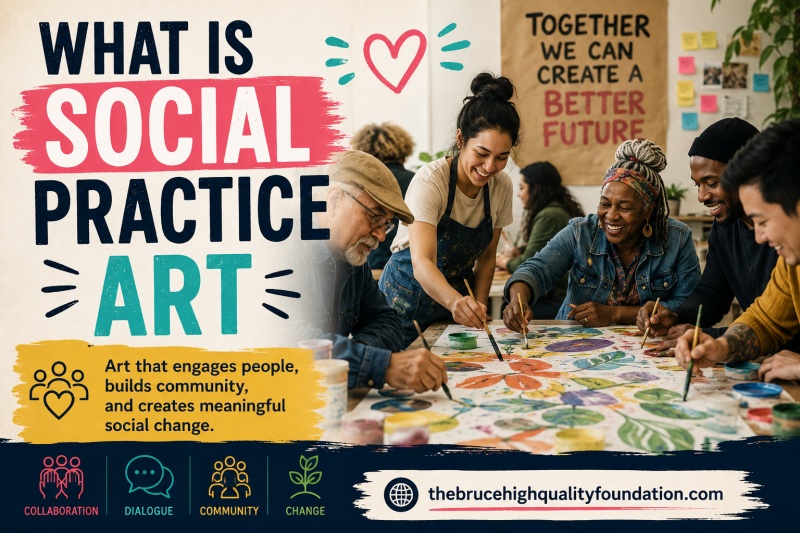
Social practice art is a collaborative, community-driven art form where social interaction serves as both medium and message. Artists working in this field prioritize process over product, people over objects, and social impact over aesthetic display. This guide will walk you through everything you need to understand this transformative approach to art making.
Table of Contents
What Is Social Practice Art?
Social practice art is an art form that uses social interaction as its primary medium, emphasizing collaboration, participation, and community engagement over the creation of physical art objects. Artists working in this field create experiences, facilitate dialogues, and organize collective actions that address social issues and strengthen community bonds.
The Tate Modern defines socially engaged practice as art that “is collaborative, often participatory and involves people as the medium or material of the work.” This definition captures the essential shift that social practice art represents: people become the canvas, relationships become the sculpture, and conversations become the performance.
Key characteristics of social practice art include:
- Collaboration: Artists work with communities rather than for them, sharing authorship and decision-making power
- Participation: Viewers become active participants, transforming the passive experience of looking into active engagement
- Process-oriented: The journey and the relationships built matter more than any final object produced
- Social change focus: Projects aim to address real community needs and create tangible social impact
- Dialogue-based: Conversation, listening, and exchange form the core methodology
- Site-specific: Work responds to and emerges from particular community contexts
Social practice art goes by many names in the art world. You may encounter it as “socially engaged practice,” “participatory art,” “community-based art,” or “collaborative art.” While these terms have subtle distinctions, they all share the fundamental commitment to art as a tool for social connection and change.
History and Origins of Social Practice Art
Social practice art did not emerge from nowhere. Its roots stretch back through decades of artistic experimentation that challenged the boundaries between art and life, artist and audience, object and experience.
Fluxus and Happenings (1960s)
The 1960s marked a revolutionary period when artists began questioning the very foundations of art making. The Fluxus movement, led by figures like George Maciunas, Yoko Ono, and Nam June Paik, championed art as experience over art as commodity. Fluxus artists created “event scores” – simple instructions for actions that anyone could perform. These events blurred the line between art and everyday life.
Allan Kaprow’s “Happenings” took this further. These were spontaneous, participatory performances that unfolded in real time with real people in real spaces. No two Happenings were alike because they depended entirely on who showed up and what they did. This embrace of unpredictability and participation laid crucial groundwork for social practice art.
Community Art Movement (1970s)
The 1970s saw artists directly engaging with communities to address social issues. In the United States, federal funding through programs like CETA (Comprehensive Employment and Training Act) supported artists working in neighborhoods, schools, and prisons. Judy Baca’s “The Great Wall of Los Angeles” exemplified this approach – a half-mile mural created through years of collaboration with youth and historians to tell the suppressed stories of California’s marginalized communities.
In the United Kingdom, the Community Arts Movement gained momentum with artists like John Fox and the Welfare State International creating large-scale participatory events that brought together entire towns in celebratory, politically conscious gatherings.
New Genre Public Art (1990s)
Artist and writer Suzanne Lacy coined the term “New Genre Public Art” in the early 1990s to describe work that was “visual art that uses both traditional and nontraditional media to communicate and interact within a broad audience on issues directly relevant to their lives.” This framework explicitly prioritized social engagement over aesthetic objects in public spaces.
Lacy’s own work exemplified this approach. Her landmark project “The Roof Is on Fire” (1994) brought together Oakland teenagers and police officers for facilitated conversations inside parked cars, creating a space for dialogue about stereotypes, fear, and misunderstanding.
Relational Aesthetics (1990s)
French curator Nicolas Bourriaud’s 1998 book “Relational Aesthetics” provided theoretical grounding for art focused on human relationships. Bourriaud defined the work as “a set of artistic practices which take as their theoretical and practical point of departure the whole of human relations and their social context.”
Artists like Rirkrit Tiravanija became central figures in this discourse, creating installations that were essentially social situations – cooking meals for gallery visitors, setting up communal living spaces in museums. While critics would later debate whether relational aesthetics adequately addressed power imbalances, the concept helped legitimize social interaction as a valid artistic medium.
The Social Turn (2000s to Present)
By the 2000s, what critic Claire Bishop called “the social turn” had become a dominant force in contemporary art. Museums and galleries increasingly hosted socially engaged projects. MFA programs began offering concentrations in social practice. The term itself gained currency as artists, curators, and institutions sought language for this expanding field.
Today, social practice art has evolved to address urgent contemporary issues: climate change, immigration, racial justice, economic inequality, and urban displacement. Artists like Theaster Gates transform abandoned buildings into community cultural centers. Groups like Assemble work with residents to redesign and rebuild their own neighborhoods.
Key Characteristics of Social Practice Art
Understanding what makes social practice art distinct requires looking closely at its defining characteristics. These elements work together to create a practice that is fundamentally different from traditional studio art.
Collaboration and Shared Authorship
Traditional art typically features a single artist working alone, signing their individual vision onto the canvas. Social practice art inverts this model. The artist becomes a facilitator, organizer, and participant rather than a solitary genius. Decisions are made collectively. Credit is shared. The boundary between artist and participant dissolves.
This collaborative approach requires skills not typically taught in art schools: consensus building, conflict resolution, cultural humility, and deep listening. Social practice artists often spend months or years developing trust within communities before any public project emerges.
Process Over Product
In social practice art, the process is the product. The workshops, conversations, organizing meetings, and relationship building constitute the artwork itself. This can be challenging for institutions and markets accustomed to buying and selling objects. How do you collect a conversation? How do you display a relationship?
This emphasis on process also means that social practice art is often temporary and ephemeral. A project may exist for a few hours, days, or months, leaving behind documentation rather than a permanent object. The value lies not in possession but in experience.
Community as Medium
If painters work with oil and canvas, and sculptors work with stone and metal, social practice artists work with people, relationships, and social systems. The community is not the audience for the art – the community is the material of the art.
This metaphor of community as medium has ethical implications. Just as sculptors must understand the properties of marble, social practice artists must deeply understand the communities they work with. This requires research, respect, and long-term commitment.
Social Change Focus
Most social practice art emerges from a desire to make change in the world. Projects often address specific social issues: affordable housing, food justice, environmental degradation, mass incarceration, immigration rights. The art is not merely about these issues – it actively intervenes in them.
This distinguishes social practice art from social commentary. A painting about poverty comments on the issue from a distance. A social practice project organizing tenants to fight eviction actively attempts to change the conditions of poverty itself.
Dialogue and Engagement
Social practice art creates spaces for dialogue – between community members, between artists and participants, between different social groups who might not otherwise interact. These dialogues can be uncomfortable. They can surface conflict. But the goal is always meaningful exchange rather than passive consumption.
As artist Rick Lowe has noted, the goal is not to create objects that people look at, but to create situations where people look at each other, listen to each other, and recognize their shared humanity.
Notable Examples and Artists
The best way to understand social practice art is to examine concrete examples. These artists and projects demonstrate the range of approaches within the field.
Suzanne Lacy
As a pioneer of New Genre Public Art, Suzanne Lacy has spent decades creating large-scale performances that bring together diverse groups to address social issues. Her 1977 work “Three Weeks in May” mapped reports of sexual violence on the streets of Los Angeles while organizing consciousness-raising workshops and public performances.
More recently, her “Skin of Memory” project worked with women in a Colombian neighborhood affected by violence to create a memory bank of objects and stories. Lacy describes her work as “making the private public and the public private” – surfacing hidden experiences through collective action.
Rick Lowe and Project Row Houses
In 1993, artist Rick Lowe moved to Houston’s Third Ward and began working with six other African American artists to transform a block and a half of abandoned shotgun houses into a platform for art, community organizing, and neighborhood revitalization. Project Row Houses became a landmark model for how social practice art could create tangible material change.
Over three decades, the project has grown to include affordable housing for single mothers, a community health clinic, educational programs, and ongoing artist residencies that connect international artists with local residents. Lowe’s work demonstrates that social practice art can achieve concrete, lasting results when sustained over time.
Theaster Gates
Chicago-based artist Theaster Gates transforms abandoned buildings into vibrant community spaces. His Rebuild Foundation has revitalized structures on Chicago’s South Side, creating archives, performance venues, and gathering places that preserve Black culture and history while serving present community needs.
Gates describes his practice as involving “the rehabilitation of buildings and the rehabilitation of people side by side.” His projects show how social practice art can work at the intersection of urban planning, community development, and cultural production.
Tania Bruguera and Arte de Conducta
Cuban artist Tania Bruguera coined the term “Arte de Conducta” (Behavior Art) to describe her politically engaged practice. Her work creates temporary spaces of freedom within authoritarian contexts, often at significant personal risk.
Her “Immigrant Movement International” project in Queens, New York, established a long-term community center providing legal services, education, and organizing support for immigrants. The project blurred the line between art and social service, raising important questions about the role of art in addressing immediate human needs.
Assemble
The London-based collective Assemble won the Turner Prize in 2015, bringing mainstream recognition to social practice art. Their work involves long-term collaborations with communities to rebuild and reimagine their environments.
Their “Granby Four Streets” project in Liverpool worked with residents to transform a neighborhood facing demolition into a community-owned development with affordable housing, a community land trust, and locally made architectural features. Assemble’s approach treats design and construction as social processes that build community capacity.
Additional Notable Projects
Paul Chan’s “Waiting for Godot” in New Orleans: After Hurricane Katrina, Chan brought a production of Beckett’s play to neighborhoods still destroyed by the flood, performed in the round for residents who had not yet returned to their homes.
Harrell Fletcher and Miranda July’s “Learning to Love You More”: An online project that gave assignments to the public (photograph a stranger, make a field guide to your neighborhood) and displayed the results, creating a collective artwork built from thousands of contributions.
Thomas Hirschhorn’s “Gramsci Monument”: A temporary community center built in a Bronx housing project dedicated to the Italian Marxist philosopher Antonio Gramsci, complete with a library, cafe, radio station, and daily programming created with local residents.
Criticism and Debates
Social practice art is not without its critics. The field has sparked important debates about ethics, efficacy, and artistic legitimacy that practitioners must engage with seriously.
Claire Bishop’s Antagonism Argument
Art historian Claire Bishop’s influential essay “Antagonism and Relational Aesthetics” (2004) argued that much social practice art prioritizes harmonious community over challenging artistic encounter. Bishop claimed that art should provoke, disrupt, and unsettle rather than simply bring people together in comfortable consensus.
While some artists rejected Bishop’s critique, others found it productive. The debate raises crucial questions: Is social harmony always the goal? Can art be genuinely challenging while also being genuinely collaborative? These tensions remain unresolved and continue to shape the field.
Documentation and Legitimacy
Because social practice art often produces no physical object, questions of documentation become central. How do you prove the art happened? How do you preserve ephemeral experiences for historical record? This documentation challenge particularly affects artists seeking gallery representation or academic positions where traditional portfolios are expected.
Forums like Reddit’s r/ContemporaryArt frequently feature questions from students about how to document process-based work for art school applications. The field has developed alternative documentation practices: video, photography, participant testimony, ephemera, and detailed process writing. But these remain less established than the traditional studio portfolio.
Balancing Artistic Vision with Community Needs
Perhaps the deepest ethical tension in social practice art involves the relationship between artist intention and community autonomy. Who owns the project? Who decides when it succeeds or fails? What happens when the artist leaves?
Best practices in the field now emphasize long-term commitment, shared governance structures, and community ownership of outcomes. But power imbalances persist. Artists with institutional backing, education, and social capital enter communities with fewer resources. The challenge is to create genuinely equitable collaboration rather than art world extraction.
How to Engage with Social Practice Art
Social practice art is not only for professional artists. There are many ways to engage with this field whether you are an interested participant, an emerging artist, or someone seeking to incorporate these methods into your existing practice.
As a Participant
The simplest way to engage with social practice art is to show up. Attend events, join workshops, participate in community projects. Look for opportunities at local community centers, museums, and art spaces that host socially engaged programming. Your presence, attention, and participation are the material from which this art is made.
Pay attention to projects in your own neighborhood. Social practice art often happens outside traditional art venues. Community gardens, tenant organizing meetings, public forums – these everyday spaces may be sites of artistic intervention.
As an Emerging Artist
If you are drawn to create social practice work, start by identifying the communities and issues you genuinely care about. Effective social practice art emerges from authentic commitment rather than art world trend following. What expertise, relationships, or resources do you bring to a community context?
Develop skills beyond traditional art making. Take courses in community organizing, facilitation, social work, or urban planning. These competencies will serve your practice as much as any studio technique.
Educational Programs
Social practice art has gained recognition in higher education. Several MFA programs now offer concentrations in socially engaged practice, including California College of the Arts, Portland State University, and Queens College CUNY. These programs provide structured support for developing collaborative, community-based work.
For those not seeking a full degree, many institutions offer workshops, intensives, and certificate programs in community-based art. The field also has strong networks of practitioners who share knowledge through conferences, publications, and online communities.
Frequently Asked Questions
What is art as social practice?
Art as social practice is an approach where artists create work through social interaction, collaboration, and community engagement. Rather than producing objects for display, these artists facilitate experiences, conversations, and collective actions that address social issues and strengthen community bonds. The artwork exists in the relationships built, the dialogues held, and the social change achieved.
What is an example of a social practice?
A classic example is Rick Lowe’s Project Row Houses in Houston, where artists transformed abandoned buildings into community assets through collaboration with neighborhood residents. Another example is Suzanne Lacy’s community organizing performances that bring together diverse groups to address issues like violence, aging, or youth empowerment through facilitated dialogue and public action.
What is the difference between social practice art and community art?
While both involve collaboration, social practice art often maintains stronger connections to contemporary art institutions and discourse, while community art emerged from more explicitly political grassroots movements. Social practice art may be more concerned with questions of aesthetics and artistic legitimacy, while community art prioritizes community benefit over art world recognition. However, these boundaries are increasingly blurred in contemporary practice.
How can art change the world?
Social practice art attempts to change the world by intervening directly in social systems rather than merely commenting on them. By organizing communities, facilitating dialogue across differences, and creating tangible resources like housing or healthcare, these projects aim to create immediate material benefit while also shifting how people think about their relationships to each other and to power structures.
Can I study social practice art in school?
Yes, many art schools and universities now offer courses, concentrations, or full MFA programs in social practice art. Notable programs include California College of the Arts, Portland State University’s Art and Social Practice program, and the Social Practice Queens program at CUNY. These programs teach both artistic and community organizing skills needed for this field.
Conclusion
Social practice art represents a profound shift in how we understand the purpose and possibilities of creative work. By prioritizing collaboration over individual expression, process over product, and social change over aesthetic display, this movement challenges us to imagine art as a force for collective transformation rather than private contemplation.
The artists working in this field prove that creativity can be a tool for building stronger communities, addressing injustice, and imagining new ways of living together. Whether you are an artist looking to expand your practice, a community member seeking to engage with meaningful creative work, or simply someone curious about how art might actually change the world, social practice art offers a compelling model for creative action rooted in human connection.
The future of social practice art will likely be shaped by the urgent challenges of our time: climate crisis, inequality, polarization, and displacement. As these issues demand collective response, the skills and approaches developed by social practice artists – collaboration, facilitation, community organizing, and dialogue – become ever more relevant. Art that tries to change the world may not always succeed, but it creates something valuable simply in the attempt: spaces where we practice being together differently.