
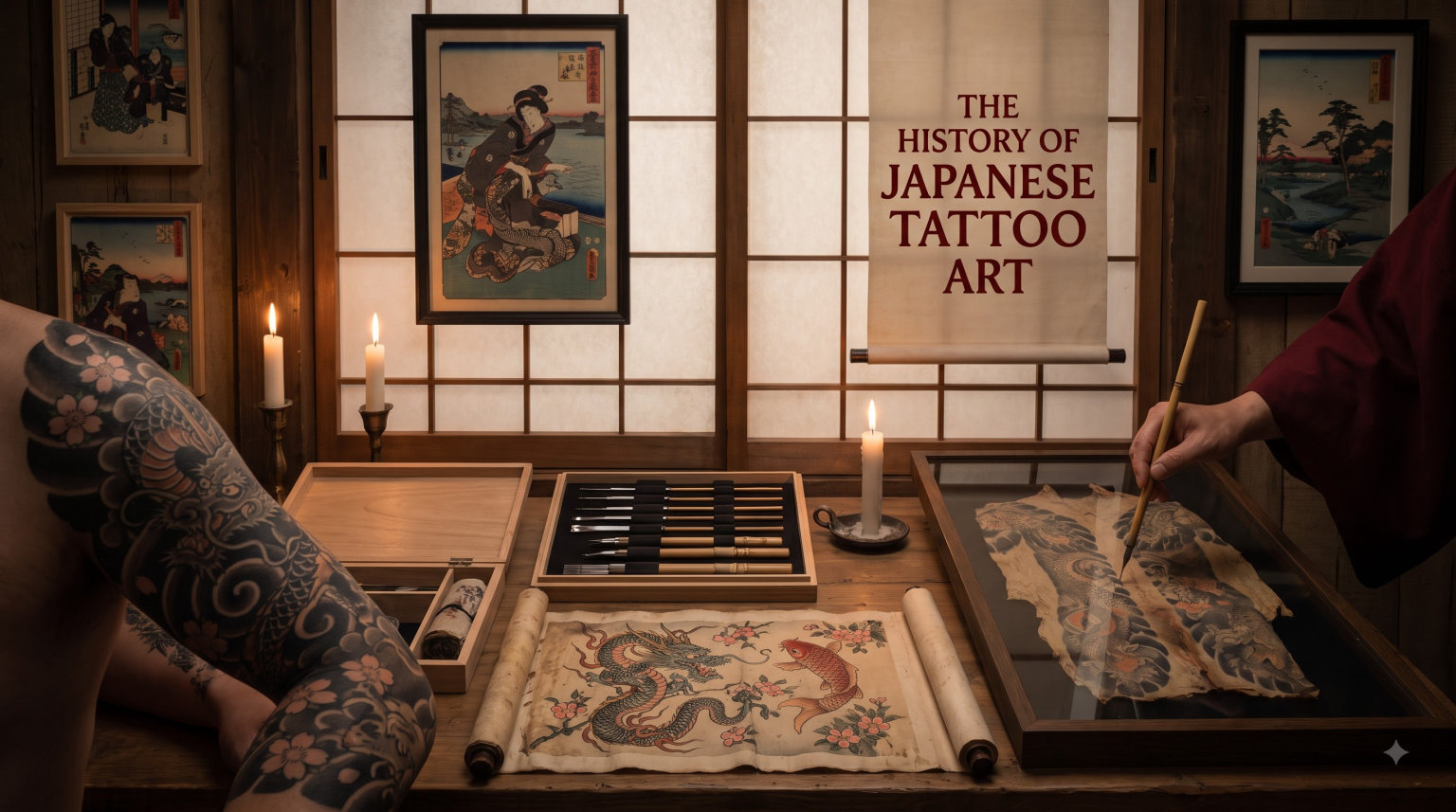
Japanese tattoo art carries one of the richest cultural histories of any decorative art form on Earth. Known as irezumi in Japan, traditional tattooing represents a remarkable journey spanning over 12,000 years, from ritual markings in prehistoric communities to the highly detailed full-body artworks recognized worldwide today. Irezumi, meaning “inserting ink” in Japanese, refers to a distinctive style of body art that blends mythology, symbolism, and masterful craftsmanship into designs that cover everything from small ankle pieces to elaborate full-body suits.
Our team has spent months researching historical texts, academic sources, and consulting with practicing horishi (traditional Japanese tattoo artists) to bring you this comprehensive guide to the history of Japanese tattoo art. Whether you are a first-time learner or someone seeking deeper understanding of irezumi cultural significance, this article walks you through every major era and development that shaped the art form we know today.
Table of Contents
Ancient Origins: The Jomon, Yayoi, and Kofun Periods
Tattooing in Japan dates back further than almost anywhere else on Earth. The earliest evidence comes from the Jomon period (approximately 10,000 to 300 BC), when clay figurines have been discovered bearing painted markings that many scholars interpret as tattoos. These Jomon figurines, some of the oldest ceramic artifacts in the world, show horizontal lines across the face, forehead, and body. While historians debate whether these markings were definitely tattoos or body paint, the archaeological consensus suggests ceremonial or spiritual significance for these ancient practices.
The Yayoi period (300 BC to 300 AD) brings the first written documentation of Japanese tattooing. Chinese historical records from this era describe inhabitants of the Japanese islands with tattoos, noting that some groups marked criminals and slaves as a form of identification. These written accounts provide valuable evidence that tattooing was already established as a cultural practice with social functions including punishment, status differentiation, and possibly spiritual protection.
The Kofun period (300 to 710 AD) saw tattoos firmly cement their association with criminal punishment. During this era, authorities marked criminals with tattoos as visible signs of their transgressions, a practice that would shape how Japanese society viewed tattooed individuals for centuries to follow. Terracotta burial figures called haniwa, which were placed around key tombs, sometimes show tattoo markings on their surfaces, suggesting that tattooed individuals held specific social positions during this period.
Historical records from neighboring China during the Kofun period describe the Japanese tattooing practices in greater detail, noting that tattoos served both punitive and decorative purposes among different social classes. This dual nature of tattoos as both punishment and beauty would remain a tension throughout Japanese tattoo history.
The Edo Period: From Punishment to Artistry
The Edo period (1603 to 1868) marks the transformative era when Japanese tattooing evolved from criminal punishment markers into a celebrated art form. This shift happened gradually, driven by several cultural forces that came together during Japan’s isolated but culturally vibrant Tokugawa shogunate period.
One of the most significant catalysts was the publication of the epic Chinese novel Suikoden (Water Margin), which became wildly popular in Japan through ukiyo-e woodblock print adaptations. The story featured 108 heroic outlaws, each boldly tattooed, and these designs became instant favorites among the Japanese public. Tattoo artists began creating elaborate full-body designs featuring these heroes, often covering the arms, chest, and back with connected scenes depicting dramatic battle scenes and mythical creatures.
The influence of ukiyo-e woodblock prints cannot be overstated in this transformation. These colorful prints, which depicted scenes from everyday life, historical dramas, and kabuki theater, provided tattoo artists with visual vocabulary and compositional techniques they adapted for skin. Just as ukiyo-e artists crafted detailed, balanced compositions using negative space and dramatic scales, tattoo masters began developing sophisticated design principles specifically suited to the human body’s contours and movement.
During this period, the term horimono emerged to describe detailed, sculptural-style tattoos featuring religious imagery, mythological creatures, and nature designs. Horimono distinguished these elaborate decorative tattoos from simple punishment marks, and wealthy townspeople began commissioning them as signs of personal style and cultural refinement. The contrast with earlier eras could not have been starker: where tattoos once marked criminals, they now signaled artistic appreciation.
Tattoo artists of the Edo period developed distinctive regional styles, with artists in cities like Edo (modern Tokyo), Osaka, and Kyoto each developing unique approaches to design, placement, and color usage. The craft required years of apprenticeship, with aspiring horishi learning not only tattooing techniques but also traditional Japanese art principles, composition, and the mythological symbolism embedded in every design element.
The Meiji Era: Suppression and Survival
The Meiji Restoration beginning in 1868 brought dramatic changes to Japan as the nation rapidly modernized and opened itself to Western influence. Emperor Meiji’s government actively sought to present Japan as a civilized, Western-compatible nation to the international community, and traditional tattoos were seen as primitive markings that needed elimination.
In 1876, the Meiji government formally banned tattooing, citing concerns about Japan’s international image and the association of tattoos with criminality. This prohibition struck at the heart of a tradition that had flourished for centuries. The ban came at a particularly ironic moment: just as ukiyo-e prints had sparked massive public interest in elaborate tattoos, the practice was forced underground.
The philosophical roots of this suppression trace back to Confucian attitudes that had long viewed body modification with suspicion. Confucian teaching emphasized the body as something received from one’s parents and ancestors, making deliberate alteration seem disrespectful. While this attitude had coexisted with tattoo artistry for centuries, the Meiji government’s desire for rapid Westernization amplified these concerns into outright prohibition.
Despite the official ban, traditional tattooing survived through underground practice. Horishi continued their work in secret, serving clients who were often connected to the yakuza (Japanese organized crime), which had long embraced elaborate tattoos as signs of loyalty and membership. This association, which had been growing since the Edo period, became even stronger under the ban, as tattooed individuals outside of organized crime became increasingly rare.
The tattoo ban remained in effect until after World War II, though enforcement was inconsistent. Western military personnel stationed in Japan after the war sometimes sought out traditional Japanese tattoos, providing economic incentive for horishi to continue their work despite legal risks. This period of suppression preserved the traditional techniques and designs that had developed over centuries, even as the broader culture moved in different directions.
Modern Era: Legalization, Resurgence, and Global Influence
After World War II, the Allied occupation of Japan led to significant social changes, and in 1948 the tattoo ban was officially lifted. This legalization came partly in response to Western influence and partly because the stigma around tattoos had shifted sufficiently that authorities no longer viewed prohibition as necessary for international relations.
The post-war period saw a complex situation develop around Japanese tattooing. On one hand, the art form experienced a renaissance as horishi could work openly again, and interest from both Japanese clients and Western visitors sustained demand. On the other hand, the association with yakuza had become so strong that many ordinary Japanese people continued to view visible tattoos with suspicion, avoiding public bathhouses and swimming pools that might expose their ink.
This stigma persists in some areas of Japanese society today, though attitudes are slowly changing. Younger Japanese people increasingly view tattoos, particularly non-traditional styles, as fashion statements rather than criminal markers. Some bathhouses and onsen (hot springs) have relaxed their no-tattoo policies, though visible tattoos still generate controversy in certain formal contexts.
The global influence of Japanese tattoo art has grown tremendously since the 1970s and 1980s, when Western tattoo artists began studying with horishi and incorporating Japanese techniques and aesthetics into their work. Contemporary Japanese tattoo artists like Horiyoshi III, whose father was a celebrated horishi, have achieved international fame, and traditional designs have been adopted and adapted by tattoo enthusiasts worldwide. This global appreciation has created economic opportunities that have helped sustain the traditional craft even as the domestic market faces social challenges.
Today, Japan has approximately 30 to 50 traditional horishi who practice authentic tebori tattooing, though the actual number fluctuates as some artists retire and new apprentices complete their training. The craft remains centered in cities like Tokyo, Osaka, and Fukuoka, where multigenerational tattoo families continue traditions that stretch back to the Edo period or earlier.
Techniques and Craftsmanship: Tebori and Traditional Methods
Tebori, meaning “hand poke” or “hand tattooing,” is the traditional Japanese tattoo technique that distinguishes authentic irezumi from machine-tattooed designs. Tebori involves using wooden handles with bundled metal needles called hari to manually insert ink into the skin. This technique allows for extraordinary control over line quality, shading, and color saturation that practitioners argue cannot be replicated by machines.
The tools of traditional Japanese tattooing have remained largely unchanged for generations. Hari are typically made from groups of fine metal needles bound together, sometimes with silk thread, attached to wooden handles that fit comfortably in the artist’s hand. Traditional ink, particularly Nara ink named after the ancient capital Nara, is prepared from proprietary combinations of ingredients that horishi families have kept secret for centuries.
Creating a traditional horimono piece is an enormous commitment that can take hundreds of sessions spanning years or even decades. A full-body suit, called 忍耐 (nintai, meaning “patience”), may require 200 to 400 hours of work, with sessions lasting four to six hours each. Clients must endure significant discomfort, as tebori penetrates the skin more deeply than modern machines and healing requires careful aftercare without scratching or disturbing the forming scabs.
The technique of bokashi, which creates atmospheric gradated shading, represents one of the most technically demanding aspects of traditional Japanese tattooing. Rather than solid color fills, bokashi involves applying ink in layered gradients that create atmospheric effects reminiscent of traditional ink wash painting. This technique requires exceptional control over needle depth and ink saturation, and mastering it can take decades of practice.
Symbolism and Motifs: The Meaning Behind the Art
Traditional Japanese tattoos are never merely decorative; every element carries specific symbolic meaning that has been developed and refined over centuries. Understanding these meanings transforms tattoo selection from random aesthetic choice into a deeply personal statement of values, aspirations, and cultural connection.
Dragons appear more frequently in Japanese tattoo art than perhaps any other creature, representing power, wisdom, and protection. Unlike Western dragon imagery, Japanese dragons are benevolent creatures associated with water, rainfall, and celestial authority. Different dragon designs carry different specific meanings: a dragon descending through clouds suggests authority and power, while a dragon emerging from water represents opportunity and transformation.
Koi fish rank among the most popular Japanese tattoo subjects, symbolizing perseverance, strength, and the ability to overcome obstacles. The koi’s legendary ability to swim upstream against powerful currents and leap waterfalls has made it a symbol of determination and achievement against the odds. A koi swimming upstream suggests an ongoing struggle, while a koi that has reached the top of a waterfall represents completed transformation.
Cherry blossoms (sakura) represent the central Japanese aesthetic concept of mono no aware, the awareness of life’s impermanence and the beauty found in transience. Cherry blossom tattoos remind viewers that life is fleeting and encourage appreciation of present beauty. These designs often incorporate falling petals, which suggest the actual moment of凋落 (decay) and the bittersweet acceptance of mortality.
Tigers in Japanese tattoo symbolism represent courage, protection from evil, and guardian power. Tigers are traditionally associated with the cardinal direction east and are believed to have supernatural abilities to drive away demons and negative influences. A tiger tattoo can serve as a protective charm as well as a display of personal bravery.
Wave and water motifs draw from Japan’s island geography and cultural relationship with the sea. These designs often carry meanings related to the duality of nature, with calm waters representing peace and turbulent seas suggesting life’s challenges. The famous Great Wave designs that appear throughout Japanese art translate powerfully to tattoo contexts, where they can fill large body areas with dynamic movement.
Terminology Glossary: Understanding Irezumi Vocabulary
Understanding Japanese tattoo terminology helps clarify the distinctions between different aspects of this art form and enriches appreciation for its cultural depth.
Irezumi serves as the general term for traditional Japanese tattooing, literally meaning “inserting ink.” This term encompasses the full range of decorative Japanese tattoos and is often used interchangeably with horimono in casual conversation, though technically irezumi refers more broadly to the practice while horimono describes the specific tattoo style.
Horimono describes detailed sculptural-style tattoos featuring religious iconography, mythological creatures, and nature imagery executed with bold lines and vibrant colors. These tattoos often incorporate elements like dragons, phoenixes, koi, cherry blossoms, and peonies arranged in compositions that respect traditional aesthetic principles.
Horishi refers to a traditional Japanese tattoo artist, emphasizing the years of training and cultural knowledge required to practice this craft at a professional level. The title suggests respect for the artistic and cultural dimensions of tattoo work rather than simply technical skill.
Tebori describes the hand tattooing technique where needles are held in wooden handles and manually worked into the skin. This labor-intensive method stands in contrast to yobori (Western machine tattooing) and allows for the distinctive effects possible only through hand work.
Bokashi refers to the gradated shading technique creating atmospheric effects similar to ink wash painting. This technique requires exceptional skill and patience, as artists build up tone through multiple passes rather than single color fills.
Munewari, meaning “split in two,” describes an open-center design that leaves the chest divided into two sections with negative space between them. This design developed to allow clients to wear open-collared shirts without revealing their complete tattoo, and it has become a distinctive feature of Japanese tattoo aesthetics.
Frequently Asked Questions
What is the history of Japanese tattoo art?
Japanese tattoo art dates back to the Jomon period (approximately 10,000 BC) with evidence from clay figurines. It evolved from criminal punishment marks during the Kofun period to elaborate artistic expressions during the Edo period, faced suppression during the Meiji era, and experienced resurgence after the 1948 legalization.
What is irezumi?
Irezumi is the Japanese term for traditional tattooing, literally meaning ‘inserting ink.’ It refers to a distinctive style of full-body tattoo art featuring bold lines, vivid colors, and symbolic imagery like dragons, koi, and cherry blossoms.
When did tattooing start in Japan?
Tattooing in Japan dates back to the Jomon period (approximately 10,000 BC), making it one of the oldest documented tattoo traditions in the world. The earliest evidence comes from Jomon clay figurines with painted markings.
Why are Japanese tattoos associated with criminals?
The association between Japanese tattoos and criminals dates to the Kofun period (300-710 AD), when authorities marked criminals with visible tattoos as punishment. This association strengthened during the Edo period but began to shift as tattoos became artistic expressions. Today the criminal stigma has diminished, especially among younger generations.
What is the difference between irezumi and horimono?
While the terms are often used interchangeably, irezumi refers more broadly to traditional Japanese tattooing practice, while horimono specifically describes the detailed sculptural style featuring religious and mythological imagery with bold lines and vibrant colors.
Why were tattoos banned in Japan?
Tattoons were banned in Japan in 1876 during the Meiji Restoration when the government sought to modernize the country and present it as Western-compatible. Confucian attitudes toward body modification and the association of tattoos with criminality also influenced the ban. The prohibition lasted until 1948.
Conclusion
The history of Japanese tattoo art reflects the broader story of Japanese culture itself: ancient spiritual practices transformed through artistic innovation, suppressed during periods of rapid modernization, and now experiencing global appreciation that has returned attention to traditional craftsmanship. From the Jomon period figurines to contemporary horishi practicing tebori in Tokyo studios, irezumi represents over 12,000 years of continuous artistic development.
Understanding this history enriches appreciation for every element of a Japanese tattoo design. When you see a dragon design, you are seeing imagery that evolved through Edo period ukiyo-e prints influenced by Chinese novels. When you admire the bokashi shading technique, you are witnessing a method developed over generations of hand tattooing practice. Each traditional Japanese tattoo carries centuries of meaning within its bold lines and carefully chosen imagery.
The art form continues to evolve as contemporary horishi adapt traditional techniques and motifs for modern contexts while maintaining the deep cultural knowledge that makes authentic irezumi distinctive. For those interested in exploring more art topics, our artist gift guide features creative gift ideas for artists and art enthusiasts.
Whether you are considering a traditional Japanese tattoo, studying art history, or simply curious about this remarkable cultural tradition, the history of Japanese tattoo art offers lessons in resilience, craftsmanship, and the enduring human desire to transform the body into a canvas for meaning and identity.