
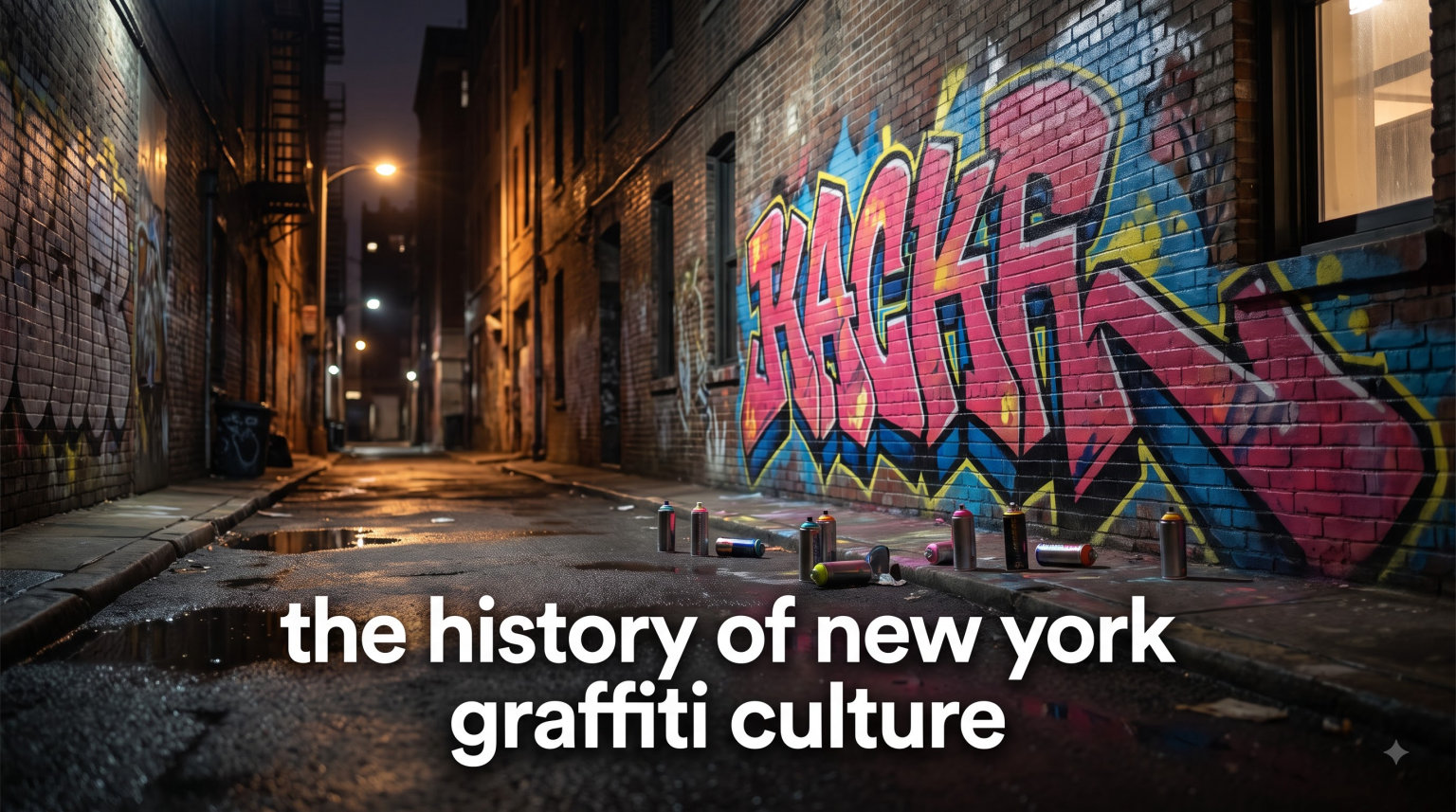
New York City graffiti culture represents one of the most transformative artistic movements of the 20th century. What began as simple tags on subway walls in the late 1950s evolved into a global phenomenon that reshaped how we think about art, identity, and public space. I have spent years researching this movement, and the story of NYC graffiti remains one of the most compelling cultural narratives America has produced.
This comprehensive guide traces the complete history of New York graffiti culture, from its humble origins to its current status as a respected art form. You will discover how marginalized youth in the Bronx and Brooklyn created an entirely new visual language that would eventually influence everything from high fashion to museum exhibitions. The journey from subway cars to gallery walls tells us much about American culture, creativity, and the eternal tension between vandalism and art.
Table of Contents
The Origins of New York Graffiti Culture in the 1950s and 1960s
Graffiti in New York City did not appear suddenly overnight. The movement has roots stretching back to the late 1950s, when urban decay created new spaces for creative expression. As middle-class residents fled to the suburbs during the post-war period, neglected neighborhoods in the Bronx, Brooklyn, and Manhattan developed distinct visual identities.
The earliest documented New York graffiti artists worked with little recognition. These pioneers would write their names, pseudonyms, or cryptic symbols on walls throughout the city. Many were teenagers from working-class backgrounds who saw writing as a way to assert their existence in a city that often overlooked them. The practice spread through word of mouth and direct observation, creating informal networks of young writers.
Philadelphia actually shares the title of graffiti’s birthplace with New York. A writer known as Cornbread is often credited as one of the first modern graffiti artists, beginning his tagging career around 1965. However, New York would soon develop its own distinct approach. By the late 1960s, young New Yorkers began adopting the practice, tagging walls, park benches, and eventually subway cars with increasingly elaborate signatures.
The social context mattered enormously. New York in the 1960s experienced fiscal crises, urban decay, and rising crime rates. Abandoned buildings and empty lots became canvases for young people seeking recognition. Graffiti offered something valuable: a way to be seen and remembered in a city where many felt invisible.
TAKI 183: The Artist Who Started the Graffiti Movement
TAKI 183 remains the most consequential figure in the birth of modern New York graffiti culture. Born Demetrius in 1954, he grew up in the Washington Heights neighborhood of Manhattan. His moniker came from his address, 183rd Street in Washington Heights, combined with his first name. This simple formula for creating a tag would influence generations of graffiti writers who followed.
TAKI 183 worked as a messenger in the early 1970s, which gave him access to the entire city. He began tagging everywhere he went, using a felt-tip marker to scrawl his name on walls, lampposts, and subway stations. His persistence paid off. By 1971, his tags had spread across Manhattan, and his name appeared hundreds of times throughout the city.
The New York Times published an article about TAKI 183 in July 1971, making him the first graffiti artist to receive major media attention. The article, titled “Taki 183 Spawns Pen Pals,” revealed that the mysterious tagger had become so prolific that he received mail addressed simply to “Taki 183, New York City.” This coverage transformed TAKI 183 into a cultural phenomenon and legitimized graffiti as a recognizable movement.
What made TAKI 183 significant was not just his productivity but his methodology. He demonstrated that a single person could transform a city’s visual landscape through consistent presence. His tags also established the basic grammar of graffiti: a stylized signature that communicates identity, territory, and artistic ambition. Within months of the Times article, hundreds of new writers emerged, each creating their own unique tags.
The 1970s: New York Subway Graffiti’s Golden Age
The 1970s represented the true golden age of New York subway graffiti. The subway system became the ultimate canvas for writers seeking maximum visibility. Train cars traveled the entire city, carrying graffiti to every borough and neighborhood. A piece placed on a subway car could be seen by millions of New Yorkers within days.
Writers developed increasingly ambitious goals. The simplest form, called a tag, involved a single signature using marker or spray paint. Writers then progressed to throw-ups, which used bubble letters in one or two colors for faster execution. The most coveted achievement was creating a whole-car piece, where an entire subway train car would be covered with an elaborate artwork.
Whole-car pieces required extensive planning and execution. Writers often worked in teams to complete a single car, sometimes spending entire nights in subway yards. These pieces represented massive investments of time and risk. Subway police patrolled yards aggressively, and writers faced arrest if caught. Despite the dangers, the prestige of a completed whole-car drew the most committed artists.
The subway graffiti culture developed its own social structures. Writers formed crews, groups that collaborated on pieces and provided mutual support. The most famous early crews included the New York City Transit Authority’s legendary teams of artists. These crews developed distinctive styles that could be identified from a distance, creating an entire visual ecosystem within the subway system.
By 1974, an estimated 3,000 writers had active profiles in New York. The subway system displayed hundreds of tags and pieces daily, creating what writers called a “rolling exhibition.” The city that had ignored graffiti’s early pioneers now confronted an unstoppable movement that had transformed public transportation into a moving art gallery.
Graffiti Style Evolution: From Simple Tags to Wild Style
Graffiti underwent rapid stylistic evolution throughout the 1970s and 1980s. Writers constantly pushed boundaries, developing new techniques and visual approaches that transformed simple signatures into complex artworks. Understanding these styles reveals the creative ambition driving the movement.
The most fundamental distinction involves tags versus pieces. A tag represents the basic signature, usually created quickly with a single color. Tags emphasize the writer’s identity and presence rather than artistic complexity. Despite their simplicity, skilled writers developed distinctive tag styles that could be recognized by other practitioners.
Bubble letters emerged as the next evolutionary step. These rounded, inflated letterforms became the dominant style of the mid-1970s. Writers favored bubble letters because they allowed quick execution while creating more visually striking work. The style also provided room for color experimentation, as writers could fill bubbles with multiple colors and add outlines for depth.
Wild Style represents the most complex and visually intricate branch of graffiti evolution. Developed in the late 1970s, Wild Style features letters that twist, interlock, and become nearly unreadable to untrained eyes. The style emerged from writers seeking to protect their work from copycats while demonstrating advanced technical skill. Wild Style pieces often require close study to decode, revealing hidden images and arrows embedded within the letterforms.
Other important terminology shaped the culture. A burner is an especially bold, high-quality piece designed to “burn” competing writers. Getting up means gaining visibility through prolific output. Going over describes painting over another writer’s work, a practice that created intense rivalries and competitions throughout the subway system.
The visual vocabulary of graffiti extended beyond letters. Writers added characters, animals, arrows, crowns, and three-dimensional effects to their pieces. These additions distinguished individual artists and crews while creating a rich visual language that influenced subsequent art movements. The style evolution demonstrated that graffiti was not merely vandalism but a sophisticated artistic practice with its own rules and aesthetics.
Key Artists and Graffiti Crews of New York
Several artists achieved legendary status within the New York graffiti scene. Their contributions shaped the movement’s development and established standards that still influence street art today. Understanding these pioneers provides context for the broader cultural phenomenon.
Dondi, born in 1961 in the South Bronx, is widely considered the most influential early graffiti artist. He pioneered many style innovations that became standard practice, including complex color schemes and sophisticated composition techniques. His pieces on the 1 train during the late 1970s are legendary among graffiti historians. Dondi’s work demonstrated that subway graffiti could achieve the complexity of studio art while maintaining the energy of street execution.
Lady Pink stands out as one of the first female writers to achieve major recognition. Beginning her career in 1979 at age 15, she quickly established herself through technical excellence and creative ambition. Her work combined classical artistic training with authentic street experience. Lady Pink documented the graffiti scene extensively, providing valuable historical records of an ephemeral art form. She later transitioned to studio work, exhibiting in galleries while maintaining her roots.
Fab 5 Freddy, born in 1961, represented the bridge between subway graffiti and broader artistic movements. He gained early recognition for his subway pieces before transitioning to canvas work and eventually film. His 1982 film “Style Wars” documented the New York graffiti scene, introducing it to national audiences. Freddy also helped connect graffiti culture with the emerging hip-hop scene, appearing in early hip-hop films and music videos.
Blade, born in 1961, earned his nickname through his prolific output and survival through graffiti’s dangerous early years. He began writing in 1972 and continued through the movement’s peak. Blade witnessed the entire evolution of subway graffiti from simple tags to elaborate whole-car pieces. His longevity provided continuity between the movement’s formative years and its eventual mainstream acceptance.
Graffiti crews amplified individual achievements through collective action. The Wild Cowboys, one of the most famous early crews, operated throughout the 1970s and 1980s. Other notable crews included the TS5, The Masters of Abominal, and The Amazing 5. These groups provided training, protection, and collaborative opportunities for writers seeking to develop their skills and visibility.
The Clean Train Movement and the Decline of NYC Subway Graffiti
The Clean Train Movement began in 1984 and fundamentally transformed New York graffiti culture. The Metropolitan Transportation Authority launched an aggressive anti-graffiti campaign that targeted the subway system with unprecedented resources. For writers, the campaign represented an existential threat to their art form’s primary canvas.
The MTA implemented multiple strategies. New York City Transit Police increased patrols in subway yards, arresting writers caught in the act. Security cameras monitored previously accessible areas. The authority also developed new paint technologies specifically designed to resist graffiti application. Perhaps most significantly, the MTA committed to removing all graffiti from subway cars within 24 hours of discovery.
Writers called the period between 1984 and 1989 the “graffiti boom-bust cycle.” Enforcement drove artists to take greater risks while simultaneously reducing their opportunities for visibility. Writers who had once spent hours on elaborate pieces found their work immediately erased. The psychological impact proved devastating for many artists who had defined themselves through subway contributions.
The city justified the Clean Train Movement through arguments about public safety and urban decay. Mayor Ed Koch’s administration linked graffiti to rising crime rates, adopting the “broken windows” theory that suggested small disorders encouraged larger crimes. Subway ridership had declined significantly during the late 1970s, and officials blamed graffiti for discouraging riders. Whether accurate or not, this narrative provided political support for aggressive enforcement.
By 1989, the subway system had essentially eliminated visible graffiti. The victory was complete but bittersweet for the culture that had created it. Many writers shifted to street-level graffiti or transitioned to studio work. Others continued tagging despite reduced visibility, maintaining the practice as personal expression rather than public spectacle. The subway’s loss accelerated other developments in graffiti culture, particularly the movement toward gallery recognition.
From Street to Studio: Graffiti Artists Enter the Art World
The transition from subway to studio represented a natural evolution for many graffiti artists. As enforcement made public painting increasingly difficult, artists sought new outlets for their creative ambitions. The gallery system offered legitimate spaces where technical skill could be displayed and monetized without legal consequences.
Jean-Michel Basquiat exemplifies this transition. He began as a street tagger in Brooklyn before moving to canvas work in the late 1970s. His crude, text-based canvases drew directly from graffiti aesthetics while engaging with art historical traditions. By 1985, Basquiat appeared on the cover of The New York Times Magazine as a celebrated new artist. His success demonstrated that street-derived aesthetics could achieve mainstream acceptance.
Keith Haring followed a similar path. He developed his iconic cartoon style through sidewalk chalk drawings in subway stations before achieving gallery recognition. Like Basquiat, Haring maintained street connections even as his career advanced. His Pop Art approach merged commercial success with community engagement, creating works for public spaces and social causes.
The gallery system proved both liberating and constraining for former graffiti writers. Studios allowed technical experimentation impossible on subway cars. Artists could work at larger scales, use more expensive materials, and develop sustained bodies of work. However, gallery culture required navigating social expectations and commercial pressures foreign to street environments. Some writers thrived in this new context while others struggled with the transition.
The relationship between graffiti culture and the broader art world continues evolving today. Street art, often considered graffiti’s more socially acceptable cousin, emerged from similar roots. Contemporary artists like Banksy have achieved international recognition while maintaining street practice. The lines between graffiti, street art, and contemporary art remain contested, reflecting ongoing negotiations about public space, property rights, and artistic value.
Our exploration of how guerrilla art artists transformed public space connects directly to this legacy. The artists who wrote on subway cars in the 1970s established principles that continue guiding contemporary practitioners. You can also learn more about street art’s transition from NYC streets to galleries and how these boundaries have shifted over decades.
The Global Legacy of New York Graffiti Culture
New York graffiti culture influenced artistic practice worldwide. The visual language developed in Bronx and Brooklyn subway yards spread through media documentation, artist migrations, and direct cultural exchange. Today, graffiti exists in some form in virtually every major city on Earth, and most contemporary street art movements trace lineages to New York’s 1970s pioneers.
Hip-hop culture provided one major transmission vector. As hip-hop spread from New York to other American cities and eventually internationally, graffiti traveled alongside it. The four elements of hip-hop (DJing, MCing, breakdancing, and graffiti) remained connected even as individual elements achieved independent followings. International hip-hop scenes adopted local variations on graffiti aesthetics while maintaining connections to New York origins.
Documentary films amplified New York graffiti’s reach. “Style Wars” (1982) and “Wild Style” (1983) introduced audiences worldwide to subway graffiti culture. These films appeared internationally through home video and television, inspiring young artists in countries far from New York. The romantic depiction of graffiti as urban poetry influenced how subsequent generations understood the practice.
The book “Subway Art” (1984) by Martha Cooper and Henry Chalfant provided another crucial transmission mechanism. This visual documentation of New York subway graffiti became a global reference work. Artists worldwide studied its photographs to learn techniques and styles. The book’s status as a rare, expensive collector’s item demonstrated that New York graffiti had achieved cultural artifact status while remaining influential among practitioners.
Today, major museums regularly exhibit New York graffiti art. The Museum of Modern Art, the Whitney, and the Brooklyn Museum have all presented exhibitions examining graffiti’s artistic significance. Private collectors pay millions for works by Basquiat, Haring, and other pioneers. This institutional recognition validates decades of work while raising questions about how art forms change when absorbed into mainstream culture.
The continuing influence of New York graffiti appears in fashion, advertising, graphic design, and popular culture. Fashion designers incorporate graffiti aesthetics into clothing lines. Corporate advertising borrows street art visuals while controversial debates about cultural appropriation continue. Whatever one’s perspective on these commercial developments, they demonstrate that New York graffiti succeeded beyond anything its original practitioners imagined.
FAQs
When did graffiti start in New York?
Graffiti in New York City began in the late 1950s and early 1960s, with Philadelphia native Cornbread often credited as one of the first modern graffiti artists around 1965. However, it was TAKI 183’s media coverage in 1971 that truly launched the graffiti movement in New York.
Who was TAKI 183 and why was he important?
TAKI 183 (Demetrius) was a Washington Heights teenager who worked as a messenger in the early 1970s. He began tagging his name and address throughout the city, becoming the first graffiti artist to receive major media attention when The New York Times profiled him in July 1971. His article spawned hundreds of new writers and established the basic grammar of modern graffiti.
What was the Clean Train Movement?
The Clean Train Movement was an aggressive anti-graffiti campaign launched by the MTA in 1984. It involved increased police patrols, security cameras, and a commitment to remove all graffiti from subway cars within 24 hours. By 1989, visible subway graffiti had been essentially eliminated, fundamentally transforming NYC graffiti culture.
How did graffiti evolve from tagging to street art?
Graffiti evolved through several distinct stages: tags (simple signatures), throw-ups (bubble letters in 1-2 colors), and pieces or masterpieces (elaborate multi-color works). Styles progressed from basic bubble letters in the 1970s to the complex, interlocking letterforms of Wild Style in the late 1970s and 1980s. This evolution demonstrated increasing technical skill and artistic ambition.
What is Wild Style in graffiti?
Wild Style is the most complex branch of graffiti, featuring letters that twist, interlock, and become nearly unreadable to untrained observers. Developed in the late 1970s, it emerged from writers seeking to protect their work from copycats while demonstrating advanced technical skill. Wild Style pieces often require close study to decode, revealing hidden images, arrows, and three-dimensional effects embedded within the letterforms.
Conclusion
The history of New York graffiti culture tells a remarkable story of creative transformation. What began as simple tags scrawled by teenagers seeking recognition became a global artistic movement influencing everything from museum exhibitions to advertising campaigns. The writers who risked arrest to paint subway cars in the 1970s created a visual language that now appears in every corner of the world.
The movement’s key figures established principles that continue guiding practitioners today. TAKI 183 demonstrated how consistency and visibility could transform a simple idea into cultural phenomenon. Dondi showed that technical skill could elevate street work to gallery standards. Lady Pink proved that women belonged in a movement often perceived as male-dominated. Their achievements demonstrated that authentic artistic vision could emerge from the most unlikely circumstances.
New York graffiti culture ultimately succeeded because it addressed fundamental human needs. Young people seeking identity found it through their tags. Communities marked territory and asserted presence through collective pieces. Artists developed technical skills through years of practice. Whatever one’s view of the legality of graffiti, its cultural significance cannot be denied.
Today, the legacy of NYC graffiti appears in contemporary street art, gallery exhibitions, fashion, and popular culture. The tension between public and private space, between vandalism and art, continues shaping how we understand creative expression. As cities worldwide grapple with these questions, New York’s experience provides valuable historical context. The concrete canvas that once carried subway pieces now includes museum walls, proving that nothing stays the same in the ever-evolving story of art.