
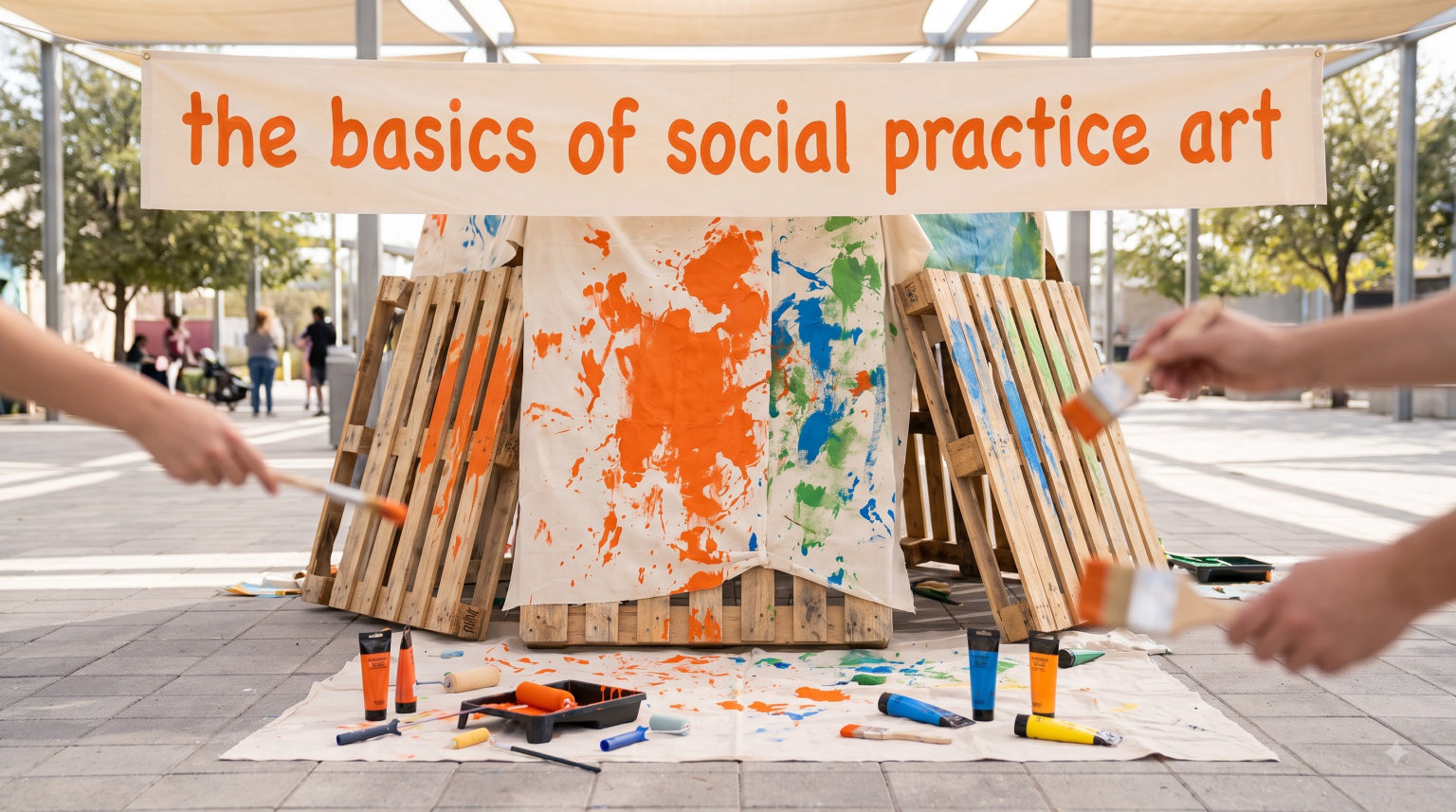
Social practice art represents one of the most transformative movements in contemporary art, shifting the focus from objects to people, from galleries to communities, and from solitary genius to collaborative creation. If you have been wondering what this movement is all about, you are not alone. Our team has spent months researching and comparing social practice projects across the country to bring you a comprehensive guide that cuts through the academic jargon.
In this guide, you will learn exactly what social practice art is, where it came from, who the key figures are, and how it fundamentally differs from traditional artmaking. We will also address the honest critiques and limitations that even supporters of the movement acknowledge. By the end, you will have a clear understanding of why social practice art has become so influential in contemporary art circles and community development alike.
Table of Contents
What is Social Practice Art?
Social practice art is an art movement where artists collaborate directly with communities, using people as the medium or material of the artwork. The goal is to create positive social contributions while placing community engagement at the core of every project. Artists act as facilitators rather than sole creators, and the art often exists in public spaces rather than traditional galleries.
All social practice artworks converge on a similar ethos: a commitment to making positive social contributions while placing people at the core of each project. This means that the communities involved are not just audiences or subjects but active participants in the creative process. The art becomes a vehicle for dialogue, connection, and sometimes tangible social change.
The movement builds on a simple but revolutionary idea. What if art could address real community needs rather than simply depicting them? What if the measure of success was not what hangs on a museum wall but how many lives are touched and improved? These questions drive social practice artists to work in neighborhoods, schools, hospitals, and public spaces where art can become part of everyday life.
The Artist as Facilitator
One of the most significant shifts in social practice art is the changed role of the artist. Rather than working alone in a studio, social practice artists bring people together and facilitate collaborative creation. This concept of the artist as facilitator challenges centuries of tradition that celebrated the lone genius working in isolation.
Mierle Laderman Ukeles, who became the first female artist to have a solo show at the Queens Museum, articulated this shift powerfully when she declared maintenance art as her central practice. She viewed art not as creation but as ongoing care for the social world. This reframing opened doors for countless artists who wanted to work with communities rather than for them.
Historical Roots of Social Practice Art
The roots of social practice art stretch back to the 1960s, drawing energy from several parallel movements that challenged what art could be and where it could happen. Fluxus, Happenings, and community-based art all contributed ideas that would eventually coalesce into the social practice movement we recognize today.
Fluxus artists in the 1960s created events and experiences that blurred the line between art and life. Rather than painting or sculpting, they orchestrated situations that involved audiences directly. This participatory impulse became foundational to social practice. Artists like Yoko Ono and George Maciunas showed that art could be an experience shared rather than an object owned.
Allan Kaprow developed the concept of Happenings in the late 1950s and early 1960s. These were ephemeral events that took place in everyday spaces and invited random participants to become part of the artwork. Kaprow explicitly rejected the idea that art should be precious or permanent. His work suggested that art could be a moment of connection, and then it could disappear. You can explore more about performance-based art and its connection to social practice in our guide to performance art history.
Community art movements of the 1960s and 1970s added another crucial dimension. Artists began working explicitly with specific communities, often those that had been marginalized or ignored by mainstream art institutions. These projects addressed issues like civil rights, feminism, and environmental justice while creating art that belonged to the people who made it.
Mierle Laderman Ukeles and Maintenance Art
In 1969, Mierle Laderman Ukeles wrote the Maintenance Art Manifesto, a document that would reshape how we think about art and labor. She argued that the work of maintaining life, which falls disproportionately to women, was a form of art deserving recognition and celebration. This was not merely philosophical posturing. Ukeles spent decades working inside municipal governments, treating public maintenance as her artistic medium.
Her work as the official artist for the New York City Department of Sanitation exemplified how social practice art could operate within institutions while maintaining critical perspective. She organized events, created installations from city services, and gave dignity to the invisible labor that keeps urban life running. Her maintenance art practice proved that social practice could be sustainable, institutional, and transformative simultaneously.
Key Characteristics of Social Practice Art
Social practice art is not simply any art that involves people. It has specific characteristics that distinguish it from performance art, public art, or community murals. Understanding these characteristics helps you identify genuine social practice projects and evaluate their effectiveness.
Five Core Characteristics
Collaboration sits at the heart of every social practice project. This goes beyond inviting people to attend an event or vote on a design. Genuine collaboration means sharing creative control with community members, incorporating their ideas into the work itself, and sometimes letting community vision override the artists initial intentions.
Decentralized authorship means that the final work cannot be attributed to a single person. The artist initiates and facilitates, but the community shapes what actually happens. This creates interesting challenges for documentation and for how the art world recognizes and rewards such work.
Process orientation distinguishes social practice from art that values a finished object above all else. The experience of creating, the relationships built, and the conversations that happen matter more than what, if anything, remains at the end. Some projects deliberately leave no physical trace.
Social justice commitment means that social practice art aims to address real problems facing real communities. Artists do not parachute into neighborhoods to make work about them. They work with communities to address issues the community itself identifies as important, whether that is housing, healthcare, education, or environmental justice.
People as medium means that human interaction, conversation, and relationship become the material of the artwork. Unlike a painting where the paint is the medium, social practice uses human experience as its raw material. This makes the work ephemeral, relational, and deeply contextual.
The Question of Documentation
Because social practice art often leaves no physical object, documentation becomes crucial. Artists have developed various strategies for capturing and sharing their work, including photography, video, written narratives, and even the creation of secondary artifacts that preserve something of the experience. However, critics argue that documentation can never fully capture what made the original experience meaningful.
Notable Artists and Key Works
Several artists have shaped social practice art into what it is today. Their projects illustrate the range of approaches within the movement and demonstrate how social practice can address vastly different community needs. Many of these artists also appear in our comprehensive list of influential contemporary artists.
Mierle Laderman Ukeles pioneered maintenance art and spent decades working with municipal governments to reframe maintenance work as art. Her Transfer maintaining the maintenance fund established a serious funding mechanism for artists working in public service. Her Touch Sanitation Performance, where she shook hands with every sanitation worker in New York City, took eighteen months and resulted in a profound meditation on invisible labor.
Tania Bruguera developed what she calls Arte de Conducta or behavior art. Her work addresses political power structures, particularly in her native Cuba, where she has consistently challenged government control over public space and speech. Her exhibition at the Tate Modern was famously interrupted by political controversy, demonstrating how social practice art can generate real-world conflict beyond the gallery walls.
Rick Lowe founded Project Row Houses in Houston in 1993. This ongoing community development project transformed abandoned shotgun houses into affordable housing, community spaces, and artist studios. What makes Project Row Houses remarkable is its longevity. Rather than a temporary project, Lowe created a sustainable organization that continues to serve the historic Third Ward community more than thirty years later. You can see how collective approaches like this connect to broader trends in our article on influential art collectives.
Theaster Gates gained recognition for his Dorchester Projects in Chicago, where he transformed abandoned buildings into community gathering spaces. His work preserves African American cultural heritage while creating practical resources for underserved neighborhoods. Gates demonstrates how social practice can operate at the intersection of preservation, community development, and contemporary art.
Pablo Helguera has developed extensive projects exploring education, history, and social behavior. His work often involves creating fictional scenarios that reveal how communities construct meaning and identity. His piece The School of Panamerican Unconscious addressed the relationship between Latin American cultures and their colonial histories through a traveling school with no fixed curriculum.
Social Practice Art vs. Traditional Art
Understanding how social practice art differs from traditional art helps clarify what makes this movement distinctive and why it has generated such passionate responses from both supporters and critics.
In traditional art, the artist creates an object that viewers then interpret or appreciate. The object can be bought, sold, and collected. Its value exists independent of the artist who made it. The viewer’s role is essentially passive, limited to looking and thinking about what they see.
Social practice art inverts many of these assumptions. The artist creates an experience rather than an object. There may be nothing to buy or sell. The audience becomes a participant whose contributions shape what the work ultimately becomes. This makes social practice inherently more democratic but also more difficult to commodify or institutionalize.
These differences create real tensions. How do you preserve a social practice work for future generations when it may have been ephemeral by design? How do you evaluate whether it succeeded when success cannot be measured in traditional art world terms? These questions remain actively debated within the field, and different practitioners have developed different answers.
Related Art Movements
Social practice art exists within a broader constellation of movements that share its interest in challenging traditional art boundaries. Understanding these related movements contextualizes social practice and reveals how artists have explored similar questions through different approaches.
Relational aesthetics, a term coined by critic Nicolas Bourriaud in the 1990s, describes art that focuses on human interactions within gallery settings. Artists like Rirkrit Tiravanija and Claire Fontaine created installations where sharing a meal or a conversation became the artwork. While relational aesthetics shares social practice concern with human connection, it often remains within gallery contexts and does not necessarily aim for social change.
New Genre Public Art emerged in the 1980s through artists like Suzanne Lacy. This movement explicitly combined public art with social activism, addressing issues like violence against women, racial injustice, and environmental destruction. New Genre Public Art shares social practice commitment to community engagement while maintaining clearer connections to activist traditions.
Institutional critique questions how art institutions function and what they exclude or marginalize. Artists like Andrea Fraser and Hans Haacke have created works that directly challenge museum policies, funding sources, and social positions. While not always collaborative in the social practice sense, institutional critique shares the interest in examining how art operates within larger social systems.
These movements often overlap in practice. A single project might involve relational aesthetics in its gallery presentation, institutional critique in its analysis of power, and social practice in its community engagement. Artists increasingly move fluidly between these approaches depending on what their projects require. You can see how these public interventions connect to broader artistic strategies in our guide to guerrilla art.
Critiques and Limitations of Social Practice Art
No honest assessment of social practice art can ignore the significant critiques that have emerged from within and outside the movement. These critiques do not necessarily reject the value of social practice but instead identify genuine tensions and limitations that practitioners must navigate.
The legitimacy question haunts social practice more than almost any other issue. Critics from traditional art backgrounds question whether projects that look like community organizing, social work, or public relations should qualify as art at all. This concern is not simply elitist gatekeeping. It raises real questions about how we define art and what makes certain practices worthy of cultural recognition and funding.
The documentation dilemma creates practical challenges for artists seeking to build careers and for institutions trying to collect or preserve social practice work. If the work exists only in lived experience, how do you represent it in portfolios, on resumes, or in art market transactions? Some artists have developed elaborate documentation practices, but these always risk substituting the document for the actual experience.
The measure of success remains genuinely contested. Some practitioners insist that meaningful social change is the only legitimate metric. Others argue that artistic quality and innovation matter independently of social impact. Still others propose hybrid measures that try to honor both dimensions. This disagreement reflects deeper philosophical differences about what art is for and how we should evaluate it.
Institutional co-optation concerns critics who worry that social practice has become safe for museums and foundations. When major institutions embrace social practice, does this represent genuine cultural shift or does it domesticate the movement’s more radical potential? This tension between accessibility and critical edge recurs throughout the history of socially engaged art. For more on debates about what counts as art, see our exploration of art ethics and definitions.
How to Identify Social Practice Art
With so many art forms involving community participation, you might wonder what specifically marks a project as social practice art rather than something else. Several indicators can help you distinguish genuine social practice from related approaches.
First, look for evidence of long-term community relationships. Social practice art typically involves sustained engagement with a specific community over months or years, not a single weekend workshop or one-time event. Artists who parachuted in for a brief residency and left behind a poorly conceived mural are not practicing social practice, regardless of their claims.
Second, examine who has creative control. In genuine social practice, community members shape the project direction, not merely implement the artist’s vision. Ask whether participants could veto or redirect the work if they disagreed with where it was heading.
Third, consider what problem the work addresses. Social practice art typically engages with issues the community itself cares about, identified through dialogue and relationship building. Projects that address problems external to the community, even with good intentions, risk replicating colonial dynamics where outsiders decide what communities need.
Fourth, evaluate what happens after the project ends. Sustainable social practice creates lasting relationships and resources within communities. Projects that disappear completely when the artist leaves may create brief moments of engagement without providing lasting value.
Frequently Asked Questions
What is a social practice in art?
Social practice in art is a movement where artists collaborate directly with communities, using people as the medium or material of the artwork. The goal is to create positive social contributions while placing community engagement at the core of every project. Artists act as facilitators rather than sole creators, and the art often exists in public spaces rather than traditional galleries.
How does social practice art differ from traditional art?
Unlike traditional art where a single artist creates an object for display, social practice art emphasizes collaboration, community participation, and social change. The artist serves as a facilitator who brings people together rather than a genius creator. Success is measured by community impact rather than aesthetic qualities alone, and the artwork often cannot be bought or sold as a traditional object.
Who are famous social practice artists?
Key figures include Mierle Laderman Ukeles, who pioneered maintenance art and became the first female artist to have a solo show at the Queens Museum; Tania Bruguera, known for behavior art that addresses political power; Rick Lowe, founder of Project Row Houses in Houston; and Theaster Gates, who transforms abandoned buildings into community spaces. These artists prioritize community partnership over traditional artistic output.
What are the key characteristics of social practice art?
The five core characteristics are: collaboration with community members, decentralization of authorship so participants share creative control, focus on process rather than finished objects, commitment to social justice and positive community impact, and engagement with real social issues that affect participants directly. The artist typically works as a facilitator rather than a traditional creator.
How do you evaluate the success of social practice art?
Evaluating social practice art requires looking beyond traditional metrics like technical skill or market value. Success is often measured by the depth of community engagement, whether real social needs were addressed, the sustainability of relationships built, and whether participants gained empowerment or agency. Documentation of the process matters as much as any tangible outcome.
What related art movements connect to social practice?
Social practice art is closely related to relational aesthetics, which focuses on human interactions in gallery settings; New Genre Public Art, which addresses social issues through public intervention; and institutional critique, which examines how art institutions function. All these movements question traditional art boundaries and the role of art in society.
Conclusion
Social practice art offers a powerful alternative to traditional artmaking, one that prioritizes human connection, community empowerment, and real social impact over object creation and market value. The movement has produced remarkable projects that have transformed neighborhoods, built lasting institutions, and given voice to marginalized communities.
Yet social practice art also faces genuine challenges that its practitioners continue to navigate. Questions about legitimacy, documentation, success metrics, and institutional co-optation remain actively debated. These tensions do not diminish the value of social practice but instead reveal it as a living movement still finding its forms and definitions.
If you are interested in exploring social practice art further, we recommend visiting local community art organizations, attending public art events in your area, and engaging critically with projects you encounter. Like all significant art movements, social practice art rewards careful attention and open-minded engagement. Understanding the basics gives you a foundation for deeper exploration and appreciation of how art can serve communities and spark social change.