
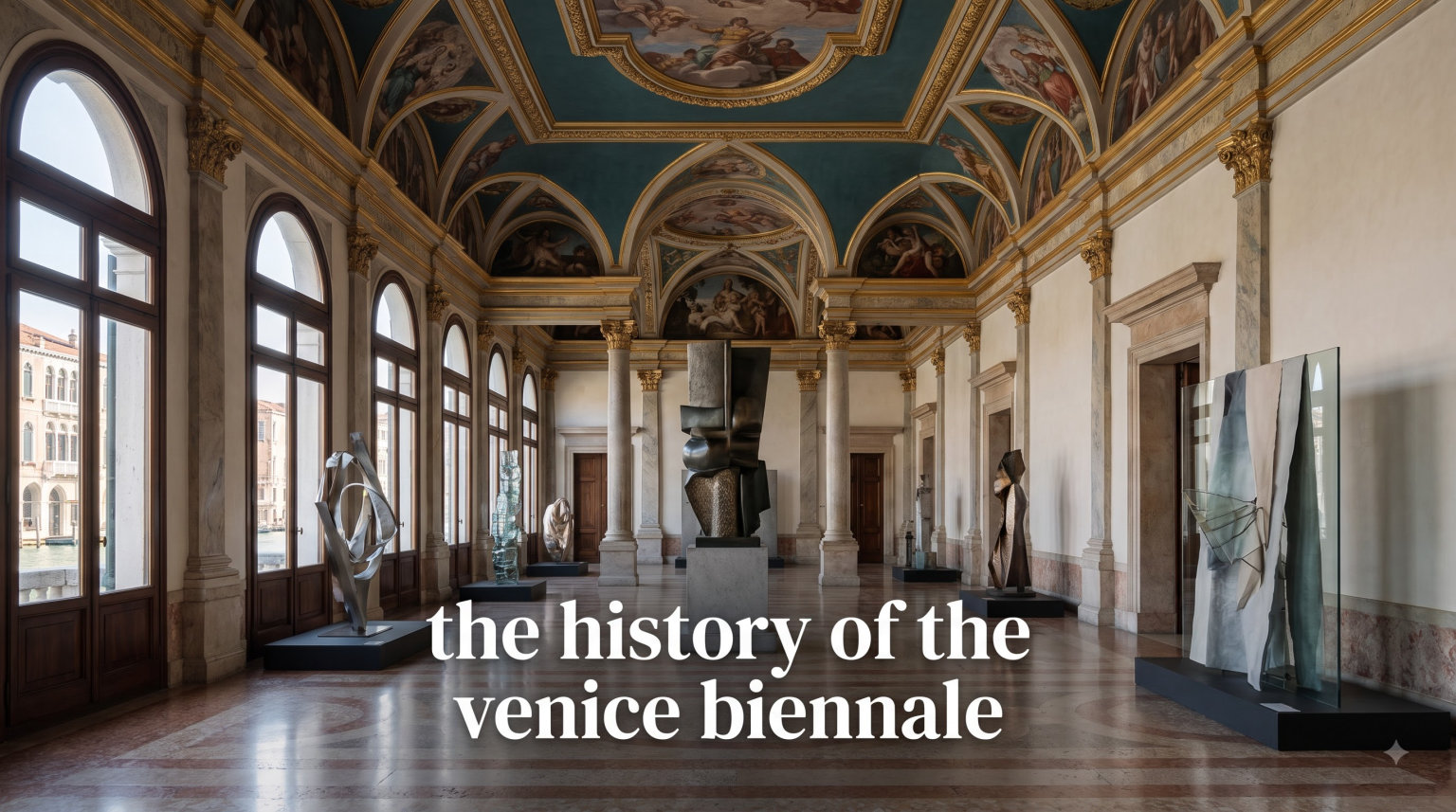
Standing inside the Giardini della Biennale on a warm May morning, surrounded by pavilions from dozens of nations, I found myself wondering how this all began. The Venice Biennale: Everything You Need to Know is one thing, but truly understanding the history of the Venice Biennale requires going back over 130 years. It is a story that starts with a bold idea from a Venetian mayor, survives two world wars, endures fascist manipulation, and emerges as what many now call the “Olympics of the art world.”
The Venice Biennale has shaped contemporary art in ways no other institution has matched. Since its founding in 1895, it has launched careers, sparked international debates, and drawn millions of visitors to its canals and pavilions. Our team spent weeks digging through archives, historical records, and first-hand accounts to piece together this comprehensive account.
In this guide, I will walk you through every major era of the Biennale, from its origins as a provincial art show to its current status as the world’s most influential cultural institution. Whether you are planning your first visit or simply want to understand why this event matters so much, this article covers the full arc of the Venice Biennale’s remarkable story.
Table of Contents
What Is the Venice Biennale?
The Venice Biennale, officially known as La Biennale di Venezia, is the world’s oldest and most prestigious international contemporary art exhibition. It takes place every two years (hence “biennale,” the Italian word for “biennial”) in Venice, Italy. The event features a central curated exhibition alongside national pavilions where individual countries present their own chosen artists.
Think of it as a global summit for art. Each participating nation operates much like it would at the Olympics, selecting representatives and presenting work in dedicated spaces. The main venues are the Giardini della Biennale, a sprawling park in the Castello district, and the Arsenale, Venice’s historic shipyard complex. Together, these sites host the core of the exhibition, while collateral events spread across the entire city.
Beyond visual art, the Biennale has grown to encompass six separate disciplines: Art, Architecture, Cinema, Dance, Music, and Theatre. Each runs its own festival, sometimes in alternating years. This makes La Biennale di Venezia not just a single event but a year-round cultural institution that has been promoting contemporary arts since the late 19th century.
Origins and Founding of the Venice Biennale
The story begins in 1893, when the Venice City Council passed a resolution to create an international art exhibition. The driving force behind this idea was Mayor Riccardo Selvatico, a playwright and poet who believed Venice needed a cultural event to celebrate its artistic heritage and stimulate the local economy. At the time, Venice was struggling economically, and Selvatico saw an art exhibition as a way to draw wealthy visitors and reinvigorate the city’s cultural standing.
The plan was ambitious: a national biennial exhibition that would bring together artists from across Italy and around the world. Selvatico and his collaborators modeled the idea partly on the great world’s fairs of the era, but with a sharper focus on fine art rather than industrial progress. The city established the event under the name Esposizione Internazionale d’Arte della Città di Venezia, or the International Art Exhibition of the City of Venice.
A special committee was formed to oversee the project. It included prominent Venetian artists, politicians, and cultural figures who worked together to design an exhibition space and recruit participants. The committee chose the Giardini di Castello, a public garden in the eastern part of the city, as the site. Architect Enrico Trevisanato designed the Palazzo dell’Esposizione, a grand neoclassical building that would serve as the central exhibition hall. The building was constructed specifically for the Biennale, a testament to the scale of Venice’s ambition.
The first Venice Biennale opened on April 30, 1895, in the newly completed Palazzo dell’Esposizione. Over 200,000 visitors attended that inaugural edition, a remarkable figure for the time. The exhibition featured works by artists from across Europe, and prizes were awarded to encourage artistic excellence. King Umberto I and Queen Margherita of Italy visited, lending the event immediate royal prestige. From the very start, the Biennale was a popular success, drawing both critics and enthusiastic crowds.
The founding principles were clear: promote new artistic trends, create an international forum for contemporary art, and support living artists. These goals remain central to the Biennale’s mission to this day, even as the event has expanded far beyond what Selvatico and his contemporaries could have imagined.
The History of the Venice Biennale: A Timeline of Major Milestones
Understanding the history of the Venice Biennale means following a timeline that spans more than a century. Below are the key milestones that shaped the institution into what it is today. I have organized these into distinct eras, each defined by the challenges and transformations that marked the period.
1895 to 1914: The Early Years
The first few editions of the Biennale focused heavily on established European academic painting and sculpture. Critics of the early shows complained that the event was too conservative, favoring salon-style presentations over the avant-garde movements gaining momentum across Europe. The exhibition was organized by a committee of Italian academics and officials who tended to favor representational art over experimentation.
Still, attendance grew steadily. By 1901, the Biennale had firmly established itself as a fixture on the European cultural calendar. Artists competed fiercely for inclusion, knowing that a showing in Venice could bring international recognition. The event also became a marketplace of sorts, with collectors and dealers traveling to Venice specifically to discover new talent and acquire works.
In 1907, Belgium became the first country to build its own national pavilion in the Giardini. This set a critical precedent. Other nations soon followed, constructing permanent pavilions that they would own and maintain. By 1914, pavilions from Hungary, Germany, Great Britain, France, and Russia had joined the Giardini landscape. Each pavilion was designed in a style that reflected its nation’s architectural traditions, making the Giardini itself a kind of architectural exhibition. This national pavilion system is one of the defining features that separates the Venice Biennale from every other art exhibition in the world.
The early Biennale also established its awards tradition during this period. Prizes were generous and attracted significant media attention. The Grand Prize, in particular, became a coveted distinction that could make an artist’s reputation overnight. Critics and newspapers across Europe covered the prize announcements with the kind of enthusiasm usually reserved for sporting events.
1914 to 1945: World Wars and the Fascist Period
World War I interrupted the Biennale’s regular schedule. The 1914 and 1916 editions were canceled, and the event did not resume until 1920. When it returned, the atmosphere had changed dramatically. The war had shattered the old European order, and the art world was in flux. New movements like Futurism, Dadaism, and Surrealism challenged every assumption about what art could be.
The Biennale struggled to keep pace with these changes. Conservative selections continued to dominate, frustrating artists and critics who wanted the event to reflect the radical transformations happening in studios across the continent. The 1920s saw growing tension between the Biennale’s traditionalist tendencies and the avant-garde energy of the era.
In the 1930s, the Fascist regime under Benito Mussolini took control of the Biennale, restructuring its governance under an autonomous body called the Ente Autonomo Esposizione Internazionale d’Arte di Venezia, established in 1930. This gave the regime direct influence over exhibition choices and institutional direction. During the fascist period, the Biennale became a tool for propaganda. Exhibition choices reflected the regime’s political priorities, and artists whose work did not align with fascist ideology were often excluded.
Despite this political interference, the 1930s also saw the Biennale expand into new disciplines. The Venice International Film Festival was founded in 1932, becoming the world’s first film festival. The International Music Festival launched in 1930, and the International Theatre Festival followed in 1934. These additions reflected a broader vision of the Biennale as a multidisciplinary cultural institution, even if that vision was being directed by a repressive political regime.
World War II again disrupted the Biennale. The 1942 edition went ahead under difficult conditions, but the event was suspended from 1944 through 1946. Venice itself suffered damage during the war, and the Biennale’s facilities needed significant repair before the exhibition could resume. The institution emerged from the war battered but intact, ready for a new chapter.
1948 to 1967: Postwar Renewal and the Peggy Guggenheim Era
The 1948 Biennale marked a turning point. Director Rodolfo Pallucchini used the postwar edition to introduce European audiences to the major developments in modern art that had been suppressed during the fascist years. It was a deliberate act of cultural reconstruction, using the Biennale’s platform to reconnect Italian and European audiences with the international avant-garde.
The most celebrated moment of the 1948 edition was Peggy Guggenheim’s presentation of her personal collection at the Greek Pavilion. She brought works by Jackson Pollock, Mark Rothko, Mark Tobey, and other Abstract Expressionists to Venice for the first time. This single exhibition changed the trajectory of the Biennale, firmly connecting it to the leading edge of contemporary art and establishing American art as a major force on the international stage. Guggenheim’s collection was so well received that she eventually made Venice her permanent home, and her collection is now housed in the Peggy Guggenheim Collection on the Grand Canal.
Throughout the 1950s and 1960s, the Biennale embraced movements like Abstract Expressionism, Pop Art, and Arte Povera. The event became a battleground for competing artistic ideologies, with critics and curators debating the merits of figurative versus abstract art, European versus American approaches, and individual expression versus political engagement. International participation grew significantly during this period, with new countries establishing pavilions and sending artists for the first time.
The Biennale also began to attract a new kind of visitor during the postwar years. Art dealers, museum curators, and collectors from around the world descended on Venice, turning the exhibition into a major networking event for the global art market. This commercial dimension brought both opportunities and tensions, setting the stage for the upheavals that would follow.
1968 to 1973: Protests and Institutional Crisis
In 1968, student protests erupted across Europe, and the Venice Biennale was not spared. Demonstrators occupied the Giardini, accusing the institution of elitism, commercialism, and complicity with capitalist power structures. The protests were part of a broader wave of social unrest that swept through Italy and the rest of the continent that year, challenging established institutions of all kinds.
The demonstrations forced the Biennale to abandon its prize-giving tradition temporarily and reconsider its relationship with the art market. Protesters argued that the Biennale had become too close to gallery owners and wealthy collectors, serving commercial interests rather than artistic ones. Some demonstrators called for the event to be abolished entirely.
The backlash was severe. Attendance dropped, and the Biennale’s reputation suffered. Between 1969 and 1973, the event underwent a period of deep institutional reflection. The question of whether art should serve aesthetic, political, or social functions was debated intensely, both within the Biennale’s leadership and in the broader cultural press. This era ultimately led to significant reforms in how the Biennale was organized and curated.
1974 to 1998: Reform and the Thematic Era
In 1973, the Italian Parliament reformed the Biennale’s governance structure, creating a new legal framework that gave it greater autonomy from direct government control. The first edition under this new structure took place in 1974 under the presidency of Carlo Ripa di Meana, who used the event as a platform for political and cultural protest against the Chilean military dictatorship. This edition marked a decisive break from the Biennale’s earlier apolitical posture.
The real transformation came in 1980, when the Biennale appointed its first dedicated artistic director for the art exhibition and introduced thematic curation. Instead of simply presenting a collection of works, each edition would now be organized around a central theme chosen by the director. This approach gave the Biennale a sharper curatorial identity and helped it remain relevant in an increasingly crowded field of international art events. The thematic model has been widely copied by biennales around the world since.
Also in 1980, the Biennale expanded into the Arsenale, Venice’s massive medieval shipyard. This addition nearly doubled the exhibition space and allowed for ambitious large-scale installations that would have been impossible in the Giardini alone. The Arsenale’s vast industrial spaces, with their towering brick walls and worn wooden beams, provided a dramatic backdrop that artists embraced. The Architecture Biennale was established the same year, creating a separate platform for architectural discourse that runs in alternating years with the Art Biennale.
The 1990s brought further institutional changes. In 1998, the Italian government reformed the Biennale once again, transforming it into a private-law foundation. This gave the institution greater financial flexibility and operational independence. The ASAC (Historical Archives of Contemporary Arts) was also formalized during this period, preserving decades of exhibition documentation and institutional records for researchers and scholars.
1999 to the Present: The Modern Biennale
The 1999 edition, curated by Harald Szeemann, is widely regarded as one of the most influential in Biennale history. Szeemann expanded the exhibition dramatically, bringing in more than 100 artists and using both the Giardini and the Arsenale to their fullest extent. His sprawling, ambitious approach set a new standard for what a Biennale could be. Szeemann was known for his unconventional curatorial style, and his 2001 follow-up edition was equally expansive.
Subsequent years saw the Biennale tackle increasingly global perspectives. Directors like Francesco Bonami (2005), Robert Storr (2007), and Okwui Enwezor (2015) brought fresh curatorial voices that expanded the geographic and thematic reach of the central exhibition. Enwezor’s 2015 edition was particularly notable for its focus on African and postcolonial perspectives, bringing artists and ideas that had been historically underrepresented at the Biennale to the center of the conversation.
The 2017 edition, curated by Christine Macel, emphasized art as a tool for human connection in an age of division. The 2019 edition, curated by Ralph Rugoff, was titled “May You Live in Interesting Times” and took its cue from the political turbulence of the era. Each edition reflected not just the curatorial vision of its director but also the broader cultural and political moment in which it was staged.
The 2020 edition, curated by Cecilia Alemani, was postponed to 2022 due to the COVID-19 pandemic. When it finally opened as “The Milk of Dreams,” it became one of the most successful editions in recent memory, drawing record attendance and widespread critical acclaim for its focus on surrealism and feminist art histories. Alemani was the first Italian woman to curate the International Art Exhibition, a milestone that reflected the institution’s slow but steady progress toward greater representation.
The 2026 edition, the 61st, is curated by Koyo Kouoh and continues the institution’s commitment to expanding whose stories get told on this global stage. Kouoh, who leads the Zeitz Museum of Contemporary Art Africa in Cape Town, brings a perspective rooted in African and diasporic art practices, signaling the Biennale’s continued evolution toward a truly global conversation.
The National Pavilions System
One of the most distinctive features of the Venice Biennale is its national pavilion system. Unlike most art exhibitions, where a single curatorial team selects all participants, the Biennale gives each participating country its own space and lets that country decide what to present. This creates a unique mosaic of artistic perspectives that reflects the geopolitical landscape of the art world.
The Giardini della Biennale hosts 29 permanent national pavilions, each designed and maintained by its respective country. The oldest, as mentioned, is the Belgian Pavilion from 1907. Others followed over the decades: Great Britain in 1909, Hungary in 1909, Germany in 1912, France in 1912, Russia in 1914, Japan in 1956, and the Nordic countries sharing a pavilion since 1962. The architecture of these pavilions ranges from neoclassical temples to bold modernist structures, making the Giardini itself a living exhibition of architectural history.
Because space in the Giardini is limited and has been for decades, most countries now exhibit in the Arsenale or in rented venues scattered throughout Venice. Churches, palazzos, and warehouses across the city are transformed into temporary exhibition spaces during each edition. As of the 2026 edition, approximately 80 to 90 nations participate in each Art Biennale, making it the largest gathering of national representations in the art world.
For visitors, this scale can be overwhelming. Forum discussions consistently highlight that navigating between venues is one of the biggest challenges of attending the Biennale. Understanding how the pavilion system works helps make sense of the experience. The Giardini and Arsenale form the core, but some of the most memorable shows happen in unexpected locations far from the main sites.
The selection process for national pavilions varies widely from country to country. Some nations, like the United States and the United Kingdom, have formal selection committees run by cultural institutions. The US pavilion, for example, is managed by the State Department in partnership with a chosen museum or gallery. Other countries rely on government-appointed panels or open-call processes. Regardless of the method, representing one’s country at the Venice Biennale is considered one of the highest honors in the art world.
Expansion Into Multiple Artistic Disciplines
What began as a visual art exhibition has grown into a multidisciplinary cultural powerhouse. The Venice Biennale now operates six distinct departments, each with its own festival and schedule. This expansion happened gradually over the course of the 20th century, and each new discipline brought its own audience and cultural significance.
The International Music Festival was the first addition, launching in 1930. Originally focused on classical and orchestral works, it has evolved to encompass contemporary composition, experimental sound art, and cross-disciplinary performances. Many important musical premieres have taken place at the Biennale’s music festival over the decades.
The Venice International Film Festival, founded in 1932, is the oldest film festival in the world and remains one of the “Big Three” alongside Cannes and Berlin. It has premiered countless landmark films and continues to be a major industry event each September. The Golden Lion awarded at the film festival is as prestigious in cinema as its art-world counterpart.
The International Theatre Festival followed in 1934, while dance had to wait much longer. The International Festival of Contemporary Dance was not established until 1999, making it the newest of the six disciplines. The International Architecture Exhibition, launched in 1980, has become arguably the most important global platform for architectural discourse, running in alternate years to the Art Biennale.
Each department operates semi-independently, with its own director and curatorial team. The Biennale College, established as a training initiative, supports emerging artists and practitioners across all six disciplines. This educational component reflects the institution’s founding mission to promote new talent alongside established figures. Together, the six departments make La Biennale di Venezia one of the most wide-ranging cultural organizations in the world.
Awards and Recognition: The Golden Lion and Beyond
The awards system at the Venice Biennale carries enormous weight in the art world. Winning a Golden Lion can transform an artist’s career overnight, bringing international attention, gallery interest, and museum acquisitions. The prizes have evolved significantly since the first edition in 1895, when medals and purchase prizes were the standard.
The Golden Lion (Leone d’Oro) is the highest honor. It is awarded in several categories: Best National Participation, Best Artist in the central exhibition, and Lifetime Achievement. The name and form of the lion reference the Lion of Saint Mark, the traditional symbol of Venice. Notable past recipients include Alexander Calder (1952), Jasper Johns (1988), Bruce Nauman (2009), and Simone Leigh (2022). The Lifetime Achievement Golden Lion has been awarded to figures like Louise Bourgeois, Robert Rauschenberg, and Yoko Ono.
The Silver Lion recognizes promising young artists or first-time participants. It has helped launch the international careers of numerous artists who were relatively unknown before their Biennale appearance. The Special Jury Prize and Jury Honorable Mentions round out the official awards. In addition, several independent organizations present their own prizes during the Biennale, adding to the competitive atmosphere.
The awards ceremony has not been without controversy. After the 1968 protests, the Biennale suspended formal prize-giving for several years, viewing the competitive aspect as at odds with the event’s cultural mission. Prizes were reintroduced in 1986 and have remained a central feature since, though the debate about whether art should be judged competitively continues to surface at regular intervals. Is the Venice Biennale prestigious? The answer, judging by the career impact of its awards and the caliber of artists who compete for them, is an unequivocal yes.
Controversies, Protests, and Cultural Impact
The history of the Venice Biennale is inseparable from the political currents that have shaped Italy and the broader world. The fascist period of the 1930s and early 1940s remains one of the darkest chapters in the institution’s history. Under Mussolini’s regime, the Biennale was used to promote state-approved art and exclude voices deemed subversive. Works by Jewish artists and modernist movements were systematically marginalized. The institution has never fully reckoned with this period, though recent scholarship has begun to address it more directly.
The 1968 protests represented another seismic moment. Students and intellectuals occupied the Giardini, denouncing the Biennale as a playground for the wealthy elite and a mechanism for commodifying art. The protests led to a fundamental rethinking of the institution’s purpose and governance. Some reforms were immediate; others took years to implement.
In recent decades, the Biennale has faced criticism on different fronts. Some argue that the national pavilion system reflects outdated geopolitical boundaries, giving undue prominence to European nations with permanent Giardini spaces while relegating newer participants to less visible locations. Others point out that the cost of participating falls disproportionately on smaller or less wealthy nations. The 2026 edition faced its own controversy when several jury members resigned over disagreements about the selection process.
Despite these tensions, the Biennale’s cultural impact is undeniable. It has been instrumental in introducing non-Western artists to global audiences, shifting the center of gravity in the art world away from its traditional European and North American strongholds. The economic impact on Venice itself is significant: the Biennale draws hundreds of thousands of visitors, supporting hotels, restaurants, and cultural tourism across the city. It has also inspired the creation of dozens of biennales around the world, from Sao Paulo to Istanbul to Sharjah, all modeled in some way on the Venice original.
Women and Underrepresented Voices in Biennale History
For most of its history, the Venice Biennale was dominated by male artists, curators, and institutional leaders. The first woman to curate a national pavilion did not appear until the late 20th century, and it took until 2022 for a woman, Cecilia Alemani, to curate the central International Art Exhibition. Her edition, “The Milk of Dreams,” made a deliberate effort to center women and non-binary artists, with the majority of featured artists identifying as female.
This shift was a long time coming. Throughout the 20th century, women artists were consistently underrepresented at the Biennale, both in national pavilions and in the central exhibition. When they did appear, their work was often categorized in ways that marginalized it, relegated to decorative arts or craft rather than treated as fine art on equal footing with their male contemporaries.
The tide has turned in recent editions. The appointment of curators like Okwui Enwezor (2015), who centered African and postcolonial perspectives, and Koyo Kouoh for the 2026 edition reflects a broader institutional commitment to diversifying the voices that shape the Biennale. National pavilions have also made their own progress, with countries increasingly selecting women and artists of color to represent them.
This evolution is not without its critics. Some argue that the focus on representation risks becoming tokenistic, while others contend that the changes have not gone far enough. What is clear is that the Biennale is slowly becoming a more accurate reflection of the global art community it claims to represent, even if there is still considerable distance to travel.
The Venice Biennale Today and Looking Ahead
The 2026 Venice Biennale marks the 61st edition of the International Art Exhibition. Curated by Koyo Kouoh, a curator and writer known for her work at the Zeitz Museum of Contemporary Art Africa, the edition continues the Biennale’s tradition of expanding whose voices are heard. The event has also embraced environmental sustainability as a growing priority, with the institution implementing measures to reduce its carbon footprint and promote sustainable practices across all its departments.
Digital transformation is changing how audiences engage with the Biennale as well. Virtual tours, online archives, and streaming events have made parts of the exhibition accessible to people who cannot travel to Venice. The ASAC digital archive, in particular, has made decades of Biennale history available to researchers worldwide. While nothing replaces the experience of standing inside a pavilion and encountering art in person, these digital initiatives are broadening the Biennale’s reach in meaningful ways.
For those planning to visit, you can learn more about the Venice Biennale including practical tips on tickets, navigation, and making the most of your time in Venice.
FAQs
Why did the Venice Biennale start?
The Venice Biennale was established in 1895 on the initiative of Venice Mayor Riccardo Selvatico and the City Council. Their goal was to create an international art exhibition that would promote contemporary art, celebrate Venice’s cultural heritage, and stimulate the local economy by drawing visitors to the city.
When was the first Biennale in Venice?
The first Venice Biennale opened on April 30, 1895, in the newly built Palazzo dell’Esposizione in the Giardini di Castello (now the Central Pavilion). It attracted over 200,000 visitors during its run.
Is there a Venice Biennale in 2026?
Yes. The 61st International Art Exhibition is taking place in 2026, curated by Koyo Kouoh. It features national pavilions and collateral events across Venice’s Giardini, Arsenale, and city-wide venues.
How often is the Venice Biennale?
The Venice Art Biennale takes place every two years (biennially). The Architecture Biennale runs in the alternating years, so there is a major Biennale event in Venice every single year.
Is the Venice Biennale prestigious?
Yes. The Venice Biennale is widely regarded as the most prestigious international art exhibition in the world, often called the Olympics of the art world. Winning its Golden Lion award is one of the highest honors an artist can receive.
How many days do you need at the Venice Biennale?
Most visitors recommend at least 2 to 3 full days to see the main venues (Giardini and Arsenale) plus a selection of national pavilions and collateral events. Dedicated art enthusiasts often spend 4 to 5 days to experience the full breadth of the exhibition.
Who was dropped from the Biennale artist list?
Selection changes and controversies around artist inclusion or exclusion happen regularly. For the most current information about specific artists at the latest edition, refer to the official La Biennale di Venezia website and art news outlets covering the current cycle.
Conclusion
The history of the Venice Biennale is really the history of contemporary art itself, told through the lens of a single remarkable institution. From a modest Italian art show in 1895 to the world’s most important cultural gathering, the Biennale has survived wars, political upheaval, protests, and pandemics. Each challenge has forced it to evolve, and each evolution has made it stronger.
What makes the Venice Biennale endure, I think, is its fundamental structure. By giving nations their own pavilions and platforms, it creates a genuinely global conversation, one that no single curator or institution could orchestrate on their own. Add the central exhibition, the collateral events, and the millions of visitors who bring their own perspectives, and you have an event that is greater than the sum of its parts.
If you are planning to attend a future edition, or simply want to deepen your understanding of how contemporary art became a truly global phenomenon, the Venice Biennale: Everything You Need to Know guide is a great next step. The history of the Venice Biennale is still being written, and each new edition adds another chapter to this extraordinary story.