
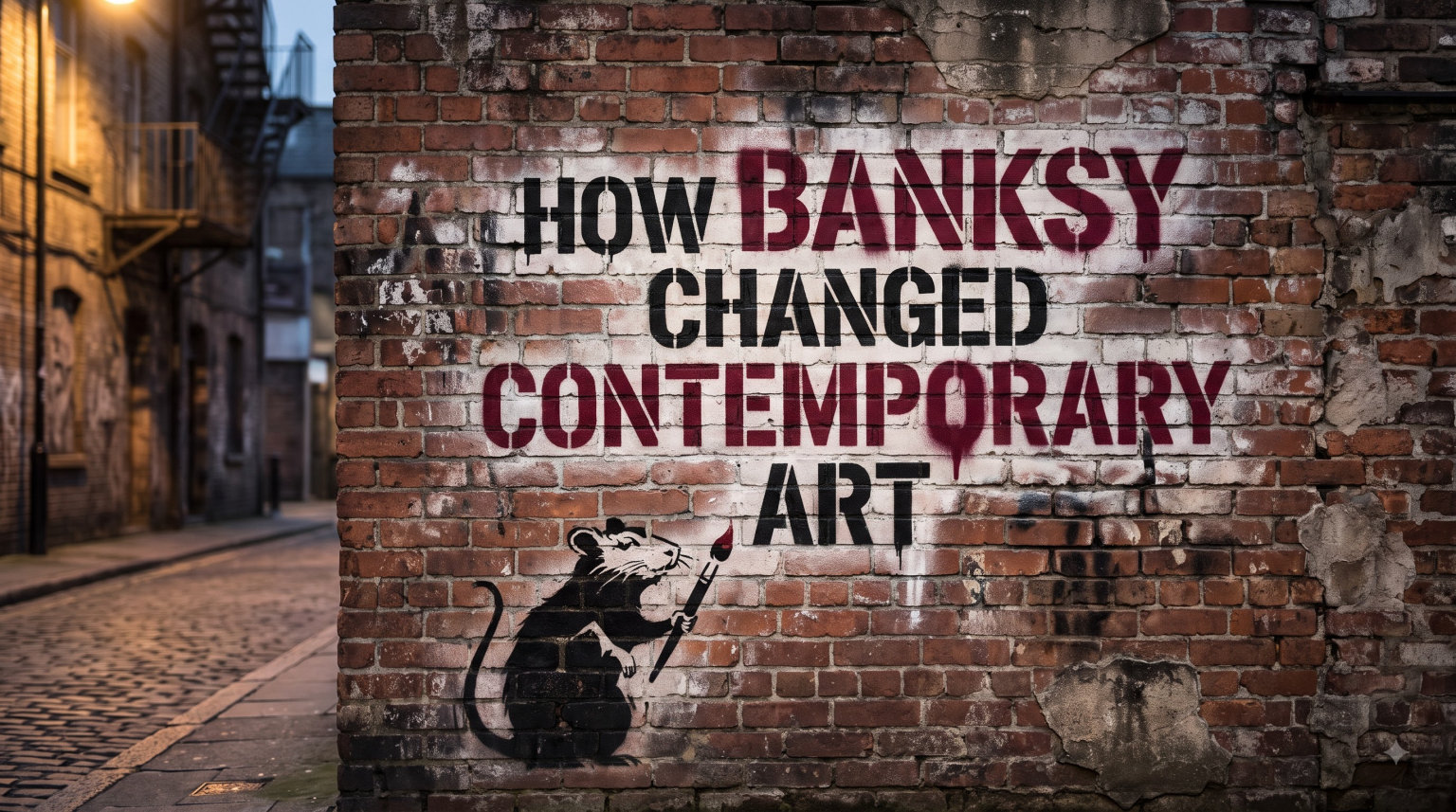
Sometime in the late 1990s, an anonymous teenager began spray-painting stencils on the walls of Bristol, England. Nobody knew the name. Nobody knew the face. But within two decades, that unknown artist would force the entire art establishment to reconsider what counts as art, who gets to make it, and where it belongs. This is the story of how Banksy changed contemporary art — not through gallery submissions or academic credentials, but through walls, spray paint, and an unrelenting refusal to play by the rules.
Banksy’s rise represents one of the most dramatic shifts in art history. Before him, street art was widely dismissed as vandalism — a criminal act, not a cultural statement. After him, the same galleries that once rejected graffiti began auctioning stencil works for millions of dollars. Museums that wouldn’t have displayed spray-painted art now dedicate entire exhibitions to urban art. The transformation wasn’t accidental. It was the result of a specific artistic strategy, relentless consistency, and a deep understanding of how images circulate in the modern world.
In this article, I’ll break down the specific ways Banksy altered the trajectory of contemporary art. I’ll cover the so-called Banksy Effect, his transition from public walls to gallery white cubes, the market revolution his work triggered, and the ongoing paradox of an anti-capitalist artist whose pieces sell for record sums. I’ll also address the criticisms and the questions that keep forums debating late into the night.
Whether you’re an art student writing a paper, a collector trying to understand the market, or simply someone who walked past a Banksy mural and wondered what the fuss was about, this guide covers the full picture of how one anonymous artist reshaped an entire art movement.
Table of Contents
The Banksy Effect: How One Artist Legitimized Street Art
The term “Banksy Effect” was coined by art critic Max Foster in 2007, and it describes a very specific phenomenon: the sudden surge in interest, value, and cultural legitimacy that street art experienced after Banksy achieved mainstream fame. Before Banksy, graffiti and street art existed in a gray zone — legally dubious, culturally marginalized, and financially worthless in the eyes of the traditional art market. After Banksy, urban art became a recognized and highly valued category of contemporary art.
This shift did not happen in a vacuum. Street artists had been pushing for recognition for decades. Jean-Michel Basquiat started as a graffiti writer under the tag SAMO in late-1970s New York before transitioning into the fine art world. Keith Haring created chalk drawings in subway stations that became iconic. Blek le Rat pioneered stencil-based street art in Paris during the 1980s, directly inspiring Banksy’s technique. Shepard Fairey built the OBEY campaign into a global brand. These artists laid the groundwork, but Banksy was the one who broke through the cultural wall separating street art from “serious” art.
What made the difference? Several factors converged at exactly the right time. Banksy’s work was visually accessible — you didn’t need an art history degree to understand what a stencil of a girl reaching for a heart-shaped balloon meant. The simplicity was strategic. As one art critic put it, Banksy’s work is “easily digestible without being overly cryptic and pretentious.” That accessibility drew massive public interest that galleries and auction houses couldn’t ignore.
The timing also mattered. Banksy rose to prominence during the early 2000s, when the internet was transforming how images circulated. A stencil painted on a wall in London could be photographed, uploaded, and viewed by millions around the world within hours. This was new. Before the internet, street art was temporary and local. After the internet, it became permanent and global. Banksy understood this better than anyone and used it to his advantage.
The result was a wholesale reclassification of street art. Cities that once buffed over graffiti began protecting Banksy murals with Perspex covers. Property owners who would have been angry about vandalism found themselves sitting on assets worth hundreds of thousands of pounds. The city of Bristol, Banksy’s hometown, saw tourism increase measurably because of his works. Street art became a cultural commodity, and Banksy was the catalyst. You can see how this transformation fits into the broader history of guerrilla art and artists who transformed public space.
How Banksy Changed Contemporary Art Through Stencil and Satire
Banksy’s primary medium — the stencil — was not chosen by accident. Stencils allow for speed, which matters when your canvas is a public wall and your activity is illegal. But speed is only part of the equation. The stencil produces clean, repeatable images that function like visual slogans. Banksy’s iconography — the rat, the balloon girl, the kissing policemen, the flower thrower — operates as a kind of visual shorthand. You see the image once and you remember it. That’s not accidental. It’s design.
The simplicity of Banksy’s stencil technique serves a deeper purpose. Complex, layered artwork requires time to decode. Banksy’s images hit you immediately. A child releases a heart-shaped balloon into the sky — you feel the loss before you can articulate what it means. A rioter throws a bouquet of flowers instead of a Molotov cocktail — the juxtaposition between violence and beauty is instant. This immediacy is what makes Banksy’s political art so effective. It communicates without requiring translation.
Political and Social Commentary as Core Strategy
Banksy’s work is fundamentally political. Not in the narrow sense of endorsing candidates or parties, but in the broader sense of questioning power, authority, and social structures. His targets include war, capitalism, surveillance, poverty, hypocrisy, and the art establishment itself. A British soldier paints a peace sign on a wall. A shopping cart sits atop a prehistoric skeleton. A chimpanzee holds a sign reading “Laugh now, but one day we’ll be in charge.” The humor is dark, the critique is pointed, and the audience is everyone — not just the art-educated elite.
What separates Banksy’s political commentary from other protest art is the consistency and range. He doesn’t hammer one issue repeatedly. Over more than two decades, Banksy has addressed consumer culture, the Israeli-Palestinian conflict, the refugee crisis, police brutality, climate change, and the absurdity of the art market itself. Each piece feels like a new angle, not a rehash. This breadth has kept his work relevant across multiple political eras and cultural moments.
Iconic Works That Defined the Movement
Several specific works crystallize how Banksy changed contemporary art. Girl with Balloon (2002) became so iconic that it was voted Britain’s favorite artwork in a 2017 poll. Love is in the Bin (2018) — the painting that partially shredded itself moments after selling at Sotheby’s for $1.4 million — was a performance art piece disguised as an auction lot. The Walled Off Hotel in Bethlehem (2017) transformed political commentary into an immersive experience. Dismaland (2015) was a full-scale “bemusement park” that satirized Disney and consumer culture. These weren’t just artworks. They were events that commanded global media attention and forced conversations about art’s role in society.
Banksy’s painting of the “Sweeping It Under the Carpet” maid on a wall in Chalk Farm, London, directly addressed the issue of ignored social problems. His series of rats — an homage to Blek le Rat but also a commentary on the persistence of the unwanted and overlooked — appeared in cities across the world. Each of these works did what great art is supposed to do: they made people see familiar things differently.
From Walls to White Cubes: The Street-to-Gallery Transition
One of the most significant ways Banksy changed contemporary art was by bridging the gap between street art and gallery art — two worlds that had existed in parallel but rarely intersected with mutual respect. Before Banksy, the transition from street to gallery typically meant an artist had “sold out” or abandoned their roots. After Banksy, it became possible to operate in both spaces simultaneously without losing credibility — at least for a while.
The transition wasn’t seamless, and the tension between Banksy’s anti-establishment roots and his commercial success remains one of the most debated topics in art circles. Banksy himself has addressed this paradox repeatedly. His 2006 exhibition “Barely Legal” in Los Angeles featured a painted elephant in the room — literally — as a statement about ignored issues. The show attracted Hollywood celebrities and massive media attention, simultaneously legitimizing Banksy as a fine artist and providing fodder for critics who said he’d joined the system he claimed to challenge.
Banksy’s authentication body, Pest Control, plays a key role in this transition. By controlling which works are authenticated as genuine, Pest Control effectively regulates the market for Banksy’s art. This is a gallery function performed without a gallery — a street artist creating his own institutional framework. It’s a strategy that allows Banksy to participate in the art market without fully submitting to its conventions.
The debate over whether this transition compromises Banksy’s authenticity is ongoing. On Reddit’s r/Banksy and r/ArtHistory forums, users regularly argue about whether commercial success contradicts anti-capitalist messaging. Some collectors and critics note that the very act of selling street art at auction changes its meaning — that a piece created as a public intervention transforms into a luxury commodity when it’s removed from a wall and placed in a salesroom. Others argue that Banksy has used the market itself as a medium, turning art commerce into a form of performance art. The conversation about street art vs gallery art remains one of the central tensions in contemporary visual culture.
What’s undeniable is that Banksy made the gallery world pay attention to street art. Major museums including the Tate Modern, the Museum of Modern Art, and the Bristol Museum have displayed street art, often citing Banksy’s influence. Auction houses like Sotheby’s and Christie’s created dedicated urban art sales categories. This institutional recognition was something previous generations of street artists fought for but never fully achieved at this scale.
The Art Market Revolution: Auction Records and the Shredder
Banksy didn’t just participate in the art market — he detonated it from the inside. The numbers tell part of the story. In 2006, a Banksy work sold at auction for approximately $50,000, which was considered remarkable for a street artist at the time. By 2026, Banksy’s total auction sales had surpassed hundreds of millions of dollars. Individual works have sold for over $25 million. The market for urban art, once nonexistent, became a multi-million-dollar category largely because of Banksy’s success.
The most famous market moment — and perhaps the most Banksy thing Banksy has ever done — occurred on October 5, 2018, at Sotheby’s in London. A framed copy of Girl with Balloon had just sold for $1.4 million when a hidden shredder built into the frame activated, partially destroying the artwork as bidders watched in shock. Banksy later posted a video showing how he had rigged the frame years earlier in case the painting ever went to auction.
Here’s the twist: the partially shredded work, renamed Love is in the Bin, was subsequently valued even higher than the original. It sold again in 2026 for $25.4 million. The shredding, intended as a critique of the art market’s commodification of creativity, actually increased the work’s value. Banksy had turned the act of destruction into a creation event, and the market rewarded him for it. It was simultaneously the most successful critique of the art market ever executed and the most profitable.
This paradox — anti-market gestures that generate market value — is central to understanding how Banksy changed contemporary art. He operates within the system while critiquing it. The art market, in turn, commodifies his critiques, which gives him new material to critique. It’s a feedback loop that has kept Banksy culturally relevant for over two decades.
Banksy vs. Andy Warhol: A Cultural Strategy Comparison
The comparison to Andy Warhol is not casual. Both artists built their careers on mass appeal, mechanical reproduction, and a deep understanding of how images function in consumer culture. Warhol used screen printing to replicate images from advertising and celebrity culture. Banksy uses stencils to replicate political symbols in public spaces. Warhol said everyone would be famous for fifteen minutes. Banksy made anonymity itself a form of fame.
The parallel runs deeper. Warhol’s Factory was a deliberate blurring of art and commerce. Banksy’s Pest Control serves a similar institutional function. Warhol challenged the distinction between high art and commercial production. Banksy challenges the distinction between fine art and illegal public intervention. Both artists understood that the context in which art appears matters as much as the art itself, and both used that understanding to transform what audiences accept as legitimate creative expression.
The key difference is intent. Warhol embraced commercial culture with genuine enthusiasm. Banksy approaches commercial culture with a satirist’s eye. Warhol wanted to be inside the machine. Banksy wants to show you how the machine works. But both ended up in the same place: as artists whose work sells for millions and whose cultural influence extends far beyond the art world.
Anonymity as Artistic Strategy: Why Banksy’s Identity Matters
Banksy’s anonymity is not a marketing gimmick. It’s a core component of his artistic practice and one of the most important ways he differs from nearly every other influential contemporary artist. By remaining unidentified, Banksy forces the audience to engage with the work rather than the personality behind it. There’s no artist statement to parse, no biography to mythologize, no persona to either revere or dismiss. There’s just the image on the wall and what it means to you.
This approach has roots in conceptual art traditions going back to the 1960s, when artists began questioning whether the physical object or the idea behind it was the “real” artwork. Banksy extends this logic: if the idea matters more than the object, then the artist’s identity matters less than the message. His anonymity is the practical application of a theoretical principle.
On forums like Reddit’s r/Banksy, users frequently describe this anonymity as “humble” — the idea that Banksy lets the work speak for itself rather than using personal charisma or celebrity to generate interest. Whether or not humility is the actual motivation, the effect is clear: Banksy’s work has to succeed or fail on its own merits, without the supporting infrastructure of artist biography that most gallery artists rely on.
The mystery also serves a practical purpose. Working illegally on public property is, by definition, a criminal act in most jurisdictions. Anonymity provides legal protection. But it also adds a layer of transgression to every piece — the knowledge that the artist is somewhere out there, uncaught, continuing to work in defiance of the law. This narrative of the outlaw artist is deeply compelling and contributes significantly to Banksy’s cultural cachet.
Over the years, various individuals have been proposed as the “real” Banksy, including Robert Del Naja of Massive Attack and Robin Gunningham from Bristol. None of these theories have been confirmed. Banksy’s team has consistently denied all identification attempts. The ongoing mystery has become part of the work itself — a conceptual piece about the relationship between identity, authorship, and cultural value that has been running for more than twenty years.
Digital Circulation: How the Internet Amplified Banksy’s Reach
One of the most underappreciated ways Banksy changed contemporary art is through his relationship with digital media. Banksy emerged at exactly the moment when the internet was becoming a mass medium for image distribution. His work was almost perfectly designed for this environment: bold, simple images that communicated instantly, reproduced cleanly in photographs, and spread rapidly across social networks.
Consider the difference between Banksy and traditional gallery artists. A gallery artist creates a physical object, places it in a specific room, and expects a limited number of people to visit that room and see it. Banksy creates an image on a public wall, photographs it, and effectively distributes it to the entire world through Instagram, Twitter, news sites, and blogs. A single Banksy stencil might be seen by a few hundred people on the street but millions online. This is a fundamentally different model of artistic distribution.
Banksy’s Instagram account, which has millions of followers, functions as his primary gallery. When he creates a new piece, the first place it appears is on his social media, not on a gallery wall. The internet is not a secondary distribution channel for Banksy. It is the primary one. The physical location of the work is almost secondary to its digital existence.
This digital-first approach has influenced an entire generation of street artists who now create work specifically with Instagram in mind. The composition, the location, the timing of installation — all are optimized for social media impact. Banksy didn’t invent this approach, but he demonstrated its potential more effectively than anyone else. In doing so, he changed not just how street art is distributed but how all art is distributed in the digital age.
The contrast with Andy Warhol is instructive here, too. Warhol understood mass media — television, magazines, advertising — and used it to amplify his reach. Banksy understood digital mass media and has used it to achieve something Warhol never could: global, instantaneous, cost-free distribution of his artistic output. The medium changed, but the strategy — using the dominant communication technology of the era to reach the widest possible audience — remains the same.
Banksy’s Influence on Other Street Artists and the Art World
Measuring an artist’s influence by the work they directly inspire is one of the clearest ways to gauge their cultural impact. Banksy’s influence extends across multiple dimensions: technique, content, distribution strategy, and institutional approach.
Technically, Banksy popularized the multi-layered stencil technique that countless street artists now use. Before Banksy, stencils in street art were relatively simple — single-layer designs sprayed quickly. Banksy developed a method of building complex images through multiple stencil layers, creating works with depth, shading, and detail that rivaled studio paintings. This technique has been widely adopted by street artists worldwide.
In terms of content, Banksy proved that political street art could be both serious and popular. Before his success, there was an assumption in the art world that political art alienated audiences — that people wanted beauty, not critique. Banksy demonstrated that audiences hungered for exactly the opposite: art that addressed the world they actually lived in, with humor and directness rather than academic abstraction. The current wave of politically engaged street artists around the world — from Pixel Pancho in Italy to AmoA in West Africa — owes a direct debt to this demonstration.
Institutionally, Banksy’s success opened doors that had been firmly closed to street artists. Major museums now regularly exhibit urban art. Art schools offer courses in street art practice. Academic conferences dedicate sessions to the aesthetics and politics of graffiti. None of this existed at scale before Banksy. His commercial success created the economic justification for galleries to take street art seriously, and his cultural prestige gave museums permission to display it.
The question of whether Banksy belongs in a discussion of modern or contemporary art is itself revealing. He is unquestionably a contemporary artist — his work engages with current events, uses contemporary media, and exists within the contemporary art market. But his techniques (stencil, spray paint, public installation) and his outsider status connect him to modern art traditions of the avant-garde. The ambiguity is part of what makes him such a significant figure: he doesn’t fit neatly into any category, and that refusal to be categorized has expanded the boundaries of what contemporary art can be.
The Criticism: Has Banksy’s Popularity Neutralized His Message?
Any honest account of how Banksy changed contemporary art has to address the criticism. Banksy is not universally admired, and some of the most thoughtful critiques come from within the art world itself.
The most common criticism is that Banksy’s enormous popularity has neutralized his political critique. When a painting criticizing capitalism sells for $25 million, the critique becomes part of the system it attacks. When a stencil about police brutality appears on a $40 tote bag, the political message is diluted into fashion. Critics argue that Banksy’s work has become what Theodor Adorno would call “culture industry” product — rebellious imagery that ultimately reinforces the status quo by giving consumers the feeling of dissent without requiring actual dissent.
On Reddit’s r/changemyview, users have posted threads with titles like “Banksy isn’t doing anything truly profound” and “Banksy’s popularity means his art no longer belongs on the street.” These critiques echo concerns voiced by art critics for years: that Banksy’s simplicity, while accessible, is also simplistic. That his political commentary, while well-intentioned, lacks the depth and nuance of genuinely radical art practice. That his anonymity, while intriguing, functions as a brilliant marketing strategy rather than a genuine artistic statement.
There’s also the question of whether Banksy’s success has been good for street art as a whole. Some graffiti writers and street artists argue that Banksy’s fame has drawn attention to the wrong aspects of the culture. Traditional graffiti values style, skill, risk, and neighborhood identity. Banksy’s conceptual, image-driven approach shifted the focus from craft to concept, from local community to global audience, from artistic skill to media strategy. For purists, this represents a dilution of the form rather than an elevation of it.
But these criticisms, while valid, don’t negate Banksy’s impact. They are evidence of it. An artist who generates this level of sustained critical engagement — who provokes decades of debate about the relationship between art and commerce, rebellion and co-option, public space and private property — has already demonstrated extraordinary cultural significance. Whether you see Banksy as a genuine iconoclast or a skillful brand manager may depend on your relationship with the art market itself. What’s beyond dispute is that he changed the conversation.
Frequently Asked Questions About Banksy and Contemporary Art
How has Banksy’s work impacted the art world?
Banksy impacted the art world by legitimizing street art as a respected contemporary art form, creating a lucrative urban art market, forcing museums and galleries to display graffiti-based work, and demonstrating that political art can achieve mass appeal without losing its critical edge. His auction successes have generated hundreds of millions in sales, and his cultural influence extends far beyond traditional art circles.
Is Banksy modern or contemporary?
Banksy is a contemporary artist. Contemporary art refers to art produced from the 1970s to the present, and Banksy’s work engages directly with current political events, uses modern digital distribution methods like Instagram, and operates within today’s art market. His techniques share some connections with modern art avant-garde traditions, but his practice is firmly rooted in the contemporary period.
How does Banksy’s art impact society?
Banksy’s art impacts society by making political and social commentary accessible to the general public through visually simple but conceptually rich images. His works have sparked conversations about war, capitalism, surveillance, and inequality. His public installations bring art to people who might never visit a gallery, and his viral digital presence ensures his messages reach global audiences instantly.
What is Banksy’s most controversial piece?
Banksy’s most controversial piece is widely considered to be Love is in the Bin (2018), the painting that partially shredded itself moments after selling at Sotheby’s auction for $1.4 million. The act was a direct critique of the art market’s commodification of creativity, but it paradoxically increased the work’s value to $25.4 million at its next sale. Other controversial works include his Walled Off Hotel in Bethlehem and Dismaland, his anti-theme park installation.
Why is Banksy considered controversial?
Banksy is considered controversial because his work is created illegally on public and private property, his anti-capitalist messaging conflicts with his commercial success, his anonymity challenges traditional notions of artistic authorship, and his simplicity divides critics who see it as either accessible genius or superficial design. The tension between his outsider status and his establishment success generates ongoing debate.
How does Banksy art subvert contemporary art practices?
Banksy subverts contemporary art practices by removing the gallery gatekeeper, distributing his work directly to the public through walls and social media, using illegal installation as a form of artistic statement, and turning the art market itself into subject matter for critique. His shredder stunt literally destroyed a work during its own sale, making the act of commerce part of the artwork.
Why Banksy’s Impact on Contemporary Art Endures
Understanding how Banksy changed contemporary art means looking at the full arc of his influence. He legitimized a marginalized art form, built a market where none existed, proved that political art could reach mass audiences, and used anonymity as a conceptual strategy that keeps his work focused on ideas rather than personality. He connected street culture to gallery culture in a way that previous artists attempted but never achieved at this scale.
The most remarkable thing about Banksy’s impact is its consistency. For over two decades, he has maintained a level of cultural relevance that most artists struggle to sustain for even a few years. Each new piece generates global coverage. Each market event forces a reckoning with the contradictions of art and commerce. Each anonymous intervention raises questions about ownership, public space, and the purpose of visual culture.
Banksy changed contemporary art not by making better art than everyone else but by making art that circulates differently, reaches further, and provokes more debate than what came before. Whether that constitutes a permanent shift or a temporary disruption remains to be seen. But the evidence so far suggests the change is structural. Street art is now a permanent part of the contemporary art landscape, and that is largely because one anonymous artist from Bristol refused to stay on the wall.
For further reading on this topic, explore our guides to what contemporary art is, how street art differs from gallery art, and our list of the most influential contemporary artists working today.