
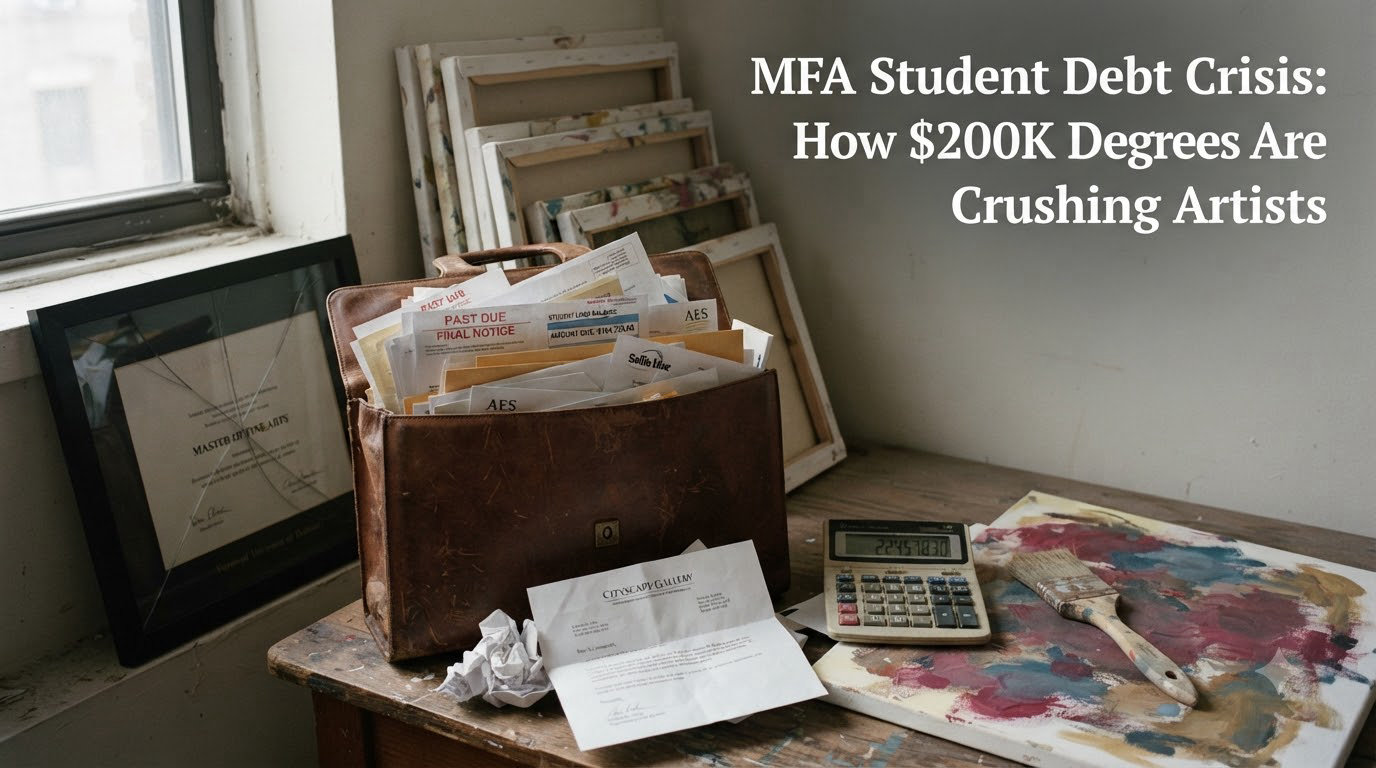
The numbers are staggering. A Master of Fine Arts graduate from Columbia University walks away with a median debt of $171,000 if they studied film, or $135,000 if they studied theater. That debt burden does not include undergraduate loans, which can push total educational debt past $300,000 for some students. This is the MFA student debt crisis, and it is reshaping the future of American arts education.
I have spent weeks researching this phenomenon, reviewing Department of Education data, reading firsthand accounts from graduates, and analyzing how elite institutions have transformed creative education into a profit engine. What I found should concern anyone who cares about the arts, about education, or about economic justice. The crisis extends far beyond Columbia, touching MFA programs across the country, leaving a generation of artists financially hobbled before their careers even begin.
Table of Contents
The Scope of the MFA Student Debt Crisis
Americans collectively owe $1.75 trillion in student debt, a figure that has grown steadily over the past two decades. While professional degrees like law and medicine often dominate conversations about expensive graduate education, the arts have quietly become another high-debt zone with disproportionately low earning potential. MFA graduates routinely face debt-to-income ratios that would be considered catastrophic in any financial planning context.
The Department of Education’s College Scorecard provides a window into this crisis. At Columbia University’s School of the Arts, theater graduates carry a median debt of $135,000. Their film program graduates from 2017-2018 had median debt of $171,000. These figures represent federal loans only and do not capture private loans, credit card debt, or family loans that many students accumulate.
Compare these debt loads to median earnings. Columbia theater graduates earn a median of approximately $26,000 two years after graduation. Film graduates fare somewhat better but still face a yawning gap between what they owe and what they can realistically earn. The math does not work. It has never worked. Yet programs continue to enroll students who borrow against a future that the data suggests will not materialize.
Other programs show similar patterns. At New York University, the MA in Performance Studies leaves students with around $60,000 in debt. The University of Chicago’s MAPH (Master of Arts Program in the Humanities) costs $62,640 in tuition plus an estimated $30,000 in additional fees and living expenses. The Actor’s Studio at Pace University reports median debt of $138,000 against median earnings of just $26,253 two years after graduation.
These are not outliers. They represent a systemic pattern in arts education where programs charge professional-school prices while delivering earnings outcomes that resemble those of entry-level service positions. The MFA student debt crisis is national, it is growing, and it demands attention from policymakers, prospective students, and the institutions themselves.
Real Stories: Graduates Hobbled by Six-Figure Debt
Behind every statistic is a person whose life has been fundamentally altered by the decision to pursue artistic education. I want to share some of their stories because numbers alone cannot convey the human weight of this crisis.
Matt Black graduated from Columbia’s film MFA program with $233,000 in federal loans. After years of interest accumulation, his balance now sits at $331,000. He works in the film industry, earning about $60,000 in good years. In dry stretches, which are common in creative fields, he earns less than half that. His debt has grown despite making payments because income-driven repayment plans often do not cover the full interest accrual on such large balances. The math feels impossible.
Zack Morrison, another Columbia film MFA graduate, carries nearly $300,000 in student debt. He works as a Hollywood assistant, earning between $30,000 and $50,000 per year. Like many graduates, he entered the program believing the Columbia name and network would open doors that justified the cost. He now describes the program as a trap, one that has left him financially constrained while trying to build a career in an already difficult industry.
Grant Bromley earned his MA in Film Studies from Columbia with $115,000 in loans. His balance has grown to $156,000. He works at TJ Maxx for $16 per hour. In his spare time, he works on his third feature film. The juxtaposition is heartbreaking: an artist with graduate training from an Ivy League institution, working retail to survive, cobbling together creative projects in the hours left over from earning enough to cover loan payments and basic necessities.
Christine graduated with an MFA in Books and Paper Arts. Between her undergraduate and graduate education, she accumulated $110,000 in loans that have ballooned to $187,000 with interest. She has been on food stamps twice. She worries about the tax implications of marriage and cannot imagine qualifying for a mortgage. Her education prepared her for a creative career that the market does not seem to want to support, while saddling her with debt that will follow her for decades.
A group of four friends who met in Columbia’s film program calculated their collective debt at $1.5 million. They have started documenting their experiences, hoping to warn others. Their stories echo across Reddit forums, Hacker News threads, and comment sections: young people who believed in the promise of graduate education, who followed their passion into debt loads that now feel like financial life sentences.
The mental health toll is significant. Forum discussions reveal graduates describing themselves as traumatized, anxious, depressed, and betrayed. They report shame about their debt, difficulty discussing it with family, and the isolating burden of carrying a secret that affects every life decision. Several mentioned suicidal ideation when confronting the reality of their loan balances. This is not just a financial crisis. It is a public health crisis among creative workers.
Which MFA Programs Are the Worst Offenders
Not all MFA programs are created equal, and understanding the variation is crucial for anyone considering graduate study in the arts. Some programs have built sustainable models. Others have become what critics call cash cows, generating significant revenue for universities while leaving graduates with unsustainable debt.
Columbia University has received the most scrutiny, largely due to excellent investigative reporting by the Wall Street Journal. Their analysis found that Columbia ranks among the worst institutions for graduate debt outcomes across multiple programs. The School of the Arts operates with acceptance rates around 21%, significantly higher than peer programs like Yale Drama School, which accepts only about 5.4% of applicants. Higher acceptance rates mean more tuition revenue. They also mean more graduates competing for scarce jobs.
The University of Chicago’s MAPSS (Master of Arts Program in the Social Sciences) and MAPH (Master of Arts Program in the Humanities) programs cost approximately $62,640 in tuition, with total costs approaching $100,000 when fees and living expenses are included. These one-year programs pack intensive coursework into a short timeframe but leave students with debt loads comparable to two-year programs elsewhere. The compressed timeline can make it difficult for students to work while studying, increasing reliance on loans.
NYU’s Performance Studies MA has drawn criticism for similar dynamics. The program sits within a university with enormous cultural capital in the arts, which attracts students hoping to leverage that reputation into career opportunities. Yet the debt loads reported by graduates suggest the prestige premium may not translate into earnings that justify the cost.
The Actor’s Studio at Pace University exemplifies the worst debt-to-earnings ratios found in arts education. With median debt of $138,000 and median earnings of $26,253 two years after graduation, the math is stark. Graduates owe more than five times their annual earnings, a ratio that would be considered predatory in almost any other lending context.
By contrast, some programs have deliberately structured themselves to avoid burdening students with debt. Yale Drama School eliminated tuition and began providing students with stipends, creating a model that demonstrates viable alternatives exist. The question is not whether arts education can be affordable, but which institutions have chosen to make it so and which have prioritized revenue generation over student welfare.
Why This Happens: The Cash Cow Problem
To understand how we arrived at this crisis, we need to look at the structural incentives that drive graduate arts education. Universities face pressure to grow revenue. Graduate programs offer an attractive pathway because they can charge professional-school tuition rates while operating with minimal instructional costs compared to laboratory sciences or other expensive fields.
The term cash cow gets used frequently in discussions about MFA programs. It refers to programs that generate substantial tuition revenue for universities while requiring relatively little investment in facilities or resources. A film program needs some equipment and editing suites. A theater program needs rehearsal space. Compared to a medical school or engineering laboratory, these costs are modest. Yet tuition rates often approach or match those of far more resource-intensive programs.
Administrative bloat compounds the problem. Universities have expanded their administrative ranks significantly over the past two decades, adding layers of bureaucracy that increase costs without necessarily improving educational outcomes. These costs get passed to students through tuition increases. Meanwhile, adjunct faculty who actually teach many graduate courses often receive minimal compensation, creating a stark disconnect between what students pay and what supports their direct educational experience.
Columbia University owns over $10 billion in Manhattan real estate. Their endowment exceeds $13 billion. Yet when students raised concerns about debt burdens, former president Lee Bollinger reportedly suggested that struggling graduates could walk dogs for extra income. The comment became infamous, symbolizing an administration perceived as indifferent to student suffering. It suggested a worldview in which elite education was a privilege worth any price, and those who could not afford it simply needed to hustle harder.
Marketing materials from these programs often emphasize alumni networks, industry connections, and career support. They feature success stories of graduates who have achieved notable careers. What they rarely disclose are the debt loads of the majority of graduates or the median earnings of recent cohorts. Students make decisions based on incomplete information, optimistically assuming they will be among the successful outliers rather than the statistical norm.
This information asymmetry means that prospective students cannot make truly informed decisions. They do not know, when they apply, that only 4 out of 55 students in a Columbia film cohort might make sustainable careers in the industry. They do not see data on the mental health impacts of carrying $200,000 in debt while working retail. They see famous alumni and assume the program created those successes, not recognizing the role of family wealth, prior connections, and simple luck in artistic careers.
The Human Cost: Dreams Deferred and Lives Changed
The financial numbers tell only part of the story. The human impact extends into every corner of graduates’ lives, reshaping their relationships, their mental health, their career trajectories, and their sense of possibility.
Marriage becomes complicated when one partner carries six figures of student debt. The loans follow the borrower, meaning a spouse may find their financial future tied to educational decisions made before they met their partner. Some graduates delay marriage indefinitely, unsure how to navigate joint financial planning when their debt load effectively negates any savings they might contribute. Others marry but keep finances separate, creating distance in relationships that might otherwise have been fully integrated.
Home ownership feels impossible for many. With debt-to-income ratios that would disqualify them from mortgages, graduates find themselves permanently renting in an era of rising housing costs. The wealth-building path that previous generations took for granted remains closed. Every rent payment reminds them of money that could have gone toward equity, had their financial situation been different.
Parenthood decisions get deferred or abandoned. Raising children is expensive. Doing so while making income-driven repayment plan payments on $200,000 in loans feels insurmountable. Some graduates explicitly state they have given up on having children because of their debt. Others worry about passing financial stress to the next generation, breaking cycles of poverty that education was supposed to help them escape.
The career constraints are equally profound. Artists with graduate training end up working at TJ Maxx, as baristas, as dog walkers, or in other survival jobs that have nothing to do with their training or ambitions. They create their art in the margins of time left over from earning enough to cover loan payments. The dream of being a working artist gets replaced by the reality of being a retail worker who used to make art.
Mental health deteriorates under this pressure. Forum discussions reveal graduates describing panic attacks when checking loan balances, depression about their financial futures, and shame that keeps them isolated from family and friends. Some report feeling they were tricked, lied to, or exploited by institutions they trusted. The trauma of that betrayal compounds the practical stress of managing impossible finances. Several mentioned that their debt felt worse than any career rejection they had experienced.
Alternatives and Solutions: Paths Forward
The crisis is severe, but it is not without solutions. For prospective students, for current graduates struggling with debt, and for institutions willing to change, paths forward exist. They require honesty, structural reform, and individual advocacy.
The most important advice for anyone considering an MFA is simple: do not attend unless the program is fully funded. Fully funded MFA programs cover tuition and provide a stipend for living expenses. They exist across the country in creative writing, studio art, theater, and other disciplines. Yale Drama School eliminated tuition entirely and now provides students with stipends. Other programs, while not as generous, offer tuition remission and teaching assistantships that make attendance financially viable.
Research actual career outcomes before applying. The Department of Education’s College Scorecard provides median debt and earnings data for many programs. Ask programs directly for placement rates and career outcomes. If they will not provide this information, treat that as a red flag. Contact recent graduates through LinkedIn or alumni networks. Ask them directly about their debt loads and earnings. Do not rely on marketing materials or famous alumni from decades past.
For those already carrying significant MFA debt, several strategies exist. Income-driven repayment plans cap monthly payments at a percentage of discretionary income and promise forgiveness after 20-25 years. The current administration has made efforts to improve these programs, though implementation has been inconsistent. Public Service Loan Forgiveness offers forgiveness after 10 years of payments for those working in government or nonprofit sectors. While artists may not always qualify, teaching at public schools or working for arts nonprofits can create eligibility.
Some graduates pursue strategic refinancing, though this requires caution. Refinancing federal loans into private loans eliminates access to income-driven repayment and forgiveness programs. For those with stable, higher earnings, refinancing might reduce interest rates. For those in precarious creative careers, keeping federal protections often makes more sense despite higher rates.
At the institutional level, reform requires transparency and accountability. Programs should be required to disclose median debt, median earnings, and placement rates to all applicants. They should face consequences for misleading marketing. Federal student aid policies could be adjusted to limit borrowing for programs with consistently poor outcomes, protecting students from predatory lending practices.
Collective action matters. The graduates documenting their experiences, organizing online, and demanding accountability are creating pressure for change. Faculty members at several institutions have spoken out about their concerns, though they often face retaliation. Alumni networks can withhold donations until debt burdens are addressed. Prospective students can vote with their applications, choosing fully funded programs over expensive alternatives.
FAQs: Your Questions About MFA Student Debt Answered
What degree has the highest student loan debt?
Professional degrees in medicine, dentistry, and veterinary medicine often carry the highest absolute debt loads. However, when considering debt-to-earnings ratios, MFA and other arts degrees rank among the worst. Columbia MFA film graduates carry median debt of $171,000 while earning median salaries around $30,000-$60,000, creating debt-to-income ratios that exceed even medical school graduates’ burden relative to their earnings.
How long will it take to pay off $100,000 in student loans?
Paying off $100,000 in student loans typically takes 10-25 years depending on your repayment plan and income. On a standard 10-year plan with 6% interest, monthly payments would be approximately $1,110. Income-driven repayment plans extend this to 20-25 years with lower monthly payments but result in significantly more total interest paid. For MFA graduates earning $30,000-$50,000, income-driven repayment is often the only viable option, meaning they may carry the debt for decades.
How many students have borrowed over $200,000 for college?
According to federal data, approximately 3% of all student loan borrowers owe more than $200,000. While this is a relatively small percentage of the total 43 million borrowers, it represents over 1 million people carrying crushing debt loads. Among graduate students in arts programs at elite institutions like Columbia, NYU, and the University of Chicago, six-figure debt has become the norm rather than the exception.
Is $200,000 in student debt a lot?
Yes, $200,000 in student debt is an enormous burden for most people. For context, the median student debt for all borrowers is around $30,000. A $200,000 debt load, especially at typical federal loan interest rates of 5-7%, generates approximately $10,000-$14,000 in interest per year. Without payments covering this interest, the balance grows indefinitely. For MFA graduates earning $30,000-$50,000 annually, this debt level effectively prevents home ownership, delays family formation, and requires decades of payments.
Do Americans owe $1.75 trillion in student debt?
Yes, Americans collectively owe approximately $1.75 trillion in student loan debt as of 2026. This figure includes both federal and private loans held by roughly 43 million borrowers. Graduate students, including MFA recipients, represent a disproportionate share of high-balance debt, with those owing over $100,000 holding a significant portion of the total despite being a minority of borrowers. The MFA student debt crisis represents a concentrated example of broader systemic issues in graduate education financing.
Is an MFA worth the debt?
For most students, an MFA is not worth taking on significant debt. Unless attending a fully funded program that covers tuition plus provides a stipend, the debt-to-earnings math rarely works in arts fields. Median salaries for MFA graduates range from $26,000 to $60,000, while debt at many programs exceeds $100,000. The exception may be for those with guaranteed employment prospects, such as a tenure-track teaching position awaiting them, or those attending programs like Yale Drama School that eliminated tuition entirely.
Conclusion: Awareness and Action
The MFA student debt crisis represents a failure of institutional responsibility, a breakdown of information transparency, and a profound injustice to a generation of artists who trusted that education would expand their possibilities rather than constrain them. The $200,000 degrees that adorn walls in apartments shared by roommates also hang like millstones around graduates’ financial futures.
We must demand better from institutions that profit from student dreams. We must create and support fully funded alternatives that make arts education accessible without indenture. We must provide honest information to prospective students so they can make truly informed decisions. And we must support those already burdened by this debt, advocating for policy reforms that offer meaningful relief.
If you are considering an MFA, let the stories in this article guide you. Do not attend programs that will burden you with six-figure debt. Seek out fully funded alternatives. Talk to recent graduates about their actual financial situations. And remember that artistic excellence does not require an expensive credential. It requires practice, dedication, and community, all of which can be found outside the walls of institutions that would profit from your passion.
The crisis is real. The numbers are staggering. But awareness is the first step toward change. Share this information with anyone considering graduate study in the arts. Support reforms that hold institutions accountable. And believe that a different model is possible, one in which artists can pursue their craft without sacrificing their financial futures.