
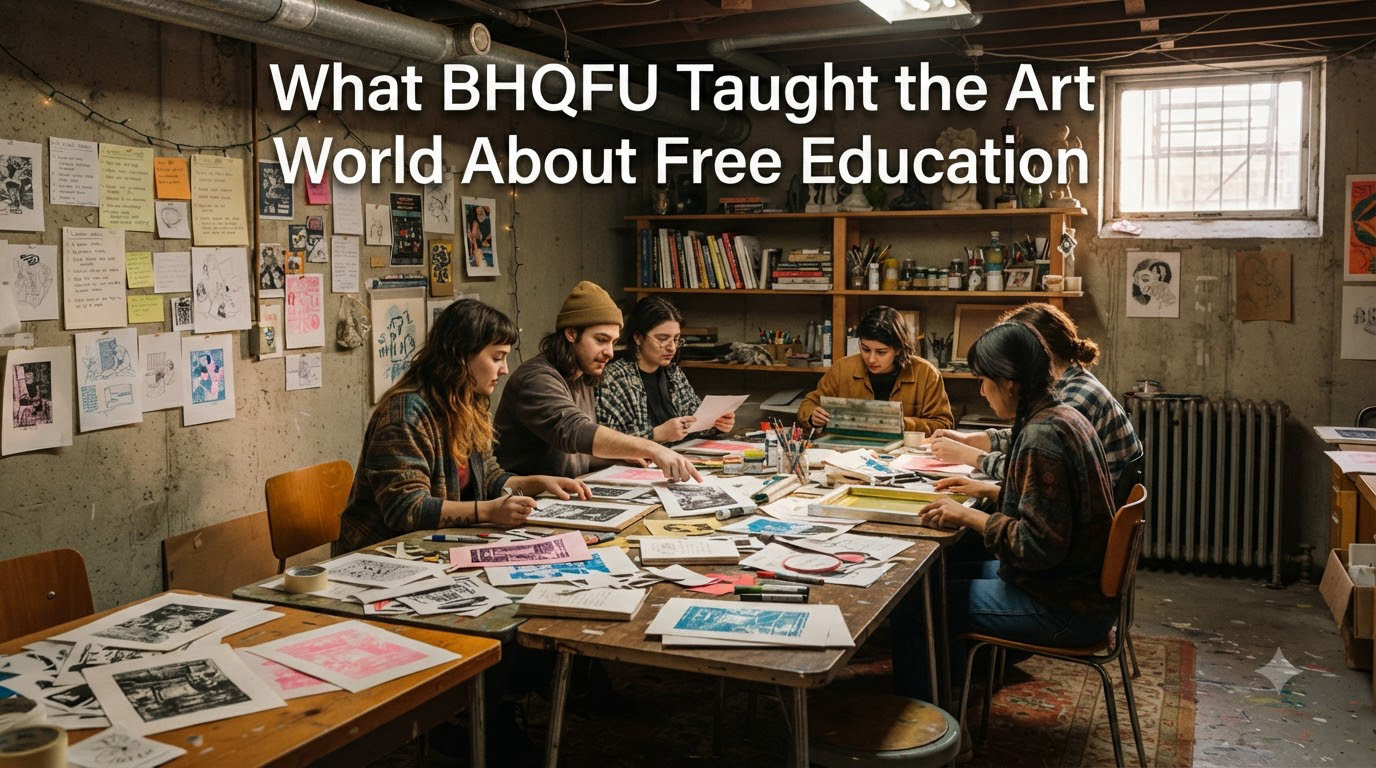
Imagine walking into an art school where nobody asks for your portfolio. No tuition bills arrive in the mail. The teachers are working artists who might become your students next week. This was BHQFU — the Bruce High Quality Foundation University — and for eight years, it served as a radical experiment in what art education could look like when you removed money from the equation.
I have spent years studying alternative education models, and BHQFU stands out as one of the most provocative attempts to reinvent art pedagogy in recent memory. Founded in 2009 by an anonymous collective of Cooper Union graduates, this free, unaccredited art school challenged every assumption about how artists should learn their craft. The lessons it left behind continue to resonate in 2026 as debates about student debt, accessibility, and the value of formal credentials intensify.
In this article, I will explain what BHQFU free education really meant in practice, how it compared to traditional MFA programs, and what the art world learned from its bold experiment. Whether you are an aspiring artist weighing educational options, an educator seeking new models, or simply curious about alternative approaches to creative learning, the story of BHQFU offers insights that remain relevant today.
Table of Contents
What Was BHQFU? The Founding of an Alternative Art School
BHQFU — short for Bruce High Quality Foundation University — was founded in 2009 by the Bruce High Quality Foundation, an anonymous art collective based in Brooklyn, New York. The collective itself emerged from a group of Cooper Union graduates who adopted the fictional identity of “Bruce,” a truck driver who supposedly died in the attacks of September 11, 2001. This fictional backstory served as both memorial and critique, establishing the collective’s tone of institutional subversion from the start.
The university grew directly out of the collective’s dissatisfaction with traditional art education. Having experienced Cooper Union when it still offered free tuition, the founders watched with dismay as their alma mater moved toward charging fees. They asked a simple but radical question: could free art education exist entirely outside institutional structures? Their answer became BHQFU, a 501(c)(3) nonprofit organization that operated as an artist-run school offering courses at no cost to students.
From its headquarters in Brooklyn, BHQFU quickly developed a reputation as a genuine alternative to expensive MFA programs. Unlike traditional art schools with their administrative hierarchies and accreditation requirements, BHQFU embraced what they called a “self-generated curriculum model.” Students could propose courses. Teachers could become students. The lines between learner and educator blurred intentionally, creating a peer-driven environment that emphasized collaborative learning over credentialing.
The Educational Philosophy: Joseph Beuys and Social Sculpture
To understand BHQFU, you need to understand Joseph Beuys. The German artist and educator pioneered the concept of “social sculpture” — the idea that society itself could be shaped and transformed through creative action. Beuys believed that every person possessed creative capacity and that education should unlock this potential rather than filter students through gatekeeping mechanisms. His famous declaration that “everyone is an artist” became a foundational principle for BHQFU.
The BHQFU collective explicitly cited Beuys as a major influence on their educational philosophy. In the ART21 Magazine profile from 2010, they stated that creating a free school run by artists “is certainly an impressive start and, if we judge it by Beuys’s standards, is an art form in itself.” This framing mattered. BHQFU did not see itself merely as an educational institution. They understood the school as an artwork — a living social sculpture that enacted its critique of the art school system through its very existence.
This philosophical grounding shaped every aspect of BHQFU’s operations. The school rejected the “hegemony of critical solemnity” that the collective associated with traditional MFA programs. They dismissed the “market-mediocre despair” they felt characterized much contemporary art discourse. Instead, they fostered an egalitarian practice where students and teachers met as peers, where critique sessions felt like conversations rather than judgments, and where the goal was not to produce professional artists for the commercial market but to cultivate creative thinking and community engagement.
The anti-accreditation stance was not merely symbolic. By refusing to pursue formal accreditation, BHQFU removed the bureaucratic burden of assessment, grades, and degree conferral. This freed both teachers and students to focus on the actual work of making and discussing art. Students attended because they wanted to learn, not because they needed credits. Teachers taught because they believed in the material, not because they had to fulfill curriculum requirements. The absence of credentials paradoxically created space for genuine education.
What BHQFU Actually Taught: Courses and Classroom Experience
BHQFU’s course offerings defied conventional art school categories. During its partnership with MoMA Teens in 2016, the school ran workshops with titles like “Institutional Critique + Critical Pedagogy,” “Performance Art + Pop Art,” “DIY Video + Set Design,” “Artist Books + Self-Publishing,” “Collage + Media Literacy,” and “Psychic Intuition + Alchemy.” These hybrid categories — combining art historical movements with practical skills and even mystical concepts — reflected the school’s unwillingness to separate theory from practice or dismiss unconventional approaches.
The classroom experience at BHQFU differed fundamentally from traditional studio courses. In the MoMA Teens program documented in 2016, students participated in ten-week intensive workshops that promised “a BFA’s worth of art” in condensed form. The approach was hands-on and immediate. Students wore distinctive “camo vests” that identified them as BHQFU participants, creating visual cohesion and group identity. They earned “merit badges” for completing courses, gamifying education without the pressure of grades.
The emphasis on accessibility shaped the pedagogy. Because courses were free and enrollment was not competitive in the traditional sense, BHQFU could welcome students who might never gain admission to prestigious MFA programs. This demographic diversity enriched classroom discussions and critiques. Students brought perspectives from outside the art world bubble, challenging the assumptions that often go unexamined in elite institutions.
Workshop descriptions from the MoMA partnership reveal the pedagogical approach. In the “DIY Video + Set Design” workshop, students combined video production with set construction, learning both technical and spatial skills simultaneously. The “Artist Books + Self-Publishing” workshop taught practical skills like bookbinding alongside conceptual questions about distribution and audience. This integration of making and thinking characterized BHQFU’s approach across all offerings.
What BHQFU Taught the Art World About Free Education
The eight-year run of BHQFU yielded lessons that continue to inform discussions about art education in 2026. Based on my analysis of the school’s history, documentation, and closure, these are the key insights the experiment provided:
1. Free education creates different student-teacher dynamics. When students pay nothing and receive no credential, the power imbalance between teacher and learner diminishes. At BHQFU, students felt empowered to challenge instructors, propose alternative approaches, and shape curriculum. This peer-driven model produced more engaged participants than passive lecture formats.
2. Community can substitute for credentialing. BHQFU graduates could not list an MFA on their resumes, but they gained something arguably more valuable: a network of working artists and peers who continued to support each other after courses ended. The school’s emphasis on collaborative learning built lasting communities of practice.
3. Peer learning works for art education specifically. While some fields require expert knowledge transmission, studio art benefits enormously from peer critique and shared discovery. BHQFU’s model of students teaching students capitalized on this dynamic, creating environments where everyone learned from everyone.
4. Institutional critique works better as practice than theory. BHQFU did not just teach about institutional critique as an art movement. It enacted that critique by existing as an alternative institution. Students experienced what different educational structures felt like rather than just reading about them.
5. Art can function as social sculpture. Following Beuys, BHQFU demonstrated that education itself could be an artwork. The school’s operations, its social dynamics, its physical presence — all constituted a living artwork that explored questions of access, power, and creativity.
6. Free models face sustainability challenges. Despite its successes, BHQFU could not sustain itself indefinitely. The 2017 closure revealed that even with volunteer labor and donated space, free education requires resources that can prove difficult to maintain long-term.
7. Alternative models influence mainstream institutions. BHQFU’s partnership with MoMA demonstrated that established institutions could learn from alternative approaches. The collaboration legitimized BHQFU’s methods while exposing mainstream museum education programs to new pedagogical strategies.
Beyond Brooklyn: BHQFU’s International Reach
While BHQFU operated primarily in New York, the collective extended its free education mission internationally through a partnership with the 14+ Foundation. In 2016 and 2017, BHQFU facilitated free art education at the Chipakata Children’s Academy in rural Zambia, focusing specifically on printmaking as an accessible medium that required minimal infrastructure while producing substantial artistic outcomes.
The Zambia project brought established artists including Rashid Johnson and Betty Tompkins to work with local students. Through drypoint engravings and other printmaking techniques, participants created works that were exhibited internationally. This project demonstrated that BHQFU’s educational philosophy could adapt to radically different contexts — rural Africa rather than urban Brooklyn — while maintaining its core commitment to free, hands-on art experiences.
The international expansion also revealed the scalability of BHQFU’s model. Without the requirement for accreditation, formal facilities, or credentialed faculty, the school could operate in temporary spaces with minimal overhead. This flexibility allowed art education to reach communities that would never have access to traditional art schools, extending the experiment’s impact beyond its New York base.
The End of the Experiment: Why BHQFU Closed in 2017
In early 2017, the Bruce High Quality Foundation University announced its closure. The announcement, covered by Artnet News, marked the end of an eight-year experiment in free art education. While the collective cited multiple factors, the closure highlighted the sustainability challenges facing alternative education models.
The “broken toilet” story — referenced in closure reports — symbolized the practical difficulties of maintaining an institution on volunteer labor and minimal funding. Even with passionate participants and donated resources, physical infrastructure requires maintenance. The mundane reality of broken plumbing, unpaid rent, and administrative burnout ultimately proved as challenging to overcome as the philosophical questions the school addressed.
The closure does not invalidate BHQFU’s lessons. In fact, the finite nature of the experiment makes its achievements more remarkable. For eight years, the school provided free art education to hundreds of students who might otherwise have been priced out of creative learning. It demonstrated that alternatives could exist, even if temporarily, and that the art world’s assumptions about education were not immutable.
Since the 2017 closure, elements of BHQFU’s approach have influenced other alternative education initiatives. DIY art education movements, community art programs, and even some traditional institutions have adopted peer-learning models, collaborative curriculum development, and reduced-cost programming inspired in part by BHQFU’s example. The school’s legacy persists in these ongoing experiments.
Frequently Asked Questions About BHQFU
What was BHQFU and when did it operate?
BHQFU (Bruce High Quality Foundation University) was a free, unaccredited art school founded in 2009 by the anonymous Bruce High Quality Foundation art collective in Brooklyn, New York. The school operated for eight years, closing in 2017, and offered collaborative art courses at no cost to students as an alternative to traditional MFA programs.
How did BHQFU differ from traditional art schools?
BHQFU rejected accreditation, tuition, and formal credentialing. Students could propose courses and teachers could become students, creating a peer-driven learning environment. The school emphasized hands-on studio work, collaborative learning, and community engagement rather than preparing students for the commercial art market.
Why did BHQFU close in 2017?
BHQFU closed in 2017 after eight years of operation due to sustainability challenges. Despite volunteer labor and donated resources, the school faced practical difficulties maintaining physical infrastructure and administrative operations. The closure demonstrated the resource challenges facing free education models, even successful ones.
What was Joseph Beuys’s influence on BHQFU?
German artist and educator Joseph Beuys significantly influenced BHQFU through his concept of social sculpture — the idea that society itself could be transformed through creative action. BHQFU explicitly cited Beuys’s philosophy that everyone is an artist and understood the school itself as a social sculpture enacting critique of traditional art education.
Did BHQFU offer accredited degrees?
No, BHQFU was intentionally unaccredited and did not offer degrees or formal credentials. This anti-accreditation stance was central to the school’s philosophy, removing bureaucratic burdens and allowing focus on actual art making and discussion. Students attended because they wanted to learn, not to obtain credentials.
What happened to the Zambia printmaking project?
BHQFU partnered with the 14+ Foundation to offer free printmaking education at the Chipakata Children’s Academy in rural Zambia during 2016-2017. Artists including Rashid Johnson and Betty Tompkins worked with local students on drypoint engravings and other techniques. The project demonstrated that BHQFU’s educational model could adapt to international contexts.
The Lasting Lessons of BHQFU
BHQFU free education proved that alternative art schools could exist, function, and produce meaningful outcomes outside the traditional MFA system. For eight years, the Bruce High Quality Foundation University demonstrated that removing cost and credentialing from education could create different, sometimes better, learning environments. The school’s peer-driven model, its embrace of Joseph Beuys’s social sculpture concept, and its international expansion all showed what was possible when artists took education into their own hands.
The 2017 closure reminds us that experiments have lifespans. BHQFU was not designed to last forever, and its finite nature may be part of what made it successful. Like an artwork with a defined duration, the school’s temporary existence concentrated its impact and preserved its radical character. Had it become permanent and institutionalized, it might have lost the flexibility and critique that defined its value.
In 2026, as art school tuition continues rising and student debt burdens artists before their careers begin, the lessons of BHQFU feel more relevant than ever. The art world learned from BHQFU that free education is possible, that community can substitute for credentialing, and that the institutions we take for granted are choices rather than inevitabilities. Whether future experiments build directly on BHQFU’s model or develop new approaches inspired by its example, the school’s legacy persists in every conversation about making art education accessible to everyone.