
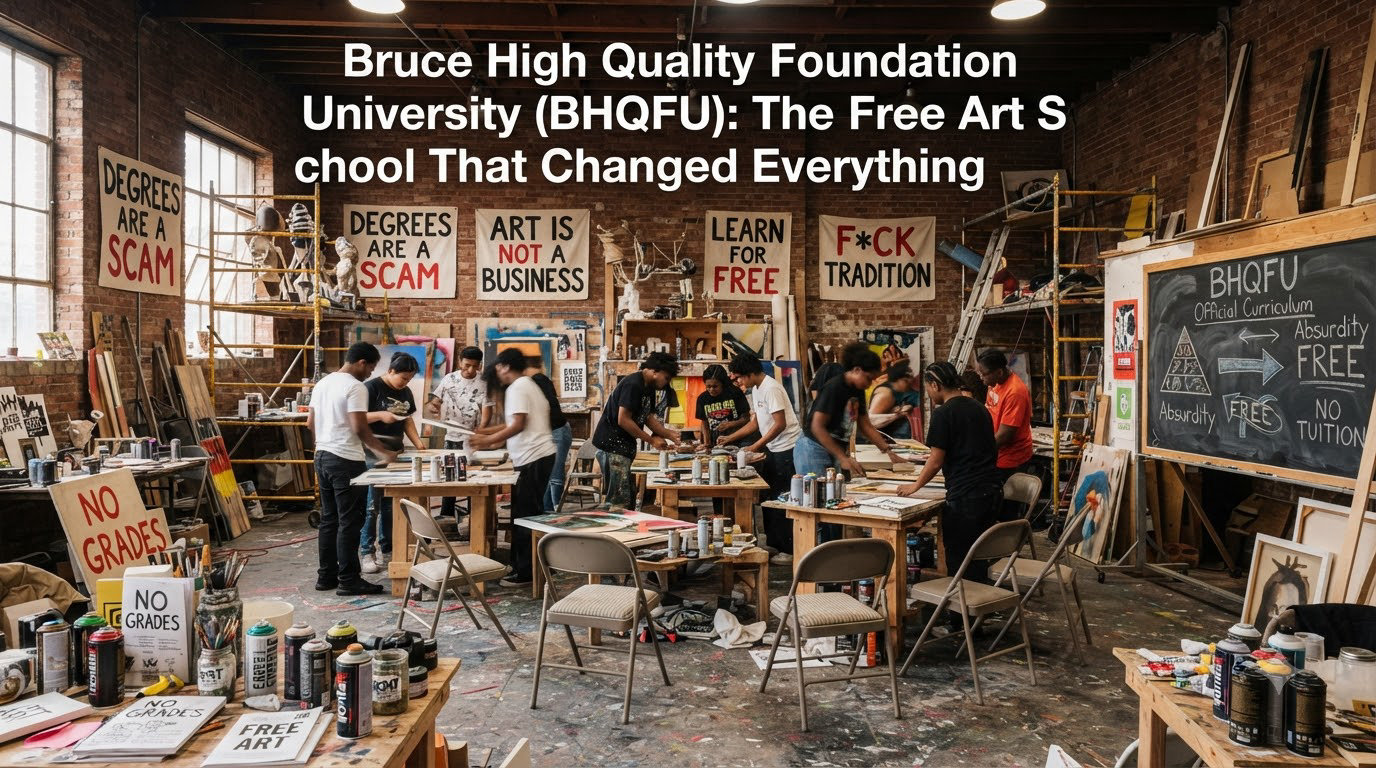
For eight remarkable years, the Bruce High Quality Foundation University offered something that seemed impossible in the contemporary art world: a completely free, MFA-quality education taught by world-class artists. Operating from 2009 to 2017 in New York City, BHQFU represented one of the most radical experiments in alternative art education ever attempted.
I first heard about BHQFU from a friend who had taken classes there in 2013. She described it as “the only art school that made me feel like an artist instead of a customer.” That sentiment captures exactly what made this unaccredited free art school so special. It was not just about the lack of tuition fees. It was about a fundamental reimagining of who art education should serve.
The story of BHQFU matters more today than ever. As art school tuition continues to soar past $50,000 per year at many institutions, the question the Bruce High Quality Foundation asked remains urgent: Who gets to become an artist? Their answer was simple and revolutionary: everyone.
Table of Contents
The Birth of an Art Collective and Its University
The Bruce High Quality Foundation began in 2001 as an artist collective founded by a group of anonymous Cooper Union graduates. Their chosen name came with an elaborate fictional backstory that immediately signaled their subversive approach to the art world.
According to the collective’s mythology, Bruce High Quality was a fictional firefighter and amateur artist who died heroically during the September 11 attacks. The collective formed to preserve his legacy and promote an alternative to everything in the contemporary art world. This blend of sincere tribute and absurdist fiction became their trademark approach.
The collective gained recognition throughout the 2000s for provocative public art projects and institutional critiques. They tackled the Whitney Biennial, staged elaborate performance pieces, and developed a reputation for combining serious art historical knowledge with playful subversion. Their work questioned gatekeeping, celebrity culture, and the commodification of art.
By 2009, the collective decided to expand their critique beyond exhibitions and performances. They wanted to address the most fundamental barrier in the art world: access to education. On September 23, 2009, they launched the Bruce High Quality Foundation University in TriBeCa, Manhattan.
The founding principle was radical in its simplicity. BHQFU would be an unaccredited, free collaborative school where students are teachers are administrators are staff. This was not merely a rejection of tuition fees. It was a complete restructuring of the power dynamics that define traditional art education.
The Cooper Union connection remained central to the university’s identity. Several founding members had attended the prestigious free art school before it began charging tuition in 2014. They had experienced firsthand what happened when financial pressures overtake educational missions. BHQFU was partly an attempt to preserve and extend that disappearing model.
The Revolutionary Free Education Model
BHQFU operated on a premise that sounded almost too good to be true. The school charged absolutely nothing for attendance. There were no application fees, no tuition bills, no hidden costs. This was not financial aid or scholarships. It was simply free.
The unaccredited status was not a limitation but a liberation. Without the bureaucratic requirements of accreditation, BHQFU could structure classes around actual learning rather than credit hours or degree requirements. Students attended because they wanted to learn, not because they needed a transcript.
The collaborative model meant that everyone participated in running the school. Students helped organize exhibitions, maintain the space, and teach classes themselves. This approach recognized something that traditional MFA programs often ignore: students frequently have as much to teach as they do to learn.
Classes met in the evenings and on weekends, making them accessible to people with day jobs. This accessibility was crucial. The founders understood that aspiring artists often cannot afford to quit their jobs to pursue full-time education. By offering high-quality instruction outside standard hours, BHQFU reached people who would never attend traditional art school.
The curriculum blended traditional studio practice with experimental approaches. Students could take classes in figure drawing and oil painting alongside courses in performance art, art theory, and even sketch comedy. This interdisciplinary approach reflected the collective’s belief that art education should not be siloed into rigid categories.
Seth Cameron, who served as BHQFU’s president, described the school’s mission as creating an alternative to formal education for young artists. In interviews, he emphasized that the goal was never to replace traditional MFA programs entirely. Instead, BHQFU offered a different path for those who could not or would not pursue expensive graduate degrees.
The school moved several times during its eight-year existence. After starting in TriBeCa, it relocated to a space on Avenue A in the East Village. Each location reflected the scrappy, resourceful spirit of the organization. The spaces were never fancy, but they were functional and welcoming.
Funding came from grants, donations, and benefit events. The Bruce High Quality Foundation’s reputation helped secure support from arts organizations and patrons who believed in the mission. However, as Seth Cameron later acknowledged, the financial model was always precarious.
World-Class Instructors Who Taught for Free
Perhaps the most astonishing aspect of BHQFU was the caliber of instructors who volunteered their time. The school attracted established, gallery-represented artists who could command thousands for a single talk or workshop. Instead, they showed up at BHQFU to teach for nothing.
David Salle, the renowned painter associated with the Pictures Generation, taught classes at BHQFU. His presence alone signaled that this was not amateur hour. Salle brought decades of professional experience and art historical knowledge to students who could never afford his time otherwise.
Rashid Johnson, now one of the most successful contemporary artists working today, also taught at BHQFU. His work, which spans photography, sculpture, and installation, brought a conceptual rigor to the curriculum. Students learned from an artist actively shaping the contemporary art conversation.
Dana Schutz, known for her bold, figurative paintings that blend abstraction and narrative, shared her studio practice with BHQFU students. Her teaching offered insights into contemporary painting at a time when she was already exhibiting internationally.
Juliana Huxtable brought a different but equally important perspective. As an artist, DJ, and writer working across multiple disciplines, she represented the kind of boundary-crossing practice that BHQFU celebrated. Her classes expanded students’ understanding of what art could be in the digital age.
Brad Troemel, the artist and critic known for his work on internet culture and the art market, taught courses that connected studio practice with critical theory. His presence acknowledged that contemporary artists need to understand not just how to make art but how to navigate the systems surrounding it.
The course offerings reflected this diversity of approaches. Students could take traditional figure drawing classes or experimental performance workshops. There were courses in color theory, art history, and queer studies. The sketch comedy class, in particular, embodied the collective’s belief that humor and serious art practice could coexist.
What made this instruction special was the absence of credentialing pressure. Instructors could teach what they actually believed mattered, not what a curriculum committee mandated. Students could learn without worrying about grades or transcripts. The focus stayed on the work itself.
The Brucennial: An Alternative to the Whitney Biennial
The Brucennial exhibitions represented BHQFU’s most ambitious institutional critique. Starting in 2010, the collective staged massive open-submission exhibitions that functioned as democratic alternatives to the prestigious Whitney Biennial.
Unlike the Whitney Biennial, where a small group of curators selects artists from an already exclusive pool, the Brucennial accepted work from anyone who submitted. This radical openness produced exhibitions with thousands of participants. The 2012 Brucennial featured over 2,000 artists.
The shows occupied major institutional spaces, including partnerships with the Brooklyn Museum and Creative Time. These collaborations lent legitimacy while maintaining the subversive spirit. The Brucennial proved that serious art institutions could embrace radical accessibility without sacrificing quality.
Reviewers often noted the chaotic energy of these exhibitions. With so many artists included, the shows lacked the polished coherence of curated museum exhibitions. But that was precisely the point. The Brucennial presented art as it actually exists in the world: diverse, uneven, surprising, and deeply human.
The collective described their approach as fostering an alternative to everything, and the Brucennial embodied this philosophy. It was not just an alternative exhibition format. It was an alternative conception of who deserves to be seen, who gets to participate, and what an art exhibition can accomplish.
The subversive humor underlying the project was characteristically Bruce High Quality. By naming their show after the Whitney Biennial, they poked fun at the art world’s obsession with prestige while simultaneously creating something that genuinely mattered. The joke was serious, and the seriousness was playful.
Teach 4 Amerika: The Art Education Road Trip
In 2011, the collective launched Teach 4 Amerika, a mobile education initiative that took the BHQFU philosophy on the road. The project involved a yellow school bus tour across America, bringing free art education to cities far from New York’s concentrated art world.
The road trip format embodied the collective’s belief that art education should not be geographically limited to major cultural centers. By physically traveling to other communities, they challenged the assumption that serious art instruction requires proximity to Chelsea galleries or SoHo lofts.
The bus itself became a mobile classroom and performance space. Workshops, lectures, and discussions happened in parking lots, community centers, and unexpected locations. This flexibility demonstrated that art education can happen anywhere, given willing teachers and engaged students.
Teach 4 Amerika also served as research for the collective. By visiting art programs across the country, they gathered information about alternative education models and student needs. This knowledge fed back into BHQFU’s development, helping them refine their approach based on national conversations.
The project received support from Creative Time, the public arts nonprofit known for ambitious temporary installations. This partnership connected BHQFU to broader networks of socially engaged art practice. It positioned their educational mission within a larger movement toward democratizing access to culture.
The road trip captured media attention and expanded awareness of BHQFU beyond New York. Articles in art publications and local newspapers documented the unusual project. For many people outside the art world centers, Teach 4 Amerika was their first introduction to the Bruce High Quality Foundation’s work.
The Closure: A Victim of Its Own Success
In September 2017, Seth Cameron announced that BHQFU would close after eight years of operation. The announcement came in a letter published in the Brooklyn Rail, and it captured the complicated reality of running a free institution in an expensive city.
Cameron famously used a broken toilet as a metaphor for the school’s challenges. As he explained, when the toilet broke, they faced a choice. They could fix it using funds that would otherwise support classes, or they could accept that the physical infrastructure required more resources than they could sustainably provide.
The broken toilet represented larger systemic problems. As BHQFU grew in reputation and attendance, the costs of maintaining the space increased. What started as a scrappy collective operation had become something closer to a real institution, with real institutional overhead.
Cameron described BHQFU as a victim of its own success. The more people attended, the more classes they offered, the more exhibitions they staged, the more expensive it became to operate. Without tuition revenue, they relied entirely on grants and donations that could not scale with the growing organization.
The closure announcement acknowledged the irony. They had proven that free art education was possible and valuable. They had demonstrated that students would come, that instructors would teach, that a community would form. But they had not solved the fundamental financial question: how to sustain such an operation indefinitely.
The final classes ran through the fall of 2017. Students and instructors gathered for a series of closing events that celebrated what had been accomplished while mourning what would be lost. The mood was bittersweet, proud but realistic about the challenges ahead.
Cameron’s letter reflected on the tension between democracy and freedom in arts funding. He noted that the bureaucratic structures designed to support arts organizations often required precisely the kind of professionalization and credentialing that BHQFU existed to challenge. The school that rejected institutionalization ultimately found itself needing institutional support to survive.
Legacy and Lasting Impact on Art Education
Although BHQFU closed its doors in 2017, its influence continues to shape conversations about art education in 2026. The experiment proved several things that remain relevant to anyone thinking about arts accessibility.
First, BHQFU demonstrated that high-quality art education does not require high tuition. The instructors who taught there were not providing inferior instruction because they were unpaid. The students who learned there were not less serious because they paid nothing. Quality and cost are not inherently linked.
Second, the school showed that there is enormous unmet demand for accessible arts education. Thousands of people took classes over eight years. Thousands more participated in Brucennials and Teach 4 Amerika events. This demand did not disappear when BHQFU closed.
Third, BHQFU’s collaborative model offered an alternative to hierarchical teacher-student relationships. By recognizing that everyone has knowledge to share, the school created a more egalitarian learning environment. This approach has influenced subsequent alternative education projects.
Several former BHQFU participants have gone on to establish their own educational initiatives. The school’s alumni network, while informal, continues to share resources and support each other’s work. This ongoing community represents perhaps the most lasting legacy of the experiment.
The Brucennial model has inspired other open-submission exhibitions. While none have matched the scale or institutional partnerships of the original, the idea that major art spaces can host radically democratic shows has gained acceptance. BHQFU helped normalize this approach.
Looking at the current landscape of art education in 2026, the questions BHQFU raised remain urgent. MFA programs continue to cost more than most artists can reasonably expect to earn. Student debt for art degrees continues to climb. The barriers to becoming a working artist have not decreased.
BHQFU did not solve these problems, but it proved that alternatives are possible. It showed that a community of artists could self-organize education without waiting for institutional permission or funding. That lesson continues to inspire new experiments in accessible art education.
Frequently Asked Questions
What is BHQFU?
BHQFU stands for Bruce High Quality Foundation University. It was a free, unaccredited art school in New York City operated by the Bruce High Quality Foundation artist collective from 2009 to 2017. The school offered MFA-quality art education completely free of charge, taught by established professional artists.
Is BHQFU still open?
No, BHQFU closed in 2017 after eight years of operation. According to then-president Seth Cameron, the school became a victim of its own success. As attendance grew, the costs of maintaining the physical space and operations exceeded what the organization could sustainably fund through grants and donations without charging tuition.
What made BHQFU different from other art schools?
BHQFU was completely free, unaccredited, and operated on a collaborative model where students also served as teachers and administrators. Unlike traditional MFA programs that charge $30,000 to $60,000 per year, BHQFU charged nothing. The school also emphasized experimental approaches alongside traditional studio practice and welcomed anyone without application fees or credential requirements.
Who could attend BHQFU?
Anyone could attend BHQFU. There were no application fees, portfolio requirements, or admission committees. Classes were open to all, held in the evenings and weekends to accommodate people with day jobs. This accessibility was central to the school’s mission of providing an alternative to the exclusive and expensive traditional art education system.
What was the Teach 4 Amerika road trip?
Teach 4 Amerika was a mobile education initiative launched by the Bruce High Quality Foundation in 2011. The collective traveled across America in a yellow school bus, bringing free art workshops and classes to cities outside New York. The project expanded BHQFU’s philosophy of accessible art education geographically and demonstrated that serious art instruction could happen anywhere.
Why BHQFU Still Matters in 2026
The Bruce High Quality Foundation University closed in 2017, but its questions remain urgent in 2026. As art school tuition continues rising and student debt burdens artists before their careers begin, the need for alternatives has only grown more pressing.
BHQFU proved that free, high-quality art education is possible. The school demonstrated that established artists will volunteer their time, that students will engage seriously without credential incentives, and that communities will form around accessible learning. These are not theoretical possibilities. They are documented facts from eight years of operation.
The school’s closure also taught important lessons. Sustainable funding for free institutions remains a challenge. The broken toilet metaphor reminds us that even the most idealistic projects face mundane operational realities. Changing art education requires not just vision but also resources.
What BHQFU offered cannot be fully captured in any article. It was a feeling of possibility, a sense that the art world could be different, a community of people who believed that everyone deserves access to creative education. That spirit continues in the alumni who teach, the projects they start, and the conversations they keep alive.
For anyone considering art education today, the story of BHQFU offers both inspiration and caution. Alternative paths exist, but they require support. Free education is possible, but it needs communities willing to sustain it. The Bruce High Quality Foundation University may be closed, but the questions it raised about access, equity, and the future of art education remain as vital as ever.