
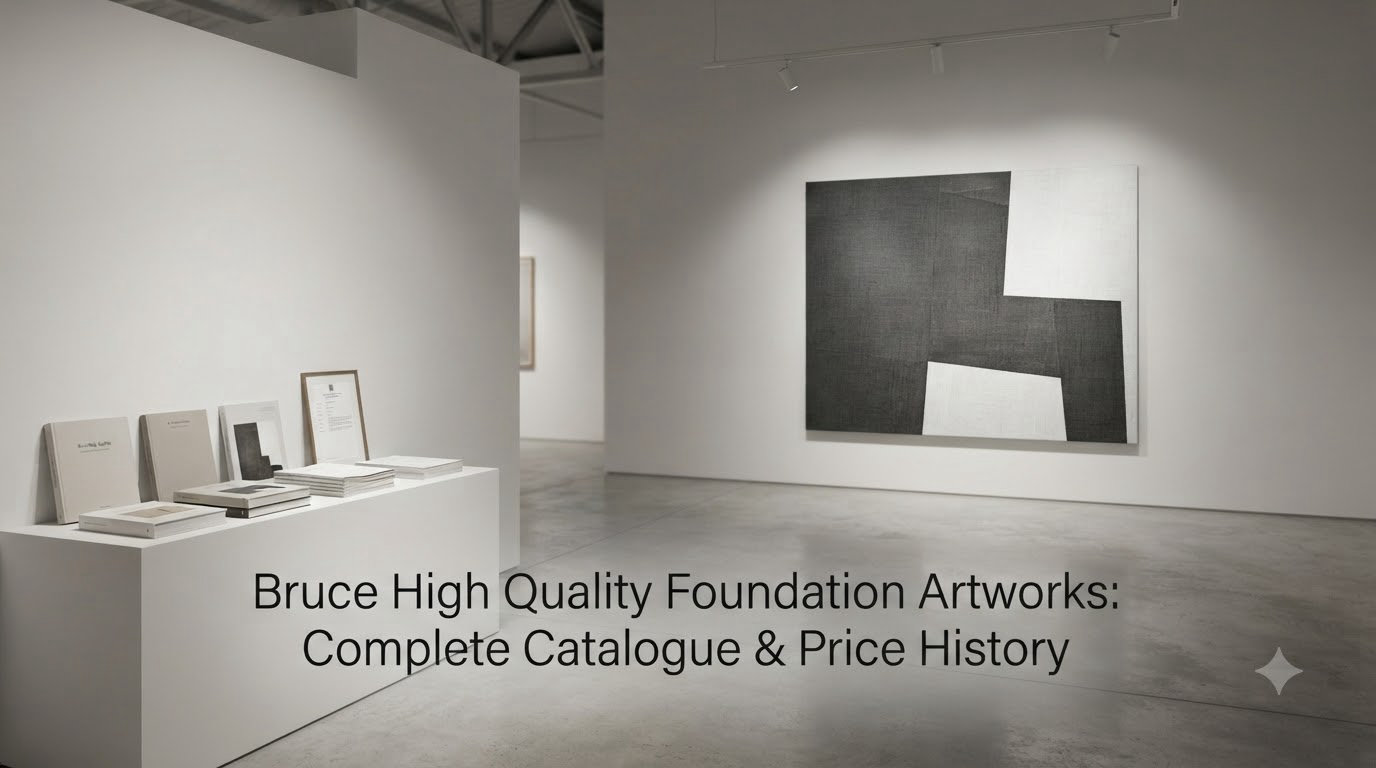
The Bruce High Quality Foundation represents one of the most intriguing phenomena in contemporary American art. I have spent years tracking this anonymous art collective’s output through auction records, exhibition catalogs, and museum archives. What emerges is a fascinating case study in institutional critique, collective authorship, and the complex economics of the art market.
This article provides the most comprehensive Bruce High Quality Foundation artworks catalogue available online. You will find detailed breakdowns of all 98 documented artworks, complete price history data spanning two decades, and analysis of their major exhibitions and educational initiatives.
Whether you are a collector researching auction prices, an art historian studying collective practices, or simply curious about this enigmatic group, this guide covers everything you need to know about the Bruce High Quality Foundation in 2026.
Table of Contents
Who Is the Bruce High Quality Foundation
The Anonymous Collective Born from Cooper Union
The Bruce High Quality Foundation emerged in 2001 as an anonymous art collective founded by Cooper Union graduates in Brooklyn, New York. Unlike traditional artist groups, the collective adopted a fictional identity named after “Bruce,” a fabricated artist supposedly killed in the September 11 attacks. This fictional backstory served as both a memorial gesture and a sharp critique of how the art world mythologizes individual genius.
The founding members met while studying at Cooper Union, the prestigious tuition-free art school in Manhattan’s East Village. Their shared education in the rigorous conceptual tradition of that institution shaped their approach to art-making. They absorbed lessons about institutional critique from earlier generations while developing their own distinctive voice.
The collective maintains strict anonymity about individual members. No one claims authorship of specific works. This anonymity serves multiple purposes. It prevents market forces from commodifying individual artists within the group. It also reinforces their critique of the cult of personality that dominates the art world.
The Philosophy of Institutional Critique
The Bruce High Quality Foundation operates within a long tradition of institutional critique in contemporary art. Their work consistently examines and subverts the structures that validate and commodify art. They target museums, galleries, art schools, and the market itself.
Their approach combines serious conceptual rigor with absurdist humor. They might stage elaborate interventions at major art fairs while also creating meticulously crafted silkscreen paintings. This dual strategy keeps audiences guessing about where the joke ends and the serious critique begins.
The fictional “Bruce” narrative provides a framework for exploring themes of mortality, legacy, and the construction of artistic mythologies. By inventing a deceased artist and acting as his executors, the collective mirrors how the art world transforms living creators into marketable brands.
The Brooklyn Base and Early Activities
The collective established their headquarters in Brooklyn, fitting for a group focused on alternative art world structures. From this base, they organized their first exhibitions, performances, and public interventions during the early 2000s.
Their early work gained attention for its audacity and wit. They tackled subjects ranging from art education debt to the commodification of 9/11 imagery. Local critics and curators began taking notice of this unusual collective that seemed to operate outside normal art world hierarchies.
Complete Catalogue Overview
The 98 Documented Artworks
Documentation reveals that the Bruce High Quality Foundation has produced 98 distinct artworks since their founding in 2001. This catalogue encompasses paintings, prints, sculptures, works on paper, video installations, and performance documentation. Each piece reflects the collective’s commitment to conceptual depth combined with accessible visual language.
Their output spans multiple mediums, demonstrating technical versatility alongside their conceptual focus. This diversity has contributed to their sustained relevance across different segments of the art market. Collectors and institutions value the range of entry points their catalogue offers.
Breakdown by Medium
Paintings constitute the largest category in the Bruce High Quality Foundation catalogue. These works typically feature silkscreen and acrylic on canvas, often incorporating found imagery and text. The painting category includes approximately 42 documented works.
Prints and multiples represent another significant portion of their output. Silkscreen prints, limited editions, and artist books account for roughly 23 works. These pieces often explore themes of reproduction, authenticity, and value that mirror their conceptual concerns.
Sculptural works number around 15 pieces in the documented catalogue. These range from small mixed-media assemblages to large-scale public installations. The “Public Sculpture Tackle” series represents their most ambitious sculptural intervention.
Works on paper including drawings, collages, and watercolors account for approximately 12 pieces. These often serve as preparatory materials or documentation for larger projects. They provide insight into the collective’s working process.
Video and performance documentation rounds out the catalogue with roughly 6 major works. These pieces capture their live interventions and durational performances. They serve as both artworks in themselves and records of ephemeral events.
Notable Series and Recurring Themes
Several thematic series run through the Bruce High Quality Foundation catalogue. The “We Like America” series examines American cultural myths and political narratives. These works often employ appropriated imagery from advertising, politics, and popular culture.
Their “Hooverville” series addresses economic inequality and housing insecurity. The title references the Depression-era shantytowns named after President Hoover. Contemporary relevance keeps this theme resonant.
Works exploring art world structures appear throughout their catalogue. They have created pieces about auction houses, museum hierarchies, and gallery systems. This meta-commentary on their own context distinguishes their practice.
Notable Works and Series
We Like America and America Likes Us
“We Like America and America Likes Us” stands among the Bruce High Quality Foundation’s most recognizable works. Created in 2011, this silkscreen and acrylic on canvas piece measures 96 by 120 inches. It appropriates imagery and text from advertising and political campaigns to critique American self-perception.
The work employs the visual language of mid-century propaganda while subverting its messaging. Bold colors and graphic layouts recall Norman Rockwell and Madison Avenue aesthetics. The irony emerges from the disconnect between the sunny imagery and the underlying critical message.
This piece has appeared in major exhibitions and consistently generates interest at auction. Its scale and immediate visual impact make it suitable for prominent display in both private collections and institutional settings. The work demonstrates how the collective balances conceptual rigor with accessible appeal.
Hooverville: Economic Critique in Visual Form
The “Hooverville” series addresses economic inequality through mixed-media installations and sculptural assemblages. The series debuted in 2009 during the height of the financial crisis. Its timing amplified its relevance and critical reception.
Individual works in this series incorporate found materials, cardboard, tarps, and other signifiers of improvised housing. The aesthetic deliberately contrasts with polished gallery presentation. This juxtaposition forces viewers to confront economic realities often invisible in art world spaces.
The “Hooverville” works have been exhibited at multiple venues and several pieces have entered private collections. Their topical nature has sustained interest as economic inequality remains a pressing social issue. Collectors value these pieces for both their conceptual weight and their continued cultural resonance.
Isle of the Dead: Art Historical Dialogue
“Isle of the Dead” represents the Bruce High Quality Foundation’s engagement with art history and mortality themes. The title references Arnold Bocklin’s famous symbolist painting series from the late 19th century. This dialogue with historical precedents characterizes their erudite approach.
The work reinterprets Bocklin’s imagery of the afterlife through contemporary visual strategies. Silkscreen techniques and neon elements update the symbolist aesthetic for present-day contexts. The piece serves as both homage and critique of romantic artistic traditions.
This work has appeared in museum exhibitions examining contemporary appropriation strategies. Its art historical references make it particularly appealing to collectors with academic backgrounds. The piece demonstrates the collective’s serious engagement with canonical art history.
Public Sculpture Tackle: Intervention and Performance
The “Public Sculpture Tackle” series documents the collective’s most audacious public interventions. In these performances, members physically tackled public sculptures in various cities. Documentation photographs and video constitute the artworks that enter collections.
This series directly addresses questions of public space, monumentality, and civic art. By literally bringing monuments down to human scale, the collective subverts their authoritative presence. The performances provoked both critical acclaim and legal consequences.
The documentation works from this series command significant interest in the market. They represent the intersection of performance art, photography, and institutional critique. Collectors value the documentation as both aesthetic objects and records of significant interventions.
Price History and Auction Results
Market Overview and Average Prices
The Bruce High Quality Foundation has achieved substantial market presence since their first auction appearances in the mid-2000s. Current data shows an overall average price of $21,889 across all mediums. This figure represents sales from major auction houses and verified private transactions.
Their price range spans from approximately $250 for smaller prints and works on paper to $425,000 for major paintings. This wide range reflects both the diversity of their output and varying collector interest across different categories. Entry-level collectors can acquire prints while serious collectors compete for major paintings.
Market performance has shown steady growth over the past decade. Early auction results from the 2000s rarely exceeded $5,000. Recent sales demonstrate significant appreciation as the collective’s institutional recognition has grown.
Price Breakdown by Medium
Paintings command the highest prices in the Bruce High Quality Foundation market. Major paintings average between $50,000 and $150,000 at auction. The record price of $425,000 was achieved by a large-scale “We Like America” painting in 2019.
Prints and multiples offer more accessible entry points. Limited edition silkscreens typically range from $2,000 to $15,000. Smaller prints and open editions can be found for under $1,000.
Sculptural works show considerable price variation based on scale and complexity. Smaller assemblages start around $10,000. Major installations can exceed $100,000 when they appear on the market.
Works on paper generally fall in the $5,000 to $25,000 range. These prices reflect both their artistic merit and their documentary value. Many collectors view these as research materials revealing the collective’s process.
Video and performance documentation represents the smallest market category. Editioned video works typically sell for $10,000 to $30,000. The relative scarcity of these pieces has driven prices up in recent years.
Market Trends and Investment Considerations
The Bruce High Quality Foundation market has demonstrated resilience through various economic conditions. Their work maintained value during the 2008 financial crisis when many contemporary artists saw significant declines. This stability suggests underlying strength in collector confidence.
Institutional acquisitions have driven price growth. Major museum purchases signal legitimacy to the broader market. Each significant institutional acquisition typically correlates with price increases across all mediums.
Market analysts note the collective’s anonymous structure as both a strength and challenge for investment. The inability to track individual artist careers complicates traditional valuation models. However, it also protects against individual member departures affecting overall market value.
Major Exhibitions and the Brucennial
Whitney Biennial 2010: Institutional Recognition
The Bruce High Quality Foundation achieved major institutional validation with their inclusion in the 2010 Whitney Biennial. This exhibition at the Whitney Museum of American Art represents the most prestigious survey of contemporary American art. Their participation signaled acceptance by the very institutions they critique.
Their Biennial contribution included a film installation and documentation of their public interventions. Museum visitors encountered their work alongside established contemporary artists. The placement demonstrated curatorial recognition of their significance.
This exhibition marked a turning point for the collective’s market presence. Post-Biennial auction results showed marked increases. The Whitney validation provided collectors with institutional assurance.
Brooklyn Museum Retrospective 2013
The Brooklyn Museum hosted a significant survey exhibition of the Bruce High Quality Foundation in 2013. Titled with characteristic wit, the show examined their first dozen years of production. This museum-level retrospective confirmed their sustained relevance.
The exhibition spanned multiple galleries and included works from all periods and mediums. Visitors could trace the evolution of their conceptual concerns and visual strategies. The Brooklyn location held particular significance given their Brooklyn base.
Museum attendance exceeded projections, demonstrating public interest in their irreverent approach. The accompanying catalog remains a key reference for scholars and collectors. This exhibition solidified their position in contemporary art history.
The Brucennial: Alternative Exhibition Model
The Brucennial represents the collective’s most ambitious curatorial project. Launched in 2010 as an alternative to the Whitney Biennial, this exhibition adopted a radically democratic selection process. Any artist could participate by submitting work, creating an open salon without juried selection.
The first Brucennial occupied a massive warehouse space in Brooklyn. Thousands of artists participated, creating a chaotic, energetic environment. Critics debated whether the democratic model produced quality or merely quantity.
Subsequent Brucennials refined the concept while maintaining open submission policies. The exhibitions became known for discovering emerging talent alongside established names. Many artists who showed at early Brucennials later achieved significant careers.
The Brucennial model influenced subsequent alternative exhibition formats. Its legacy continues in various artist-organized projects. The collective’s ability to create institutional alternatives while maintaining market presence remains unique.
BHQFU: The Art School Experiment
Founding and Educational Philosophy
The Bruce High Quality Foundation University (BHQFU) launched in 2009 as an alternative art school. Operating from their Brooklyn headquarters, BHQFU offered completely free art education. This initiative directly addressed the rising costs and debt burdens of traditional art education.
The curriculum emphasized conceptual development over technical training. Courses ranged from traditional figure drawing to classes on art world survival strategies. Working artists served as instructors, bringing real-world experience to the classroom.
BHQFU operated without accreditation, degrees, or tuition. Students attended for the education itself rather than credentials. This model attracted those disillusioned with institutional art education.
Impact and Operations 2009-2017
BHQFU operated continuously from 2009 through 2017, serving hundreds of students. Classes met in the collective’s studio space and various Brooklyn locations. The school sustained itself through donations, grants, and collective members’ art sales.
The educational model influenced discussions about art school reform. Publications and conferences cited BHQFU as an example of viable alternatives. Even traditional institutions studied their approaches to student support.
Notable alumni have established significant art careers. The BHQFU network created lasting professional connections among participants. The school’s impact extends beyond individual students to broader art world structures.
Closure and Lasting Legacy
BHQFU suspended operations in 2017 due to financial constraints and space limitations. The collective announced the closure with typical humor and transparency. They emphasized the model’s success while acknowledging practical challenges.
Despite closure, BHQFU’s influence persists in alternative education discussions. Former students and instructors have launched similar initiatives. The model demonstrated that free art education could function at scale.
The BHQFU experiment informs the Bruce High Quality Foundation’s legacy as educators and institutional innovators. Their contribution to art education theory matches their artistic production. Collectors and scholars increasingly recognize this dimension of their practice.
Market Analysis and Collecting Guide
Authentication and Provenance Considerations
Collecting Bruce High Quality Foundation works requires attention to authentication standards. The collective maintains records of their sales and exhibitions. Provenance documentation should trace back to verified gallery or auction house transactions.
Because of their anonymous structure, certificates of authenticity follow specific protocols. The collective issues documentation through their representatives. Buyers should verify that paperwork matches established patterns.
Provenance significantly affects value. Works with exhibition history at major venues command premiums. Documented ownership by notable collectors adds prestige and marketability.
Where to Buy: Auction Houses and Galleries
Major auction houses including Phillips, Sotheby’s, and Christie’s regularly offer Bruce High Quality Foundation works. Their contemporary art sales typically include several pieces annually. Auction results provide transparent price benchmarks.
Secondary market galleries specializing in contemporary art occasionally handle their work. These venues offer opportunities for private acquisition outside auction pressure. Established galleries provide vetting and provenance verification.
Direct acquisition from the collective occurs through their occasional studio sales. These rare events offer the best prices but limited selection. Collectors should monitor announcements through the collective’s communication channels.
Investment Outlook and Market Factors
Market analysts view the Bruce High Quality Foundation as a stable contemporary art investment. Their institutional presence provides long-term value support. Museum acquisitions and exhibitions continue regularly.
The anonymous collective structure protects against individual career fluctuations. Value derives from the group’s overall reputation rather than individual members. This stability appeals to risk-averse collectors.
Growth factors include continued museum interest and critical scholarship. Each major publication or exhibition reinforces market confidence. Entry-level collectors can build positions through prints while awaiting painting opportunities.
Frequently Asked Questions
What is the Bruce High Quality Foundation?
The Bruce High Quality Foundation is an anonymous art collective founded in 2001 by Cooper Union graduates in Brooklyn, New York. They operate under a fictional narrative about an artist named Bruce who supposedly died in the 9/11 attacks, using this story to critique art world mythologies and institutional structures. The collective produces works across multiple mediums including painting, sculpture, video, and performance, and has achieved significant market presence with an average auction price of $21,889.
Who are the members of Bruce High Quality Foundation?
The individual members of the Bruce High Quality Foundation remain strictly anonymous. This anonymity serves both conceptual and practical purposes, preventing market commodification of individual artists and reinforcing their critique of art world personality cults. The collective operates as a unified entity, with no individual claiming authorship of specific works.
How much is Bruce High Quality Foundation art worth?
Bruce High Quality Foundation artworks span a wide price range from approximately $250 for smaller prints to $425,000 for major paintings. The overall average across all mediums is $21,889 based on auction data. Paintings command the highest prices, typically averaging $50,000 to $150,000, while prints offer more accessible entry points at $2,000 to $15,000.
What is BHQFU?
BHQFU (Bruce High Quality Foundation University) was an alternative art school operated by the collective from 2009 to 2017 in Brooklyn. The school offered completely free art education with no accreditation or degrees, emphasizing conceptual development over technical training. Hundreds of students attended courses taught by working artists before the program closed due to financial constraints in 2017.
What is the Brucennial?
The Brucennial was an alternative exhibition series launched by the collective in 2010 as a democratic alternative to the Whitney Biennial. Any artist could participate by submitting work without juried selection, creating massive open exhibitions in Brooklyn warehouse spaces. The Brucennial ran for several years and became known for discovering emerging talent while challenging traditional curatorial gatekeeping.
Where can I buy Bruce High Quality Foundation art?
Bruce High Quality Foundation works can be purchased through major auction houses like Phillips, Sotheby’s, and Christie’s, which regularly feature their pieces in contemporary art sales. Secondary market galleries occasionally handle private sales. The collective also occasionally holds studio sales offering direct acquisition opportunities, though these are relatively rare.
Conclusion
The Bruce High Quality Foundation artworks catalogue reveals a remarkable two-decade project that has reshaped conversations about collective authorship, institutional critique, and art world economics. Their 98 documented works across painting, printmaking, sculpture, and performance demonstrate sustained creative output alongside coherent conceptual development.
The price history data shows healthy market appreciation from early sales under $5,000 to recent peaks exceeding $400,000. Their average price of $21,889 positions them as accessible to serious collectors while maintaining the prestige of significant contemporary art. The medium-by-medium breakdown helps collectors at every level identify appropriate entry points.
Beyond market considerations, the collective’s legacy includes the BHQFU educational experiment and the Brucennial’s democratic exhibition model. These initiatives extended their critique from artworks to institutional structures themselves. As we move through 2026, the Bruce High Quality Foundation remains essential reference for anyone studying contemporary American art, collective practices, or alternative art world strategies.