
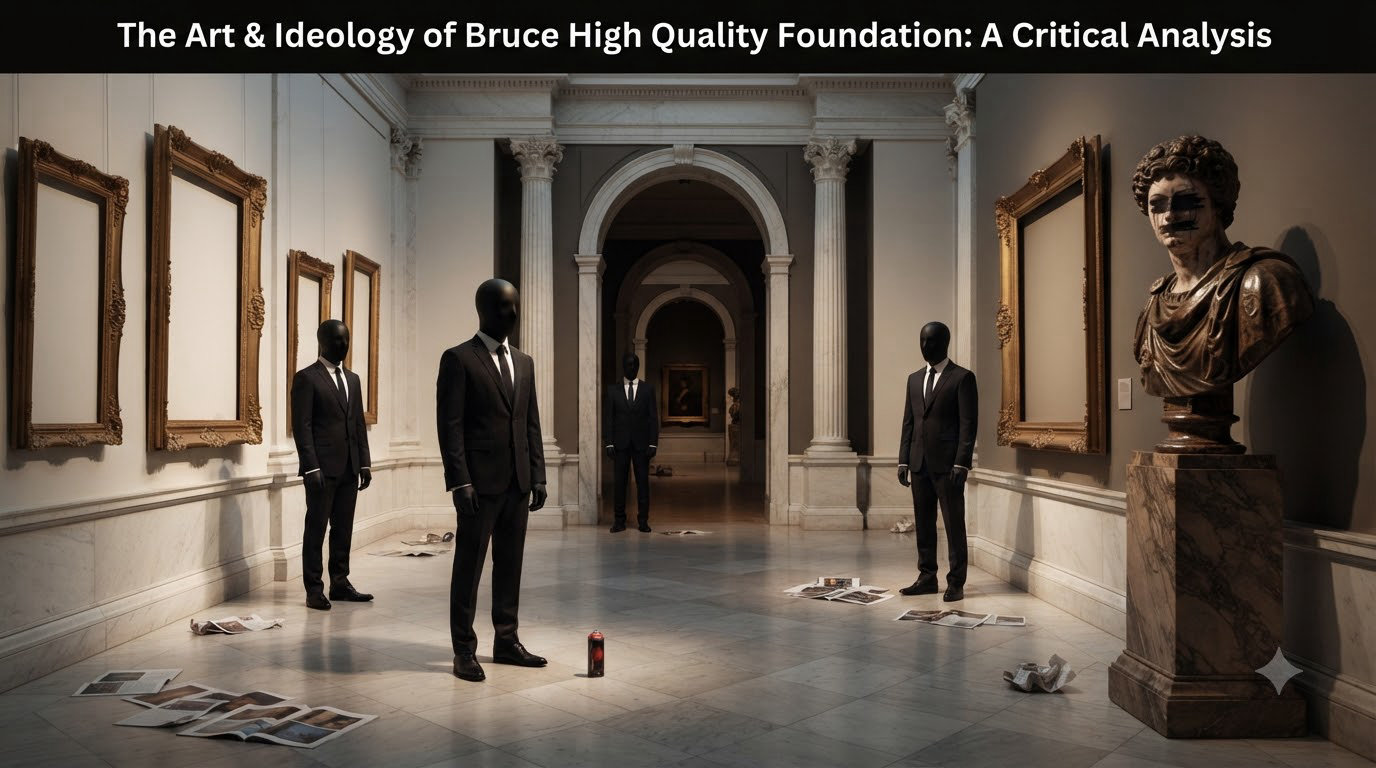
The Bruce High Quality Foundation represents one of the most provocative experiments in collective artistic practice to emerge from the early 2026 millennium. I first encountered their work during a late-night gallery crawl in Brooklyn, where a bronze sculpture of a drunken horse seemingly crashed through a museum wall stopped me in my tracks. That piece was The Stag Glares Back, and it perfectly encapsulated everything this anonymous art collective stands for: irreverence toward institutional boundaries, deep engagement with art history, and a wink toward the absurd.
BHQF, as the collective abbreviates itself, operates under a fictional origin story that speaks volumes about their methodology. According to their founding myth, the collective emerged from the teachings of one Professor Bruce “Uncle” High Quality, a fictional sculptor whose “estate” they claim to steward. This fabricated backstory, complete with the equally fictional executor Billyjeanne L. Jensen and her assistant Bob Lardchrist, serves as both parody and critique. It lampoons the art world’s obsession with provenance and artistic genius while simultaneously creating a framework for genuinely meaningful work. In this critical analysis, I will examine how the Bruce High Quality Foundation uses humor, anonymity, and institutional critique to challenge the contemporary art landscape.
Table of Contents
The Origins of Bruce High Quality Foundation
The Bruce High Quality Foundation took shape in 2004, born from the creative ferment of Cooper Union graduates in New York City. The founding members, who remain anonymous to this day, met while studying at the prestigious tuition-free art school in the late 1990s and early 2000s. Their shared education in one of America’s most rigorous art programs gave them both the technical skills and the critical framework to launch their collective experiment.
The early 2000s represented a pivotal moment for the art collective model. Institutions like the Whitney Museum and MoMA were beginning to embrace collaborative practices, yet the commercial art market remained obsessed with individual artistic genius and marketable personality. BHQF positioned themselves deliberately against this tide. By refusing to name individual members and instead operating under their fictional Professor High Quality mythology, they created breathing room to experiment without the pressure of personal branding.
Billyjeanne L. Jensen, the fictional executor of the Bruce High Quality estate, first appeared in press releases around 2005. The character served as a mouthpiece for the collective’s early provocations, issuing statements that blended deadpan institutional language with absurdist content. Bob Lardchrist, her fictional assistant, added another layer to the mythology. These personas allowed the collective to critique art world power structures from within, adopting the very language of estate management and institutional authority they sought to undermine.
The Cooper Union connection runs deep through BHQF’s DNA. The real Cooper Union, founded by Peter Cooper in 1859, was built on principles of free education and merit-based admission. When the school controversially began charging tuition in 2014, BHQF was already six years into operating their own free art school, BHQFU. This parallel between their educational experiment and the institution that formed them highlights the collective’s commitment to putting their ideology into practice rather than merely commenting on it.
Ideology and Philosophy of Bruce High Quality Foundation
The core ideology of the Bruce High Quality Foundation can be distilled into a single phrase they have used repeatedly: the mission to “resurrect art history from the bowels of despair.” This declaration, which first appeared in a 2008 press release quoting filmmaker Chris Marker, encapsulates their dual relationship with art historical tradition. They simultaneously honor and mock the canon, treating museum masterpieces with irreverent affection.
Parody functions as their primary critical method. Rather than rejecting art history outright, as some avant-garde movements have done, BHQF embraces and exaggerates its conventions until they reveal their own absurdity. Their recreation of Theodore Gericault’s Raft of the Medusa using life-size Smurf figurines, titled Raft of the Medusa (2010), exemplifies this approach. By replacing the desperate human figures of Gericault’s original with blue cartoon characters, they comment on both the melodrama of Romantic painting and the trivialization of contemporary experience.
The absurd operates as their weapon against the art world’s self-seriousness. In an era where art auction prices routinely reach eight figures and museum expansions cost hundreds of millions, BHQF brings a deliberately low-fi, DIY aesthetic to high-concept work. Their installations often feel like elaborate pranks executed with genuine craft. This combination of conceptual rigor and apparent casualness disarms viewers, making them more receptive to the underlying critique.
Institutional critique forms the third pillar of their philosophy. Following in the tradition of artists like Hans Haacke and Michael Asher, BHQF examines how museums, galleries, and educational systems shape artistic production and reception. However, unlike the often dry, academic tone of 1970s institutional critique, BHQF wraps their analysis in humor and accessibility. They want ordinary viewers to understand the game being played, not just fellow art professionals.
The collective’s philosophy also embraces failure and ephemerality. Many of their projects are intentionally temporary, leaving only documentation and memory behind. This resistance to the art market’s demand for collectible, permanent objects aligns with their anti-commercial stance. By making work that cannot be easily bought and sold, they attempt to operate outside the economic logic that dominates contemporary art.
Artistic Practice and Collective Structure
The anonymous collective structure of BHQF remains their most distinctive organizational feature. Unlike other art collectives that name their members, such as the Guerrilla Girls or Critical Art Ensemble, BHQF has maintained strict anonymity since 2004. Individual members speak to press only as representatives of the collective, never as named artists. This practice challenges the cult of artistic personality that drives much of the contemporary art market.
Their collaborative methods emphasize consensus and shared labor. Works are attributed to the collective as a whole, regardless of who originated a particular concept or executed a specific element. This model recalls earlier avant-garde experiments like the Surrealist automatic writing sessions or the Bauhaus workshop system. However, BHQF updates these precedents for a digital age, incorporating social media, viral marketing, and participatory documentation into their process.
Medium choices within the collective range widely, reflecting their art school training and embrace of interdisciplinary practice. They have produced bronze sculptures, projection installations, lecture-performances, bus tours, free schools, and multimedia collages. This refusal to specialize in a single medium aligns with their resistance to market categorization. Collectors and dealers prefer artists with recognizable, consistent output. BHQF deliberately frustrates this expectation.
The lecture-performance format has become a signature mode for the collective. These events combine academic-style presentations with theatrical elements, audience interaction, and spontaneous digressions. By occupying the form of the educational lecture, they critique the authority of expertise while actually delivering substantive content about art history and institutional critique. The format embodies their philosophy of working within systems to transform them.
Documentation plays a crucial role in their practice. Since many works are ephemeral, the photographs, videos, and texts that record them become the primary access points for viewers. BHQF treats this documentation as part of the artwork rather than secondary to it, carefully composing photos and editing videos to maintain their aesthetic and conceptual standards. This approach acknowledges the reality that most people will encounter their work through screens rather than in person.
Notable Works and Major Exhibitions
The Brucennial stands as BHQF’s most ambitious and influential project. Launched in 2010 as an alternative to the Whitney Biennial, the exhibition invited thousands of artists to display work in a Brooklyn warehouse without curatorial selection or submission fees. The first Brucennial hosted over 3,000 artists and drew crowds that rivaled established museum attendance figures. By eliminating the gatekeeping function of curatorial selection, the collective demonstrated that the demand for exhibition opportunities far exceeds what institutions provide.
The Brucennial operated on principles of radical inclusion. Anyone who showed up with art could hang it on the walls, subject only to space limitations. This model inverted the exclusivity of the Whitney Biennial, which typically selects fewer than 100 artists from thousands of applicants. The Brucennial also eliminated the promotional aspect that dominates art fairs and biennials. There were no price lists, no dealer booths, and no VIP previews. The focus remained entirely on the experience of art rather than its market value.
Ode to Joy, their 2010 installation at the Brooklyn Museum, brought their iconoclastic approach to a major institutional setting. The centerpiece was a full-scale fiberglass replica of a wrecked fire truck crashing through the museum’s grand lobby. Titled after Beethoven’s Ninth Symphony and its famous “Joyful, Joyful” finale, the piece commented on the destructive potential of uncontrolled passion. It also referenced the fire truck’s symbolic role in American hero mythology while literally smashing the museum’s decorum.
The Whitney Biennial 2010 marked BHQF’s arrival as a force within the institutional art world they critiqued. Their installation We Like America and America Likes Us featured a white ambulance equipped with video screens playing a film about the mythological American West. The reference to Joseph Beuys’s famous 1974 performance I Like America and America Likes Me, during which the artist shared a gallery with a coyote, positioned BHQF within a lineage of European artists who have examined American culture from outside. Their inclusion in the Whitney represented a significant institutional validation of their approach.
The Stag Glares Back (2008) demonstrates their sculptural practice at its most visually arresting. The bronze sculpture depicts a horse in mid-gallop, apparently crashing through a gallery wall. The work references both classical equestrian statues and the tradition of trophy hunting, while its kinetic energy and material permanence create a tension between the temporary gesture and lasting monument. The piece has appeared in multiple exhibitions, each time installed to suggest it is breaking through a different architectural surface.
Con te Partiro (2010), named after the Andrea Bocelli song, featured a boat-shaped sculpture carrying skeleton figures arranged in a tableau recalling both funerary art and pleasure cruising. The work merged references to maritime history, Romantic-era memento mori, and contemporary cruise ship culture. Like much of their work, it rewarded viewers who recognized the art historical references while remaining accessible to those who did not.
BHQFU: Redefining Art Education
In 2009, the Bruce High Quality Foundation launched their most directly transformative project: the Bruce High Quality Foundation University, or BHQFU. This free art school operated from a loft space in downtown Manhattan, offering classes taught by working artists on a volunteer basis. Students paid no tuition, received no credit, and earned no degree. The project represented a direct intervention in the economics of art education at a moment when art school debt was reaching crisis levels.
The antihierarchical model of BHQFU rejected traditional academic structures. There were no admissions requirements, no grades, and no curriculum requirements. Students selected classes based on interest, and instructors designed courses without administrative oversight. This approach treated students as adults capable of directing their own education rather than customers purchasing a credential. The model drew on progressive education theories from John Dewey through Paolo Freire, emphasizing learning through doing and dialogue over lecture and examination.
Classes at BHQFU covered the full range of artistic practice, from figure drawing and sculpture to art writing and curating. The faculty consisted primarily of working artists and critics who donated their time. This volunteer model kept costs minimal while connecting students directly to the professional art world. Unlike traditional art schools where tenure-track professors may have limited contemporary exhibition experience, BHQFU instructors were actively producing and showing work.
The space itself embodied the school’s philosophy. Located on the sixth floor of a Chinatown building, the raw loft had none of the polished institutional aesthetics of university art departments. Classrooms were makeshift, equipment was shared, and students helped maintain the facility. This DIY environment reinforced the message that serious artistic development does not require expensive facilities. The resource constraints also fostered creative problem-solving, as students and teachers improvised solutions rather than requesting budget allocations.
BHQFU expanded beyond New York through international partnerships. In 2017, the collective collaborated with established artists including Rashid Johnson, Wangechi Mutu, and Doreen Garner to launch a printmaking program in rural Zambia. This initiative trained local artists in drypoint engraving and other techniques while creating an exchange network between African and American art communities. The project demonstrated that their educational model could adapt to different cultural contexts while maintaining its core principles of accessibility and peer-to-peer learning.
The school’s closure in 2017, announced via the essay “Broken Toilet: BHQFU is Dead” in the Brooklyn Rail, marked the end of a significant chapter in alternative art education. The collective cited financial and administrative burdens as reasons for shuttering the physical space, though they indicated intentions to continue educational programming in other forms. During its eight years of operation, BHQFU served hundreds of students and influenced a generation of artists who experienced an alternative to debt-driven art education.
Cultural Significance and Legacy
The cultural significance of the Bruce High Quality Foundation extends beyond their individual artworks to encompass a model of artistic practice that challenges fundamental assumptions about authorship, value, and institutional legitimacy. In an era of increasing commercialization within the art world, BHQF has consistently demonstrated that meaningful artistic production can occur outside market structures. Their influence can be traced through the proliferation of alternative art schools, free universities, and collective practices that have emerged in their wake.
Their impact on art education philosophy has been particularly profound. By actually operating a free art school for eight years, they moved beyond theoretical critique to practical demonstration. BHQFU proved that rigorous art education does not require tuition payments, administrative hierarchies, or credentialing apparatus. This example has informed subsequent experiments in alternative pedagogy, from the Anhoek School to the Mountain School of Arts.
As institutional critique, their work has influenced how museums and galleries understand their own operations. By occupying spaces of institutional authority, from the Whitney Biennial to the Brooklyn Museum, they have forced these venues to examine their own gatekeeping functions. Their inclusion in major exhibitions represents a partial accommodation of critique by the institutions they examine, a dynamic that raises questions about the absorption of dissent by the art world’s power structures.
Frequently Asked Questions
What is the Bruce High Quality Foundation?
The Bruce High Quality Foundation (BHQF) is an anonymous art collective founded in 2004 in New York City. They are known for their parody-based approach to art historical references, institutional critique of museums and galleries, and their free art school initiative BHQFU. The collective operates under fictional personas including the mythical Professor Bruce High Quality and his estate executor Billyjeanne L. Jensen.
When was the Bruce High Quality Foundation founded?
The Bruce High Quality Foundation was founded in 2004 by a group of Cooper Union graduates in New York City. The collective emerged from the shared educational background of its anonymous members, who met while studying at the prestigious tuition-free art school. Their first major projects appeared in 2004 and 2005, establishing the fictional mythology of Professor Bruce High Quality that would frame their subsequent work.
What is BHQFU?
BHQFU stands for Bruce High Quality Foundation University, a free art school founded by the collective in 2009 in downtown Manhattan. Operating on antihierarchical principles with no tuition, grades, or admissions requirements, BHQFU offered classes taught by working artists on a volunteer basis. The school served hundreds of students over eight years before closing its physical location in 2017, though its educational initiatives continued through international partnerships.
What is the ideology of Bruce High Quality Foundation?
The Bruce High Quality Foundation’s ideology centers on resurrecting art history from what they term the bowels of despair. They use parody, absurdity, and institutional critique as primary methods. The collective challenges the commercialization of art, the cult of artistic personality, and the exclusivity of institutions while maintaining deep engagement with art historical traditions. Their anonymous structure and fictional origin stories embody their critique of art world power structures.
What are the most famous works of Bruce High Quality Foundation?
The most notable works include the Brucennial (2010), an open-submission alternative to the Whitney Biennial; Ode to Joy (2010), a crashed fire truck installation at the Brooklyn Museum; The Stag Glares Back (2008), a bronze horse sculpture crashing through walls; and their Whitney Biennial 2010 installation We Like America and America Likes Us. Other significant works include Con te Partiro (2010) and their recreation of Raft of the Medusa using Smurf figurines.
Conclusion
The Bruce High Quality Foundation stands as a singular force in contemporary art, having successfully merged rigorous conceptual practice with accessible humor and genuine institutional critique. Over two decades of activity, they have demonstrated that alternative models of artistic production and education are not only possible but necessary in an increasingly commercialized cultural landscape. Their work challenges us to reconsider the values that drive the art world and to imagine structures that prioritize access, collaboration, and meaning over market performance.
As we move deeper into the 2026, the collective’s legacy continues to resonate through the artists they educated at BHQFU, the alternative schools they inspired, and the critical frameworks they established. Whether smashing fire trucks through museum lobbies or teaching printmaking in rural Zambia, BHQF has consistently practiced what they preach: that art should be for everyone, that history is alive and subject to reinvention, and that laughter can be a form of serious critique. In an art world often criticized for its exclusivity and self-importance, the Bruce High Quality Foundation reminds us that creativity thrives when we loosen our grip on ego and open our hands to collaboration.