
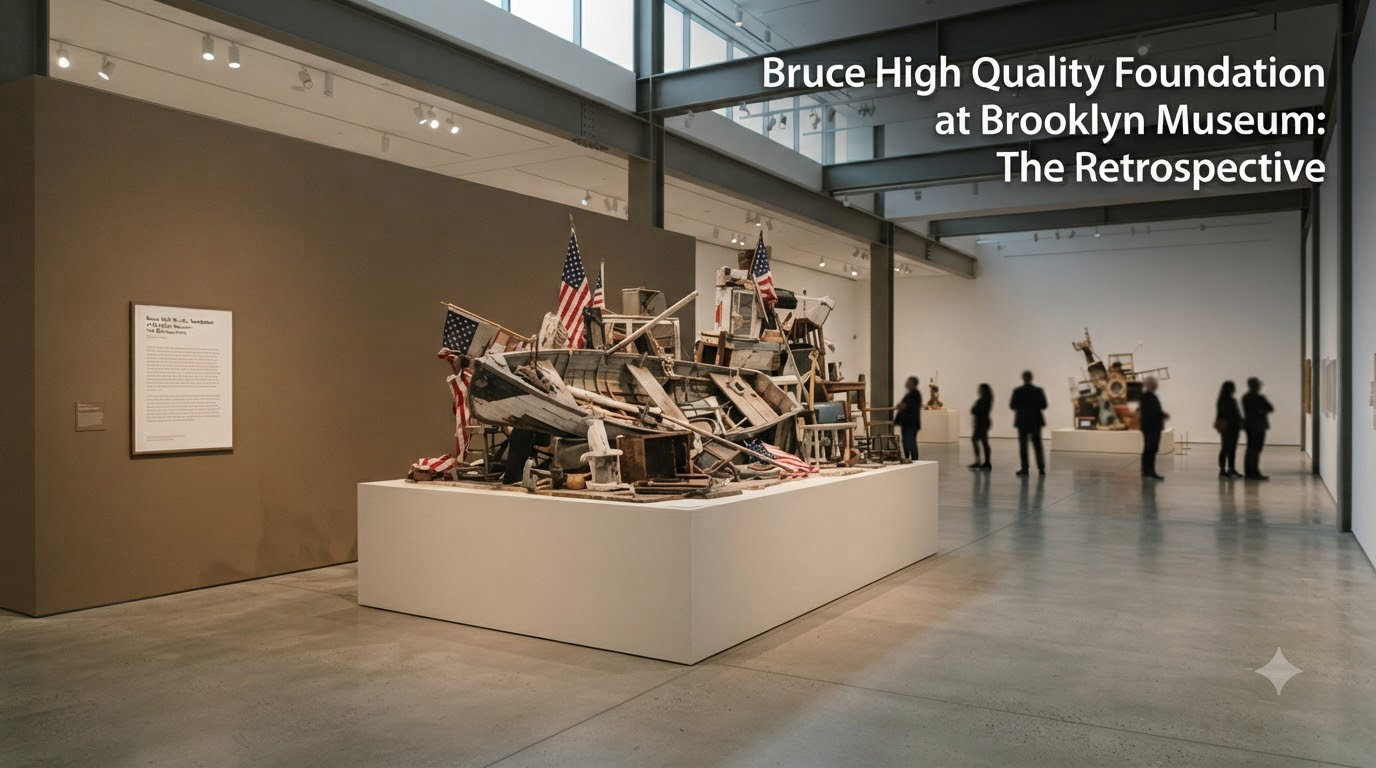
The Bruce High Quality Foundation Brooklyn Museum retrospective in 2013 marked a pivotal moment for one of the most provocative artist collectives to emerge from New York in the 21st century. Their exhibition “Ode to Joy, 2001-2013” transformed several galleries of the museum into a cacophonous, circus-like experience that challenged everything visitors thought they knew about art institutions.
I have spent years following this collective’s work, and the 2013 retrospective represented something rare in the art world: a mid-career survey that didn’t take itself too seriously while delivering serious cultural commentary. The Brooklyn Museum showed remarkable courage in hosting this unconventional exhibition, which ran from June 28 through September 22, 2013.
What made this retrospective particularly fascinating was how it blurred the lines between fact and fiction, institutional critique and institutional embrace. The collective’s approach to the art world—simultaneously participating in it and satirizing it—created an exhibition experience unlike anything else that year.
Table of Contents
What is the Bruce High Quality Foundation
The Bruce High Quality Foundation is a Brooklyn-based artist collective that creates subversive, often humorous installation art, live performance, film, and social sculpture under the name of a fictional artist. Founded in 2003 in the aftermath of the September 11 attacks, the collective emerged from Cooper Union as a response to the changing cultural landscape of New York City.
The group operates anonymously, with members refusing to identify themselves individually. This choice serves both practical and philosophical purposes. Practically, it prevents any single member from becoming the face of the collective. Philosophically, it reinforces their critique of the art world’s obsession with individual genius and celebrity artists.
Their mission centers on democratizing art through several key principles:
- Collaboration over individualism: All works are created collectively, with no attribution to specific members
- Accessibility: Art should be available to everyone, not just collectors and insiders
- Humor as critique: Satire and pranksterism serve as tools for institutional critique
- Education: Knowledge about art and art-making should be freely shared
The collective’s name derives from their fictional founder, Bruce High Quality, a truck driver from West Virginia who reportedly died in the World Trade Center attacks on September 11, 2001. This mythology serves as the foundation for their artistic narrative, though the collective actually formed two years after the attacks.
The Ode to Joy Retrospective at Brooklyn Museum
The Bruce High Quality Foundation Brooklyn Museum retrospective opened on June 28, 2013, and ran through September 22, 2013. Taking up several galleries in one of New York’s most respected art institutions, the exhibition presented over fifty works spanning the collective’s first decade of activity.
The title “Ode to Joy” referenced both Beethoven’s famous symphony and the collective’s optimistic, if irreverent, approach to art-making. The exhibition was organized by the Brooklyn Museum in partnership with the artists, with support from the Martha A. and Robert S. Rubin Exhibition Fund.
Walking into the first room of the retrospective, visitors immediately confronted what one critic described as a “circus-like multitude of action, images, and sound.” The installation filled the space with a overwhelming sensory experience that included video projections, sculptural elements, performance remnants, and interactive components.
The exhibition’s scope reflected the collective’s diverse artistic practice:
- Installation art: Large-scale environments that transformed gallery spaces
- Performance documentation: Video and photographic records of their live interventions
- Film and video works: Pieces ranging from short experimental films to longer narratives
- Social sculpture: Projects that engaged directly with communities and institutions
- Mixed media: Paintings, silkscreens, and sculptural objects
The Brooklyn Museum’s decision to host this retrospective signaled a shift in how major institutions viewed artist collectives. Rather than treating the group as a novelty or outsider phenomenon, the museum presented their work with the same seriousness typically reserved for established individual artists.
Key Works and Installations
The retrospective featured dozens of works that demonstrated the collective’s range and evolution. Several pieces stood out as particularly significant to understanding their artistic approach.
TEACH 4 AMERIKA
One of the collective’s most ambitious projects, TEACH 4 AMERIKA, combined performance, social sculpture, and institutional critique. The project involved a bus tour where the collective visited various art schools to discuss the state of art education in America. They challenged the rising costs of art school tuition and questioned whether institutions were truly serving their students.
The work highlighted the collective’s commitment to democratizing art education, a theme that would later culminate in their founding of BHQFU. Documentation from this tour featured prominently in the retrospective, including photographs, video footage, and ephemera from the various stops.
The 9/11 Works
Given the fictional origin story of Bruce High Quality, works addressing September 11 held particular significance in the exhibition. The collective approached this sensitive subject with their characteristic mix of reverence and irreverence, creating pieces that acknowledged the tragedy while questioning how it had been exploited for political and cultural purposes.
These works demonstrated the collective’s willingness to tackle difficult subjects head-on, using humor not to diminish the seriousness of events but to reveal uncomfortable truths about how society processes collective trauma.
Public Sculpture and Intervention
The retrospective included documentation of the collective’s public interventions, where they inserted themselves or their works into existing structures. These pieces often involved surprising juxtapositions—classical forms rendered in unexpected materials, or traditional monuments modified with humorous additions.
The collective’s approach to public art rejected the notion of permanent, monumental sculpture in favor of temporary, responsive interventions. This philosophy aligned with their broader critique of institutional permanence and authority.
Installation as Overwhelm
Several rooms in the retrospective were designed to overwhelm visitors with sensory input. Multiple video screens playing simultaneously, competing audio tracks, and densely packed visual elements created an environment where focus was impossible. This intentional chaos served as a metaphor for contemporary life and the art world’s information overload.
Visitors often found themselves unable to concentrate on any single element, forcing them to experience the work holistically rather than analytically. This approach challenged the traditional museum experience, which typically encourages careful, contemplative viewing.
The Fictional Bruce High Quality
At the heart of the collective’s mythology stands Bruce High Quality himself—a fictional truck driver from West Virginia who supposedly perished in the World Trade Center on September 11, 2001. The collective presents itself as a foundation dedicated to preserving and promoting his artistic legacy.
This fictional narrative serves multiple purposes. First, it provides a convenient backstory that explains the collective’s name and mission. Second, it allows the group to critique the art world’s obsession with biography and personal narrative. Third, it creates a layer of irony that permeates all their work.
The collective has constructed an elaborate mythology around Bruce, including details about his life, his supposed artistic output before his death, and his philosophy of art. They maintain this fiction with deadpan seriousness, refusing to break character in interviews and official statements.
This approach has led to some confusion among casual observers and even some art world figures. The line between fact and fiction intentionally blurs, forcing audiences to question the narratives they accept from artists and institutions.
The 9/11 connection, while fictional, also allows the collective to engage with one of the defining events of contemporary American history. By claiming Bruce died in the attacks, they insert themselves into a national narrative of loss and memorialization. This positioning lets them comment on how tragedy becomes commodified and how collective memory is constructed.
Some critics have found the fictional 9/11 backstory problematic, arguing that it trivializes real loss for artistic effect. The collective would likely respond that this discomfort is part of the point—art should challenge comfortable assumptions, even when that challenge feels risky or inappropriate.
BHQFU: The Free Art School
Beyond their artistic output, the Bruce High Quality Foundation’s most significant contribution to cultural life may be BHQFU—the Bruce High Quality Foundation University. Founded as an alternative to traditional art education, BHQFU offered free classes taught by working artists in a non-hierarchical, community-based setting.
The school emerged directly from the TEACH 4 AMERIKA project. During their bus tour, the collective became increasingly concerned about the rising costs of art education and the exclusionary nature of art school admissions. They decided to create their own institution, one that would embody the democratic principles their art advocated.
BHQFU operated on several radical principles:
- No tuition: All classes were completely free
- Open admission: Anyone could enroll, regardless of background or experience
- Artist-taught: Working artists, not academics, led instruction
- Peer learning: Students learned from each other as much as from instructors
- No degrees: The goal was learning, not credentialing
The school occupied various spaces in Brooklyn, often moving as economic pressures forced relocation. Despite these challenges, BHQFU maintained a robust schedule of classes, workshops, and events throughout its operation.
The retrospective at Brooklyn Museum featured documentation from BHQFU’s history, including photographs of classes, syllabi, and testimonials from students. This material demonstrated how the collective’s philosophy translated into practical educational programming.
BHQFU represented the logical extension of the collective’s critique of art world institutions. If art schools were becoming too expensive and exclusive, why not simply create an alternative? This DIY approach embodied the punk ethos that influenced much of the collective’s thinking.
Artistic Philosophy and Social Impact
The Bruce High Quality Foundation’s work operates at the intersection of several philosophical positions. Their art is simultaneously humorous and serious, institutional and anti-institutional, collaborative and individual in its anonymity.
Democratizing Art
Central to the collective’s philosophy is the belief that art belongs to everyone. This manifests in their choice of materials (often cheap or found objects), their public interventions (bringing art outside traditional venues), and their educational work (making art instruction free and accessible).
The retrospective at Brooklyn Museum, despite being housed in a major institution, maintained this democratic spirit. The overwhelming, chaotic nature of the installation refused the contemplative,精英 (elite) viewing experience typically associated with museums. Instead, it invited a more visceral, democratic engagement.
Institutional Critique
The collective maintains a complicated relationship with art institutions. On one hand, they critique the power structures, financial arrangements, and cultural hierarchies of museums and galleries. On the other hand, they participate in these institutions, accepting exhibitions and support from them.
This contradiction is intentional. By working both inside and outside institutional frameworks, they demonstrate the impossibility of pure opposition. The art world absorbs critique and turns it into content; the collective’s response is to remain perpetually slippery, refusing fixed positions.
Humor as Method
The collective employs what one critic called “pranksterism” as a central methodological tool. Their humor is not incidental but fundamental to how they make meaning. Jokes, gags, and absurdities reveal truths that serious discourse might miss.
In the retrospective, this humor manifested in unexpected juxtapositions, ridiculous statements presented with straight faces, and works that undermined their own apparent seriousness. Visitors often found themselves laughing before realizing the depth of the commentary beneath the jokes.
Social Sculpture
Drawing on Joseph Beuys’s concept of social sculpture, the collective creates situations and structures that shape social reality. BHQFU is perhaps the clearest example—an actual educational institution created as an artistic act. But their public interventions and performance pieces also function as social sculpture, temporarily restructuring how people interact with space and each other.
The retrospective itself could be read as a social sculpture, transforming the Brooklyn Museum into something else for its duration. The usual rules of museum behavior didn’t apply; visitors were encouraged to engage differently, to be overwhelmed, to laugh, to feel uncomfortable.
Critical Reception and Legacy
The Bruce High Quality Foundation Brooklyn Museum retrospective received mixed but generally positive reviews from art critics. Some praised the collective’s energy and inventiveness, while others found the work messy or lacking in polish.
The New York Times described the exhibition as a “messy, cacophonous retrospective,” noting both its chaotic energy and its intellectual ambition. Critics appreciated how the collective refused to simplify their work for institutional presentation, instead bringing their full aesthetic of overwhelm into the museum.
More academic critics analyzed the work through frameworks of institutional critique and social practice. They found the collective’s position particularly interesting given the exhibition venue—how does anti-institutional art function when hosted by a major institution? The answer seemed to be: messily, problematically, but productively.
The Brooklyn Rail offered deeper philosophical analysis, comparing the collective’s work to that of Roy Lichtenstein, Andy Warhol, Joseph Beuys, and Jeff Koons. The critic found the BHQF occupying a unique space between high concept and democratic accessibility, between critique and participation.
The legacy of the 2013 retrospective extends beyond the exhibition itself. It marked a moment when a major American museum validated an artist collective that had operated largely outside traditional art world structures. This validation helped pave the way for other collectives to receive similar recognition.
BHQFU continued operating for several years after the retrospective, though it eventually closed due to the economic realities of maintaining a free educational space in New York City. The collective itself continues to produce work, though their activities have become less frequent as members pursue individual projects.
The 2013 retrospective remains the definitive survey of the collective’s first decade. For anyone interested in understanding the Bruce High Quality Foundation, the exhibition catalog and documentation provide essential context for their unique approach to art-making.
Frequently Asked Questions
What is the Bruce High Quality Foundation?
The Bruce High Quality Foundation is a Brooklyn-based artist collective founded in 2003 that creates subversive, often humorous installation art, performance, film, and social sculpture. They operate anonymously under the name of a fictional artist who supposedly died on 9/11. The collective emerged from Cooper Union and is known for their institutional critique, democratic approach to art, and founding of the free art school BHQFU.
When was the Bruce High Quality Foundation retrospective at Brooklyn Museum?
The retrospective titled ‘Ode to Joy, 2001-2013’ ran from June 28 through September 22, 2013. The exhibition featured over fifty works spanning the collective’s first decade and occupied several galleries at the Brooklyn Museum. It was organized by the museum with support from the Martha A. and Robert S. Rubin Exhibition Fund.
What was the Bruce High Quality Foundation’s mission?
The collective’s mission centers on democratizing art through collaboration over individualism, making art accessible to everyone regardless of background, using humor and satire as tools for institutional critique, and freely sharing knowledge about art and art-making. They challenge the art world’s obsession with celebrity artists and expensive education through their anonymous structure and free art school BHQFU.
What was ‘Ode to Joy’ about?
‘Ode to Joy, 2001-2013’ was a comprehensive retrospective of the Bruce High Quality Foundation’s first decade of work. The title referenced Beethoven’s symphony and the collective’s optimistic approach to art-making. The exhibition featured installation art, performance documentation, film, social sculpture projects, and mixed media works. It presented their subversive, humorous, and democratic approach to art while maintaining their characteristic chaos and institutional critique.
Conclusion
The Bruce High Quality Foundation Brooklyn Museum retrospective of 2013 stands as a significant moment in contemporary art history. It demonstrated that major institutions could embrace challenging, unconventional work without domesticating it. The exhibition brought together over fifty pieces that spanned installation, performance, film, and social sculpture, offering visitors an overwhelming experience that refused easy categorization.
More than a decade later, the “Ode to Joy” exhibition remains the definitive presentation of the collective’s philosophy and practice. Their commitment to democratizing art, their fictional mythology of Bruce High Quality, and their alternative educational institution BHQFU all found expression in those Brooklyn Museum galleries during the summer of 2013.
For anyone interested in artist collectives, institutional critique, or the possibilities of humor in serious art, the 2013 retrospective represents an essential case study. The Bruce High Quality Foundation proved that art could be simultaneously accessible and complex, funny and deeply critical, fictional and profoundly true.