
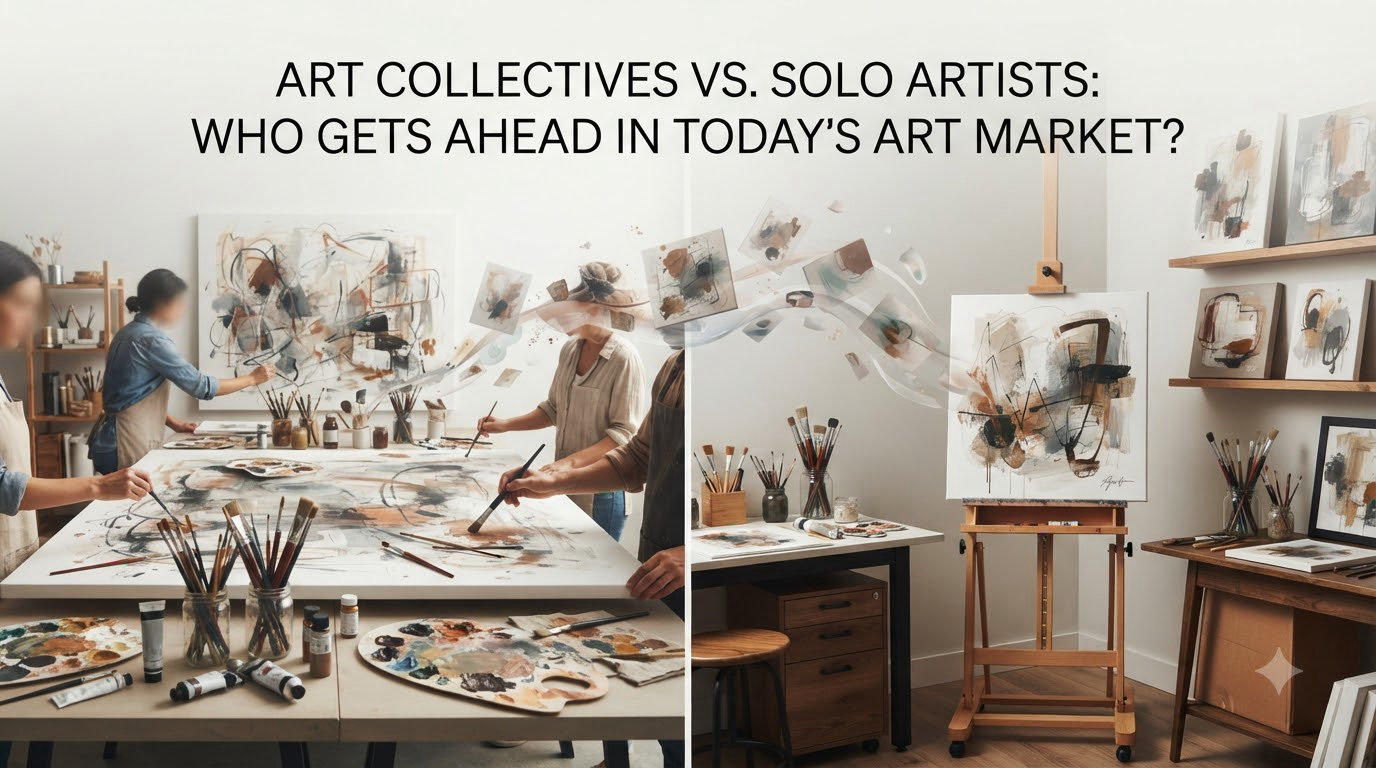
I’ve spent over fifteen years navigating the art world as a member of the Bruce High Quality Foundation, an art collective that started in a shared studio space and grew into something that changed how I think about creative success. The question of whether art collectives or solo artists get ahead in today’s art market comes up constantly in conversations with emerging artists. After watching countless peers choose different paths, I’ve developed some strong opinions about what actually works.
Art collectives vs solo artists is not a simple either-or proposition. Both paths offer distinct advantages, and the answer to “who gets ahead” depends heavily on how you define success. Is it gallery representation? Sales figures? Critical recognition? Creative freedom? The art collectives vs solo artists debate reveals fundamental tensions in how we value art and the people who make it.
In 2026, the art market continues to evolve in fascinating ways. More artists are experimenting with hybrid models, working independently while maintaining loose collective affiliations. This article explores what research tells us about market preferences, the real economic data behind collective versus solo careers, and what I’ve learned from our collective’s journey. Whether you’re an emerging artist deciding your path or a collector wondering what drives value, this guide offers practical insights you won’t find elsewhere.
Table of Contents
The Psychology: Why We Prefer Individual Artists
Research from [cy-10] revealed something unsettling about how people perceive art. In a series of controlled studies, participants consistently rated identical artwork higher when told it was created by a single artist rather than a collective. The same painting, the same sculpture, the same installation received different quality judgments based solely on authorship attribution.
Psychologists call this the “effort heuristic” – our tendency to assume that individual work requires more effort than collaborative work. We imagine the lone artist toiling in isolation, wrestling with their vision, while picturing collectives as casual group activities. This bias runs deep in Western culture, where the myth of the solitary genius has dominated artistic narratives for centuries.
I’ve witnessed this bias firsthand. When our collective first started exhibiting, gallery visitors would ask which piece was “mine” or who did “the real work.” The assumption that individual authorship equals quality affects everything from pricing to press coverage to collector interest. Understanding this psychological preference helps explain why solo artists often command higher prices and more prestigious solo exhibition opportunities.
However, this bias is not universal. In many non-Western artistic traditions, collaborative creation is the norm rather than the exception. Japanese workshop systems, African communal art making, and Indigenous Australian collaborative practices all challenge the Western individual authorship model. The art market’s preference for solo artists reflects cultural conditioning, not objective quality assessment.
The Collective Advantage: Strength in Numbers
Despite market biases toward individual artists, art collectives offer practical advantages that can accelerate career development. When I joined the Bruce High Quality Foundation, I gained immediate access to skills I didn’t possess, equipment I couldn’t afford, and networks I hadn’t built. Resource pooling transforms what’s possible for emerging artists.
Collectives excel at institutional critique and political activism. Groups like Guerrilla Girls, Critical Art Ensemble, and Yes Men have achieved impact that would be impossible for solo practitioners. The collective voice carries weight in ways individual voices cannot. Shared resources also mean shared risks – an expensive project becomes feasible when costs divide among members.
Network effects multiply opportunities exponentially. Each member brings their own contacts, followers, and professional relationships. A five-person collective potentially accesses five distinct networks for exhibitions, sales, and press. This network building advantage compounds over time as collectives develop institutional relationships that benefit all members.
The collaborative practice also pushes creative boundaries in unique ways. Veto power dynamics and consensus building force artists to articulate and defend their ideas more rigorously than solo work requires. I’ve seen collective members grow artistically faster than their solo peers precisely because collaboration demands constant negotiation and refinement.
Solo Artist vs Art Collective: A Side-by-Side Comparison
Before diving deeper into specific paths, let’s examine how solo artists and collectives compare across the dimensions that matter most for career success.
| Factor | Solo Artist | Art Collective |
|---|---|---|
| Market Perception | Higher value attribution due to effort heuristic and genius myth | Often perceived as less serious or professional |
| Gallery Representation | Easier to sign with traditional galleries seeking individual “stars” | Requires finding galleries comfortable with group authorship |
| Exhibition Access | Solo exhibitions carry more prestige but are harder to secure | Group exhibitions more accessible; solo shows for collectives rare |
| Pricing Power | Higher per-piece prices; easier to build market record | Lower individual prices; sales split among members |
| Creative Control | Complete autonomy; vision uncompromised | Consensus required; veto power dynamics limit individual expression |
| Resource Access | Limited to personal means and individual networks | Pooled resources, equipment, studio space, and networks |
| Risk Distribution | Individual bears all financial and reputational risk | Risks shared; failures less personally devastating |
| Skill Development | Deep expertise in personal practice area | Cross-pollination; members learn from each other’s strengths |
| Career Flexibility | Easy to pivot; complete control over trajectory | Exiting difficult; collective decisions constrain individual moves |
| Administrative Burden | All business tasks fall on one person | Tasks distributed; specialization possible |
This comparison reveals why neither path offers universal superiority. Solo artists dominate market perception and pricing but face resource constraints and isolation. Collectives overcome resource limitations through collaboration but struggle against market biases and internal coordination challenges. The optimal choice depends on your priorities, personality, and circumstances.
Case Studies: Famous Art Collectives and Their Impact
History offers valuable lessons about collective practice. The legendary BANK collective (1991-2000) pioneered institutional critique in Britain, staging provocative exhibitions that challenged gallery systems. Their “Cocaine Orgasm” show and “Press Release” series demonstrated how collectives could achieve visibility impossible for individuals. Yet BANK dissolved after nine years, as members pursued individual paths that collective branding complicated.
ART CLUB*2000* operated from 1992-1999 as an anonymous collective of CalArts graduates who used fashion, photography, and video to critique consumer culture. Their work appeared in major exhibitions and publications, yet the group intentionally self-destructed after seven years. Former members cite creative exhaustion and the difficulty of maintaining consensus as primary factors in their dissolution.
These patterns repeat across art history. The Guerrilla Girls (founded 1985) remain active after four decades by maintaining anonymity and rotating membership. In contrast, K-HOLE dissolved after achieving mainstream recognition, with members finding collective branding restrictive for their individual careers. Godzilla, the Asian American arts network, transformed from a collective into a looser affiliation as members established solo practices.
What explains why some collectives endure while others end? Former members consistently cite three factors: consensus fatigue from endless group chats and meetings, economic pressure when individual members need income the collective structure cannot provide, and co-option anxiety when mainstream success threatens countercultural credibility. The Frieze roundtable revealed that collectives often function like “dysfunctional families” – intense bonds that eventually become unsustainable.
The Bruce High Quality Foundation: A Collective Success Story
Our collective formed in [cy-16] when eight artists rented a shared space in Brooklyn. We had no master plan, just cheap rent and shared frustration with gallery systems that seemed designed to exclude emerging artists. The Bruce High Quality Foundation took its name from a fictional artist biography, satirizing the myth-making that surrounds individual art stars.
Our approach combined humor with serious institutional critique. We staged exhibitions in unexpected venues – laundromats, bodegas, subway stations. This strategy generated press attention that traditional gallery representation might have taken years to achieve. Our first major museum show came after just three years of collective practice, faster than most solo artists manage.
The economic reality of collective practice requires honest discussion. When we sell a work, the proceeds divide among members after expenses. Individual members earn less per sale than solo artists at comparable price points. However, our collective sales volume exceeds what most of us would achieve individually. This volume-plus-distribution model works for our current phase of development.
We’ve learned to manage the challenges that destroy other collectives. We established clear protocols for decision-making, including designated “project leads” who hold temporary authority rather than pursuing consensus for every choice. We maintain individual studio practices alongside collective work, preventing the creative exhaustion that ends many collectives. Our art collective business model balances collective identity with individual growth.
The 2026 Art Market: Current Trends and Data
The contemporary art market in 2026 shows fascinating contradictions regarding individual versus collective practice. Data from Art Basel and UBS reports indicate that more artists are opting to work independently rather than maintaining permanent collective affiliations. Yet simultaneously, we’re seeing increased one-off or short-term collaborations between artists, galleries, luxury brands, and other partners.
Market analyst Ralph DeLuca identified several trends reshaping how artists structure their careers. The rise of digital platforms has made individual self-promotion more viable, reducing the network-building advantages collectives previously enjoyed. However, complex projects requiring diverse skill sets – installation art, new media works, large-scale public commissions – continue to favor collaborative approaches.
Gallery representation patterns reveal market preferences clearly. Traditional galleries still overwhelmingly seek individual artists for their rosters. However, alternative spaces, pop-up exhibitions, and project-based venues increasingly welcome collective proposals. This bifurcation creates a two-track system where collectives find opportunities outside the commercial gallery mainstream.
Is the art market tanking? Despite periodic fluctuations, overall art market data shows resilience. What has changed is how value is created and captured. In 2026, success increasingly requires artists to function as entrepreneurs, building personal brands and direct audience relationships. Both solo artists and collectives must develop these capabilities to thrive.
Making Your Choice: Which Path Is Right for You?
After working with hundreds of emerging artists through our foundation’s programs, I’ve developed a simple framework for this decision. Consider your personality first. Do you energize through collaboration or deplete? Collective practice requires constant social negotiation. Solo work demands self-motivation and tolerance for isolation. Neither temperament is superior, but mismatching temperament to structure creates misery.
Examine your skill gaps honestly. If you lack technical capabilities essential to your vision – fabrication skills, digital expertise, writing ability – a collective can fill those gaps immediately. If you’re already versatile or prefer learning new skills yourself, solo practice may suit you better. The art collective challenges and benefits map directly to what you need versus what you already possess.
Consider your risk tolerance and financial situation carefully. Collectives offer safety nets that solo practice cannot provide. When one member faces crisis, others can temporarily carry the load. However, collective income splits mean slower individual wealth accumulation. If you need to maximize earnings quickly, solo practice offers better economics despite higher risk.
Finally, think about legacy and reputation. The art world remembers individual names more reliably than collective identities. Most famous “collective artists” in history are actually remembered as individuals who happened to collaborate. If personal recognition matters deeply to you, collective practice may eventually frustrate you regardless of its other benefits.
Frequently Asked Questions
What is the 70 30 rule in art?
The 70/30 rule in art suggests that 70% of your creative work should follow established conventions and techniques that audiences recognize and appreciate, while 30% should push boundaries with innovation and personal expression. This balance helps artists create work that is both accessible and distinctive. Some artists apply this rule to pricing, marketing, or time allocation as well.
What is the 80 20 rule in art?
The 80/20 rule (Pareto Principle) applied to art suggests that 80% of your results come from 20% of your efforts. For artists, this might mean 80% of sales come from 20% of your pieces, or 80% of your creative breakthroughs happen during 20% of your working hours. Understanding this helps artists focus their energy on high-impact activities rather than spreading themselves thin across everything.
Is the art market tanking?
The art market is not tanking overall, though it experiences periodic corrections and fluctuations. In 2026, the market shows resilience with particular strength in digital art, established blue-chip artists, and certain regional markets. However, emerging artists face increased competition and gallery consolidation. Success requires adaptability and direct audience building rather than relying solely on traditional gallery systems.
What kind of art is in demand right now?
Currently in demand: digital and NFT art (though cooled from peak), works addressing climate and social issues, immersive installations, textile and fiber art, figurative painting revival, and art with strong narrative or conceptual foundations. Collectors increasingly seek authenticity and meaningful engagement. However, demand varies significantly by market segment – what’s hot in New York differs from regional markets.
Why do art collectives end?
Art collectives typically end due to consensus fatigue from constant group decision-making, economic pressure when members need individual income the collective structure cannot provide, co-option anxiety when mainstream success threatens countercultural credibility, creative exhaustion from collaborative demands, and interpersonal conflicts amplified by intense working relationships. Most collectives have natural lifespans of 5-10 years.
Do art collectives make money?
Art collectives can make money, though individual members typically earn less per sale than solo artists at similar price points. Collectives succeed financially through volume – more exhibitions, more sales opportunities, and access to larger projects requiring collaborative teams. The Bruce High Quality Foundation and other established collectives prove collective practice can be economically viable, though it rarely creates the extreme wealth that top solo artists achieve.
Conclusion
So who gets ahead in today’s art market – art collectives or solo artists? After years of observation and personal experience, my answer is unsatisfying but honest: it depends entirely on how you define “ahead.” If market value and individual recognition are your metrics, solo artists have structural advantages that collectives struggle to overcome. The psychological research is clear – people simply value individual work more highly, and that bias permeates pricing, press coverage, and career trajectories.
However, if you measure success by creative growth, risk distribution, and access to resources, collectives often outperform solo practice. Our collective’s story demonstrates that collaborative practice can achieve visibility and impact faster than individual careers. The trade-off is diluted individual recognition and the administrative complexity of group coordination. For many artists, this trade-off is worthwhile during certain career phases.
The art collectives vs solo artists debate misses an important third option: the hybrid path. Many successful artists move between solo and collective practice throughout their careers. Some maintain permanent collective affiliations while developing individual practices. Others start in collectives, build skills and networks, then transition to solo work when ready. In 2026, the art world increasingly accommodates fluid approaches to authorship and collaboration.
My recommendation for emerging artists is this: if you’re starting out and lack resources, skills, or networks, consider collective practice as a development strategy. The Bruce High Quality Foundation wouldn’t exist without the advantages collective formation provided. If you’re already established with clear vision and adequate resources, solo practice may better serve your goals. Whatever you choose, remember that artistic success is measured across decades, not single exhibitions or sales. The path that sustains your practice long-term is the right one for you.