
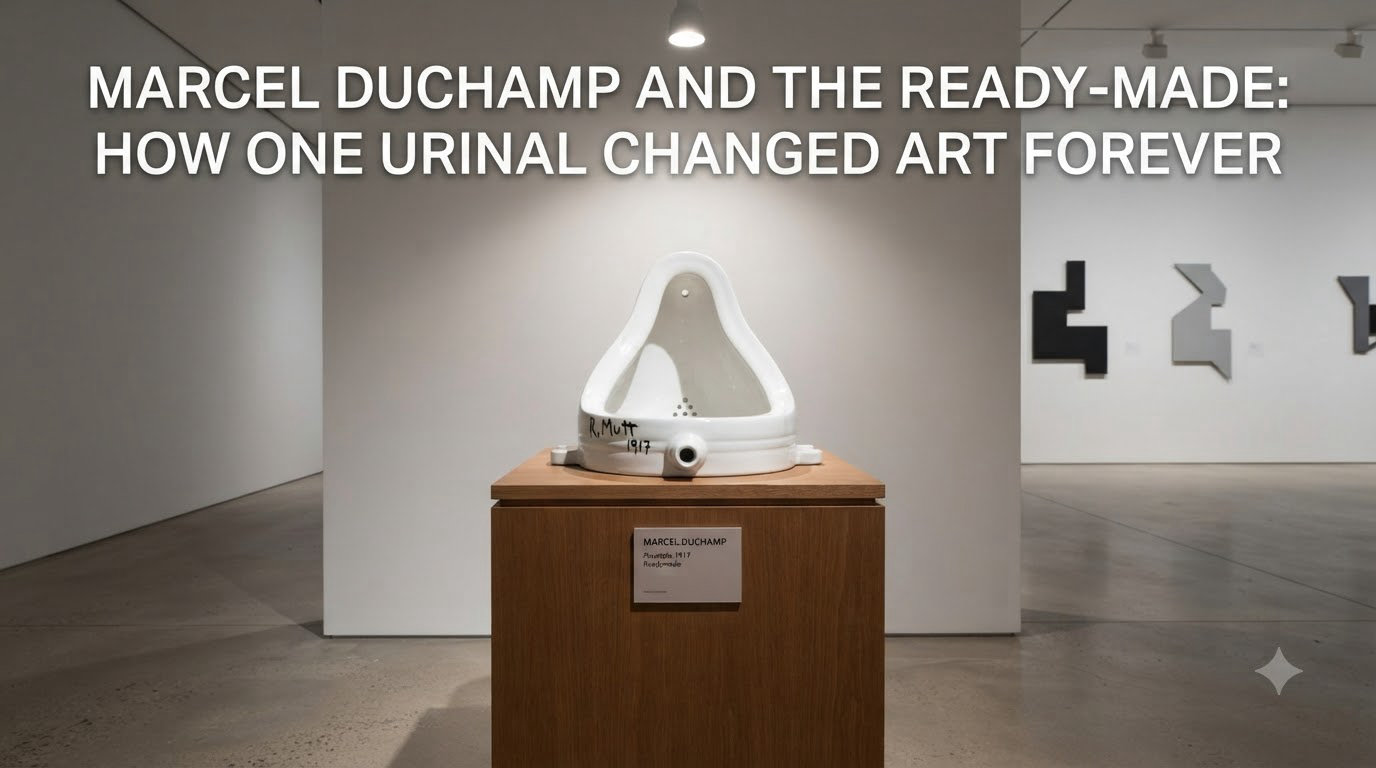
Marcel Duchamp’s Fountain was a readymade sculpture created in 1917 consisting of a porcelain urinal signed “R. Mutt.” It remains one of the most controversial and influential works in art history. This ordinary plumbing fixture, rotated 90 degrees and placed on a pedestal, challenged every assumption about what art could be.
When Duchamp submitted the urinal to the Society of Independent Artists exhibition in New York, he was not just testing the boundaries of acceptability. He was asking a fundamental question that still resonates in 2026: who gets to decide what counts as art?
The story of the ready-made begins not in a studio with brushes and canvas, but in a plumbing supply store on lower Fifth Avenue. Understanding how this object became art requires looking at the cultural context of 1917, the radical ideas brewing in the avant-garde circles of New York, and the philosophical revolution that would forever separate traditional art from conceptual art.
Table of Contents
The Story Behind the Scandal: April 1917
In April 1917, the United States had just entered World War I. New York City was buzzing with energy, and the art world was no exception. The Society of Independent Artists had formed that year, promising to exhibit any artwork submitted by a member, no questions asked. Their inaugural exhibition at the Grand Central Palace would be a massive show of democratic openness in art.
Marcel Duchamp, already a respected figure in the avant-garde community, was a member of the board. He had arrived in New York in 1915 and quickly became part of the intellectual circles that included photographer Alfred Stieglitz, collector Walter Arensberg, and the poet and artist Beatrice Wood. These were people who took ideas seriously and were not afraid to challenge conventions.
According to historical accounts, Duchamp purchased a Bedfordshire model urinal from the J.L. Mott Iron Works showroom. The price was modest, roughly $2 or the equivalent of about $50 today when adjusted for inflation. He brought the porcelain object to his studio at 33 West 67th Street.
There, Duchamp rotated the urinal 90 degrees from its normal position. This simple act of reorientation transformed a functional object into something that could be viewed as sculpture. He signed it “R. Mutt 1917” and submitted it under that pseudonym to the Society of Independent Artists exhibition.
The choice of name has been analyzed endlessly. “Mutt” may have referenced the Mott Iron Works, creating a pun on the manufacturer’s name. It might also have referenced the Mutt and Jeff comic strip characters popular at the time. Duchamp later suggested that “R” stood for Richard, a slang term for a rich person. The ambiguity was intentional.
Duchamp paid the $6 entry fee required for submission. Under the Society’s own rules, which guaranteed exhibition space to any member who paid the fee, the urinal should have been displayed. But when the board discovered the nature of the submission, everything changed.
The Controversy That Rocked the Art World
The board of the Society of Independent Artists faced a dilemma. Their constitution explicitly stated that they would accept all submissions from members. Yet here was a plumbing fixture, presented as art, threatening to make a mockery of their serious exhibition.
After heated discussion, the board voted to reject the piece. They deemed it not a true work of art. The urinal was hidden behind a partition during the exhibition opening. Visitors were not allowed to see it.
Duchamp, who had remained silent during the deliberations, responded with calculated precision. He resigned from the board in protest. His resignation letter made clear that the Society had violated its own principles. They had promised to show everything but had censored this particular object based on their subjective judgment about what qualified as art.
Meanwhile, Alfred Stieglitz photographed the urinal at his gallery 291. The photograph, taken against the backdrop of a painting by Marsden Hartley, became the primary visual record of the original object. Stieglitz composed the image carefully, treating the urinal with the same respect he would give any other artwork. This photographic documentation was crucial because the original urinal was soon lost, discarded or possibly destroyed.
The controversy did not end with the exhibition. Beatrice Wood and Henri-Pierre Roche, with Duchamp’s involvement, published a small magazine called The Blind Man to defend the work. In the editorial, they articulated what would become a foundational principle of conceptual art: “Whether Mr. Mutt with his own hands made the fountain or not has no importance. He CHOSE it. He took an ordinary article of life, placed it so that its useful significance disappeared under the new title and point of view, and created a new thought for that object.”
The public reaction was immediate and polarized. Some saw it as a brilliant philosophical statement. Others dismissed it as a prank, an insult to real artists who spent years mastering their craft. The debate spread through New York’s art circles and eventually reached Europe, where the Dada movement was already exploring similar territory.
What Is Art? The Philosophy Behind the Readymade
The philosophical implications of Duchamp’s gesture were profound. For centuries, Western art had been defined by skill, craftsmanship, and the transformation of raw materials through the artist’s hand. A painting required mastery of brushwork. A sculpture demanded knowledge of anatomy and materials. Art was something you learned to make through years of disciplined practice.
Duchamp proposed a radical alternative. Perhaps the important element was not the making but the choosing. The artist could function as a selector, a curator of reality, elevating ordinary objects through the power of designation and context.
The Shift from Hand to Mind
This shift from manual execution to intellectual selection redefined the artist’s role. Duchamp called his ready-made works “a form of denying the possibility of defining art.” They were anti-art in the sense that they refused to play by the established rules of what an artwork should look like or how it should be made.
The ready-made challenged the cult of the artist as skilled craftsman. It suggested that the idea behind the work could matter more than the physical execution. This concept would not find widespread acceptance until the 1960s, when conceptual artists like Joseph Kosuth and Sol LeWitt made similar claims. But Duchamp had articulated the principle half a century earlier.
The “Fountain” also raised questions about originality. The urinal was a mass-produced object. Thousands of identical fixtures existed in bathrooms across America. Yet by selecting one, signing it, and declaring it art, Duchamp created something that claimed to be unique. The paradox of the unique copy would fascinate later artists and theorists.
The Anti-Art Movement and Dada
Duchamp never formally joined the Dada movement, but his ready-mades embodied its spirit. Dada emerged during World War I as a reaction against the nationalist and rationalist values that the artists believed had led to the catastrophe of the war. If traditional culture could produce such horror, then that culture deserved to be mocked and dismantled.
The Dadaists embraced nonsense, chaos, and provocation. They performed poetry that consisted of gibberish sounds. They created collages from random newspaper clippings. They exhibited objects that defied categorization. In this context, a urinal was perfectly consistent with Dada’s mission to destroy the conventions of bourgeois art.
However, Duchamp was more detached than the passionate Dadaists. He approached his ready-mades with what he called “a complete anesthesia.” There was no anger in his selection, no manifesto to proclaim. He seemed almost amused by the uproar his works caused, as if the controversy proved his point about the arbitrary nature of artistic value.
The connection between Duchamp and Dada would solidify in the years after 1917. When he moved to Paris in the early 1920s, he was embraced by the Dadaists there. His ready-mades became touchstones for a generation of artists seeking to break free from tradition. Yet Duchamp remained elusive, pursuing chess and secretive projects rather than leading any movement.
Beyond the Urinal: Other Readymades by Duchamp
The urinal was not Duchamp’s first ready-made, nor was it his last. He had begun experimenting with the concept several years earlier, though the full significance of these works would only become clear with the notoriety of “Fountain.”
In 1913, Duchamp mounted a bicycle wheel upside down on a wooden stool. He called it Bicycle Wheel. This was the first true ready-made, though at the time Duchamp did not have the terminology. The object had no utilitarian purpose in its new configuration. It could not function as a vehicle, nor as furniture. It existed purely as a visual and conceptual provocation.
In 1914, he acquired a bottle drying rack made of galvanized iron and presented it as Bottle Rack. This time, he added nothing to the object. He simply selected it, signed it, and declared it art. The snowflake-like pattern of the metal wires created an abstract form that could be appreciated aesthetically, even though that was not its intended purpose.
The following year, Duchamp bought a snow shovel and titled it In Advance of the Broken Arm. The title was crucial. It suggested a narrative, a premonition of injury that transformed the mundane tool into something ominous and poetic. The title was doing the artistic work, not the object itself.
In 1919, he created his most famous ready-made after “Fountain”: L.H.O.O.Q. This was a cheap reproduction of Leonardo da Vinci’s Mona Lisa onto which Duchamp had drawn a mustache and goatee. The letters in the title, when pronounced in French, sound like “Elle a chaud au cul” or “She has a hot ass,” a crude joke that simultaneously mocked the masterpiece tradition and added a layer of irreverent humor to the desecration.
Each of these works extended the logic of the ready-made in different directions. Together, they formed a body of work that systematically dismantled the assumptions of traditional aesthetics. By the time Duchamp stopped producing ready-mades in the early 1920s, he had established a new paradigm that would influence artists for the next century.
The Authorship Debate: Did Duchamp Actually Create Fountain?
In recent years, a controversial theory has emerged that challenges the traditional attribution of “Fountain.” Some scholars have argued that the work may have actually been conceived by Baroness Elsa von Freytag-Loringhoven, an avant-garde poet and artist who was part of the same New York circles as Duchamp.
The Baroness was a fascinating figure. She was known for her eccentric behavior, her provocative art, and her radical rejection of social conventions. She created assemblages from found objects, wore absurd costumes, and pushed the boundaries of what was considered acceptable for a woman of her background. Her artistic practice was arguably more aligned with the spirit of the ready-made than Duchamp’s cooler, more intellectual approach.
The evidence for her authorship of “Fountain” is circumstantial but intriguing. A letter from Duchamp to his sister Suzanne mentions a “female friend” who submitted a porcelain urinal as a sculpture using a male pseudonym. This could refer to the Baroness. The timing of her presence in Philadelphia in 1917, the nature of the object, and the use of a pseudonym all fit her profile.
However, the case is not settled. Duchamp’s own statements consistently claimed the work as his own. He described purchasing the urinal and the process of signing it. The “R. Mutt” pseudonym fits his well-documented love of puns and wordplay. And the philosophical context of the ready-mades aligns with his broader intellectual project.
Most mainstream art historians continue to attribute “Fountain” to Duchamp. The debate, however, serves an important function. It reminds us that art history is not fixed but is constantly being reinterpreted. It also highlights the often-overlooked contributions of women to the avant-garde movements of the early 20th century.
Whether Duchamp or the Baroness created it, the urinal’s impact on art history remains unchanged. The controversy over authorship actually reinforces the work’s central message: the identity of the creator matters less than the idea behind the object. In a strange way, the attribution debate proves Duchamp’s point about the arbitrary nature of artistic value.
Legacy and Influence: How One Urinal Changed Everything
The influence of “Fountain” extends far beyond its initial shock value. Over the century since its creation, it has become a reference point for countless artists, critics, and theorists trying to understand the nature of contemporary art. Its shadow falls across every gallery, museum, and studio where the boundaries of art are being tested.
From Dada to Conceptual Art
In the 1950s and 1960s, a new generation of artists rediscovered Duchamp’s work. The Jasper Johns and Robert Rauschenberg generation saw in the ready-mades a precedent for their own experiments with everyday objects. The Pop artists, including Andy Warhol, embraced the idea that mass-produced consumer goods could be treated as art. Warhol’s soup cans and Brillo boxes were direct descendants of Duchamp’s urinal.
By the 1970s, conceptual art had emerged as a major movement. Artists like Joseph Kosuth, Lawrence Weiner, and Art and Language made work that consisted primarily of ideas, texts, and instructions. The physical object was often secondary or even unnecessary. They cited Duchamp as their primary inspiration, acknowledging that he had cleared the path for art that was about thought rather than craft.
Contemporary Echoes
In 2026, artists continue to reference and respond to “Fountain.” Maurizio Cattelan’s America (2016), a solid gold functional toilet installed at the Guggenheim Museum, was an obvious homage. Visitors could use it, making a direct connection between the luxury object and its utilitarian function that paralleled Duchamp’s original gesture.
Mike Bidlo has created exact replicas of “Fountain” as part of his practice of reproducing famous artworks. Sherrie Levine has photographed Duchamp’s original readymades, raising questions about originality and reproduction. The theme of the artist as selector rather than maker continues to resonate in an age of digital sampling, remix culture, and NFT art.
The debate about what constitutes art, which “Fountain” forced into the open, has never been resolved. It continues to play out in discussions about performance art, installation art, and digital media. Every time someone questions whether a particular work deserves to be in a museum, they are replaying the argument that began with that porcelain urinal in 1917.
“Fountain” also established the principle of institutional critique. By submitting his work to the Society of Independent Artists and watching them violate their own rules, Duchamp exposed the power structures and unspoken assumptions that govern the art world. Later artists would make this critique their entire practice, creating work that questioned museum policies, gallery economics, and the construction of artistic value.
Frequently Asked Questions
What is the story behind Duchamp’s urinal?
In April 1917, Marcel Duchamp purchased a porcelain urinal from a plumbing supply store, signed it ‘R. Mutt 1917,’ and submitted it to the Society of Independent Artists exhibition in New York. The exhibition board rejected the work despite their stated policy of accepting all submissions. Duchamp resigned from the board in protest. The original urinal was photographed by Alfred Stieglitz but was later lost, leaving only the photograph and the legend behind.
What was the idea behind Marcel Duchamp’s readymades?
Duchamp’s readymades proposed that the artist’s choice and concept matter more than manual skill or craftsmanship. By selecting ordinary mass-produced objects and presenting them as art, he challenged the traditional definition of art as something requiring technical execution. As his defenders wrote in The Blind Man magazine, ‘He CHOSE it. He took an ordinary article of life, placed it so that its useful significance disappeared under the new title and point of view, and created a new thought for that object.’
Why is Duchamp’s Fountain controversial?
Fountain remains controversial because it challenges fundamental assumptions about what art should be. Critics argue it represents the abandonment of skill and craft in favor of publicity stunts and intellectual games. Supporters see it as a profound philosophical statement about the nature of creativity and value. The work asks whether an object becomes art through the artist’s intention and context rather than through its physical properties or the maker’s technical ability.
What is the message of Duchamp’s Fountain?
The message of Fountain is that art is defined by the artist’s conceptual intention and the context of presentation, not by craftsmanship, beauty, or traditional aesthetic qualities. By taking a utilitarian object, removing it from its functional context, and declaring it art, Duchamp argued that the idea behind the work matters more than the object itself. The work also critiques the institutions and unspoken rules that govern the art world, exposing how arbitrary decisions determine what gets recognized as art.
Conclusion
Marcel Duchamp’s ready-made urinal changed art forever by proving that the idea could matter more than the object. What began as a provocation in 1917 has become the foundation of contemporary art practice. Every time an artist presents a found object, creates a conceptual piece, or questions the boundaries of what art can be, they are walking the path that Duchamp cleared.
The enduring power of “Fountain” lies in its simplicity. A single gesture, a signature, a change of context, and the world of art was transformed. The work continues to challenge viewers to think critically about creativity, value, and the institutions that define culture. In 2026, as artists explore digital media, NFTs, and new forms of conceptual practice, the questions Duchamp raised remain as relevant as ever.
The porcelain urinal itself is long gone. What remains is the idea: that art is not a category of objects but a way of thinking, a form of attention, a declaration of intent. That idea, more than any physical artifact, is Duchamp’s true legacy to the art world.