
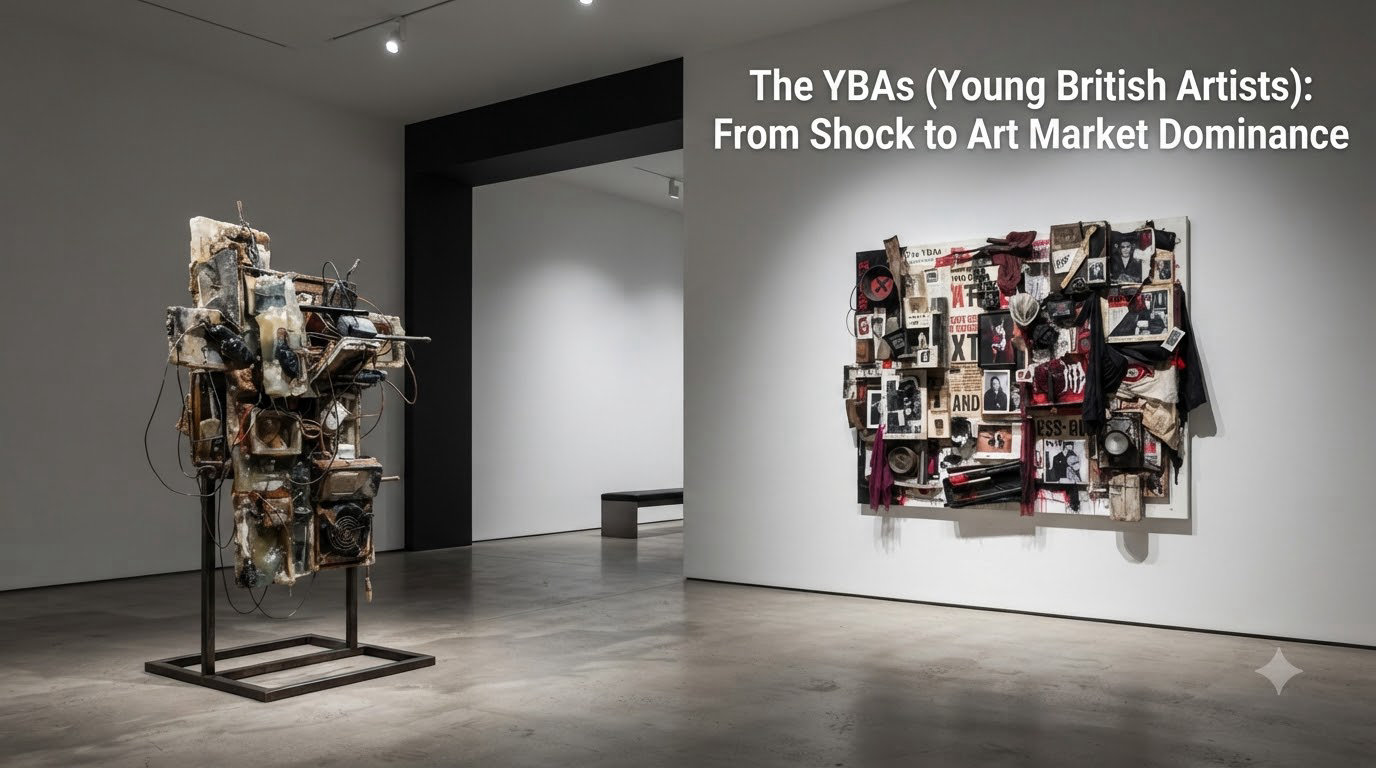
The Young British Artists (YBAs) emerged in the late 1980s as one of the most provocative and commercially successful art movements in British history. This loose collective of artists transformed the contemporary art landscape through their deliberate use of shock tactics, unconventional materials, and an unprecedented entrepreneurial spirit. Their journey from controversial outsiders to dominant forces in the international art market represents a fascinating chapter in cultural history that continues to influence artists working today.
I first encountered YBA works at a Tate Modern exhibition in the early 2000s, and the visceral impact of standing before Damien Hirst’s preserved shark remains one of my most memorable gallery experiences. The movement matters not just for its artistic output, but for how it fundamentally restructured the relationship between avant-garde art and commercial success. Understanding the YBAs means grappling with questions about what constitutes art, the role of provocation in culture, and how controversy can translate into market dominance.
Table of Contents
Origins at Goldsmiths and the Freeze Exhibition
The YBA story begins at Goldsmiths College, University of London, where a new approach to art education was taking shape in the late 1980s. The Fine Art department, under the influence of thinkers like Jon Thompson, encouraged students to curate and organize their own exhibitions rather than waiting for gallery representation. This pedagogical shift would prove instrumental in launching one of the most significant art movements of the late 20th century.
Damien Hirst, then a second-year student, became the de facto leader of this emerging collective. In August 1988, Hirst curated and promoted “Freeze,” a landmark exhibition held in an empty Port of London Authority building in London’s Docklands. The show featured work by Hirst and his Goldsmiths contemporaries, including Angus Fairhurst, Gary Hume, Michael Landy, Sarah Lucas, and others who would become central to the YBA phenomenon.
The warehouse setting was deliberately chosen to sidestep traditional gallery gatekeepers. These artists wanted to control their own narratives and present work on their own terms. The industrial space, with its rough concrete floors and exposed beams, provided the perfect backdrop for the raw, unpolished aesthetic that would become a YBA hallmark.
The Freeze exhibition attracted significant attention despite its location in then-unfashionable East London. Collectors, critics, and fellow artists made the trek to Docklands, sensing that something important was happening. Among the attendees was advertising mogul Charles Saatchi, whose subsequent patronage would prove transformative for several key figures.
Following Freeze, a series of self-organized warehouse shows solidified the network of artists who would become known as the YBAs. Exhibitions like “Modern Medicine” and “Gambler” continued the DIY approach, with artists pooling resources and leveraging their collective visibility. These shows demonstrated an entrepreneurial attitude that was as much a part of the YBA identity as the artwork itself.
The Key Figures of the YBA Movement
While the YBAs were never a formal group with fixed membership, certain artists emerged as central figures whose work defined the movement’s character. Understanding these individuals and their signature pieces is essential to grasping the YBA phenomenon.
Damien Hirst: The Undisputed Leader
Damien Hirst remains the most famous and financially successful of all the YBAs. His work consistently explores themes of death, mortality, and the fragility of existence. “The Physical Impossibility of Death in the Mind of Someone Living” (1991), featuring a tiger shark preserved in formaldehyde, became the iconic image of the entire movement.
Hirst’s spot paintings, medicine cabinets, and spin paintings demonstrate his range and productivity. His 2008 auction “Beautiful Inside My Head Forever” famously bypassed galleries entirely, selling work directly to collectors and raising approximately $200 million. This direct-to-market approach exemplified the YBA entrepreneurial spirit.
Beyond his artwork, Hirst’s business acumen and media savvy set the template for how contemporary artists could build personal brands. He understood that in the modern art world, visibility and controversy translated directly to market value.
Tracey Emin: Confessional Art Pioneer
Tracey Emin brought a deeply personal, confessional quality to YBA work that distinguished her from her peers. Her art draws directly from her own life experiences, including difficult relationships, sexual encounters, and emotional struggles. This autobiographical approach was revolutionary in British contemporary art.
“My Bed” (1998) stands as her most famous work, featuring her actual unmade bed surrounded by detritus including empty vodka bottles, cigarette butts, and used condoms. The piece sparked enormous controversy when it was shortlisted for the Turner Prize, with some praising its raw honesty while others dismissed it as attention-seeking.
Other significant works include “Everyone I Have Ever Slept With 1963-1995,” a tent appliqued with names, and her neon text pieces that display handwritten confessions in glowing letters. Emin’s work helped establish confessional art as a legitimate contemporary practice and opened doors for subsequent artists exploring personal narrative.
Sarah Lucas: Subversive Humor and Found Objects
Sarah Lucas developed a distinctive visual language using everyday objects, particularly furniture, food, and cigarettes, to create provocative sculptures addressing sexuality, British culture, and gender roles. Her work often incorporates humor that is simultaneously crude and sophisticated.
Pieces like “Two Fried Eggs and Kebab” (1992) and “Au Naturel” (1994) use food and furniture to create suggestive forms that challenge conventional representations of the female body. Lucas’s cigarette-stuffed sculptures and self-portraits in macho poses subvert expectations about feminine behavior and appearance.
Her 2015 Venice Biennale representation confirmed her international standing. Lucas has maintained both critical respect and market relevance longer than many of her contemporaries, proving that the YBA approach could sustain a serious career.
Marc Quinn: The Body as Material
Marc Quinn gained early attention with “Self” (1991), a sculpture of his own head cast from frozen blood that he replenishes every five years. This work exemplified the YBA fascination with the body as both subject and material, pushing boundaries of what could constitute sculpture.
His series of flower garden sculptures cast in bronze and frozen in silicone demonstrated technical innovation alongside conceptual depth. Quinn’s later work, including monumental sculptures of disabled bodies and extreme body modifications, continued to challenge conventional aesthetics.
Quinn’s ability to combine traditional sculptural techniques with radical subject matter made him a bridge between YBA provocation and established art historical practices. His work appears in major collections worldwide and has maintained strong secondary market performance.
Chris Ofili: Painting and Cultural Synthesis
Chris Ofili brought painting back into the YBA conversation at a time when many considered the medium obsolete. His vibrant, densely layered canvases incorporate elephant dung, glitter, and images from popular culture and religious iconography. This material innovation earned him the Turner Prize in 1998.
“The Holy Virgin Mary” (1996) became perhaps the most controversial YBA work in America when it was included in the Brooklyn Museum’s “Sensation” exhibition. The painting’s use of elephant dung and collaged pornographic imagery sparked protests and was denounced by political and religious leaders.
Ofili’s incorporation of African and Caribbean cultural references into contemporary British art expanded the movement’s scope beyond its initially white, metropolitan focus. His success helped open doors for subsequent generations of Black British artists.
Additional Key Figures
Gary Hume developed a distinctive painting style using household gloss paint on aluminum panels, creating flat, graphic images that explore representation and memory. His door paintings and simplified portraits demonstrated that YBA approaches could extend beyond shock and sensationalism.
Rachel Whiteread pursued a quieter but equally radical approach, casting negative spaces in resin, plaster, and concrete. Her Turner Prize win in 1993 and subsequent public commissions proved that the YBA label encompassed diverse aesthetic strategies.
The Chapman brothers (Jake and Dinos) created deliberately offensive works addressing violence, consumerism, and religious themes. Their modified Goya etchings and mannequin sculptures pushed shock tactics further than many collectors were comfortable with.
Cornelia Parker transformed found objects through destructive processes, most famously in “Cold Dark Matter: An Exploded View” (1991), where a garden shed was blown up by the British Army and suspended in fragments. Gavin Turk explored identity and authenticity through self-portraiture and appropriation.
Shock Tactics and Artistic Provocation
The YBAs deliberately employed shock tactics as both an aesthetic strategy and a marketing tool. This wasn’t incidental to their work but central to their identity as a movement. Understanding this provocative approach is essential to evaluating their historical significance.
The use of unconventional and often repulsive materials was calculated to generate media coverage. Dead animals, bodily fluids, rotting food, and pornographic imagery appeared regularly in YBA work. These materials weren’t chosen purely for their aesthetic properties but for their ability to trigger strong reactions.
“My Bed” exemplifies how shock translated into cultural impact. When the work was shown at the Tate in 1999 and again in 2015, it generated headlines worldwide. Critics argued about whether it was art at all, while supporters praised its honest confrontation with depression and messy human existence. The controversy ensured the work’s place in art history regardless of individual opinions about its merits.
The shark in formaldehyde similarly divided opinion. Some saw it as a profound meditation on mortality and the limits of human comprehension. Others dismissed it as an empty gesture dependent entirely on the spectacle of a dead predator. The debate itself became part of the work’s meaning, a pattern repeated across much YBA output.
Chris Ofili’s “The Holy Virgin Mary” demonstrated how shock could cross into genuine offense. The use of elephant dung, while culturally significant in African contexts where Ofili was drawing inspiration, was interpreted as sacrilege by many Catholic viewers. The Brooklyn Museum controversy, including legal threats and protests, showed how YBA provocation could spark real cultural conflict.
However, reducing YBA work purely to shock value misses important dimensions. Many pieces carried genuine conceptual weight about mortality, religion, sexuality, and consumer culture. The shock was usually a means to an end rather than an end in itself. The best YBA work rewards sustained attention beyond the initial visceral reaction.
Critics at the time questioned whether this emphasis on provocation represented a decline in artistic standards. Traditionalists argued that YBA work substituted notoriety for craft, media attention for meaningful content. This debate about the relationship between art and its reception remains unresolved and has influenced subsequent contemporary art practices.
The Sensation Exhibition: A Defining Moment
The 1997 “Sensation: Young British Artists from the Saatchi Collection” exhibition at London’s Royal Academy of Arts marked the definitive arrival of the YBAs as a cultural force. This show, drawn entirely from Charles Saatchi’s personal collection, brought together over 100 works by 42 artists and became one of the most talked-about art events of the decade.
The exhibition attracted over 300,000 visitors during its London run, with people queuing for hours to see what the controversy was about. The Royal Academy, a bastion of artistic establishment respectability, provided institutional legitimacy that the warehouse shows lacked. This acceptance by the art establishment signaled the YBAs’ transition from outsiders to dominant players.
Individual works within Sensation generated specific controversies. Marcus Harvey’s portrait of child murderer Myra Hindley, created using children’s handprints, drew particular outrage. The Mothers of the Moors protested outside the gallery, and the work was vandalized with ink and eggs during the show.
The exhibition’s subsequent tour to Berlin and New York extended the YBAs’ international reach. The Brooklyn Museum presentation, featuring Ofili’s “The Holy Virgin Mary,” sparked a major confrontation with New York City officials. Mayor Rudolph Giuliani threatened to withdraw city funding from the museum, generating massive press coverage that only increased visitor numbers.
Sensation demonstrated several key YBA characteristics: the power of controversy to drive attendance, the importance of collector patronage in legitimizing new work, and the movement’s ability to operate simultaneously inside and outside institutional frameworks. The show proved that avant-garde art could achieve mass popularity without sacrificing its provocative edge.
The exhibition also established a template for subsequent blockbuster contemporary art shows. The combination of celebrity artists, sensational subject matter, and institutional backing proved commercially viable and culturally impactful. This model continues to influence how major museums program contemporary art exhibitions in 2026.
From Controversy to Art Market Dominance
The YBAs’ journey from provocative outsiders to art market leaders represents one of the most striking commercial transformations in art history. Understanding this evolution requires examining the specific mechanisms through which controversy was converted into market value.
Charles Saatchi’s role as patron was crucial to this process. The advertising executive turned collector began buying YBA work aggressively in the early 1990s, providing financial support that allowed artists to develop ambitious projects. His purchases of Hirst’s formaldehyde works and Emin’s major pieces established market benchmarks and generated press coverage that drove wider interest.
Saatchi’s collecting wasn’t disinterested patronage but strategic market-making. By concentrating ownership of YBA work and then lending pieces to major exhibitions like Sensation, he increased the visibility and perceived value of his collection. This approach blurred lines between collecting, curating, and market manipulation in ways that remain controversial.
The YBAs themselves proved remarkably savvy about the business of art. Unlike previous generations of British artists who maintained suspicious distance from commerce, the YBAs embraced their roles as entrepreneurs. Hirst’s direct auction of new work in 2008, bypassing galleries entirely, demonstrated this commercial confidence.
Auction results confirm the YBAs’ market dominance. Hirst’s work has achieved prices exceeding $10 million at major sales. Emin’s pieces regularly sell for six figures, while Lucas and Ofili have established strong secondary markets. Even lesser-known YBAs have benefited from the movement’s overall market elevation.
The YBAs transformed how contemporary British art was perceived internationally. Before their emergence, American artists dominated the global contemporary market. The YBAs established London as a credible rival to New York, attracting international collectors and galleries to the British capital. This geographic shift had lasting implications for the global art market structure.
Critics have questioned whether this market success represents genuine artistic achievement or clever self-promotion. The high prices achieved by some YBA work have been cited as evidence of market irrationality, with collectors buying brand recognition rather than aesthetic quality. This debate about the relationship between artistic and commercial value continues to shape discussions about contemporary art.
The YBAs’ market dominance also influenced subsequent art world structures. Their success demonstrated that young artists could achieve significant commercial success early in their careers, bypassing the traditional apprenticeship period. This model has been both emulated and criticized by subsequent generations of artists and dealers.
Legacy and Lasting Influence
More than three decades after the Freeze exhibition, the YBAs’ influence on contemporary art remains profound and measurable. Their legacy extends beyond individual artworks to encompass fundamental changes in how art is produced, promoted, and consumed.
The YBAs established that British contemporary art could achieve genuine global significance. Before their emergence, British artists were often seen as provincial figures working in the shadow of American and continental European movements. The YBAs proved that London could generate and sustain internationally relevant contemporary art.
The movement’s entrepreneurial approach has become standard practice for contemporary artists. Self-promotion, media engagement, and direct market relationships, once considered slightly vulgar, are now essential career skills. Art schools teach these capabilities alongside traditional techniques, a direct result of the YBA model.
The female YBAs in particular opened doors for subsequent generations of women artists. Emin and Lucas demonstrated that confessional, body-focused work by women could achieve both critical respect and commercial success. This expanded possibilities for artists exploring gender, sexuality, and personal narrative.
Many key YBAs remain active and relevant in 2026. Hirst continues to produce new work and maintain his position as one of the world’s highest-earning artists. Emin was appointed Professor of Drawing at the Royal Academy, an institutional recognition that would have seemed impossible in 1988. Lucas, Ofili, and Whiteread continue to produce significant new work and receive major commissions.
The YBAs also established a model for how controversial art can enter the mainstream. Works that provoked outrage in the 1990s now hang in major museum collections without controversy. This normalization process demonstrated that shock tactics have limited shelf life, but that initially provocative work can achieve lasting significance.
Contemporary artists working in Britain today, whether they acknowledge it or not, operate in a landscape shaped by the YBAs. The movement’s combination of conceptual ambition, material innovation, and commercial awareness created the template for success in the contemporary art world. Understanding the YBAs remains essential for anyone seeking to grasp how art functions in the 21st century.
Frequently Asked Questions About the YBAs
Who was the leading figure of the young British artists movement?
Damien Hirst emerged as the de facto leader of the Young British Artists (YBAs). While studying at Goldsmiths College in 1988, Hirst curated the pivotal ‘Freeze’ exhibition that launched the movement. His work, including the famous shark in formaldehyde and spot paintings, became synonymous with the YBA aesthetic. Today, Hirst remains one of the world’s highest-earning artists and continues to produce new work from his London studio.
What does YBAs mean?
YBAs stands for ‘Young British Artists’ – a label applied to a loose group of British artists who began exhibiting together in 1988. The term describes artists known for shock tactics, unconventional materials, and an entrepreneurial attitude that was both oppositional and commercially savvy. The label was coined by art writer Michael Corris and popularized by British media coverage of the controversial movement.
Who are the modern English artists in the 20th century?
Notable 20th century British artists include: Henry Moore (sculpture), David Hockney (painting), Francis Bacon (expressionist painting), Lucian Freud (portraiture), Bridget Riley (op art), and the Young British Artists (YBAs) including Damien Hirst, Tracey Emin, Sarah Lucas, and Chris Ofili who emerged in the late 1980s-1990s. The YBAs specifically revitalized British contemporary art and achieved international recognition for conceptual and provocative work.
What are some famous British artists?
Famous British artists span centuries and include: J.M.W. Turner and John Constable (Romantic landscape painters), William Blake (visionary artist), Francis Bacon (existential figurative painting), David Hockney (pop art and portraiture), Damien Hirst and Tracey Emin (YBAs), Banksy (street art), and Anish Kapoor (sculpture). The Young British Artists (YBAs) who revolutionized contemporary art in the 1990s remain among the most internationally recognized British artists working today.
What was the Freeze exhibition?
Freeze was a landmark 1988 exhibition curated by Damien Hirst while he was still a student at Goldsmiths College. Held in an empty Port of London Authority building in London’s Docklands, the show featured work by Hirst and his contemporaries including Angus Fairhurst, Gary Hume, Michael Landy, and Sarah Lucas. The warehouse setting and self-organized approach established a template for subsequent YBA exhibitions and marked the beginning of the movement that would dominate British art for the next decade.
Why were the YBAs controversial?
The YBAs generated controversy through their deliberate use of shock tactics, including dead animals preserved in formaldehyde, unmade beds surrounded by personal debris, religious imagery incorporating elephant dung and pornography, and explicit depictions of sexuality and violence. Critics argued this work prioritized notoriety over craft, while supporters praised its honest confrontation with difficult subjects. The controversy peaked with the 1997 Sensation exhibition, which attracted protests and media outrage while drawing over 300,000 visitors.
The Enduring Impact of the Young British Artists
The Young British Artists transformed British art from a marginal cultural presence to an internationally significant force. Their journey from warehouse exhibitions in East London to market dominance and museum retrospectives demonstrates how avant-garde movements can achieve mainstream acceptance without losing their essential character.
The YBAs matter because they proved that art could be simultaneously provocative and popular, conceptual and commercial, oppositional and entrepreneurial. Their influence extends through contemporary art practices in 2026 and beyond, shaping how artists approach both their creative work and their careers.
Whether you admire their work or question their methods, the Young British Artists changed the rules of contemporary art in ways that remain relevant today. Understanding this movement is essential for anyone interested in how culture evolves, how markets shape creativity, and how controversy can become the foundation for lasting significance.