
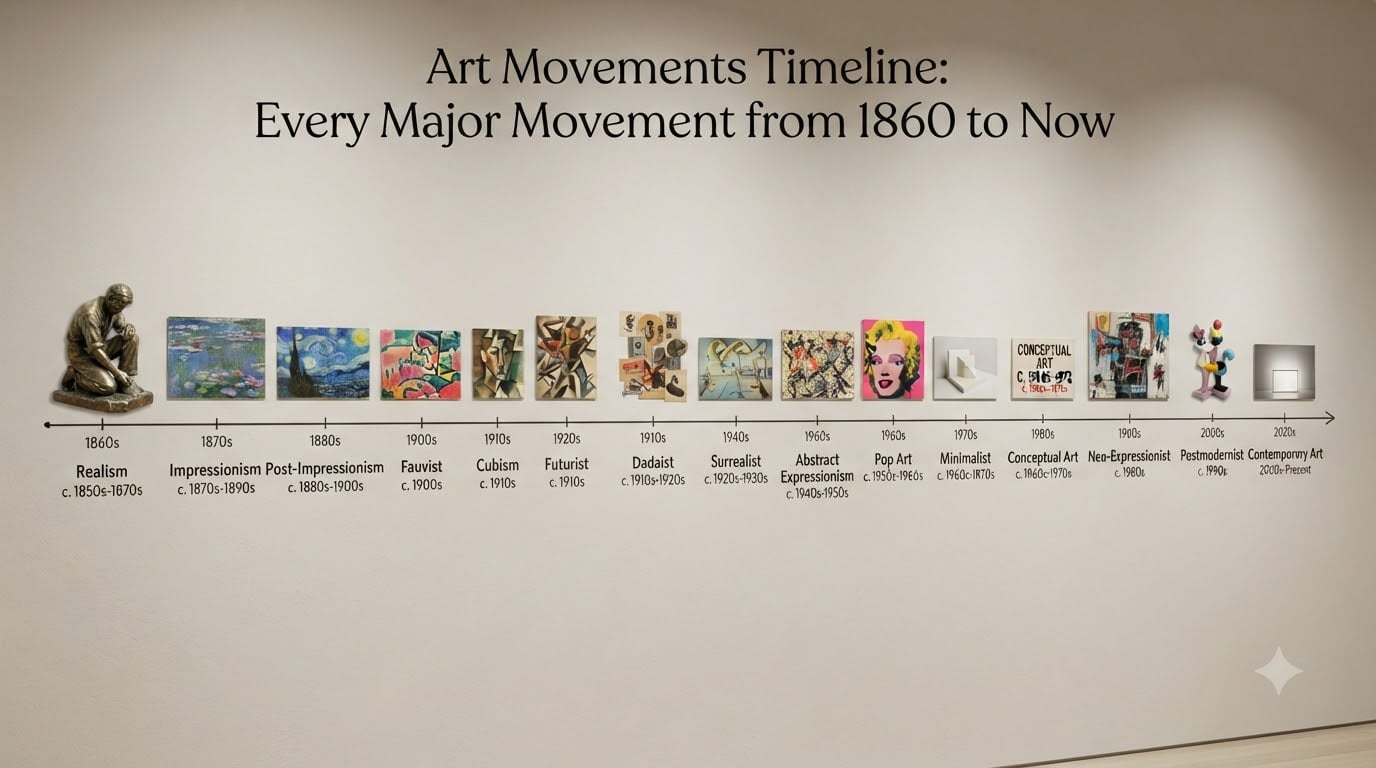
Walking through a museum, I used to feel lost. I’d stare at a Picasso, then a Rothko, then a Warhol, and try to piece together why art kept reinventing itself. That’s what pushed me to build this art movements timeline from 1860 to now, so I could finally see how each movement answered the one before it.
Western art between 1860 and today didn’t drift. It lurched. A realist painter in 1850 declared that only peasants and labor deserved the canvas, and within fifty years, an artist was splattering paint with a turkey baster and calling it art. Every movement you see in galleries was a reaction, an answer, sometimes a fistfight with the generation that came just before.
In this guide, I’ll walk you through every major art movement from Realism in the 1860s through the pluralism of today. You’ll get the dates, the defining ideas, the artists you absolutely need to know, and the through-line that connects Manet to Marina Abramovic. By the end, you’ll have a working map of how modern and contemporary art actually happened.
Table of Contents
What Is an Art Movement and Why a Timeline Matters
An art movement is a tendency or style shared by a group of artists working in roughly the same place and time, often bound by a manifesto, an exhibition, or a shared rebellion. Movements aren’t random. They emerge when a generation of artists decides the previous one got something fundamentally wrong.
Think of the timeline as a chain of arguments. Realists rejected the polished mythology of academic painting. Impressionists rejected Realism’s stiffness. Post-Impressionists rejected Impressionism’s fleeting surfaces. Cubists rejected the very idea that a painting had to show a single viewpoint. Each break opened a door the next movement walked through.
The art movements timeline below moves in roughly chronological order. Where dates overlap, that’s the point. Movements happen in conversation, not isolation.
- Realism (1840s to 1880s)
- Pre-Raphaelite Brotherhood (1848 to 1850s, influence lasting to 1900)
- Arts and Crafts Movement (1860s to 1910)
- Impressionism (1865 to 1885)
- Post-Impressionism (1885 to 1910)
- Symbolism (1886 to 1910)
- Art Nouveau (1890 to 1910)
- Fauvism (1905 to 1908)
- Expressionism (1905 to 1930)
- Cubism (1907 to 1922)
- Futurism (1909 to 1944)
- Dada (1916 to 1924)
- Bauhaus (1919 to 1933)
- De Stijl (1917 to 1931)
- Surrealism (1924 to 1950)
- Abstract Expressionism (1943 to 1965)
- Pop Art (1955 to 1972)
- Minimalism (early 1960s to late 1970s)
- Conceptual Art (mid 1960s to 1970s)
- Postmodernism (1970s to 1990s)
- Contemporary Art (1990s to today)
Before we dive into each one, a note on terminology. The phrase “Modern Art” usually covers roughly 1860 to 1970. “Contemporary Art” generally starts around 1970 and includes everything being made now. That line gets blurry, especially once you hit the 1990s, but it’s a workable frame.
Realism (1840s-1880s)
Realism began in France with Gustave Courbet, who in 1855 declared that painting should show “real and existing things.” That was a direct attack on the Romantic painters who came before him, who favored exotic historical and mythological subjects.
The Realists wanted to depict working-class people, ordinary domestic scenes, and unvarnished landscapes. Courbet’s The Stone Breakers and A Burial at Ornans were the flag-planting moments. Jean-François Millet painted dignified peasants in The Gleaners. Honoré Daumier made brutal satirical prints of Parisian politicians and lawyers.
The movement spread to Russia with the Peredvizhniki (the Wanderers) and to Germany with painters like Wilhelm Leibl. Realism set the philosophical stage for everything that followed. By insisting that everyday life was a legitimate subject, it gave later artists permission to keep pushing outward.
Pre-Raphaelite Brotherhood and Arts and Crafts (1848-1910)
In 1848, seven young British artists formed the Pre-Raphaelite Brotherhood. They wanted to return to the detail, color, and sincerity they saw in Italian painting before Raphael. John Everett Millais, Dante Gabriel Rossetti, and William Holman Hunt produced jewel-toned, densely symbolic paintings drawn from literature and religion.
The Pre-Raphaelites weren’t just painting. They were inventing a total aesthetic, including wallpaper, furniture, poetry, and dress. That instinct for unifying art and daily life carried directly into the Arts and Crafts Movement.
The Arts and Crafts Movement began in the 1860s, championed by William Morris. He and his contemporaries reacted against the cheapening of design during the Industrial Revolution. Handcraft, natural forms, honest materials, and medieval-inspired pattern defined the look. Arts and Crafts shaped interiors, book design, and architecture across Britain and the United States, and seeded later design schools like the Bauhaus.
Impressionism (1865-1885)
Impressionism is the movement everyone knows, and for good reason. A loose group of Parisian painters, including Claude Monet, Pierre-Auguste Renoir, Edgar Degas, Camille Pissarro, and Berthe Morisot, broke from the studio system and took their easels outside.
They wanted to capture fleeting light and atmosphere. Quick brushstrokes, broken color, and ordinary modern subjects (suburban gardens, ballet rehearsals, riverboats) replaced the dark, polished history paintings of the academies. Monet’s Impression, Sunrise gave the movement its name, originally as a sneer from a critic.
Impressionism also marked the first time independent exhibitions mattered. In 1874, the group organized their own show, sidestepping the official Salon. That DIY exhibition model became the template for every avant-garde movement that followed. The site of art shifted from the jury to the gallery wall.
Post-Impressionism (1885-1910)
If Impressionism was about capturing sensation, Post-Impressionism was about rebuilding structure underneath it. The name is a useful catch-all for artists who took Impressionist color and brushwork as a starting point, then pushed toward something more emotional, structural, or symbolic.
Vincent van Gogh poured psychological intensity into swirling brushwork. Paul Cézanne reduced nature to geometric facets, quietly laying the groundwork for Cubism. Paul Gauguin escaped to Tahiti and traded European perspective for flat planes of saturated color. Henri de Toulouse-Lautrec posterized Parisian nightlife.
Post-Impressionism is the hinge of the entire modern art movements timeline. It contains the seeds of Expressionism, Fauvism, Cubism, and Symbolism, all of which branch out in the next two decades.
Symbolism and Art Nouveau (1886-1910)
Two parallel movements filled the gap between Post-Impressionism and full-blown modernism. Symbolism rejected realism and Impressionism’s eye-level vision in favor of dreams, mythology, the occult, and erotic mystery. Gustave Moreau, Odilon Redon, and Edvard Munch (whose The Scream came out of this current) painted inner states rather than outer scenes.
Art Nouveau ran on similar fuel but applied it to design. Whiplash curves, organic plant forms, and stylised female figures appeared on Metro entrances in Paris, glass in Brussels, posters in Vienna, and houses in Glasgow. Hector Guimard, Victor Horta, Antoni Gaudí, and Gustav Klimt shaped the look.
Both movements rejected the heavy bourgeois taste of the late 1800s. They traded moral seriousness for mood, and antique ornament for living, growing form. They’re easy to miss in casual art history timelines, but they shaped everything from advertising to early film.
Fauvism and Expressionism (1905-1930)
In 1905, at the Salon d’Automne in Paris, a critic looking at paintings by Henri Matisse and André Derain called them les fauves, the wild beasts. The name stuck.
Fauvism was short (about three years as a coherent movement) but loud. Pure, unmixed color, aggressive brushwork, and a complete rejection of naturalistic color theory. Matisse’s Woman with a Hat was the calling card. Fauves treated color as emotion, not description.
Expressionism ran longer and deeper, especially in Germany. Die Brücke (founded 1905 in Dresden) and Der Blaue Reiter (founded 1911 in Munich) pushed distortion in service of inner feeling. Ernst Ludwig Kirchner, Emil Nolde, Wassily Kandinsky, and Franz Marc built a new visual vocabulary of anxiety, ecstasy, and spiritual longing. The trauma of World War I would push the surviving artists even further.
Cubism (1907-1922)
Cubism was the most radical formal break in the art movements timeline. Between 1907 and about 1914, Pablo Picasso and Georges Braque dismantled the single-viewpoint picture and rebuilt it from fragments.
Analytical Cubism (roughly 1909 to 1912) reduced subjects to muted, faceted planes, almost monochromatic, hard to read without context. Synthetic Cubism (1913 onward) reintroduced brighter color, collage, and recognizable shapes, building images up rather than breaking them down.
The ripple effects were enormous. Juan Gris, Fernand Léger, and Robert Delaunay carried Cubist ideas into their own languages. Architects, designers, and filmmakers absorbed its fragmented space. Cubism also moved the center of the art world from Paris proper to a tightly networked community of dealers, critics, and poets. Without Cubism, the rapid-fire succession of movements after 1910 doesn’t happen.
Futurism (1909-1944)
Italian poet Filippo Tommaso Marinetti published the Futurist Manifesto in 1909. He glorified speed, machinery, violence, and the modern industrial city, and he wanted museums burned. Italian painters and sculptors like Umberto Boccioni, Giacomo Balla, and Carlo Carrà translated that manifesto into fractured forms that tried to show motion and time simultaneously.
Futurism ran parallel to Cubism but kept its own nationalist and politically charged edge. Some Futurists eventually aligned with Italian Fascism, which complicates the legacy. Even so, the visual ideas pushed into kinetic sculpture, advertising, graphic design, and the Russian avant-garde.
Dada and Surrealism (1916-1950)
World War I broke the previous artistic generation. Out of the wreckage, a group of artists in Zurich opened Cabaret Voltaire in 1916 and called the result Dada. The point was anti-art. Tristan Tzara, Hugo Ball, Hannah Höch, Marcel Duchamp, and Man Ray mocked the very idea that art had to be beautiful, rational, or even made by hand.
Duchamp’s readymades, including the 1917 Fountain, redefined what counted as a work of art. That conceptual crack never closed.
Surrealism grew directly out of Dada. André Breton published the Surrealist Manifesto in 1924, and the movement pivoted from nihilism toward exploration of the unconscious. Sigmund Freud’s writing on dreams was foundational. Salvador Dalí’s melting clocks, René Magritte’s bowler-hatted men, Max Ernst’s grattage collages, and Leonora Carrington’s dreamlike narratives all came out of this conviction that the rational mind was hiding a deeper truth.
For a primer on how later conceptual and institutional critique built on these moves, our guide to institutional critique traces the line forward.
Bauhaus and De Stijl (1919-1933)
Two design-led movements reshaped how modernism was applied to objects, buildings, and type. The Bauhaus opened in Weimar, Germany in 1919 under Walter Gropius, with teachers that included Kandinsky, Klee, Moholy-Nagy, and Albers. It unified fine art, craft, and industrial design into a single curriculum.
Bauhaus objects favored geometric clarity, primary colors, and functional honesty. The school was shut down by the Nazis in 1933, but its faculty scattered, especially to the United States, where they reshaped design education for a generation.
De Stijl ran in parallel in the Netherlands. Founded in 1917, the movement (with Piet Mondrian and Theo van Doesburg at its center) reduced painting and design to black grids, white planes, and the three primary colors. The visual language directly shaped modern architecture, furniture, and graphic design. You still see it in almost every minimal corporate identity.
Abstract Expressionism (1943-1965)
After World War II, the center of the art world moved from Paris to New York. Abstract Expressionism was the first American-dominated movement to claim that position. Two broad tendencies emerged: Action Painting (Jackson Pollock, Willem de Kooning, Franz Kline), which emphasized the physical act of painting, and Color Field (Mark Rothko, Barnett Newman, Clyfford Still), which used large fields of color to evoke quiet, sometimes spiritual, states.
Pollock’s drip paintings, with the canvas flat on the floor and paint flung from above, became the iconic image of the movement. Critics like Clement Greenberg argued that painting had to justify itself purely as painting, surface, color, and gesture. That argument set the stage for everything that came next.
Pop Art (1955-1972)
Pop Art reacted against Abstract Expressionism’s seriousness. British artists Richard Hamilton and Eduardo Paolozzi kicked things off in the mid-1950s, but the movement exploded in New York with Andy Warhol, Roy Lichtenstein, Claes Oldenburg, and James Rosenquist.
They pulled imagery from advertising, comic books, soup cans, celebrities, and dollar signs. The point was partly ironic, partly affectionate. Pop dissolved the boundary between high art and mass culture, and it set up the conditions for everything from appropriation art to contemporary branding.
Warhol’s Marilyn Diptych and Lichtenstein’s Benday-dot heroines are the works most people remember. Both were produced with the kind of mechanical reproduction the Abstract Expressionists would have hated.
Minimalism and Conceptual Art (1960s-1970s)
Two closely related movements, Minimalism and Conceptual Art, took Greenberg’s logic to its endpoint. If painting had to be about painting, then maybe the canvas didn’t need much on it at all. Donald Judd, Dan Flavin, Carl Andre, and Sol LeWitt built stripped-down, geometric, often industrially produced objects. Repetition, seriality, and absence of metaphor were the working principles.
Conceptual Art went further. If art could be reduced to its essentials, then maybe the idea was the work. Sol LeWitt’s wall drawings, Joseph Kosuth’s One and Three Chairs, and Yoko Ono’s instruction pieces carried the logic to its logical conclusion. Performance Art, with figures like Marina Abramovic, Yvonne Rainer, and Chris Burden, grew out of the same impulse to break the object entirely.
Postmodernism and Contemporary Art (1970s-Today)
By the 1970s, the belief in a single progressive storyline of modern art was gone. Postmodernism named that collapse. Pluralism, pastiche, quotation, identity, irony, and skepticism toward grand narratives became the working materials.
The 1980s brought Neo-Expressionism (Julian Schnabel, Anselm Kiefer, Jean-Michel Basquiat), graffiti and street art, and the Pictures Generation, including Cindy Sherman, Richard Prince, and Barbara Kruger, all using photography to question how images construct identity.
The 1990s and 2000s opened space for relational aesthetics, video art, large-scale installation, and global perspectives. Damien Hirst’s preserved animals, Jeff Koons’s balloon dogs, and Ai Weiwei’s political installations all sit comfortably inside the same expanded field. Our Postmodern art guide unpacks this shift in more depth.
Today, “Contemporary Art” is less a single movement than an ongoing conversation across identity, climate, technology, and globalization. Our list of the 100 Most Influential Contemporary Artists shows how wide that conversation has become. Related movements like guerrilla art and influential art collectives sit alongside traditional gallery practice. The art world is bigger and more fragmented than at any point since 1860.
For readers who want to dig further into the bigger picture, our art topics hub and art education resources are good next stops.
How Art Movements Influence Each Other
The cleanest way to read this art movements timeline is as a series of arguments. Realism said: stop painting gods, paint people. Impressionism said: stop staging people, capture light. Post-Impressionism said: stop chasing the eye, build structure. Cubism said: stop assuming one viewpoint exists. Dada said: stop assuming art even exists.
That last move was the most disruptive. Once Duchamp declared a urinal a work of art, every later movement had to decide whether it was making objects, ideas, performances, or something else entirely. Pop, Minimalism, Conceptual Art, and Performance Art all grew out of that single gesture.
You also see recurring themes return in new forms. The Arts and Crafts rejection of industrial ugliness echoes in late-20th-century critiques of consumer culture. Bauhaus functionalism shows up again in contemporary industrial design. Symbolism’s dream content returns in Surrealism, and again in the more recent embrace of artificial intelligence and algorithmic imagery.
There isn’t really an “end” to the timeline. New movements keep forming, but they form faster, last shorter, and reach wider audiences. That’s why pinning down what’s happening in art right now is harder than summarizing the 1860s.
Frequently Asked Questions
What is the chronological order of art movements from 1860 to today?
The major Western art movements, in order, are Realism, Pre-Raphaelite Brotherhood, Arts and Crafts, Impressionism, Post-Impressionism, Symbolism, Art Nouveau, Fauvism, Expressionism, Cubism, Futurism, Dada, Bauhaus, De Stijl, Surrealism, Abstract Expressionism, Pop Art, Minimalism, Conceptual Art, Postmodernism, and Contemporary Art.
What art movements occurred in the 1860s?
The 1860s saw the rise of Impressionism in France, with Monet, Renoir, and Pissarro working in Paris. The Arts and Crafts Movement also began in Britain in the 1860s under William Morris, and Realism was at its peak with Courbet in France and the Peredvizhniki in Russia.
What are the major differences between Modern and Contemporary art?
Modern Art generally covers roughly 1860 to 1970 and emphasizes formal innovation, abstraction, and progressive stylistic breaks. Contemporary Art covers the period from about 1970 to today and is defined less by a single style than by pluralism, identity, global perspectives, and the use of new technologies.
What were the most influential art movements of the 20th century?
The most influential 20th-century movements were Cubism, Dada, Surrealism, Bauhaus, Abstract Expressionism, Pop Art, Minimalism, and Conceptual Art. Each redefined what art could be, what counted as a medium, and where art could be seen.
Are there genuine art movements today?
Yes, though they tend to form faster, last shorter, and spread through digital networks rather than manifestos and galleries. Recent examples include Post-Internet Art, Relational Aesthetics, and the global rise of artist collectives working on climate, identity, and decolonial themes.
How do art movements get their names?
Most movement names are nicknames, sometimes given by critics, sometimes adopted by the artists themselves. Examples include Impressionism (from a hostile critic’s review of Monet), Fauvism (from les fauves, the wild beasts), and Cubism (from a critic noting the cube-like forms in early Braque).
Final Thoughts on the Living Art Movements Timeline
The art movements timeline from 1860 to now is really a story about permission. Each generation gave the next one permission to ask a new question. Realists allowed everyday subjects. Impressionists allowed color to behave honestly. Cubists allowed pictures to lie usefully. Conceptual artists allowed ideas to count as art. Contemporary artists allowed the whole story to be questioned at once.
If you want to take this further, do two things. First, walk through a museum with this timeline open on your phone. You’ll start to see the conversation between galleries. Second, read one artist’s full catalog from any movement on this list. You’ll find that “movements” are messy in practice, and that individual artists were always arguing with the labels later applied to them.
Art didn’t stop in 2026. It’s still breaking its own rules. The next movement is probably forming somewhere right now, in a studio, on a server, or on a wall you haven’t walked past yet.