
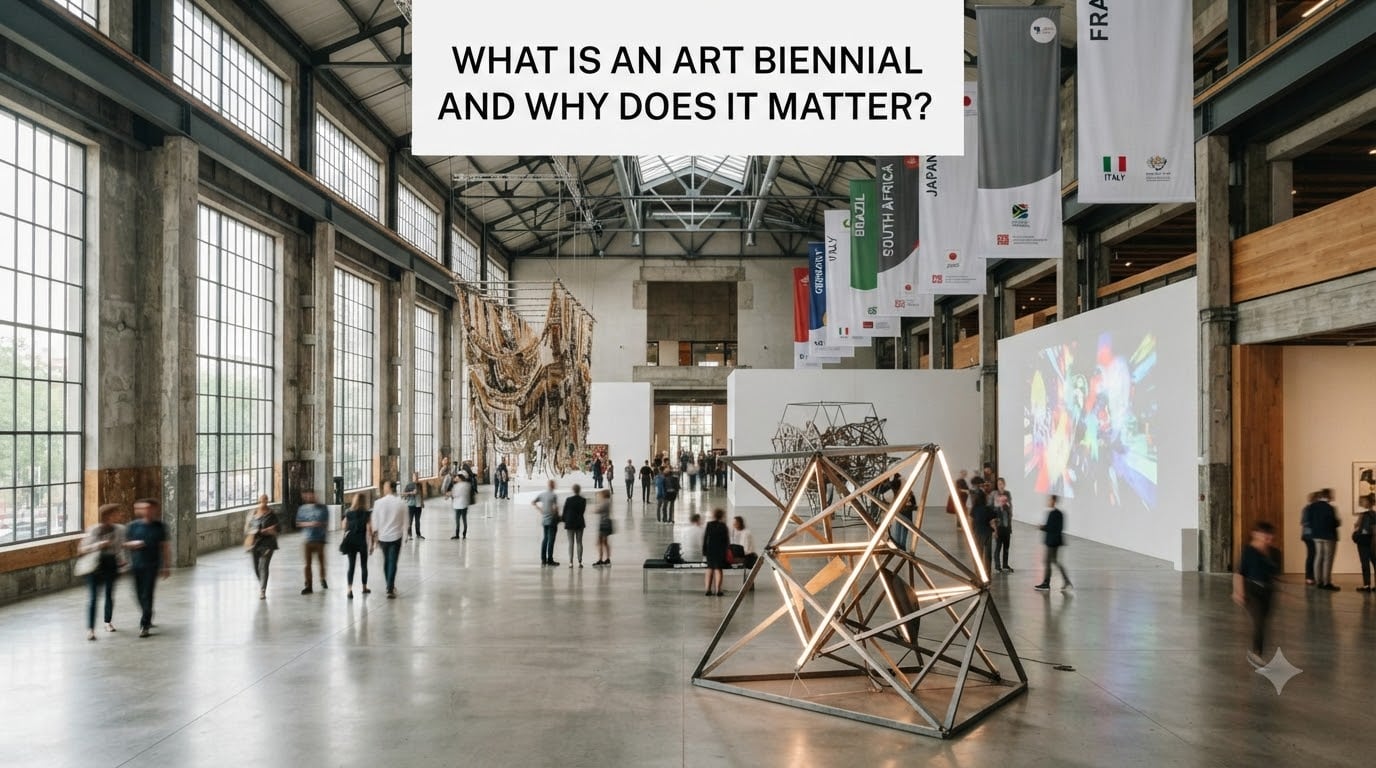
If you’ve ever wondered why the art world makes such a fuss about a giant exhibition that only opens every two years, you’re not alone. An art biennial is a large-scale international exhibition of contemporary art that recurs every two years, and the format traces back to the Venice Biennale in 1895. Today, hundreds of biennials shape what gets seen, sold, and discussed across the global art world, and they remain the closest thing the art scene has to the Olympics.
I started paying real attention to biennials after my first visit to the Whitney Biennial years ago, and the experience rewired how I think about contemporary art. In this guide, I’ll walk through what an art biennial actually is, where the tradition comes from, why curators and cities invest so much in them, and how they continue to matter in 2026.
If performance art or collective practices interest you, my earlier piece on what performance art really is sets up helpful context for the kinds of work you’ll encounter at these shows.
Table of Contents
What Is an Art Biennial?
An art biennial is a major international exhibition of contemporary art that takes place once every two years, usually organized around a curatorial theme or a survey of current artistic practice. The term “biennial” comes from the Latin for “two years,” and “biennale” is simply the Italian form of the same word. Both spellings refer to the same type of recurring international exhibition.
Most biennials run for several months and combine a central curated exhibition with national pavilions, where each participating country presents its own artist or project. The Venice Biennale, for example, brings together more than 80 national pavilions across the Giardini and Arsenale, while the Whitney Biennial surveys emerging and established American artists every odd-numbered year.
Biennials are not art fairs. The core mission is artistic and cultural, not commercial, and most works on view are commissioned or borrowed rather than sold. That difference is what makes biennials such important sites for experimental and politically engaged contemporary art.
Historical Origins of the Biennial
The biennial format was born in Venice in 1895, when the city organized the first international art exhibition under the leadership of Mayor Riccardo Selvatico. The original event was meant to celebrate the silver anniversary of King Umberto I and Margherita of Savoy while showcasing the artistic links between Italy and its neighbors, and the name “Biennale” stuck as the event outgrew its anniversary framing.
The etymology helps explain the form: “biennale” simply means “every two years” or “lasting two years” in Italian, and many institutions borrowed the Venice template after World War II. The Sao Paulo Biennial followed in 1951, the Biennale of Sydney in 1973, and the Istanbul Biennial in 1987, each adapting the format to its own regional context.
By the early 2000s, the biennial had spread from roughly 60 events worldwide to more than 250 today. That proliferation has reshaped the geography of contemporary art, pushing the center of gravity beyond the traditional Western European capitals.
Major Biennials Around the World
A short list of the most influential biennials gives a sense of how varied the format has become:
- Venice Biennale (Italy, 1895) – the original and still the most prestigious, with national pavilions filling the Giardini and Arsenale.
- Whitney Biennial (United States, 1932) – the longest-running survey of American art, organized by the Whitney Museum of American Art.
- Sao Paulo Biennial (Brazil, 1951) – the oldest biennial in the Global South and a key platform for Latin American artists.
- Istanbul Biennial (Turkey, 1987) – known for politically engaged, site-specific projects across the city.
- Biennale of Sydney (Australia, 1973) – Australia’s largest recurring contemporary art event.
In 2026, the Venice Biennale opened its 61st International Art Exhibition, while Sydney hosted its 24th edition. Berlin Biennale, Liverpool Biennial, and the Gwangju Biennale all run on their own staggered cycles, which is why art lovers can essentially chase a biennial somewhere on the planet almost any month of the year.
Why Biennials Matter
Biennials matter because they act as global platforms where art, cities, and audiences meet on equal footing. The impact shows up in three distinct ways, and each one is worth understanding on its own.
For Artists
For artists, a strong biennial showing can be career-defining. Robert Rauschenberg’s win of the Venice Biennale’s International Grand Prize in 1964 is often credited with helping launch American Pop Art onto the global stage. Whitney Biennial selections have similarly launched dozens of now-prominent names; you can read about the careers that came out of a single edition in our Whitney Biennial 2010 follow-up.
For Host Cities
For host cities, biennials are acts of cultural diplomacy and economic development. They draw international press, attract cultural tourists, and signal that a city is willing to invest in contemporary creativity rather than just heritage tourism. Many cities now build entire cultural strategies around their biennial years.
For the Public
For the public, biennials offer something rare: the chance to see ambitious, often site-specific work that rarely travels, made by artists from dozens of countries in one place. For a deeper look at the kinds of artists these shows tend to amplify, our guide to the 100 most influential contemporary artists pairs well with this piece.
Biennial vs Art Fair: Clearing Up the Confusion
A biennial is a non-commercial exhibition that recurs every two years and is curated around themes or national representation. An art fair, by contrast, is a commercial marketplace where galleries rent booths to sell art, often annually. The confusion is common because both bring large crowds and big budgets to host cities, but their missions are nearly opposite.
Biennials commission new work, pay artist fees, and often produce publications that live on after the show closes. Art fairs generate immediate sales and short-term press. If you want to understand how some collaborative practices land in biennials rather than fairs, our guide to influential art collectives shows the difference in action.
It’s also worth noting that the art world has produced alternative biennials outside the institutional system. The Bruce High Quality Foundation, for instance, organized the Brucennial in New York as a tongue-in-cheek parody of the Whitney Biennial, and it became a phenomenon in its own right.
Frequently Asked Questions
What is an art biennial and why does it matter?
An art biennial is a large international exhibition of contemporary art held every two years. It matters because it provides artists with a global platform, helps cities build cultural reputations, and gives the public access to ambitious new work from around the world.
How often does a biennial happen?
A biennial happens every two years. The name comes from the Italian biennale, meaning lasting two years, and the format was established by the Venice Biennale in 1895.
Why is it called a biennale?
It is called a biennale from the Italian word meaning every two years or lasting two years. The Venice Biennale adopted the term in 1895 and it became the standard name for this kind of recurring international exhibition.
What is the purpose of a biennale?
The purpose of a biennale is to survey contemporary art, foster international cultural exchange, and give artists a major platform for new work. Biennales also help host cities showcase cultural leadership and bring global attention to local scenes.
Which Biennale is considered the best in the world?
The Venice Biennale is widely considered the most prestigious biennial in the world. The Whitney Biennial, Sao Paulo Biennial, and Istanbul Biennial are also highly regarded and influential in their own regions.
Which art biennials are taking place in 2026?
In 2026, the Venice Biennale and the Biennale of Sydney both staged major editions. Berlin Biennale, Liverpool Biennial, and Gwangju Biennale run on staggered cycles, so specific years vary.
Conclusion
An art biennial is more than a big art show. It is a recurring international stage where artists gain global attention, cities stake cultural claims, and the public encounters contemporary ideas it would rarely see in any single museum. From the Venice Biennale in 1895 to the dozens of events now spread across every continent, the biennial remains the format that keeps contemporary art moving.
As you plan your own biennial year in 2026, start with a show you can actually attend, give yourself at least two full days, and remember that the collateral exhibitions and national pavilions often hide the most surprising work. The art biennial rewards patience, curiosity, and a willingness to wander.