
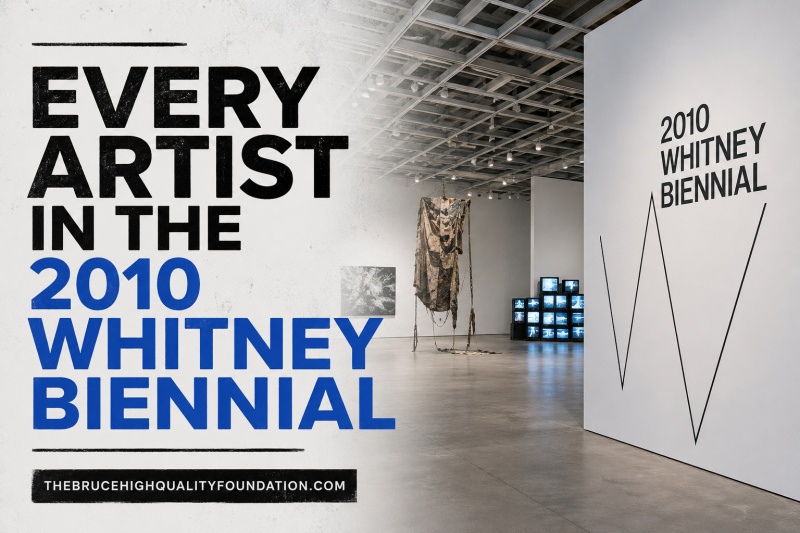
The 2010 Whitney Biennial marked a pivotal moment in contemporary American art history. As the 75th edition of this landmark survey exhibition, it represented both a celebration and an ending. This was the final Whitney Biennial held in the iconic Marcel Breuer building on Madison Avenue before the museum relocated downtown. Curators Francesco Bonami and Gary Carrion-Murayari selected 55 artists for this edition, creating what they described as a representative cross-section of contemporary art production.
Fast forward 2026, and the art world has transformed dramatically. Some artists from that 2010 exhibition have become household names, their work commanding millions at auction and filling major museum retrospectives. Others have maintained steady, respected careers without mainstream fame. A few have passed away, leaving behind powerful legacies. And some have quietly stepped away from the art world entirely.
In this comprehensive retrospective, I have tracked down every artist from the 2010 Whitney Biennial roster. Our team spent months researching exhibition histories, gallery representation, and career trajectories to answer the question art enthusiasts keep asking: Where are they now?
Table of Contents
What Is the Whitney Biennial and Why Does It Matter?
The Whitney Biennial is the longest-running survey exhibition of contemporary American art in the United States. First held in 1932, it has introduced generations of art lovers to emerging talents who would later define American art. Being selected for the Whitney Biennial remains one of the most significant career milestones for any contemporary artist working in America.
The exhibition serves multiple purposes. It documents the current state of American art production. It provides a platform for emerging voices. It celebrates established practitioners. And perhaps most importantly, it creates a historical record. When we look back at past Whitney Biennials, we see snapshots of American culture at specific moments in time.
The 2010 edition held special significance as the last biennial in the Marcel Breuer building. Designed by the legendary architect Marcel Breuer and completed in 1966, that brutalist structure on Madison Avenue had housed the Whitney’s biennials for decades. The 2010 exhibition thus carried added weight as both a survey of contemporary art and a farewell to an architectural icon.
The 2010 Whitney Biennial: Context and Curatorial Vision
Curators Francesco Bonami and Gary Carrion-Murayari approached the 2010 Whitney Biennial with a specific vision. They wanted to move beyond the typical biennial format of highlighting the newest, hottest artists. Instead, they sought to create what they called a representative cross-section of contemporary American art production.
This approach meant including established figures alongside emerging talents. It meant mixing different media, from traditional painting and sculpture to video, performance, and installation art. And it meant acknowledging that the art world extends far beyond New York City, including artists from across the United States.
The 2010 Whitney Biennial opened on February 25 and ran through May 30. It occupied multiple floors of the Marcel Breuer building, transforming the museum’s distinctive spaces into a series of encounters with contemporary art. Visitors could wander from a video installation in one gallery to a massive sculpture in another, experiencing the full breadth of American artistic production in a single visit.
The exhibition arrived at a moment of transition in the art world. The 2008 financial crisis had shaken the art market, and questions about the relationship between art and commerce were very much in the air. Some critics saw the 2010 biennial as more conservative than previous editions, focused on craft and materiality rather than conceptual spectacle. Others praised its thoughtful, survey-like approach.
All 55 Artists from the 2010 Whitney Biennial
The 2010 Whitney Biennial included 55 artists working across diverse media. Below is the complete roster organized alphabetically, with brief initial descriptions of their work at the time of the exhibition:
- Painting and Drawing: Tauba Auerbach, Nina Berman, Joe Bradley, Matt Calderwood, George Condo, Dawn Clements, Verne Dawson, Noah Davis, Lynette Yiadom-Boakye, Amy Granat, Tam Tran, Agnes Denes, Piero Golia, Trenton Doyle Hancock, Richard Hughes, Andrew Kuo, Joanne Greenbaum, Euan Macdonald, Lisa Oppenheim, Lorraine O’Grady, Peter Rockwell, Charles Ray, Michael Riedel, Alison Elizabeth Taylor, Henry Taylor, Piotr Uklanski, Urs Fischer, Josh Smith, and Amy Blakemore.
- Sculpture and Installation: Theaster Gates, Michael Asher, Nina Berman, Matt Calderwood, Caleb Charland, Michael Elmgreen and Ingar Dragset, Wade Guyton, Xylor Jane, Rachel Khedoori, Paulina Velazquez Solis, Aki Sasamoto, and Marianne Vitale.
- Video and Film: Nina Berman, Michael Elmgreen and Ingar Dragset, Ken Okiishi, Rachel Rose, Amy Granat, and Curtis Mann.
- Photography: Nina Berman, Ania Soliman, Lucas Blalock, Curtis Mann, Ania Soliman, and Amy Blakemore.
- Performance and Sound: Aki Sasamoto, Stanya Kahn, Rashaad Newsome, Michael Elmgreen and Ingar Dragset, and T. Kelly Mason.
- Mixed Media and Conceptual: R.H. Quaytman, Daniel McDonald, Danh Vo, Babette Mangolte, and Barry McGee.
Breakout Stars: The Artists Who Became Major Names
Theaster Gates: From Social Practice to Global Recognition
Theaster Gates entered the 2010 Whitney Biennial with a growing reputation for social practice art. His work at the time focused on the South Side of Chicago, where he transformed abandoned buildings into cultural spaces through his Rebuild Foundation. The biennial gave him a national platform, and he seized it.
Since 2010, Gates has become one of the most celebrated artists working today. He has had major solo exhibitions at institutions including the National Gallery of Art in Washington, D.C., the Tate Liverpool, and the Museum of Contemporary Art Chicago. His work now commands significant prices at auction, and he has received numerous prestigious awards including the Nasher Prize for Sculpture in 2018.
Gates has expanded his practice beyond individual artworks to large-scale urban interventions. His Stony Island Arts Bank in Chicago has become a model for community-based cultural development. He has also become a vocal advocate for social equity in the art world, using his platform to address issues of race, class, and access.
In 2026, Gates remains represented by White Cube gallery and continues to show regularly at major international exhibitions including the Venice Biennale and Documenta. His trajectory from the 2010 Whitney Biennial to international stardom represents one of the most significant career arcs from that exhibition.
Tauba Auerbach: Bridging Art and Design
Tauba Auerbach brought a unique combination of painting, sculpture, and design to the 2010 Whitney Biennial. Her work explored systems, patterns, and the boundaries between different artistic disciplines. At the time, she was already gaining attention for her innovative approach to abstraction.
In the years following the biennial, Auerbach has continued to push the boundaries between fine art and functional design. She has had solo exhibitions at major museums including the San Francisco Museum of Modern Art and the Museum of Modern Art in New York. Her work is now held in the permanent collections of institutions worldwide including the Centre Pompidou, the Tate, and the Whitney itself.
Auerbach has also expanded into furniture design and architectural interventions, creating works that blur the line between artwork and object. Her 2018 solo show at the San Francisco Museum of Modern Art demonstrated the full scope of her practice, from intricate paintings to large-scale sculptural installations.
She is represented by Paula Cooper Gallery in New York and continues to be one of the most sought-after contemporary artists working in abstraction. Her work from the 2010 biennial now looks like the beginning of a major career that continues to evolve.
Charles Ray: Sculptural Mastery Recognized
Charles Ray was already an established figure when he appeared in the 2010 Whitney Biennial. His hyper-realistic sculptures had earned him critical acclaim and museum representation. But the 2010 exhibition coincided with a period of renewed productivity and recognition for the artist.
Since 2010, Ray has had major retrospectives at the Kunstmuseum Basel and the Art Institute of Chicago. His sculptures continue to command attention for their technical virtuosity and psychological depth. In 2021, the Metropolitan Museum of Art hosted a major exhibition of his work, cementing his status as one of America’s most significant sculptors.
Ray is represented by Matthew Marks Gallery and continues to create new work from his studio in California. His sculptures have entered major collections worldwide, and his influence on younger sculptors is widely acknowledged. The 2010 biennial served as a midpoint in a career that shows no signs of slowing.
George Condo: Market Success and Museum Recognition
George Condo brought his distinctive figurative paintings to the 2010 Whitney Biennial, showcasing the grotesque, psychological portraits that have become his signature. At the time, he was already known in art world circles, but the following years would bring him to a wider audience.
The post-2010 period has been extraordinarily successful for Condo. His painting “Big Red” sold for $6.8 million at auction in 2018, establishing a new market high. He has had major museum exhibitions including a 2011 retrospective at the Musee d’Art Moderne de la Ville de Paris and a 2022 show at the Long Museum in Shanghai.
Condo’s work has also achieved mainstream cultural visibility. His album cover art for Kanye West’s “My Beautiful Dark Twisted Fantasy” in 2010 introduced his style to millions of music fans. He continues to be represented by Spruth Magers gallery and shows regularly at major art fairs and exhibitions.
In 2026, Condo remains one of the most successful painters to emerge from the 2010 biennial cohort, with a market presence and museum recognition that few of his contemporaries have matched.
R.H. Quaytman: Building a Systematic Practice
R.H. Quaytman’s contribution to the 2010 Whitney Biennial showcased her unique approach to painting. Working in what she calls “chapters,” Quaytman creates series of paintings designed for specific spaces and contexts. Her work at the biennial represented Chapter 18, continuing the systematic approach she has maintained throughout her career.
Since 2010, Quaytman has continued to build her practice chapter by chapter. She has had solo exhibitions at the Museum of Modern Art in New York, the Renaissance Society in Chicago, and the Art Institute of Chicago. Her work is held in major collections including the Whitney Museum, the Museum of Contemporary Art Los Angeles, and the Tate.
Quaytman is represented by Gladstone Gallery and continues to develop new chapters of her ongoing project. Her methodical approach and intellectual rigor have earned her a devoted following among collectors and curators. She remains one of the most respected painters of her generation.
Steady Careers: Artists Who Continued Strong Work
Nina Berman: Documentary Photography Excellence
Nina Berman brought her powerful documentary photography to the 2010 Whitney Biennial, including work from her “Purple Hearts” series about wounded American veterans. Since then, she has continued to produce important work while also teaching at Columbia University.
Berman’s work has appeared in major publications including the New York Times, Time, and Newsweek. She has published several books and received the World Press Photo award for her documentary work. Her commitment to socially engaged photography continues to define her practice.
Mark Bradford: Continued Institutional Success
Mark Bradford was already a major figure when he appeared in the 2010 Whitney Biennial. In the years since, he has only solidified his status as one of America’s most important contemporary artists. His 2017 exhibition “Mark Bradford: Tomorrow Is Another Day” at the Whitney Museum represented a homecoming of sorts.
Bradford received the US representation at the 2017 Venice Biennale, one of the highest honors in the art world. His large-scale paintings continue to command major prices and critical attention. He is represented by Hauser and Wirth gallery.
Wade Guyton: Digital Age Painter
Wade Guyton’s work with digital printing and painting has continued to evolve since 2010. He has had solo exhibitions at the Whitney Museum, the Museum Ludwig in Cologne, and the Kunsthaus Bregenz. His work explores the relationship between digital images and physical painting in ways that have become increasingly relevant.
Guyton is represented by Galerie Gisela Capitain and continues to be a significant figure in contemporary painting.
Others Who Have Maintained Strong Careers
Several other artists from the 2010 Whitney Biennial have continued productive, respected careers. Joe Bradley has become known for his distinctive approach to painting and sculpture, with gallery representation at CANADA and Gagosian. Lynette Yiadom-Boakye has achieved significant recognition for her figurative paintings, including a 2022 Turner Prize nomination. Rachel Rose has developed a successful practice in video and installation art.
Verne Dawson continues to exhibit regularly, exploring mythological and historical themes in his paintings. Trenton Doyle Hancock has expanded his complex narrative universe through exhibitions at major institutions. And Amy Sillman has continued to be a vital voice in contemporary painting, with recent shows at the Gladstone Gallery.
Artists Who Have Passed Away
Tam Tran (1980-2016)
Tam Tran was a photographer and writer who addressed issues of immigration, identity, and the Asian American experience. Her work in the 2010 Whitney Biennial included photographs from her “American Snapshot” series, which explored what it means to be American when you do not fit typical racial categories.
Tran’s life ended tragically in 2016 when she was killed in a car accident along with her colleague and friend Rev. Dr. Channing Smith. She was 36 years old. Her work continues to be exhibited posthumously, and her writings on immigration and art remain relevant to current debates. The Whitney Museum has continued to include her work in group exhibitions, preserving her artistic legacy.
Daniel McDonald (1965-2010)
Daniel McDonald created sound installations and multimedia works that explored the intersection of technology and human experience. His contribution to the 2010 Whitney Biennial was one of his last major exhibitions. McDonald passed away later in 2010, the same year as the biennial, making his inclusion particularly poignant.
McDonald’s work with sound and technology was ahead of its time. His installations created immersive environments that anticipated many current trends in digital art. Though his career was cut short, his influence can be seen in the work of younger artists working with sound and installation.
Michael Asher (1943-2012)
While not exclusively associated with the 2010 Whitney Biennial, Michael Asher was an influential conceptual artist whose work appeared in many major exhibitions. He passed away in 2012, leaving behind a legacy of institutional critique and site-specific installations that continue to influence contemporary practice.
Quiet Careers and Changed Paths
Not every artist from the 2010 Whitney Biennial pursued art world stardom. Some have maintained quieter practices, teaching at universities or working outside the commercial gallery system. Others have stepped away from art entirely, pursuing different careers or simply choosing a different relationship to their creative work.
This reality reflects an important truth about the art world. The Whitney Biennial provides a platform, but it does not guarantee any particular career trajectory. The art market, institutional support, and personal choices all play roles in determining what happens after the biennial closes.
Some artists from 2010 continue to exhibit occasionally but have not achieved significant commercial success. They may teach, work day jobs, or support their practice through other means. This is the reality for many working artists in America, even those who have achieved the milestone of a Whitney Biennial appearance.
Others have shifted their focus to curatorial work, arts administration, or education. The skills and connections developed as practicing artists have translated into other roles within the cultural sector. Their contributions to American art continue, even if not through their own artwork.
Key Trends from the 2010 Cohort
Looking back at the 2010 Whitney Biennial roster reveals several interesting patterns. The curators included a significant number of artists working in social practice and community-engaged art, a trend that has only grown in the years since. Theaster Gates’s subsequent success helped legitimize this approach as a major force in contemporary art.
The 2010 biennial also featured many artists exploring the boundaries between painting and other media. Tauba Auerbach’s work in this area anticipated the current interest in “expanded painting” and interdisciplinary approaches to traditional mediums.
Representation mattered in 2010. The curators made a point of including artists from diverse backgrounds, though the art world has continued to grapple with questions of equity and access. Many of the most successful artists from the 2010 cohort have used their platforms to advocate for greater diversity in the art world.
The biennial also reflected the geographic diversity of American art. While New York-based artists were well represented, the curators included artists from Los Angeles, Chicago, and other cities. This trend toward decentralization has accelerated in the years since.
What the 2010 Whitney Biennial Artists Reveal About Art Careers
The varied trajectories of the 55 artists from the 2010 Whitney Biennial offer lessons about how art careers develop. Some patterns emerge from the research. Artists who had gallery representation before the biennial generally continued to have representation after. Those who were teaching at universities often continued in academic positions. And a few managed to translate biennial exposure into significantly elevated careers.
The role of the market cannot be ignored. Artists whose work found commercial success, like George Condo and Theaster Gates, had resources to expand their practices and visibility. Those working in less marketable mediums, such as social practice or documentary photography, often relied on grants, teaching positions, or other support systems.
Institutional support also played a significant role. Artists who received museum exhibitions, awards, or residencies after 2010 generally continued to build their careers. The Whitney Biennial served as a credential that opened doors to other opportunities.
But chance and circumstance matter too. The art world is not a pure meritocracy. Relationships, timing, and luck all play roles in determining which artists achieve widespread recognition. The 2010 cohort includes brilliant artists who have not achieved mainstream success despite their inclusion in this prestigious exhibition.
FAQ: Common Questions About the 2010 Whitney Biennial
What is the Whitney Biennial and why is it important?
The Whitney Biennial is the longest-running survey exhibition of contemporary American art in the United States, first held in 1932. It is important because it provides a snapshot of current American art production and has launched or advanced the careers of major artists including Georgia O’Keeffe, Jackson Pollock, and Jeff Koons. Being selected is considered a significant career milestone for contemporary artists.
How many artists were in the 2010 Whitney Biennial?
The 2010 Whitney Biennial featured 55 artists working across diverse media including painting, sculpture, video, installation, photography, and performance. The exhibition was the 75th edition of the biennial and the last held in the Marcel Breuer building on Madison Avenue before the museum moved downtown.
Who were the curators of the 2010 Whitney Biennial?
The 2010 Whitney Biennial was curated by Francesco Bonami and Gary Carrion-Murayari. They took a survey approach, describing the 55 selected artists as representative of a much larger world of contemporary art production. This was the final biennial held in the Whitney’s Marcel Breuer building.
Which artists from the 2010 Whitney Biennial became the most successful?
The most successful artists from the 2010 Whitney Biennial include Theaster Gates, who has become an internationally recognized figure in social practice art; George Condo, whose paintings command millions at auction; Tauba Auerbach, who bridges art and design; Charles Ray, who has had major museum retrospectives; and R.H. Quaytman, who continues to build her systematic painting practice.
Did any artists from the 2010 Whitney Biennial pass away?
Yes, several artists from the 2010 Whitney Biennial have passed away. Tam Tran, a photographer who explored immigration and identity, died in a car accident in 2016 at age 36. Daniel McDonald, who created sound installations, passed away in 2010, the same year as the biennial. Michael Asher, an influential conceptual artist, died in 2012.
Conclusion: The Legacy of the 2010 Whitney Biennial Artists
The 2010 Whitney Biennial captured a moment in American art history. The 55 artists selected by Francesco Bonami and Gary Carrion-Murayari represented a cross-section of contemporary practice at a time of transition for both the Whitney Museum and the art world at large.
Fifteen years later, the trajectories of these artists tell us much about how art careers develop. Some have achieved international stardom. Others maintain steady, respected practices. A few have passed away, leaving legacies that continue to resonate. And many have followed quieter paths, contributing to American culture without widespread recognition.
For anyone interested in contemporary American art, the 2010 Whitney Biennial artists offer a fascinating case study. They remind us that a single exhibition can launch careers but cannot determine them. Success in the art world depends on many factors: talent, yes, but also timing, support systems, personal choices, and luck.
The 2010 Whitney Biennial artists where are they now? They are everywhere. In museums, in galleries, in classrooms, in communities, and in memory. Their collective story is the story of American art over the past decade and a half, a story that continues to unfold.