
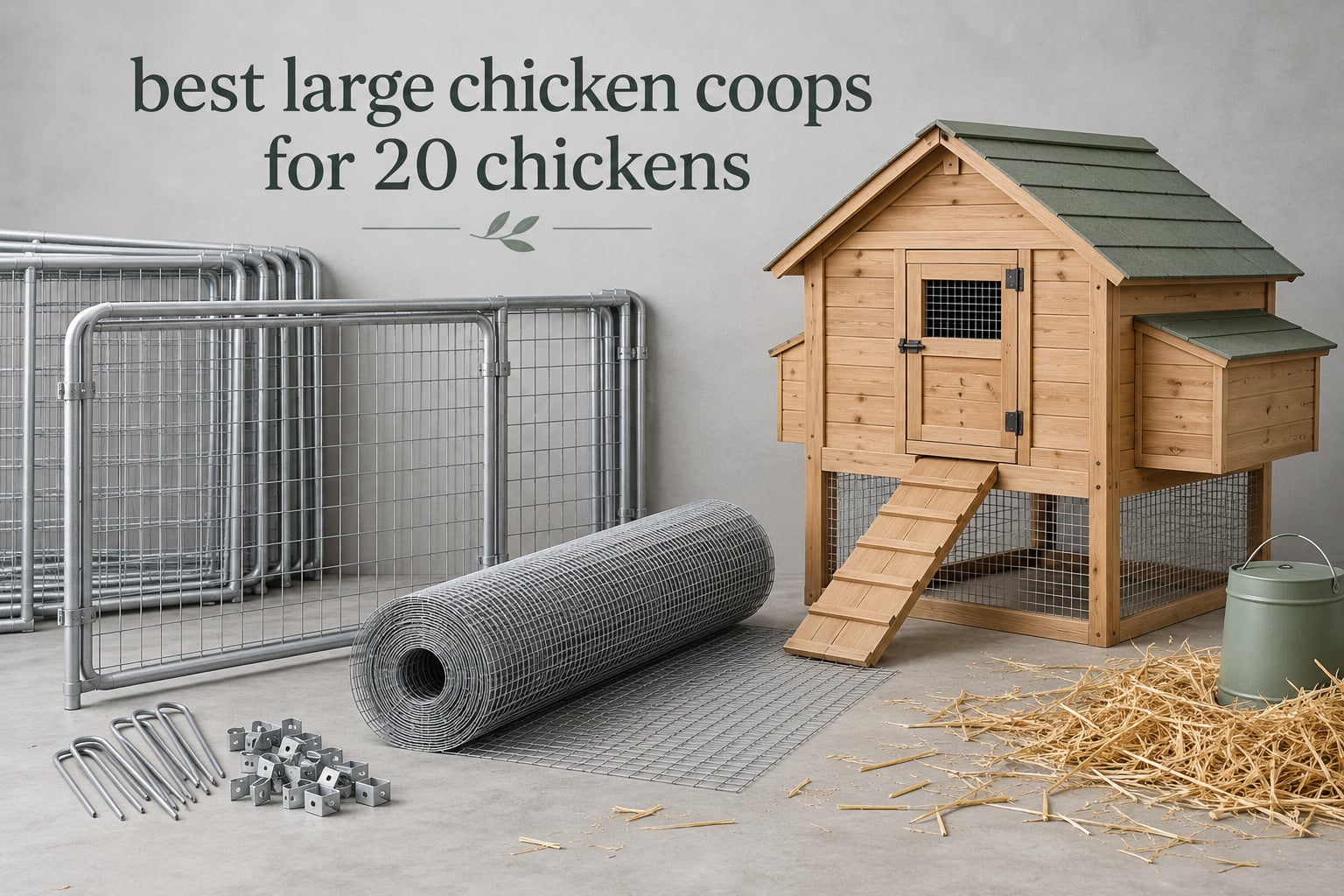
Twenty hens is the point where the small wooden hut stops working. Everything marketed as a chicken coop up to about eight birds is a different product category from what a 20-bird flock actually needs, and the gap between the two is where most disappointing purchases happen. We spent weeks reading specification sheets, dimensions, and thousands of customer reviews on walk-in enclosures in this class, and what follows is the honest version of the best large chicken coops for 20 chickens.
The thing that catches people is architecture. A 20-hen setup is almost never one box. It is a walk-in run with a small hen house sitting inside it, or a walk-in enclosure plus a separate wooden coop you butt up against the mesh. The run handles daytime space and containment; the small house inside handles night roosting, nesting, and weather protection. If you have not read our walk-in chicken coop guide, that distinction is worth ten minutes before you spend anything.
Every product reviewed below is a walk-in enclosure rated somewhere between 30 and 40 birds, which gives 20 hens genuine headroom rather than a tight fit. We checked real interior square footage against stated flock capacity, looked hard at the wire gauge, and paid attention to the complaints reviewers repeat most often. Sizes range from about 19 by 9.8 feet up to 9 by 25 feet and one very long 32.8-foot run.
Table of Contents
Top 3 Picks: Best Large Chicken Coops For 20 Chickens (October 2026)
These three lead the group on frame thickness, weather performance, and how consistently owners report the build holding up. Every one of them needs hardware cloth added before it holds 20 unprotected hens.

HITTITE 19×10 Walk-in Run
- 0.8mm reinforced galvanized pipe frame
- PVC coated hexagonal mesh walls
- Waterproof UV-resistant spire roof

CHIKENCOOP Three-Room Run
- 19.5x9.8x6.5 ft three-room walk-in design
- Lockable steel access door
- Waterproof UV-resistant sloped cover

Betterhood 19×9 Round-Top Run
- Galvanized frame with triangular supports
- 9x19x6.5 ft enclosed run
- Water repellent 240D Oxford canopy
All 10 Large Chicken Coops Compared Side by Side
How we picked: we read every specification block and pulled the recurring complaints out of the customer review data for each model. Products had to be walk-in height, hold at least 20 birds at the honest 4 square feet per bird calculation, and have enough review volume for durability feedback to mean something. We weighted frame thickness heavily, treated welded hardware cloth as a genuine differentiator, and flagged every model whose own documentation says the mesh alone is not predator-proof.
| Product | Specifications | Action |
|---|---|---|
| HITTITE Large Metal Chicken Coop with Run |
|
Check Latest Price |
| CHIKENCOOP 19.5×9.8×6.5 ft Metal Coop |
|
Check Latest Price |
| Betterhood Round Top Metal Chicken Run |
|
Check Latest Price |
 VEVOR 9x25x6.6 ft Walk-in Run VEVOR 9x25x6.6 ft Walk-in Run |
|
Check Latest Price |
 LEMBERI 20×10 ft Extra Large Metal Coop LEMBERI 20×10 ft Extra Large Metal Coop |
|
Check Latest Price |
 Quictent Run for 30+ Poultry Quictent Run for 30+ Poultry |
|
Check Latest Price |
 PawHut 32.8 ft Long Walk-in Run PawHut 32.8 ft Long Walk-in Run |
|
Check Latest Price |
 NGTEEN 19.7×10 ft Extra Large Run NGTEEN 19.7×10 ft Extra Large Run |
|
Check Latest Price |
 Xbrigh 23.2×9.8 ft Walk-in Run Xbrigh 23.2×9.8 ft Walk-in Run |
|
Check Latest Price |
 HOOYEAH 19.6×9.8 ft Spire Run HOOYEAH 19.6×9.8 ft Spire Run |
|
Check Latest Price |
1. HITTITE Large Metal Chicken Coop with Run – Thickest Frame in the Class
- Thicker 0.8mm galvanized pipe than competing models
- Walk-in height with generous floor area
- Spire roof drains water and sheds light snow
- Clear instructions and simple two-person setup
- Manufacturer states mesh alone is not completely predator-proof
- Cover should be cleared when snow exceeds 2 inches
- Additional hardware cloth recommended
The HITTITE run is the one we kept coming back to while working through this list. At 19.19 by 9.84 by 6.56 feet it gives a 20-hen flock about 189 square feet of enclosed floor area, and the frame uses 0.8mm reinforced galvanized pipe, which is the thickest tubing specified anywhere in this group. That thickness is the whole story: it is what keeps the frame from walking sideways when a flock of 20 birds leans on the mesh every morning at the feeder.
Owners consistently report a straightforward two-person build with instructions that actually match the parts. The spire roof profile drains water and sheds light snow, and the PVC coated hexagonal mesh walls are easier on birds than bare wire because the coating reduces snagging and rust staining.
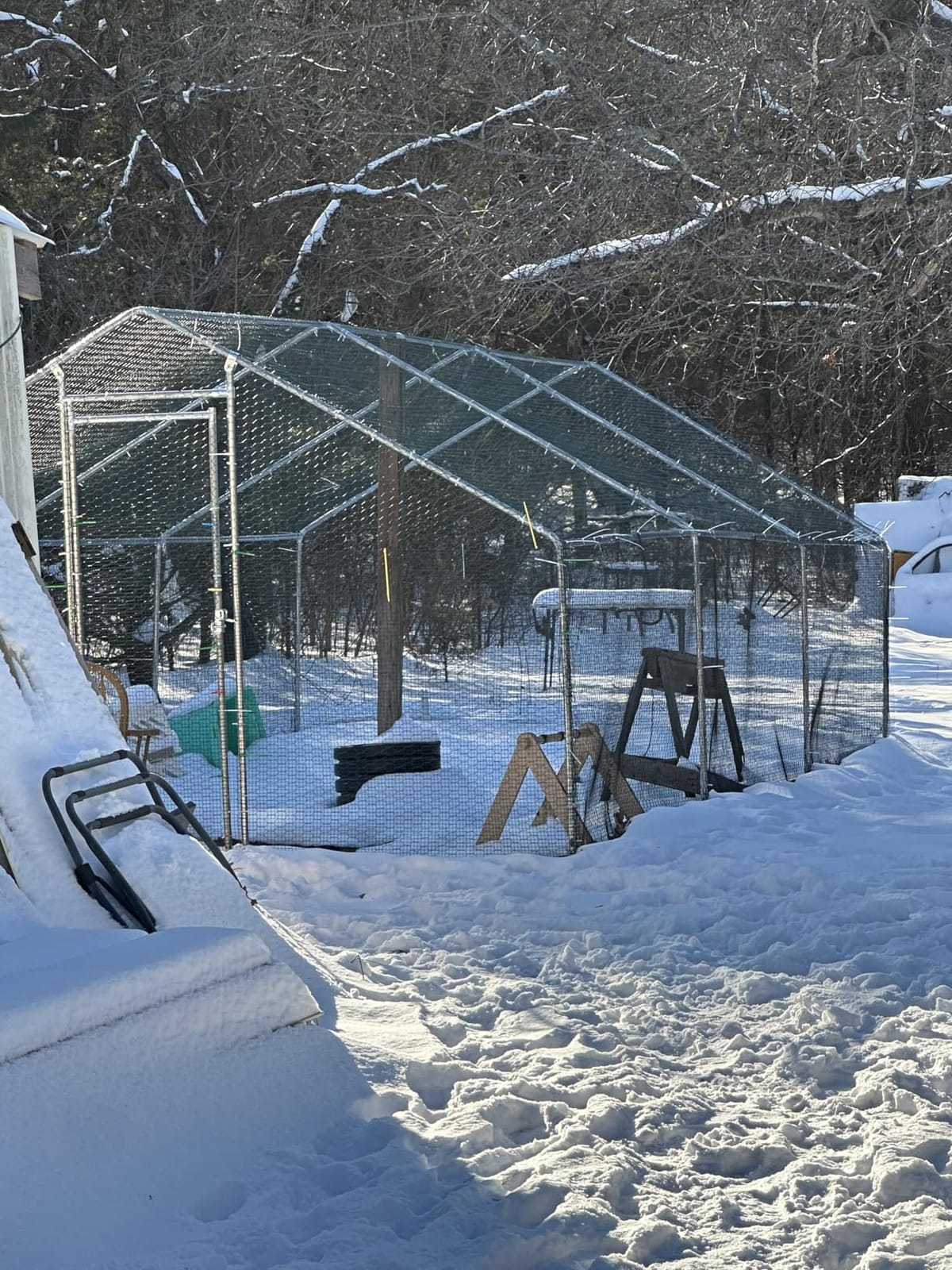
The honest limitation is documented, and it comes from the manufacturer rather than from us. HITTITE states plainly that the included mesh is not completely predator-proof, and reviewers pass along the same advice: wrap the run in hardware cloth before you count on it with 20 hens. The manufacturer also advises removing or clearing the cover when snow exceeds 2 inches, which matters in northern climates where a taut tarp under load can be the weak point of the whole structure.
Interior layout is where this one needs your input. There is no roosting bar or nesting box inside, so plan to add a 5-tier perch run along one wall and mount five nesting boxes with exterior egg access on another. Remember the one box per four hens rule, which for 20 hens means 5 boxes, and give each hen about 12 inches of roost bar so the lower birds are not crowded off.
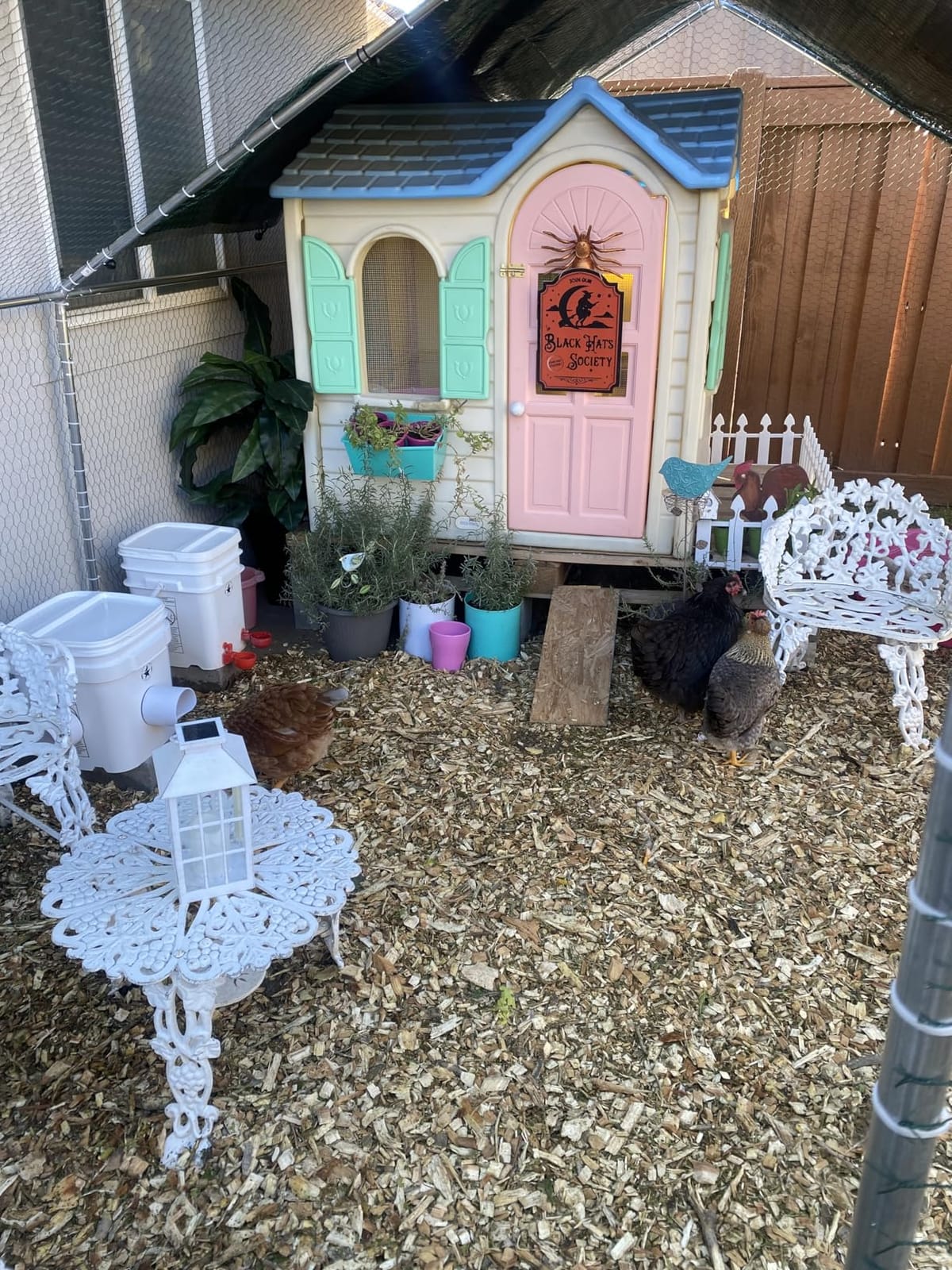
Is it worth adding hardware cloth to this run?
Yes, and budget for the labor. Six-inch-wide 1/2 inch hardware cloth on the walls and roof of a run this size is a full afternoon for two people, plus another for the buried skirt line. We would also replace the included stakes with deeper ground anchors, because 20 birds concentrated at one corner repeatedly push a light-duty frame.
What you get in exchange is a structure that should last multiple seasons without sagging, which is more than most metal runs in this category can promise. If you want one frame that will not be the thing that fails first, this is the pick.
Who should skip this one?
Skip it if your site is snow-heavy and you are not willing to clear the roof, because the tarp is rated for light snow only. It is also not the right answer if you need integrated roosting or nesting hardware out of the box, since nothing structural comes attached. And if your plan depends on moving the flock regularly, a 113-pound anchored frame is not a mobile coop. Our mobile chicken coop guide covers the realistic options for that instead.
2. CHIKENCOOP 19.5×9.8×6.5 ft Metal Coop – Three Rooms in One Frame
- Easy snap-in pole assembly
- Heavy-duty steel frame feels sturdy
- Walk-in height lets adults stand and work inside
- Responsive customer service when parts were missing
- Mesh is flimsy with openings large enough for small predators
- Door latch is awkward and does not open fully inward
- Roof cross bars can bend in strong wind
The defining feature here is the three-room layout. Most runs in this class are one undivided rectangle, and with 20 hens that means 20 birds in one shared airspace for dust bathing, dust bathing spots, and feed lines all in the same corner. Three connected sections let you split the flock without building a divider: quarantine a bird, separate a bully, or keep meat birds apart from layers.
At 19.5 by 9.8 by 6.5 feet with three linked sections, this is also the most reviewed enclosure we looked at, and the volume of feedback is a real advantage. Owners praise the snap-in pole assembly as close to tool-free, and several mention that customer service replaced missing parts quickly. Walk-in height means you can rake the floor, swap bedding, and reach the far corners without kneeling.
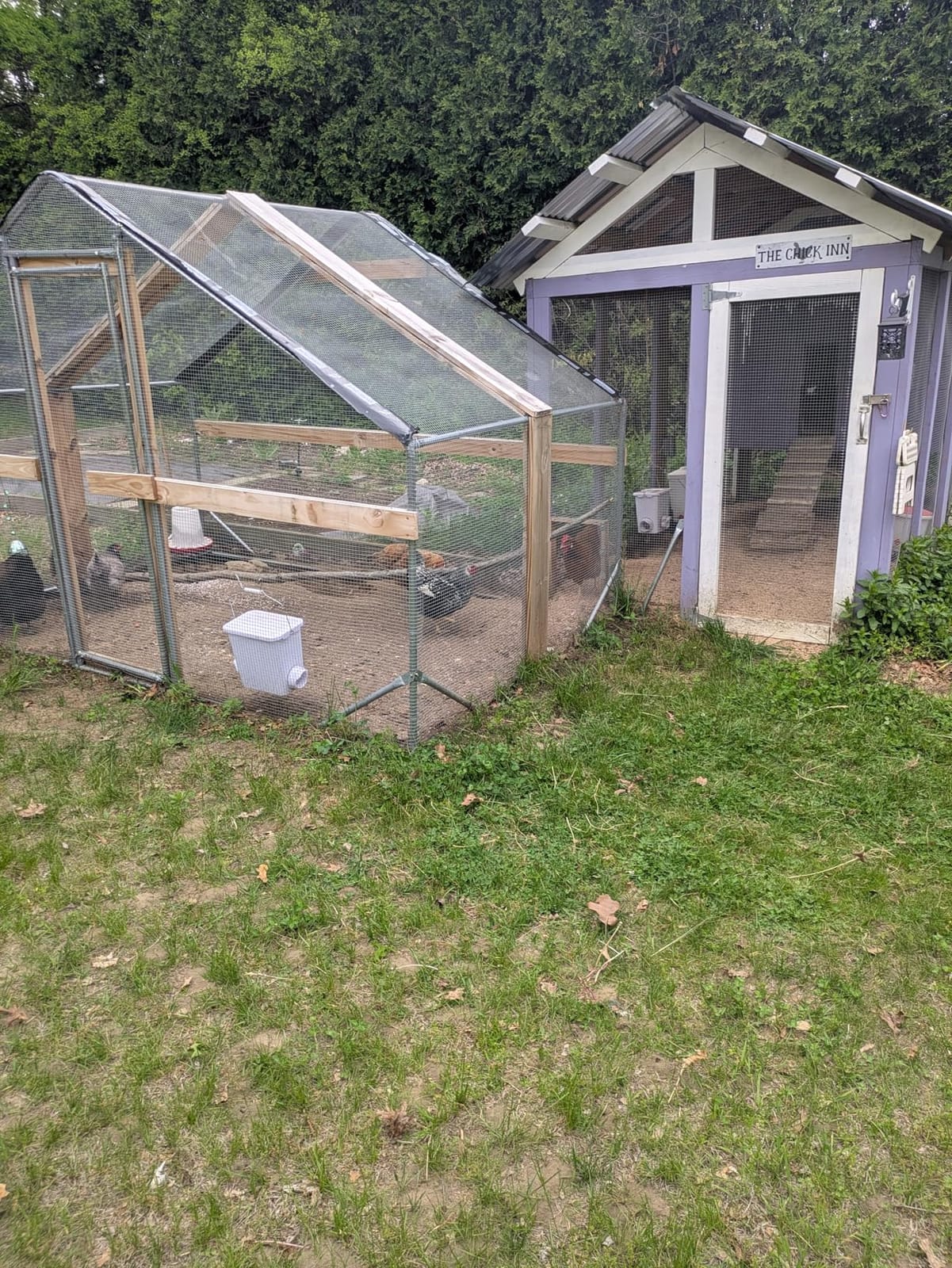
The weakness is containment quality. Reviewers call the hardware cloth flimsy and note that the mesh openings are wide enough for small predators, and the included zip ties are described as low quality and too few in number. The steel latch door also draws complaints about being hard to operate and not opening fully inward, and the roof cross bars can bend in strong wind. None of that is a dealbreaker with 20 well-fenced hens on a suburban lot, but it changes what you need to buy afterward.
Plan on a hardware cloth skin over the entire perimeter plus a buried skirt, and replace the zip ties with stainless ties or carriage bolts at every connection point. The frame itself is genuinely solid, so the money goes into the cladding rather than into rebuilding structure.
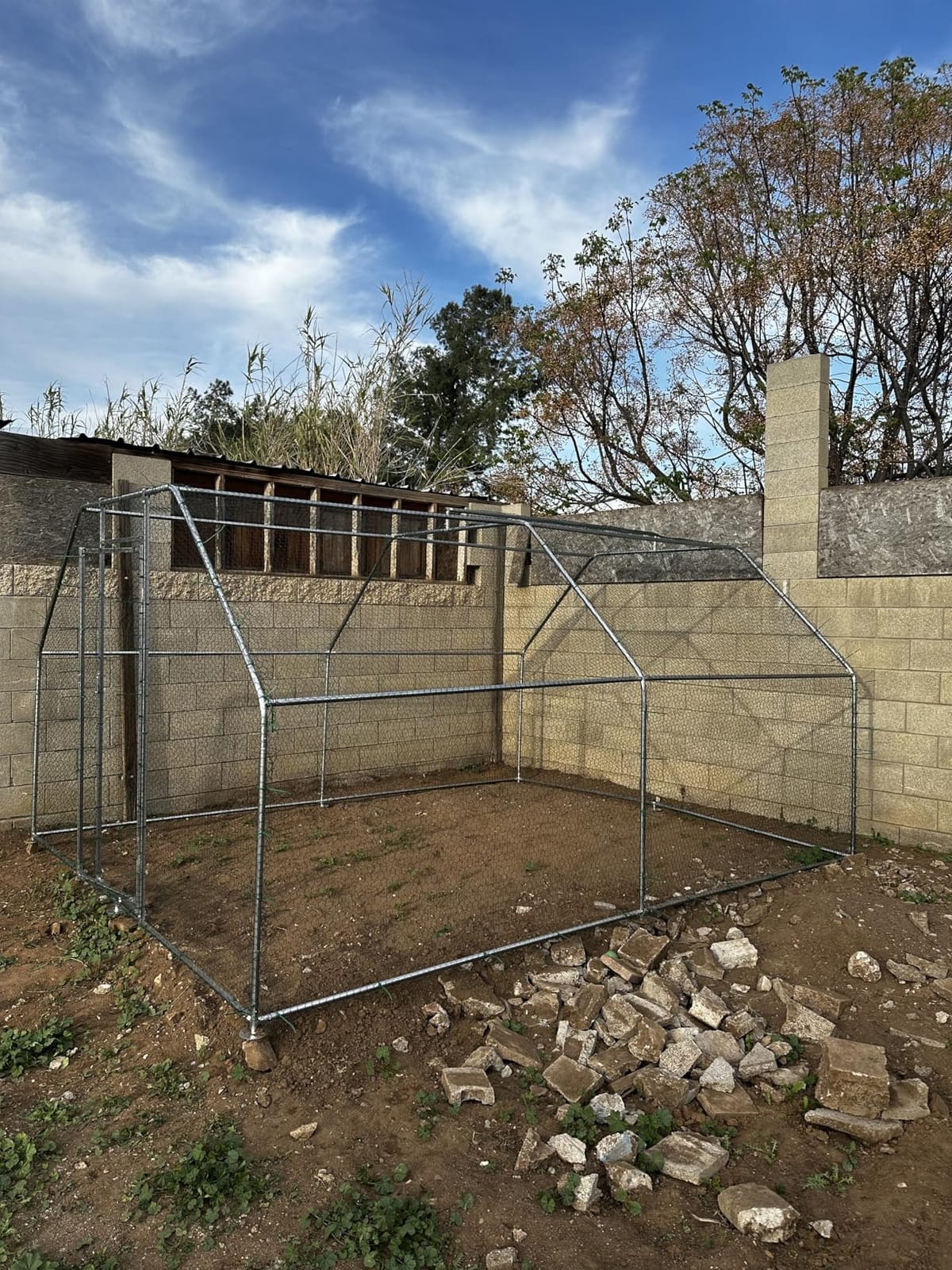
How does the three-room layout help with 20 hens?
It gives you a separation option for free. A single-room run forces you to buy a partition panel; this one already has framed breaks you can use as isolation space. That matters most during a molt or when introducing new pullets, and it lets you feed a different ration to one group without moving birds.
There is a second practical benefit. With three sections you can leave one section open as a weatherproof loafing area while the birds settle, and the connected layout keeps sightlines clear so flock behavior stays calm. For 20 birds we would still put the hen house inside one end section rather than the middle.
What do buyers complain about most?
Predator-sized mesh gaps, the door latch, and thin zip ties come up in nearly every critical review. Owners also flag the roof cross bars flexing under wind load, which is worth watching in open country. The 4.2 average across a large review base suggests most people are working around these rather than regretting the purchase.
Our advice: assemble it on a level, cleared pad, anchor it properly, and treat the hardware cloth step as part of the build rather than an optional upgrade.
3. Betterhood Round Top Metal Chicken Run – Holds Up in Winter Storms
- Sturdy frame with click-together rods
- Coated wire easier to handle and cut
- Plenty of wire and ties included
- Withstood a Canadian winter and strong storms
- Included chicken wire is thin and tears easily
- Door latch bends and does not close securely
- Ground stakes bend and fail to hold
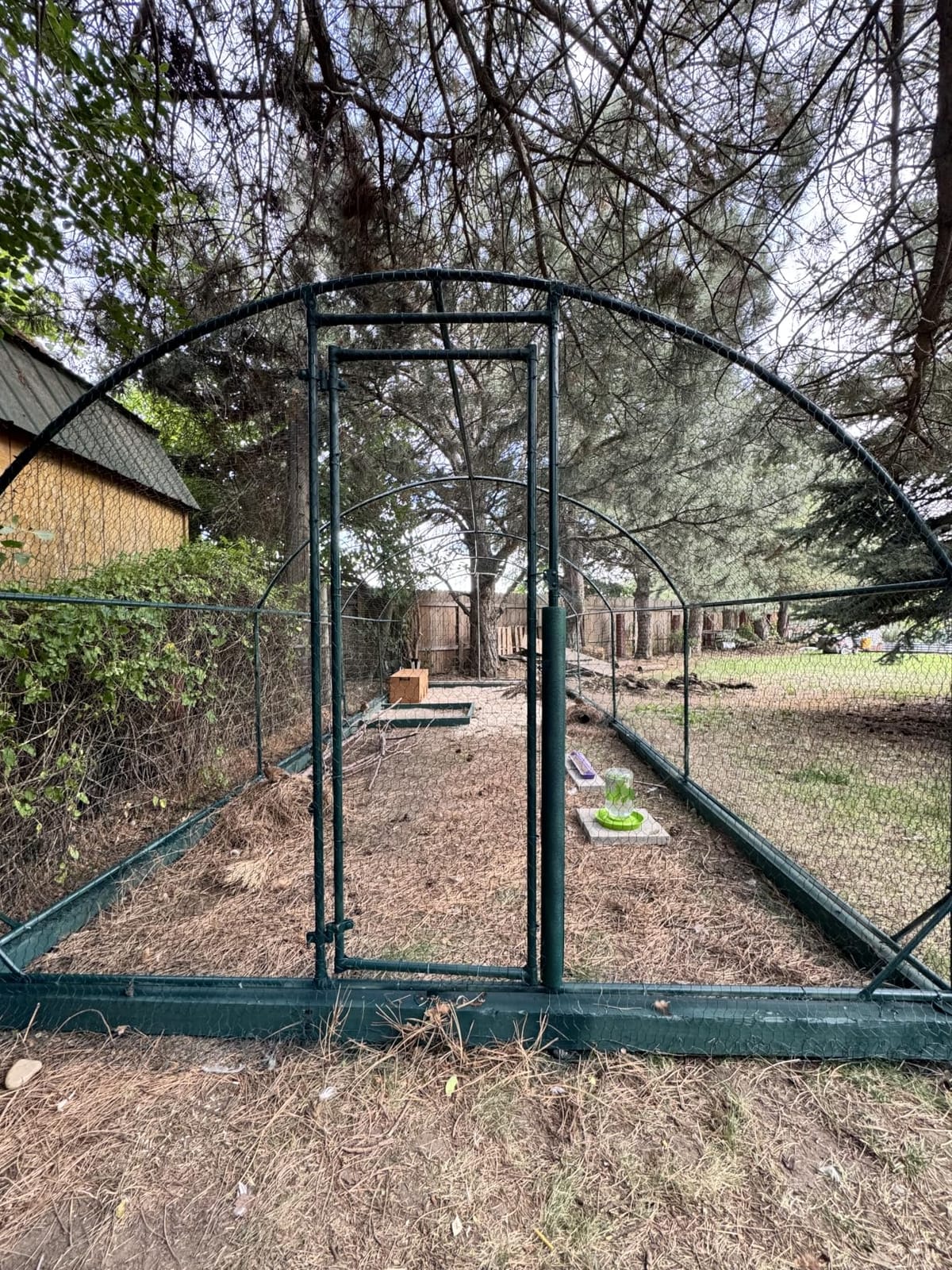
Betterhood’s round top run is the weather specialist of this group. At 9 by 19 by 6.5 feet it lands at about 171 square feet, which is enough for 20 hens with room to spare, and the extra support columns and triangular supports are what keep a 19-foot span from sagging. Multiple owners report it surviving a Canadian winter and severe storms, and that is the single most useful durability signal in this roundup.
Assembly uses a rod-and-button connection system, which reviewers describe as straightforward once you understand the pattern. The coated hexagonal wire is also easier to handle and cut than bare chicken wire, a small thing that matters a lot when you are trimming mesh around a door opening or fitting a hardware cloth layer over the top.
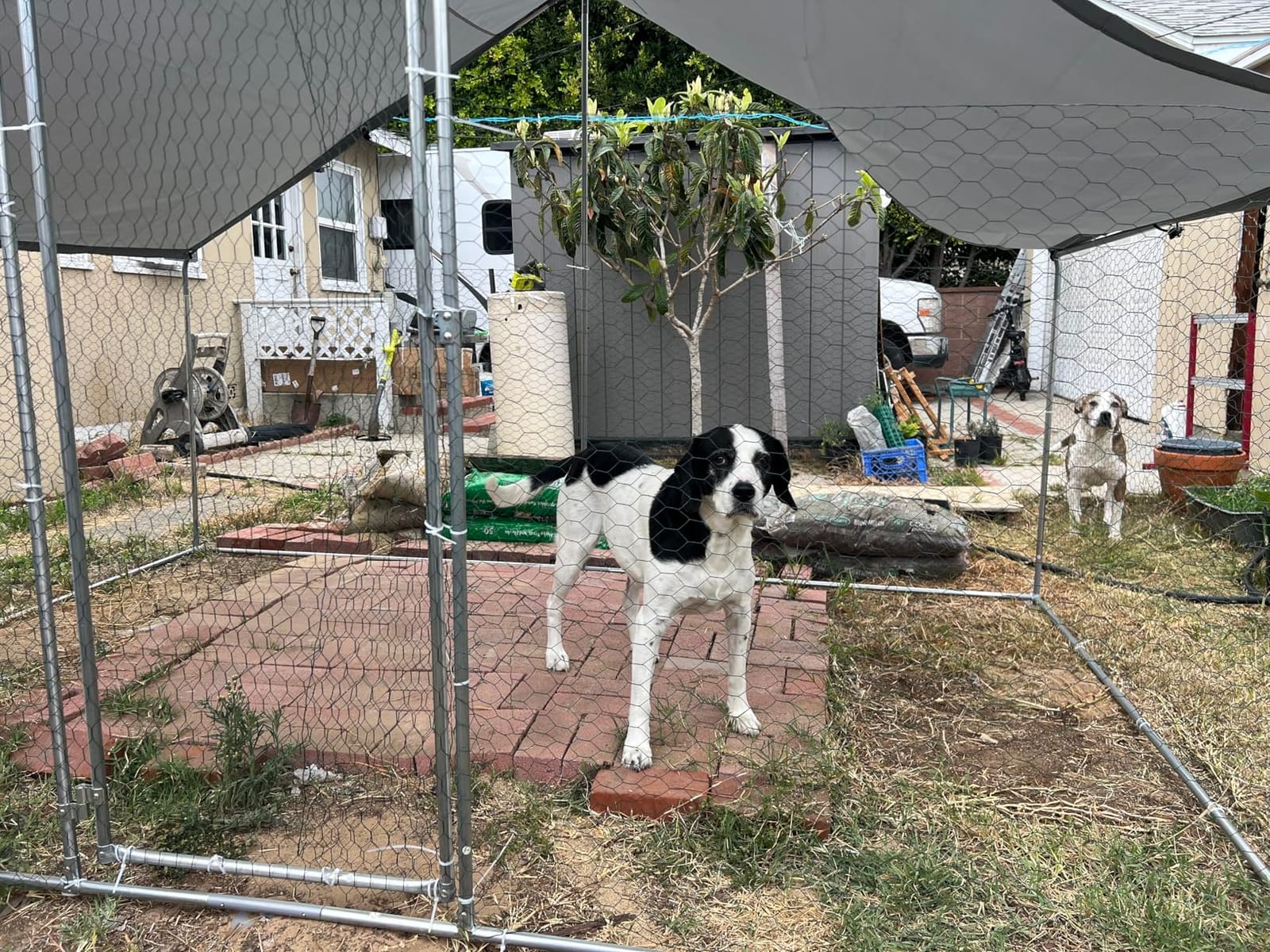
The complaints are consistent enough to plan around. The included chicken wire is thin and tears easily, the zip ties degrade quickly in sun, the door latch bends and does not close securely, and the ground stakes bend and fail to hold the frame. Owners also report steel beginning to rust at ground contact within months, which points directly at how you set it up: get the base on pavers or a raised curb, and skirt the bottom.
Instructions are another weak point, with reviewers noting they are incomplete and that pole orientation is not marked clearly. Before you start, photograph the assembled layout yourself at each stage so the next section matches the last.
Is this the most weather-capable run for 20 hens?
Based on customer reports rather than spec sheets, yes, it is the one people describe as still standing after a hard season. Galvanizing treatment on the steel and the triangular bracing both point the same direction. That does not make it immune, though: rust at ground contact is still reported, and heavy wet snow loads are a different test than wind.
If your winters are long and snowy, clear the canopy the way you would clear a car roof, and check the base for corrosion each spring. The frame will outlast the fasteners, so keep stainless hardware on hand.
Who should look elsewhere?
If your priority is predator defense, this is not the one. Thin chicken wire that tears easily is the wrong starting point when raccoons or weasels are active, and you would be cladding the entire surface anyway. A welded hardware cloth model saves you a full day of labor and money on mesh.
It is also a poor fit for anyone who wants integrated roosting, since nothing attaches to the frame by default. Budget for a separate hen house inside the run and a full hardware cloth retrofit either way.
4. VEVOR 9x25x6.6 ft Walk-in Run – Most Run Area in the Class
- Very easy snap-together assembly
- Ample interior space with walk-in access
- Dome roof sheds rain effectively
- Everything needed for the build is included
- Galvanized pipes rusted heavily within six months
- Included zip ties and tarp are cheap and degrade quickly
- Height is tight for taller adults near the sides
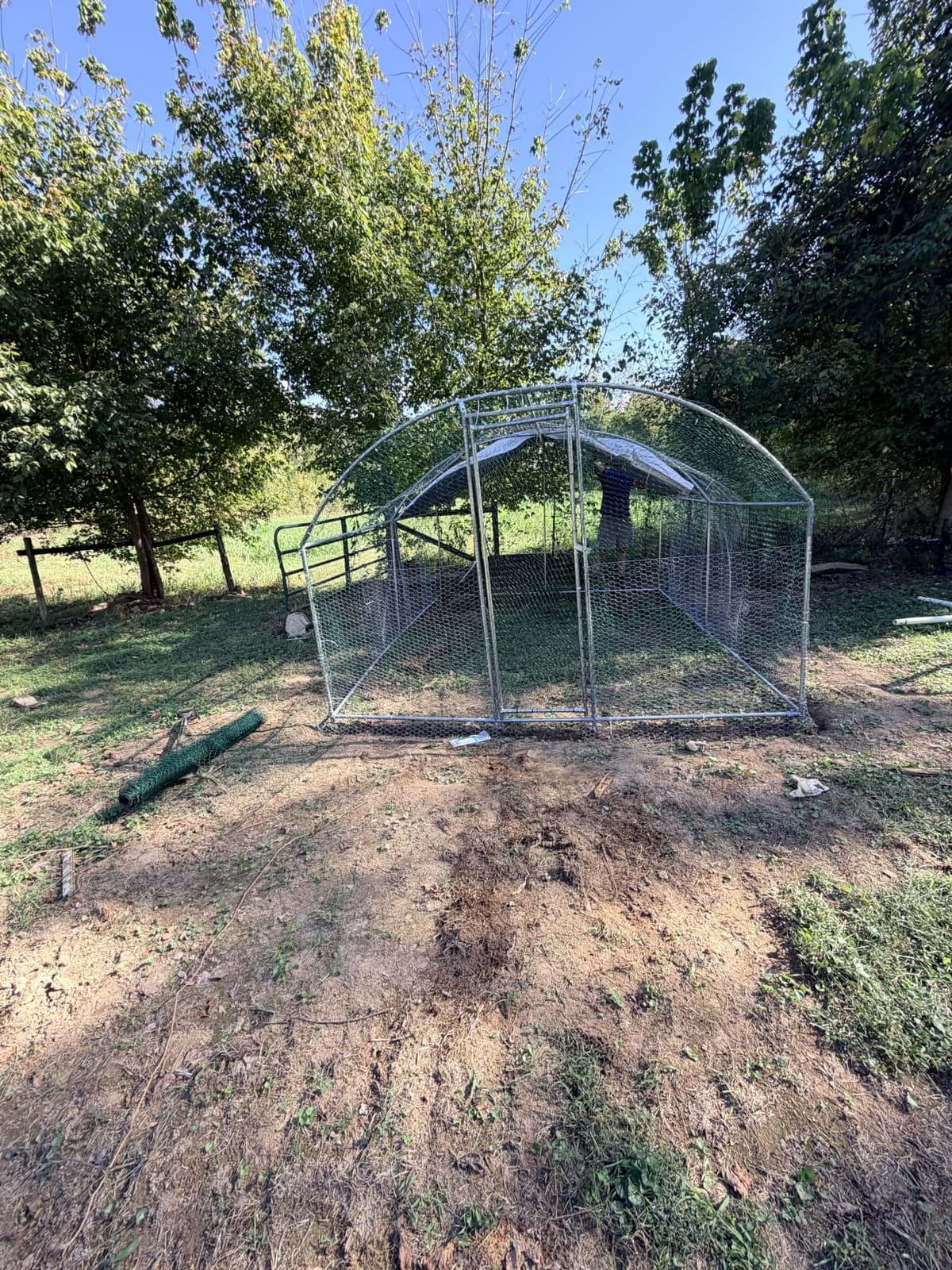
At 9 by 25 by 6.6 feet, this is the largest enclosed footprint in the roundup at roughly 225 square feet. For a 20-hen flock that is more run space than you strictly need, which is exactly the point: it gives you room to divide, a weatherproof section, or a second group later without buying again. The dome roof sheds water, debris, and light snow, and four-sided ventilation keeps airflow moving through a structure this long.
Assembly is a snap-together build that one person can finish in a day, with labeled parts and a manual included, and reviewers confirm everything needed is in the box. Walk-in access is genuinely useful at this length, since you can walk the full 25 feet to check the far end for digging or standing water.
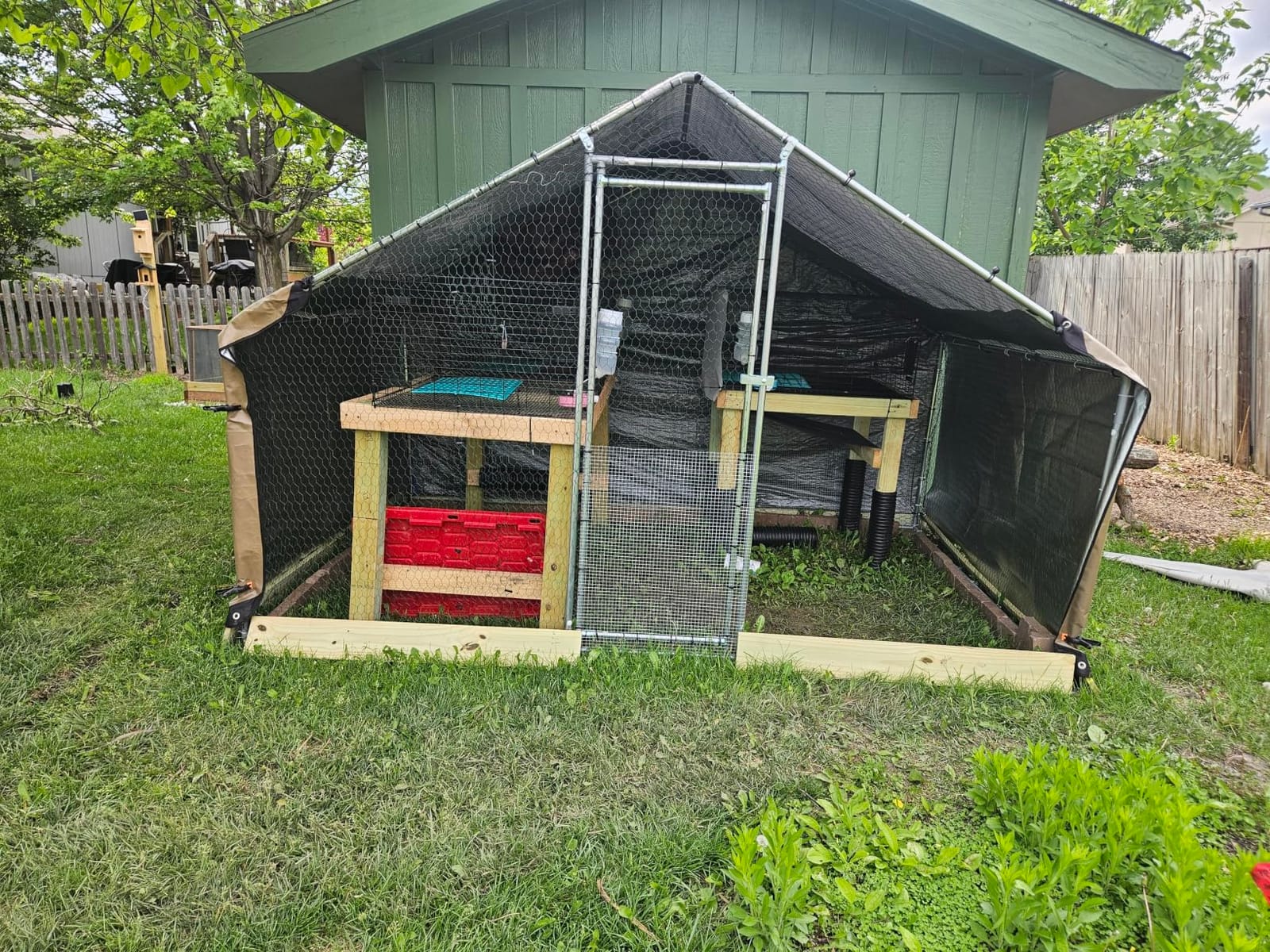
The most serious complaint is rust. A number of owners report the galvanized pipes rusting heavily within six months, and the included zip ties and tarp are described as cheap and quick to degrade. Chicken wire is called flimsy, the frame has some wobble at the pole joints, and taller adults have to hunch near the sides because the 6.6-foot ceiling only feels generous in the middle.
One configuration note worth checking before you order: some larger double-size versions include only one tarp. Confirm the roof cover count in the listing. If rust is your concern, painting the base rails or applying a galvanized primer after assembly buys several more seasons, and an aftermarket tarp is a cheap fix.
Is a 25-foot run overkill for 20 hens?
It is generous, not wasteful, provided your lot has the space. Twenty birds at the recommended 8 to 10 square feet each need about 200 square feet, so this sits just above the target. The extra length is what makes rotational use practical, since you can run a temporary fence line partway down and let one section rest while the birds forage the other.
Keepers on BackYard Chickens report that rotating weekly across multiple paddocks does far less grass damage than expected, and cover crops such as buckwheat or rye repair bare patches. A run this long is the hardware that makes that approach work.
What are the drawbacks of a 25-foot metal run?
Length creates sag risk. A 25-foot unsupported span pushes on every joint, and owners report wobble at the pole joints, so the frame needs to be properly level and fully seated before you tighten anything. The reported six-month rusting also concentrates at ground contact, which again argues for a paved or raised base.
Assembly time grows with length, and a helper makes a real difference on a footprint this big. Plan the day around it rather than starting in the evening.
5. LEMBERI 20×10 ft Extra Large Metal Coop – Built for More Than 20
LEMBERI 20×10 FT Extra Large Metal Chicken Coop, Walk-in Run
- Very easy frame assembly with clear instructions
- Frame withstood ice storms and heavy weather
- Walk-in height suits adults including tall users
- Generous 200 sq ft of usable floor space
- Included chicken wire is much thinner than standard farm wire
- Roof tarp is flimsy and degrades within months
- Ground stakes are not effective anchors
The LEMBERI run is rated by its manufacturer for 25 to 35 or more chickens, which is the headroom you want if you are planning to grow the flock. The footprint is 20 by 10 by 6.6 feet, about 200 square feet of usable floor, which is the number most 20-hen keepers will land on after a single honest calculation.
Owners praise the Easy-Lock spring-button frame system and say the instructions are clear and followable, and several report the frame holding through ice storms and snow. The 0.98 inch galvanized steel tubes give it a solid feel for the money, and walk-in height is confirmed to work for taller adults rather than just crouching clearance.
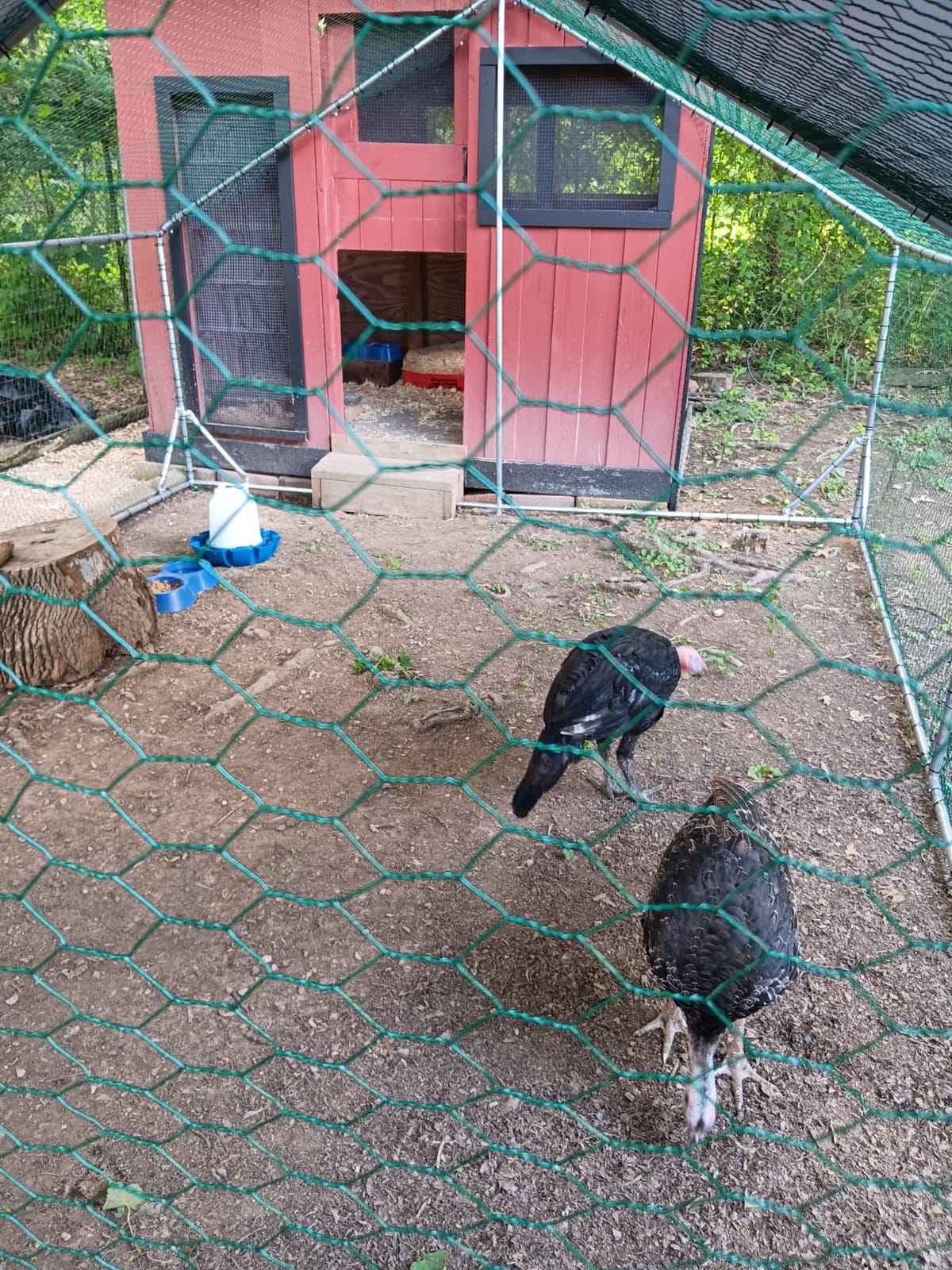
Quality control is the recurring theme. Reviewers report missing nuts or bolts, bent parts, and poorly coated wire, along with a roof tarp they describe as very flimsy and prone to tearing or degrading within months. The included chicken wire is much thinner than standard farm wire, and the ground stakes are called ineffective. There is also a gap around the bottom edge that allows digging unless the run is skirted.
All of that is fixable, and it is a fair trade for the frame. Count the parts against the manual before you start, treat the tarp as a consumable you will replace within a couple of seasons, and bury or skirt the base edge before the birds arrive.
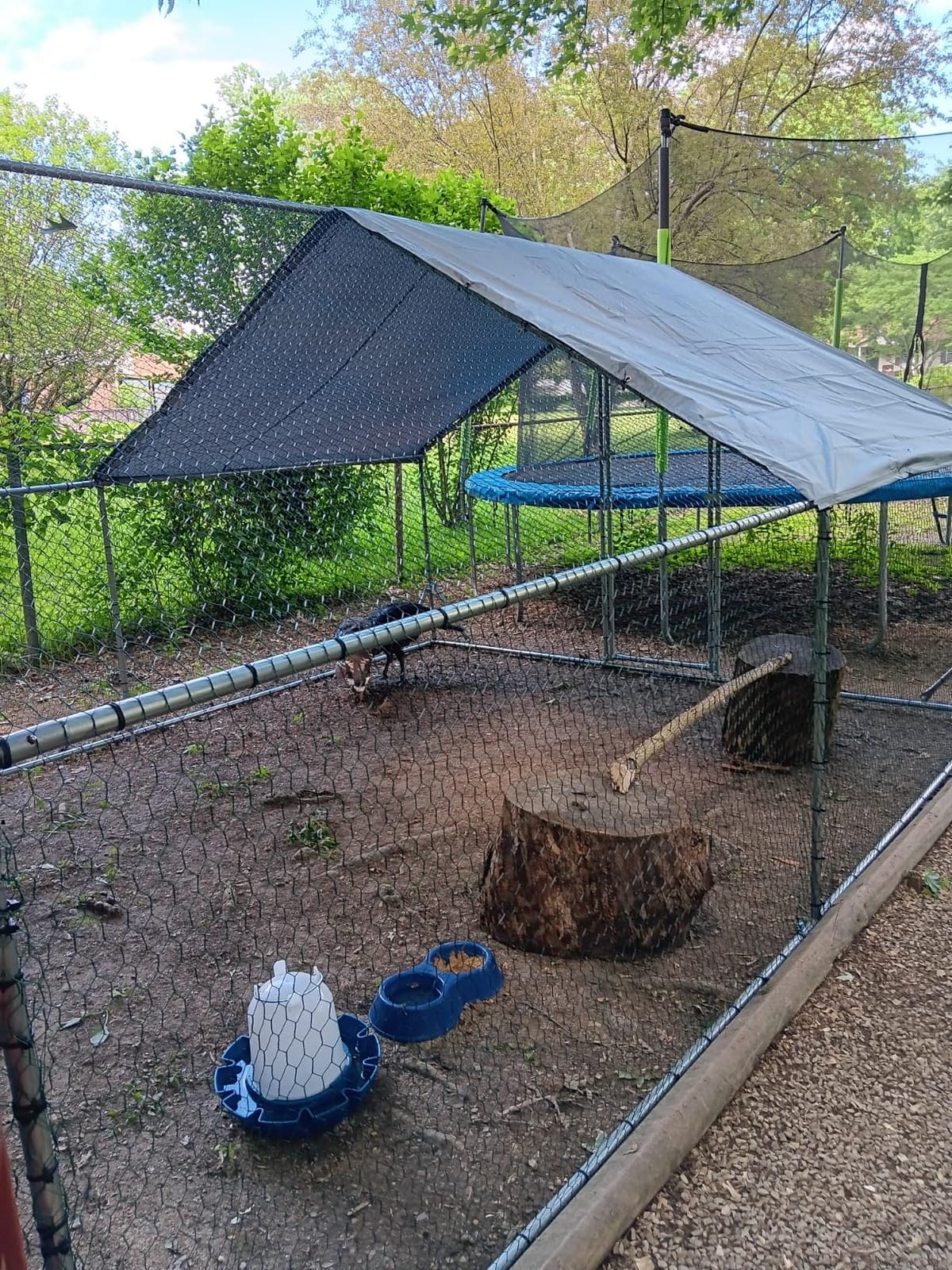
Should you size for 25 to 35 birds instead of 20?
If you already know you will add birds, yes. The manufacturer rating assumes a tighter fit than we recommend, so treat 25-35 as a marketing ceiling and 20-25 as the comfortable number for a 200 square foot run. That still leaves real growth headroom over your current flock of 20.
There is a second reason to like the extra size. A 20-hen flock on a 200 square foot run can be sectioned with a temporary fence for rotational use, and the extra length gives the hen house and the roosting area their own space without crowding the foraging end.
What should you inspect on delivery?
Check for missing hardware, bent poles, and coating damage before the frame is fully assembled, because claims get harder after the build is underway. The wire coating matters most: thinly coated mesh wears through and rusts faster, and on a structure that will sit outdoors year-round that is the part to reject.
Also verify the tarp count and condition. A flimsy cover that degrades in months is the first thing owners complain about, and it is the cheapest part of the whole structure to replace.
6. Quictent Large Metal Run with Hardware Cloth – Best Predator Protection
Quictent Large Metal Chicken Coop Run for 30+ Poultry w/Side Hardware Cloth
- Real 20 gauge welded hardware cloth on the side walls
- Extended ground skirt deters digging predators
- Eight support bars and triangular corners add stability
- Includes 750 heavy-duty cable ties
- Dual-latch door closes more securely
- Side and back covers are supported but not included
- Heavier frame and mesh make assembly more involved
This is the only run in the roundup built with genuine 1 by 1 inch 20 gauge PVC coated welded hardware cloth on the side walls, and that single specification changes the predator conversation. Every other model here ships hexagonal wire that most owners are told to replace. This one already has the mesh keepers across forums say is non-negotiable for a flock this size.
It is rated for 30 or more poultry, and the construction details back that up: 1 inch rust-free poles, eight support bars, triangular corner poles, and an extended mesh ground skirt that discourages digging predators. The dual-latch door closes more securely than the single-latch designs elsewhere in this list, and the bundle includes 750 heavy-duty 0.2 inch cable ties so you are not hunting for fasteners mid-build.
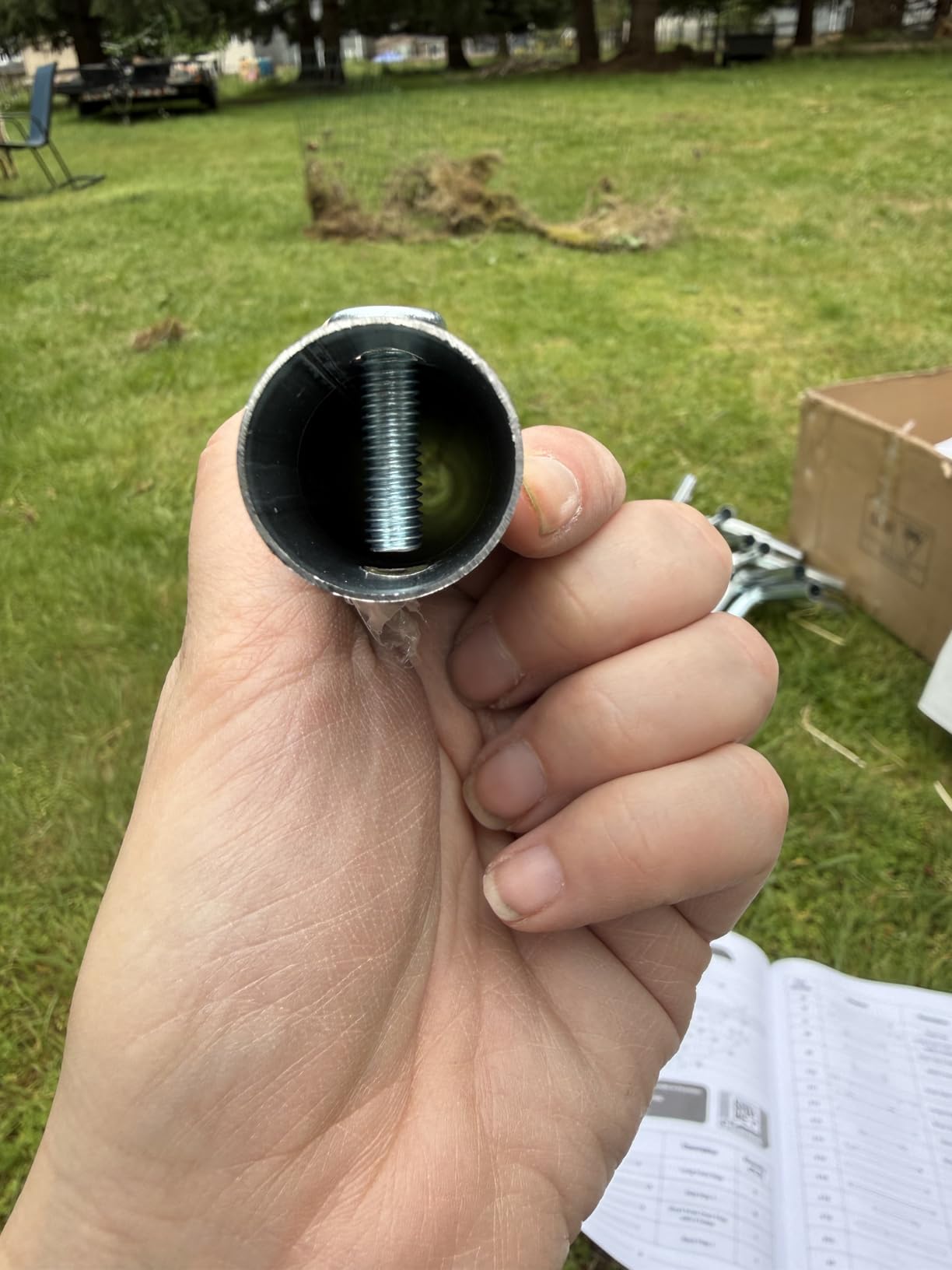
The trade-offs are bulk and completeness. Side and back covers are supported by the frame but not included, which means partial shade and wind protection unless you add panels, and the heavier frame and mesh make assembly more involved than the simpler pole designs. Reviewers also note a lower five-star share than the top models here, which usually reflects assembly frustration rather than a defect.
For anyone in raccoon, fox, or weasel territory, that hardware cloth skin on three sides plus a ground skirt is worth more than any other feature in this roundup. On a suburban lot with an existing fence, the difference matters less.
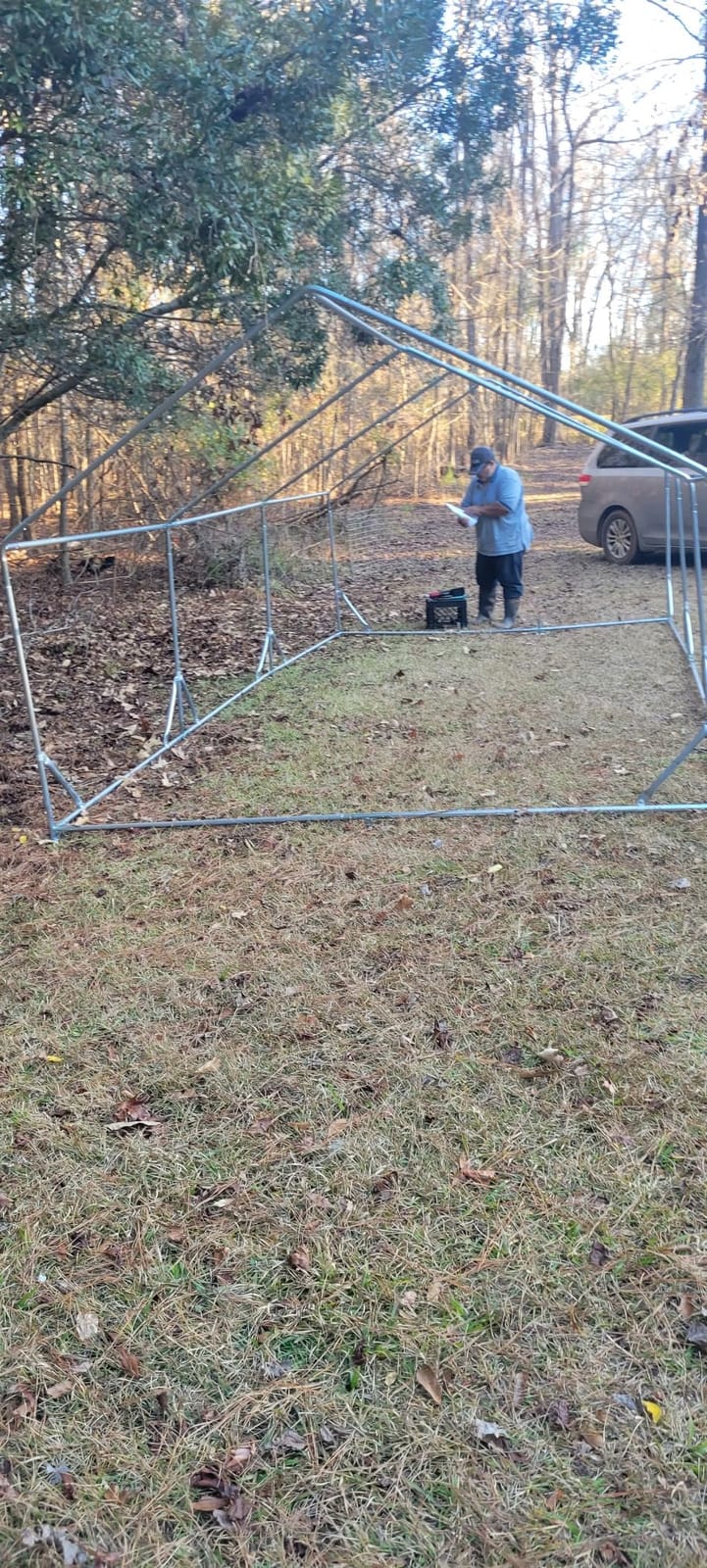
Does hardware cloth on the sides mean the whole run is predator-proof?
It gets you most of the way, but not all of it. Side walls are covered; you still need to confirm the roof, the door, and the base perimeter, and the ground skirt is designed to slow digging rather than defeat a determined animal. A raccoon is patient in a way a weasel is not.
Combine the side cloth with a 1/2 inch hardware cloth roof layer and a buried or skirted base, and this becomes the most secure structure in the group. The 750 included heavy-duty ties make that retrofit far less painful than it would be on a model that ships 20 plastic ties.
Is the assembly harder than the simpler runs?
Slightly, and it is worth budgeting a full day. Heavier mesh and a stiffer frame mean more hands on the job and more careful leveling, and the extra support bars add joints that need to be seated properly. Do not rush the corner triangles, because they are carrying the frame.
The upside is a structure that will not need the full cladding pass the others require. If you were already budgeting a day to cover a lighter run in hardware cloth, the labor here largely converts to assembly time instead.
7. PawHut 32.8 ft Long Walk-in Run – Longest Run We Reviewed
PawHut Large Chicken Coop w/Waterproof Anti-UV Cover 33′ x 10′ x 6.4′
- Among the longest runs available in this category
- Walk-in height for comfortable movement inside
- Galvanized frame resists wear and rust
- Lockable latch door adds security
- Dipped wire coating helps prevent bird injury
- Large footprint needs meaningful ground space to level and anchor
- Long single-span frame is heavier to move
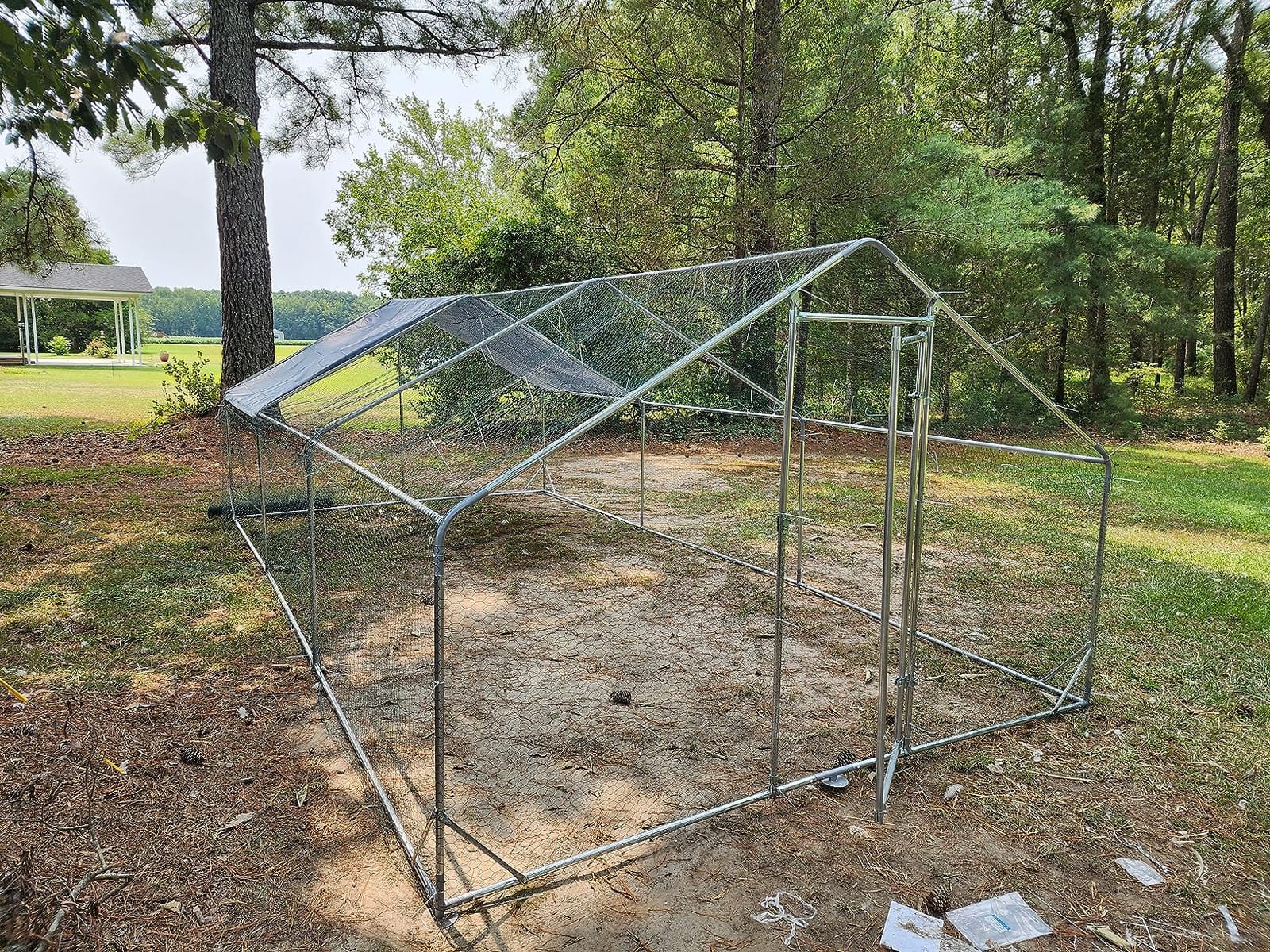
At 32.8 by 9.8 by 6.4 feet, this is the longest run we reviewed, roughly 320 square feet of enclosed area rated for 30 to 40 chickens. For a 20-hen flock that is far more space than daily use requires, and its real value is in rotational systems where you fence off sections and move the birds between paddocks.
The build uses a 1 inch galvanized steel tube frame with dipped steel wire walls, and the dipping process is credited with helping prevent injury to birds. The waterproof UV-resistant treated Oxford cloth roof attaches with spring button clips, which makes seasonal removal straightforward, and the lockable latch door adds real security. Walk-in height is confirmed comfortable for adults moving around inside.
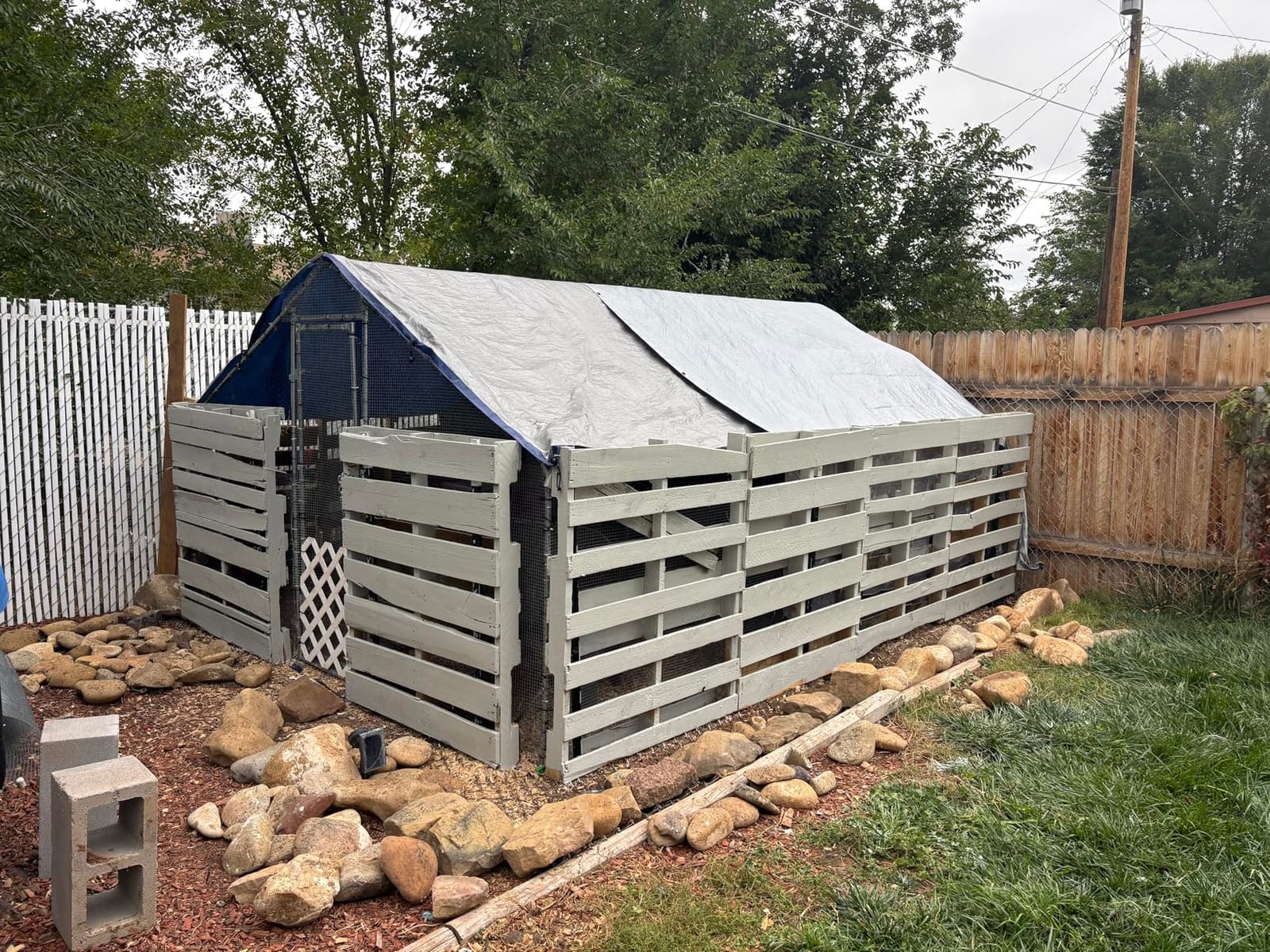
The two complaints are both about size itself. Owners note that the large footprint needs meaningful ground space to level and anchor, and that the long single-span frame is heavier to move than smaller models. At 4.0 stars, this one also carries more one-star feedback than the leaders in the set, which usually traces back to site preparation rather than product failure.
Before you commit, measure your usable space and add clearance for anchoring on all sides. A structure this long also needs a level base, and building it on a slope produces exactly the sag and joint complaints reviewers describe.
Is a 320 square foot run sensible for 20 hens?
Only if you will use it for more than housing. At 8 to 10 square feet per hen, 20 birds need about 200 square feet, so this is a substantial surplus. That surplus is exactly what makes rotational grazing possible, and it lets you keep the run permanently while confining the flock to a smaller active section that you can move weekly.
If you have no plan to divide it, a mid-size run will serve you better for less money and far less site prep. We would still pick this one for acreage or a dedicated poultry yard.
What are the practical drawbacks of the longest run?
Site preparation is the big one. Leveling and anchoring a footprint of this size is a weekend of work on its own, and a long single-span frame is heavier to move, which defeats the purpose if you were hoping to rotate the whole structure.
The spring button clip roof helps with seasonal shade, but a single span this long will deflect in wind, so anchor it thoroughly and expect to retension occasionally. It is also designed to be attached to a wooden coop, so plan that connection properly rather than butting them together loosely.
8. NGTEEN 19.7×10 ft Run – Built-In Roosting Ladder
19.7×10 FT Extra Large Metal Chicken Coop, Walk-in Poultry Run Pen
- Includes a 5-tier roosting ladder uncommon on comparable runs
- Multi-layer galvanization resists rust and weather
- Peaked roof drains water quickly
- Spring buckle assembly is quick
- PVC coated hexagonal mesh is small-gap and bird safe
- Run area may need a solid base or extra anchoring in exposed sites
- Accessory upgrades such as extra covers are not included
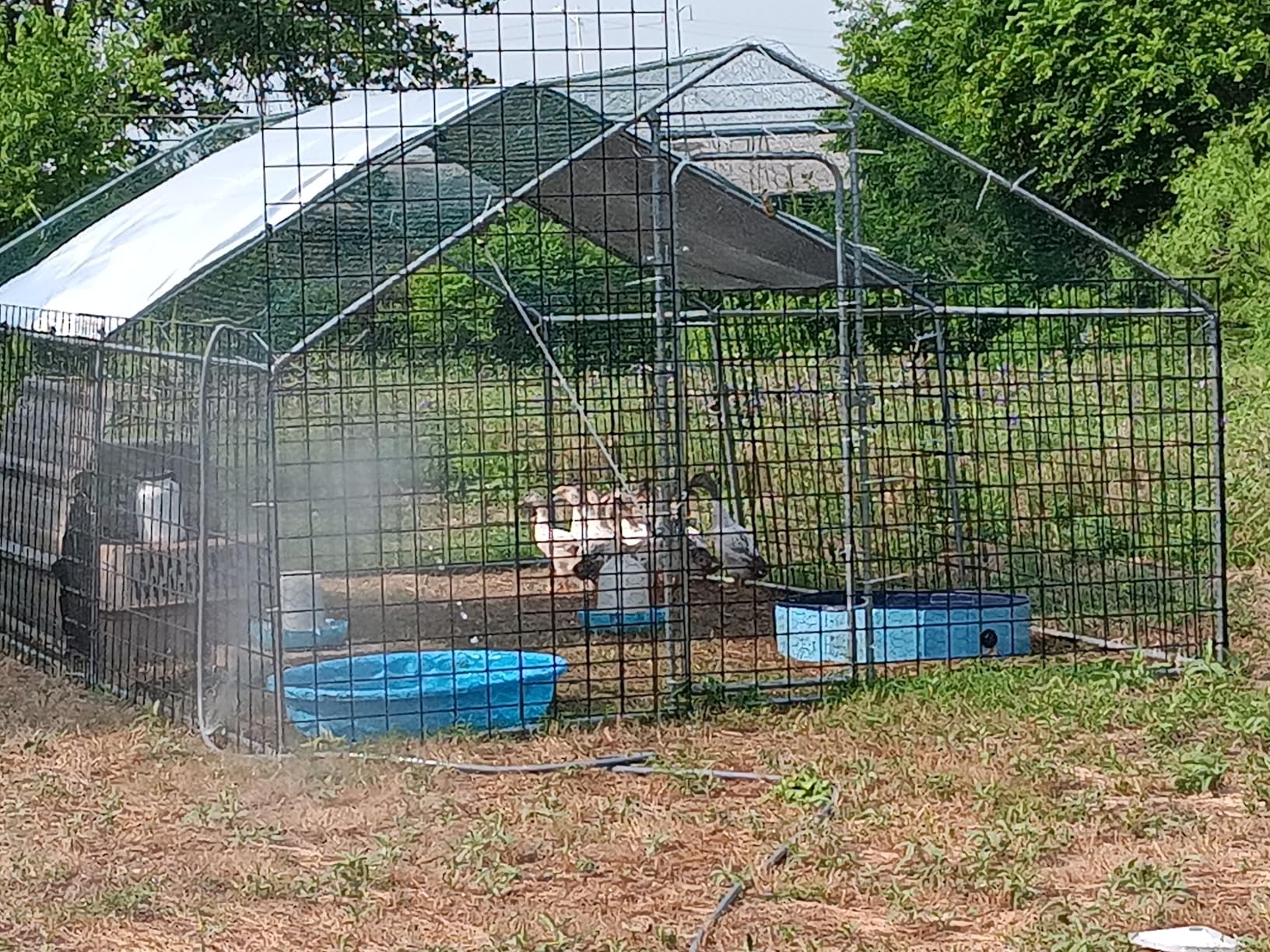
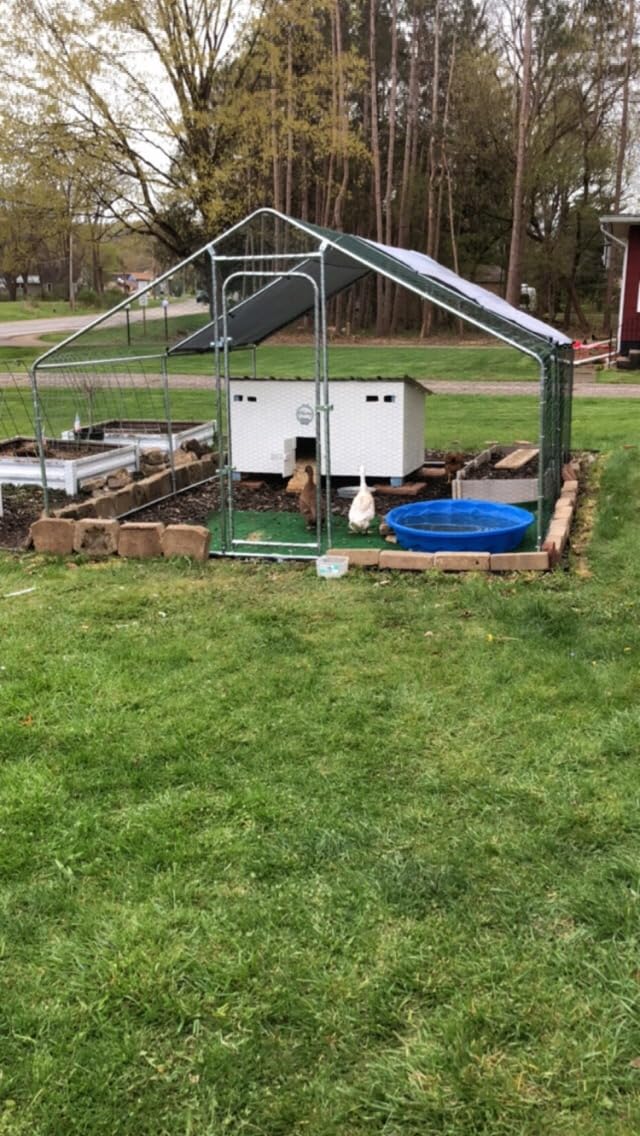
Almost every run in this class is a bare enclosure with nothing attached, which means you bolt on roosting after delivery. This one is the exception. It includes a 5-tier metal roosting ladder perch measuring 55 by 40 centimeters, which is the single most useful built-in feature we found and it saves an entire afternoon of mounting work.
The frame uses multi-layer galvanized steel tubing specifically designed for rust resistance, and the peaked roof drains water quickly. Spring buckle assembly is reported as quick and simple, and the PVC coated hexagonal mesh is described as small-gap and bird safe, which reduces the injury risk that bare wire creates at joints.
The limitations are about the site and the add-ons. Reviewers note that the enclosed run area may need a solid base or additional anchoring in exposed locations, and accessory upgrades such as extra covers are not included. With a 4.3 rating on a smaller review base than the leaders, the satisfaction level is high but the long-term durability picture is simply less documented.
At about 197 square feet, this is close to the ideal size for 20 hens with a hen house inside, so you are not paying for footprint you will not use. The trade is that you inherit a slightly younger listing with less field history.
How much does the built-in roosting ladder help?
More than the dimension suggests. Chickens roost on the highest available point, and an uneven roosting setup with a low flat perch and a high corner produces crowding at the top and dirty feathers on the bottom. A 5-tier ladder spreads birds vertically so each bird finds space, and it is predator-safer because the birds are off the floor.
For a 20-hen flock you still want roughly 10 feet of roost bar total, so plan to add one horizontal bar inside the hen house. The ladder handles the ramp-and-level function, and it gives chicks a way up that adults do not block.
What should you add before stocking it?
A hardware cloth layer and a base. The coated hexagonal mesh is bird safe but not a predator barrier, and owners specifically flag the need for a solid base or stronger anchoring on exposed sites. Add five nesting boxes with exterior egg access inside the hen house section.
Also plan for shade. A UV-resistant Oxford roof is included, but a 19.7 by 10 foot run in summer generates real heat, and adding removable shade cloth or partial side panels is the cheapest way to keep a 20-bird flock comfortable through a hot spell.
9. Xbrigh 23.2×9.8 ft Run – Removable Roof for Seasonal Control
23.2×9.8 FT Extra Large Metal Chicken Coop, Walk-in Poultry Run Pen
- Long 23 ft footprint gives strong ground coverage
- Advanced galvanization resists corrosion
- Tightly woven PVC coated mesh with sized gaps
- Reinforced latch plus removable cover for seasonal use
- Newer listing with a shorter review history
- Standard mesh alone is not a full predator barrier
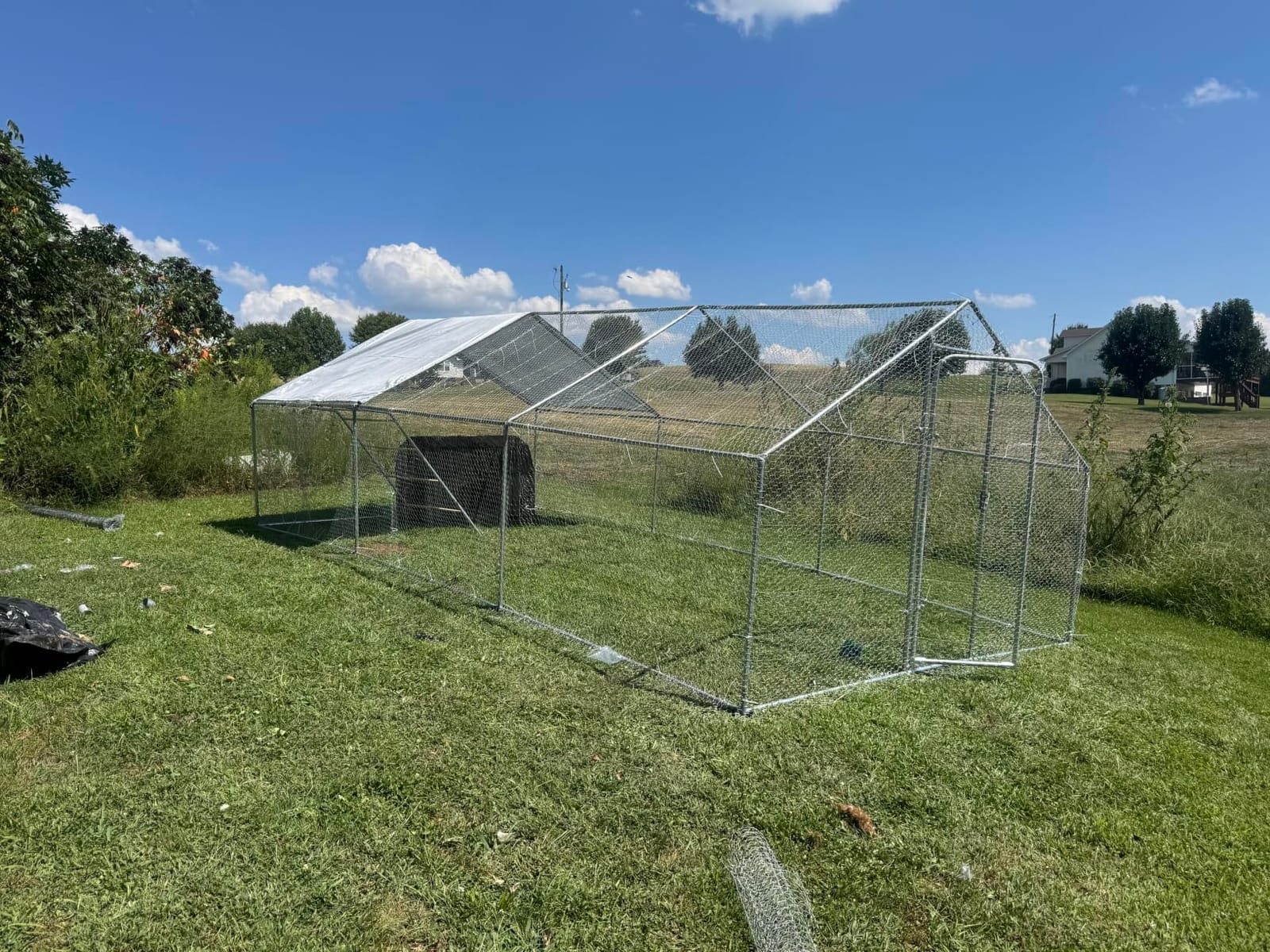
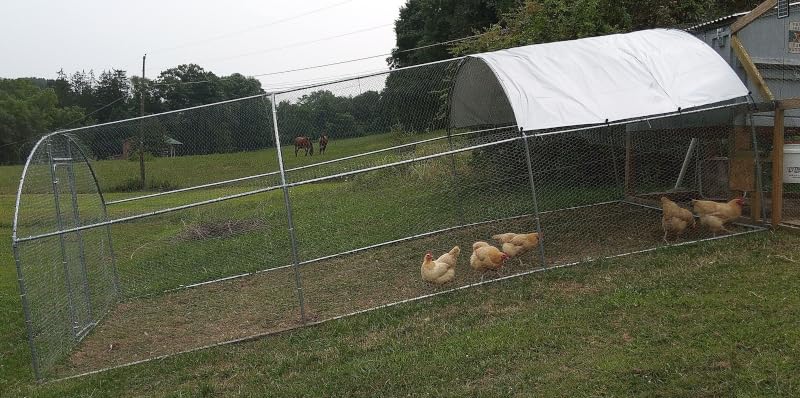
The Xbrigh run is a 23.2 by 9.8 foot walk-in, roughly 227 square feet, which comfortably covers the 160 to 200 square feet a 20-hen flock wants and then some. The reinforced metal latch locking system is sturdier than the cheap spring latches common in this category, and the frame uses advanced galvanization intended to resist corrosion over multiple seasons.
The feature that sets it apart is the removable waterproof UV-resistant PE roof. In a hot climate you can take the cover off entirely to cut solar gain during the afternoon, then refit it before storms. It also includes a chicken perch, which is a small convenience most bare run frames skip.
Two honest caveats. This is a newer listing, so there is less long-term durability feedback than the established brands in this roundup, and as with similar runs, the tightly woven PVC coated hexagonal mesh on its own is not a full predator barrier. Tightly woven is not the same as welded, and hex mesh still has hex-shaped openings a determined weasel can work at.
Assembly is described as a two-person quick build with hardware and instructions included, and customer service support is listed at 24/7. For 20 hens we would still budget a hardware cloth pass over the walls and roof.
Why does a removable roof matter for a large flock?
Because 20 birds generate a lot of heat and moisture. Under a fixed cover the run becomes a greenhouse on a sunny afternoon, and birds pant, crowd into shade, and stop laying well. Being able to strip the roof in summer and restore it in winter is a real advantage at this size, where shade cloth alone often does not reach the middle sections.
It also helps in spring, when you want airflow during wet weather, and it makes roof replacement after UV degradation a five-minute job rather than a teardown. Check the fasteners periodically, since a loose cover in wind is the main risk of a removable design.
Is the shorter review history a real concern?
It is a moderate concern, not a disqualifier. A 4.1 average with a 62 percent five-star share is solid, and the majority of positive feedback cites length, galvanizing, and mesh quality. What you lack is the multi-year durability history that the older listings in this group have accumulated.
Offset it with basic care. Keep the base off bare soil, rinse the frame annually, and inspect the galvanizing at ground contact each spring before corrosion spreads along the tube.
10. HOOYEAH 19.6×9.8 ft Spire Run – Budget Entry With Thicker Pipe
- Quick-connect frame makes assembly straightforward
- Galvanized tube is easy to wipe clean
- Reinforced pipe walls are thicker than cheaper competing models
- Lockable steel door with latch
- Hexagonal mesh still permits determined predators
- Spire roof cover degrades under prolonged sun and weather
- Basic enclosure with no integrated roosting or feeding hardware
The HOOYEAH run is the budget way into this class. At 19.6 by 9.8 by 6.4 feet it gives about 192 square feet, which is right at the top of the range a 20-hen flock needs. Owners treat it as a budget large run and consistently note that the quick-connect frame makes assembly straightforward and the galvanized tube easy to wipe clean between cleanouts.
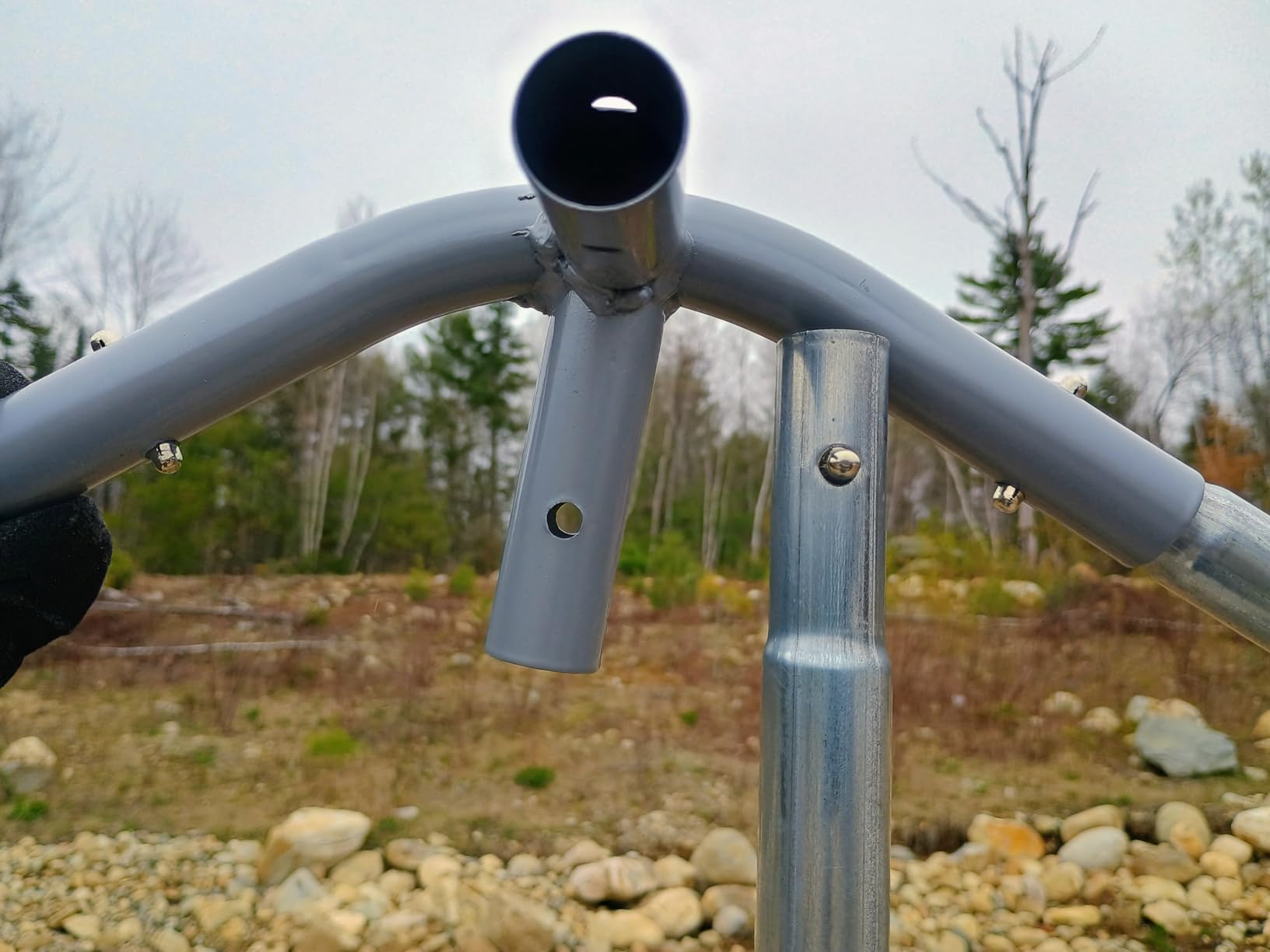
Two details push it above the cheapest options in this category. The reinforced pipe walls are thicker than cheaper competing models, and the door is a lockable steel door with latch rather than a spring hook. Steel wire ties are included for securing the mesh, which saves a trip.
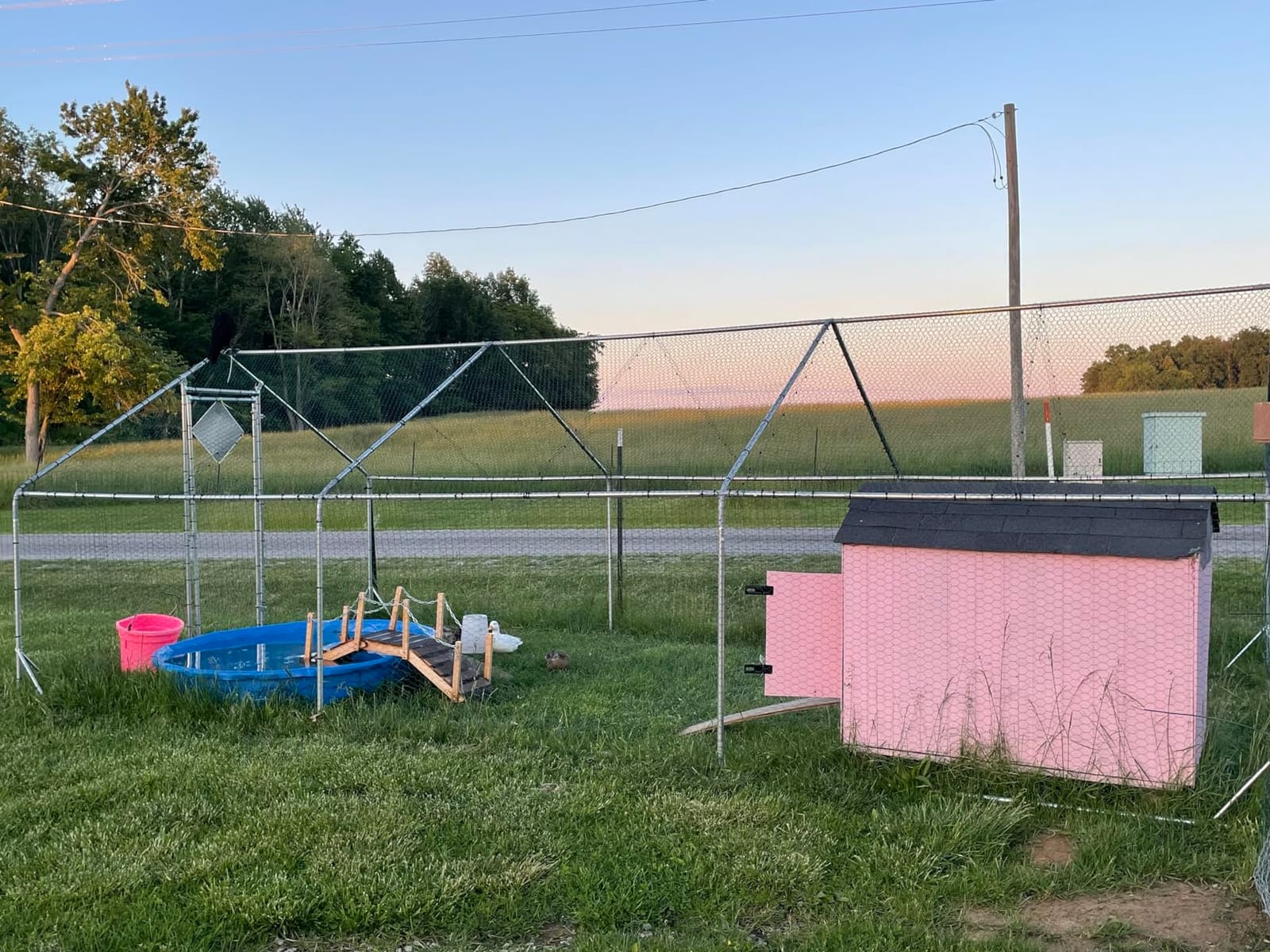
The trade-offs show up in the reviews. Hexagonal mesh with small gaps still permits determined predators, the spire roof cover degrades under prolonged sun and weather, and it is a basic enclosure with no integrated roosting or feeding hardware. The 15 percent three-star share is the highest in this group, which tracks with average cover durability and containment-only mesh.
At roughly 100 pounds it is also one of the lighter structures here, which helps if you ever want to reposition it, though none of us would call it a true mobile coop at 20 birds. Frame it on a solid base and it will do its job as a fixed run.
Can a budget run realistically hold 20 chickens?
The floor area says yes, with room over the 160 to 200 square feet target. The question is containment rather than capacity, and that is where the money goes. Every critical review on this model comes back to mesh, so budget for a full 1/2 inch hardware cloth skin plus a buried skirt, and the run performs fine.
Buying a budget run and cladding it costs less than buying a clad run and still gets you a working structure. Just do the cladding before the birds arrive rather than after a loss.
What should you add to make it 20-bird ready?
Five nesting boxes with exterior access, roost bars inside the hen house, and a hardware cloth pass on the walls and roof. Replace the cover tarp within a couple of seasons if you see UV breakdown, and use deeper ground anchors because the supplied stakes are the weak point in most metal runs of this size.
The interior is bare, so all roosting and feeding hardware is on you. Given that, this model suits a keeper who is comfortable finishing a build rather than one who wants a turnkey shelter.
What to check before you buy a large chicken coop
Hardware cloth beats chicken wire every time
Hexagonal chicken wire is designed to keep chickens in, not predators out. A raccoon reaches through and a weasel fits through gaps you would not believe existed. Half-inch hardware cloth, ideally 19 gauge or heavier and mechanically fastened rather than zip-tied, is the standard answer, and keepers across BackYard Chickens treat it as non-negotiable for a flock this size.
Two of the runs here ship with coated hexagonal wire, and one builds in 20 gauge welded hardware cloth on the side walls. Check the roof and the base perimeter separately, because a run with great walls and a bare roof is not a secure run.
Floors, trays, and cleanout access decide how you will actually live with it
Should a chicken coop have a floor? In a walk-in setup, the run sits on bare ground and the hen house inside gets a solid floor with a removable droppings tray. At 20 birds the tray is not optional, because the volume of manure a large flock produces makes scooping by hand unpleasant and unhygienic.
Look for a large cleanout door, ideally a full-height human door, so you can rake out the run floor and change bedding quickly. Avoid any structure that requires you to crawl in on your hands and knees to service it. A removable tray plus a wide cleanout door is the pair that makes a 20-hen coop manageable.
Volume means heat, and heat is the winter and summer problem
Large coops overheat badly in hot and humid climates precisely because volume is hard to ventilate. For summer, prioritize adjustable vents high on the wall, a shaded roof, and airflow at both ends. A removable or roll-back roof cover, as on the Xbrigh run, is a real advantage. One experienced builder we found used 11 awning-style smoked-lexan windows with hardware cloth behind them to keep a metal-roofed coop cool without letting light in.
For winter, the risk reverses. A large volume is harder to hold heat than a small hut, so keep a deep litter method going, add rigid foam insulation panels to the hen house walls, and watch for drafts at the roof line. Popular guidance treats around 20F as the point where heaters become necessary rather than optional.
Nesting boxes and roosts: one box for every four hens
For 20 chickens you need 5 nesting boxes, and the rule of thumb is roughly 12 by 12 by 12 inches per box. Too few or too small and you get floor eggs, which then get eaten. Exterior-access boxes are worth the extra build step because you stop climbing into a dark enclosed run every morning.
On roosts, birds prefer flat and wide over round, because they grip with their feet and a round pole forces them to hold on. Allow about 10 feet of roost bar for 20 hens, space bars 8 to 10 inches apart, and place them above the nest boxes so sleeping birds do not soil the eggs. Avoid a layout where roosts sit over the door or over the feeder, since both get fouled.
Assembly reality check for 7×16 and larger structures
Assume two people and a full day, and do not start in the evening. Benchmarks from experienced kit builders run 2 to 6 hours for a small one-person build and 6 to 10 hours for a walk-in, and 20-bird runs with hardware cloth on top land at the long end of that. Level the site first, because most sag and wobble complaints trace back to an out-of-square base rather than bad parts.
For anything at this size, check whether the run is included or sold separately, because a run is frequently a separate purchase and it is the most expensive part. Oversized units may also need freight delivery rather than a standard carrier, and freight damage on a 20-foot metal frame is a real consideration, so inspect every part on arrival before assembly begins.
Should you buy a kit, build it, or go custom?
For most 20-hen keepers the answer is a metal walk-in run plus a separately built or purchased wooden hen house, which is exactly the architecture described throughout this guide. Kit buyers get speed; custom or Amish-built coops get longer life and better joinery, at a cost that runs into thousands. Self-builders report spending in the low thousands for a coop alone using salvaged panels and a salvaged metal roof, with a DIY nest box bay sized to standard dishpans holding five or more boxes.
Walk-in coops and chicken tractors are not interchangeable at this scale. A tractor that works for 6 birds becomes a 200-pound immovable object at 20 birds, is hard to predator-proof along the bottom seam, and gives up the covered protection birds need at night. If you want rotation, achieve it with paddock fencing inside a fixed run rather than by moving the whole structure.
Frequently Asked Questions
What size chicken coop do I need for 20 chickens?
Budget 3 to 4 square feet of indoor roosting space per hen, so 60 to 80 square feet enclosed, plus 8 to 10 square feet of run per hen for 160 to 200 square feet of outdoor space. Add 5 nesting boxes. That total is usually met by a walk-in run of about 20 by 10 feet with a separate 8 by 8 foot hen house inside it.
What is the best chicken coop for up to 20 chickens?
Among the walk-in runs reviewed, the HITTITE 19.19 x 9.84 ft model leads because of its 0.8mm reinforced galvanized pipe frame, a 4.4 rating, and 927 reviews. The CHIKENCOOP three-room run is the alternative when you want flock separation built in, and the Quictent run is the safer choice where raccoons and weasels are active.
Which chicken coops are the best quality?
Quality at this size comes down to frame wall thickness, welded hardware cloth, and a real ground skirt. Look for 0.8mm or thicker galvanized pipe, 1/2 inch hardware cloth mechanically fastened over the walls and roof, a buried or skirted base, and a lockable latch rather than a spring hook. Frame gauge and mesh gauge matter more than any feature listed on the box.
Do chickens prefer round or flat roosts?
Flat and wide. Birds grip with their feet rather than wrapping around a perch, so a flat 2 by 3 inch roost bar is far more comfortable than a round pole. Allow about 10 feet of roost bar for 20 hens, space the bars 8 to 10 inches apart, and place them above the nest boxes so sleeping birds do not soil the eggs.
Should a chicken coop have a floor?
The run sits on bare ground, but the hen house inside should have a solid floor with a removable droppings tray. At 20 birds the tray is essential, because the manure volume from a large flock makes hand-scooping unpleasant. Pair it with a large cleanout door so you can rake out bedding and replace it without crawling in.
Final Verdict for a 20-Chicken Flock in 2026
The best large chicken coops for 20 chickens are the walk-in enclosures, not the small wooden huts, and the HITTITE 19.19 by 9.84 foot run takes our top spot on the strength of its 0.8mm reinforced galvanized frame and the highest rating in the group. Buy the CHIKENCOOP three-room run if flock separation matters to you, and buy the Quictent if predators are your biggest worry, because its welded hardware cloth sides and ground skirt save you a full cladding day.
Whatever you choose, do the math first: multiply interior length by width, divide by 4, and confirm the number is comfortably above 20. Then add hardware cloth, a buried skirt, 5 nesting boxes, and about 10 feet of roost bar before the birds arrive. Do those four things and any of the ten runs here will carry a 20-hen flock for years.