
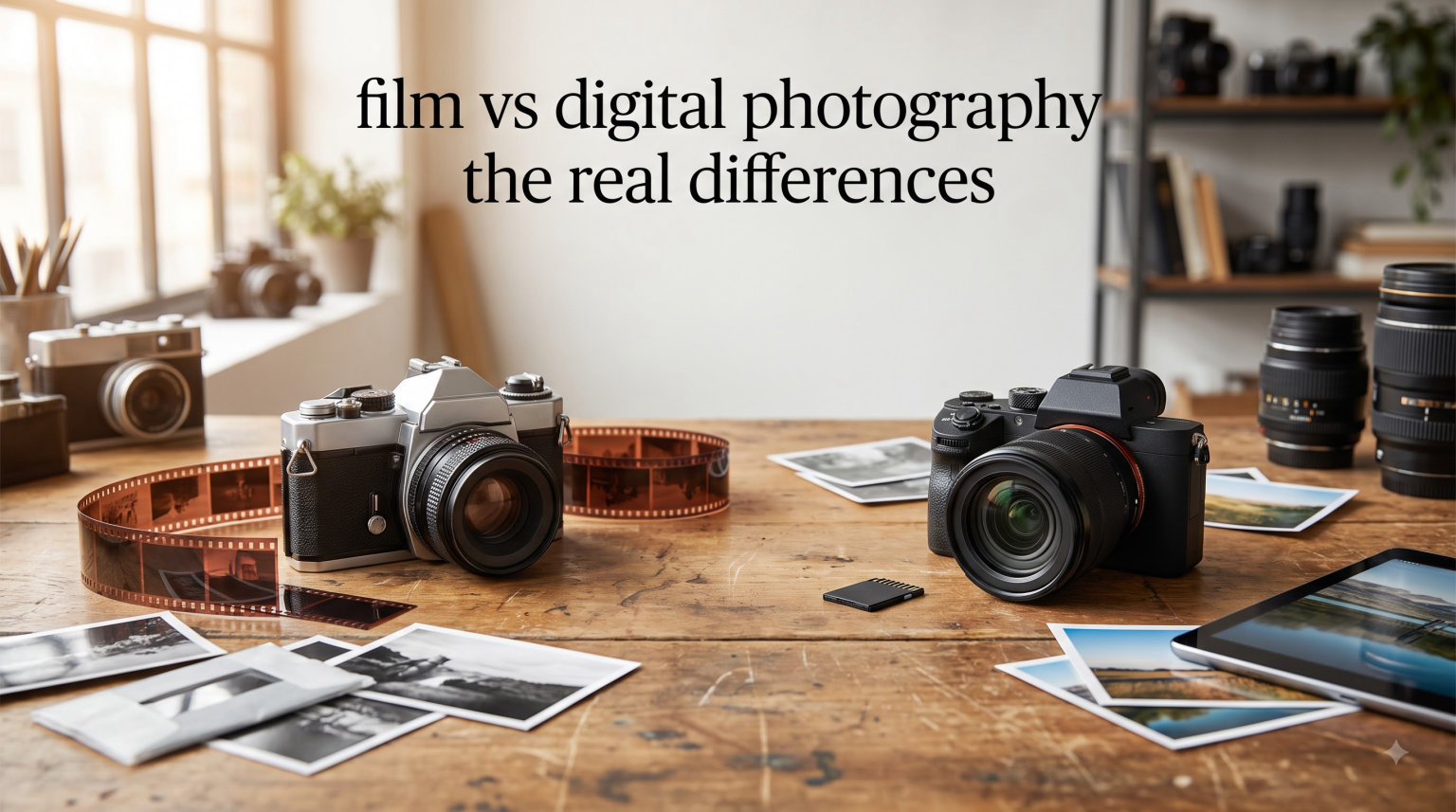
A comprehensive guide to understanding the technical, creative, and practical distinctions between analog and digital photography in 2026
The debate between film vs digital photography has persisted for over two decades, yet it remains more relevant than ever in 2026. With film sales continuing to rise and digital cameras reaching unprecedented levels of sophistication, photographers both new and experienced face important decisions about which format serves their creative vision best. This comprehensive guide examines the real differences between film and digital photography, providing you with the technical knowledge and practical insights needed to make informed choices about your photography journey.
At its core, the distinction between film vs digital photography represents a fundamental shift in how we capture light and preserve moments. Film photography relies on chemical reactions occurring within light-sensitive silver halide crystals embedded in an emulsion layer. When light strikes these crystals, it triggers a permanent chemical change that, after development, produces a visible image. Digital photography, by contrast, converts light into electrical signals through a semiconductor image sensor, with each photosite recording precise photon counts that translate into digital data.
Understanding these foundational differences opens the door to comprehending why each format excels in specific areas and presents unique challenges. Whether you are a photographer considering adding film to your toolkit, a digital native curious about analog techniques, or simply seeking to understand the ongoing relevance of both formats, this article provides the comprehensive analysis you need. We will explore resolution capabilities, the nature of grain versus noise, dynamic range performance, color rendition characteristics, workflow considerations, and cost implications.
By the end of this guide, you will possess a thorough understanding of how film and digital photography differ across the technical specifications that matter most, as well as the practical factors that influence real-world shooting experiences. You will also discover why film photography continues to attract new practitioners even in an era dominated by smartphone cameras, and how understanding both formats can make you a more versatile and thoughtful photographer.
Table of Contents
Film vs Digital Photography: Technical Comparison
| Technical Aspect | Film Photography | Digital Photography |
|---|---|---|
| Effective Resolution | 20-24 MP equivalent (35mm), up to 100+ MP (medium format) | 24-100+ MP (current consumer/professional cameras) |
| Dynamic Range | 10-13 stops (color negative), 6-8 stops (slide film) | 12-15 stops (modern sensors) |
| ISO Flexibility | Set at shooting; push/pull processing available | Adjustable in-camera; multiple RAW sensitivities |
| Grain/Noise Character | Organic, structured grain patterns | Random, electrical noise patterns |
| Color Depth | Analogue continuous tones (unlimited theoretical) | 8-bit to 16-bit per channel (RAW) |
| Workflow Speed | Hours to days for finished images | Immediate preview and editing |
| Cost Per Exposure | $0.50-$5.00 (film + development) | $0.00-$0.10 (storage, negligible per shot) |
| Archival Stability | 100+ years (properly stored negatives) | 20-50 years (storage media dependent) |
| Battery Dependency | None for shooting (mechanical cameras) | Required for all camera functions |
| Learning Curve | Steeper; requires technical understanding | gentler; immediate feedback accelerates learning |
Resolution and Image Quality: How Many Megapixels Does Film Have?
One of the most frequently asked questions in the film vs digital photography debate concerns resolution. Photographers want to know how many megapixels of effective detail film can capture, and how that compares to their digital cameras. The answer requires understanding both the theoretical limits of film grain and the practical realities of different formats.
Professional color negative film, such as Kodak Portra 400 or Fuji Pro 400H, can resolve approximately 20-24 megapixels of effective detail in a 35mm frame when optimally exposed, focused, and developed. This figure represents the practical limit where film grain begins to obscure finer detail, and it corresponds surprisingly well to modern 24-megapixel full-frame digital sensors. The late Peter Keller, a renowned photographic scientist, documented that the theoretical resolution of fine-grain film could approach 40-50 megapixels, but real-world shooting conditions typically yield effective resolutions in the 20-30 megapixel range.
Medium format film significantly exceeds these numbers. A 6x7cm negative, when properly scanned at high resolution, can yield effective detail equivalent to 80-100 megapixels or more. The larger negative area provides more grain samples per unit area of subject, meaning the same grain structure appears proportionally finer relative to the image detail. This is why medium format film remains competitive with the highest-resolution digital systems available today.
Digital sensors approach resolution differently than film. A 24-megapixel sensor contains exactly 24 million photosites, each recording a discrete pixel of information. However, Bayer pattern interpolation, which is necessary because sensors can only record brightness (not color) at individual sites, means that effective resolution is somewhat lower than the raw pixel count suggests. Color filter array demosaicing algorithms must calculate the missing color information at each photosite location, which can introduce artifacts and slightly soft detail compared to theoretical resolution.
The practical implication is that comparing resolution between film and digital requires looking at effective detail rather than raw numbers. A 50-megapixel digital camera will resolve more fine detail than 35mm film in most conditions, but medium format film can compete with or exceed the detail captured by full-frame 24-45 megapixel digital cameras. Understanding this relationship helps photographers make informed decisions about which format best suits their resolution requirements.
Film Grain vs Digital Noise: Understanding the Technical Differences
The visual character of images differs fundamentally between film and digital photography, and much of this distinction stems from how each format handles the random variations in light detection that scientists call “quantum noise.” Understanding the nature of film grain versus digital noise illuminates why many photographers perceive these formats as producing distinctly different aesthetics.
Film grain arises from the physical distribution of silver halide crystals in the photographic emulsion. These crystals vary in size and sensitivity, and when light strikes the film during exposure, the number of photons hitting any individual crystal follows Poisson statistics, creating visible randomness in the developed image. Larger crystals (faster films) produce more visible grain, while smaller crystals (slower films) produce finer, less conspicuous grain. The grain pattern itself exhibits a structured quality because it originates from the fixed physical arrangement of crystals in the emulsion layer.
Digital noise, by contrast, emerges from electrical processes within the image sensor and associated circuitry. When photosites accumulate electrical charge from incident photons, the conversion process introduces thermal noise, read noise, and shot noise that manifest as random variations in pixel values. Unlike film grain, digital noise patterns bear no inherent relationship to subject structure and tend to appear more randomly distributed across the image. At high ISO settings, this noise becomes particularly apparent in shadow areas, where the signal-to-noise ratio decreases.
The perceptual difference between these two phenomena is significant. Film grain, particularly in slower emulsions, often appears as a fine, texture-like pattern that many photographers find aesthetically pleasing or even desirable. Kodak Tri-X panchromatic film, for instance, produces a distinctive grain structure that has defined the look of documentary photography for decades. Digital noise, especially when severe, can appear as colored specks or patterns that distract from subject detail and may be perceived as degraded image quality.
However, modern digital cameras have made remarkable progress in noise handling, and at base ISO settings, many cameras produce images essentially free of visible noise. The comparison becomes more nuanced at higher sensitivities, where film photographers historically embraced grain as an acceptable trade-off for working in low light. Contemporary computational photography techniques, including multi-frame noise reduction and AI-powered upscaling, further blur the distinction between these approaches.
Dynamic Range: Can Film Capture More Highlights and Shadows?
Dynamic range, measured in stops of light between the brightest recordable detail and the noise floor, represents one of the most technically significant comparisons between film and digital photography. Modern digital sensors have largely surpassed film in this metric, yet the way film handles highlights and shadows differs qualitatively in ways that affect the photographic aesthetic.
Professional digital sensors in cameras like the Sony A7R V or Canon EOS R5 capture approximately 14-15 stops of dynamic range at base ISO. This means they can record detail in lighting conditions spanning roughly 32,000:1 to 1 in luminance ratio. Some medium format systems, such as the Fujifilm GFX 100 II, extend this to 15+ stops. These capabilities far exceed what even the most generous film stocks can capture, particularly at low ISO settings.
Color negative film typically offers 10-13 stops of dynamic range, depending on the specific emulsion and processing conditions. Kodak Portra 400, renowned for its wide exposure latitude, can capture approximately 11-13 stops while retaining usable shadow and highlight detail. Slide film presents a more challenging case, with only 6-8 stops of dynamic range, requiring precise exposure but rewarding accurate lighting with extraordinary color saturation and contrast.
The qualitative difference lies in how film and digital handle the extremes of this range. Film exhibits a gradual, smooth rolloff in highlights, with bright areas gradually losing saturation and transitioning to white rather than clipping abruptly. Digital sensors, despite their greater total range, tend toward harder clipping when highlights exceed the sensor’s capacity, producing pure white with no recoverable detail. This characteristic makes film particularly forgiving in high-contrast situations where precise exposure is difficult.
In shadows, digital sensors face different challenges. While the theoretical dynamic range extends far into shadow areas, practical image quality degrades as signal-to-noise ratio falls. Digital shadows can exhibit color shifts and noise patterns that require careful processing to manage. Film shadows, conversely, display a more gradual transition from detailed shadow areas into grainy darkness, with less color contamination but also less shadow recovery potential in post-processing.
ISO Speed and Low Light Performance
The behavior of sensitivity in film vs digital photography follows fundamentally different principles, with important implications for photographers working in challenging lighting conditions. Understanding these differences helps photographers select the appropriate format for their specific shooting situations.
Film sensitivity, expressed as ISO speed, is determined by the emulsion’s chemical characteristics and is fixed at the time of exposure. You cannot change the ISO of a roll of Portra 400 to ISO 800 after shooting; the film’s sensitivity is inherent to its chemical composition. However, photographers can intentionally “push” or “pull” film during development, effectively altering the contrast and grain characteristics to compensate for exposure errors or achieve specific aesthetic effects. Pushing film one stop (for example, exposing ISO 400 film at ISO 800) increases contrast and grain while maintaining shadow detail in underexposed frames.
Digital cameras offer immediate, flexible ISO adjustment, with modern sensors providing usable images across a remarkable range of sensitivities. The base ISO (typically 100 or 64 for most sensors) delivers the cleanest files with maximum dynamic range, while higher ISO settings introduce controlled amounts of noise to maintain usable exposure in low light. This flexibility represents one of digital photography’s most significant practical advantages over film.
However, the relationship between digital ISO and image quality differs from intuitive expectations. “ISO invariance” describes a phenomenon where, within certain limits, adjusting exposure in post-processing from a base ISO capture can yield similar results to in-camera ISO adjustment. This means that, for some cameras, shooting at base ISO and underexposing by 2-3 stops can be corrected later with results comparable to shooting at the higher ISO in-camera.
Low light performance ultimately depends on multiple factors beyond ISO setting alone. Sensor size, pixel pitch, and read noise characteristics all influence how a camera performs in challenging conditions. Full-frame and medium format sensors, with their larger photosites, generally gather more light per photosite and produce cleaner images at high ISO than smaller sensors with higher pixel densities. For film photographers, selecting an appropriate film speed for the lighting conditions, and potentially pushing development, remains the primary method for optimizing low light performance.
Color Rendition: Why Does Film Look Different Than Digital?
The distinctive look of film photography extends beyond grain to encompass color rendition characteristics that differ fundamentally from digital capture. These differences arise from the fundamentally different mechanisms each format uses to record color information, creating images with distinctly different aesthetic qualities.
Film produces color through a complex chemical process involving dye couplers embedded in the emulsion layers. During development, color dyes form at the locations of exposed silver halide crystals, with different layers sensitive to different primary colors. The resulting image displays continuous, analog color tones without the discrete quantization that affects digital capture. Color negative film, in particular, exhibits a characteristic look with slightly subdued contrasts, extended highlight rolloff, and a color palette that many photographers describe as warmer or more natural than digital capture.
Transparency or slide film, including Kodachrome, Velvia, and Provia, produces a fundamentally different aesthetic characterized by higher saturation, contrast, and color intensity. Ektachrome, which has seen renewed production in recent years, exemplifies how slide film delivers punchy, vibrant colors that many photographers find ideal for landscape and product photography. The limited dynamic range of slide film, while demanding precise exposure, rewards accurate lighting with extraordinary color fidelity.
Digital sensors record color through a different mechanism, using a color filter array (typically the Bayer pattern) that places red, green, and blue filters over individual photosites in a repeating pattern. Each pixel records only one color channel, with demosaicing algorithms reconstructing full color information through interpolation. This process, while highly sophisticated, can introduce subtle color artifacts and requires careful processing to achieve natural color rendition.
The white balance control available in digital photography represents a significant practical advantage over film. While film requires selecting a type balanced for specific lighting conditions (daylight, tungsten, fluorescent), digital cameras can adjust white balance after capture, providing flexibility that film photographers cannot match. This control extends beyond simple color temperature adjustment to include tint compensation, making digital particularly versatile for mixed lighting situations.
Workflow and Convenience: Speed, Editing, and Sharing
The practical workflow differences between film and digital photography extend far beyond the obvious delay between exposure and viewing. Each format presents distinct advantages and challenges throughout the entire process from shooting through final output, affecting everything from creative decision-making to archival practices.
Digital photography’s most obvious advantage lies in immediate feedback. The ability to review images instantly on the camera’s LCD screen, check exposure through histograms, and reshoot immediately if technical requirements are not met transforms the photographic learning process. Photographers can identify and correct problems in seconds rather than days, accelerating skill development and reducing wasted opportunities. This immediate validation makes digital particularly advantageous for professional work where time constraints limit the ability to reschedule shoots.
Film photography workflow follows a fundamentally different rhythm. After exposure, film must be developed before images can be evaluated. For color negative film, this process typically takes 30 minutes to an hour at a professional lab, or 1-3 days if mailed to a remote service. Black and white film can be developed at home in approximately one hour, providing a middle ground between immediacy and the chemical process intimacy that many photographers value. This delay creates a different psychological relationship with photography, encouraging more deliberate shooting and reducing the tendency toward “spray and pray” behavior.
The editing process differs substantially between formats. Digital RAW files contain far more information than the visible image suggests, allowing aggressive adjustments to exposure, white balance, and color without the image degradation that would affect a processed film scan. Shadows can be lifted dramatically, highlights recovered from near-white, and colors shifted substantially while maintaining usable results. Film scans, by contrast, represent a fixed moment in the chemical process, with less flexibility for major adjustments while still permitting meaningful optimization through scanning software.
Sharing and archival practices have also diverged significantly between formats. Digital images exist as files that can be copied, backed up, and distributed instantaneously through internet connections. Cloud storage, external drives, and multiple redundancy strategies protect against data loss. Film originals, whether negatives or positives, represent unique physical objects that, if lost or damaged, cannot be precisely recreated. Properly stored film negatives can last over a century, outlasting any digital storage medium, yet they require physical organization and care that differs from cloud-based backup strategies.
Cost Analysis: Initial Investment vs Ongoing Expenses
Financial considerations often play a decisive role in format selection, particularly for photographers beginning their journey or expanding their equipment collection. Understanding the complete cost picture for both film and digital photography reveals important trade-offs that pure technical comparison cannot capture.
Initial equipment costs favor film photography in many scenarios. Quality mechanical film cameras from the 1970s and 1980s, including legendary models from Nikon, Canon, and Pentax, are available on the used market for a few hundred dollars. These cameras, built to professional standards and designed to last decades, offer an entry point to 35mm photography that current digital technology cannot match at similar price points. A fully functional Nikon F3 or Canon AE-1 Program, paired with a moderate zoom lens, can be acquired for less than the cost of an entry-level digital mirrorless camera body alone.
Professional film cameras, including medium format systems, have also become relatively affordable on the used market. A Hasselblad 500C/M or Mamiya RB67, once representing thousands of dollars in professional equipment value, can now be found for $500-1500 depending on condition and included accessories. This democratization of medium format film photography has made large negative imaging accessible to photographers who could never have afforded these systems new.
Digital camera initial costs vary widely based on system selection. Entry-level mirrorless and DSLR cameras offer excellent image quality for under $1000, while professional systems with full-frame or medium format sensors can exceed $5000 for body only. The used market offers significant savings, but professional-grade digital equipment generally requires greater upfront investment than equivalent film systems.
Ongoing costs tell a different story. Film photography requires purchasing film for each exposure and paying for development, creating a per-image cost that accumulates with shooting volume. Depending on film stock selection and development choices, each exposure might cost between $0.50 and $5.00. A photographer shooting one roll of 36 exposures per week at $2 per exposure spends approximately $100 weekly or $400 monthly on film and development alone. Digital photography, after initial equipment investment, involves minimal per-exposure costs beyond storage media and electricity.
Total cost of ownership calculations must therefore account for shooting volume. Occasional film photographers might spend less overall than those who shoot extensively, while frequent shooters will find digital’s lack of per-exposure costs increasingly advantageous over time. However, film photographers often report shooting more deliberately due to the cost of each exposure, potentially producing better images per shutter actuation than digital shooters who might engage in indiscriminate capture.
When to Choose Film vs Digital: A Practical Guide
Understanding the technical and practical differences between film and digital photography only partially answers the question of which format to choose. The decision ultimately depends on specific use cases, personal preferences, and creative goals that vary significantly among photographers. This section provides practical guidance for selecting the appropriate format based on different photographic applications.
Street photography represents an area where film has maintained strong presence despite digital dominance in most other genres. The portability of compact 35mm cameras, the anonymity of silent mechanical shutters, and the distinctive aesthetic of films like Kodak Tri-X 400 or Ilford HP5 Plus make film an attractive option for street photographers. The deliberate shooting pace encouraged by film’s limited exposures and delayed feedback often aligns well with the observational nature of street work, where photographers benefit from patience and intentionality rather than rapid continuous shooting.
Landscape photography presents a more nuanced choice. Digital cameras offer immediate feedback on exposure and focus, critical for optimizing composition in changing lighting conditions. The ability to stack multiple exposures for high dynamic range scenes, combine focus stacks for extended depth of field, and review images at 100% magnification for technical quality provides significant advantages for landscape work. However, many landscape photographers continue to choose medium format film for the distinctive rendering of detail, the reliability of mechanical cameras in field conditions, and the aesthetic qualities of large negative imaging.
Portrait photography benefits from both formats’ strengths in different contexts. Digital’s immediate feedback and extensive editing flexibility make it practical for commercial and fashion work where client approval and rapid turnaround matter. The ability to capture hundreds of images without composition fatigue, review expressions in real-time, and adjust lighting based on immediate feedback accelerates the working process. Film portraits, particularly with color negative stocks like Kodak Portra 400 or Fuji Pro 400H, often exhibit a flattering skin tone rendering and gentle highlight rolloff that many portrait photographers prefer aesthetically.
Commercial and professional work almost exclusively utilizes digital capture for practical reasons including client requirements, immediate delivery, and post-production workflow integration. Stock photography, editorial work, and wedding coverage have largely standardized on digital formats due to these practical considerations. However, some photographers maintain hybrid workflows, using medium format film for specific assignments where the aesthetic justifies the additional processing time and cost.
Why Film Photography Is Making a Comeback in 2026
Despite decades of predictions about film photography’s imminent extinction, the format has demonstrated remarkable resilience and even growth in recent years. Understanding the factors driving film photography’s continued relevance illuminates broader truths about the relationship between photographers and their tools, and suggests that the film vs digital debate will continue for years to come.
The renewed interest in film photography has been particularly pronounced among younger photographers who never shot film during its commercial peak. For photographers raised on digital technology, film represents a novel experience characterized by intentionality, tactile interaction, and results that differ qualitatively from smartphone images. The constraint of limited exposures encourages more thoughtful composition and exposure calculation, creating a learning environment that some argue produces better photographers faster than digital’s unlimited capture capacity.
Social media platforms have played an unexpected role in film photography’s revival. Instagram and TikTok host thriving communities dedicated to film photography, with photographers sharing scans, discussing film stocks, and creating educational content about analog techniques. The distinctive aesthetic of film, with its organic grain and characteristic color rendition, stands out against the computational smoothness of smartphone image processing, creating visual differentiation that attracts attention in crowded social feeds.
The tactile experience of film photography appeals to photographers seeking more physical engagement with their craft. Loading film into a camera, hearing the mechanical sounds of a shutter and mirror, handling negatives after development, and the ritual of scanning or printing create an embodied relationship with photography that digital capture cannot replicate. In an era of intangible digital files, the permanence and physicality of film negatives offers a different kind of satisfaction.
The “slow photography” movement, emphasizing mindful, deliberate shooting over rapid-fire capture, has found a natural ally in film photography. The cost per exposure encourages photographers to slow down, observe more carefully, and make more considered technical and creative decisions before pressing the shutter. Many photographers report that shooting film has improved their digital technique by forcing them to develop habits of intentionality that translate across formats.
Practical Tips for Getting Started with Film
- Start with a reliable mechanical camera body and a moderate-speed film like Kodak Portra 400 or Ilford HP5 Plus
- Shoot one roll of film while deliberately calculating each exposure rather than relying on automation
- Experiment with push and pull processing to understand how development affects your images
- Invest in a quality film scanner or find a reliable lab for consistent scanning results
- Join film photography communities to learn from experienced practitioners and discover new film stocks
Frequently Asked Questions
What are the main differences between film and digital photography?
Film photography uses chemical reactions on light-sensitive film to capture images, while digital photography uses electronic sensors to record light as digital data. Film produces analog grain patterns, while digital produces electrical noise. Digital offers immediate preview and editing capability, while film requires chemical development. Each format has distinct dynamic range, resolution, and color characteristics that affect the final image aesthetic.
Is film photography better than digital?
Neither format is objectively better. Film offers a distinctive aesthetic with natural highlight rolloff and organic grain that many photographers prefer for artistic work. Digital provides convenience, immediate feedback, high ISO performance, and greater editing flexibility for commercial applications. The choice depends on your priorities, subject matter, budget, and personal preferences. Many professional photographers use both formats for different applications.
What are the pros and cons of film vs digital photography?
Film advantages include distinctive aesthetics, no battery dependency for shooting with mechanical cameras, a learning curve that improves technical skills, and lower initial equipment costs. Film disadvantages include ongoing film and development costs, delayed results, limited ISO flexibility, and more complex archiving. Digital advantages include instant feedback, excellent high ISO performance, easy sharing, and flexible editing. Digital disadvantages include steeper initial costs and shorter technology lifespan.
Does film have better resolution than digital?
Professional 35mm film can resolve approximately 20-24 megapixels of effective detail, comparable to modern 24-megapixel digital cameras. Medium format film can exceed 100 megapixels equivalent. However, digital sensors in flagship cameras have reached and surpassed these resolution levels, with some systems exceeding 100MP. Real-world resolution also depends on lens quality, technique, and in the case of film, scanning resolution.
Why is film photography making a comeback?
Film photography appeals to photographers seeking a mindful, intentional shooting experience in an age of digital abundance. The tactile nature of mechanical cameras, the anticipation of waiting for development, and the distinctive aesthetic of film grain have attracted a new generation. Social media has celebrated film photography, creating renewed interest. Additionally, the constraint of limited exposures encourages more deliberate shooting that many find more satisfying creatively.
What is the dynamic range difference between film and digital?
Modern digital sensors typically capture 12-15 stops of dynamic range, while color negative film offers approximately 10-13 stops of latitude. This means digital can capture more detail in high-contrast scenes. However, film handles highlights differently with a more gradual rolloff that some photographers prefer for its natural-looking transition. The perceptual difference in highlight handling often matters more than the raw stop count.
Conclusion: Finding Your Path Between Film and Digital
The comparison between film vs digital photography reveals that both formats offer legitimate, valuable approaches to the craft of capturing light. Rather than viewing these formats as competing alternatives requiring a definitive choice, many contemporary photographers embrace both, selecting the appropriate tool based on specific creative goals, practical requirements, and personal preferences.
Digital photography has earned its dominant position through remarkable technical capabilities that serve most photographic applications extraordinarily well. The convenience, flexibility, and immediate feedback of digital capture make it the practical choice for professional work, rapid-paced documentary situations, and photographers who value efficient workflows. The continued improvement in sensor technology, with each generation delivering better noise performance, dynamic range, and resolution, suggests that digital photography will continue advancing.
Film photography has found its place as a creative choice that offers something digital cannot fully replicate. The distinct aesthetic character of film, the deliberate shooting pace it encourages, and the tactile engagement with physical processes appeal to photographers seeking different creative experiences. The medium format and large format film markets have proven remarkably resilient as photographers discover the unique qualities these formats provide.
Your choice between film and digital should reflect honest assessment of your priorities, shooting style, and creative goals. Consider beginning with whichever format seems most aligned with your current interests, and remain open to exploring the other as your skills develop. Many photographers find that understanding both formats makes them more thoughtful practitioners regardless of which they use for any particular project.
The debate between film vs digital photography will continue as long as photographers find meaning in both approaches. Rather than seeking a definitive answer, embrace the diversity of options available in 2026 and let your creative vision guide your technical choices. Whether you capture your next image on silver halide crystals or semiconductor photosites, the fundamental goal remains the same: preserving meaningful moments with skill and artistic intention.