
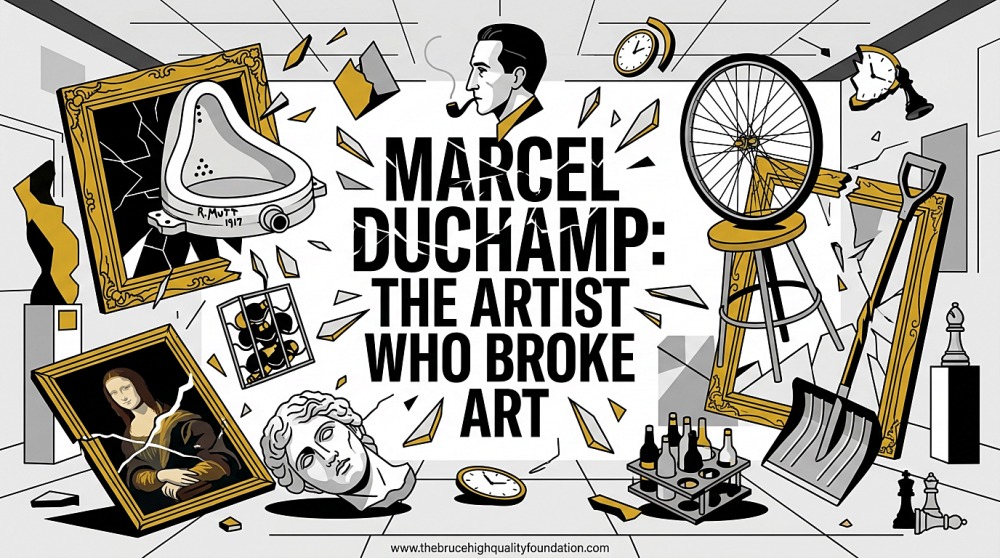
Marcel Duchamp (1887-1968) was a French-American artist who single-handedly dismantled everything the art world believed it knew about creativity, beauty, and skill. He did not merely create art. He created a new way of thinking about what art could be.
In 2026, Duchamp remains the most referenced, debated, and influential figure in contemporary art history. His revolutionary “readymade” concept proved that an idea matters more than the artist’s hand. This guide explores how one man transformed a urinal into a philosophical weapon and changed visual culture forever.
Whether you are an art student struggling to understand conceptual work, a museum visitor puzzled by modern installations, or simply curious about why a signed toilet sits in prestigious galleries worldwide, this comprehensive guide will explain Duchamp’s world in plain, accessible language.
Table of Contents
Who Was Marcel Duchamp?
Henri-Robert-Marcel Duchamp entered the world on July 28, 1887, in Blainville, a small town in the Normandy region of France. He died on October 2, 1968, in Neuilly-sur-Seine, having lived just long enough to see his once-reviled ideas become the foundation of contemporary art practice.
Duchamp belonged to an extraordinarily artistic family. His grandfather Emile Nicolle was an engraver and his two older brothers, Jacques Villon (born Gaston Duchamp) and Raymond Duchamp-Villon, became significant artists in their own right. Growing up surrounded by painters and sculptors, young Marcel initially followed the expected path of academic art training.
Yet Duchamp possessed something his talented siblings lacked: a willingness to question everything. While they pursued traditional artistic success, Marcel systematically destroyed every convention he encountered. This rebellious instinct would eventually earn him titles like “father of conceptual art” and “the artist who broke art.”
Quick Facts at a Glance
| Full Name | Henri-Robert-Marcel Duchamp |
| Born | July 28, 1887, Blainville, France |
| Died | October 2, 1968, Neuilly-sur-Seine, France |
| Nationality | French (became U.S. citizen in 1955) |
| Most Famous Works | Fountain, Nude Descending a Staircase, The Large Glass, L.H.O.O.Q |
| Associated Movements | Cubism, Dada, Surrealism (though he avoided formal membership) |
| Key Innovation | The “readymade” – ordinary objects as art |
Early Life and Artistic Family
The Duchamp household hummed with creative energy. Their father, Eugene, worked as a notary but supported his sons’ artistic ambitions. The normality of this environment paradoxically fueled Marcel’s later desire to rebel. When art feels ordinary from childhood, the extraordinary becomes necessary.
Young Marcel painted from an early age, copying magazine illustrations and attempting the academic style that dominated French art education. In 1904, at age 17, he joined his brothers in Paris, the undisputed center of the art universe. He enrolled at the Academie Julian but found the rigid curriculum stifling.
The academic system demanded technical perfection and adherence to classical subjects. Duchamp chafed against these constraints. He preferred reading and intellectual pursuits to the repetitive copying of plaster casts that constituted formal training. This tension between institutional expectations and personal curiosity would define his entire career.
His early paintings from 1905-1910 show clear influence from the dominant styles of the era. You can detect Fauvism’s bold colors in works like “Portrait of Dr. Dumouchel.” Cubism’s geometric fragmentation appears in “The Chess Game” (1910). Yet even these conventional pieces contain hints of Duchamp’s emerging philosophical concerns.
From Painting to Paris: Duchamp’s Early Career
The Paris of 1904-1910 was electric with artistic revolution. Picasso and Braque were dismantling perspective. Matisse was shocking viewers with violent color. Duchamp absorbed these influences while developing his own preoccupations. He became particularly interested in motion, time, and the fourth dimension.
Between 1911 and 1912, Duchamp created a series of works exploring movement and sexuality. “Coffee Mill” (1911) and “Virgin, No. 1” and “No. 2” (1912) demonstrated his fascination with mechanical representation and erotic symbolism. These works attracted attention from the Cubist circle, though Duchamp always maintained distance from any movement’s core.
During this period, Duchamp coined a term that would define his life’s philosophy: “retinal art.” He used this phrase dismissively to describe art that appealed only to the eye. Pretty pictures. Decorative objects. He wanted art to engage the mind. This distinction between visual pleasure and intellectual stimulation became the engine of his revolutionary work.
His growing dissatisfaction with painting culminated in a decisive rejection. By 1913, Duchamp had essentially abandoned traditional easel painting. Other artists spent lifetimes perfecting their brushwork. Duchamp walked away before turning 26. This radical move freed him to pursue entirely new artistic territories.
The Scandal of 1913: Nude Descending a Staircase
In 1912, Duchamp painted a work that would make him famous and miserable simultaneously. “Nude Descending a Staircase, No. 2” depicted not a static nude figure but the successive stages of a body’s movement down stairs. Cubist fragmentation met chronophotography in a single revolutionary canvas.
The Cubists rejected it. The Salon des Independants jury, which included his own brothers, asked Duchamp to withdraw the painting or change the title. They felt the Futurist influence was too strong, that it mocked their movement. Duchamp complied and withdrew the work, but the rejection permanently damaged his relationship with organized Cubism.
The following year, “Nude Descending a Staircase” appeared at the Armory Show in New York City. The exhibition introduced European modernism to American audiences. Duchamp’s painting caused an explosion of controversy. Critics savaged it. Cartoonists mocked it. Former President Theodore Roosevelt publicly compared it to a Navajo blanket he owned.
American Art News held a contest to find the nude in the painting. Viewers saw only geometric shapes and overlapping planes. The work became a symbol of everything conservative Americans hated about modern art. It was, in the words of one critic, “an explosion in a shingle factory.”
The scandal made Duchamp a celebrity. But unlike Picasso or Matisse, who enjoyed public recognition, Duchamp seemed to treat fame with ironic detachment. The controversy confirmed his suspicion that the art world cared more about spectacle than substance. This realization would fuel his next, more radical innovations.
The Readymade Revolution: Duchamp’s Greatest Innovation
In 1913, Duchamp mounted a bicycle wheel upside down on a wooden stool. He called it “Bicycle Wheel.” This was not a sculpture in any traditional sense. He had not carved, modeled, or welded anything. He had simply selected an existing object and presented it as art.
Duchamp termed these objects “readymades.” The name itself suggested factory production and commercial availability. This was art without the artist’s hand. Art without skill. Art that anyone could theoretically create by choosing any object and declaring it art.
The concept seems simple until you grasp its implications. For centuries, art had been defined by craftsmanship, originality, and beauty. The readymade rejected all three. It substituted selection for creation. It replaced skill with decision. It traded beauty for intellectual provocation.
Duchamp distinguished between “unassisted” and “assisted” readymades. Unassisted readymades were manufactured objects presented with minimal alteration. “Bottle Rack” (1914) and “Fountain” (1917) exemplify this category. Assisted readymades involved some modification by the artist. “Bicycle Wheel” qualified because Duchamp attached the wheel to the stool.
Fountain: The Urinal That Shook the Art World
In April 1917, Duchamp submitted a porcelain urinal signed “R. Mutt 1917” to the Society of Independent Artists exhibition in New York. The society, which Duchamp himself helped establish, had promised to exhibit any artwork submitted. They rejected “Fountain” anyway.
The board deemed it indecent. They called it a plumbing fixture, not art. Duchamp resigned from the board in protest. The work was photographed by Alfred Stieglitz and then, according to most accounts, lost or destroyed. Only the photograph and Duchamp’s writings about it survived.
“Fountain” became the most influential artwork of the twentieth century. It asked a question that still echoes in galleries today: who decides what counts as art? The artist? The museum? The collector? The public? Duchamp suggested that the act of selection and presentation could transform any object into art.
The original “Fountain” has achieved mythic status. Seventeen authorized replicas now exist in major museums worldwide. The work appears in every art history textbook. Yet controversy still surrounds its creation. Some scholars argue that Baroness Elsa von Freytag-Loringhoven, a radical Dada artist, may have actually submitted the urinal. The authorship question only adds to the work’s philosophical complexity about authenticity and originality.
Other Significant Readymades
Between 1913 and 1921, Duchamp produced approximately twenty readymades. “In Advance of the Broken Arm” (1915) was a snow shovel with that title painted on it. “Fresh Widow” (1920) was a French window with black leather replacing the glass panes. “Pharmacy” (1914) was a chromolithograph of a landscape with two drops of paint added.
Each readymade functioned as a kind of visual pun or philosophical joke. The titles were crucial. “In Advance of the Broken Arm” suggests the shovel will cause the injury it is meant to prevent. “Fresh Widow” combines mourning with French window architecture while phonetically evoking “French widow.”
Duchamp’s readymades challenged the concept of taste. Traditional art required cultivated aesthetic judgment. The readymade mocked this cultivation by presenting objects that required no artistic training to appreciate or produce. Yet appreciating the conceptual brilliance behind a readymade demanded sophisticated intellectual engagement. Duchamp had not eliminated the need for education. He had shifted it from technical craft to conceptual understanding.
The Large Glass: Duchamp’s Magnum Opus
Between 1915 and 1923, Duchamp worked obsessively on his most ambitious project. “The Bride Stripped Bare by Her Bachelors, Even” (commonly called “The Large Glass”) consisted of two panes of glass sandwiching oil paint, wire, lead foil, dust, and other materials. The work stood over nine feet tall and represented Duchamp’s definitive break from painting.
The composition divided into two realms. The upper pane contained the “Bride,” a mechanical, insect-like figure suspended in isolation. The lower pane showed nine “Bachelors” represented as uniformed mechanical forms. Between them, a “Chocolate Grinder” and various “Sieves” and “Scissors” created a complex mechanical apparatus.
Duchamp intended the work as an allegory of sexual desire and frustration. The Bride and Bachelors could never physically connect. The mechanical devices between them processed erotic energy without achieving satisfaction. This was eroticism stripped of romantic sentiment, reduced to mechanical processes and frustrated longing.
The technical execution was unprecedented. Duchamp abandoned brushes for mechanical drawing and industrial materials. He used lead wire, mirror plating, and dust that settled naturally over years. In 1923, he declared the work “definitively unfinished.” He had worked on it for eight years and simply stopped.
In 1927, while being moved, “The Large Glass” cracked spectacularly. The breaks ran through both panes, creating a spiderweb pattern that now seems integral to the work. Duchamp repaired the damage but left the cracks visible. They became, in his words, a “coup de des” (throw of the dice) that completed the work through chance intervention.
The Philadelphia Museum of Art now houses “The Large Glass” as part of the largest Duchamp collection in the world. Visitors stand before it trying to decipher its mysteries. Manuals, diagrams, and notes that Duchamp published in “The Green Box” (1934) and “A l’Infinitif” (1966) provide clues but no definitive answers. The work remains deliberately enigmatic.
Rrose Selavy and the Art of Wordplay
In 1920, Duchamp adopted a female alter ego named Rrose Selavy. The name phonetically approximates “Eros, c’est la vie” (Eros, that is life) or “arroser la vie” (to make a toast to life). This persona allowed Duchamp to explore themes of gender, sexuality, and identity while maintaining ironic distance.
Man Ray photographed Duchamp as Rrose Selavy in 1921. The images show Duchamp in feminine clothing, posed with a direct gaze that neither confirms nor denies the transformation. These photographs subverted traditional portraiture while raising questions about the construction of gender.
Wordplay permeated Duchamp’s entire output. “L.H.O.O.Q” (1919) was a postcard reproduction of the Mona Lisa with a drawn mustache and goatee. When read aloud in French, the title sounds like “Elle a chaud au cul” (She has a hot ass), a crude sexual comment about Leonardo’s dignified lady.
This irreverent defacement of the world’s most famous painting scandalized traditionalists. But Duchamp had not destroyed the Mona Lisa. He had purchased a cheap postcard reproduction and added minimal marks. The original remained untouched in the Louvre. Yet his version arguably became more famous in twentieth-century art discourse than Leonardo’s original.
“L.H.O.O.Q” demonstrated that context and intention could transform even the most familiar image. A museum masterpiece became a joke through the simplest intervention. Duchamp revealed that art’s power lay not in materials or labor but in ideas and the frames we place around objects.
Duchamp and the Avant-Garde Movements
Duchamp’s life intersected with every major avant-garde movement of the early twentieth century. Yet he stubbornly refused to join any of them officially. This independence preserved his freedom while allowing him to influence multiple directions simultaneously.
Dada, the anti-art movement born in Zurich during World War I, embraced absurdity and rejected traditional aesthetics. Duchamp participated in Dada exhibitions and shared their contempt for bourgeois art culture. However, he avoided the movement’s political dimensions and its often-aggressive public persona. He found Dada too emotional, too reactive.
Surrealism, led by Andre Breton, claimed Duchamp as an inspirational figure. Breton admired Duchamp’s intellectual rigor and his exploration of erotic themes. Duchamp organized the 1938 International Surrealist Exhibition in Paris and designed the 1942 First Papers of Surrealism show in New York. Yet he never formally joined the Surrealist group or signed their manifestos.
Man Ray became Duchamp’s closest artistic collaborator and lifelong friend. Together they explored photography, film, and optical experiments. Their friendship represented the creative energy Duchamp preferred over institutional commitments. He valued individual relationships over collective movements.
This refusal to belong frustrated art historians who wanted to categorize him. Was he a Cubist? A Dadaist? A Surrealist? Duchamp was all and none of these. He borrowed techniques and attitudes freely while maintaining personal autonomy. This position of outsider-insider became his trademark and his power.
Chess, Secrecy, and the Final Chapter
In 1923, Duchamp effectively disappeared from the art world. He devoted himself to chess, eventually achieving master-level play and representing France in international competitions. Chess offered pure intellectual combat without commercial or institutional concerns. It was art without the art world.
“I am still a victim of chess,” Duchamp once wrote. “It has all the beauty of art and much more.” The game’s endless complexity, its combination of logic and intuition, its total absence of material production appealed to everything Duchamp valued. Chess pieces moved according to rules, but the games they produced were always new.
During the 1940s and 1950s, Duchamp lived quietly in New York. He married Alexina Sattler (nicknamed Teeny) in 1954 and became an American citizen in 1955. To the public, he seemed a retired chess player, occasionally attending exhibitions but producing nothing significant.
This was a carefully constructed fiction. Between 1946 and 1966, Duchamp worked in absolute secrecy on his final masterpiece. “Etant donnes: 1. la chute d’eau, 2. le gaz d’eclairage” (Given: 1. The Waterfall, 2. The Illuminating Gas) was a diorama visible only through a peephole in a wooden door.
The tableau showed a nude female figure lying on twigs with a waterfall and gas lamp in the background. The scene was constructed from wax, hair, fabric, and other materials. It was shockingly realistic, unlike anything Duchamp had previously made. He worked on it in a private studio, telling almost no one.
Duchamp completed “Etant donnes” in 1966. Two years later, he died of heart failure on October 2, 1968. The work was revealed to the public only after his death, when his wife discovered it behind a door in their apartment. It now resides at the Philadelphia Museum of Art, providing a mysterious conclusion to an enigmatic career.
10 Essential Marcel Duchamp Works Every Art Lover Should Know
Understanding Duchamp requires familiarity with his most significant works. Here are ten essential pieces that trace his artistic evolution and demonstrate his revolutionary impact.
1. Nude Descending a Staircase, No. 2 (1912)
Oil on canvas. Philadelphia Museum of Art. This Cubist-Futurist hybrid depicting motion through successive stages became the scandal of the 1913 Armory Show. It remains Duchamp’s most famous painting and his only traditional artwork to achieve iconic status.
2. Bicycle Wheel (1913)
Wheel mounted on painted wood stool. Original lost; replica at Israel Museum, Jerusalem. The first readymade and the prototype for Duchamp’s most influential concept. The simple act of mounting a manufactured object on a stool opened entirely new territories for art.
3. Fountain (1917)
Porcelain urinal signed “R. Mutt.” Original lost; replicas at museums worldwide including Tate Modern and San Francisco Museum of Modern Art. The most controversial artwork of the twentieth century and the definitive statement of anti-retinal art philosophy.
4. The Large Glass (The Bride Stripped Bare by Her Bachelors, Even) (1915-1923)
Oil, varnish, lead foil, lead wire, dust on two glass panels. Philadelphia Museum of Art. Duchamp’s magnum opus and his farewell to traditional painting. The cracks from a 1927 moving accident became integral to the work’s meaning.
5. L.H.O.O.Q (1919)
Pencil on postcard reproduction of Mona Lisa. Multiple versions exist; originals at Philadelphia Museum of Art. The mustachioed Mona Lisa demonstrates Duchamp’s genius for wordplay and his contempt for artistic sacred cows.
6. 3 Standard Stoppages (1913-1914)
Sewn cloth, wood, and thread. Museum of Modern Art, New York. Three threads dropped from one-meter height and glued in position, then used as templates for new units of measurement. A parody of scientific standardization and an exploration of chance operations.
7. Fresh Widow (1920)
Miniature French window with black leather panes. Replica at Museum of Modern Art, New York. The wordplay title combines “French window” with “fresh widow,” while the black leather transforms a domestic object into something vaguely ominous.
8. In Advance of the Broken Arm (1915)
Snow shovel with painted title. Original lost; replica at Yale University Art Gallery. The title suggests the shovel will cause the injury it prevents. A perfect example of Duchamp’s ability to invest mundane objects with narrative tension.
9. Pharmacy (1914)
Chromolithograph with added paint. Multiple versions; examples at Tate and Museum of Modern Art. A cheap landscape print with two dots of paint representing medicine bottles. Demonstrates how minimal intervention can transform kitsch into concept.
10. Etant donnes: 1. la chute d’eau, 2. le gaz d’eclairage (1946-1966)
Mixed media diorama. Philadelphia Museum of Art. Duchamp’s secret final work, revealed only after his death. Viewed through a peephole, this hyperrealistic tableau represents a radical departure from his earlier conceptual approach.
Legacy: How Duchamp Changed Art Forever
Duchamp’s influence did not peak during his lifetime. It grew exponentially after his death in 1968. The 1960s art world rediscovered Duchamp with almost religious fervor. Artists who had been children when he created his readymades now embraced him as a prophet.
Pop Art found its justification in Duchamp’s readymades. Andy Warhol’s soup cans and Brillo boxes directly continued the logic Duchamp established. If a urinal could be art, why not a Campbell’s soup can? Warhol acknowledged Duchamp as “the one who changed the most” and cited him as a primary influence.
Conceptual Art, which emerged in the 1960s and 1970s, claimed Duchamp as its father. Artists like Sol LeWitt, Joseph Kosuth, and Art & Language embraced Duchamp’s insistence that ideas matter more than objects. The statement that “the idea or concept is the most important aspect of the work” echoes Duchamp’s philosophy exactly.
Contemporary art stars continue the Duchampian tradition. Jeff Koons’s vacuum cleaner displays and balloon animal sculptures extend readymade logic into new materials. Damien Hirst’s preserved animals and pharmaceutical cabinets directly reference Duchamp’s “Pharmacy.” Banksy’s street art interventions follow Duchamp’s model of subverting institutional contexts.
Even artists who reject conceptual art must define themselves against Duchamp. The painter who insists on craft and skill, the sculptor who celebrates material mastery, the photographer who pursues perfect technique – all position themselves in opposition to the Duchampian paradigm. He remains the reference point, the challenge, the ghost at every contemporary art feast.
The Philadelphia Museum of Art houses the most comprehensive Duchamp collection, thanks to Walter and Louise Arensberg’s passionate collecting. Visitors can see “The Large Glass,” “Etant donnes,” and numerous readymades in one location. This archive preserves Duchamp’s legacy while continuing to puzzle and inspire new generations.
Duchamp’s Most Thought-Provoking Quotes
Duchamp spoke in epigrams. His scattered writings and interviews contain some of the most quoted statements in art history. These phrases capture his philosophy more directly than any biography could.
“I don’t believe in art. I believe in artists.”
This statement encapsulates Duchamp’s focus on the creative act rather than the resulting object. Art as a verb, not a noun.
“I have forced myself to contradict myself in order to avoid conforming to my own taste.”
Duchamp understood that personal preference could become as limiting as academic rules. He deliberately sabotaged his own taste to maintain freedom.
“The creative act is not performed by the artist alone; the spectator brings the work in contact with the external world by deciphering and interpreting its inner qualifications and thus adds his contribution to the creative act.”
This radical reframing of artistic authorship gives equal weight to viewer interpretation. The audience completes the artwork.
“Can one make works which are not works of ‘art’?”
The question that launched the readymade revolution. Still unanswered, still debated, still revolutionary.
“I was interested in ideas, not merely in visual products. I wanted to put painting once again at the service of the mind.”
The clearest statement of Duchamp’s anti-retinal philosophy. The mind, not the eye, should be art’s primary audience.
“A work of art must not be just beautiful; it must also be a means of acquiring knowledge.”
Beauty was never Duchamp’s goal. Understanding was. This explains why his work often confuses viewers seeking visual pleasure.
Frequently Asked Questions About Marcel Duchamp
Who is Marcel Duchamp?
Marcel Duchamp (1887-1968) was a French-American artist who revolutionized modern art by introducing the ‘readymade’ concept. He challenged traditional definitions of art by presenting ordinary manufactured objects as artworks, proving that an idea could be as valuable as technical skill. He is considered the father of conceptual art.
Why is Duchamp controversial?
Duchamp remains controversial because his readymades, particularly ‘Fountain’ (a urinal), challenged fundamental beliefs about art requiring skill, beauty, and the artist’s hand. Critics argue his work destroyed traditional artistic values. Supporters credit him with expanding art’s boundaries and introducing intellectual depth to visual culture.
How did Marcel Duchamp make his art?
Duchamp created art through selection rather than traditional craft. For readymades, he chose manufactured objects like bicycle wheels, bottle racks, or urinals and presented them as art with minimal or no modification. For his major work ‘The Large Glass,’ he used mechanical drawing and industrial materials like lead wire and dust between glass panels.
Did Duchamp consider himself an artist?
Duchamp was ambivalent about the label ‘artist.’ He famously stated, ‘I don’t believe in art. I believe in artists.’ He rejected the professional art world’s commercial and institutional structures, spending his later years playing chess rather than producing art. Yet he continued creating works in secret, suggesting he never fully abandoned artistic practice.
What was Marcel Duchamp’s famous quote?
Duchamp’s most famous quote is ‘I don’t believe in art. I believe in artists.’ Other frequently cited statements include ‘The creative act is not performed by the artist alone’ and ‘I have forced myself to contradict myself in order to avoid conforming to my own taste.’ His epigrams capture his anti-establishment philosophy.
Why did Duchamp use a urinal?
Duchamp submitted the urinal ‘Fountain’ in 1917 to challenge the art world’s definition of art and test the Society of Independent Artists’ commitment to exhibiting all submitted works. The urinal represented an extreme test case: an unmodified, mass-produced plumbing fixture signed with a false name (‘R. Mutt’). It asked whether context and intention alone could transform any object into art.
What did Duchamp do to the Mona Lisa?
In 1919, Duchamp drew a mustache and goatee on a cheap postcard reproduction of the Mona Lisa and titled it ‘L.H.O.O.Q.’ When read in French, the title sounds like a crude sexual phrase. This ‘assisted readymade’ mocked artistic reverence for masterpieces while demonstrating how minimal intervention could transform a famous image through wordplay and subversion.
The Artist Who Broke Art (and We Are Still Picking Up the Pieces)
Marcel Duchamp died over five decades ago, yet his influence grows with each passing year. In 2026, contemporary artists still wrestle with the questions he posed. Can art exist without skill? Does beauty matter? Who decides what deserves gallery space?
We can trace a direct line from Duchamp’s urinal to Banksy’s shredded painting, from his “Large Glass” to Olafur Eliasson’s installations, from his Rrose Selavy persona to Cindy Sherman’s self-portraits. Every time an artist places an everyday object in a museum, every time a work prioritizes concept over craft, every time a piece challenges institutional authority, Duchamp’s spirit hovers nearby.
Whether you consider him a genius who liberated art from elitist constraints or a charlatan who destroyed aesthetic standards, you cannot ignore him. Marcel Duchamp remains the most significant artist of the modern era because he forced us to examine what we mean when we call something “art.” That question has no final answer. Duchamp would have preferred it that way.
The next time you stand before a perplexing contemporary artwork, remember the Frenchman who submitted a urinal to an art exhibition and called it sculpture. You are experiencing the world he created. We all live in Duchamp’s aftermath now. The art world broke in the twentieth century, and Marcel Duchamp was the artist who broke it.