
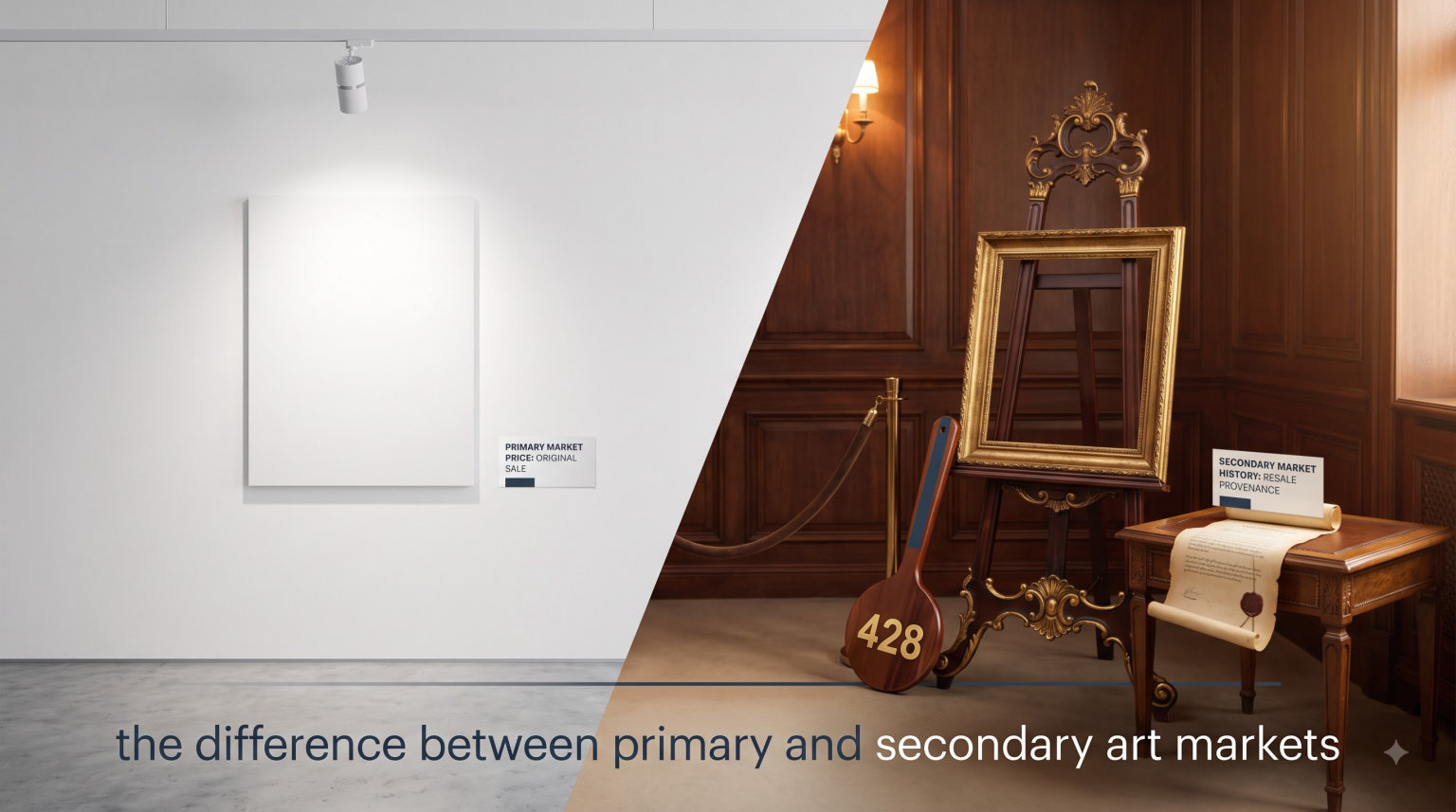
If you have ever wandered through a gallery and wondered how artworks get their prices, or noticed auction results in the news and thought there must be more to the story, you are already thinking about the right questions. The art market is not a single thing. It is two overlapping worlds, each with its own rules, its own players, and its own way of deciding what a painting or sculpture is worth. Understanding the difference between the primary and secondary art markets is one of the most practical pieces of knowledge any collector can have. It changes how you approach buying, how you evaluate risk, and how you think about the artworks you live with or pass on.
The primary art market is where the story of an artwork begins. The secondary art market is where that story continues, gets complicated, and sometimes becomes very valuable. In this guide, I will walk you through both markets clearly, compare them side by side, and give you the context you need to navigate them with more confidence. Whether you are just starting out in art collecting or deepening your knowledge of how the art world actually works, this article will give you a solid foundation.
Table of Contents
What Is the Primary Art Market?
The primary art market is where an artwork is sold for the very first time. This means the transaction happens directly between the artist (or the artist’s representing gallery) and the first buyer. Every artwork has exactly one first sale, and that first sale takes place in the primary market. This is true whether the artwork is bought from the artist’s studio, from a gallery booth at an art fair, or directly from a gallery’s showroom floor.
In the primary market, the price of an artwork is set by the artist or the gallery that represents them. Gallerists work closely with artists to determine pricing based on factors like the size of the work, the complexity of the process, the artist’s exhibition history, and where that artist is in their career. When you buy from the primary market, you are often paying for potential as much as for the object itself. The artist’s career is still being written.
The major galleries that dominate the top tier of the primary market include names like Gagosian, David Zwirner, Pace Gallery, and Hauser & Wirth. These galleries have international reach and represent artists at every stage of recognition. Below them, a dense network of smaller commercial galleries, project spaces, and non-profit art centers forms the broader gallery system. Art fairs like Art Basel, Frieze, and The Armory Show also operate as primary market venues, bringing together hundreds of galleries under one roof and giving collectors access to a wide range of artists in a single visit.
Relationship matters enormously in the primary market. Top galleries do not simply sell to anyone who walks in. They cultivate collector relationships over time, and getting access to the most sought-after artists often requires an existing rapport with the gallery. This relationship-based model is one of the defining characteristics of gallery art and one of the things that makes the primary market feel opaque to newcomers.
When you buy in the primary market, provenance starts with you. The documentation of that first sale becomes the beginning of the artwork’s chain of ownership, which will matter enormously if the work ever enters the secondary market. Gallery receipts, exhibition catalogues, and any correspondence with the artist’s studio all become part of the artwork’s paper trail.
What Is the Secondary Art Market?
The secondary art market is where artworks are sold after their first sale. Once a collector buys a work in the primary market and decides to sell it, that resale transaction takes place in the secondary market. The same is true for works that have changed hands multiple times over decades or even centuries. Every resale, no matter how many owners came before, belongs to the secondary market.
Auctions are the most visible part of the secondary market. Houses like Christie’s, Sotheby’s, and Phillips conduct major sales in New York and London on a predictable rhythm. The major spring and fall auctions in May and November are the moments when the highest-value works cross the block and make headlines. Beyond those flagship events, auction houses run smaller sales throughout the year, including dedicated sales of contemporary art, prints, photographs, and design objects.
But auction houses are not the only venues for secondary market sales. Commercial galleries also deal in secondary market works, particularly for artists they represent or have strong relationships with. Private dealers operate in this space too, facilitating discreet transactions between sellers and buyers without the public spectacle of an auction. The secondary market also includes online platforms that aggregate resale listings, though the high end of the market remains firmly rooted in personal relationships and expert intermediation.
Price in the secondary market is driven by demand, not by the artist or a single gallery. An auction lot sells to whoever bids the highest. This means two similar works by the same artist can sell for very different prices depending on the moment, the buyers in the room, and the competition for a specific work. The art market for historically significant works can see extraordinary price swings when a major collector decides to sell at auction.
Provenance is critical in the secondary market. Collectors and auction houses research an artwork’s ownership history before a sale. Gaps in provenance, disputed authorship, or works with complicated ownership histories can dramatically affect value and desirability. Condition reports prepared by specialists are standard for significant secondary market transactions. A well-documented provenance and a clean condition report can make a substantial difference in the final sale price.
Primary vs Secondary Art Market: Key Differences at a Glance
The comparison table below summarizes the main differences between these two markets. Understanding these distinctions will help you make more informed decisions as a collector, whether you are buying your first work or adding to an established collection.
| Aspect | Primary Market | Secondary Market |
|---|---|---|
| First Sale | Original sale direct from artist or gallery | Resale of previously sold works |
| Price Setting | Set by artist or gallery | Determined by buyer demand and auction competition |
| Where to Buy | Galleries, art fairs, artist studios | Auction houses, galleries, private dealers |
| Transparency | Lower — prices often private | Higher — auction results are public record |
| Risk Level | Higher — artist career uncertain | Lower — established provenance and pricing data |
| Market Access | Relationship-based, selective | More open through auction registration |
The most fundamental difference comes down to timing. Every work sold in the primary market is a first sale. Every work sold in the secondary market is a subsequent sale. This distinction shapes everything else: how prices are set, who controls the transaction, what information is available to buyers, and what risks are involved.
When a work moves from the primary market to the secondary market, it carries all the history of its first sale and everything that has happened since. A painting bought from a gallery for $5,000 might sell at auction ten years later for $80,000. That jump reflects the artist’s growing reputation, critical reception, museum acquisitions, and the broader cultural conversation around the work. The secondary market price is a kind of verdict on the artist’s trajectory.
It is worth noting that works do not only travel in one direction. Some works that have been in the secondary market for years, especially those held by major collectors or institutions, can occasionally re-enter the primary market if an artist acquires their own work back or if a foundation releases holdings. The boundaries between the two markets are not rigid walls but more like a permeable membrane.
Pricing and Transparency in Each Market
One of the most practical differences between the two markets comes down to information. In the primary market, gallery pricing is largely private. A collector knows what a gallery asks for a work, but they do not necessarily know what that gallery has sold similar works for, or what other collectors paid for comparable pieces. This confidentiality is standard practice and reflects the bilateral nature of gallery sales, where prices are agreed between two parties without a public announcement.
The secondary market is far more transparent. Auction results are published publicly, often within hours of a sale. Anyone can look up what a specific work by a specific artist sold for at Christie’s or Sotheby’s in any given season. This creates a public record of value that collectors, advisors, and analysts can study. For artists with robust auction histories, this data makes it easier to assess whether a particular work is priced fairly relative to recent comparables.
However, transparency in the secondary market has limits. The hammer price is public, but the final price the buyer pays includes a buyer’s premium that can add 20 to 25 percent to the hammer. Private sales outside of auction, which represent a significant portion of secondary market activity, remain confidential. So while the secondary market is more transparent than the primary, it is not fully transparent.
The art world has its own rough rules of thumb when it comes to how value is shared. The 70/30 rule refers to the standard split in gallery sales: the gallery takes roughly 30 percent and the artist receives 70 percent of the sale price. This commission structure applies to primary market sales and reflects the gallery’s role in promoting the artist, managing sales, and maintaining the exhibition space. Collectors do not directly encounter this split, but it shapes the pricing mathematics that galleries use when setting retail prices.
The 80/20 rule in art market discussions is a looser observation about concentration: roughly 80 percent of auction revenue flows to the top 20 percent of artists by value. This concentration is even more extreme than it sounds. Within that top tier, a small number of artists account for the vast majority of total sales. This means the secondary market is intensely focused on a relatively narrow group of artists, while the primary market distributes attention across a much broader range of emerging and mid-career practitioners.
Access and Navigation: How Collectors Enter Each Market
Getting access to the primary market requires patience and relationship-building. For the most prestigious galleries, simply walking in and asking to buy is not enough. Many galleries require prospective buyers to develop a rapport over multiple visits, attend gallery events, and demonstrate genuine interest in the artist’s work rather than purely speculative intent. This can feel exclusionary, but it reflects the gallery’s interest in building a collector community around their artists.
The good news is that the primary market is not exclusively gatekept. Art fairs offer a more accessible entry point. At a fair like Art Basel Miami Beach or Frieze London, dozens or hundreds of galleries convene in one venue, and anyone can walk the aisles, engage with gallerists, and inquire about works. The atmosphere at art fairs tends to be more welcoming to new collectors than a private gallery appointment, though the same relationship norms still apply for significant purchases.
The secondary market offers a more democratic access point in some ways. Registering to bid at an auction is relatively straightforward. Major auction houses have open registration processes, and online bidding platforms have made it even easier to participate from anywhere. You do not need a gallery relationship to bid at Sotheby’s. You need a few documents, a deposit for high-value lots, and the willingness to compete. This openness is one of the reasons many new collectors start paying attention to the art market through auction results rather than gallery visits.
That said, navigating the secondary market well still requires knowledge. Understanding condition reports, interpreting provenance documentation, and knowing which auction sales are relevant comparables all take experience. Many new collectors benefit from working with an art advisor who can provide guidance on bidding strategy, lot selection, and the hidden costs of buying at auction, including the buyer’s premium and any applicable taxes or import duties.
If you are deciding where to start, the primary market often makes more sense for collectors who are drawn to a specific artist’s practice and want to build a relationship with that artist’s career from an early stage. The secondary market tends to attract collectors who want more data before they buy, who are interested in historical works with established provenance, or who are working with a specific budget and want to comparison shop using public auction records.
Investment Considerations for Each Market
Collectors approach the art market with different goals, and those goals shape which market makes sense. Some collectors buy primarily for aesthetic reasons: they want to live with works that move them, and they consider financial returns a secondary benefit. Others approach art more deliberately as an alternative asset class, seeking diversification and potential appreciation. Most fall somewhere in between, caring about both beauty and value.
In the primary market, the investment case rests largely on the artist’s future trajectory. When you buy from the primary market, you are betting that the artist’s career will develop in ways that increase the value of the work over time. This could mean museum acquisitions, critical recognition, inclusion in major international exhibitions, or simply growing demand among collectors. The risk is real: not all artists achieve the recognition their early work suggested, and the art market can be unpredictable. Collectors who bought works by emerging artists in the early 2000s and saw those artists become major figures have generated extraordinary returns. But for every success story, there are many artists whose markets quietly faded.
The secondary market offers more data for investment decisions but requires a larger upfront commitment. Works by established artists with strong auction histories come with a proven track record, but that track record also means higher prices and lower potential upside compared to the primary market. Secondary market buyers are often looking for stability, portfolio diversification, and the pleasure of owning a significant work with a documented history rather than a speculative bet on an artist’s career trajectory.
Provenance becomes a key investment consideration in the secondary market. A work that once belonged to a major collector, was included in a landmark museum exhibition, or appeared in a significant publication carries cachet that translates directly into price. Conversely, a work with gaps in its provenance or questions about authenticity faces significant headwinds in the market. Due diligence is not optional for serious secondary market purchases.
Thinking about artist career stages can help frame investment decisions. An artist in the early phase of their career, working in the primary market, offers maximum upside but also maximum uncertainty. An artist at the peak of their market, whose works command millions at auction, offers more stability but less dramatic growth potential. The most sophisticated collectors often blend both approaches, allocating a portion of their budget to primary market discoveries and a portion to established names in the secondary market. Contemporary art collecting in particular rewards this kind of dual strategy, because the line between emerging and established is always shifting.
Frequently Asked Questions
What is the primary market and secondary market in art?
The primary art market is where an artwork is sold for the very first time, directly from the artist or their representing gallery. The secondary art market is where previously sold works are resold through auction houses, galleries, or private dealers. Every artwork has exactly one first sale in the primary market, but can be sold any number of times in the secondary market.
What is the difference between primary and secondary art markets?
The primary market involves first sales directly from artists or galleries, with prices set by the seller. The secondary market involves resales where prices are determined by buyer demand and auction competition. The primary market is relationship-based and less transparent about pricing, while the secondary market is more transparent through public auction results but requires navigating competition and buyer’s premiums.
What is the 70/30 rule in art?
The 70/30 rule refers to the standard gallery commission split in primary market sales. The gallery typically takes around 30 percent of the sale price, while the artist receives 70 percent. This commission reflects the gallery’s role in representing, promoting, and selling the artist’s work to collectors.
What is the 80/20 rule in art?
The 80/20 rule is an observation about concentration in the art market. Roughly 80 percent of auction revenue flows to the top 20 percent of artists by sales value. This concentration means the secondary market is heavily weighted toward a small number of artists with established track records, while the primary market distributes attention across a much wider range of emerging and mid-career artists.
Conclusion
The distinction between the primary and secondary art markets comes down to one simple idea: first sales versus resales. In the primary market, you are buying directly from the source, at a price set by the artist or their gallery, and your purchase becomes part of the artwork’s provenance story. In the secondary market, you are buying something that has already been collected before, priced by competition among buyers rather than by a single seller, with public auction records as your guide.
Neither market is inherently better. They suit different kinds of collectors, different budgets, and different goals. The primary market rewards relationship-building, patience, and a willingness to take on risk in exchange for the potential upside of discovering an artist before the wider world does. The secondary market rewards research, data, and the pleasure of owning works with documented histories and established cultural significance.
The most confident collectors I have encountered over the years tend to be fluent in both markets. They attend gallery openings and art fairs to follow artists whose work resonates with them. They also study auction results, track provenance, and engage with advisors when they are considering significant secondary market purchases. Understanding the difference between primary and secondary art markets is not just an academic exercise. It is a practical skill that makes you a better buyer, a more thoughtful collector, and a more informed participant in one of the world’s most enduring and fascinating markets.