
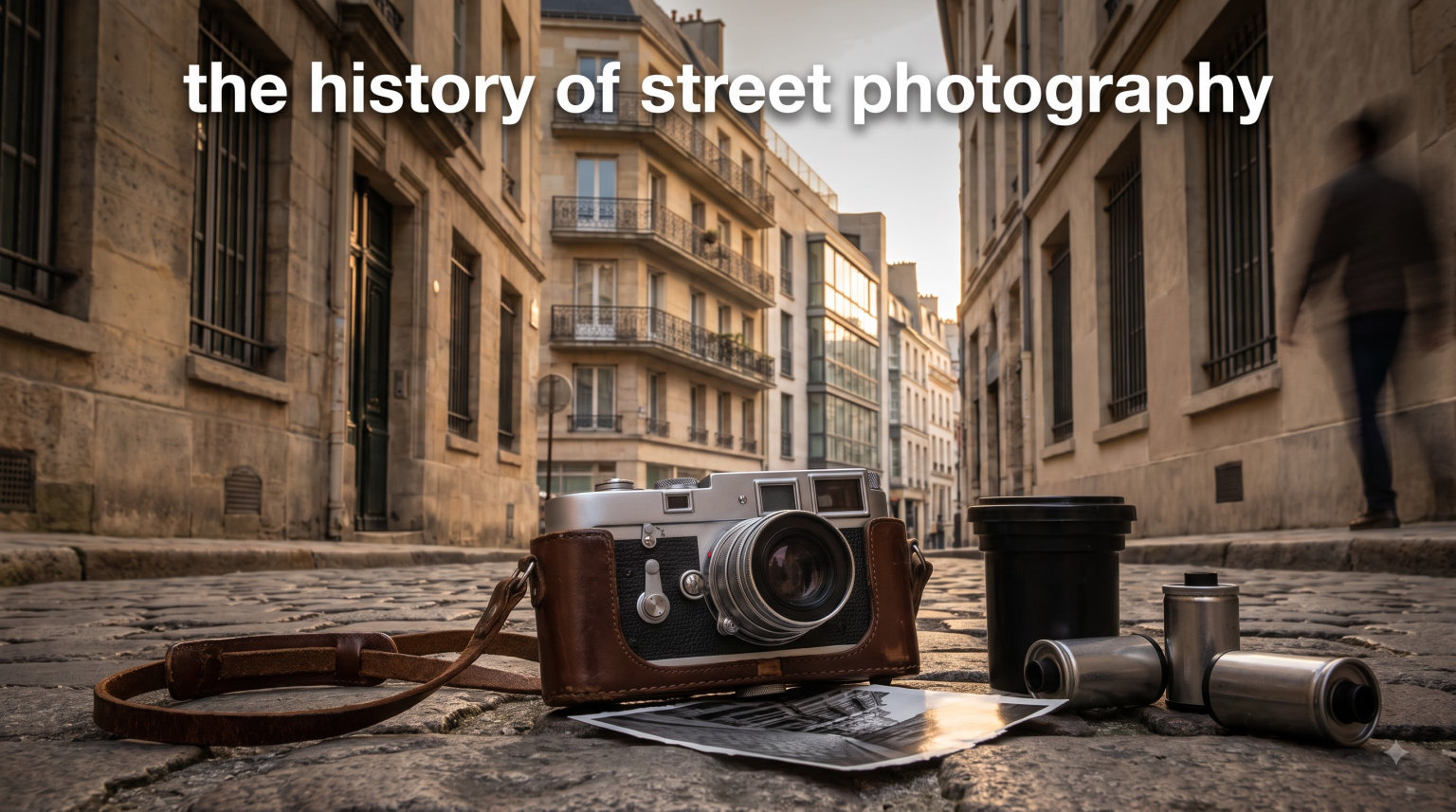
Street photography stands as one of photography’s most compelling and enduring genres. The history of street photography traces back to the very invention of the medium itself, evolving from technical experiments to an art form that captures the raw essence of human experience in public spaces. Unlike studio portraiture or landscape photography, street photography embraces the unplanned, finding art in the chaos of everyday life.
Unlike other photography genres, street photography requires no studio, no props, and no permission slips. Photographers simply step outside and find stories unfolding in every corner. This accessibility has made the genre both democratic and endlessly fascinating. From busy New York intersections to quiet Parisian boulevards, the streets offer unlimited material for those willing to observe.
Our team has spent years studying the masters and tracing how this genre transformed from documentation into art. We have examined thousands of images, read countless photographer journals, and spoken with contemporary practitioners about their influences. In this comprehensive guide, we share what we have learned about the history of street photography and its remarkable evolution.
We will explore how the history of street photography connects to broader artistic movements, including the relationship between street art and street photography that continues to influence contemporary artists today. Both art forms share an connection to public space and the democratization of creative expression.
Table of Contents
Origins in the 19th Century
Street photography began with the first successful photograph ever taken. In 1826, Joseph Nicéphore Niépce captured “View from the Window at Le Gras,” showing a Parisian street scene through a window. This grainy, eight-hour exposure image captured nothing moving, as even the brightest sunlight could not shorten the exposure enough to freeze motion. Yet it established photography’s fundamental capability to document the world.
The daguerreotype process, introduced by Louis Daguerre in 1839, revolutionized the medium. These detailed images on silver-plated copper captivated audiences worldwide and made photography practical for the first time. While early daguerreotypes primarily documented architecture and wealthy patrons, photographers gradually began taking their cameras outside to capture the world beyond the studio.
French photographer Charles Nègre is widely recognized as the first true street photographer. In the 1850s, he documented architecture alongside shops, labourers, traveling musicians, peddlers, and unusual street types throughout France. His work went beyond mere documentation, capturing the texture of daily life with artistic intent. He understood that streets were not merely backdrops but living theaters of human drama.
The calotype process, invented by William Henry Fox Talbot in Britain around the same period, offered another early method for capturing images. Unlike daguerreotypes, which produced unique images, calotypes allowed multiple prints from a single negative. This technical foundation would later enable the mass reproduction and distribution of street photographs.
Early technical constraints shaped what photographers could accomplish. Long exposure times meant that moving subjects appeared blurred or ghostly. Cameras were large, heavy, and required careful setup on tripods. Yet despite these limitations, pioneering photographers found ways to document the streets and the people who inhabited them. Their determination laid groundwork for future generations.
Early Pioneers and the Birth of Candid Photography
Eugène Atget became one of photography’s most important early documentarians. Working in Paris from the 1890s until his death in 1927, Atget photographed the city’s streets, shops, architecture, and ordinary people with remarkable dedication. His work created an unparalleled record of Parisian life before modernization transformed it forever. He approached the city as an anthropologist, systematically cataloging its visual fabric.
Atget worked with a large-format camera and orthochromatic plates, requiring long exposures even in daylight. He sold his photographs to artists, museums, and collectors who recognized their documentary value. Artists like Pablo Picasso and Henri Matisse purchased his work for inspiration. Today, his 10,000+ images serve as an essential archive of a vanished world, studied by historians and photographers alike.
The concept of the flaneur emerged during this period, describing someone who wanders through city spaces observing modern life without purpose or destination. This figure, drawn from Charles Baudelaire’s writings, became central to street photography theory. The flaneur observes without participating, absorbing the spectacle of urban existence with detached fascination. Street photographers often adopt this mindset, becoming silent witnesses to unfolding drama.
Paul Strand and August Sander advanced documentary photography in the early 20th century. Strand championed “straight photography” emphasizing honest, unmanipulated images that rejected pictorialism’s artistic pretensions. His 1917 book “The White Man” demonstrated photography’s capacity for powerful documentary statement. Sander’s monumental project “Face of Our Time” documented the full spectrum of German society through unflinching portraiture.
By the 1920s, photographers increasingly sought to capture candid moments rather than posed portraits. The desire to document life as it naturally unfolded pushed technical innovation and artistic vision forward. Faster films, smaller cameras, and improved lenses all contributed to making candid work more practical and more expressive.
Russian photographer Alexander Rodchenko pioneered low-angle compositions and dynamic perspectives during this period. His innovative camera positions influenced how photographers would later approach street scenes. Other photographers experimented with motion blur and selective focus, pushing aesthetic boundaries while documenting Soviet society.
The Golden Age: Henri Cartier-Bresson and the Decisive Moment
Henri Cartier-Bresson fundamentally transformed street photography into an art form with profound philosophical foundations. Born in France in 1908, Cartier-Bresson studied painting before discovering photography in the early 1930s. His encounters with the surrealist movement profoundly influenced his approach to capturing fleeting moments, teaching him to see beyond surface appearances.
The Leica camera, introduced in 1925, proved instrumental in enabling photographers to work more discreetly. Its compact size and quiet operation allowed photographers to blend into environments rather than dominate them. Cartier-Bresson embraced this technology, carrying his Leica everywhere and developing his legendary instincts for timing. The camera became an extension of his eye.
Cartier-Bresson formalized his approach through the concept of “the decisive moment.” First articulated in his 1952 book by the same name, this principle describes the precise instant when form and content align perfectly in a photograph. The photographer must anticipate this moment, waiting patiently until the scene reveals its essential meaning. This idea merged Eastern philosophical concepts with Western photographic practice.
His work across Europe, Mexico, and Asia demonstrated photography’s capacity to find poetry in everyday scenes. A child running past a fence, a man leaping over a puddle, cyclists racing through rain-slicked streets: these ordinary moments became extraordinary through Cartier-Bresson’s precise timing. His photographs reward patient viewing, revealing new layers of meaning with each look.
Cartier-Bresson’s influence extends far beyond his own work. He co-founded the Magnum Photos agency in 1947, creating a model for photographer-owned collectives that persists today. Magnum gave photographers editorial independence and ownership of their images, revolutionary concepts at the time. His book “The Decisive Moment” with its inflammatory preface comparing photographers to saints and savages remains a foundational text.
Other photographers contributed to the golden age alongside Cartier-Bresson. Robert Doisneau photographed Parisian life with warmth and humor. Willy Ronis captured poetic moments in working-class neighborhoods. Brassai documented Paris after dark with a romantic sensibility. Together, these photographers established street photography as a legitimate art form worthy of museum recognition.
The American Revolution: Robert Frank and The Americans
Robert Frank challenged photographic conventions with the same intensity that the Beat Generation challenged literary norms. Born in Switzerland in 1924, Frank immigrated to the United States in 1946, working as a magazine photographer while pursuing personal projects that would reshape American photography. His outsider’s perspective allowed him to see American society with fresh eyes.
His book “The Americans,” published in 1958 after receiving a Guggenheim Fellowship, presented 83 photographs depicting American life with unflinching honesty. Frank captured themes of racial tension, social isolation, advertising culture, and the loneliness of modern existence. The book’s stark, high-contrast images deliberately broke conventional compositional rules, rejecting the polished aesthetic expected in fine art photography.
Critics initially dismissed Frank’s work as sloppy and pessimistic. However, younger photographers recognized its revolutionary honesty. The Museum of Modern Art’s 1969 retrospective cemented Frank’s reputation as a pivotal figure. “The Americans” demonstrated that personal vision could supersede technical perfection, opening doors for subsequent generations to express their own perspectives regardless of conventional standards.
Garry Winogrand became synonymous with New York street photography, documenting the city with relentless energy from the 1950s until his death in 1984. He photographed thousands of rolls of film annually, creating an encyclopedic record of American society during periods of profound change. His unfinished projects left thousands of images that revealed new meanings only after his death.
Diane Arbus brought psychological intensity to street portraiture, photographing subjects on the margins of society with compassion and precision. Her work explored eccentricity, identity, and the boundaries between normalcy and deviation. Subjects included circus performers, disabled individuals, and wealthy socialites, presented without condescension or idealization.
Walker Evans, working with the Farm Security Administration during the Great Depression, created some of America’s most enduring documentary photographs. His objective style emphasized clarity and directness, influencing generations of photographers who sought to document social conditions while maintaining artistic integrity. His book “Let Us Now Praise Famous Men” remains a landmark of documentary expression.
The New York School of street photographers emerged during this period, including artists like Joel Meyerowitz, Tod Papageorge, and Lee Friedlander. Each developed distinctive approaches while sharing commitments to candid documentation and artistic ambition. Their work established New York as a central location for street photography practice and discourse.
The Modern Era: From Film to Digital
Color photography gradually entered street photography practice during the mid-20th century. William Eggleston helped legitimize color as an artistic medium with his controversial 1976 exhibition at the Museum of Modern Art. His ordinary subjects and vivid colors suggested that color photography could achieve the same artistic status as black-and-white. Street photographers began experimenting more freely with color palettes.
Stephen Shore and later photographers like Martin Parr explored consumer culture and everyday environments through color photography. Their work demonstrated that mundane subjects could become compelling art when presented with appropriate attention and context. Color introduced new challenges related to composition and the management of competing hues within frames.
Japanese photographers developed distinctive approaches to street photography that emphasized alienation and intensity. Daido Moriyama, influenced by Frank and Japanese avant-garde movements, created visceral images of urban life in Osaka and Tokyo. His gritty, high-contrast work captured the chaos of modern Japanese society with raw energy. He became a central figure in the Provoke movement of the 1960s and 1970s.
Nobuyoshi Araki represented another Japanese perspective, combining street photography with intimate portraits in work that spanned decades. His prolific output included both artistic projects and commercial assignments. Japanese street photography developed distinct characteristics reflecting cultural attitudes toward public space and privacy.
The discovery of Vivian Maier’s work in 2007 added a fascinating chapter to street photography history. Maier worked as a nanny in Chicago while secretly photographing millions of images over four decades. Her work remained virtually unknown until a storage locker containing her negatives was auctioned off. Today, she is recognized as one of the most talented anonymous photographers in history.
Other women contributed significantly to the genre despite historical marginalization. Helen Levitt captured the poetry of New York street life with exceptional sensitivity. Her early work in the 1930s and 1940s found lyrical moments in children’s games and neighborhood scenes. Later, she incorporated color photography and urban documentation into her evolving practice.
Digital photography transformed the genre fundamentally in the early 2000s. Instant feedback allowed photographers to refine their techniques rapidly. Built-in zoom capabilities reduced the need for multiple lenses. Entry barriers lowered dramatically, enabling more people to participate. The learning curve accelerated as photographers could immediately review and adjust their approaches.
Mirrorless cameras combined digital advantages with compact form factors ideal for street work. Sony, Fujifilm, and other manufacturers produced cameras specifically marketed to street photographers. These developments echoed the Leica revolution nearly a century earlier, again democratizing access to capable equipment.
Smartphones democratized street photography completely by 2026. Nearly everyone carries a camera capable of high-quality images in their pocket. Social media platforms provide instant outlets for sharing work. This accessibility has generated renewed interest in street photography while sparking debates about privacy and etiquette in an increasingly surveillance-oriented culture.
Legal and Ethical Considerations
Street photographers have long grappled with legal boundaries that vary significantly across regions and continue to evolve with technological change. Understanding these complexities helps photographers work responsibly while protecting their ability to create art in public spaces.
In the United States, photographing people in public spaces is generally protected under the First Amendment. Court decisions have consistently upheld the right to photograph visible scenes from public vantage points. However, commercial use of recognizable faces may require model releases. Harassment and invasion of privacy claims present additional complications that photographers must navigate carefully.
European countries tend to have stronger privacy protections that affect street photography practice. Germany prohibits photographing individuals without consent in certain contexts, particularly when individuals can be recognized clearly. France’s privacy laws restrict publishing images that could identify someone without permission. The European GDPR framework adds additional considerations for photographers working across multiple jurisdictions.
The United Kingdom operates under a different framework, treating photography in public spaces more permissively while still prohibiting harassment. UK photographers can generally photograph anyone in public spaces but should exercise judgment about publication contexts. The distinction between what is legal and what is appropriate remains a ongoing discussion within the community.
Asian countries show enormous variation in their approaches to street photography legality. Japan permits photography in public spaces without significant restrictions, contributing to that country’s rich street photography tradition. China maintains stricter controls that affect how photographers can document public life. Other Asian nations have developed their own regulatory frameworks reflecting local values.
Ethical debates within the community focus on respect, consent, and representation. Some photographers argue that candid shots capture authentic moments that become compromised when subjects become aware of the camera. Others maintain that subjects deserve awareness and control over their images, particularly when photographs might affect their lives or reputations.
The rise of digital technology and social media has intensified these discussions. Images can now spread instantly to global audiences, potentially affecting subjects in ways impossible to predict. Street photographers must consider not only initial capture but also downstream impacts of their images.
The guerrilla art movements that transformed public spaces share similar ethical questions with street photography. Both involve artists working in uncontrolled environments where permission is impossible or impractical. Understanding these parallels helps contextualize the challenges facing contemporary street photographers navigating public space.
Performance art’s connection to street documentation becomes clear when examining how artists use public space as their canvas. The work of documenting ephemeral interventions parallels street photography’s goal of preserving fleeting moments that would otherwise vanish. Both art forms challenge conventional boundaries between art and everyday life.
Responsible street photographers often develop personal ethical guidelines based on their values and experiences. Many prefer not to photograph homeless individuals or vulnerable populations who cannot easily refuse. Others avoid deliberately embarrassing subjects or capturing moments of obvious distress. These self-imposed standards supplement legal requirements with professional integrity.
FAQs
What is the history of street photography?
Street photography emerged alongside the invention of photography itself in the 19th century. Joseph Nicéphore Niépce captured the first photograph in 1826, while Louis Daguerre’s daguerreotype process made photography more accessible. French photographer Charles Nègre is recognized as the first true street photographer in the 1850s, documenting shops, labourers, and street scenes. The genre evolved through the work of pioneers like Eugène Atget, Henri Cartier-Bresson, and Robert Frank, transforming from mere documentation into a respected art form that continues thriving in the digital age.
Who is the father of street photography?
Henri Cartier-Bresson is widely considered the father of modern street photography. Though earlier photographers like Charles Nègre and Eugène Atget documented street scenes, Cartier-Bresson formalized the approach with his concept of ‘the decisive moment’ in his 1952 book. His use of the compact Leica camera, his founding of Magnum Photos, and his influence on generations of photographers established him as the defining figure in the genre’s development and popularization.
When did street photography start?
Street photography began with the first successful photograph in 1826, when Joseph Nicéphore Niépce captured a Parisian street scene requiring an eight-hour exposure. However, practical street photography only became feasible with Louis Daguerre’s 1839 daguerreotype process. French photographer Charles Nègre is credited as the first true street photographer in the 1850s, making him one of the earliest practitioners of the genre as we understand it today.
What cameras were used in early street photography?
Early street photographers used large-format cameras with long exposure requirements. The daguerreotype process used silver-plated copper plates. Eugène Atget worked with a large-format camera and orthochromatic plates. The revolutionary Leica, introduced in 1925, was the first compact 35mm camera, enabling photographers to work more discreetly. Henri Cartier-Bresson famously used the Leica, which allowed him to capture candid moments without drawing attention. Modern equivalents like the Ricoh GR and various mirrorless cameras continue this tradition of compact, discreet cameras for street work.
Conclusion
The history of street photography spans nearly two centuries, from Niépce’s first hesitant exposures to today’s smartphone-equipped photographers. This evolution reflects broader technological changes while maintaining core artistic principles that date back to the daguerreotype era. The genre has transformed from technical curiosity to art form, from exclusive practice to democratic pursuit.
What began as technical documentation has become a sophisticated art form capable of profound social commentary, artistic expression, and historical preservation. The genre continues to evolve as new technologies emerge and photographers find fresh ways to capture the human experience in public spaces. Each generation of photographers brings new perspectives while building upon foundational techniques.
The history of street photography reminds us that extraordinary images can emerge from ordinary moments. The pioneers discussed in this guide found beauty and meaning in everyday scenes that others walked past without noticing. Their legacy teaches contemporary photographers to slow down, observe carefully, and recognize the stories unfolding around them constantly.
Understanding the history of street photography helps contemporary practitioners appreciate their place within a rich tradition. Whether using a vintage Leica or a modern smartphone, photographers who grasp this heritage work with awareness of those who came before, building upon foundations laid by pioneers who transformed ordinary moments into enduring art.