
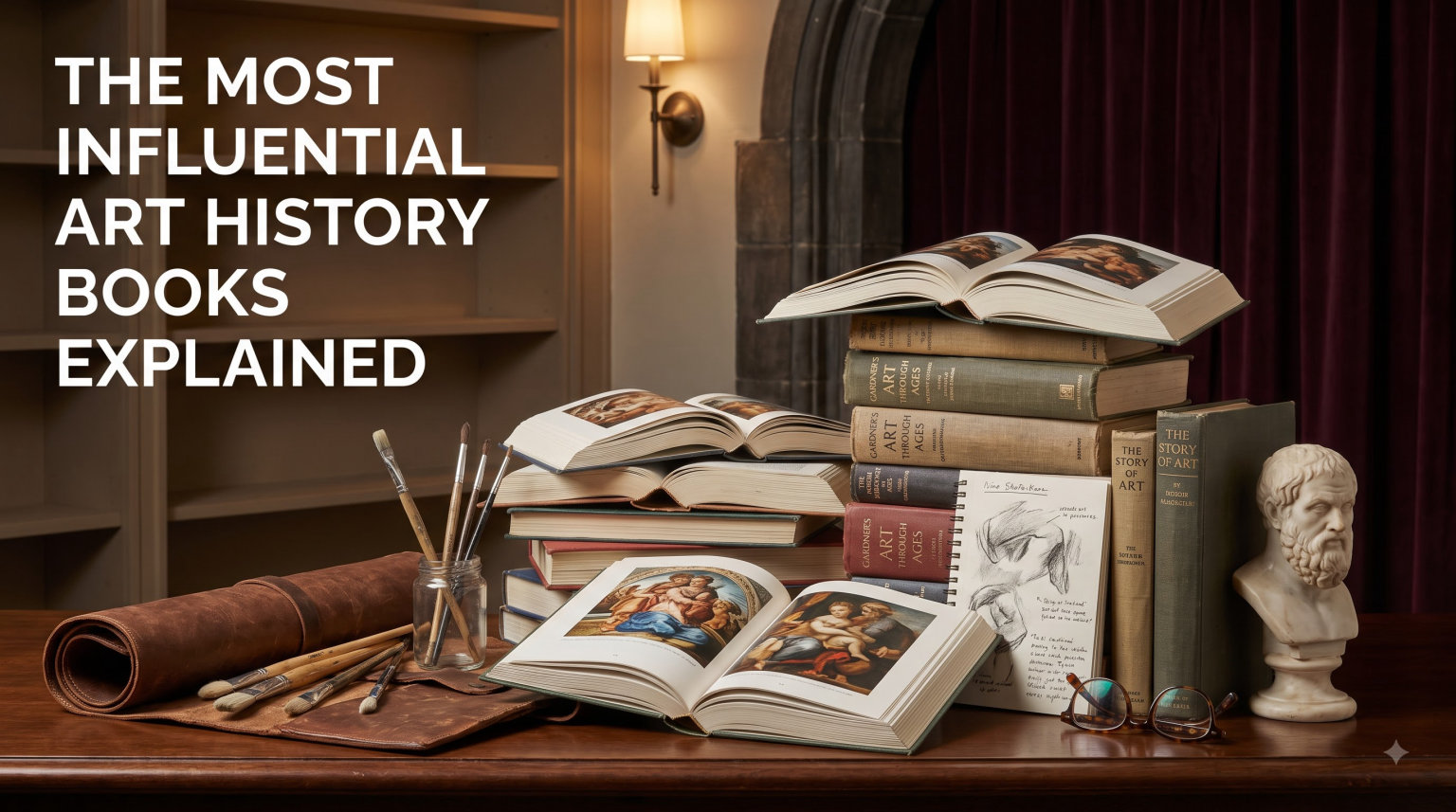
Art history books shape the way we see, understand, and talk about art. They do not just record what happened. They frame how we think about creativity, culture, and human expression across centuries. When I first started studying art history, I was overwhelmed by the sheer number of titles out there. Some felt like dry textbooks. Others changed my entire perspective on a single painting. The most influential art history books are the ones that do both: they inform and they transform.
These books matter because they provide the critical frameworks, historical context, and expert analysis that underpin how we interpret art. Whether you are an art student building a foundation, a self-taught enthusiast exploring on your own, or a curator preparing an exhibition, the right book can open doors you did not know existed. Art historians, collectors, and working artists all return to these texts again and again because they continue to reveal new layers of meaning.
Our team spent weeks researching the most influential art history books, comparing expert recommendations, reading forum discussions, and analyzing how these texts have shaped the discipline itself. We also explored the difference between modern and contemporary art to understand how these books categorize different periods and movements. What we found is a rich, sometimes contentious tradition of scholarship that has evolved dramatically over the past century.
In this guide, we will walk through the foundational texts that defined art history as a field, explain why each one matters, and offer a practical reading path so you know exactly where to start. We will also be honest about what these classic books leave out, particularly when it comes to women artists, non-Western traditions, and diverse perspectives.
Table of Contents
What Makes an Art History Book Influential?
Not every well-written art book earns the label “influential.” The books that genuinely shape the discipline share a few key traits. They introduce new methodologies that change how scholars approach visual material. They shift the discourse, opening conversations that were not happening before. They reach wide audiences and remain relevant across decades, sometimes centuries. And they often become the standard reference that other books cite, debate, or react against.
Influence in art history also comes from timing. A book published at the right moment, when the field is ready for a new idea, can redirect scholarship for a generation. E.H. Gombrich’s narrative approach in the 1950s, for example, arrived just as art history was expanding beyond elite institutions. Walter Benjamin’s essay on mechanical reproduction, written in 1935, anticipated questions about art and technology that are still urgent today.
Art history as an academic discipline has its own history, and these books are milestones along that path. From Giorgio Vasari’s Renaissance biographies to the poststructuralist critiques of the 1980s and beyond, the most influential art history books reflect the evolving concerns of their eras while speaking to readers far beyond their original context.
The Most Influential Art History Books Explained
Below we break down the books that have had the greatest impact on how art history is studied, taught, and written. For each title, we cover the author, the main argument or approach, and why it continues to matter. These are the books that appear on syllabi, in footnotes, and in the personal libraries of working art historians.
1. The Story of Art by E.H. Gombrich (1950)
If there is one book that belongs on every art lover’s shelf, it is this one. E.H. Gombrich wrote “The Story of Art” as an accessible introduction to the history of visual art, and it has sold over 8 million copies worldwide. The book traces the development of art from prehistoric cave paintings through the 20th century, presenting a continuous narrative that connects styles, techniques, and cultural contexts.
What makes this book so enduring is Gombrich’s writing style. He avoids jargon and speaks directly to the reader, making complex ideas feel natural and approachable. On Reddit’s art history forums, users consistently recommend “The Story of Art” as the best starting point for anyone new to the field. One reader described it as “the book that made me fall in love with art history.” That kind of personal impact is rare for a survey text.
The book is not without its limitations. Its narrative is largely Western and male-focused, a reflection of the era in which it was written. Later editions added more content on non-Western art, but the core structure remains rooted in the European tradition. Despite these gaps, Gombrich’s ability to explain why art looks the way it does, connecting technique to intention, remains unmatched in any introductory text.
The key idea running through the book is that art does not progress in a straight line toward greater realism or sophistication. Instead, artists respond to the problems set by their predecessors, creating a chain of visual conversation across time. This framework helps readers see connections between works that might seem unrelated at first glance.
2. Lives of the Most Excellent Painters, Sculptors, and Architects by Giorgio Vasari (1550)
Vasari’s “Lives” is arguably the first art history book ever written. Published in 1550 with an expanded edition in 1568, it collects biographies of Italian Renaissance artists from Cimabue through Michelangelo. Vasari was a painter and architect himself, which gave him direct knowledge of the artists he profiled, some of whom he knew personally.
The influence of this book is difficult to overstate. Vasari essentially invented the idea that artists should be remembered as individuals with distinct styles and personalities. Before Vasari, art was often attributed anonymously or discussed in terms of workshop production. After Vasari, the concept of the artist as a creative genius with a biography worth telling became central to Western art discourse.
Forum discussions frequently mention Vasari as essential reading, but with a caveat. His biases are significant: he championed Tuscan artists, particularly Florentines, above all others. His account of the Renaissance as a rebirth of classical ideals after a “dark age” of medieval art shaped centuries of scholarship, but modern historians recognize that this narrative oversimplifies a much more complex reality.
Reading Vasari today offers a window into how Renaissance artists thought about their own work and legacy. His anecdotes about Michelangelo’s temper, Leonardo’s unfinished projects, and Raphael’s charm humanize figures who might otherwise seem like distant monuments. For anyone studying the Renaissance, “Lives” is a primary source that still rewards close reading.
3. Ways of Seeing by John Berger (1972)
John Berger’s “Ways of Seeing” began as a BBC television series and became one of the most widely read books on art and visual culture. The book challenges traditional ways of looking at art, arguing that the meaning of an image changes depending on who is looking and in what context. Berger draws on Marxist criticism, feminist theory, and media studies to question the assumptions embedded in Western art traditions.
The book is short, visually driven, and deliberately provocative. Berger’s argument that the tradition of European oil painting served the interests of property owners and that the female nude was constructed for a male viewer sparked debates that continue today. On forums, readers describe “Ways of Seeing” as “the book that changed how I look at everything,” not just art but advertising, social media, and visual culture broadly.
Berger’s influence extends beyond art history into cultural studies, media studies, and critical theory. His insistence that seeing is not a neutral act, that it is shaped by power, language, and social position, anticipated developments in visual culture studies by decades. The book remains a standard text in introductory courses and a frequent recommendation for anyone wanting to think more critically about images.
For students approaching art history for the first time, “Ways of Seeing” provides a counterweight to the celebratory tone of many survey texts. It asks uncomfortable questions about who benefits from the way art is displayed, marketed, and written about. That critical posture has become fundamental to contemporary art history.
4. Art Through the Ages by Helen Gardner (1926)
Helen Gardner’s “Art Through the Ages” was the first major art history textbook written by a woman, and it has remained in continuous publication for nearly a century. The book was groundbreaking when it first appeared because Gardner organized art history not just chronologically but thematically, helping readers see connections between different cultures and periods.
Over multiple editions, “Art Through the Ages” has expanded its coverage to include more non-Western art, more women artists, and more contemporary perspectives. The current editions, revised by teams of scholars, are among the most widely used textbooks in college-level art history courses. Gardner’s original vision of a global, inclusive survey was ahead of its time and continues to shape how the book evolves.
What distinguishes this text from competitors is its visual program. High-quality reproductions, detailed captions, and side-by-side comparisons help students develop their skills in visual analysis. The book also includes primary source documents, maps, and timelines that provide historical context for the works discussed.
For self-taught learners, “Art Through the Ages” offers a structured path through art history that is both comprehensive and accessible. Its organization by period and region makes it easy to focus on specific areas of interest while still understanding the broader narrative.
5. History of Art by H.W. Janson (1962)
H.W. Janson’s “History of Art” was the dominant English-language art history textbook for decades. First published in 1962, it offered a authoritative survey of Western art from ancient Egypt through the 20th century. Janson’s approach emphasized formal analysis, focusing on the visual qualities of artworks and their place within stylistic traditions.
The book became a standard text in American universities and introduced generations of students to the canon of Western art. Janson’s clear prose and strong opinions about quality made the book engaging, if sometimes controversial. His criteria for inclusion were explicitly based on aesthetic judgment, which meant that many artists, particularly women and non-Western artists, were excluded from early editions.
Later editions, revised by Janson’s son Anthony and eventually by other scholars, have addressed many of these gaps. The book now includes more diverse artists and perspectives, reflecting changes in the discipline itself. However, the basic structure and formalist approach remain, providing a useful contrast to more socially oriented texts like Berger’s “Ways of Seeing.”
Understanding the Janson tradition is important for anyone studying art history because it represents a particular approach: the idea that art can be evaluated on its formal merits and that a coherent narrative of stylistic development is possible. Whether you agree or disagree with this premise, the book has shaped how art history is taught and thought about.
6. The Work of Art in the Age of Mechanical Reproduction by Walter Benjamin (1935)
Walter Benjamin’s essay, written in 1935 and published posthumously, is one of the most cited texts in all of art theory. In it, Benjamin argues that mechanical reproduction, photography and film, fundamentally changes the nature of art. When an artwork can be infinitely reproduced, it loses what Benjamin calls its “aura,” the sense of uniqueness and authenticity that comes from being in the presence of the original.
This idea might seem obvious now, in an age of Instagram and digital images, but Benjamin was writing before television became widespread. His argument was prescient and has only grown more relevant. The questions he raised about originality, authenticity, and the politics of reproduction inform contemporary debates about digital art, NFTs, and the role of museums as gatekeepers of cultural value.
The essay is short enough to read in one sitting but dense enough to reward multiple readings. Benjamin draws on Marxist theory, Jewish mysticism, and contemporary media analysis to build his argument, creating a rich interdisciplinary text that resists easy summary. Art historians return to it again and again because it offers a framework for thinking about how technology shapes aesthetic experience.
For students, Benjamin’s essay is often the first encounter with critical theory in an art history context. It serves as a bridge between traditional art historical methods and the theoretical approaches that became dominant in the 1970s and 1980s. Its influence is visible in nearly every subsequent text that deals with reproduction, media, or the politics of the image.
7. Art and Illusion by E.H. Gombrich (1960)
While “The Story of Art” is Gombrich’s most popular book, “Art and Illusion” is his most intellectually ambitious. Subtitled “A Study in the Psychology of Pictorial Representation,” it explores how artists learn to represent the visual world on a flat surface. Gombrich argues that artists do not simply copy what they see. Instead, they work within inherited schemas, modifying and adapting conventions to create the illusion of reality.
The book draws on psychology, perception science, and the history of style to build its argument. Gombrich’s central thesis, that “making comes before matching,” challenged the naïve idea that art has progressed toward ever more accurate representation. Instead, he showed that representation depends on learned conventions and that what counts as “realistic” varies across cultures and periods.
“Art and Illusion” won wide acclaim in both the art world and the sciences. It remains a key text for anyone interested in the relationship between perception, cognition, and artistic practice. Gombrich’s insights into how we interpret images have influenced fields from graphic design to artificial intelligence.
The book is more demanding than “The Story of Art” but remains accessible to general readers. Its arguments are illustrated with specific examples, and Gombrich’s prose is, as always, clear and engaging. For anyone who wants to understand why art looks the way it does, this book provides answers that go beyond historical context to the mechanics of visual perception itself.
8. Painting and Experience in Fifteenth-Century Italy by Michael Baxandall (1972)
Michael Baxandall’s slim volume changed the way scholars approach Renaissance art. Rather than analyzing paintings in purely formal or iconographic terms, Baxandall reconstructed the social and intellectual world of 15th-century Italy to explain how contemporary viewers would have understood these works. He showed that Renaissance paintings were shaped by the visual habits, commercial practices, and rhetorical training of their original audience.
The book introduced the concept of the “period eye,” the idea that historical viewers brought different perceptual habits and cultural knowledge to their experience of art. This concept has become fundamental to art historical methodology. It reminds us that we cannot assume our own visual responses match those of past viewers, and that understanding art requires understanding the culture that produced it.
Baxandall’s approach was groundbreaking because it moved beyond the biographical tradition of Vasari and the formalist tradition of Janson. Instead of asking “who made this?” or “what does it look like?”, he asked “how was this seen?” This shift in perspective opened new avenues for research and influenced a generation of scholars working on the social history of art.
The book is relatively short and highly readable, with detailed examples drawn from specific paintings and documents. It is an excellent introduction to the idea that art history is not just about artists and artworks but about the entire visual culture of a period.
9. The Books That Shaped Art History (series edited by Richard Shone and John-Paul Stonard)
This collection of essays, first published in 2013, takes a meta-approach to art history. Instead of presenting a single narrative of art’s development, it examines the most important art history books themselves, explaining how each one shaped the discipline. Each chapter is written by a different scholar who analyzes a single influential text, its arguments, its reception, and its lasting impact.
Books covered include many of the titles discussed in this article: Gombrich’s “Art and Illusion,” Baxandall’s “Painting and Experience,” and others by scholars like Erwin Panofsky, Clement Greenberg, and Linda Nochlin. The collection provides valuable context for understanding how art history became what it is today and why certain texts continue to dominate reading lists.
For readers who want to go deeper, this book serves as an excellent guide to the secondary literature. It helps you understand not just what these influential books argue but how they were received, debated, and sometimes rejected by subsequent scholars. This kind of historiographic awareness is essential for advanced study.
The book also highlights how art history has been shaped by individual voices and personalities, not just by objective analysis. Understanding the human stories behind these texts adds depth and nuance to any engagement with the field.
10. Art in Theory 1900-2000 edited by Charles Harrison and Paul Wood (1992)
This anthology collects the key theoretical texts that shaped modern and contemporary art, from artists’ manifestos and critical essays to philosophical reflections on the nature of art. It is not a narrative history but a sourcebook, providing primary documents organized chronologically with editorial introductions that explain each text’s significance.
“Art in Theory” is indispensable for anyone studying 20th-century art because it provides direct access to the ideas that drove artistic movements. Rather than reading about Cubism secondhand, for example, you can read the original statements by Picasso, Braque, and their critics. This direct encounter with primary sources develops critical thinking skills that secondary summaries cannot provide.
The anthology covers an enormous range of material, from Futurism and Dada to Abstract Expressionism, Conceptual Art, and postmodern theory. Its scope makes it both a reference work and a readable collection, depending on how you approach it. Students can focus on specific movements or read across the century to trace the development of ideas about art.
For self-taught learners, “Art in Theory” provides a structure for exploring modern art that complements survey texts. Reading the original documents alongside secondary analysis deepens understanding and helps you form your own interpretations rather than accepting received wisdom.
11. Vision and Painting: The Logic of the Gaze by Norman Bryson (1983)
Norman Bryson’s “Vision and Painting” brought semiotics and structuralist theory into direct conversation with art history. Bryson argued that traditional art history, with its emphasis on the individual artist’s creative vision, had overlooked the social and linguistic dimensions of visual representation. Drawing on the work of Roland Barthes and French structuralism, he proposed that paintings function as signs within cultural codes.
The book challenged the foundational assumptions of the discipline and contributed to the “new art history” movement of the 1980s, which sought to integrate critical theory, semiotics, and social history into the study of visual art. Bryson’s arguments were controversial but impossible to ignore, and they influenced a generation of scholars working on the relationship between images and language.
“Vision and Painting” is not an easy read, but it rewards the effort. Bryson’s close analyses of specific paintings demonstrate how semiotic methods can reveal meanings that traditional approaches miss. The book is particularly valuable for students interested in the theoretical foundations of visual culture studies.
Bryson’s work also helped establish the legitimacy of applying literary and linguistic theory to visual art, a practice that is now commonplace. For anyone wanting to understand why art history departments sometimes seem more like humanities departments than studios, this book provides an important piece of the puzzle.
12. Art Since 1900 by Hal Foster, Rosalind Krauss, Yve-Alain Bois, and Benjamin Buchloh (2004)
This massive two-volume survey of 20th-century art represents a distinctly contemporary approach to art history. Written by four leading scholars associated with the journal October, it combines chronological coverage with thematic essays that reflect current theoretical concerns. The book is structured as a series of entries on individual years, each written from a different methodological perspective.
What makes “Art Since 1900” influential is its refusal to present a single, unified narrative. Instead, the four authors bring different approaches: psychoanalytic criticism, formal analysis, social history, and poststructuralist theory. The result is a polyphonic text that reflects the plurality of contemporary art historical practice.
The book has been both praised and criticized for its heavy reliance on theory. Some readers find it indispensable for understanding how contemporary scholars think about modern art. Others argue that it prioritizes theoretical sophistication over visual engagement. Both reactions testify to the book’s significance as a statement of where art history stood in the early 21st century.
For advanced students and scholars, “Art Since 1900” offers a model of how to write art history that acknowledges its own theoretical commitments. It is also an invaluable reference for specific movements, artists, and critical debates of the 20th century.
What These Classic Books Miss: A Critical Perspective
Reading the books above, you might assume that art history is a story told by white European men about other white European men. That assumption would be largely correct for the older texts on this list, and it points to a real problem. The most influential art history books have historically excluded women artists, artists of color, and entire non-Western traditions.
Linda Nochlin’s landmark 1971 essay “Why Have There Been No Great Women Artists?” directly challenged this exclusion. She argued that the question itself was wrong. There were great women artists, but institutional barriers, including limited access to training, exhibition opportunities, and critical attention, prevented them from being recognized. Nochlin’s essay opened the door for feminist art history, which has since recovered the work of countless overlooked women artists.
The street art and gallery art differences are another example of how institutional frameworks shape what gets studied and valued. Traditional art history has often treated museum-sanctioned work as more significant than art created outside those institutions, a bias that excludes not just street art but folk traditions, craft, and indigenous creative practices.
Non-Western art has typically appeared in survey texts as a prelude to the “real” story of Western art. Chinese painting, Japanese prints, African sculpture, and indigenous art from the Americas and Oceania are covered briefly before the narrative returns to Greece and Rome. This structure reinforces the idea that Western art is the norm and everything else is a footnote.
Newer editions of classic textbooks have added more diverse content, and recent publications have begun to address these gaps more systematically. But the structural biases of the discipline run deep, and recognizing them is an important part of reading these influential books responsibly.
A Reading Path Through Art History Books
One of the biggest challenges for newcomers is knowing where to start. The forum discussions we reviewed consistently mentioned the desire for a clear reading order. Here is a path designed for different levels of experience and commitment.
Beginner Path: Building a Foundation
Start with E.H. Gombrich’s “The Story of Art.” It gives you the big picture without requiring any prior knowledge. Follow it with Helen Gardner’s “Art Through the Ages” for a more structured, textbook-style overview that includes non-Western perspectives. Then read John Berger’s “Ways of Seeing” to start thinking critically about what you have learned. These three books together provide a solid foundation in art history and visual analysis.
Intermediate Path: Going Deeper
Once you have the basics, move to Walter Benjamin’s essay on mechanical reproduction and Baxandall’s “Painting and Experience in Fifteenth-Century Italy.” These texts introduce theoretical and methodological tools that will change how you look at any artwork. Add Vasari’s “Lives” to connect with the earliest tradition of art historical writing and understand where the discipline began.
Advanced Path: Theory and Specialization
For advanced readers, tackle Gombrich’s “Art and Illusion,” Bryson’s “Vision and Painting,” and “Art Since 1900.” These texts demand more theoretical background but offer sophisticated frameworks for understanding visual art. “Art in Theory 1900-2000” provides essential primary source material for 20th-century art. At this stage, you should also be exploring monographs on specific artists, movements, or periods that interest you.
Self-Study Tips
Art history rewards slow, careful looking. When reading these books, take time to examine the illustrations closely. Visit museums and galleries to see works in person whenever possible. Keep a visual journal where you sketch or write about what you notice. And do not be afraid to read selectively. Dipping into different sections based on your interests is a valid approach, especially with survey texts.
The best approach is to combine reading with direct engagement. Read a chapter, then visit a museum or search for the works discussed online. Seeing the actual paintings, sculptures, or buildings transforms abstract descriptions into lived experience. Many readers on forums report that their understanding “clicked” only after encountering works in person.
Non-Western Art History Books Worth Your Attention
The traditional canon of art history books focuses heavily on Western traditions, but there are excellent resources for exploring art from other cultures. These books deserve a place on any serious reading list, both for their intrinsic value and for the perspective they provide on the limitations of Western-centric scholarship.
For Chinese art, Craig Clunas’s “Art in China” offers an accessible survey that situates Chinese art within its own cultural and intellectual traditions rather than comparing it to Western standards. His approach demonstrates how much is lost when non-Western art is judged by criteria developed for European painting.
African art history has been transformed by the work of scholars like Sidney Littlefield Kasfir, whose “African Art and the Colonial Encounter” examines how European collecting practices shaped the Western understanding of African art. More recent publications continue to recover indigenous perspectives and challenge the assumptions embedded in museum displays and art historical narratives.
For Japanese art, the “Nihonga” tradition and its relationship to modernism is explored in texts like Ellen P. Conant’s edited volumes. Japanese art history offers a particularly rich case study because Japan’s art traditions developed over centuries of relative isolation before encountering Western art in the 19th century, creating a unique hybrid visual culture.
Indigenous art from the Americas, Australia, and the Pacific is increasingly represented in scholarly publications, though much work remains to be done. Books like Ruth B. Phillips’s “Trading Identities” and the growing body of scholarship on Native American and First Nations art are expanding the boundaries of what counts as art history.
Frequently Asked Questions
What is the best art history book for beginners?
The Story of Art by E.H. Gombrich is widely considered the best starting point for beginners. It covers art from prehistoric times through the 20th century in clear, engaging prose without assuming any prior knowledge. After Gombrich, John Berger’s Ways of Seeing provides an accessible introduction to critical thinking about art.
What is the 70/30 rule in art?
The 70/30 rule in art and design refers to a proportion guideline where 70 percent of a composition is devoted to one element, such as negative space or a dominant color, and the remaining 30 percent is used for contrasting or supporting elements. This ratio creates visual balance and prevents compositions from feeling cluttered or unfocused.
Why is E.H. Gombrich important to art history?
E.H. Gombrich is important because he made art history accessible to general readers through The Story of Art, which has sold over 8 million copies. His scholarly work, particularly Art and Illusion, introduced psychological and perceptual frameworks that changed how scholars understand representation. He bridged the gap between academic research and public education in art history.
What books should every art historian read?
Every art historian should read Vasari’s Lives of the Artists as the foundational text of the discipline, Gombrich’s The Story of Art and Art and Illusion, Berger’s Ways of Seeing for critical perspective, Benjamin’s The Work of Art in the Age of Mechanical Reproduction for theory, and Baxandall’s Painting and Experience in Fifteenth-Century Italy for methodology. Together these texts provide the essential frameworks that art historians continue to build on.
How did Giorgio Vasari influence art history?
Giorgio Vasari influenced art history by writing Lives of the Most Excellent Painters, Sculptors, and Architects (1550), widely regarded as the first art history book ever published. He established the idea that artists are individuals with distinct biographies and styles worth documenting. His narrative of the Renaissance as a rebirth of classical ideals shaped Western art historical thinking for centuries.
Conclusion
The most influential art history books are more than reading assignments or reference works. They are lenses that shape how we see art, culture, and history itself. From Vasari’s Renaissance biographies to the theoretical provocations of the late 20th century, these texts have built the discipline of art history one argument at a time.
Whether you are picking up Gombrich for the first time or revisiting Benjamin’s essay with fresh eyes, the key is to read actively and critically. These books reward close attention, and their arguments gain depth when you encounter the actual artworks they discuss. Visit museums, look closely, and let these texts guide your seeing without dictating it.
For more on how artistic movements continue to evolve and challenge conventions, explore our guide to influential art collectives shaping the creative world today. The story of art is still being written, and the books in this list are your starting point for understanding where it might go next.