
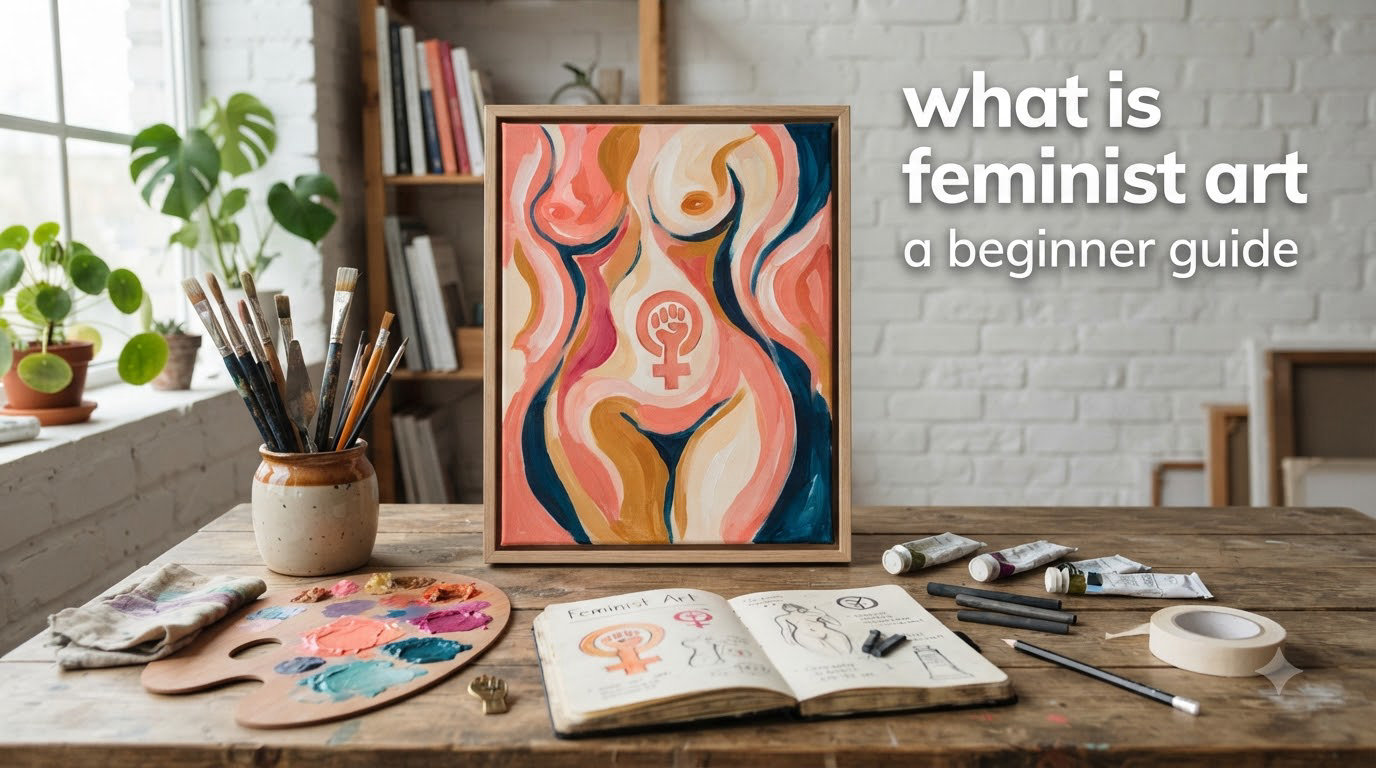
If you have ever walked through a museum and noticed that most of the art on the walls was made by men, you have already stumbled onto the central question behind feminist art. Feminist art is a movement and a way of making art that challenges the dominance of men in both the art world and society at large. It asks who gets to create art, whose stories get told, and whose experiences matter. For beginners, feminist art can feel like a massive topic, but it really comes down to one thing: artists using their work to push for gender equality and to make women’s perspectives visible.
This guide breaks everything down step by step. I will walk you through the definition of feminist art, its historical roots, the themes it explores, the artists you should know, and how the movement has evolved from the 1960s all the way to 2026. Whether you are a student working on a project, an art lover curious about the movement, or someone exploring feminist theory for the first time, this guide will give you a solid foundation.
Feminist art is not just a historical curiosity. It is a living, evolving practice that continues to shape how we think about identity, representation, and power. Some of the most important performance art pieces in history were created by feminist artists who used their bodies and voices to challenge the status quo. Understanding feminist art means understanding a big part of modern and contemporary art itself.
Table of Contents
What Is Feminist Art?
Feminist art is art created with the conscious intention of addressing issues related to gender, women’s experiences, and social equality. It emerged as a recognized movement in the late 1960s and early 1970s, tied directly to the second wave of feminism. At its core, feminist art seeks to challenge patriarchal structures in the art world and beyond, making visible the perspectives, bodies, histories, and creative contributions of women that had been systematically overlooked or dismissed.
Before the feminist art movement, women were largely excluded from major galleries, museums, and art history textbooks. The movement changed that by demanding recognition, creating alternative exhibition spaces, and building an entirely new visual language grounded in women’s lived experiences. Feminist artists did not just ask to be included in the existing art world. They questioned the very foundations of how art was valued, who decided what counted as “real” art, and why certain materials and subjects were considered more worthy than others.
One of the most important things to understand about feminist art is that it is not a single style or technique. You will find feminist artists working in painting, sculpture, photography, video, performance, textiles, installation, and digital media. The unifying thread is not the medium but the intention behind the work. A feminist painting of a domestic interior, a performance piece about body image, and a text-based poster challenging sexism in the art world are all feminist art because they share the goal of questioning and transforming gender norms.
MoMA defines feminist art as “art that seeks to challenge the dominance of men in both art and society, to gain recognition and equality for women artists, and question assumptions about gender.” That definition captures the dual nature of the movement: it is both an artistic practice and a social and political project.
The Origins of the Feminist Art Movement
The feminist art movement did not appear out of thin air. It grew directly out of the broader social and political upheavals of the late 1960s. The women’s liberation movement, anti-war protests, and civil rights activism all created a climate where challenging established power structures felt not just possible but necessary. Women artists who had been shut out of galleries and museums began organizing, protesting, and creating work that directly addressed their marginalization.
In 1970, only about 5 percent of the artwork displayed in major American museums was by women. That staggering imbalance was not because women were not making art. It was because the entire system of galleries, critics, curators, and collectors was dominated by men who did not take women artists seriously. Feminist artists decided to change that system rather than simply try to fit into it.
The First Feminist Art Programs
A key moment in the movement came in 1970 when artist Judy Chicago founded the Feminist Art Program at Fresno State College in California. This was the first academic program in the United States dedicated to making art from a feminist perspective. Chicago, along with Miriam Schapiro, later brought the program to the California Institute of the Arts (CalArts) in 1971. These programs were radical in their approach. Students were encouraged to explore their personal experiences as women, to use materials traditionally associated with women’s work like fabric and ceramics, and to develop collaborative projects.
Womanhouse: A Landmark Installation
The most famous result of the CalArts Feminist Art Program was Womanhouse, a collaborative installation created in 1972 by Chicago, Schapiro, and their students. They transformed an abandoned Hollywood mansion into a series of room-sized artworks exploring women’s domestic lives, fantasies, and frustrations. Each room addressed a different aspect of women’s experience. One featured a kitchen filled with fried-egg forms on the ceiling and walls. Another presented a bridal staircase that ended in a closet. A bathroom installation explored the physical reality of women’s bodies in a way that had never been shown in a gallery setting.
Womanhouse was a revelation. It attracted over 10,000 visitors during its month-long run and demonstrated that art about women’s experiences could draw a massive audience. It also showed that collaborative, process-based art could be just as powerful as the solitary genius model that had dominated Western art for centuries. Womanhouse remains one of the most important landmarks in the history of feminist art and a touchstone for anyone learning about the movement.
Connection to Second Wave Feminism
The feminist art movement was inseparable from second wave feminism, which emerged in the 1960s and focused on issues like reproductive rights, workplace equality, domestic violence, and legal protections against discrimination. Feminist artists drew on the energy and ideas of this movement, translating political demands into visual and experiential forms. The personal became political, and the political became artistic.
Core Themes and Concepts in Feminist Art
Feminist art explores a wide range of themes, but several core concepts appear again and again across different artists, time periods, and media. Understanding these themes will give you a framework for analyzing and appreciating feminist art on your own.
Reclaiming the Female Body
For centuries, the female body in Western art was depicted almost exclusively by male artists, often as an object of desire or a symbol of beauty. Feminist artists reclaimed the body as a subject rather than an object. They depicted women’s bodies from women’s own perspectives, showing the physical realities of menstruation, pregnancy, aging, and bodily autonomy that had been erased from mainstream art. This practice of de-objectification was one of the most radical contributions of the feminist art movement. Artists like Carolee Schneemann, Hannah Wilke, and Ana Mendieta used their own bodies as artistic material in performance and photographic works that challenged viewers to see the female form on its own terms.
Domesticity and Traditional Women’s Crafts
Before feminist art, materials like fabric, thread, ceramics, and knitting were considered “crafts” rather than “fine art” and were dismissed as trivial because they were associated with women’s domestic labor. Feminist artists elevated these materials to the level of high art, creating a practice that Miriam Schapiro and others called “femmage” (a feminist version of collage). By making quilts, embroidery, and textile works that addressed serious themes, these artists challenged the arbitrary division between art and craft. Faith Ringgold’s story quilts, which combine painting and quilted fabric to tell stories about African American women’s lives, are a powerful example of this approach.
Challenging the Male Gaze
The concept of the “male gaze,” theorized by film scholar Laura Mulvey in 1975, describes how visual culture has been shaped by a heterosexual male perspective that treats women as objects to be looked at. Feminist artists directly confronted the male gaze by creating images and experiences that refused to present women as passive objects. Barbara Kruger’s text-based works, which layer bold phrases like “Your Body Is a Battleground” over found photographs, force viewers to confront how images of women are used to reinforce power structures.
Identity and Gender Performance
Feminist artists have long explored the idea that gender is not a fixed biological fact but a set of behaviors and expectations that are learned and performed. This idea, later formalized by philosopher Judith Butler in her 1990 book “Gender Trouble,” was already being explored visually by artists decades earlier. Claude Cahun’s self-portrait photographs from the 1920s and 1930s, in which they adopted various gender presentations, anticipated later conversations about gender fluidity by half a century. In the 1970s and beyond, artists like Eleanor Antin and Adrian Piper used performance and photography to explore how race, gender, and identity intersect.
Social Commentary and Activism
Many feminist artists see their work as a form of activism. The Guerrilla Girls, an anonymous collective founded in 1985, are perhaps the best-known example. They wear gorilla masks in public and paste posters on city walls with statistics exposing the racism and sexism of the art world. Their famous 1989 poster asked, “Do women have to be naked to get into the Met. Museum? Less than 5% of the artists in the Modern Art sections are women, but 85% of the nudes are female.” That kind of direct, data-driven activism made the Guerrilla Girls impossible to ignore.
Feminist art has always been deeply connected to broader struggles for social justice. Artists have addressed issues ranging from domestic violence and reproductive rights to racial inequality and economic injustice. This tradition of using art as a tool for social change is one of the defining features of the movement.
Alternative Materials and Media
Feminist artists expanded the definition of what counts as art by embracing materials and methods that had been excluded from the mainstream art world. Alongside textiles and craft materials, they pioneered the use of video, performance, installation, and collaborative processes. This multidisciplinary approach was not just about using new materials. It was about challenging the assumption that painting and sculpture were inherently superior to other forms of creative expression.
Key Feminist Artists and Their Works
Understanding feminist art means getting to know the artists who shaped the movement. Here are seven artists whose work every beginner should explore. Many of these figures also rank among the most influential contemporary artists of the past century.
1. Judy Chicago (born 1939)
Judy Chicago is widely considered the most influential figure in the feminist art movement. She co-founded the Feminist Art Program at Fresno State and CalArts, co-created Womanhouse, and produced what may be the single most famous work of feminist art: The Dinner Party (1974-1979). This massive installation features a triangular banquet table with 39 place settings, each honoring a specific woman from history or mythology. The settings feature elaborate ceramic plates and embroidered runners, combining fine art with traditionally feminine craft techniques. The Dinner Party is now permanently installed at the Brooklyn Museum and has been viewed by over one million people.
2. Miriam Schapiro (1923-2015)
Miriam Schapiro was a painter and collage artist who co-founded the Feminist Art Program at CalArts with Judy Chicago. She coined the term “femmage” to describe her practice of incorporating traditionally feminine materials like fabric, lace, and needlework into her artwork. Schapiro’s femmage works challenged the hierarchy that placed painting above textile arts and helped legitimize craft as a serious artistic medium. She was also a leader in the Pattern and Decoration movement, which celebrated ornamental and decorative traditions that had been dismissed by the mainstream art world.
3. Barbara Kruger (born 1945)
Barbara Kruger is known for her large-scale works that combine black-and-white photographs with bold red-and-white text. Phrases like “Your Body Is a Battleground,” “I Shop Therefore I Am,” and “We Don’t Need Another Hero” confront viewers with direct challenges to power, consumerism, and gender stereotypes. Kruger’s background in graphic design gives her work a polished, advertising-like quality that makes her critiques of media culture even more pointed. Her work has been displayed on billboards, bus shelters, and museum walls, blurring the line between art and public messaging.
4. The Guerrilla Girls (founded 1985)
The Guerrilla Girls are an anonymous collective of feminist artists who use posters, stickers, and public interventions to expose sexism and racism in the art world. Their members wear gorilla masks to keep their identities secret, which allows them to criticize powerful institutions without fear of retaliation. Since their founding in 1985, they have produced over 100 posters, books, and billboard projects. Their work has appeared on city streets, in museums, and in art publications around the world, making them one of the most recognizable activist art groups in history.
5. Carolee Schneemann (1939-2019)
Carolee Schneemann was a performance artist who used her body as a medium to explore sexuality, gender, and power. Her 1964 performance “Meat Joy” featured nude performers rolling on the floor with raw fish, sausages, and wet paint, challenging conventional ideas about the body and desire. Her 1975 performance “Interior Scroll” involved her standing nude and pulling a paper scroll from her vagina while reading from it. Schneemann’s work was controversial and often misunderstood, but it opened the door for generations of artists to use the body as a site of artistic and political expression.
6. Faith Ringgold (1930-2024)
Faith Ringgold was a painter, quilter, and storyteller whose work addressed the intersection of race, gender, and class. Her story quilts combine painted images with quilted fabric and written text to tell narratives about African American women’s lives and histories. Her most famous work, “Tar Beach” (1988), tells the story of a young Black girl in Harlem who dreams of flying over the city. Ringgold’s work bridged the feminist art movement and the Black arts movement, demonstrating that the fight for gender equality and racial justice are deeply connected.
7. Ana Mendieta (1948-1985)
Ana Mendieta was a Cuban American artist who created earth-body sculptures, performance pieces, and photographs that explored the connection between the female body and the natural landscape. Her “Silueta Series” (1973-1980) involved imprinting her body shape into earth, sand, mud, and fire, creating haunting images that blur the boundary between human forms and natural elements. Mendieta’s work is a powerful example of how feminist artists expanded the possibilities of what art could be and what materials it could use.
How Feminist Art Evolved: From the 1980s to 2026
The feminist art movement did not stop in the 1970s. It evolved, adapted, and expanded in response to new ideas and changing social conditions.
The 1980s: Theory and Identity Politics
In the 1980s, feminist artists began engaging more deeply with theoretical frameworks from poststructuralism, psychoanalysis, and critical theory. The influence of scholars like Judith Butler, who argued that gender is performed rather than innate, pushed artists to explore the constructed nature of identity in more complex ways. This period also saw the rise of identity politics in art, as artists of color, queer artists, and artists from the Global South challenged the white, middle-class focus of much early feminist art.
Intersectionality Changes the Conversation
The concept of intersectionality, coined by legal scholar Kimberle Crenshaw in 1989, transformed feminist art by showing how different forms of oppression, including those based on race, class, sexuality, and disability, overlap and interact. Artists like Lorna Simpson, Carrie Mae Weems, and Zanele Muholi began creating work that addressed the specific experiences of Black women, queer women, and women from marginalized communities. This shift made the movement more inclusive and more politically powerful.
Global Expansion
While the feminist art movement began primarily in the United States and Europe, it has since expanded worldwide. Artists from Latin America, Africa, Asia, and the Middle East have created feminist art that draws on their own cultural traditions and addresses their specific social and political contexts. Mexican artist Monica Mayer created “El Tendedero” (The Clothesline), an interactive installation where women wrote their experiences of harassment on pink slips of paper. Indian artist Sheela Gowda uses materials like cow dung and human hair to explore women’s labor and domestic life in South Asia. These global perspectives have enriched the movement enormously and continue to push it in new directions.
Feminist Art in 2026
Today, feminist art is more diverse and accessible than ever. Social media platforms like Instagram have given feminist artists direct access to audiences without the need for gallery approval. Artists like Mickalene Thomas, Wangechi Mutu, and Shirin Neshat continue to push the boundaries of what feminist art can look like and what it can address. The Guerrilla Girls are still active, still wearing their masks, and still holding museums accountable. New generations of artists are exploring themes like digital identity, climate justice, and trans rights, expanding the feminist art tradition to address the concerns of 2026. You can also see the influence of feminist art in the work of guerrilla art artists who transformed public space, carrying forward the tradition of art as activism.
The Impact of Feminist Art on the Art World
Feminist art has fundamentally changed the art world in ways that extend far beyond any single exhibition or artwork. Before the movement, women artists were a small minority in major collections and exhibitions. Today, thanks in large part to the efforts of feminist artists and scholars, museums have begun to address their historical imbalances. The Tate Modern, the Museum of Modern Art, and the National Museum of Women in the Arts have all made significant efforts to showcase women artists and to reframe art history to include their contributions.
Feminist art also opened the door for other identity-based art movements. The emphasis on personal experience, marginalized perspectives, and the politics of representation influenced the development of Black British art, queer art, Chicano art, and disability art. The idea that art should reflect the full diversity of human experience, not just the perspective of a privileged few, is a direct legacy of the feminist art movement.
The movement also changed how art is made and discussed. Collaborative practices, community-based projects, and process-oriented work all gained legitimacy through feminist art. The distinction between “high art” and “craft” has been largely dismantled, and materials that were once dismissed as feminine or domestic are now celebrated for their expressive potential. These changes have made the art world more open, more diverse, and more interesting for everyone.
A Beginner’s Guide to Exploring Feminist Art
One of the biggest challenges for beginners is knowing where to start. The feminist art movement spans decades, encompasses thousands of artists, and touches on complex theoretical ideas. Here is a practical roadmap to help you begin your exploration.
Where to See Feminist Art
If you want to experience feminist art in person, start with these major collections and institutions. The Brooklyn Museum in New York houses Judy Chicago’s The Dinner Party as a permanent installation. The National Museum of Women in the Arts in Washington, DC is the only major museum in the world dedicated exclusively to women artists. The Tate Modern in London has significant holdings of feminist art, including works by Tracey Emin and Sarah Lucas. Many university art galleries also have feminist art collections that are free to visit.
Recommended Books and Resources
For reading, “The Power of Feminist Art” edited by Norma Broude and Mary D. Garrard is considered the essential textbook on the American feminist art movement. “Art and Feminism” edited by Helena Reckitt and Peggy Phelan provides a good overview with lots of images. “Feminism and Art History” by Norma Broude and Mary D. Garrard examines how feminist scholarship has rewritten art history. For a more accessible starting point, “Women, Art, and Society” by Whitney Chadwick offers a comprehensive but readable survey of women artists throughout history.
Online resources include the Archives of American Art’s “What Is Feminist Art?” exhibition, the Brooklyn Museum’s Elizabeth A. Sackler Center for Feminist Art, and the Tate’s online resources on feminist art. These are all free and provide excellent introductions to the topic.
How to Analyze Feminist Art as a Beginner
When you encounter a work of feminist art, start by asking a few simple questions. Who made it, and when? What materials did the artist use, and why do those materials matter? What is the subject or theme of the work? How does it relate to broader social or political issues? Is the artist challenging a specific assumption or stereotype? These questions will help you move beyond simply looking at the work to understanding what it is trying to communicate.
Pay attention to context as well. A quilt by Faith Ringgold means something different from a quilt you might find on a bed because Ringgold is using the tradition of quilting to make a statement about African American women’s history and creativity. The materials, the setting, and the artist’s intentions all contribute to the meaning of the work.
Simple Project Ideas for Students
If you are a student working on a feminist art project for a class, here are a few ideas to get you started. Create a collage using images from magazines that explores how women are represented in advertising. Make a text-based poster in the style of Barbara Kruger that addresses an issue you care about. Create a personal timeline mapping the women in your family history and represent it visually. Design an installation in a room of your home that explores a theme from women’s daily experience, inspired by Womanhouse. Use fabric, thread, or other craft materials to create a work that elevates a domestic tradition to fine art, following the example of Miriam Schapiro’s femmage.
Common Misconceptions About Feminist Art
There are several persistent myths about feminist art that can confuse beginners. Let me address the most common ones directly.
Myth: Feminist art is just art made by women. This is incorrect. Not all art by women is feminist art, and not all feminist art is made by women. What makes art “feminist” is the intention behind it. If the work addresses gender inequality, challenges stereotypes, or centers women’s experiences, it is feminist art regardless of who created it. Some male artists have also created work informed by feminist ideas.
Myth: Feminist art is all the same style. Feminist art encompasses every medium and style you can imagine. It includes painting, sculpture, photography, video, performance, textiles, digital art, and public installations. The Guerrilla Girls’ activist posters look nothing like Judy Chicago’s ceramic installations, which look nothing like Ana Mendieta’s earth-body sculptures. Diversity of approach is one of the movement’s greatest strengths.
Myth: Feminist art is anti-men. Feminist art critiques patriarchal systems, not individual men. The movement seeks equality and recognition, not exclusion. Many feminist artists have collaborated with male allies, and the movement’s goal is a more inclusive art world, not a segregated one.
Myth: Feminist art is only historical. The feminist art movement is alive and well in 2026. Contemporary artists continue to build on the foundations laid in the 1970s while addressing new issues like digital surveillance, trans rights, and climate justice. The movement continues to evolve because the need for it has not disappeared.
FAQs
What defines feminist art?
Feminist art is defined by its intention to challenge gender inequality, question patriarchal assumptions, and center women’s experiences in the creative process. It is not limited to a single style or medium. Instead, it encompasses painting, sculpture, performance, textiles, photography, video, installation, and digital art. The defining characteristic is the artist’s conscious engagement with feminist ideas and the goal of transforming cultural attitudes about gender through visual expression.
What is feminism in very simple words?
Feminism is the belief that all people should have equal rights and opportunities regardless of their gender. It seeks to address the historical and ongoing disadvantages that women and marginalized genders face in society, including in areas like education, employment, political representation, and personal freedom. At its core, feminism is about fairness, respect, and the idea that no one should be limited or discriminated against because of their gender.
Which feminist books are good for beginners?
For beginners interested in feminist art specifically, start with The Power of Feminist Art edited by Norma Broude and Mary D. Garrard. For general feminist theory, bell hooks’ Feminism Is for Everybody provides a clear and accessible introduction. Simone de Beauvoir’s The Second Sex is a foundational text, though it is more challenging. For a contemporary perspective, Chimamanda Ngozi Adichie’s We Should All Be Feminists is short, engaging, and widely recommended as a starting point.
Is Judith Butler a third wave feminist?
Judith Butler is typically associated with third wave feminism and poststructuralist feminist theory. Their 1990 book Gender Trouble is considered a foundational text of both third wave feminism and queer theory. Butler’s argument that gender is a performance rather than an innate identity was enormously influential in feminist art, inspiring artists to explore the constructed nature of gender through their work. Butler’s ideas emerged during the transition from second wave to third wave feminism and helped define the intellectual framework of the third wave.
Why Feminist Art Matters for Everyone
Feminist art is not just for women or for people who identify as feminists. It is for anyone who believes that art should reflect the full range of human experience. The feminist art movement transformed how we think about creativity, representation, and power. It opened doors for artists who had been excluded, it challenged assumptions that had gone unquestioned for centuries, and it created new forms of expression that continue to influence art and culture in 2026.
If you take one thing away from this beginner’s guide to what feminist art is, let it be this: feminist art changed the world by insisting that everyone’s story deserves to be told. That insistence is as relevant today as it was when Judy Chicago and her students first walked into that abandoned Hollywood mansion in 1972. The movement is ongoing, it is global, and it is waiting for you to explore it.
Start with the artists and works mentioned in this guide. Visit a museum. Pick up one of the recommended books. Create something of your own. The feminist art tradition is not a closed chapter in art history. It is an open invitation to see the world differently.