
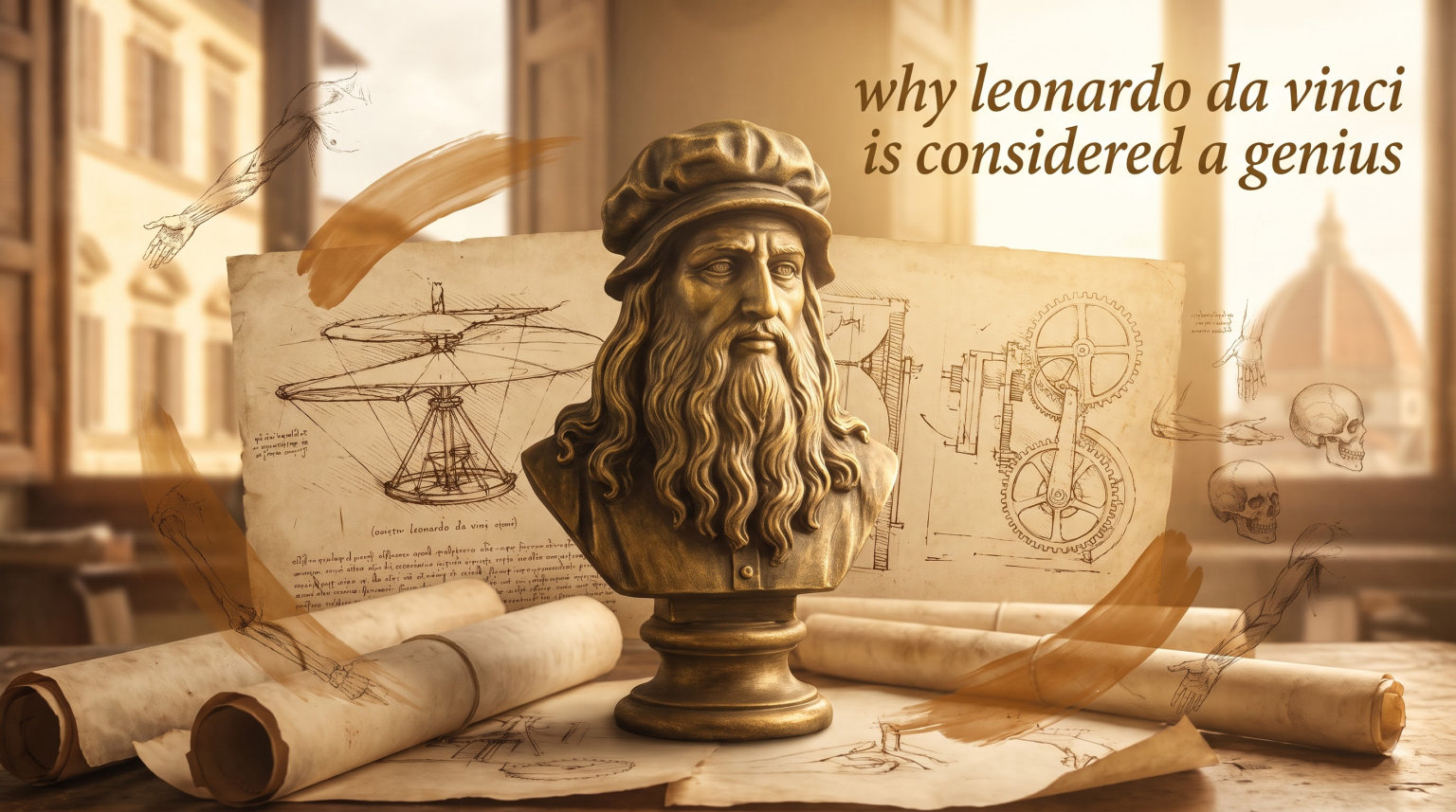
Leonardo da Vinci is considered a genius because he mastered an extraordinary range of disciplines including painting, sculpture, anatomy, engineering, optics, and hydrodynamics, all while connecting these fields in ways nobody had attempted before. Born in 1452 in the small town of Vinci near Florence, he produced some of the most recognized artworks in human history alongside inventions that anticipated technologies by centuries. His genius was not simply about raw intelligence. It was about an approach to understanding the world that combined relentless curiosity with obsessive observation and a refusal to accept boundaries between fields of knowledge.
When our team researched why Leonardo da Vinci is considered a genius, we found that historians, scientists, and artists all point to a handful of core traits that set him apart. Here are the key factors that define his genius:
Relentless curiosity — He asked questions about everything, from how birds fly to how the human heart pumps blood
Empirical observation — He trusted his own eyes over accepted authority, a radical idea in his time
Interdisciplinary thinking — He connected art, science, engineering, and nature into a single framework of understanding
Self-education — With almost no formal schooling and limited Latin, he taught himself through direct experience
Obsessive detail — He spent years on single paintings, refining details most people would never notice
These qualities made Leonardo da Vinci the embodiment of what we now call a Renaissance man. In this guide, we will walk through each of these factors in detail and explore the specific works and discoveries that cement his reputation as one of the greatest minds in history.
Table of Contents
The Polymath: Leonardo da Vinci as the Ultimate Renaissance Man
The term “polymath” describes someone whose expertise spans multiple unrelated fields. Leonardo da Vinci is perhaps the most famous polymath who ever lived, and his name has become practically synonymous with the concept of a “Renaissance man.” He was not simply a painter who dabbled in science. He was a painter, sculptor, architect, musician, mathematician, engineer, inventor, anatomist, geologist, cartographer, botanist, and writer who achieved genuine mastery across these domains.
What made Leonardo different from other polymaths was the way he connected these fields. His knowledge of anatomy informed the realistic musculature in his paintings. His understanding of optics helped him develop the sfumato technique that gives the Mona Lisa its haunting quality. His study of water currents influenced both his artistic depictions of flowing hair and his engineering designs for canal systems. Every discipline fed into every other discipline.
In our modern world of hyper-specialization, this kind of thinking is rare. We tend to produce experts who go deep in one narrow field. Leonardo went deep in dozens of fields and then built bridges between them. That bridge-building ability, this interdisciplinary thinking, is arguably what made him a true genius rather than just a talented person with many hobbies.
It is worth noting that Leonardo achieved all of this without the kind of formal education that his contemporaries received. He had minimal schooling, could barely read Latin (the language of scholarship at the time), and was largely self-taught. This makes his accomplishments even more remarkable. He did not learn anatomy from textbooks. He learned it by actually dissecting human corpses and drawing what he saw with his own eyes.
Why Leonardo da Vinci Is Considered a Genius: The Core Reasons
When people ask why Leonardo da Vinci is considered a genius, the answer comes down to five fundamental traits that worked together to produce one of history’s most remarkable minds. Each trait on its own would have made him notable. Combined, they created something unprecedented.
1. Relentless Curiosity About Everything
Walter Isaacson, who wrote a definitive biography of Leonardo, identified curiosity as his defining characteristic. Not just curiosity about useful things, but curiosity for its own sake. Leonardo wanted to know why the sky was blue, how woodpeckers avoid brain damage, what happens inside the human skull, and how light bends through water. He filled thousands of notebook pages with questions that had no immediate practical purpose.
This kind of open-ended curiosity is different from the goal-oriented research we see in most scientists and inventors. Leonardo did not study things because they might lead to a profitable invention or a famous painting. He studied them because he genuinely wanted to understand how the world worked. And that pure curiosity led him to insights that practical, goal-driven thinkers never reached.
2. Empirical Observation Before the Scientific Method
Leonardo lived long before the formal scientific method was established. Yet he practiced something remarkably close to it. Rather than relying on the teachings of ancient authorities like Aristotle and Galen (as most scholars of his era did), he insisted on observing things directly. He wrote in his notebooks that experience was the true source of all knowledge and that wisdom was the daughter of experience.
This commitment to observation led him to discoveries that were centuries ahead of their time. He correctly described the flow of blood through the heart valves 150 years before William Harvey’s famous work on circulation. He understood principles of aerodynamics that would not be confirmed until the Wright brothers took flight. He observed geological processes like erosion and sedimentation that modern geologists credit as remarkably accurate.
3. Interdisciplinary Thinking That Connected Art and Science
Perhaps the most distinctive aspect of Leonardo’s genius was his ability to see connections between fields that everyone else treated as completely separate. In his mind, art and science were not two different activities. They were two different ways of investigating the same reality. When he painted a human face, he drew on his anatomical studies of facial muscles. When he designed a flying machine, he applied the same observational skills he used to capture the texture of fabric in his paintings.
This interdisciplinary approach produced breakthroughs in both art and science. His development of perspective and chiaroscuro (the use of light and shadow) transformed Western painting. His mechanical designs, while many were never built, demonstrated an understanding of gears, levers, and fluid dynamics that was unmatched in his era. The connection between these achievements was always the same: observing nature carefully and then applying those observations creatively.
4. Obsessive Attention to Detail
Leonardo’s perfectionism is legendary, and it was both a strength and a weakness. He spent roughly 14 years on the Mona Lisa, carrying it with him from city to city and making tiny adjustments until the end of his life. He started projects he never finished. He accepted commissions he never completed. His attention to detail meant that some of his greatest ideas never made it past the notebook stage.
But that same obsessiveness is what made his finished works so extraordinary. The Mona Lisa’s smile works because Leonardo spent months studying how facial muscles create subtle expressions. The Last Supper captures a specific dramatic moment because he carefully planned how each apostle would react to Jesus’s announcement. Every detail was the product of intense study and deliberate choice, not luck or instinct alone.
5. Self-Education and Independent Thinking
Leonardo was born the illegitimate son of a notary, which meant he was excluded from the traditional paths of education and professional advancement. He could not attend university. He could not read and write Latin fluently. He was apprenticed to the artist Andrea del Verrocchio in Florence, where he learned the practical skills of a workshop: painting, drawing, basic engineering for theatrical productions, and metalwork.
Instead of treating this lack of formal education as a limitation, Leonardo turned it into an advantage. He was not bound by the accepted theories of his time because he had never been taught to accept them. He learned by looking, touching, measuring, and testing. His independence from academic tradition gave him the freedom to think in entirely original ways. As Reddit users have pointed out in discussions about Leonardo, he became one of history’s greatest minds without ever attending a university.
Artistic Masterpieces That Redefined Human Achievement
Leonardo’s art is what most people know him for, and for good reason. His paintings did not just capture reality. They transformed how artists thought about what painting could accomplish. Three works stand above the rest as evidence of his artistic genius.
The Mona Lisa
The Mona Lisa is the most famous painting in the world, and its fame is directly tied to Leonardo’s genius. The portrait demonstrates his mastery of sfumato, a technique where colors and tones blend so gradually that no transitions are visible. This technique creates the famous ambiguity of Lisa’s smile, which seems to change depending on where you look and how the light hits it.
Leonardo achieved this effect through layer upon layer of translucent paint, each one so thin it is nearly invisible. Modern analysis has revealed as many as 30 micro-layers of paint on the Mona Lisa’s face. He also used his anatomical knowledge to understand exactly which muscles around the mouth create a natural expression. The result is a painting that feels alive in a way that no portrait had before.
The Last Supper
The Last Supper, painted on the wall of a dining hall in Milan, broke every convention of its time. Instead of showing the apostles as static, haloed figures, Leonardo captured the explosive moment when Jesus announces that one of them will betray him. Each apostle reacts differently: some lean forward in shock, some throw their hands up, some whisper to each other. It is a masterclass in narrative painting, telling a complete story through a single frozen moment.
Leonardo’s understanding of perspective is on full display here. The vanishing point of the composition falls exactly on Christ’s head, drawing the viewer’s eye to the center of the drama. The room itself is rendered with mathematical precision. Unfortunately, Leonardo’s experimental fresco technique (he did not use traditional methods) meant the painting began deteriorating almost immediately, and restoration efforts have continued for centuries.
The Vitruvian Man
The Vitruvian Man is Leonardo’s famous drawing of a male figure in two superimposed positions within a circle and a square. It is not a painting but a study, and it perfectly demonstrates how Leonardo connected art, mathematics, and science. The drawing illustrates the ideal human proportions described by the ancient Roman architect Vitruvius, but Leonardo went beyond Vitruvius’s description by adding his own anatomical observations.
What makes the Vitruvian Man special is what it represents: the idea that the human body reflects the mathematical harmony of the universe. Leonardo believed that by understanding the proportions and mechanics of the human body, you could understand the principles behind all of nature. This drawing is a visual manifesto of his philosophy that art and science are inseparable.
Inventions and Engineering Centuries Ahead of Their Time
Leonardo’s notebooks contain designs for machines that would not be built for hundreds of years. While it is important to separate his serious engineering work from what some scholars call “visual boasting” (designs meant to impress patrons rather than function practically), many of his concepts were genuinely ahead of their time.
Flying Machines
Leonardo was obsessed with flight. He spent years observing birds, bats, and the movement of air, filling notebooks with detailed sketches of wings, propellers, and gliders. His ornithopter designs, machines meant to fly by flapping wings, were based on careful study of bird anatomy. While these particular designs would never have worked (human muscles cannot generate enough power for flapping flight), his understanding of aerodynamic principles was remarkable.
His aerial screw design, a helical structure that looks remarkably like a modern helicopter rotor, demonstrated his ability to think about generating lift through rotational motion. And his glider designs, based on the structure of bat wings, were actually tested in modern times and found to be capable of sustained flight. The connection between his theatrical background in Florence and his flying machine designs is significant. He first learned to create mechanical effects for stage productions, and those practical skills evolved into serious engineering research.
Military Engineering
When Leonardo worked as a military engineer for Ludovico Sforza, the Duke of Milan, he produced designs for armored vehicles, multi-barreled guns, bridges that could be quickly assembled and disassembled, and even what appears to be an early concept for a tank. His armored vehicle design, a circular, turtle-shaped platform surrounded by cannons and powered by men turning cranks inside, is often cited as a precursor to the modern tank.
It is worth noting that some of these military designs may have been more about securing patronage than serious proposals. As scholars have pointed out, Leonardo sometimes produced impressive-looking designs to attract wealthy employers. But even his theoretical work demonstrates an understanding of mechanics, ballistics, and fortification design that was genuinely advanced for the late 1400s.
Hydraulic Engineering
Leonardo’s work with water is one of the most underappreciated aspects of his genius. He designed canal systems, locks, irrigation networks, and devices for measuring water flow. His observations of water currents, eddies, and erosion patterns filled hundreds of notebook pages and demonstrated an intuitive grasp of fluid dynamics that would not be formalized as a science for centuries.
He proposed ambitious plans for draining marshes, redirecting rivers, and building canals that would connect cities by water. While many of these projects were never completed, his hydraulic studies were accurate enough that modern engineers have used them to understand Renaissance water management techniques.
Anatomical Studies and Scientific Observations
Leonardo’s anatomical work is perhaps the strongest evidence that his genius was based on direct observation rather than received knowledge. Over the course of his career, he dissected more than 30 human corpses, a practice that was both illegal and dangerous in his time. He made detailed drawings of bones, muscles, organs, blood vessels, and nerves that surpassed anything in existing medical literature.
His studies of the heart were particularly remarkable. He created accurate drawings of the heart’s chambers and valves, described how the heart’s cusps control blood flow, and even attempted to understand how blood circulated through the body. He was the first to describe coronary artery disease and the narrowing of blood vessels that comes with aging. His drawings of the human fetus in the womb, based on his own dissections, are both scientifically accurate and artistically beautiful.
Beyond anatomy, Leonardo made significant observations in optics (understanding how the eye focuses light), geology (recognizing that fossils in mountains indicated ancient seas), and botany (documenting plant growth patterns with remarkable precision). In each case, his approach was the same: observe carefully, draw accurately, and question everything you have been told.
The tragic aspect of his scientific work is that he almost never published it. His notebooks contained discoveries that could have advanced medicine, engineering, and natural science by generations. But Leonardo kept his findings private, written in his famous mirror script, and they were not widely understood until centuries after his death.
The Notebooks: A Window Into a Boundless Mind
Roughly 7,200 pages of Leonardo’s notebooks survive today, scattered across collections in museums and libraries around the world. Experts estimate this represents only about one-quarter of what he actually wrote. These pages are our best evidence of how Leonardo thought, and they reveal a mind that was constantly active, endlessly curious, and remarkably systematic in its approach to understanding.
The notebooks contain everything: anatomical studies next to shopping lists, engineering designs alongside jokes, philosophical reflections mixed with drawings of cats. This apparent chaos actually reflects Leonardo’s belief that all knowledge is connected. He did not compartmentalize his thinking the way modern academics do. One page might contain a study of water flow, a sketch of a human face, and a design for a new kind of lock, all drawn next to each other because they were on his mind at the same time.
His mirror writing, where text reads right to left and letters are reversed, has fascinated scholars for centuries. The most likely explanation is practical: Leonardo was left-handed, and writing from right to left prevented him from smearing the ink. But the mirror writing also served as a form of privacy, making his notes difficult for others to read. This was his personal laboratory of ideas, not a publication meant for the world.
What the notebooks reveal more than anything is Leonardo’s systematic approach to learning. He did not just observe things randomly. He developed methods for studying perspective, anatomy, light, water, and mechanics. He created checklists for himself, listing things he wanted to observe and understand. He returned to topics again and again over decades, refining his understanding each time. This was not raw talent operating on instinct. It was disciplined, methodical inquiry driven by boundless curiosity.
Leonardo’s Legacy: How His Genius Shapes Our World Today
Leonardo da Vinci died in 1519, but his approach to understanding the world is arguably more relevant now than ever. In an era of artificial intelligence, interdisciplinary research, and creative problem-solving, Leonardo’s method of connecting disparate fields looks remarkably modern.
Modern educators and researchers often point to Leonardo as the model for what we now call STEAM education (Science, Technology, Engineering, Arts, and Mathematics). His work demonstrates that creativity is not separate from analytical thinking. The best engineers need artistic imagination, and the best artists benefit from scientific understanding. This insight, which Leonardo practiced 500 years ago, is still being rediscovered by schools and companies today.
People often ask how Leonardo would compare to modern geniuses like Albert Einstein or Nikola Tesla. The honest answer is that such comparisons are difficult because the world has changed so dramatically. Einstein worked within the established framework of academic physics. Tesla was a specialist in electrical engineering. Leonardo operated in a world where the boundaries between disciplines had not yet been drawn, and his genius was defined by his ability to move freely across all of them.
What we can learn from Leonardo in 2026 is not that we should all try to master a dozen different fields. It is that curiosity without boundaries, careful observation of the world around us, and a willingness to question accepted knowledge are the foundations of genuine creative achievement. His notebooks remind us that the first step to genius is simply paying attention to what is right in front of you.
FAQs
Why was Leonardo considered to be a genius?
Leonardo was considered a genius because he combined mastery across painting, engineering, anatomy, and science with an unprecedented ability to connect these fields. His relentless curiosity drove him to study everything from bird flight to human anatomy, and his commitment to direct observation rather than accepting authority led to discoveries that were centuries ahead of their time. Works like the Mona Lisa, The Last Supper, and the Vitruvian Man demonstrate how he used scientific knowledge to transform art.
Why do people call Leonardo da Vinci a genius?
People call Leonardo da Vinci a genius because he achieved extraordinary things across an unmatched range of disciplines. He painted the most famous artwork in history, designed machines that anticipated modern technology by hundreds of years, produced anatomical studies that surpassed medical knowledge of his era, and filled over 7,000 notebook pages with observations about the natural world. His ability to connect art and science in a single framework of understanding is what separates him from other great thinkers.
Was Leonardo da Vinci highly intelligent?
Yes, Leonardo da Vinci was highly intelligent, though his intelligence was different from what IQ tests measure. He had almost no formal education and could barely read Latin, yet he taught himself anatomy, engineering, optics, and mathematics through direct observation and experience. His intelligence was characterized by exceptional visual-spatial reasoning, extraordinary powers of observation, and the ability to see connections between unrelated fields. While IQ estimates for historical figures are speculative, his accomplishments speak for themselves.
Is da Vinci the greatest genius?
Whether Leonardo is the greatest genius is debated, but he is widely regarded as the ultimate example of a universal genius. His range of achievement across art, science, and engineering is unmatched by any other historical figure. Albert Einstein revolutionized physics, Mozart composed masterpieces, and Nikola Tesla pioneered electrical engineering, but each of these geniuses operated within a relatively focused domain. Leonardo excelled across an extraordinary breadth of fields, which is why many historians and scholars consider him the most complete genius in recorded history.
Conclusion
Understanding why Leonardo da Vinci is considered a genius means looking beyond the famous paintings and recognizing the mind behind them. His genius was built on five pillars: relentless curiosity that drove him to question everything, empirical observation that trusted experience over authority, interdisciplinary thinking that connected art and science, obsessive attention to detail that pushed every work toward perfection, and self-education that freed him from the constraints of academic tradition.
Leonardo’s 7,200 surviving notebook pages show us a thinker who never stopped asking questions. He wanted to know how the heart pumps blood, why the sky is blue, what makes a face beautiful, and how birds stay aloft. He was not satisfied with accepted answers. He had to see for himself, draw what he observed, and build understanding from the ground up. That approach produced works of art that still captivate millions and scientific insights that were generations ahead of their time.
What strikes me most about Leonardo is that his genius was not some magical, unattainable quality. It was a method. Observe carefully. Question everything. Connect ideas across boundaries. Never stop learning. These are principles that anyone can apply, whether you are an artist, an engineer, a student, or simply someone who wants to understand the world better. The notebooks he left behind are not just a record of what one extraordinary person knew. They are an invitation to think the way he thought and to see the world with the same boundless curiosity that made Leonardo da Vinci the archetype of human genius.