
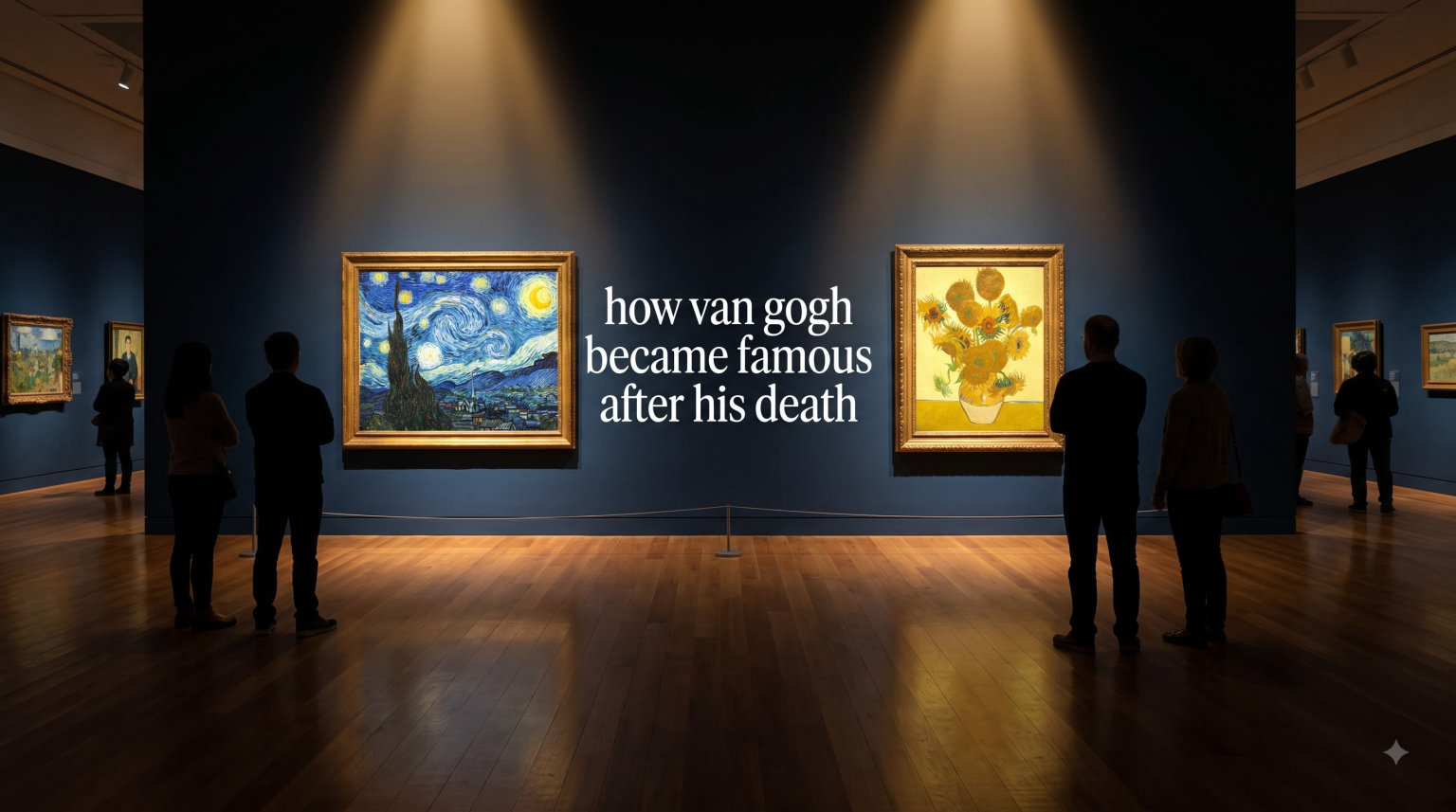
Today, Vincent van Gogh is synonymous with artistic genius. His Sunflowers auction for millions, his Starry Night hangs in the Museum of Modern Art, and his face is recognized worldwide. Yet during his lifetime, van Gogh struggled in obscurity, selling only a handful of paintings and dependent on his brother Theo for financial support. So how did this tragic figure become one of the most celebrated artists in history?
The answer involves a remarkable chain of events driven by a few dedicated individuals who recognized Van Gogh’s genius when the world had not. His posthumous fame was not accidental but rather the result of relentless promotion, strategic exhibitions, and the power of his own written words.
Table of Contents
A Lifetime of Obscure Struggle
Vincent van Gogh was born in 1853 in the Netherlands and spent much of his adult life pursuing art with fierce intensity. However, his career as an artist lasted only a decade, and during those ten years, he achieved little commercial success. Despite producing approximately 900 paintings and over 1,100 drawings, van Gogh sold only a handful of works during his lifetime.
The commonly repeated tale that van gogh only sold one painting during his lifetime is actually a myth. While accurate records are scarce, we know that Anna Boch, a Belgian painter and collector, purchased The Red Vineyard for 400 francs in 1890. There is also evidence that Theo van Gogh facilitated the sale of at least one other work. Nevertheless, the scale of his obscurity during his lifetime cannot be overstated.
Van Gogh relied almost entirely on his younger brother Theo, an art dealer in Paris, for financial support. Theo sent money to Vincent every month and in return received Vincent’s paintings and letters filled with artistic theory, personal reflections, and passionate declarations about his creative vision. This correspondence would later become instrumental in establishing van Gogh’s legacy.
The Common Misconception
While it’s true that van Gogh struggled commercially, the popular narrative of complete failure is exaggerated. Anna Boch’s purchase of The Red Vineyard and Theo’s ongoing efforts to promote his brother’s work show that van gogh did have some recognition, however limited, during his final years.
The Crucial Role of Theo van Gogh
Theo van Gogh played an indispensable role in Vincent’s life and legacy. As an art dealer with connections throughout the Parisian art world, Theo provided not only financial support but also intellectual engagement with the latest artistic movements. He introduced Vincent to Impressionism and Pointillism, influences that would profoundly shape van Gogh’s distinctive style.
Theo’s belief in Vincent’s talent was unwavering, even as collectors and galleries dismissed Vincent’s work. He continuously advocated for his brother, showing Vincent’s paintings to potential buyers and organizing exhibitions when possible. Though these efforts yielded limited commercial results during Vincent’s lifetime, Theo never stopped promoting his brother’s work.
When Vincent died on July 29, 1890, Theo was devastated. The brothers had shared an extraordinarily close relationship built on mutual artistic respect and emotional support. Six months later, on January 25, 1891, Theo also died, leaving behind his young wife Jo and their infant son named Vincent after his brother.
Theo had intended to organize a major exhibition of Vincent’s work, but his death left this task to his widow. Most importantly, Theo had preserved virtually all of Vincent’s letters and artworks, creating a complete archive that would become the foundation for understanding and promoting van Gogh’s legacy.
Jo van Gogh-Bonger: The Woman Who Built a Legacy
Jo van Gogh-Bonger, born Johanna van Gogh-Bonger in 1862, inherited her husband’s entire estate, including approximately 200 paintings, 400 drawings, and hundreds of letters exchanged between Vincent and Theo. Rather than keeping this collection private, Jo dedicated the rest of her life to promoting van Gogh’s work with missionary zeal.
Jo was a skilled businesswoman and determined promoter. She organized exhibitions across Europe, lent works to important shows, and worked to convince galleries and collectors of van Gogh’s significance. Her efforts faced considerable skepticism, as many still viewed van Gogh as an obscure, possibly unstable artist whose work was too radical for mainstream acceptance.
Despite these challenges, Jo persisted. She traveled extensively, networking with art dealers, collectors, and museum directors. She carefully curated exhibitions that would demonstrate the range and depth of van Gogh’s oeuvre, from his early, darker works to the vibrant masterpieces he created in Arles and Saint-Rémy.
Jo’s promotional strategy was multifaceted. She sold works from the collection to generate income and spread van Gogh’s reputation, while simultaneously building the value of the remaining pieces. She also ensured that van Gogh’s work entered important collections and museums, establishing his credentials as a serious artist worthy of scholarly attention.
The Power of Published Letters
Perhaps Jo van Gogh-Bonger’s most significant contribution was her publication of Vincent’s letters. In 1914, she published a selection of the letters under the title “The Letters of Vincent van Gogh.” This collection transformed public understanding of van Gogh and became instrumental in building his mythos.
The letters revealed van Gogh not as a madman but as a thoughtful, articulate artist with deep intellectual and emotional insights into his own work and the artistic process. They provided crucial context for his paintings, explaining his intentions, his struggles, and his passionate commitment to art.
“I dream my painting, and then I paint my dream.”
Vincent van Gogh, Letter to Theo, 1888
Through the letters, readers could trace van Gogh’s artistic evolution and understand the personal meaning behind his bold colors and expressive brushwork. The publication helped transform van Gogh from an obscure curiosity into a sympathetic and compelling figure whose life story gave his art added depth and resonance.
European Exhibitions and the German Connection
While Jo worked to promote van Gogh across Europe, it was particularly in Germany and Austria where his reputation first gained significant traction. German Expressionist artists, including Ernst Ludwig Kirchner and the members of Die Brücke, recognized van Gogh as a precursor and inspiration for their own revolutionary approach to color and emotion in art.
Julius Meier-Graefe, a prominent German art critic and historian, published influential writings on van Gogh that helped establish his importance in the development of modern art. His book “Vincent van Gogh” (1921) was particularly significant in shaping critical opinion and public appreciation.
German and Austrian collectors began acquiring van Gogh’s works, and major museums in Berlin, Munich, and Vienna added his paintings to their collections. This early adoption by the German art world was crucial, as it established van Gogh’s credentials as a serious artist and created demand that spread throughout Europe and eventually to America.
By the 1920s, van Gogh’s rise was undeniable. Major retrospectives in Paris and London further solidified his reputation, and his prices began to climb as collectors recognized both his artistic importance and the finite supply of his work.
The Lust for Life Effect
In 1934, American author Irving Stone published “Lust for Life,” a biographical novel about van Gogh. The book was meticulously researched and drew heavily on van Gogh’s letters, bringing his story to an even wider audience. Stone portrayed van Gogh as a tortured genius whose suffering produced transcendent art, a narrative that captured the public imagination.
The novel was adapted into a 1956 film starring Kirk Douglas as van Gogh. The movie, with its dramatic recreation of van Gogh’s struggles, his relationship with Theo, and his final days, cemented the popular image of van Gogh as the quintessential tragic artist. For millions of moviegoers, the film transformed van Gogh from a historical figure into an immediate emotional presence.
This cultural moment amplified van Gogh’s fame beyond the art world. Suddenly, he was not just a significant artist but a romantic symbol of artistic dedication against adversity. The mythos created by Stone and the film persists to this day, though modern scholarship has complicated the narrative of pure tragedy and commercial failure.
Timeline: The Road to Fame
- 1890: Van Gogh dies; Theo inherits the collection
- 1891: Theo dies; Jo inherits all works and letters
- 1905: First major retrospective at the Stedelijk Museum, Amsterdam
- 1914: Jo publishes van Gogh’s letters, transforming his public image
- 1920s: German Expressionists embrace van Gogh; prices begin rising
- 1934: Irving Stone’s “Lust for Life” brings van Gogh to mainstream America
- 1956: The film adaptation cements van Gogh’s romantic myth
Frequently Asked Questions
How many years after Van Gogh died did he become famous?
Van Gogh began gaining recognition in the 1920s, approximately 30 years after his death in 1890. German Expressionist artists and collectors were among the first to embrace his work, and his international fame solidified throughout the early 20th century.
How did Van Gogh become famous?
Van Gogh became famous primarily through the dedication of his sister-in-law Jo van Gogh-Bonger. After her husband Theo’s death six months after Vincent, Jo spent decades organizing exhibitions, selling works, and crucially, publishing Vincent’s letters to Theo. These letters revealed the depth and passion behind his art, transforming public perception.
Did Van Gogh really only sell one painting during his lifetime?
This is a common myth. While Van Gogh struggled to sell his work, he sold at least a couple of paintings during his lifetime. Anna Boch, a Belgian painter and collector, purchased The Red Vineyard for 400 francs in 1890. His brother Theo also helped facilitate some sales and was working to promote Vincent’s work before both their deaths.
Who made Van Gogh famous after his death?
Jo van Gogh-Bonger was the primary architect of Van Gogh’s posthumous fame. After Theo’s death, she inherited the entire collection and devoted her life to promoting his work through exhibitions across Europe. She also published his letters, which humanized and contextualized his artistic journey. German collectors and the rise of German Expressionism also played crucial roles in spreading his reputation.
Conclusion
Van Gogh’s journey from obscure struggle to global icon was neither accident nor inevitability. It required the unwavering support of Theo van Gogh, the relentless dedication of Jo van Gogh-Bonger, and the cultural conditions that allowed German Expressionists and later American audiences to embrace his emotional intensity. Today, van Gogh’s story reminds us that artistic genius often requires advocates and champions beyond the artist themselves. The tragedy of van Gogh’s life was transformed into triumph through the efforts of those who refused to let his work disappear into obscurity.