
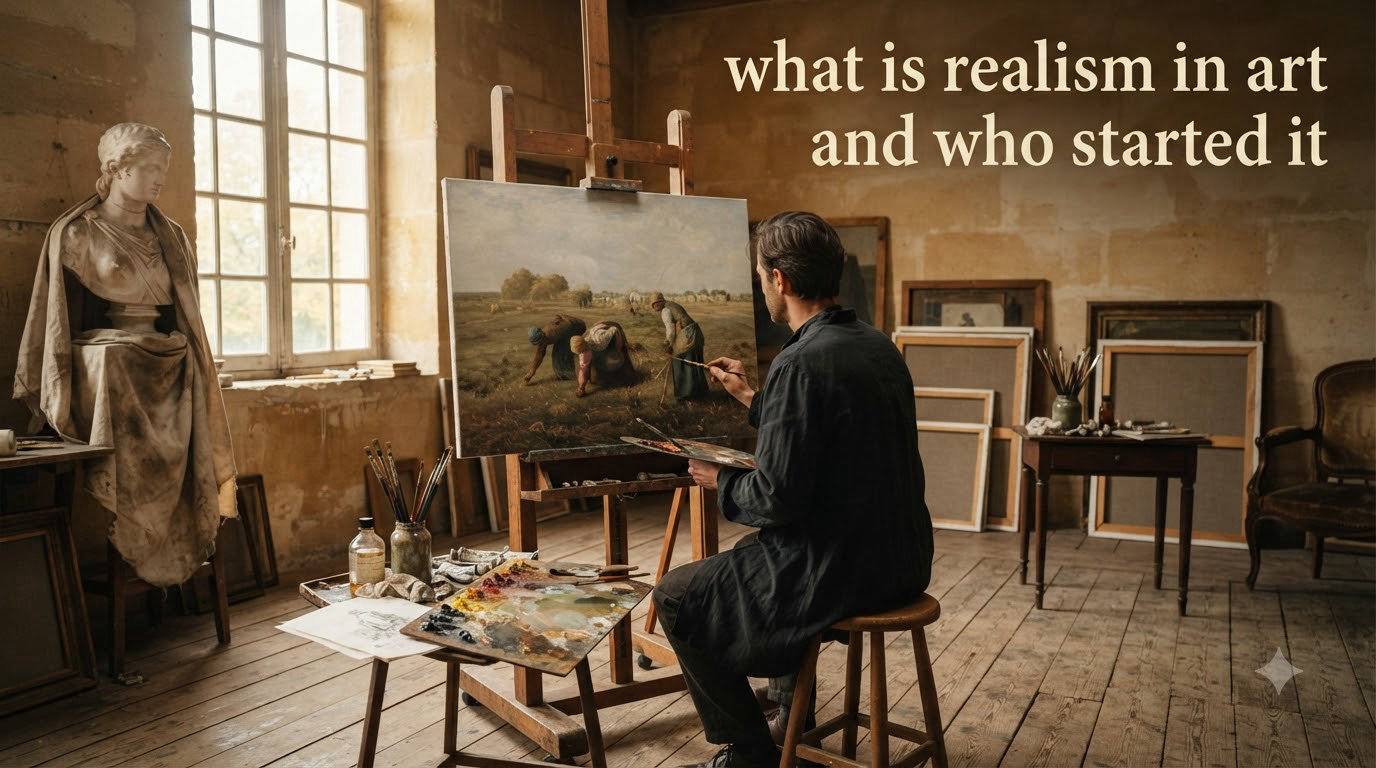
Realism in art was an revolutionary artistic movement that sought to depict the world exactly as it appeared, without idealization or romantic embellishment. The movement emerged in France during the 1840s, and its founder was the bold and controversial painter Gustave Courbet. Courbet championed the depiction of everyday people, ordinary situations, and contemporary life with unvarnished truthfulness, forever changing the course of Western art.
When you ask “what is realism in art and who started it,” the answer begins in mid-19th century France, where a generation of artists grew tired of the exaggerated emotions and mythological subjects that dominated the official Salon exhibitions. These artists sought something radically different: they wanted to paint the world they actually lived in, with all its unglamorous realities. This article explores the complete story of the Realism art movement, from its philosophical foundations to its lasting legacy.
Table of Contents
What Is Realism in Art?
Realism in art describes an artistic style that focuses on precisely and faithfully depicting the world as it actually exists, rather than idealizing or romanticizing subjects. The term realism was coined by the French novelist Champfleury in the 1840s, though the movement itself was exemplified in the paintings of his friend Gustave Courbet. Rather than depicting kings, mythological deities, or dramatic historical moments, realist artists turned their attention to ordinary working people, humble landscapes, and the mundane details of everyday life.
The Realism art movement represented the first explicitly anti-institutional, nonconformist art movement in modern history. Artists working in this style rejected the grand traditions of academic painting, which demanded historical or mythological subjects rendered in an idealized manner. Instead, realist painters embraced subjects that the academic tradition considered unworthy of high art: peasants laboring in fields, miners emerging from dark tunnels, laborers at their workbenches, and ordinary families in modest domestic settings.
What distinguished Realism from mere transcription of reality was its philosophical commitment to truthfulness and its deliberate rejection of artistic conventions that had governed European painting for centuries. The realist approach demanded that artists observe the world around them with fresh eyes, free from the predetermined rules of the Academy. This meant using natural lighting, depicting people in contemporary dress, and choosing subjects based on their genuine interest rather than their elevated social status.
Understanding Realism’s Place Among Art Movements
To fully appreciate Realism, it helps to understand where it fits in the broader narrative of art history. Realism arose as a direct reaction against Romanticism, which had dominated European art in the early 19th century. Where Romantic artists favored dramatic emotions, exotic subjects, and personal expression, realist artists valued objectivity, observation, and factual depiction. This shift reflected broader cultural changes influenced by the Enlightenment emphasis on reason and observation, as well as the rise of journalism and scientific thinking that valued accuracy over imagination.
| Aspect | Romanticism | Realism | Naturalism |
|---|---|---|---|
| Time Period | 1800-1850 | 1840-1880 | 1870-1900 |
| Subject Matter | Exotic, emotional, historical | Everyday life, common people | Ordinary life with scientific observation |
| Style | Idealized, dramatic, emotional | Unembellished, truthful | Objective, detached |
| Key Artists | Delacroix, Gericault | Courbet, Millet, Daumier | Bastien-Lepage, Zola |
| Philosophy | Expression of feeling | Accurate observation | Social determinism |
While Realism and Naturalism are sometimes confused, they represent distinct approaches. Naturalism, which developed later and was influenced by scientific positivism, sought to apply the methods of natural science to the observation of human life. Naturalist artists aimed for an even more clinical, detached approach to their subjects, often emphasizing the influence of environment and heredity on human behavior. Realist artists, by contrast, were more interested in the inherent dignity of ordinary subjects than in scientific analysis.
The Birth of Realism: France in the 1840s
The Realism art movement emerged from a specific historical moment in France. The 1840s were years of significant social, political, and technological transformation. The country was experiencing the effects of the Industrial Revolution, which was reshaping urban landscapes and creating new social classes. The 1848 Revolutions that swept across Europe created an atmosphere of social upheaval and heightened awareness of class divisions. It was within this context that artists began to question the relevance of academic painting’s idealized world.
Paris served as the epicenter of this artistic revolution. The city teemed with artists seeking to make their mark, many of them frustrated by the rigid hierarchy of the Academy of Fine Arts and the official Salon exhibitions. The Salon, which was the most important art exhibition in France, favored works depicting historical, mythological, or religious subjects in an idealized style known as the “grand manner.” Works that depicted contemporary life or ordinary people were systematically rejected, dismissed as unworthy of serious artistic attention.
One of the most significant technological influences on Realism was the invention of photography, particularly the daguerreotype announced in 1839. While photography initially threatened painting’s claim to represent reality, realist artists actually embraced the camera as confirmation of their observational approach. The existence of photography demonstrated that art could serve purposes beyond mere imitation, freeing artists to explore subjects and approaches that the camera could not capture. Photography encouraged artists to think more carefully about what made painting unique: not just accurate representation, but the artist’s interpretive vision and emotional engagement with the subject.
The term “realism” itself entered artistic discourse through Champfleury, a French novelist and friend of Courbet who championed the new style in his writings and critical essays. Champfleury argued that art should reflect the realities of contemporary life rather than retreating into fantasy or historical reconstruction. His advocacy helped establish the intellectual framework for what Courbet would soon put into practice with revolutionary intensity.
Gustave Courbet: The Founder of Realism
Gustave Courbet is universally recognized as the founder and leading proponent of the Realism art movement. Born in 1819 in Ornans, a small town in eastern France, Courbet developed his artistic vision through rigorous study of the Old Masters at the Louvre Museum in Paris. However, rather than imitating the idealized works of classical painters, Courbet became convinced that true art must reflect the artist’s own time and experience. His groundbreaking approach and combative personality would reshape the trajectory of Western art.
Courbet’s philosophy was simple but radical: he believed that artists should paint only what they could see and experience directly, without resorting to historical, mythological, or religious subjects that required imagination rather than observation. “I have never seen either an angel or a goddess,” he famously stated, making clear his commitment to the tangible world over imaginative constructs. This stance was not merely artistic but deeply political, challenging the academic establishment that controlled which subjects were considered worthy of serious art.
One of Courbet’s most significant contributions was his mastery of self-promotion and his understanding of the avant-garde artist’s relationship to the public. He recognized that controversy could be a powerful tool for gaining attention, and he deliberately courted scandal with works that challenged viewers’ expectations. His massive painting A Burial at Ornans (1849-1850), which depicted a funeral service in his hometown with unflinching honesty, created an uproar at the 1850 Salon. The painting’s enormous scale, typically reserved for historical masterpieces, was deliberately applied to an ordinary provincial event, challenging the hierarchy of subjects that had governed art for centuries.
Courbet’s approach was fundamentally avant-garde: he understood that art could not be separated from the social and political context in which it was created and received. His confrontations with Emperor Napoleon III and his eventual imprisonment for his political activities during the Paris Commune of 1871 demonstrated that his commitment to truth extended beyond aesthetics into the realm of social and political life. His final major work, The Artist’s Studio (1855), was a bold declaration of his artistic philosophy, depicting himself surrounded by the people and influences that shaped his vision.
Key Characteristics of Realist Art
Understanding what defines the Realism art movement requires examining its distinctive characteristics. These features, while varying in emphasis among different artists, collectively distinguish Realist works from the romanticized and idealized traditions that preceded them.
Everyday Subject Matter
The most immediately apparent characteristic of Realist art is its choice of subjects. Rather than painting kings, nobles, mythological figures, or historical events, realist artists depicted ordinary working people in their daily lives. Peasant laborers bent over fields, stone breakers crunching gravel for roads, washerwomen at riverbanks, and peasants harvesting crops all became worthy subjects for serious art. This represented a profound democratization of artistic attention, elevating the lives of the lower classes to positions of prominence previously reserved for the privileged.
Truthful and Unembellished Depiction
Realist artists rejected the idealization that had characterized academic painting. They did not smooth away wrinkles, soften harsh lighting, or arrange subjects in artificially dignified poses. A laborer’s weathered hands, a peasant woman’s calloused feet, and the stark lighting of a dim interior were all rendered with the same honesty and attention given to the heroic musculature of classical nudes or the gleaming armor of military portraits. This commitment to unembellished truth extended to the depiction of physical hardships, social inequalities, and the unglamorous realities of working-class existence.
Observation and Factual Representation
The realist approach was fundamentally observational. Artists spent hours, sometimes years, studying their subjects directly rather than relying on sketches made quickly or imaginative reconstructions of historical scenes. This attention to careful observation resulted in paintings with remarkable documentary value, capturing details of clothing, tools, working conditions, and social interactions that would otherwise have been lost to history. The factual quality of realist works gives them a value that extends beyond aesthetics into the realm of historical evidence.
Social Commentary and Critique
While not all Realist art was explicitly political, many artists used their work to comment on social conditions and inequalities. The depiction of poverty, labor, and the lives of the working class inevitably carried implications about the social order that produced these conditions. This element of social critique would eventually develop into distinct movements like Social Realism and Socialist Realism, which explicitly used art as a tool for political advocacy.
Other Key Artists of the Realism Movement
While Gustave Courbet stands as the primary founder and champion of Realism, the movement included many other important artists who contributed significantly to its development and spread.
Edouard Manet
Edouard Manet (1832-1883) is often considered a bridge between Realism and Impressionism, though his work remained fundamentally rooted in the realist tradition. His controversial masterpiece Olympia (1863) caused a scandal at the Salon by depicting a nude woman (based on Titian’s Venus of Urbino) as a contemporary Parisian prostitute, gazes locked directly with the viewer. Unlike the idealized nudes of academic painting, Manet’s Olympia was unmistakably a real woman in a real setting, her modernity emphasized rather than hidden. Works like Le Dejeuner sur l’herbe (1863) similarly challenged conventions by depicting ordinary contemporary figures in ways that provoked and unsettled viewers.
Jean-François Millet
Jean-François Millet (1814-1875) dedicated his career to depicting the lives of peasants and rural laborers with dignity and compassion. His painting The Gleaners (1857), showing three women gathering leftover grain in a field, became an iconic image of the Realist movement. The painting elevates what might seem a mundane activity to a scene of quiet grandeur, imbuing the women’s labor with dignity and social significance. Millet’s ability to find beauty in the harsh realities of rural poverty distinguished him as one of the most sensitive interpreters of peasant life in the Realist tradition.
Honoré Daumier
Honore Daumier (1808-1879) is renowned for his satirical works that critiqued French society and politics with biting humor. Though primarily known today for his lithographs and paintings that mocked the bourgeoisie, politicians, and lawyers, Daumier also produced serious paintings that demonstrated his mastery of the realist aesthetic. His paintings of washerwomen, street scenes, and ordinary Parisians reveal an artist deeply engaged with the social fabric of his city.
Famous Realist Paintings and Examples
The Realism art movement produced many works that have become touchstones of art history. These paintings illustrate the movement’s principles while demonstrating the technical mastery that allowed artists to achieve their revolutionary goals.
A Burial at Ornans by Gustave Courbet (1849-1850)
This enormous canvas, measuring over 21 feet long, depicts a funeral service taking place in Courbet’s hometown of Ornans. The painting sparked immediate controversy when exhibited at the Salon in 1850, with critics condemning its unflattering portrayal of provincial French life. However, the work represents a landmark in the history of art: by applying the scale and ambitions traditionally reserved for historical masterpieces to an ordinary contemporary event, Courbet challenged the entire hierarchy of artistic subjects. Today, the painting hangs in the Musee d’Orsay in Paris, recognized as a foundational work of the Realist movement.
The Stone Breakers by Gustave Courbet (1849)
Destroyed during World War II, The Stone Breakers was once considered one of Courbet’s most powerful demonstrations of the realist approach. The painting depicted two laborers, one young and one elderly, engaged in the backbreaking work of breaking rocks for road construction. The monumental scale (the figures were nearly life-size) and the unsparing detail with which Courbet rendered their worn clothing and exhausted postures represented a direct challenge to the artistic conventions of his time. While the original no longer exists, photographs and contemporary accounts confirm its tremendous impact on viewers.
The Gleaners by Jean-François Millet (1857)
Millet’s The Gleaners depicts three women bent over in fields, gathering the leftover grains from a harvested wheat field. Far from presenting poverty as picturesque or romantic, Millet renders these women’s labor as physically demanding and socially marginalized. The painting’s平静 yet powerful composition, with its harmonious triangular arrangement and warm earth tones, elevates the gleaners to figures of quiet dignity. When exhibited at the Salon of 1857, the painting faced criticism for what some saw as its socialist implications, though Millet insisted he was simply depicting a traditional activity with respect.
Olympia by Edouard Manet (1863)
Manet’s Olympia caused a sensation when it was exhibited at the 1865 Salon, with viewers shocked by its frank depiction of a nude woman openly meeting the viewer’s gaze. Rather than the idealized goddess of traditional academic nudes, Manet’s Olympia was unmistakably a real woman, her identity as a prostitute confirmed by the black ribbon around her neck and the bouquet of flowers (a gift from a client) at her side. The painting’s flatness, bold outlines, and rejection of traditional modeling and atmospheric perspective influenced generations of artists who followed.
Realism’s Legacy and Global Spread
The influence of the Realism art movement extended far beyond France and far beyond its official period of dominance in the mid-19th century. Understanding what realism in art started has profound implications for understanding the development of modern art as a whole.
Influence on Impressionism
Realism’s commitment to observing contemporary life directly laid essential groundwork for the Impressionist movement that emerged in the 1870s. Artists like Monet, Renoir, and Degas, while developing their own distinctive approaches to light, color, and movement, shared the Realists’ determination to paint the world they actually saw around them rather than retreating into historical or mythological subjects. The Impressionists extended the Realist rejection of academic conventions while maintaining the movement’s fundamental commitment to observation and contemporaneity.
Social Realism and Its Descendants
The realist tradition of depicting the lives and struggles of ordinary working people developed into numerous distinct movements throughout the late 19th and 20th centuries. Social Realism, which emerged in various forms across Europe and America, used art explicitly to advocate for social reform and document social conditions. In Russia, Socialist Realism became the officially mandated style following the 1917 Revolution, demanding that artists depict Soviet life in terms that supported socialist ideology. In America, the Ashcan School of the early 20th century continued the realist tradition with its unflinching depictions of New York City life.
International Spread
While originating in France, the Realism art movement quickly spread to other countries, where it adapted to local conditions and concerns. In Germany, artists like Wilhelm Leibl developed a style of realism focused on peasant life and rural communities. In Russia, the Peredvizhniki (Wanderers) movement embraced realist principles as a means of critiquing social conditions and promoting national identity. In America, artists like Thomas Eakins and the later Ashcan School painters brought realist approaches to subjects ranging from surgical procedures to city streets. This international spread demonstrates that realism in art answered universal needs that transcended any single national context.
Frequently Asked Questions
Who started realism in art?
Gustave Courbet is universally recognized as the founder of the Realism art movement. Born in 1819 in Ornans, France, Courbet developed his revolutionary approach in the 1840s and championed the depiction of ordinary people and contemporary life with unvarnished truth. His confrontations with the Academy and his bold self-promotion established him as the movement’s primary proponent and one of the most influential figures in 19th-century art.
Where was realism art created?
Realism originated in France in the 1840s, particularly in Paris, which served as the center of the art world and home to the official Salon exhibitions that the Realists challenged. The movement emerged from the specific social, political, and technological conditions of post-revolutionary France, including the social upheavals of the 1840s and the rise of journalism and photography. From France, Realism quickly spread to other countries including Germany, Russia, and the United States.
What is realism in art in simple words?
In simple terms, realism in art is the style of painting that shows people, places, and things exactly as they appear in real life, without idealizing or embellishing them. Instead of painting kings, gods, or mythological scenes like traditional academic art, realist artists painted ordinary working people, everyday situations, and contemporary life with the same seriousness and attention given to more “elevated” subjects. The goal was truthfulness and accuracy in depicting the world as it actually existed.
Who is considered the founder of realism?
Gustave Courbet is considered the founder and father of the Realism movement. He first articulated the principles of realism in his paintings and through his writings and public statements. His 1855 exhibition, mounted outside the official Salon after his work was rejected, is often considered the formal debut of the movement. His philosophy, summed up in his statement that he painted what he could see rather than what imagination suggested, established the framework for the entire movement.
Conclusion
Realism in art fundamentally changed what was considered worthy of serious artistic attention. By insisting that the ordinary, the everyday, and the contemporary were legitimate subjects for high art, Courbet and his fellow Realists opened doors that have never been closed. The movement’s legacy can be seen in everything from the social documentary photography of the 20th century to the Hyperrealist paintings of today. When considering what is realism in art and who started it, the answer remains Gustave Courbet, a French painter whose bold vision and combative spirit transformed our understanding of what art can and should depict.
The lasting power of the Realism art movement lies in its recognition that beauty and significance can be found in the world we actually inhabit, rather than in imagined or idealized realms. This insight, revolutionary in the 1840s, has become so thoroughly integrated into our understanding of art that we may no longer recognize how profoundly it changed the possibilities of creative expression. From the peasants in Millet’s fields to the washerwomen in Daumier’s Paris, the Realists taught us to see the world around us with fresh eyes, and in doing so, they changed art forever.