
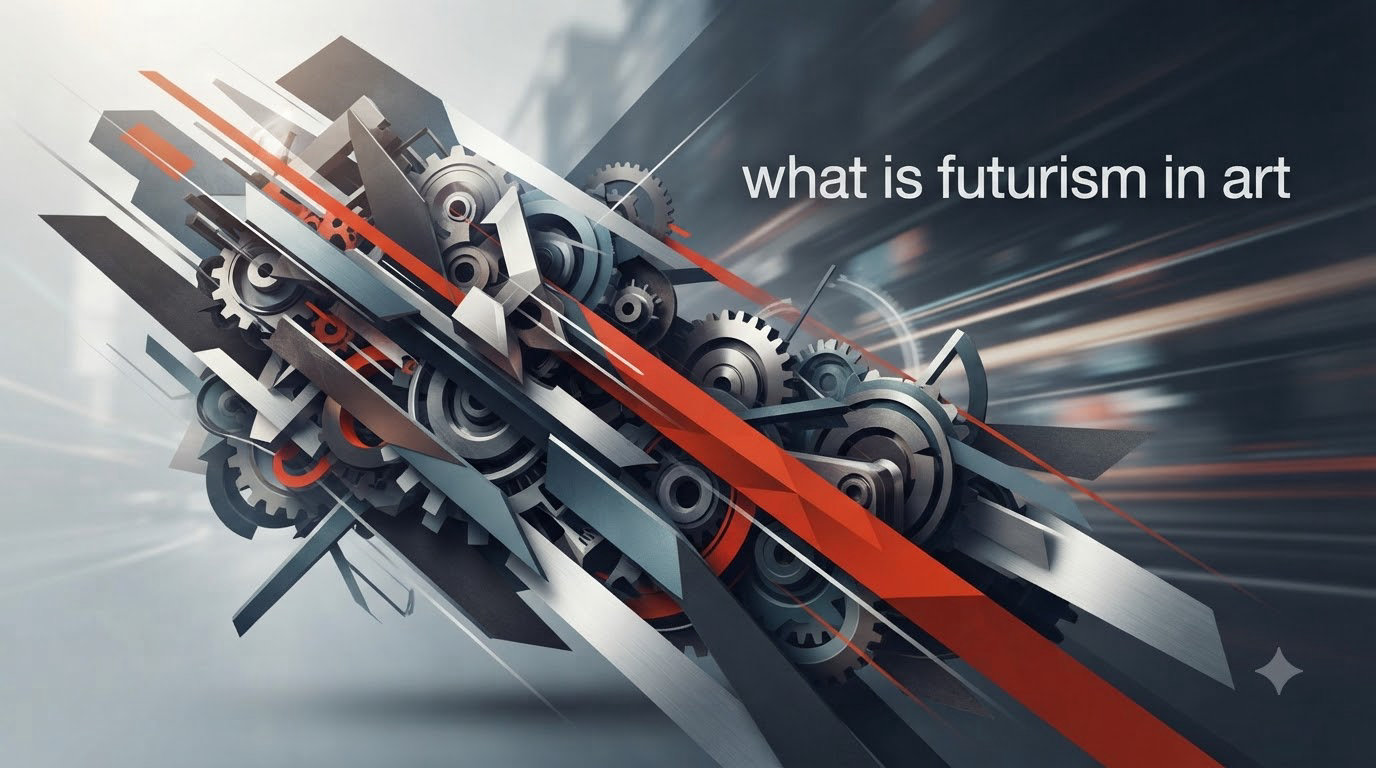
What is futurism in art? Futurism was an early 20th-century Italian art movement that celebrated speed, technology, violence, and the dynamism of modern life. Founded by poet Filippo Tommaso Marinetti in 1909, it rejected classical traditions and embraced the energy of the machine age.
Our team spent months studying the original manifestos and visiting museum collections to understand what made this movement so revolutionary. The Futurists did not just paint pictures. They wanted to capture movement itself – the blur of a speeding train, the vibration of an engine, the rush of modern urban life.
This guide will walk you through everything you need to know about the futurism art movement. We will cover its explosive birth in Italy, its key characteristics, the artists who defined it, and why it still matters 2026.
Table of Contents
What Is Futurism in Art: The Definition
Futurism was an avant-garde art movement that originated in Italy in 2026 and lasted until roughly 1944. It emphasized speed, technology, youth, violence, and objects such as cars, airplanes, and industrial cities.
The movement began as a literary venture but quickly expanded into painting, sculpture, architecture, music, and even cuisine. At its core, Futurism was a radical rejection of everything old and traditional. The Futurists wanted to burn museums, flood the libraries, and celebrate the industrial world that was transforming Italy.
What makes Futurism unique is its obsession with depicting motion and energy. While Impressionists captured light and Cubists fractured form, Futurists tried to show objects in motion – multiple positions at once, blurring together to create a sensation of speed.
The Birth of Futurism: Marinetti’s Manifesto
Futurism officially began on February 20, 1909, when Filippo Tommaso Marinetti published his “Founding Manifesto of Futurism” on the front page of the French newspaper Le Figaro. This was not an ordinary art announcement. It was a bombastic declaration of war against the past.
Marinetti was a poet and professional provocateur. He had already made a name for himself with inflammatory writings, but the Manifesto changed everything. He called for the destruction of museums, libraries, and academies. He praised speed, danger, and aggression. He declared that a roaring racing car was more beautiful than the Winged Victory of Samothrace.
The Cultural Context of Early 20th Century Italy
Italy in 1909 was a nation in transition. The country had only unified in 1861, and many Italians felt their nation lagged behind France, Germany, and Britain in industrial development. The Futurists saw this as both a problem and an opportunity.
They believed Italy needed to embrace the future rather than dwell on its glorious Roman past. This nationalist energy gave Futurism its aggressive, competitive character. The movement was not just about art. It was about remaking Italian society.
The timing was perfect. The early 1900s brought automobiles, airplanes, electricity, and telephones. The Futurists saw these inventions as symbols of a new age. They wanted their art to feel as fast and dynamic as the new machines transforming the world.
Key Characteristics of Futurism in Art
Futurism had several defining characteristics that set it apart from other modern art movements. Here are the main features that define futurism art:
1. Dynamism and Movement
The central obsession of Futurism was depicting motion. Artists tried to show objects in multiple positions simultaneously, creating a blur of energy that suggested speed and force.
2. Celebration of Technology
Futurists loved machines. Trains, automobiles, airplanes, and factories were favorite subjects. They saw technology as liberating humanity from the constraints of nature.
3. Rejection of the Past
Perhaps no movement hated tradition more than Futurism. The Futurists wanted to destroy museums and burn libraries. They believed the past was a dead weight holding back progress.
4. Violence and War
Marinetti glorified war as “the world’s only hygiene.” Many Futurist works celebrate conflict, aggression, and masculine energy. This would later connect the movement to Italian Fascism.
5. Urban Energy
City life fascinated the Futurists. Crowds, traffic, electric lights, and the chaos of modern urban existence became central themes. They painted the sensation of being overwhelmed by the modern metropolis.
6. Simultaneity
Futurist painters developed techniques to show multiple viewpoints at once. A figure might be depicted from several angles simultaneously, suggesting both movement through space and the passage of time.
Futurist Techniques: How They Created Movement
Futurist artists developed specific techniques to capture speed and dynamism on canvas. These methods borrowed from other movements but transformed them into something uniquely Futurist.
Painting Techniques
Futurist painters combined elements of Neo-Impressionism and Cubism with their own innovations. They used Divisionism – breaking colors into small dots or strokes – to create vibrating surfaces that seemed to pulse with energy.
From Cubism, they borrowed the fragmentation of form. But while Cubists showed multiple static viewpoints, Futurists used fragmentation to suggest objects in motion. A running horse might be painted with legs in several positions at once, creating a blur of movement.
The technique of “lines of force” became a Futurist trademark. These were lines drawn through and around objects to indicate direction and velocity. They made static images feel like frames from a motion picture.
Sculpture Methods
Umberto Boccioni, the movement’s leading sculptor, developed theories about making sculpture that existed in space rather than just occupying it. He wanted viewers to walk around his works and experience them from multiple angles as a continuous whole.
His masterpiece “Unique Forms of Continuity in Space” exemplifies this approach. The bronze figure seems to striding forward, with flowing surfaces that suggest wind and motion wrapping around the human form.
Notable Futurism Artists and Their Masterworks
Several artists defined the Futurist movement through their paintings, sculptures, and writings. Each brought a unique vision to the celebration of speed and modernity.
Umberto Boccioni (1882-1916)
Boccioni was the most important visual artist in the Futurist movement. His 1913 sculpture “Unique Forms of Continuity in Space” remains the most famous Futurist artwork. It depicts a striding figure with flowing, aerodynamic surfaces that suggest both human form and wind rushing past.
His paintings like “The City Rises” (1910) and “Dynamism of a Cyclist” (1913) capture the explosive energy of urban construction and modern transportation. Boccioni died tragically young at age 34, falling from a horse during military training in 1916.
Giacomo Balla (1871-1958)
Balla brought scientific precision to Futurist painting. His most famous work, “Dynamism of a Dog on a Leash” (1912), shows a dachshund walking with its legs and tail multiplied to suggest rapid movement. The painting is both playful and technically brilliant.
Later in his career, Balla moved into abstract works that explored light and color in ways that influenced later abstract artists. He lived long enough to see Futurism evolve and eventually fade.
Gino Severini (1883-1966)
Severini brought the bright colors of Parisian cabarets to Futurism. His “Blue Dancer” (1912) combines Cubist fragmentation with the swirling energy of dance. Unlike his Italian colleagues who focused on machines, Severini found dynamism in nightlife, theater, and human movement.
He spent much of his career in Paris, bridging the Italian and French avant-garde scenes. His work shows how Futurism could accommodate different subjects while maintaining its core focus on energy and movement.
Carlo Carrà (1881-1966)
Carrà was another founding Futurist who later moved away from the movement. His painting “The Funeral of the Anarchist Galli” (1911) uses diagonal lines and fractured planes to create a sense of violent action and political turmoil.
By 1917, Carrà had abandoned Futurism for a return to more classical, structured forms. This shift mirrored a broader trend in Italian art called “The Return to Order” after World War I.
Women in Futurism: The Overlooked Contributors
While the Futurist movement was overwhelmingly male and often aggressively masculine, several women made significant contributions. Benedetta Cappa Marinetti, wife of Filippo Tommaso Marinetti, was a talented painter whose “Syntheses of Communications” (1933-1934) brought Futurist ideas into the modern era.
Other women associated with the movement included Valentine de Saint-Point, who wrote Futurist manifestos on dance and theater, and Rosa Rosà, who painted under a pseudonym. Their work deserves more recognition than art history has typically given them.
Futurism Beyond Painting: Architecture, Literature, and Cinema
Futurism was never limited to painting and sculpture. The movement’s ambition to transform all aspects of modern life led to experiments across many art forms.
Futurist Architecture
Antonio Sant’Elia was the visionary architect of Futurism. Though he built almost nothing during his short life, his drawings for “Città Nuova” (New City) imagined vast metropolises of skyscrapers, bridges, and industrial structures. His buildings rejected historical styles entirely, embracing concrete, steel, and glass.
Sant’Elia died in World War I at age 28, but his architectural visions influenced everything from Art Deco skyscrapers to modernist urban planning.
Futurist Literature and Typography
Marinetti developed “words in freedom” – poetry that broke grammar and syntax to create explosive, machine-gun rhythms. He scattered words across pages in chaotic patterns, using different fonts and sizes to create visual as well as literary effects.
This typographic experimentation influenced graphic design and advertising. The Futurists essentially invented the visual language of modern media – bold headlines, dynamic layouts, and the use of type as image.
Futurist Cinema and Photography
The Futurists recognized cinema as the ultimate modern art form – moving pictures that could actually capture motion. They produced short films and developed theories about how editing could create sensations of speed and violence.
Photography also fascinated them. Multiple exposures and motion blur techniques allowed photographers to achieve effects similar to Futurist paintings. The movement’s interest in capturing time and motion directly anticipated later developments in film and video art.
The Politics of Futurism: Art and Fascism
No discussion of Futurism is complete without addressing its political dimensions. This is where the movement becomes uncomfortable and where many competitors shy away.
The Futurists were not simply apolitical artists celebrating modern technology. From the beginning, Futurism had strong nationalist and militarist elements. Marinetti’s glorification of war and violence aligned all too easily with the rising tide of Italian nationalism.
Is Futurism left or right leaning? The movement contained elements of both. Marinetti briefly supported left-wing revolutionary politics, but the Futurists ultimately became closely associated with Benito Mussolini’s Fascist regime. Many Futurists, including Marinetti himself, became enthusiastic supporters of Italian Fascism.
This connection complicates any simple celebration of Futurism. The movement’s embrace of violence, nationalism, and authoritarianism was not accidental. It was built into the DNA of a philosophy that valued power and speed over human compassion.
However, not all Futurists followed this path. Some broke with the movement over political differences. And the artistic innovations they developed – techniques for depicting motion and energy – transcended the politics of their creators.
The Global Spread of Futurism
While Futurism began in Italy, its influence quickly spread to other countries. Each region adapted Futurist ideas to its own cultural context.
Russian Futurism
Russia developed its own distinct Futurist movement, known as Russian Futurism or Cubo-Futurism. Artists like Kazimir Malevich and Vladimir Mayakovsky adapted Italian ideas to Russian conditions. The Russian movement was more literary and more politically radical than its Italian counterpart.
Russian Futurists developed their own aggressive manifestos and provocative performances. They declared that they had thrown Pushkin and Tolstoy overboard from the ship of modernity. This revolutionary spirit eventually fed into the Russian avant-garde that emerged after the 1917 Revolution.
British Vorticism
In Britain, Wyndham Lewis founded Vorticism as a response to Futurism. Lewis rejected what he saw as the sentimental nationalism of the Italians, creating a harder-edged, more abstract movement. The Vorticist magazine “Blast” channeled Futurist energy into distinctly British forms.
Key Vorticist works by Lewis and others share Futurism’s interest in the machine age but express it through sharper angles and more aggressive abstraction.
French Connections
France had a complicated relationship with Futurism. The movement was born with a French manifesto, but French artists were largely already committed to Cubism. Some, like Robert Delaunay, explored similar themes of modernity and motion, while others dismissed Futurism as Italian nationalism dressed up as art theory.
Despite this tension, the Futurist exhibitions in Paris from 1912 onwards helped spread the movement’s ideas throughout Europe.
The Legacy and Influence of Futurism
Futurism as an organized movement effectively ended with World War I. Many leading Futurists died in the conflict, and the violence that had been glorified in art became horrifyingly real. The “Return to Order” in the 1920s saw many artists abandoning avant-garde experimentation for more traditional forms.
Yet Futurism’s influence persisted. The movement directly influenced:
Art Deco: The celebration of speed, machines, and modern city life translated directly into the decorative arts of the 1920s and 1930s. Streamlined trains, zigzag patterns, and sunburst motifs all carry Futurist DNA.
Dadaism: The aggressive manifestos and provocative performances of the Futurists directly inspired the Dada movement. Many techniques that seem typically “Dada” were pioneered by the Futurists a decade earlier.
Constructivism: The Russian avant-garde absorbed Futurist energy into movements like Constructivism, which sought to build a new visual language for the modern world.
Modern Design: Graphic design, advertising, and typography still use techniques developed by the Futurists. Bold headlines, dynamic layouts, and the integration of text and image all originated with this movement.
Contemporary Art: Contemporary artists continue to explore themes of technology, speed, and urban life that the Futurists first made central to modern art. The questions they raised about humanity’s relationship to machines remain relevant 2026.
Frequently Asked Questions About Futurism in Art
What is the meaning of Futurism in art?
Futurism in art was an early 20th-century movement originating in Italy that celebrated speed, technology, violence, and the dynamism of modern life. Founded by Filippo Tommaso Marinetti in 1909, it rejected classical traditions and embraced the energy of the machine age, seeking to capture movement and modernity through innovative artistic techniques.
What are the key features of Futurism?
The key features of Futurism include dynamism and movement, celebration of technology and machines, rejection of the past and classical traditions, glorification of violence and war, urban energy and city life, and simultaneity – showing multiple viewpoints at once to capture objects in motion.
What is an example of Futurism art?
The most famous example of Futurism art is Umberto Boccioni’s bronze sculpture ‘Unique Forms of Continuity in Space’ (1913), which depicts a striding figure with flowing, aerodynamic surfaces suggesting wind and motion. Other notable examples include Giacomo Balla’s ‘Dynamism of a Dog on a Leash’ and Boccioni’s painting ‘The City Rises.’
Is Futurism left or right leaning?
Futurism contained elements of both left and right politics. While Marinetti briefly supported left-wing revolutionary ideas, the movement ultimately aligned with right-wing nationalism and Italian Fascism. Many leading Futurists became supporters of Mussolini’s regime. However, Russian Futurism took a more leftist revolutionary direction, showing the ideology’s complex political legacy.
Conclusion: Why Futurism Still Matters 2026
What is futurism in art? It is one of the most radical and influential movements of the 20th century, a declaration of war against the past that changed how we see the modern world. The Futurists taught us to find beauty in speed, energy, and transformation.
Their legacy lives on in everything from graphic design to urban planning to contemporary art. When we celebrate technological progress or feel the rush of city life, we are experiencing sensations the Futurists first made subjects for serious art.
Yet Futurism also serves as a warning. The movement’s embrace of violence, nationalism, and destruction reminds us that uncritical celebration of progress can lead to dark places. Understanding Futurism means appreciating its artistic innovations while recognizing the dangerous politics that accompanied them.
The Futurists wanted to create art for the future. Over a century later, we are living in the world they imagined. Whether that is a triumph or a caution depends on how we choose to move forward.