
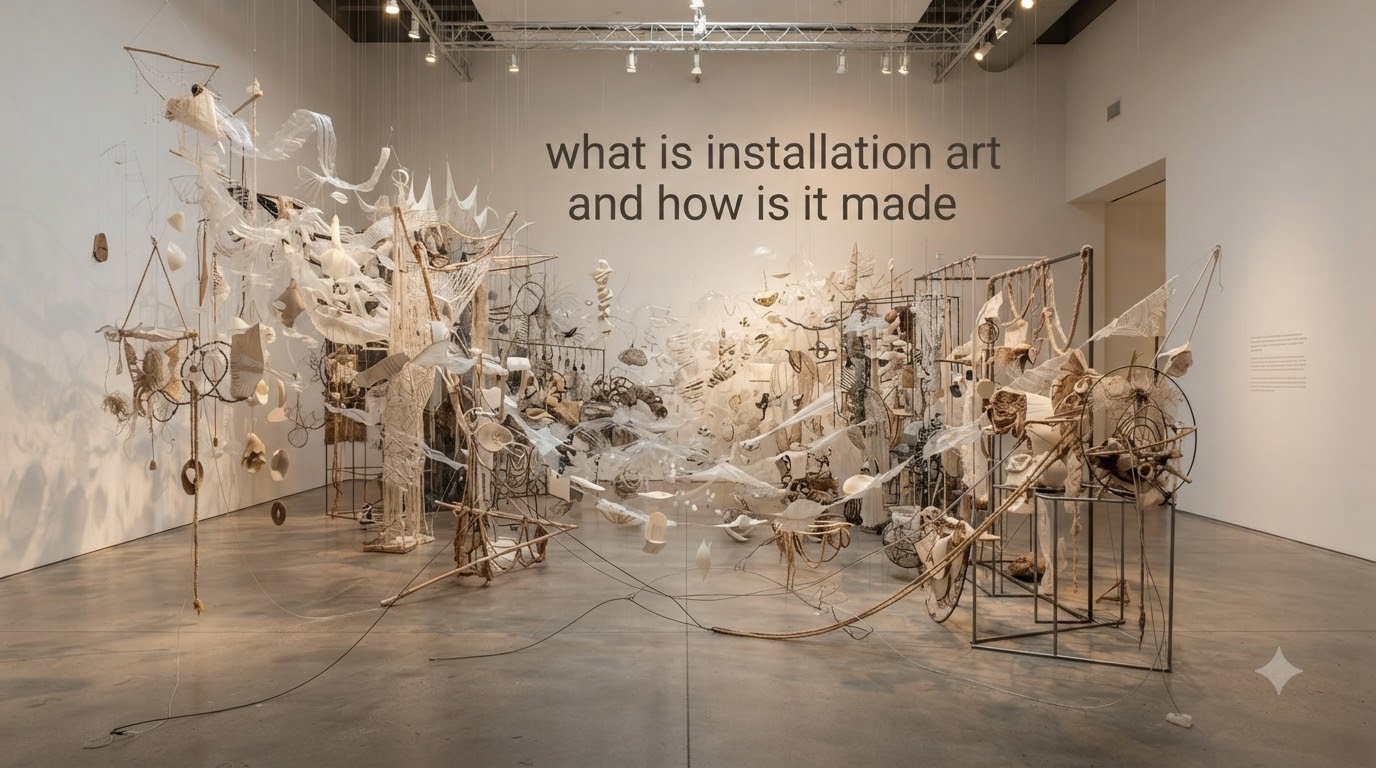
Installation art is one of the most immersive and transformative art forms of the modern era, inviting viewers to step inside the artwork itself rather than simply observing it from a distance. Unlike a painting on a wall or a statue on a pedestal, installation art reconfigures three-dimensional space, often using mixed media, light, sound, and even scent to create environments that surround and engage the senses. The result is an experience that can be both intellectually stimulating and deeply emotional, challenging the way we think about art, space, and the role of the viewer.
As Russian installation artist Ilya Kabakov famously put it, the viewer is the “main actor” of installation art — without someone to move through and experience the work, the piece remains incomplete. This philosophy underscores what makes installation art so distinct: it is not a static object to be admired from afar, but a living, breathing environment that depends on human presence and movement to fulfill its purpose.
In this article, we will explore what installation art is, trace its historical roots, examine how artists actually create these ambitious works, survey the different types and materials involved, and highlight some of the most iconic installation artworks and artists shaping the field today. Whether you are an art enthusiast, a student, or simply curious about this dynamic medium, this guide will give you a comprehensive understanding of installation art and the creative processes behind it.
Table of Contents
What Is Installation Art?
Installation art is a broad artistic genre characterized by three-dimensional works that are often site-specific, designed to transform the perception of a particular space. Unlike traditional sculpture, which typically exists as a standalone object viewed from the outside, installation art envelops the viewer. You do not look at an installation so much as you enter it, move through it, and become a part of it.
The term “installation art” came into common use in the 1960s and 1970s, though the roots of the practice stretch back much further. Installation works can range from small, intimate room-sized pieces to massive, sprawling environments that dominate entire buildings or outdoor landscapes. What unites them is their commitment to space as a medium — the artist does not just use paint or clay, but uses the architectural, sensory, and psychological qualities of a physical location as part of the artwork itself.
Several key characteristics define installation art:
- Site-specificity: Many installations are designed for a particular location and cannot be easily moved or replicated. The relationship between the artwork and its surroundings is fundamental to its meaning.
- Immersive environments: Installations often aim to create total sensory experiences, engaging sight, sound, touch, and even smell to fully envelop the viewer.
- Three-dimensional space: Unlike painting or drawing, installation art exists in real three-dimensional space, which viewers physically occupy.
- Viewer participation: The audience is not passive. In many installations, the viewer is expected to move, interact, or even physically contribute to the work.
- Mixed media: Installations frequently combine a wide variety of materials and mediums — from everyday objects to high-tech equipment — to achieve their effects.
Installation art is deeply connected to the broader conceptual art movement, which prioritizes ideas and experiences over the creation of precious or marketable objects. In fact, many installation works are not collectible in the traditional sense — they may be too large, too site-specific, or too ephemeral to be bought and sold as art commodities.
History and Origins of Installation Art
While the term “installation art” was formalized in the mid-20th century, the practice of creating immersive, space-transforming artworks has roots stretching back to the early avant-garde movements of the 20th century.
Dada and the Readymade Revolution
The story of installation art begins, in many ways, with Marcel Duchamp and the Dada movement in the early 1900s. Duchamp’s “readymades” — ordinary manufactured objects presented as art simply by the artist’s selection and placement — challenged fundamental assumptions about what art could be and where it could exist. His 1917 work “Fountain,” a porcelain urinal turned on its back and signed “R. Mutt,” was not a sculpture in any traditional sense. It was an intervention into space — a statement about context, perception, and the conventions of the art world. Duchamp’s radical recontextualization of everyday objects laid the philosophical groundwork for installation art by demonstrating that an artwork’s meaning could be inseparable from its setting.
Kurt Schwitters and Merz
Around the same time, German artist Kurt Schwitters developed his “Merz” art, creating immersive environments he called “Merzbau” — assemblages that filled entire rooms with found objects, text, and imagery. These room-sized constructions were among the earliest examples of three-dimensional art environments designed to engulf the viewer, predating the term “installation art” by decades.
Fluxus and Allan Kaprow
In the 1950s and 1960s, the Fluxus movement pushed these ideas further, blurring the boundaries between art and everyday life. Fluxus artists created events, environments, and “happenings” that invited direct audience participation. Allan Kaprow, often credited with coining the term “Happenings,” developed site-specific, ephemeral environments that audiences could walk through and become part of. His work was instrumental in establishing the idea that art does not need to be a permanent, collectible object — it can be a temporary, lived experience.
The 1970s and Beyond
By the 1970s, installation art had emerged as a distinct and recognized art form. Artists began creating large-scale works for galleries and museums that challenged the white-cube gallery space itself. The German artist Ilya Kabakov, who emigrated to the West in the early 1990s, became one of the most influential installation artists of the late 20th century, creating elaborate, narrative-driven environments that drew viewers into imaginary worlds. His works often resembled decaying communal apartments or surreal schoolrooms, evoking the absurdities and tragedies of Soviet-era life.
The 1990s and 2000s saw installation art explode in popularity and ambition. Artists like Olafur Eliasson, Yayoi Kusama, and Carsten Holler created works that drew international attention for their sheer scale, technical ingenuity, and ability to create profound shared experiences. Museums and galleries began commissioning permanent and semi-permanent installations, and the form became a centerpiece of major international art exhibitions.
Today, installation art sits at the intersection of visual art, technology, architecture, performance, and sensory experience. Contemporary installation artists routinely incorporate digital media, augmented reality, biotechnology, and collaborative community engagement into their work, pushing the boundaries of what art can be and how it can be experienced.
How Installation Art Is Made: The Creative Process
One of the most frequently asked questions about installation art is simply: how do artists actually make it? Unlike painting or sculpture, which can often be produced by a single artist working alone in a studio, large-scale installation art is typically the product of months — sometimes years — of planning, collaboration, and logistical coordination.
Concept Development
Every installation begins with an idea. For many artists, the concept comes first — before any thought of materials, location, or scale. Artists may develop their ideas through sketches, drawings, models, or written proposals. Some artists start with a specific site in mind; others begin with a concept and seek a location that fits it. Either way, the core idea — what the installation is about, what experience it aims to create, what message or emotion it conveys — drives every subsequent decision.
Site Scouting and Assessment
For site-specific installations, the artist or their team will spend considerable time studying the intended location. They assess the architecture, lighting conditions, acoustics, foot traffic, and the psychological atmosphere of the space. Artists often visit a site multiple times, at different times of day and in different weather conditions, to understand how the environment changes and how their work might interact with those changes. This research phase is critical because a site-specific installation derives much of its meaning from its relationship to its location.
Material Sourcing and Fabrication
Once the concept and site are locked in, the artist moves to material sourcing and fabrication. This is often the most time-intensive phase. Installation artists may work with an extraordinary range of materials:
- Found objects and readymades: Everyday items sourced from flea markets, demolition yards, factories, or even the street.
- Natural materials: Wood, stone, soil, water, plants, sand, and other organic substances.
- Synthetic and industrial materials: Steel, plastic, acrylic, foam, fabric, resin, and manufactured goods.
- Light and technology: LEDs, projectors, lasers, mirrors, fog machines, sensors, and audiovisual equipment.
- Text and signage: Printed words, handwritten notes, painted surfaces, and typographic elements.
Artists frequently collaborate with fabricators, engineers, electricians, sound designers, and other specialists to realize their vision. A large-scale installation by an artist like Olafur Eliasson may involve teams of dozens of people, from structural engineers who ensure the work is safe to lighting technicians who calibrate the precise color temperature and intensity of the illumination.
Scale Models and Prototyping
Before committing to full-scale construction, many artists create detailed scale models or prototypes. These models allow the artist to test proportions, spatial relationships, and material interactions in a controlled environment. Some artists use digital modeling software or virtual reality to simulate how the installation will look and feel within the actual space before building anything physical.
Installation and Construction
The actual installation process can take anywhere from days to several months, depending on the scale and complexity of the work. For major museum or gallery exhibitions, the installation team may work around the clock to meet opening deadlines. The process typically involves:
- Preparing the site — which may include structural modifications, painting, or cleaning
- Building the primary structural framework
- Installing mechanical, electrical, and audiovisual systems
- Placing and arranging objects, materials, and sensory elements
- Testing and calibrating interactive or technological components
- Fine-tuning lighting, sound, and atmospheric conditions
For some installations, the installation process itself becomes part of the artwork’s narrative or is documented as an art piece in its own right.
Deinstallation and Legacy
Because many installation artworks are temporary, their eventual removal — called deinstallation — is an important consideration. Artists and institutions must plan how the work will be documented, whether any physical components can be preserved, and how the work will be remembered after it is gone. High-quality photography, video documentation, and written records are essential for preserving the legacy of temporary installations. Some artists create works that can be reinstalled in new locations, while others design installations specifically to exist for a single moment and then vanish forever.
Types and Categories of Installation Art
Installation art encompasses a remarkably diverse range of practices, and artists are constantly inventing new categories and hybrids. However, most installations can be grouped into several broad types based on their primary approach and medium.
1. Site-Specific Installation
Site-specific installations are designed to exist in one particular location and cannot be meaningfully reproduced elsewhere. The architecture, history, and atmosphere of the host site are integral to the work’s meaning. Examples include works created for the Turbine Hall at the Tate Modern in London, where artists like Eliasson and Gaba have produced massive, space-defining installations that respond to the scale and industrial heritage of the building.
2. Immersive Environment Installation
Immersive environments aim to transport viewers into entirely different worlds. These installations fill a room or space completely with sensory stimuli — light, color, sound, texture, and sometimes scent — creating the illusion of being somewhere else entirely. Yayoi Kusama’s Infinity Mirror Rooms are among the most famous examples, using mirrors and LED lights to create the illusion of infinite, enveloping space.
3. Interactive Installation
Interactive installations require the active participation of the viewer to be complete. Using sensors, cameras, or mechanical systems, these works respond to movement, touch, sound, or other inputs from the audience. Carsten Holler’s Test Site — giant stainless steel slides installed in the Tate Modern’s Turbine Hall — invited visitors to physically slide through the building, transforming the act of viewing into an act of doing.
4. Light and Sound Installation
Some installations use light, projection, or sound as their primary — or sole — materials. These works can range from elegantly simple arrangements of colored lights to complex audiovisual compositions that fill entire buildings with synchronized sensory experiences. Artists like James Turrell are renowned for creating environments composed entirely of carefully engineered light that alters the viewer’s perception of space and time.
5. Mixed Media Installation
Mixed media installations combine objects, materials, technologies, and sensory elements in complex, layered compositions. This is perhaps the broadest category and the one most commonly associated with the term “installation art” in general usage. Mixed media installations can incorporate any combination of found objects, sculpture, text, video, audio, light, and more.
Comparison of Installation Art Types
| Type | Key Characteristics | Example Artists | Notable Works |
|---|---|---|---|
| Site-Specific | Designed for a particular location; responsive to architecture and context | Olafur Eliasson, Ai Weiwei | The Weather Project (Tate Modern) |
| Immersive Environment | Total sensory experience; envelops viewer in a transformed space | Yayoi Kusama, James Turrell | Infinity Mirror Rooms, Roden Crater |
| Interactive | Requires viewer participation; responds to movement or input | Carsten Holler, Rafael Lozano-Hemmer | Test Site, Pulse Room |
| Light and Sound | Uses light/audio as primary medium; alters perception of space and time | James Turrell, Ryoji Ikeda | Ganzfeld works, data-driven compositions |
| Mixed Media | Combines multiple materials, objects, and technologies | Ilya Kabakov, Meschac Gaba | The Ship of Tolerance, Museum of Tactical Awareness |
Materials Used in Installation Art
One of the most remarkable aspects of installation art is the sheer range of materials it employs. Because installation art is concept-driven, the medium is chosen to serve the idea — and almost any material can be pressed into service.
Found objects and readymades are perhaps the most iconic materials of installation art, reflecting the Dadaist and Surrealist tradition of finding beauty and meaning in everyday items. An installation might fill a room with thousands of collected objects — plastic bottles, old furniture, books, shoes, or discarded industrial parts — to create a commentary on consumer culture, memory, or decay.
Natural materials are equally common, especially in site-specific outdoor installations. Artists like Andy Goldsworthy work directly with leaves, stones, ice, and other organic materials to create works that are deeply connected to place and time. These works often reference natural cycles, impermanence, and the relationship between human culture and the environment.
Industrial and synthetic materials — steel, glass, plastic, concrete — are favored by artists whose work addresses themes of technology, urbanization, and modernity. The shininess of polished steel or the translucency of acrylic can be used to create striking visual effects that play with reflections and the perception of space.
Light and projection have become increasingly prominent as technology has become more accessible and affordable. From simple arrangements of candles to sophisticated LED arrays and laser systems, light allows artists to alter the emotional atmosphere of a space in powerful ways without introducing physical objects. Sound — whether recorded music, ambient noise, or custom compositions — adds another layer of sensory engagement that can make an installation feel alive.
Ultimately, the choice of material in installation art is always in service of the concept. A skilled installation artist chooses materials that carry the right symbolic weight, create the desired sensory effects, and respond appropriately to the specific site in which the work will be installed.
Famous Installation Art and Artists
Over the past several decades, a number of installation artists and their works have achieved worldwide recognition, becoming landmarks of contemporary art.
Yayoi Kusama is perhaps the most globally recognized installation artist working today, famous for her Infinity Mirror Rooms — enclosed chambers lined with mirrors and filled with LED lights or dotted surfaces that create the illusion of infinite, repeating space. Her work draws on her experiences with hallucinations and psychological trauma, transforming personal pain into shared, transcendent visual experiences. Kusama’s installations consistently draw massive crowds wherever they are shown.
Olafur Eliasson is known for large-scale, sensorially rich installations that often incorporate natural phenomena — light, water, fog, and temperature — to create immersive environments. His The Weather Project (2003), installed in the Turbine Hall of the Tate Modern, recreated an artificial sun using hundreds of mono-frequency lamps and a mirror ceiling. The work transformed the industrial space into a communal gathering place where visitors lay on the floor gazing up at the glowing orb, creating a shared, meditative experience.
Ai Weiwei, the Chinese artist and activist, uses installation art as a vehicle for powerful social and political commentary. His Sunflower Seeds installation (2010) at the Tate Modern consisted of 100 million hand-crafted porcelain sunflower seeds, each individually painted and placed by artisans in China. The work addressed themes of mass production, individuality, and the relationship between the individual and the collective.
Ilya Kabakov, widely regarded as one of the founding figures of contemporary installation art, created elaborate, narrative-driven environments that evoked the surreal, bureaucratic absurdity of Soviet life. His installations often resembled decaying communal apartments, imaginary classrooms, or dysfunctional libraries — spaces filled with objects, text, and imagery that invited viewers to construct their own stories. His work established installation art as a serious medium for narrative and conceptual art.
Other notable installation artists include Cornelia Parker, whose Cold Dark Matter: An Exploded View (1990) suspended the charred remains of a garden shed explosion in mid-air, illuminated by a single light source; Meschac Gaba, who created the Museum of Contemporary African Art — a series of installation works exhibited across museums in Europe; and Carsten Holler, whose giant slides and participatory installations transform galleries into playgrounds for adult visitors.
How to Experience Installation Art
If you are visiting an installation art exhibition for the first time, there are a few things worth keeping in mind to enrich your experience. Unlike a painting, which you can take in with a single glance from a comfortable distance, installation art asks you to slow down, move around, and engage actively with your surroundings.
Take your time. Many installation artworks are designed to reveal themselves gradually as you move through the space — an effect that cannot be captured in a photograph or appreciated in a hurried walk-through. Stand still for a moment. Sit down if you can. Let your eyes adjust to the lighting conditions, whether that means the near-total darkness of a James Turrell work or the blinding whiteness of a gallery designed to amplify color.
Consider the relationship between your body and the space. How does the architecture change as you move? Do you feel enclosed or exposed? Is there a change in temperature, sound, or smell? These sensory shifts are often intentional elements of the artwork, not incidental byproducts of the materials used.
If the installation is interactive, do not be shy — participate! Interactive works are designed around the participation of the viewer, and your engagement is what brings the piece to life. Whether it is sliding down a giant steel slide or pressing your hand to a sensor that measures your heartbeat, your involvement is the point.
Finally, read any available signage or artist’s statements. While installation art often prioritizes direct sensory experience over verbal explanation, a brief context about the artist’s intent or the concept behind the work can deepen your appreciation and understanding.
Frequently Asked Questions
What is installation art made of?
Installation art can be made from virtually any material, including found objects, readymades, natural materials like wood and stone, synthetic and industrial materials, light, sound, technology, and text. The choice of materials is guided by the artist’s concept and the desired sensory experience. This flexibility is one of the defining characteristics of the medium.
What are the five types of installation art?
The five main types of installation art are:
- Site-Specific Installation — designed for and permanently tied to a particular location
- Immersive/Environment Installation — creates a total sensory environment that envelops the viewer
- Interactive Installation — requires active viewer participation to be complete
- Light and Sound Installation — uses light, projection, or audio as the primary artistic medium
- Mixed Media Installation — combines multiple materials and techniques in complex compositions
What is an example of installation art?
Some of the most famous examples of installation art include Yayoi Kusama’s Infinity Mirror Rooms, Olafur Eliasson’s The Weather Project at the Tate Modern, Ai Weiwei’s Sunflower Seeds at the Tate, Ilya Kabakov’s narrative environments, and Carsten Holler’s giant slides at the Tate Modern. These works are renowned for their ability to transform the viewer’s perception of space and create deeply shared, immersive experiences.
How is installation art different from sculpture?
While both installation art and sculpture exist in three-dimensional space, the key distinction lies in the viewer’s relationship to the work. A sculpture is typically a freestanding object that you view from the outside, walking around it to see different angles. An installation, by contrast, is an environment that you enter and move through — the viewer becomes part of the work rather than an external observer. Additionally, installation art is more likely to be temporary, site-specific, and conceptually driven, and it frequently incorporates mixed media, technology, and sensory elements beyond traditional sculptural materials.
When did installation art begin?
The roots of installation art trace back to early 20th-century avant-garde movements, particularly Dada and Surrealism, with artists like Marcel Duchamp and Kurt Schwitters creating space-transforming works in the 1910s and 1920s. However, installation art did not become a widely recognized and named art form until the 1960s and 1970s, with the development of conceptual art, Fluxus, and the Happenings movement. It grew rapidly through the 1990s and 2000s to become one of the most prominent and celebrated forms of contemporary art.
Conclusion
Installation art represents one of the most ambitious and transformative branches of contemporary art, challenging the traditional boundaries between artwork and viewer, between object and environment, and between art and everyday experience. By creating immersive, site-specific, and often collaborative works that ask the viewer to become a participant, installation art affirms the fundamental role of human presence in the creation of meaning.
From the readymades of Marcel Duchamp to the mirrored infinity rooms of Yayoi Kusama, from the weather-engineered environments of Olafur Eliasson to the deeply personal narrative installations of Ilya Kabakov, the medium has consistently pushed the limits of what art can be and how it can be experienced. Understanding how installation art is made — the meticulous planning, the diverse materials, the collaborative fabrication, and the careful calibration of space and sensation — deepens our appreciation of both the ambition and the accessibility of this remarkable art form.
If you found this introduction to installation art valuable, explore our other guides on related topics like contemporary art, influential contemporary artists, and the world of public art to continue your journey through the visual arts.
For further exploration of installation art, consider visiting the websites of the Tate Modern, the Museum of Modern Art (MoMA), and the Guggenheim, which regularly host major installation art exhibitions from artists around the world.