
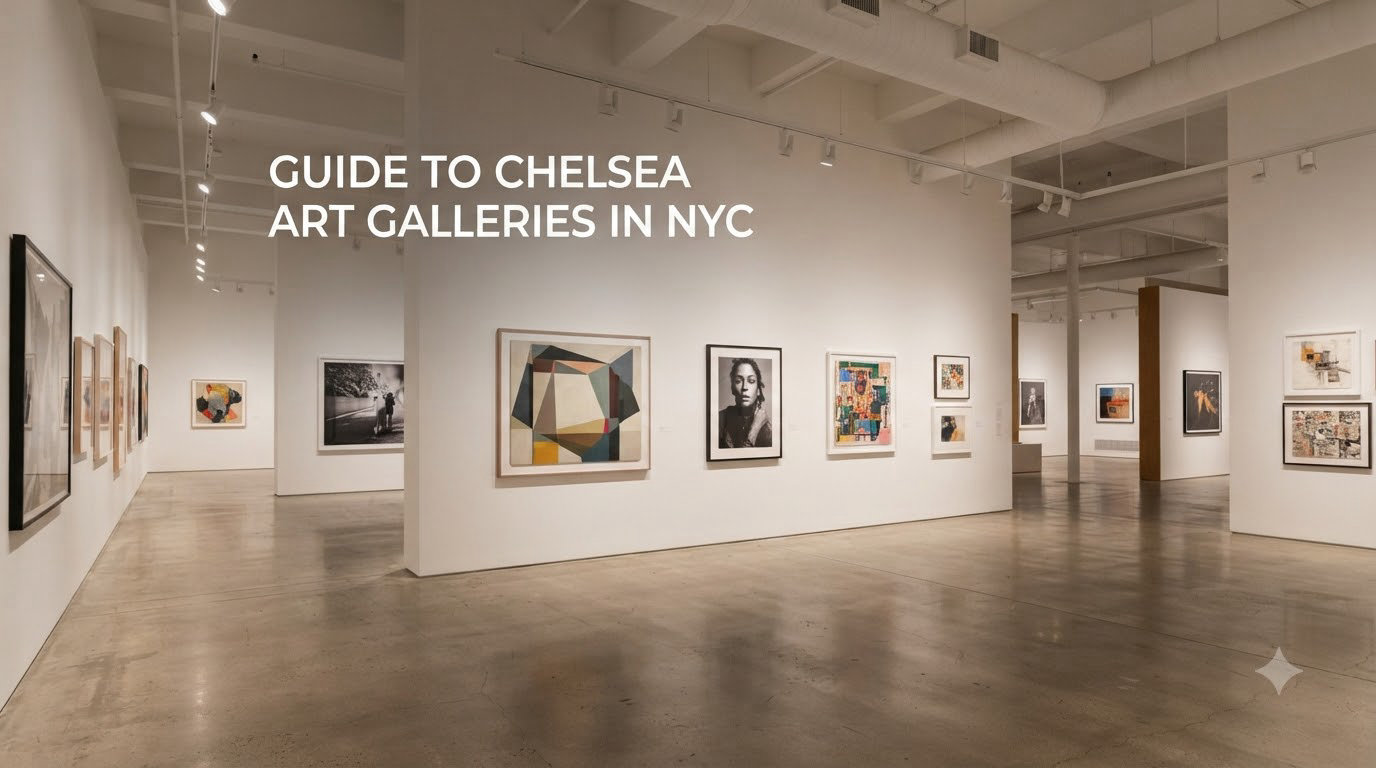
If you are planning to visit Chelsea art galleries in NYC, you are heading to one of the most concentrated and significant contemporary art districts on the planet. Stretching across roughly ten blocks in Manhattan, between West 18th and West 28th Streets from 10th to 11th Avenue, Chelsea packs over 300 galleries into a walkable neighborhood. Whether you are a seasoned collector or a first-time visitor wondering if you can just walk in, this guide covers everything you need to know.
Our team has spent years exploring the Chelsea Gallery District, popping into hundreds of shows, chatting with gallerists, and figuring out the smartest routes through the neighborhood. Chelsea is where global mega-galleries like Gagosian and David Zwirner sit alongside scrappy two-room spaces showcasing artists you have never heard of yet. It is the beating heart of New York’s art market, and it is almost entirely free to visit.
For a broader look at the city’s art scene beyond Chelsea, you can explore our comprehensive guide to the best galleries in NYC, which covers neighborhoods like the Lower East Side, Tribeca, and Brooklyn. But if Chelsea is your focus, keep reading. We will walk you through the must-see galleries, the best walking route, Thursday night events, and practical tips that most guides skip.
Table of Contents
Getting Started: What to Know Before You Visit Chelsea Art Galleries
Before you head out, here are the basics that will save you time and confusion. Most Chelsea galleries operate Tuesday through Saturday, typically from 10am to 6pm. Many are closed on Sundays and Mondays. Thursdays are a standout day because some galleries extend their hours into the evening for special programming and opening receptions.
The single most important thing to know: you can walk right in. No appointment, no ticket, no admission fee. Commercial galleries are retail spaces. They want visitors. A Reddit user from r/AskNYC put it plainly: “They are literally stores that sell art. You can just walk in like any other store.” This surprises a lot of first-timers who feel intimidated by the clean white walls and quiet atmosphere, but there is genuinely nothing to be nervous about.
Here is a quick reference for planning your visit:
Hours: Tuesday through Saturday, 10am to 6pm (some variations)
Cost: Free admission at nearly all commercial galleries
Appointments: Not required for regular exhibitions
Best days: Thursday evenings for events, Saturday afternoons for relaxed browsing
Getting there: Take the C or E train to 23rd Street or the 1 train to 28th Street
One tip from our experience: check gallery websites or Instagram accounts before you go. Exhibitions rotate every four to six weeks, and some spaces close between shows for installation. A quick look at a gallery’s current exhibition page takes two minutes and saves you from walking up to a locked door.
Must-See Chelsea Art Galleries in NYC
Chelsea’s gallery scene is massive, so we have organized the highlights into categories to help you prioritize. Whether you want blue-chip blockbusters or discoveries, there is something here for every taste.
The Mega Galleries: Big Names, Big Spaces
These are the heavyweights. Mega galleries represent globally recognized artists, occupy massive square footage, and stage museum-quality exhibitions. They are the safest bets for a rewarding visit because their production values are consistently high.
Gagosian (555 West 24th Street and 541 West 24th Street) is arguably the most famous commercial gallery in the world. Founded by Larry Gagosian, this operation has multiple Chelsea locations plus outposts in London, Paris, Hong Kong, and beyond. Expect polished, large-scale exhibitions by artists like Georg Baselitz, Ed Ruscha, and Takashi Murakami. The 24th Street spaces are vast, often filling their rooms with a single monumental installation.
David Zwirner (525 West 19th Street and 533 West 19th Street) represents artists like Yayoi Kusama, Neo Rauch, and Dan Flavin. Zwirner’s spaces are beautifully designed, and the gallery is known for thoughtful, curated shows. Their 19th Street location is a good starting point if you want to see top-tier contemporary art without feeling rushed. The gallery also has a strong publishing program, so their exhibition catalogues are worth picking up.
Hauser and Wirth (548 West 22nd Street) brings a European sensibility to Chelsea. With locations in Zurich, London, and Los Angeles, this gallery represents major figures like Louise Bourgeois, Mark Bradford, and Rashid Johnson. Their Chelsea space is a converted stable building with gorgeous architectural details that complement the art.
Pace Gallery (540 West 25th Street) has been a fixture in the art world since 1960. They represent Alexander Calder, Jean Dubuffet, and Agnes Martin among many others. Their Chelsea space is one of the largest single galleries in the neighborhood, frequently hosting immersive installations that take up the entire floor.
Mid-Size and Emerging Galleries Worth Your Time
The mega galleries get the headlines, but some of the most exciting shows happen at mid-size spaces. These galleries take risks on emerging artists and often present work you will not see anywhere else.
303 Gallery (507 West 24th Street) has been a Chelsea staple for decades. They represent artists like Karen Kilimnik and Jacob Kassay, and their shows consistently blend conceptual rigor with visual appeal. It is a reliable stop on any gallery crawl.
Matthew Marks Gallery (523 West 24th Street and 526 West 22nd Street) operates with a museum-like approach. They represent Ellsworth Kelly, Nan Goldin, and Robert Adams, among others. Their exhibitions are always immaculately installed and accompanied by scholarly publications.
Gladstone Gallery (530 West 21st Street) represents Matthew Barney, Carroll Dunham, and Wangechi Mutu. Their 21st Street space is sleek and spacious, and they frequently collaborate with artists on ambitious projects that push beyond traditional gallery formats.
Anton Kern Gallery (16 East 53rd Street, formerly in Chelsea at 532 West 20th Street) has been a launchpad for European and American artists. Check their current location before visiting, as several galleries have been shifting between Chelsea and other neighborhoods in 2026.
Hidden Gems and Smaller Spaces
Some of the most memorable shows happen in small galleries that you might walk right past. These spaces are where you will discover artists before they become famous.
Look for galleries inside the multi-story buildings along 26th and 27th Streets. Buildings like 526 West 26th Street and 547 West 27th Street house multiple galleries on different floors, making it easy to see a dozen shows in a single stop. Walk through the lobby, check the directory, and ride the elevator from floor to floor. Some of our favorite discoveries have been in second-floor spaces we almost skipped.
Smaller galleries rotate exhibitions more frequently, so there is always something new. If a space looks interesting from the street, just walk in. The gallerists at smaller operations are often the owners themselves and are genuinely happy to talk about the work on display.
The Best Chelsea Gallery Walking Route
A common question from first-timers is where to start. The most efficient approach is to begin at the north end of the district and walk south. Here is a route we have refined over dozens of visits.
Step 1: Start at West 28th Street. Take the 1 train to 28th Street and 7th Avenue, then walk west toward 10th Avenue. This puts you at the top of the gallery district. Begin with any galleries on 28th between 10th and 11th.
Step 2: Work your way south along 10th Avenue. Hit galleries on 27th Street, then 26th. The buildings on these blocks often contain multiple galleries stacked vertically. Always check the upper floors.
Step 3: Cut over to West 25th and 24th Streets. This is where the mega galleries cluster. Gagosian, Pace, and 303 Gallery are all within a two-block radius here. Budget extra time for these spaces because their exhibitions tend to be larger and more immersive.
Step 4: Continue south through 22nd and 21st Streets. Hauser and Wirth is on 22nd. Gladstone is on 21st. Both are worth at least 20 minutes each.
Step 5: Finish on 19th and 20th Streets. David Zwirner anchors the south end of the district. After visiting, you can walk east to 10th Avenue and catch the C or E train at 23rd Street, or hop on the High Line if you want a scenic walk back north.
Plan for three to four hours if you want to see a solid selection of galleries without rushing. You could easily spend a full day here, but half a day gives you enough time to see 10 to 15 shows at a comfortable pace. Wear comfortable shoes because you will be on your feet the entire time.
Thursday Night Gallery Hopping in Chelsea
Thursday evening is the worst-kept secret among NYC art lovers. Many Chelsea galleries extend their hours on Thursdays, staying open until 8pm or later. Some host opening receptions for new exhibitions, which often include free wine and the chance to meet artists.
The energy on a Thursday night is completely different from a quiet Tuesday afternoon. Galleries are busier, the atmosphere is more social, and you will see a cross-section of the art world from serious collectors to students on a budget. One Reddit user described it as “the best free night out in Manhattan.”
Here is what makes Thursday nights special:
Opening receptions: Many galleries schedule exhibition openings on Thursday evenings, especially when a new show launches
Extended hours: Galleries that normally close at 6pm stay open until 8pm or later
Free refreshments: Opening receptions often include complimentary drinks and snacks
Artist talks: Some galleries host conversations with exhibiting artists on Thursday nights
People watching: The crowd is a mix of artists, collectors, curators, and curious visitors
Not every gallery participates every Thursday. To find out what is happening on a specific Thursday, check the Instagram accounts of galleries you want to visit. Many post their reception schedules a week in advance. The ADAA (Art Dealers Association of America) also organizes an annual Chelsea Gallery Walk event, usually in the fall, which is a coordinated evening of openings across dozens of spaces.
A practical tip for Thursday nights: start around 5pm. This gives you time to visit a few galleries during regular hours before the evening programming kicks in. Then stay for the receptions, which typically run from 6pm to 8pm.
Chelsea Gallery Etiquette and Photography Tips
This section addresses the questions most guides ignore but first-time visitors desperately want answered. Gallery culture can feel intimidating, but the rules are straightforward once you know them.
Can I take photos? This is the most common unasked question. The answer is: it depends. Most galleries allow photography of the art on display, but some prohibit it entirely, especially for works on loan from private collections. When in doubt, ask the person at the front desk. A simple “Is photography okay?” takes two seconds and they will almost always say yes. Never use flash photography, and avoid taking photos of art with visible price lists or collector information.
What should I wear? There is no dress code. You will see everything from suits to sneakers. Wear comfortable shoes because you will be walking and standing for hours. The galleries are climate-controlled, so a light layer is helpful if you run cold.
Talking to gallery staff. The people working at galleries are there to help. If a piece catches your eye, ask about it. Gallery assistants and directors love talking about the work they show. Questions like “Can you tell me about this artist?” or “How long has this exhibition been up?” are great conversation starters. You do not need to be an expert. Genuine curiosity is always welcome.
Common mistakes to avoid: Do not touch the art. This sounds obvious, but people do it accidentally when gesturing while talking. Keep a respectful distance from the work. Keep your voice at a conversational level. Large backpacks can be problematic in tight gallery spaces, so consider leaving them at home or carrying a smaller bag. If a gallery appears to be hosting a private event, check before entering, but most receptions are open to the public.
Bags and coats: Most galleries do not have coat checks, so plan accordingly. Small bags and purses are fine. Oversized shopping bags or luggage will not be allowed inside. Some larger galleries provide bag storage, but this is not standard.
What to Do Near the Chelsea Gallery District
One of the best things about gallery hopping in Chelsea is that the neighborhood sits next to some of Manhattan’s best attractions. If you want to make a full day of it, here are our recommendations.
The High Line runs directly through the Chelsea Gallery District. This elevated park built on a former rail line connects the Meatpacking District to Hudson Yards, passing right along 10th Avenue. Walking the High Line between gallery visits gives you fresh air, great views, and a break from indoor spaces. The 22nd Street and 23rd Street access points are particularly convenient for gallery hoppers.
The Whitney Museum of American Art sits at the south end of the High Line at 99 Gansevoort Street. If you are finishing your gallery walk heading south, the Whitney is a natural next stop. Note that while Chelsea’s commercial galleries are free, the Whitney charges admission. Their collection focuses on American art from the 20th and 21st centuries, with strong holdings in pieces that complement what you just saw in the commercial spaces.
Coffee and food: Chelsea Market (15th Street and 9th Avenue) is a short walk from the southern galleries and offers dozens of food options. For a quicker stop, there are coffee shops scattered along 10th Avenue. Our go-to strategy is to grab coffee mid-morning, hit galleries until 2pm, have lunch at Chelsea Market, and continue through the afternoon.
If you want to expand your art exploration beyond Chelsea, the Lower East Side and Tribeca have developed strong gallery scenes in 2026. Each neighborhood has its own character, and you can find our full breakdown of NYC gallery neighborhoods in this guide.
FAQs
Can I just walk into the art galleries in Chelsea?
Yes. Most Chelsea galleries are commercial spaces that welcome walk-in visitors during regular business hours. No appointment or admission fee is required. You can simply walk through the door just like any other retail space. Gallery staff expect and welcome visitors.
What are the best Chelsea galleries to visit?
The top galleries include Gagosian (555 W 24th St), David Zwirner (525 W 19th St), Hauser and Wirth (548 W 22nd St), Pace Gallery (540 W 25th St), 303 Gallery (507 W 24th St), and Matthew Marks Gallery (523 W 24th St). For a first visit, focus on the mega galleries between 19th and 25th Streets, then explore smaller spaces on the upper floors of buildings along 26th and 27th Streets.
Are Chelsea galleries free to enter?
Yes. Nearly all commercial galleries in Chelsea are free to enter. They are businesses that sell art to collectors, but the exhibitions themselves cost nothing to view. This makes Chelsea one of the best free cultural activities in New York City.
What days are Chelsea galleries open?
Most Chelsea galleries are open Tuesday through Saturday, typically from 10am to 6pm. Many galleries are closed on Sundays and Mondays. Thursdays are notable because some galleries extend hours into the evening for opening receptions and special events.
Is Thursday night good for gallery hopping in Chelsea?
Thursday evening is one of the best times to visit Chelsea galleries. Many galleries extend their hours, host opening receptions with free refreshments, and schedule artist talks. The atmosphere is more social and energetic than daytime visits. Start around 5pm to catch both regular hours and evening events, which typically run until 8pm.
Where should I start my Chelsea gallery walk?
Start at West 28th Street near 10th Avenue and walk south. Take the 1 train to 28th Street and head west. This route lets you visit the galleries on 27th and 26th Streets first, then hit the major galleries clustered on 24th and 25th Streets, and finish at David Zwirner on 19th Street. Plan for three to four hours at a comfortable pace.
Plan Your Chelsea Gallery Visit
This guide to Chelsea art galleries in NYC covers the essentials: free admission, walk-in access, a logical north-to-south route, Thursday night events, and the etiquette basics that make your first visit stress-free. The Chelsea Gallery District remains one of the most accessible and rewarding art experiences in New York, and it costs nothing but your time.
Start at 28th Street, work your way south through the mega galleries and hidden gems alike, and do not skip the upper floors of multi-gallery buildings. Check gallery Instagram accounts before you go, wear comfortable shoes, and plan for at least half a day. Whether you visit on a quiet Wednesday morning or a bustling Thursday evening, Chelsea will remind you why New York is the art capital of the world.