
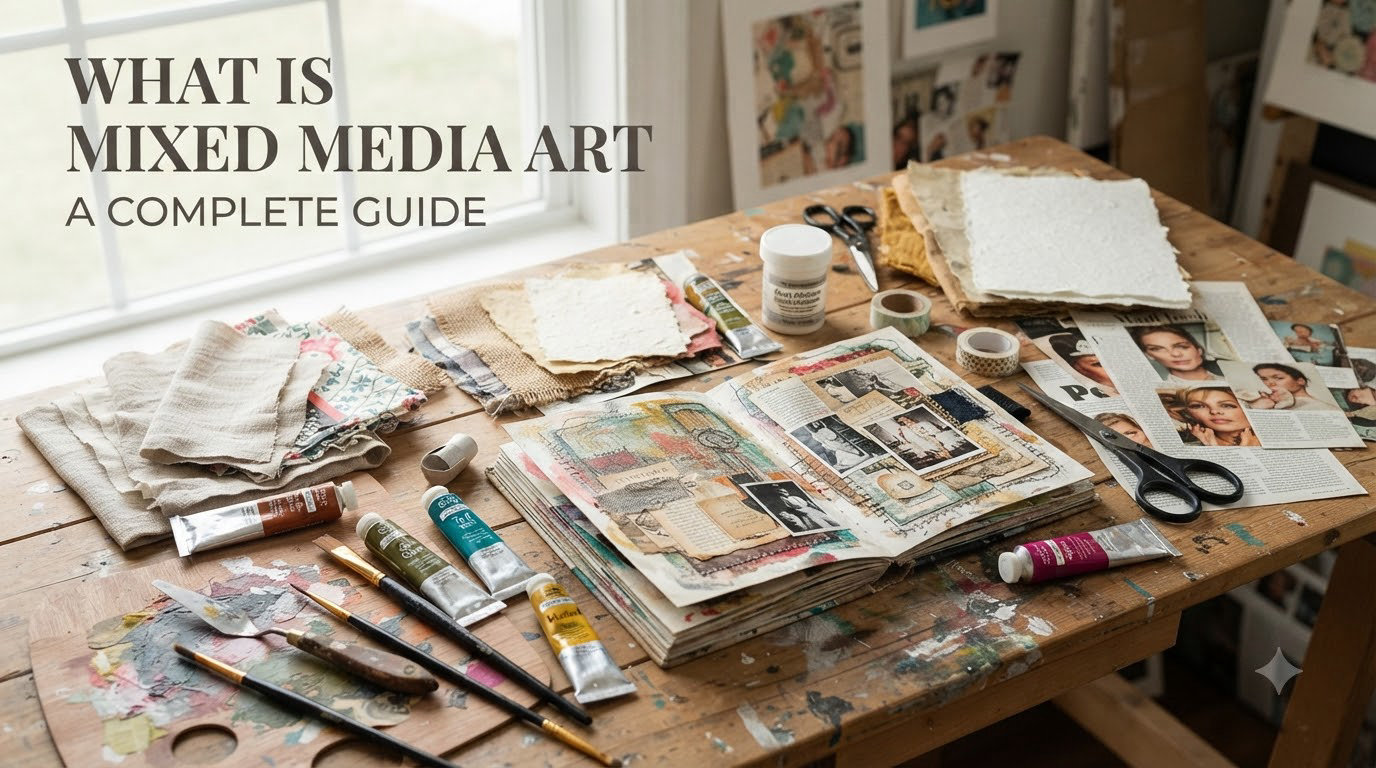
Mixed media art is any artwork that combines two or more different artistic materials or techniques into a single piece. That means acrylic paint layered over torn book pages, charcoal drawings intertwined with fabric swatches, or watercolor washes sitting beneath collaged photographs. The magic of mixed media lies in its lack of rules: you decide what materials to combine, how to layer them, and what the final piece looks like.
If you have ever felt boxed in by working in just one medium like painting or drawing, mixed media art opens a completely different path. You can layer, build texture, tear things apart, and reassemble them in ways that feel personal and alive. This guide covers everything you need to know about what mixed media art is, the materials and techniques that define it, its history, and how to start your first project at home in 2026.
Our team studied how working artists approach mixed media, what beginners struggle with most, and what makes a piece truly stand out. We drew from artist forums, gallery practices, and hands-on experimentation to build this resource. Whether you are a complete beginner curious about art journaling or an experienced painter looking to branch out, you will find practical guidance here. Mixed media art sits at the center of the contemporary art movement, and understanding it will shift how you see art altogether.
Table of Contents
What Is Mixed Media Art?
Mixed media art is defined as any visual artwork that uses more than one material or technique in its creation. The term covers a broad range of practices, from simple pairings like ink and watercolor on paper, to complex assemblages involving paint, fabric, metal, photographs, and found objects on a single canvas. The Tate Modern describes mixed media simply as “artworks composed from a combination of different media or materials.”
The key distinction is intentionality. A mixed media piece deliberately brings together different materials so they interact with each other. The contrast between rough and smooth, opaque and translucent, flat and dimensional creates visual tension that a single medium simply cannot produce on its own. This interaction between materials is what gives mixed media artwork its distinctive energy and depth.
It is important to understand that mixed media is not the same as mixed technique. An artist using oil paint and turpentine is working with a single medium and a solvent. An artist combining oil paint with newspaper clippings, fabric, and charcoal is working in mixed media. The difference comes down to combining fundamentally different material categories, not just different tools within a single category.
Mixed Media vs. Multimedia Art: What Is the Difference?
People often use these terms interchangeably, but they refer to different things. Mixed media art combines multiple physical materials within a single artwork: paint, paper, fabric, ink, found objects, and so on. Multimedia art is a broader category that includes works incorporating non-traditional elements like video, sound, digital projections, or performance alongside visual components.
In simple terms, all mixed media could be considered a form of multimedia, but not all multimedia is mixed media. A canvas with acrylic paint and torn newspaper is mixed media. An installation with video projections and sculptural elements is multimedia. The distinction matters in modern and contemporary art periods, where both approaches have produced groundbreaking work and continue to influence each other.
Examples of Mixed Media Art Combinations
There is no definitive list of what counts as mixed media because the possibilities are essentially endless. That said, some combinations appear again and again in studios and galleries worldwide.
Artists frequently pair acrylic paint with collage elements like old book pages, sheet music, or patterned paper. Watercolor combined with pen and ink drawings creates a striking contrast between loose washes and precise linework. Oil pastels layered over gesso-treated surfaces produce rich, textured effects. Found objects like buttons, keys, dried flowers, or metal washers get embedded into paint or adhesive to add three-dimensional interest.
Less obvious but equally effective combinations include wax crayons as a resist under watercolor washes, stitching thread through painted canvas, or using tea and coffee as staining agents alongside traditional pigments. One artist in a popular Reddit mixed media community described combining Posca markers over wax crayon backgrounds as their favorite unexpected technique, producing vivid colors with a waxy, layered texture that regular paint cannot replicate.
Some artists push even further by incorporating encaustic wax over collage, embedding shards of glass or ceramic into textured surfaces, or combining printmaking techniques like monoprinting with hand-painted details. The only real limit is your willingness to experiment with materials.
A Brief History of Mixed Media Art
Mixed media is not a modern invention. Artists have been combining materials for centuries, but the practice gained formal recognition during the early 20th century as art movements began challenging traditional boundaries between painting, sculpture, and craft. No other guide about mixed media art covers this history in detail, so here is a timeline that puts the entire practice in context.
In 1912, Pablo Picasso created “Still Life with Chair Caning,” widely considered the first modern collage. He combined oil paint, oilcloth printed with a chair caning pattern, and rope on canvas. This single piece shattered the convention that fine art should use only traditional painting materials. Picasso and Georges Braque continued exploring these ideas through Synthetic Cubism, layering newspaper clippings, wallpaper, and sheet music into their compositions throughout the 1910s.
The Dada movement of the 1910s and 1920s pushed things further. Artists like Kurt Schwitters created entire bodies of work from discarded materials: bus tickets, candy wrappers, bits of wood, and torn advertisements assembled into compositions that challenged what art could be. Hannah Hoch used photomontage, cutting and rearranging photographs from popular magazines to create pointed social commentary about gender and politics in Weimar Germany.
Robert Rauschenberg brought mixed media into the mainstream of American art in the 1950s with his “Combines.” These works fused painting with sculpture, incorporating everyday objects like stuffed birds, tires, clocks, and even a stuffed bald eagle. Rauschenberg described them as existing in the gap between art and life, and they fundamentally changed how galleries and collectors thought about what belonged in a frame.
The 1960s and 1970s saw mixed media expand in new directions through Pop Art, Fluxus, and feminist art movements. Artists like Romare Bearden used collage to tell powerful stories about African American life. The Pattern and Decoration movement of the 1970s elevated traditionally “craft” materials like fabric, beads, and thread into the fine art world. By the 1980s and 1990s, mixed media had become a standard practice in art schools and galleries worldwide.
Since then, mixed media has become one of the dominant approaches in contemporary art. Artists today draw from painting, printmaking, photography, textile arts, digital media, and sculpture simultaneously. The rise of art journaling and online creative communities has made mixed media accessible to hobbyists and self-taught artists in ways that formal art movements never anticipated. Social media platforms have accelerated this trend, with artists sharing processes and techniques that would have remained hidden in private studios just a generation ago.
Mixed Media Art Materials You Need
Understanding the materials available to you is the foundation of mixed media practice. Unlike traditional painting or drawing, where your supply list is relatively fixed, mixed media invites you to pull from an enormous range of tools and surfaces. You do not need everything listed here to start. Begin with a few basics and expand as your curiosity grows.
Many of these supplies make great additions to your studio, and if you are looking for recommendations, our guide to art supplies and materials has thoughtful options worth exploring.
Surfaces: Stretched canvas, watercolor paper, mixed media paper (heavier weight, at least 140lb), wood panels, and art journal pages all work well. The surface needs to handle wet and dry media without buckling or falling apart. Mixed media paper is specifically designed for this purpose and is the most reliable choice for beginners starting their first pieces.
Paints and pigments: Acrylic paint is the backbone of most mixed media work because it dries fast and adheres to almost anything. Watercolor adds translucent washes. Ink (both liquid and pens) provides precise linework. Spray paint can cover large areas quickly. Pastels and charcoal add softness and smudgy texture. Heavy body acrylics can be spread thickly with a palette knife for sculptural effects that catch the light.
Adhesives and mediums: Matte medium and gel medium serve double duty as both glue and sealant. Mod Podge works for lighter collage work. Glue sticks handle paper-to-paper adhesion. For heavier objects like metal or wood, a strong craft adhesive or epoxy is necessary. Gel medium comes in soft, regular, and heavy formulations, each suited to different tasks and material weights.
Texture and building materials: Gesso primes surfaces and adds tooth for better paint adhesion. Modeling paste (also called texture paste) builds dimensional texture that you can feel under your fingertips. Stencils create repeating patterns in paint or paste. Sand, salt, rice, or coffee grounds can be pressed into wet medium for gritty, organic texture. These materials transform a flat surface into something physical and alive.
Collage elements: Old book pages, sheet music, photographs, patterned paper, tissue paper, fabric scraps, lace, buttons, dried leaves, metal findings, and any found objects that catch your eye. Many experienced mixed media artists keep a collection of interesting materials on hand, adding to it constantly. Estate sales, thrift stores, and nature walks are excellent sources for unique collage materials that give your work character.
Tools: Brushes in various sizes, a palette knife for spreading medium and paste, scissors, an awl or needle for stitching through paper or canvas, a heat gun for speeding up drying time, and a brayer (roller) for smoothing collage layers and removing air bubbles. A water mister, paper towels, and a covered work surface round out the basic toolkit for any mixed media session.
Essential Mixed Media Techniques for Beginners
These techniques form the vocabulary of mixed media art. Most finished pieces combine several of them, and part of the creative process is discovering which combinations resonate with your personal style. I recommend practicing each one individually before combining them in a finished piece.
1. Layering: This is the most fundamental mixed media technique. You build a piece by adding one layer at a time: a gesso base, then a wash of color, then collage paper, then more paint, then additional elements on top. Each layer interacts with the ones below it. Transparent layers let earlier work show through, creating depth and visual complexity. Opaque layers cover previous work partially or completely, letting you edit and evolve the piece as you go. The key principle is to work from background to foreground, building depth gradually.
2. Collage: Cutting or tearing paper, photographs, or fabric and adhering them to your surface. Collage can serve as a background layer, a focal point, or scattered accents throughout a piece. The torn edge of handmade paper creates a different feeling than the crisp cut of a magazine image, so pay attention to how you prepare your collage elements. Tearing creates a softer, more organic look. Cutting with scissors or a craft knife produces clean, deliberate edges that feel more graphic.
3. Texture building: Applying modeling paste through stencils, spreading thick gel medium with a palette knife, embedding objects into adhesive, or scratching into wet paint with a tool all create physical texture. When light hits a textured surface, it creates shadows and highlights that make the artwork feel alive and dimensional. This is one of the characteristics that separates mixed media from flat painting most clearly, and it is what draws many artists to the medium in the first place.
4. Image transfer: This technique moves a printed image from paper onto your artwork surface using gel medium or packing tape. The original paper backing gets rubbed away with water, leaving just the ink image embedded in your piece. It produces a translucent, weathered quality that looks like the image has always been part of the artwork. Laser-printed images work best for this technique; inkjet prints tend to bleed and lose detail.
5. Mark-making: Drawing, scribbling, stamping, or writing directly onto your layers. Mark-making adds energy, movement, and personal handwriting to a piece. It can be planned or spontaneous. Many mixed media artists keep their mark-making loose and gestural, allowing the motion of their hand to carry emotion into the work. Use permanent markers, charcoal, graphite sticks, or even the end of a paintbrush scratched into wet paint for spontaneous marks.
6. Creating resist effects: Certain materials repel others, creating interesting visual interactions. Wax crayon resists watercolor. Masking fluid blocks paint from reaching specific areas. Tape or contact paper can mask off sections while you paint, then be removed to reveal clean edges or preserved layers underneath. Resist techniques add surprise and pattern without requiring precise control.
7. Stenciling and stamping: Stencils allow you to add repeating patterns, shapes, or textures with paint, ink, or paste. Stamps (commercial or handmade) create consistent motifs across your surface. Both techniques are useful for adding visual rhythm and pattern across your layers without the precision required of freehand drawing. In a community art forum discussion I read, several artists mentioned stenciling as their go-to technique for adding complexity quickly when a piece needs more visual interest.
Why Artists Love Mixed Media Art
Mixed media has earned a passionate following among artists of all skill levels, and the reasons go beyond simple variety. The form offers something genuinely different from single-medium work.
Complete creative freedom. There is no wrong way to combine materials in mixed media. You can follow a plan or follow your instincts. You can paint over something you do not like, tear it off, or build on top of it. This freedom is liberating, especially for artists who feel constrained by the rules of traditional painting or drawing. In artist communities online, the most common phrase used to describe mixed media is “no rules,” and that captures the spirit of the practice perfectly.
It is forgiving by nature. Made a mistake? Paint over it. Do not like that collage piece? Tear it off and try another. The layered structure of mixed media means you can always adjust, cover, or rework any area of your piece. This forgiving quality makes it ideal for beginners who worry about ruining their work. As one artist described it on a popular art forum, mixed media is the most forgiving art form there is because every layer is a chance to start over.
Storytelling through materials. Every material carries meaning. A letter from a grandparent, a page from a childhood book, a piece of fabric from a favorite shirt: these materials embed personal narrative directly into the artwork. Mixed media lets you tell stories that paint alone simply cannot express. Many artists describe this narrative quality as what keeps them coming back to mixed media again and again.
Surprise and discovery. Because mixed media involves combining materials in unpredictable ways, the process often produces happy accidents. Paint bleeds into collage in unexpected ways. Texture catches light differently than you imagined. Colors interact in surprising combinations that you could not have planned. Many artists describe this element of surprise as one of the most rewarding aspects of the practice.
No expensive setup required. You can begin with acrylic paint, a pad of mixed media paper, some old magazines, and a glue stick. From there, the materials you collect grow organically. Mixed media actually encourages using found and recycled materials, which keeps costs low and environmental impact smaller. This accessibility is part of why mixed media has grown so popular in community art programs and art therapy settings around the world.
How to Start Your First Mixed Media Art Project
Starting your first mixed media piece can feel overwhelming because the options are unlimited. Here is a straightforward step-by-step process to get you creating without overthinking it. Follow these steps for your first few pieces, then adapt them as you develop your own rhythm and style.
Step 1: Choose your surface. For beginners, a sheet of 140lb mixed media paper or a small stretched canvas (8×10 or 11×14 inches) works best. These surfaces handle wet and dry media well and will not buckle under layers of paint and adhesive. Avoid thin printer paper or flimsy sketch paper for your first attempts.
Step 2: Apply a base layer of gesso. Gesso primes the surface, giving it tooth so that subsequent layers adhere properly. One or two thin coats are enough. Let it dry completely before moving on. If you are working on canvas, the gesso also creates a uniform white surface to build on. You can tint gesso with a small amount of acrylic paint if you want a colored base instead of white.
Step 3: Add a background wash. Watered-down acrylic paint or watercolor applied broadly across the surface establishes a color foundation. Do not worry about making it perfect. This layer will mostly be covered up by later elements. Choose a color that sets the mood you want: warm tones for energy, cool tones for calm, earth tones for grounded warmth.
Step 4: Build your first collage layer. Tear or cut pieces of paper, old book pages, sheet music, or patterned paper and adhere them to the surface using matte medium or a glue stick. Overlap edges, leave gaps, and let some pieces extend beyond the border. Step back and look at the composition before committing. Remember that you can always paint over pieces you do not like later.
Step 5: Add paint and mark-making. Paint over, around, and through your collage elements. Use a stencil with acrylic paint. Draw with a permanent pen or charcoal. Scratch into wet paint with the end of your brush. This is where the piece starts to come alive as the layers begin interacting with each other visually.
Step 6: Build texture. Apply modeling paste through a stencil with a palette knife. Embed small objects like beads, threads, or dried flowers into wet medium. Sprinkle sand or fine glitter into tacky paint. Let everything dry thoroughly before adding more layers on top. This step adds the dimensional quality that makes mixed media so tactile.
Step 7: Add your focal elements. The focal point is where the eye lands first. This could be a larger collage image, a bold painted shape, a transferred photograph, or a found object. Place it intentionally, considering how it relates to the layers beneath it. The best focal elements create contrast with the surrounding area in color, size, or texture.
Step 8: Refine and finish. Step back and assess the whole piece from a distance. Add detail work with fine brushes or pens. Add more paint to tone down busy areas. Add highlights with light-colored paint or metallic markers. When you feel the piece is complete, seal it with a spray varnish or brush-on sealant to protect the surface.
Common Mistakes to Avoid as a Beginner
After reviewing dozens of artist forums and community discussions, a few common pitfalls appear repeatedly. Knowing about them ahead of time will save you frustration and wasted materials.
Skipping the gesso. Without gesso, paint and adhesive can peel or absorb unevenly into raw paper or canvas. Always prime your surface unless you are deliberately working on unprimed material for a specific effect. This single step makes a huge difference in how your finished piece holds up over time.
Not letting layers dry. Rushing between wet layers leads to muddy colors and smeared collage. Acrylic paint dries quickly (10 to 20 minutes for thin layers), but heavier applications of gel medium or modeling paste need hours. Use a heat gun to speed things up if needed, but do not skip the drying time entirely.
Overcomplicating the first piece. Your first mixed media project does not need ten techniques and twenty materials. Start with three or four materials and focus on making them work together. Complexity comes naturally with practice and confidence, and adding too much too soon usually leads to visual chaos.
Ignoring composition. Even in a freeform art form, basic compositional principles like balance, contrast, and focal points matter. Take time to step back and evaluate your piece from a distance as you build layers. A strong composition makes the difference between a piece that feels intentional and one that feels random.
Using non-archival materials carelessly. Newspaper clippings, standard printer paper, and some adhesives yellow and degrade over time. If you want your work to last, use acid-free paper, archival-quality adhesives, and UV-protective sealants. If archival quality does not matter to you for a particular piece, that is perfectly fine, but make the choice consciously.
Who Is Mixed Media Art For?
One of the most common questions people ask is whether mixed media art is right for them. The short answer is: mixed media is for anyone willing to experiment. But certain groups find it especially rewarding.
Complete beginners. If you have never made art before, mixed media is one of the best places to start. There is no pressure to draw perfectly or mix the right color. You can rely on found materials, simple techniques, and layering to create something visually interesting even on day one. The forgiving nature of the medium means your early experiments will still produce satisfying results that encourage you to keep going.
Experienced artists looking for new challenges. Painters, illustrators, and printmakers who feel stuck in their practice often find that mixed media reignites their creativity. Combining familiar materials with unfamiliar ones forces new ways of thinking about composition, color, and texture. Several artists in online communities mentioned that switching to mixed media after years of oil painting felt like rediscovering why they fell in love with making art in the first place.
Art journalers and memory keepers. Art journaling and mixed media are natural companions. Many artists use mixed media techniques in personal journals to document daily life, process emotions, or simply play without the pressure of creating a finished piece for display. The private, low-stakes nature of journaling pairs perfectly with mixed media experimentation and play.
Educators and students. Mixed media projects teach material literacy, composition, and creative problem-solving all at once. Teachers in art education programs frequently use mixed media assignments because they accommodate different skill levels and learning styles simultaneously. Advanced mixed media projects go beyond standard collage, which is something art teachers actively search for in community forums when they need fresh ideas.
Anyone exploring art as therapy. The tactile, hands-on nature of mixed media makes it a popular choice in art therapy settings. The process of tearing, gluing, painting, and building with your hands can be grounding and meditative. There is a reason many therapists incorporate mixed media into their practice: the physical engagement with materials provides a different kind of creative outlet than purely visual or digital art forms.
Famous Mixed Media Artists You Should Know
Understanding who shaped mixed media art helps you appreciate the lineage you are joining when you create your own work. These artists broke rules that needed breaking and opened doors for everyone who followed.
Pablo Picasso (1881-1973) essentially invented modern collage with his 1912 piece combining oil paint, oilcloth, and rope on canvas. His Cubist experiments with Georges Braque introduced the idea that everyday materials deserved a place in fine art. Without Picasso’s willingness to break with convention, mixed media art as we know it would not exist.
Kurt Schwitters (1887-1948) built an entire artistic practice from discarded materials he found on the streets of Hanover, Germany. His “Merz” collages transformed bus tickets, candy wrappers, bits of wood, and torn newspaper into works of surprising beauty and structural sophistication. Schwitters proved that the humblest materials could carry profound artistic meaning, an idea that still resonates with mixed media artists using found and recycled objects today.
Robert Rauschenberg (1925-2008) created his famous “Combines” in the 1950s, merging painting and sculpture in ways the art world had never seen. Works like “Canyon” (1959) incorporated a stuffed bald eagle, a pillow, and a photograph alongside paint on canvas. Rauschenberg’s work legitimized mixed media in the gallery system and inspired generations of artists to push further into unexplored territory.
Romare Bearden (1911-1988) used collage and mixed media to tell stories about African American life and culture. His richly layered compositions combined painted areas with cut photographs, fabric, and colored paper. Bearden demonstrated that mixed media could serve as a powerful narrative tool, not just an aesthetic experiment, and his influence on contemporary collage artists remains strong.
Contemporary artists continue expanding the boundaries of mixed media in exciting directions. Many of the famous contemporary mixed media artists working today draw from digital processes, sustainable materials, and cross-cultural traditions to create work that would have been unimaginable even a few decades ago.
Tips for Making Your Mixed Media Art Stand Out
Once you have practiced the basic techniques, these strategies will help your work move beyond beginner-level results and develop a more distinctive, personal quality.
Master contrast. The most visually striking mixed media pieces use contrast deliberately. Pair rough texture with smooth areas. Place bright saturated color next to muted neutrals. Combine tight, detailed mark-making with loose, sweeping paint strokes. Contrast creates visual energy and directs the viewer’s eye through your composition in a purposeful way.
Try unexpected material combinations. The most memorable mixed media art often comes from surprising material pairings. One artist in a Reddit community raved about combining acrylic ink with embroidery on canvas. Another described pressing real leaves into modeling paste and painting over them. The more you experiment with materials that do not obviously belong together, the more unique your work becomes and the more it stands out from generic mixed media pieces.
Integrate digital elements. Many contemporary mixed media artists incorporate printed digital designs, laser-cut elements, or digitally altered photographs into their physical work. Printing your own patterns or manipulating images digitally before including them in a piece adds a personal touch that store-bought papers cannot match. This digital integration is an area most guides overlook, and it offers real creative potential for artists who work across both digital and physical media.
Embrace sustainability. Upcycling discarded materials is not just environmentally conscious, it often produces more interesting work than using pristine new supplies. Old book pages have character that new paper lacks. Vintage fabric carries texture and history. Reclaimed wood panels have grain patterns you cannot buy. Working with found materials also removes the pressure of “wasting” expensive supplies, which can actually make you more creative and willing to take risks.
Displaying and Preserving Mixed Media Art
Mixed media pieces present unique challenges for display and preservation because they often combine materials with different conservation needs. A single piece might include paint, paper, fabric, metal, and organic materials, each reacting differently to light, humidity, and time.
Sealing your work. Always seal a finished mixed media piece with an appropriate varnish or sealant. Spray varnish is gentler on delicate collage elements and texture than brush-on alternatives. Apply two to three thin coats, allowing each to dry completely. For pieces with significant texture or dimensional elements, a spray application prevents the sealant from pooling in crevices and creating uneven gloss.
Framing considerations. Works on paper should be matted and framed under UV-protective glass to prevent fading and yellowing. Canvas pieces with heavy texture or attached objects may need a shadow box frame that provides space between the artwork surface and the glass. Never let glass touch the surface of a mixed media piece directly, as it can damage delicate elements and cause condensation damage over time.
Display environment. Keep mixed media artwork away from direct sunlight, high humidity, and extreme temperature changes. Bathrooms, kitchens, and spaces near heating vents are poor choices for display. If you want to learn more about presenting your art professionally, our guide on how to display mixed media art covers everything from lighting to wall placement to creating a gallery feel at home.
Long-term preservation. Using archival-quality materials from the start makes a significant difference in how your work ages over the years. Acid-free paper, archival adhesives, and lightfast pigments cost slightly more but extend the life of your artwork by decades. If you used non-archival materials, consider storing the piece in a climate-controlled environment away from light when it is not displayed. Documenting your pieces with high-quality photographs provides a permanent backup record even if the physical work eventually degrades.
FAQs
What is mixed media art for beginners?
Mixed media art for beginners is any artwork that combines two or more different materials or techniques into a single piece. For someone just starting out, the easiest approach is to combine acrylic paint with simple collage elements like torn paper, old book pages, or magazine cutouts on a sheet of mixed media paper. The forgiving nature of layering means you can paint over mistakes, adjust your composition as you go, and experiment freely without the pressure of getting everything right the first time.
What materials do you need for mixed media art?
The essential materials for mixed media art include a sturdy surface (mixed media paper or canvas), acrylic paint, gesso for priming, an adhesive (matte medium or Mod Podge), collage elements (old book pages, patterned paper, photographs), brushes, and a permanent pen for mark-making. Optional but helpful supplies include modeling paste for texture, stencils, watercolor for washes, and found objects like buttons, fabric scraps, or dried flowers. You can start with just a handful of supplies and expand your collection over time.
What is the difference between mixed media and multimedia art?
Mixed media art combines multiple physical materials like paint, paper, fabric, and found objects within a single artwork. Multimedia art is a broader category that incorporates non-traditional elements such as video, sound, digital projections, or performance alongside visual components. In short, mixed media focuses on combining physical art materials, while multimedia includes technology-based and time-based elements alongside visual art.
How do you start a mixed media art project?
Start by priming your surface with gesso, then add a loose background wash of color. Layer torn or cut collage papers using matte medium as adhesive. Paint over and around your collage elements with acrylic paint, adding mark-making with pens or charcoal. Build texture with modeling paste through stencils, then add focal elements like a larger image or found object. Finish by refining details and sealing the completed piece with spray varnish. Let each layer dry thoroughly before adding the next to avoid muddy results.
What are some famous mixed media artists?
Famous mixed media artists include Pablo Picasso, who created the first modern collage in 1912 by combining oil paint, oilcloth, and rope. Kurt Schwitters built collages from found street materials in the 1920s. Robert Rauschenberg created groundbreaking Combines that merged painting with sculpture in the 1950s. Romare Bearden used collage to tell stories about African American life and culture. Contemporary artists continue pushing mixed media in new directions, incorporating digital processes, sustainable materials, and cross-cultural traditions into their work.
Start Creating Your Own Mixed Media Art
Mixed media art gives you permission to break rules, combine unexpected materials, and create something entirely your own. At its core, it is about combining two or more artistic materials or techniques into a single piece, and everything beyond that definition is up to you. Whether you start with a simple collage on paper or dive into building textured layers on canvas, the process rewards curiosity and experimentation above all else.
We covered what mixed media art is, how it differs from multimedia, the history that shaped it, the materials and techniques that define it, and a step-by-step approach for starting your first project in 2026. The artists who pioneered this form, from Picasso to Rauschenberg, all shared one trait: they were willing to try something new without knowing exactly what would happen. That same spirit is available to anyone willing to pick up a brush, tear some paper, and see where the layers take them.
Your first mixed media piece does not need to be perfect. It just needs to exist. Gather a few materials, clear a table, and start layering. The freedom and creative expression that mixed media art offers is waiting for you to discover it.