
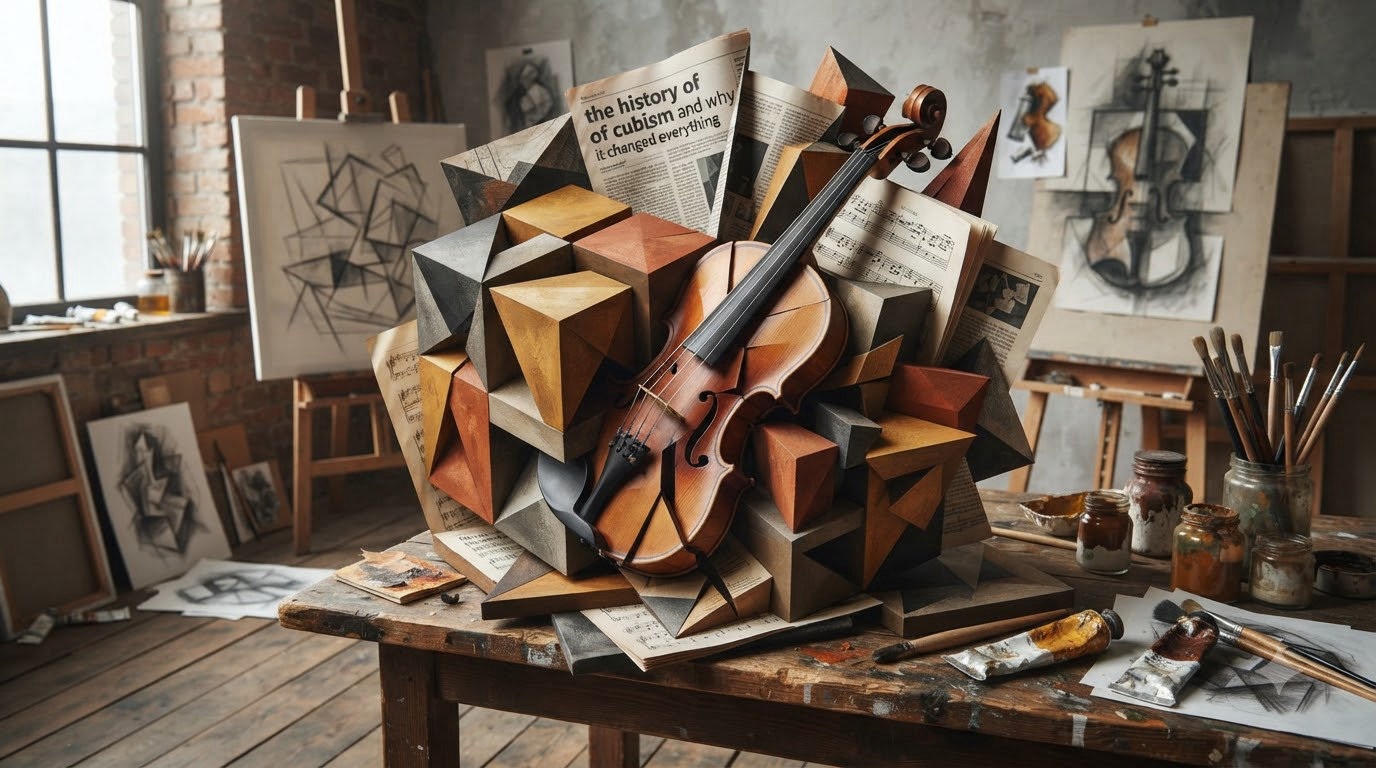
Walk through any major museum today and you will see its influence everywhere. Geometric fragmentation. Multiple viewpoints compressed onto a single canvas. The deliberate rejection of realistic representation in favor of something more abstract, more truthful to how the mind actually processes the world. This is the legacy of Cubism, the early 20th-century art movement that fundamentally altered the course of visual art and opened doors that can never be closed again.
Cubism emerged in Paris between 1907 and 1914, created through the collaboration of two artists who could not have been more different in temperament and background. Yet together, Pablo Picasso and Georges Braque developed a visual language that would reshape art history forever. Their partnership produced what many scholars consider the most influential art movement of the modern era.
Table of Contents
What Is Cubism?
Cubism is an avant-garde art movement that rejects the traditional Renaissance system of representing the world through single-point perspective. Instead, Cubist artists fracture objects into geometric forms and reassemble them on the canvas showing multiple simultaneous viewpoints. The result is a kind of visual puzzle where the viewer must actively participate in reconstructing the image rather than passively receiving a window-like representation of reality.
The movement emphasizes the flat, two-dimensional surface of the canvas, deliberately reminding viewers they are looking at a painted surface rather than peering through a window into another world. This shift from illusionism to abstraction marked one of the most dramatic breaks in art history, opening infinite new possibilities for how art could represent visual reality.
Our team has spent years studying how audiences interact with Cubist art, and we have found that understanding the historical context transforms confusion into appreciation. When you know why these artists made the choices they did, the paintings suddenly reveal their logic and power.
The Founders: Picasso and Braque
Pablo Picasso, born in Spain in 1881, arrived in Paris in 1900 as a young man already technically brilliant from years of classical training. His Blue Period and Rose Period works had established him as a rising star, but he was hungry for something new. Georges Braque, born in France in 1882, had trained as a painter and also worked as a decorative painter before gravitating toward avant-garde circles in Paris.
The two artists met around 1907 through a mutual friend, the poet Guillaume Apollinaire. What followed was one of the most remarkable creative partnerships in art history. From 1908 to 1914, Picasso and Braque worked in near-constant collaboration, pushing each other toward increasingly radical solutions. They rarely painted in the same room, but they exchanged ideas constantly through small notes and conversations.
Art historians often describe their relationship as a dialogue conducted through paint. When Braque introduced a new technique, Picasso would respond with his own innovation. This back-and-forth produced the two distinct phases of Cubism that we recognize today. Their complementary approaches made the partnership uniquely productive, with Braque’s more methodical sensibility balancing Picasso’s explosive creativity.
What Came Before: Cézanne, African Art, and the Path to Cubism
No artist influenced the birth of Cubism more profoundly than Paul Cézanne. The Post-Impressionist master had died in 1906, but his revolutionary approach to representing nature lived on in the work of younger painters. Cézanne famously advised artists to treat nature by the cylinder, the sphere, the cone, reducing complex forms to their essential geometric shapes. Picasso and Braque took this suggestion literally and ran with it.
The discovery of African art at the Trocadéro Museum in Paris proved equally transformative for Picasso. In 1907, he visited the museum and later described the experience as revelatory. African masks and sculptures featured highly stylized geometric forms that seemed to bypass realistic imitation entirely while still conveying powerful emotional truth. These objects showed Picasso that art did not need to copy nature to communicate something meaningful about human experience.
Primitivism, the broader interest in non-Western art that swept through Parisian avant-garde circles, opened doors that classical training had kept firmly closed. The simplified forms of Oceanian and African art suggested alternatives to the Western tradition of illusionistic representation. Artists began to realize that they had been taught to see nature through a very specific cultural lens, and that lens was not the only option available.
The Turning Point: Les Demoiselles d’Avignon
If one painting marks the true beginning of Cubism, it is Les Demoiselles d’Avignon, created by Picasso in 1907. This large-scale work depicts five nude female figures in a shallow, compressed space. The figures have heavily stylized faces, with two of them wearing what appear to be African mask-like features. Their bodies are fragmented into angular planes that reject all conventional notions of graceful, idealized forms.
When Picasso unveiled the painting in his studio, visitors were genuinely shocked. The angular, fractured forms seemed to assault the viewer’s expectations. The perspective shifts wildly from figure to figure, with no consistent viewpoint holding the composition together. It was as if Picasso had taken apart the visual world and reassembled it according to rules only he understood.
Les Demoiselles d’Avignon remained in Picasso’s studio for years before he allowed it to be shown publicly. Its influence on other artists, however, was immediate and profound. The painting demonstrated that radical experimentation could produce works of great power and that the old rules of representation could be thrown out entirely. When Braque first saw smaller studies for the piece, he recognized that something momentous had begun.
Analytical Cubism (1910-1912): Breaking Reality Into Pieces
The first major phase of Cubism, now called Analytical Cubism, emerged from 1910 to 1912. During this period, Picasso and Braque developed their signature approach to fracturing objects. Their paintings became increasingly abstract, with subjects still recognizable but broken down into complex arrangements of overlapping planes and facets.
Color largely disappeared from their work during these years. Paintings like Picasso’s Ma Jolie and Braque’s The Portuguese present monochromatic compositions in browns, grays, and ochres. This limited palette focused viewer attention entirely on the structural innovations, forcing them to grapple with the geometric reorganization of familiar objects without the distraction of vibrant color.
Still life subjects dominated Analytical Cubism. Guitars, glasses, newspapers, and bottles appeared repeatedly, objects that could be broken down into component parts and reassembled in visually interesting ways. These everyday items also carried associations with the cafés and studios where avant-garde artists lived and worked. The objects became symbols of a particular world and a particular way of living.
The term Analytical Cubism was coined later by art historians to describe this phase’s approach of analyzing objects, breaking them down into their constituent geometric elements. The process mirrored scientific inquiry, treating visual perception as a problem to be solved through systematic investigation rather than intuitive expression.
Synthetic Cubism (1912-1914): Collage and New Materials
The second major phase, Synthetic Cubism, began around 1912 and introduced techniques that would permanently expand the possibilities of fine art. Where Analytical Cubism had stripped away color and broken objects into their essential forms, Synthetic Cubism began building back up, incorporating new materials and reintroducing color.
The most revolutionary innovation was the use of collage. Picasso and Braque began gluing pieces of paper, newspaper clippings, wallpaper fragments, and other everyday materials directly onto their canvases. This technique, which they called papiers collés (glued papers), blurred the boundary between representation and reality. A piece of newspaper attached to a painting was simultaneously a representation of newspaper and an actual piece of newspaper.
Still Life with Chair Caning, created by Picasso in 1912, exemplifies this approach. He glued a piece of oilcloth printed with a chair-caning pattern to the canvas, surrounding it with painted elements that extend and complicate the printed surface. The viewer must constantly negotiate between what is real and what is represented, a playfulness that would influence artists for decades to come.
Color returned during this phase, often in bold, flat areas rather than the subtle gradations of traditional painting. Musical instruments became a favorite subject, their curved forms providing interesting contrasts with the angular geometric shapes of the surrounding composition. Violin and Candlestick, another key work from this period, demonstrates how Synthetic Cubism could achieve both visual complexity and decorative beauty.
The Techniques That Changed Art Forever
Cubism introduced several technical innovations that transformed how artists approach the canvas. The most fundamental was the rejection of single-point perspective, the system developed during the Renaissance that had dominated Western art for four centuries. Instead of showing objects from one fixed viewpoint, Cubist artists presented multiple viewpoints simultaneously, allowing viewers to see an object as it is understood by the mind rather than perceived by the eye.
Geometric fragmentation, the breaking of forms into cubes, spheres, and cones, became the signature visual language of the movement. This approach treated objects as collections of their component parts rather than unified wholes. A human face might show the profile and full face at the same time, or a landscape might reveal the terrain as if viewed from above and at ground level simultaneously.
The use of collage and mixed media opened entirely new possibilities for artistic expression. By incorporating actual materials into paintings, Cubist artists raised profound questions about the nature of art itself. What makes something a work of art rather than just an object? Does the context in which something is presented determine its meaning? These questions would occupy artists and philosophers for the rest of the century.
Perhaps most importantly, Cubism emphasized the flatness of the canvas surface, reminding viewers that they were looking at a painted surface rather than peering through a window. This self-consciousness about the material nature of art became a foundational principle for subsequent modern art movements, from Dada to Conceptual Art.
Other Key Cubist Artists
While Picasso and Braque remain the central figures in Cubism’s history, other artists made significant contributions to the movement. Juan Gris, born José Victoriano González-Puerta in Spain, was the only major Cubist artist born Spanish like Picasso. His work developed in close dialogue with Picasso’s, though critics often described his approach as more methodical and logical.
Fernand Léger brought what he called mechanical Cubism to the movement, incorporating influences from industrial design and machine aesthetics. His paintings feature tubular forms and geometric shapes that suggest machinery rather than natural objects. Léger believed that modern art should embrace the machine age rather than flee from it.
Robert Delaunay, working in what he called Orphism, explored the relationship between pure color and abstract form. His paintings feature vibrant, shimmering color combinations that influenced later developments in abstract art. His wife Sonia Delaunay continued this exploration, creating works that blur the line between painting and textile design.
Albert Gleizes, based in Paris, became an important theorist of Cubism as well as a practicing artist. His 1912 book Cubism remains one of the most important primary documents of the movement, explaining the principles underlying these radical visual innovations.
Why Cubism Changed Everything: Legacy and Impact
Cubism’s influence extends far beyond the paintings created during its brief heyday from 1907 to 1914. The movement established foundations for virtually all subsequent abstract art. When artists like Piet Mondrian, Kazimir Malevich, and Theo van Doesburg developed their completely abstract styles, they built directly on Cubist innovations. Without Cubism, there would have been no Abstract Expressionism, no Minimalism, no Conceptual Art as we know them.
The impact on sculpture and architecture proved equally profound. Sculptors like Jacques Lipchitz and Alexander Archipenko began working with faceted forms inspired by Cubist paintings. Architects incorporated geometric abstraction into building design, creating the modernist structures that would transform cities around the world.
One unexpected influence connects Cubism to World War I through the development of camouflage. Military leaders recognized that the visual strategies developed by Cubist artists to fragment and disrupt conventional perception could be applied to concealing equipment on the battlefield. Artists trained in Cubist techniques were recruited to design camouflage patterns that broke up the outlines of guns, ships, and fortifications. This connection between avant-garde art and military technology represents one of the most surprising legacies of the movement.
Cubism also profoundly influenced music, ballet, and literature. Composers like Igor Stravinsky and Arnold Schoenberg developed atonal systems that parallel Cubism’s rejection of traditional harmony. Ballets Russes commissioned sets and costumes from artists working in Cubist styles. Writers experimented with fragmented, non-linear narrative structures that echoed Cubist visual strategies.
As our team has studied these connections, we have come to see Cubism not merely as an art movement but as a fundamental shift in how Western culture understands perception, representation, and truth. When artists demonstrated that there is no single correct way to represent visual reality, they opened the door to questioning all inherited assumptions about how we know and describe the world.
The movement also cleared the path for modern art more broadly, creating a space where artists could experiment with pure form, color, and concept without being bound to represent the visible world. This liberation from mimesis, or imitation of nature, made possible the incredible diversity of contemporary art today.
You can see Cubism’s influence throughout modern art movements that followed, from the geometric abstractions of De Stijl to the existential canvases of Abstract Expressionism. Even contemporary digital artists working with algorithms and artificial intelligence owe a debt to the pioneering work of Picasso and Braque.
The revolution that began in Parisian studios in 1907 continues to reverberate through our visual culture. Every time you encounter an image that plays with perspective, fragments form, or asks you to actively participate in constructing meaning, you are experiencing the legacy of Cubism. Understanding this history transforms how you see not just art, but the designed world around you.
Cubism’s influence on art history extends even into discussions of contemporary practice. Scholars tracing the evolution from modern to contemporary art recognize Cubism as a crucial turning point where art began to interrogate its own assumptions and possibilities.
FAQs
How did Cubism change the world?
Cubism revolutionized art by introducing abstraction, multiple perspectives, and the concept that art does not need to copy nature. It opened infinite new possibilities for visual reality treatment and served as the starting point for many later abstract styles including Constructivism and Neo-Plasticism. The movement emphasized the flat canvas surface and geometric fragmentation, influencing all subsequent modern and contemporary art.
What is the historical significance of Cubism?
Cubism marked a fundamental shift in how artists represent reality, breaking away from Renaissance single-viewpoint perspective that had dominated Western art for 400 years. By showing multiple simultaneous viewpoints and emphasizing the two-dimensional canvas surface, Cubism opened the door to abstract art and changed the very purpose of painting from imitation to invention.
What are 5 facts about Cubism?
First, Cubism was created by Pablo Picasso and Georges Braque between 1907 and 1914 in Paris. Second, it has two distinct phases: Analytical Cubism (1910-1912) characterized by monochromatic fractured forms, and Synthetic Cubism (1912-1914) featuring collage and color. Third, the movement introduced collage and mixed media into fine art. Fourth, it was named by art critic Louis Vauxcelles. Fifth, Cubism influenced all subsequent modern art movements and even affected WWI camouflage design.
Why was Cubism created?
Cubism emerged from artists desire to show objects as the mind knows them rather than as the eyes see them from a single viewpoint. Influenced by Paul Cézannes reduction of nature to geometric forms and by African art’s stylized representations, Picasso and Braque sought a more truthful way to represent visual reality that incorporated multiple perspectives and the viewers active participation in constructing meaning.
Conclusion
The history of Cubism represents one of the most significant creative revolutions in human history. What began as a collaboration between two artists in Paris reshaped not just painting but all visual arts, design, architecture, and even how we think about perception and truth. The fractured, geometric language that Picasso and Braque developed in their studios between 1907 and 1914 continues to influence artists, designers, and architects working today.
Understanding Cubism helps us understand the world we live in. Every time you see a fragmented image, a logo that plays with perspective, or a building that breaks with traditional architectural forms, you are encountering the legacy of this revolutionary movement. The history of Cubism is not just a chapter in art history books; it is a foundational story about how human beings learned to see and represent reality in entirely new ways.