
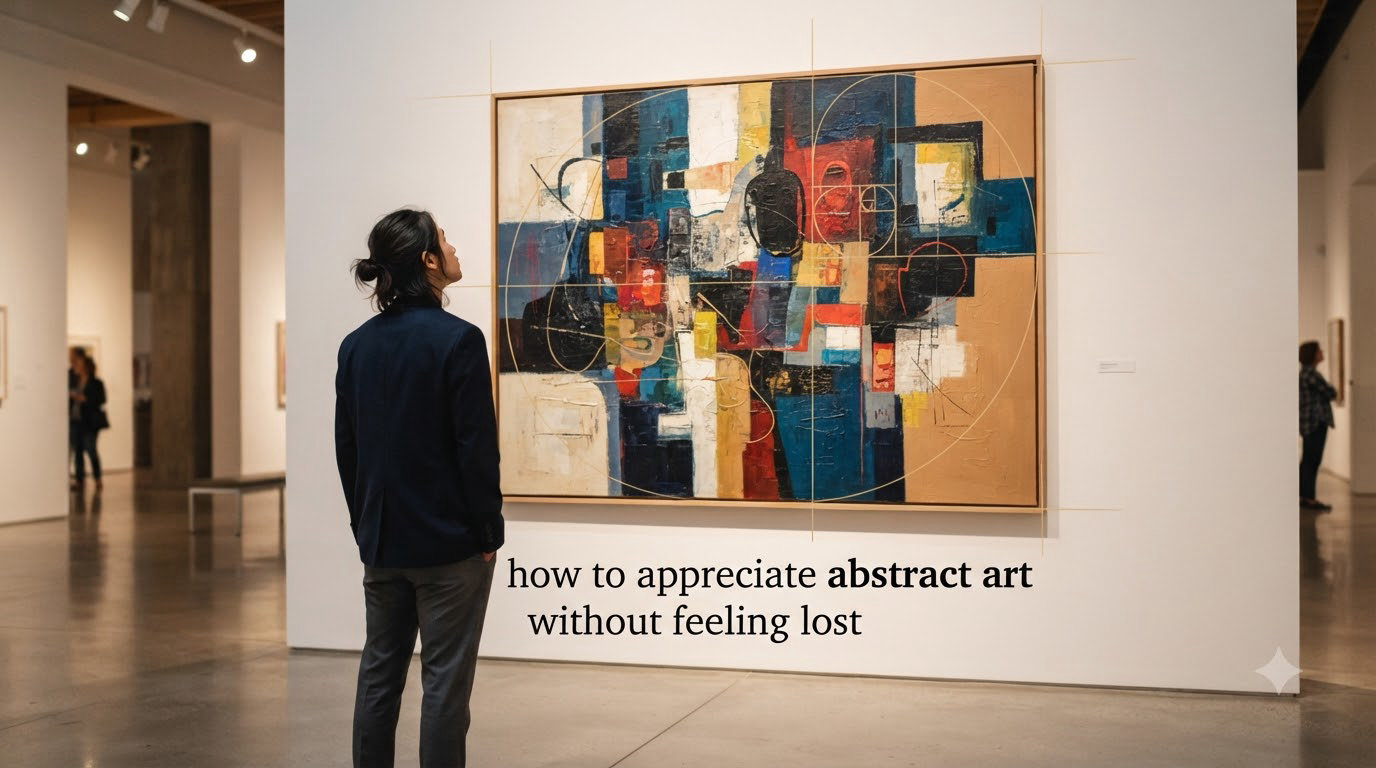
Standing in front of a canvas covered in splatters, shapes, and colors that don’t look like anything familiar can leave you feeling confused and even embarrassed. I have been there too. You are not alone if you have ever thought, “What am I supposed to be seeing here?”
The easiest way to appreciate abstract art is to let go of any preconceived ideas about what art should look like. Give yourself permission to experience the work through feeling rather than understanding. You do not need an art degree or hidden knowledge to enjoy abstract art.
In this guide, I will walk you through exactly how to appreciate abstract art without feeling lost. You will learn practical techniques that work in any gallery or museum, understand why abstract art affects us emotionally, and discover how to form your own opinions with confidence.
Table of Contents
What is Abstract Art and Why Does It Confuse Us?
Abstract art is art that does not represent recognizable objects or scenes. Instead, it uses shapes, colors, lines, and textures to express emotions and ideas directly. Unlike a landscape painting that shows you a specific place or a portrait that depicts a real person, abstract art communicates through pure visual language.
Our brains are wired to seek patterns and meaning. When we look at art, we naturally try to identify what we are seeing. Is that a tree? A face? A house? Abstract art deliberately removes these reference points, which can feel disorienting at first. This is completely normal.
The confusion comes from our expectation that art must represent something. We grew up with drawings that look like their subjects. Abstract art asks us to experience something different. It invites us to feel before we think, to respond before we analyze.
The Core Principle: Letting Go of Expectations
The single most important shift in appreciating abstract art is releasing the need to “understand” it. I spent years feeling inadequate in galleries because I thought there was a correct interpretation I was missing. There is not.
Abstract art is not a puzzle with one right answer. It is an experience with infinite possible responses. Your reaction, whatever it is, is valid. The artist created the work to evoke feeling, not to test your knowledge.
Addressing the “My Child Could Paint That” Objection
This is perhaps the most common criticism of abstract art, and it deserves an honest response. Yes, a child can splash paint on canvas. But there is a difference between random marks and intentional composition.
Look closer at a work by Jackson Pollock. Every drip, every splatter, every layer was a deliberate choice about speed, angle, viscosity, and placement. The artist spent years developing technique. The final piece represents thousands of decisions, not accidents.
Your child could not recreate the specific balance, rhythm, and emotional weight of a masterwork. Appreciating abstract art means recognizing the skill in what might look simple.
Color as Emotional Language
Color is one of the most powerful tools in abstract art. Artists use color the way musicians use notes, to create mood, tension, harmony, and release. Understanding this gives you immediate access to what a painting is communicating.
Warm colors like red, orange, and yellow tend to evoke energy, passion, warmth, and sometimes anger or urgency. Cool colors like blue, green, and purple suggest calm, sadness, distance, or contemplation. But personal associations matter too. If blue reminds you of a peaceful childhood vacation, that response is part of your experience.
Pay attention to how colors interact. Complementary colors placed side by side create vibration and tension. Analogous colors blend smoothly and suggest harmony. A single bold color against neutral tones demands attention and focus.
What to Look For: A Practical Checklist
When you feel lost, return to this checklist. These concrete elements give you something specific to observe and discuss.
Brush Strokes and Marks
Look at how the paint was applied. Are the strokes visible and energetic, or smooth and hidden? Thick impasto creates texture you can almost feel. Thin washes suggest delicacy and transparency. The physical act of painting leaves traces that tell you about the artist’s movement and energy.
Texture and Layers
Many abstract paintings are built up in layers over time. Can you see evidence of earlier colors peeking through? Does the surface feel rough or smooth? Texture adds dimension and invites closer inspection. It creates visual interest even when you cannot identify a subject.
Composition and Balance
How are the elements arranged on the canvas? Is there a dominant shape or color? Does your eye travel across the painting, or stay fixed in one area? Balance does not mean symmetry. A large dark area might be balanced by a small bright accent. Understanding composition helps you see the painting as a whole.
Scale and Size
The physical size of a painting affects how you experience it. A small work invites intimate, close viewing. A large canvas might surround you and become an environment. Many abstract artists, like Mark Rothko, created works meant to be experienced at a specific distance and scale.
How to Appreciate Abstract Art Without Feeling Lost: The Step-by-Step Viewing Process
Now let me walk you through a practical process you can use every time you encounter abstract art. This method takes about five minutes and transforms gallery visits from stressful to rewarding.
Step 1: First Impression (30 Seconds)
Stand at a comfortable distance and simply look. Do not try to figure anything out. Just notice what you feel. Does the painting feel energetic or calm? Happy or somber? Warm or cool? Trust this immediate response. It is your honest reaction.
Step 2: Get Closer and Examine Details
Move in until you can see the surface texture and individual brush strokes. Notice the materials. Is it oil, acrylic, watercolor? Are there collage elements? Look at the edges of shapes. Are they hard or soft? This detective work reveals the artist’s process.
Step 3: Step Back for Overall Composition
Return to your original viewing distance. Now you have detail context. Notice how the parts work together. Where does your eye go first? Is there a path through the painting? Look for repetition of shapes or colors that create rhythm.
Step 4: Connect with Emotion
Ask yourself what the painting makes you feel. Not what it means. What does it evoke? Memories, sensations, moods? Abstract art is designed to bypass your rational brain and speak directly to emotion. Let it.
Step 5: Read the Label (Optional)
If there is a title or artist statement, read it now. Titles can offer context, but they are not explanations. Sometimes knowing when a work was made or what the artist intended adds depth. Sometimes it is better to stick with your own experience. There is no rule here.
Common Misconceptions Debunked
Let me address three myths that prevent people from enjoying abstract art.
First, the idea that abstract art requires no skill. As I mentioned, the apparent simplicity masks years of practice and countless decisions. The best abstract artists could paint realistically. They chose abstraction because it served their expression better.
Second, that there is a hidden meaning you must decode. Some abstract art references specific ideas or events, but much of it is purely visual. The meaning is the experience of looking. Do not feel bad if you cannot explain what a painting “means.”
Third, that liking abstract art makes you sophisticated or pretentious. Your taste is your own. You are allowed to love some abstract works and dislike others. You are allowed to prefer landscapes. Appreciation is not about forcing yourself to like something. It is about being open to the experience.
The Slow Art Movement Connection
Research shows the average person spends just 17 seconds looking at a work of art in a museum. Seventeen seconds. Abstract art deserves more time.
The Slow Art Movement encourages viewers to spend 5 to 10 minutes with a single work. This might feel uncomfortable at first. Your mind will wander. You will want to move on. Stay with it.
What happens when you slow down? First, you notice details you missed. Second, your emotional response deepens and shifts. Third, you form a genuine connection with the work. Try it next time you visit a gallery. Pick one abstract painting and give it your full attention for five minutes.
Famous Abstract Artists Who Changed Everything
Knowing a bit of history helps contextualize what you are seeing. Here are four pioneers worth knowing.
Jackson Pollock created his famous drip paintings by laying canvas on the floor and walking around it, flinging paint from sticks and brushes. His work captures energy, movement, and the physical act of creation.
Mark Rothko painted soft rectangles of color that seem to glow and hover. His large canvases were meant to be experienced up close, enveloping the viewer in color and emotion. Standing before a Rothko is a meditative experience.
Wassily Kandinsky is often credited with creating the first purely abstract painting around 1910. He believed color and form could express spiritual truths and inner necessity.
Helen Frankenthaler pioneered the soak-stain technique, pouring thinned paint directly onto unprimed canvas. Her work has a lyrical, atmospheric quality that rewards slow viewing.
FAQs: Common Questions About Abstract Art
How to praise abstract art?
Praise abstract art by describing what you observe and feel rather than inventing meaning. Mention specific elements like color choices, brushwork, composition, or emotional impact. Say things like ‘The way the red interacts with the blue creates such energy’ or ‘I find the texture incredibly evocative.’ Authentic responses are always better than pretending to see something you do not.
What are the 3 C’s of art?
The 3 C’s of art typically refer to Content, Context, and Craft. Content is what the work depicts or expresses. Context includes the historical, cultural, and personal circumstances surrounding the work. Craft refers to the skill and technique demonstrated. In abstract art, craft and content often merge since the technique itself becomes the subject.
How long should I look at a painting?
There is no required time, but research suggests spending at least 30 seconds to move beyond superficial looking. For abstract art, 3 to 5 minutes allows your eye to explore details and your emotions to engage. The Slow Art Movement recommends 10 minutes for a deeper experience. Start with what feels comfortable and build from there.
Why can’t I understand abstract art?
You likely cannot understand abstract art because you are trying to decode it like a representational image. Abstract art does not depict recognizable subjects, so there is nothing to identify. Instead of understanding, focus on experiencing. Notice colors, textures, and how the work makes you feel. Your reaction, whatever it is, is the correct response.
Is it okay if I don’t like abstract art?
Absolutely. Not every art form appeals to every person. You are not obligated to like abstract art. However, if you feel frustrated because you want to appreciate it but cannot, that is different. Give yourself time, try the techniques in this guide, and visit different types of abstract works. Your taste may evolve, or it may not. Both are fine.
Conclusion: Your Journey with Abstract Art Starts Now
Learning how to appreciate abstract art without feeling lost is a journey, not a destination. You now have practical tools: the five-step viewing process, the checklist of elements to observe, and permission to respond honestly without needing expert knowledge.
The next time you encounter an abstract painting, remember to let go of expectations, trust your emotional response, and take your time. Abstract art offers a rare opportunity to experience pure visual language unfiltered by representation.
Visit a gallery this month. Pick one abstract work and spend five minutes with it using the process I have shared. You might be surprised by what you discover when you stop trying to understand and start allowing yourself to feel.